

Cultural Competence in Medical Admin: Terms & Interactive Guide
Medical administrators shape whether patients can enter, understand, trust, and complete care. A misspelled name, unqualified interpreter, culturally tone-deaf reminder, inaccessible portal, or unexplained bill can damage the relationship before a clinician enters the room. Effective cultural competence connects patient intake procedures, patient communication, front-desk operations, patient confidentiality, and equitable problem-solving. The goal is a responsive administrative experience that respects each patient’s language, identity, beliefs, communication needs, health literacy, family structure, and decision-making preferences.
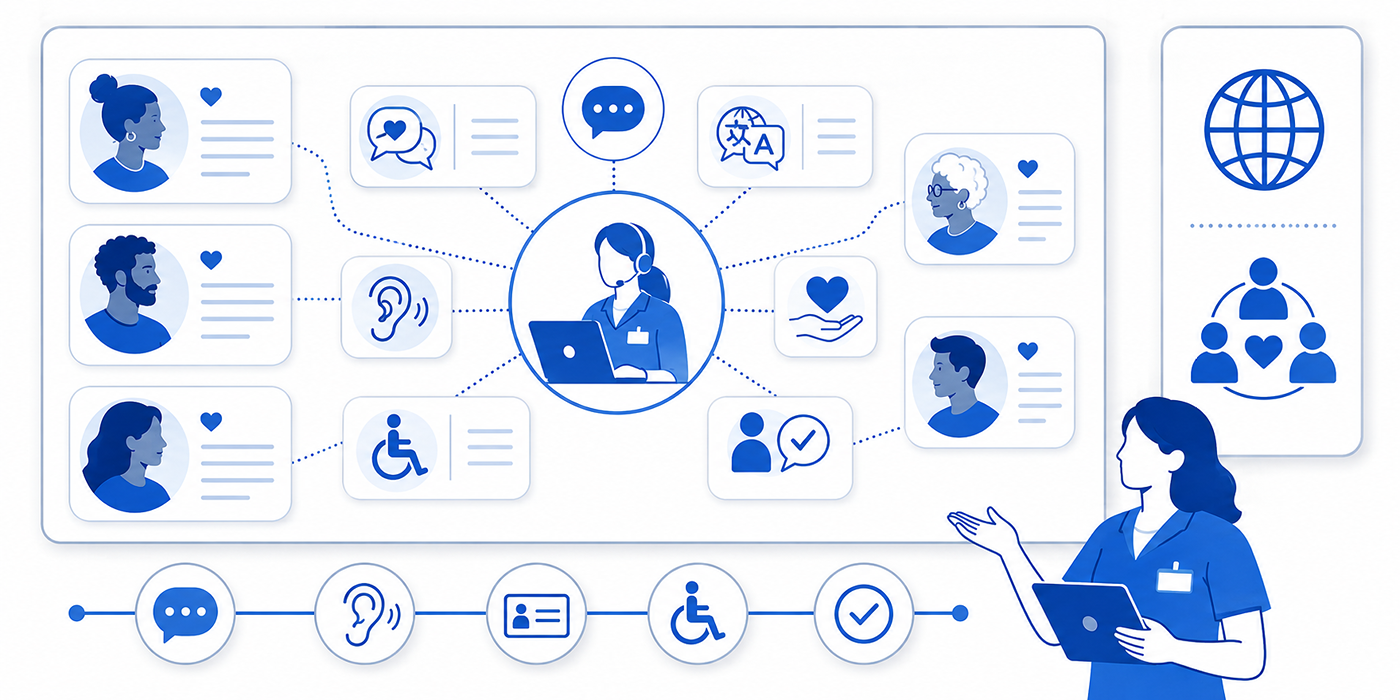
1. What Cultural Competence Means in Medical Administration
Cultural competence in medical administration is the ability to deliver administrative services respectfully and effectively across differences in language, ethnicity, nationality, religion, disability, gender, family structure, socioeconomic circumstances, health beliefs, literacy, and communication style. It influences appointment scheduling, registration, insurance support, financial conversations, interpreter coordination, consent paperwork, referrals, patient portals, complaints, and follow-up.
The Office of Minority Health describes culturally and linguistically appropriate services as an approach based on respect for the whole individual and responsiveness to that person’s health needs and preferences. Cultural responsiveness can improve service quality and support efforts to reduce health disparities.
For medical administrative professionals, competence appears through small operational decisions. Staff ask how a patient wants to be addressed. They record a preferred spoken and written language accurately. They arrange qualified language assistance before a complex discussion. They avoid guessing who holds decision-making authority. They use active listening techniques, confirm understanding, protect patient privacy, and adjust communication without making the patient defend every request.
A culturally unsafe workflow often looks efficient from inside the organization. The scheduling script may be fast, yet it assumes every patient understands medical vocabulary. The portal may be technically available, yet it is inaccessible to patients with limited digital literacy. The registration form may collect demographic data, yet staff cannot explain why the questions are asked. The reminder system may reduce staff workload, yet its wording exposes sensitive appointment details on shared phones.
These failures create measurable operational consequences. Patients may miss appointments, abandon referrals, misunderstand preparation instructions, delay payment, decline portal enrollment, or file complaints. Staff then spend hours resolving problems that began with one preventable communication gap. Strong de-escalation skills, healthcare CRM practices, medical office policies, and risk-management controls transform those gaps into controlled workflows.
Cultural competence and cultural humility
Cultural competence focuses on the knowledge, communication skills, policies, and systems needed to serve diverse populations effectively. Cultural humility adds continuing self-examination. It asks staff to notice assumptions, recognize power differences, accept correction, and remain curious about the individual patient.
Humility prevents cultural knowledge from becoming stereotyping. A staff member may know that some families prefer collective decision-making. That knowledge supports a respectful question about whom the patient wants involved. It never establishes that every person from a particular community follows the same pattern.
A reliable administrative approach uses three steps:
Ask the patient what they need.
Document the answer accurately and discreetly.
build the accommodation into future workflows.
This approach strengthens patient record updates, medical administrative workflows, team collaboration, and continuity across departments.
Language access requires operational readiness
Language access reaches far beyond having a bilingual employee nearby. The administrative team needs a documented process for identifying language needs, obtaining qualified assistance, recording interpreter details, translating vital materials, handling telephone calls, and monitoring service quality.
Current HHS guidance identifies five useful elements for a language-assistance plan: identifying people who need assistance, defining access measures, training staff, notifying people that assistance is available, and monitoring the plan.
Under applicable Section 1557 requirements, covered entities must provide language-assistance services accurately, timely, free of charge, and in a manner that protects privacy and independent decision-making. Qualified interpreters must communicate effectively, accurately, impartially, and with the necessary specialized vocabulary.
Administrative staff therefore need more than a vendor telephone number. They need telehealth platform knowledge, private spaces, tested equipment, after-hours procedures, interpreter documentation fields, and escalation paths when the requested language or communication method is unavailable.
| # | Essential Term | Working Definition | Medical Administrative Example | Common Failure | Better Practice |
|---|---|---|---|---|---|
| 1 | Cultural Competence | The ability to provide effective services across cultural, linguistic, social, and communication differences. | Adapting registration, scheduling, and financial communication to the patient’s stated needs. | Using one rigid process for every patient. | Embed flexibility into front-desk operations. |
| 2 | Cultural Humility | An ongoing practice of self-reflection, curiosity, and willingness to correct assumptions. | Asking who the patient wants involved in decisions instead of assuming a family hierarchy. | Treating cultural knowledge as a fixed profile. | Use respectful questions and active listening. |
| 3 | CLAS | Culturally and Linguistically Appropriate Services designed around respectful, understandable, responsive care. | Providing language support, accessible information, and culturally responsive service policies. | Limiting cultural competence to an annual training module. | Connect training with operational policies. |
| 4 | Implicit Bias | Automatic associations that can influence decisions without deliberate intent. | Assuming a patient will miss an appointment based on accent, clothing, address, or insurance type. | Allowing assumptions to affect tone, access, or scheduling choices. | Use standardized scheduling criteria. |
| 5 | Explicit Bias | Conscious attitudes or beliefs that influence treatment of individuals or groups. | Refusing reasonable administrative support based on nationality or identity. | Normalizing discriminatory remarks or practices. | Apply formal legal and escalation procedures. |
| 6 | Stereotyping | Assigning presumed group characteristics to an individual. | Assuming a patient’s religion determines diet, consent, or family involvement. | Replacing questions with generalized beliefs. | Ask individual preference questions during patient intake. |
| 7 | Preferred Language | The language a patient prefers for discussing health information. | Recording the spoken language needed for appointments and telephone calls. | Entering nationality as a substitute for language. | Use a dedicated, updateable language field. |
| 8 | Written-Language Preference | The language in which the patient prefers written information. | Sending instructions and notices in the patient’s readable language where available. | Assuming spoken and written proficiency are identical. | Verify both preferences through patient communication. |
| 9 | Limited English Proficiency | A circumstance in which a person has limited ability to read, speak, write, or understand English. | Arranging language assistance for registration, billing, consent, or scheduling. | Labeling the patient as difficult or uncooperative. | Activate a documented language-access process. |
| 10 | Qualified Interpreter | A person able to interpret accurately, effectively, impartially, and with necessary terminology. | Interpreting an authorization explanation or complex financial discussion. | Using an untrained staff member merely because they speak the language. | Record interpreter access within the administrative workflow. |
| 11 | Qualified Translator | A professional capable of accurately translating written material into another language. | Translating intake instructions, privacy notices, and financial-assistance forms. | Using automated translation without review for vital documents. | Maintain approved versions within controlled template libraries. |
| 12 | Language Concordance | Shared language capacity between the patient and the professional communicating with them. | Routing a routine call to an appropriately qualified bilingual employee. | Confusing conversational fluency with interpreter qualification. | Define staff language roles and boundaries clearly. |
| 13 | Vital Document | A document whose accurate and timely understanding has significant consequences for access, rights, or services. | Consent information, notices, eligibility documents, or appeal instructions. | Translating promotional materials while leaving essential documents inaccessible. | Prioritize high-impact materials through communication policies. |
| 14 | Health Literacy | The ability to find, understand, and use health information and services. | Explaining check-in instructions, benefits, or preparation steps in clear language. | Equating education level with understanding. | Use plain language and confirm comprehension. |
| 15 | Insurance Literacy | The ability to understand coverage, cost sharing, networks, authorizations, and claims. | Explaining deductibles and coinsurance without payer jargon. | Handing the patient an EOB and expecting independent interpretation. | Connect explanations with an EOB reference. |
| 16 | Plain Language | Communication designed so the intended audience can understand and use it easily. | Replacing “remit your outstanding balance” with “pay the amount shown.” | Using formal wording that hides the required action. | Apply plain wording in patient messages. |
| 17 | Teach-Back | A method in which the patient explains information in their own words to confirm understanding. | Asking the patient to describe when to arrive and what documents to bring. | Asking only, “Do you understand?” | Use teach-back for complex authorization requirements. |
| 18 | Communication Accommodation | An adjustment that enables effective communication for a person with a disability. | Providing captioning, large print, an interpreter, or an accessible digital format. | Offering the same aid to every person with a similar disability. | Ask about the person’s usual communication method. |
| 19 | Auxiliary Aid or Service | A tool or service that supports effective communication for people with communication disabilities. | Qualified sign-language interpretation, real-time captioning, or accessible electronic text. | Relying on lip-reading during complex communication. | Coordinate the aid before the scheduled appointment. |
| 20 | Accessible Communication | Information presented in a format the patient can perceive, navigate, and understand. | Providing large print, audio, captioning, or screen-reader-compatible information. | Assuming a patient portal is accessible because it opens on a phone. | Test accessibility within portal workflows. |
| 21 | Preferred Name | The name a patient wants staff to use during interaction. | Displaying the preferred name where appropriate while preserving legal billing fields. | Calling out a different name in a public waiting area. | Configure discreet fields and privacy controls. |
| 22 | Pronouns | Words a person uses when others refer to them. | Recording pronouns in a respectful, optional, workflow-supported field. | Guessing pronouns from appearance or legal documents. | Ask neutrally and correct mistakes briefly. |
| 23 | Family Decision Preference | The patient’s choice regarding who may participate in communication or decisions. | Including a spouse, adult child, elder, or other support person with permission. | Allowing relatives to replace the patient’s voice automatically. | Confirm authorization through HIPAA-aware procedures. |
| 24 | Religious Accommodation | A reasonable workflow adjustment connected to religious observance or practice. | Considering fasting, prayer schedules, modesty, or holy-day conflicts during scheduling. | Assuming every member of a religion follows identical practices. | Ask what adjustment would support the individual patient. |
| 25 | Modesty Preference | A patient’s preference regarding privacy, clothing, physical exposure, or staff presence. | Flagging a request for additional privacy or a same-gender professional where feasible. | Dismissing the request as inconvenient. | Communicate early through triage and scheduling. |
| 26 | Trauma-Informed Communication | Communication that prioritizes safety, choice, predictability, and control. | Explaining why sensitive questions are asked and allowing appropriate pauses. | Pressuring the patient to disclose personal information publicly. | Use private spaces and transparent explanations. |
| 27 | Social Determinants of Health | Nonclinical conditions influencing access, health, and the ability to follow care plans. | Transportation, housing, work schedules, childcare, food access, and internet availability. | Describing structural barriers as lack of motivation. | Record actionable barriers and route available support. |
| 28 | Digital Divide | Unequal access to devices, internet connectivity, digital skills, or accessible technology. | A patient cannot complete online registration or join a video appointment. | Making portal use the only route to service. | Maintain telephone and in-person options through virtual patient procedures. |
| 29 | Microaggression | A comment or behavior that communicates disrespect or exclusion, sometimes unintentionally. | Repeatedly expressing surprise that a patient speaks English fluently. | Defending intent while ignoring impact. | Acknowledge concerns and use complaint-resolution procedures. |
| 30 | Name Pronunciation | The correct spoken form of a patient’s name. | Asking for pronunciation and adding a discreet phonetic note where appropriate. | Shortening the name without permission. | Use respectful clarification during registration. |
| 31 | Intersectionality | The way multiple aspects of identity and circumstance interact to shape experience. | A patient may face language, disability, transportation, and financial barriers simultaneously. | Treating each barrier as an isolated checkbox. | Coordinate support through team workflows. |
| 32 | Equity | Providing resources and adjustments according to differing barriers and needs. | Offering interpretation, accessible formats, flexible communication, or navigation assistance. | Confusing identical treatment with equal access. | Measure access gaps through administrative analytics. |
2. How Cultural Competence Shapes the Patient’s Administrative Journey
Cultural competence should follow the patient from first contact through final account resolution. Limiting it to bedside communication leaves the most common access barriers untouched.
First contact and appointment requests
The first telephone call reveals whether the organization is prepared for varied communication needs. Staff should identify the caller’s preferred language, communication method, accessibility needs, urgency, and scheduling constraints. A patient asking for an interpreter should receive a defined next step instead of being transferred repeatedly.
The scheduler should explain appointment type, expected duration, location, arrival time, required documents, cost-related steps, and cancellation rules using understandable language. Appointment scheduling terminology, scheduling-conflict procedures, emergency appointment management, and secure scheduling technology should support that conversation.
A culturally responsive scheduler also listens for practical barriers. A patient may need an evening appointment due to hourly work, additional travel time because of public transportation, or a telephone alternative because the portal is inaccessible. Capturing the barrier early protects schedule capacity and prevents staff from misclassifying a foreseeable access problem as irresponsibility.
Registration and demographic collection
Demographic questions can feel intrusive when their purpose is unexplained. Staff should state why information is collected, how it will be used, and whether responding is optional where applicable. Tone matters. A hurried demand for race, ethnicity, language, disability, gender identity, or household information can create suspicion even when the data supports legitimate quality improvement.
Records should distinguish legal name, preferred name, pronouns, spoken language, written language, communication accommodations, and interpreter needs. Sensitive details require appropriate access controls under patient confidentiality, HIPAA terminology, EMR compliance, and legal responsibility guidelines.
CMS identifies standardized demographic and language data as useful for quality improvement when organizations collect and use it responsibly. Its health-equity framework also treats language access, health literacy, culturally tailored services, and accessibility as important parts of quality, safety, and patient experience.
Insurance and financial communication
Insurance language creates cultural and literacy barriers even when the patient speaks fluent English. Terms such as allowed amount, deductible, coinsurance, network status, prior authorization, coordination of benefits, and medical necessity require explanation in practical terms.
Staff should clarify which amount is known, which amount remains an estimate, what the payer must decide, and what action the patient needs to take. Valuable support includes insurance verification guidance, billing terminology, prior authorization education, claims-processing explanations, and EOB definitions.
Financial assumptions can quickly become discriminatory. Clothing, accent, insurance type, occupation, or neighborhood should never determine how much respect, explanation, or patience a patient receives. Consistent scripts, transparent assistance policies, and documented escalation routes reduce discretionary treatment.
Waiting-room and check-in experience
Privacy expectations vary, and the administrative team should still protect sensitive information consistently. Staff should avoid announcing diagnoses, procedures, balances, interpreter requests, or personal circumstances across a waiting room. A patient’s companion should receive information only within the patient’s permission and applicable rules.
The environment also communicates belonging. Readable signs, clear navigation, accessible seating, visible language-assistance notices, gender-neutral wording where appropriate, and multiple check-in options reduce avoidable friction. Medical office organization, office ergonomics, infection-control communication, and daily procedure checklists should incorporate these access needs.
3. Cultural Competence Scenarios Medical Administrators Must Handle Correctly
Scenario 1: A family member offers to interpret
A patient with limited English proficiency arrives with an adult relative who immediately begins answering questions. Staff feel relieved because the waiting room is busy.
The administrator should speak directly to the patient, identify the patient’s preferred language, explain available language assistance, and follow the organization’s interpreter policy. The relative may remain involved when the patient wants their support and the situation permits, though their presence does not automatically replace qualified language assistance for consequential communication.
This scenario requires active listening, patient privacy communication, difficult-conversation skills, and a documented interpreter workflow. The administrator should record the language service used, relevant identifiers, and any refusal according to policy.
Scenario 2: Staff repeatedly mispronounce a patient’s name
A patient corrects the pronunciation during several visits. Each new employee repeats the same error, and one staff member suggests using a shorter nickname.
The immediate response is a sincere correction without an extended defense. Staff should ask for the correct pronunciation, use the patient’s preferred name, and add an appropriate phonetic guide in the permitted field. A nickname should come from the patient.
Repeated errors signal a system problem rather than isolated forgetfulness. The practice may need a pronunciation field, clearer patient intake procedures, improved medical record updates, and better team collaboration tools.
Scenario 3: A patient misses online registration
The practice sends all forms through a portal. A patient arrives without completing them and explains that they share a phone, have limited data, and struggled with the interface. Staff tell the patient to reschedule.
A culturally responsive process provides another secure route whenever operationally possible. Staff can offer an accessible device, paper form, telephone assistance, or supported completion in a private area. The barrier should inform future communication preferences rather than become a judgment about cooperation.
The organization should review its healthcare portal workflow, patient communication applications, virtual patient management, and telehealth administration for digital-access assumptions.
Scenario 4: A patient requests a communication aid
A patient who is deaf requests a qualified sign-language interpreter when scheduling a detailed consultation. Staff offer written notes and ask the patient to bring a family member.
The request requires an effective-communication assessment and prompt activation of the organization’s accommodation process. The nature, duration, complexity, and context of the communication, together with the person’s normal communication method, guide the appropriate aid or service.
ADA guidance explains that covered entities must communicate effectively with people who have vision, hearing, or speech disabilities and may need auxiliary aids such as qualified interpreters, captioning, large print, accessible electronic information, or other suitable services.
The scheduler should document the requested method, arrange the service, verify availability, and prepare a backup plan. The same controls should extend to telemedicine appointments, where platforms may need captioning or interpreter integration.
Scenario 5: Religious fasting affects appointment preparation
A patient explains that they are fasting and asks whether preparation instructions can be adjusted. The administrator provides clinical advice based on a previous patient’s experience.
Administrative staff should avoid independently modifying clinical instructions. They should document the concern, route it to the appropriate clinical professional, and help identify a workable appointment time after guidance is received. The response respects the patient’s practice while preserving clinical boundaries.
Useful controls include medical office triage, appointment-conflict management, patient communication, and clear administrative policies.
Scenario 6: A billing conversation becomes hostile
A patient receives a large bill and says nobody explained the deductible. The employee responds that the patient should have understood the insurance plan.
The administrator should slow the exchange, acknowledge the concern, review the verification record, separate the provider’s charge from the payer’s decision, explain the account in plain language, and identify available next steps. Blame intensifies the conflict while leaving the account unresolved.
Strong handling combines de-escalation techniques, empathy in healthcare administration, patient complaint procedures, insurance verification, and revenue cycle knowledge.
4. How to Build a Culturally Responsive Medical Administrative Workflow
A culturally responsive office converts respect into repeatable operations. Good intentions cannot compensate for missing interpreter contracts, inaccessible forms, inconsistent name fields, or staff who lack authority to solve routine barriers.
Build preference collection into intake
The intake process should capture the patient’s preferred spoken language, written language, communication method, interpreter need, accessibility requirement, preferred name, pronunciation, and relevant scheduling considerations. Sensitive questions should include a brief explanation of purpose.
Staff should confirm information periodically instead of treating it as permanent. Language proficiency, contact method, family involvement, accessibility needs, and household circumstances may change. The update process can connect patient intake, EMR compliance, front-desk checklists, and healthcare CRM fields.
Create a language-access map
The practice should identify every point where language support may be needed:
Appointment calls
Registration and consent
Insurance and authorization discussions
Financial estimates
Clinical encounters
Procedure preparation
Discharge or follow-up
Portal support
Complaints and appeals
Billing and payment arrangements
Each point needs an approved access method, responsible role, backup option, privacy standard, and documentation requirement. Staff must know how to obtain help without asking the patient to navigate internal departments.
The same map should cover telehealth platforms, patient portals, patient communication apps, and virtual patient management.
Rewrite communication around patient action
Every message should make the required action visible. Appointment reminders should state the date, time, location, arrival requirement, preparation step, cancellation method, and contact route. Financial notices should separate provider charges, payer processing, adjustments, previous payments, current responsibility, due date, and assistance options.
Plain language supports all patients, including those who speak English fluently. Staff can use teach-back for complex instructions: “Please tell me how you will prepare for the appointment so I can make sure I explained it clearly.”
This wording places responsibility on the communication process. It also strengthens effective patient communication, active listening, appointment scheduling, and insurance claim education.
Design escalation without humiliation
Front-line staff need permission to escalate interpreter failures, inaccessible documents, identity-field problems, discriminatory behavior, and unresolved accommodation requests. The patient should never need to argue with several employees to reach someone capable of acting.
The escalation process should identify:
Who can approve urgent language or accessibility support
Who corrects demographic or identity-field errors
Who handles privacy-sensitive complaints
Who reviews discriminatory conduct
Who authorizes scheduling flexibility
Who investigates repeated system failures
These roles should appear in legal responsibility procedures, risk-management plans, patient complaint workflows, and medical office policies.
Protect privacy during accommodations
Interpreter use, disability accommodations, identity information, immigration concerns, financial hardship, and family relationships may involve sensitive details. Staff should discuss them privately, restrict unnecessary access, and document only information required for care and operations.
A language need should never become a visible label that invites ridicule. A preferred name field should not overwrite legally required payer data. A family member’s presence should not eliminate direct communication with the patient. HIPAA guidance for administrative assistants, patient confidentiality training, privacy communication essentials, and record-update controls should govern the workflow.

5. Training, Measuring, and Improving Cultural Competence
Cultural competence training should change decisions at registration desks, scheduling lines, billing queues, portals, and complaint channels. Awareness without workflow change leaves patients facing the same barriers.
Train with real administrative scenarios
Effective training places staff inside practical decisions. Employees should practice responding when:
A patient requests an interpreter during a busy clinic
A relative answers every question for the patient
A portal blocks a preferred name
A religious observance conflicts with appointment preparation
A patient cannot read a translated document
A person requests captioning for telehealth
A patient disputes a culturally insensitive remark
A financial discussion exposes low insurance literacy
A staff member makes an assumption about family authority
An automated message reveals sensitive information
Scenario training should incorporate de-escalation techniques, difficult patient conversations, active listening, patient satisfaction principles, and relevant privacy procedures.
Measure operational equity
A practice needs more than a completed-training percentage. Useful measures include:
Interpreter requests completed on time
Appointments delayed by language-access failures
No-show rates by preferred language
Portal activation and completion gaps
Complaint themes involving respect or communication
Patient-form completion problems
Accessibility requests completed successfully
Authorization denials linked to misunderstanding
Scheduling delays by communication need
Staff confidence in accessing interpreter services
Translated-document availability
Patient understanding of financial responsibility
Data should be reviewed carefully. A higher no-show rate within one group signals a need for investigation rather than a conclusion about behavior. The practice should examine reminder language, transportation, appointment availability, work schedules, digital access, and interpreter coordination.
Predictive analytics, medical admin time-tracking tools, healthcare CRM terminology, and patient communication systems can help identify recurring access gaps.
Use complaints as improvement data
A complaint may expose an inaccurate translation, dismissive employee, broken accommodation process, inaccessible portal, privacy breach, or harmful assumption. Closing the complaint after apologizing wastes its operational value.
The review should identify what happened, where the process failed, who owned the step, whether similar cases exist, what corrective action occurred, and when results will be reassessed. Repeated concerns should influence staff training, office procedures, risk management, and technology configuration.
Evaluate vendors and digital tools
Third-party systems can weaken cultural access even when internal staff perform well. Practices should test whether scheduling tools, portals, payment systems, telehealth platforms, automated reminders, and chat functions support:
Multiple languages
Accessible formats
Screen readers
Captions
Interpreter participation
Preferred names
Flexible text length
Plain-language customization
Alternative contact methods
Secure human assistance
Vendor evaluation should connect secure patient scheduling tools, EMR integration technology, emerging medical admin technologies, AI and automation, and human escalation.
6. Frequently Asked Questions About Cultural Competence in Medical Administration
-
Medical administrative assistants control many access points: registration, scheduling, insurance, authorizations, portals, payments, referrals, complaints, and follow-up. Their decisions influence whether patients understand requirements and can complete care. Strong competence combines front-desk operations, patient communication, insurance verification, and patient confidentiality.
-
Cultural competence develops the knowledge, systems, and communication skills required to serve diverse populations. Cultural humility maintains curiosity, self-reflection, and openness to correction. Administrators use competence to create policies and humility to avoid treating any patient as a cultural stereotype.
-
Administrative staff should follow applicable law and organizational policy, offer qualified language assistance when required, and preserve the patient’s privacy and independent voice. Family involvement may remain important when the patient wants support. Consequential medical, consent, authorization, or financial communication requires careful assessment rather than automatic reliance on relatives. Privacy communication, active listening, and legal responsibility guidance should direct the response.
-
A neutral question works well: “Which language do you prefer for discussing your healthcare?” Staff should ask separately about written information because spoken and reading proficiency may differ. The answer should enter a structured, updateable field connected to scheduling, interpreter coordination, and patient portal communication.
-
Use familiar words, short explanations, one action at a time, clear numbers, visual support where useful, and teach-back. Staff should avoid judging understanding from education, occupation, vocabulary, or confidence. Billing terms, EOB explanations, insurance verification guidance, and appointment instructions should use plain language.
-
Yes. Effective administration responds to the patient’s communication and accessibility needs, including captioning, sign-language interpretation, large print, accessible electronic materials, mobility access, and alternative communication methods. Telemedicine workflows, virtual patient management, office ergonomics, and portal design should include accessibility from the beginning.
