

Scheduling Conflict Management: Key Terms & Interactive Examples
Scheduling conflicts rarely begin with one dramatic mistake. They usually grow from small operational gaps: an unrecorded provider preference, an incomplete intake note, a delayed authorization, a missed follow-up, or a patient who was promised a time the system could never support. Effective conflict management connects appointment scheduling best practices, disciplined front-desk operations, accurate patient intake procedures, and confident patient communication so the right patient receives the right appointment under clinically and operationally safe conditions.
1. What Scheduling Conflict Management Actually Requires
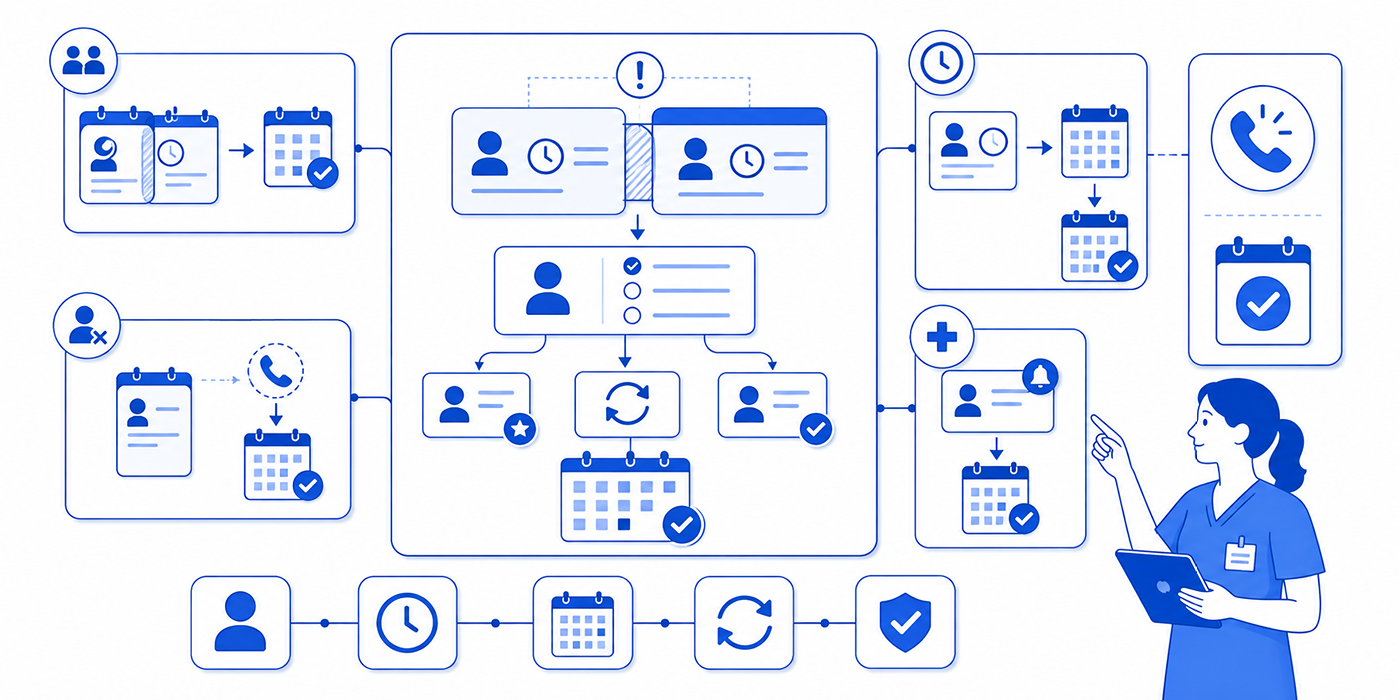
Scheduling conflict management is the structured process of identifying competing appointment demands, assessing their urgency and operational impact, selecting the safest resolution, communicating the change, and documenting the outcome. The strongest schedulers do more than move appointments between time slots. They understand how each decision affects patient safety, provider workload, room availability, staffing, authorizations, transportation, continuity of care, and patient satisfaction.
A conflict becomes expensive when it is treated as a calendar problem alone. A double booking may delay a patient who arranged unpaid leave from work. A missing referral may leave a specialist slot unused. A late arrival may create a chain of delays across the entire clinic. An incorrectly scheduled telehealth visit may fail because the patient needs an in-person examination. These failures expose weaknesses in the organization’s medical administrative workflow, practice management system, patient portal management, and daily office procedures.
Effective resolution requires five connected judgments:
Clinical priority: Which patient faces the greatest health risk from delay?
Operational feasibility: Which provider, room, equipment, and staff resources are genuinely available?
Administrative readiness: Are registration, insurance, referral, and authorization requirements complete?
Patient impact: Which option creates the least disruption while preserving access?
Documentation quality: Can another staff member understand what changed, why it changed, who approved it, and what follow-up remains?
Schedulers who lack access to reliable medical scheduling tools often compensate with memory, sticky notes, personal inboxes, and verbal handoffs. Those workarounds create hidden schedules that other team members cannot see. Stronger systems combine secure patient scheduling tools, clear escalation rules, role-based permissions, standardized notes, and real-time communication.
| # | Key Term | Operational Meaning | Practical Response |
|---|---|---|---|
| 1 | Double booking | Two patients occupy the same provider slot without an approved overlap rule. | Compare urgency, visit complexity, arrival status, and provider capacity before moving either patient. |
| 2 | Overbooking | Extra appointments are intentionally added to compensate for expected cancellations or no-shows. | Use historical attendance data and defined limits instead of staff intuition. |
| 3 | Appointment collision | A patient, provider, room, or resource is committed to incompatible appointments. | Identify the constrained resource first, then rebuild the affected portion of the schedule. |
| 4 | Provider template | The approved pattern of visit types, durations, buffers, and administrative blocks. | Protect the template through controlled permissions and formal exception approval. |
| 5 | Visit-type mismatch | The scheduled appointment type does not match the patient’s actual clinical need. | Use structured intake questions and medical office triage terminology. |
| 6 | Duration mismatch | The allocated time is too short or unnecessarily long for the expected service. | Base duration on visit type, procedure requirements, complexity, and provider rules. |
| 7 | Resource conflict | Required equipment, rooms, interpreters, or support staff are unavailable. | Check resource calendars before confirming the appointment. |
| 8 | Room conflict | More patients require a specific room type than the clinic can accommodate. | Match appointments to room capabilities, cleaning time, and infection-control needs. |
| 9 | Staffing conflict | The schedule exceeds available nurses, assistants, technicians, or front-desk support. | Coordinate appointment capacity with the staff scheduling system. |
| 10 | Urgent add-on | A clinically time-sensitive patient must be considered within a full schedule. | Use defined escalation criteria and obtain clinical approval before insertion. |
| 11 | Same-day request | A patient seeks evaluation before the next routine opening. | Screen symptoms, determine urgency, and offer the safest appropriate access route. |
| 12 | Waitlist | A prioritized list of patients willing to accept earlier openings. | Record availability, notice requirements, visit type, and communication preference. |
| 13 | Cancellation window | The time period in which a patient may cancel without a fee or penalty. | Explain the policy during booking and send reminders before the deadline. |
| 14 | No-show | A patient misses an appointment without completing the cancellation process. | Document outreach, assess barriers, and follow the approved no-show protocol. |
| 15 | Late arrival | A patient arrives after the time needed to complete intake and begin care safely. | Apply a consistent grace-period rule and ask the clinical team whether care remains feasible. |
| 16 | Schedule cascade | One delay creates additional delays across later appointments. | Communicate early, adjust buffers, and avoid making promises before capacity is confirmed. |
| 17 | Provider delay | The clinician is running behind because of emergencies, complexity, or workflow disruption. | Give patients honest estimates and offer meaningful choices. |
| 18 | Administrative hold | A slot is reserved for meetings, charting, procedures, or operational needs. | Require approval before releasing protected time. |
| 19 | Block scheduling | Similar appointment types are grouped into defined time periods. | Use blocks to control equipment demand, staffing, and workflow transitions. |
| 20 | Buffer time | Protected minutes absorb delays, cleaning, charting, and room turnover. | Preserve buffers around high-variance visits and procedures. |
| 21 | Priority override | An authorized person approves a scheduling exception. | Record the approving individual, rationale, and downstream impact. |
| 22 | Escalation pathway | The defined route for unresolved or high-risk conflicts. | Specify when schedulers contact a supervisor, nurse, provider, or practice manager. |
| 23 | Clinical escalation | A scheduling decision requires medical judgment beyond the administrator’s role. | Transfer symptom-based decisions to appropriately licensed staff. |
| 24 | Authorization delay | A payer has not approved a service before the scheduled date. | Follow the prior authorization workflow and protect the patient from unexpected costs. |
| 25 | Eligibility conflict | Coverage information does not support the scheduled service or provider. | Complete insurance verification before final confirmation when required. |
| 26 | Referral dependency | The appointment requires a valid referral, order, or supporting record. | Track missing documents and establish a deadline before releasing the slot. |
| 27 | Continuity-of-care conflict | Moving the visit may separate the patient from the appropriate clinician or follow-up timeline. | Preserve the intended care relationship whenever delay could affect outcomes. |
| 28 | Telehealth conversion | An in-person visit is changed to a virtual appointment or the reverse. | Confirm clinical suitability, technology access, location, consent, and platform readiness. |
| 29 | Interpreter dependency | The appointment requires qualified language assistance. | Coordinate through approved medical interpreter services. |
| 30 | Transportation dependency | The patient relies on medical transport, a caregiver, or a narrow travel window. | Avoid casual rescheduling and document the patient’s logistical constraints. |
| 31 | Communication failure | The patient or team member receives incomplete, late, or contradictory information. | Use standardized messages and record successful contact. |
| 32 | Conflict note | A structured record explains the issue, action, approval, and next step. | Document facts, avoid blame, and include pending follow-up. |
| 33 | Schedule audit | A recurring review identifies preventable collisions, delays, and template violations. | Analyze causes by provider, visit type, day, channel, and staff role. |
| 34 | Access metric | A measure such as third-next-available appointment or time to urgent care. | Use access data to distinguish capacity shortages from scheduling errors. |
| 35 | Closed-loop follow-up | The issue remains tracked until the patient and internal team receive a confirmed resolution. | Assign ownership, due dates, and escalation triggers. |
2. The Most Common Causes of Scheduling Conflicts
Incomplete intake information
A scheduler cannot assign the correct visit type when the patient’s need is described vaguely. “Follow-up,” “pain,” or “test results” may represent very different appointment lengths and clinical priorities. Structured patient intake procedures should capture the reason for the visit, symptom timing, recent procedures, referral source, preferred provider, accessibility needs, and required supporting records.
Administrative staff should avoid diagnosing or independently deciding clinical urgency. Their role is to recognize escalation triggers and route them through an approved medical office triage process. A patient reporting chest pressure, rapid deterioration, severe shortness of breath, or other emergency indicators should never be placed into an ordinary scheduling queue while the team debates openings.
Provider templates that do not reflect reality
A template may show four available appointments even though the provider requires procedure time, chart review, room turnover, or a staff member who is unavailable. Scheduling teams need clear template rules, documented slot types, approved buffers, and accurate resource dependencies. Mastery of scheduling software helps staff see these restrictions before promising a time.
Template problems become especially damaging when multiple employees can modify schedules without accountability. Role-based permissions, change logs, and recurring medical chart audits strengthen traceability. A schedule should show who created, moved, canceled, released, or overrode each appointment.
Delayed insurance and authorization work
Many conflicts surface shortly before the visit because eligibility, referral, or authorization work started too late. The patient may already have arranged childcare, transportation, and time away from work. The clinic then has to choose between postponing care, accepting financial risk, or asking the patient to self-pay.
A reliable process separates clinical scheduling from administrative readiness while keeping both visible. Staff should track insurance verification, referral status, payer requirements, and prior authorization deadlines within the same operational workflow. Patients should receive early, specific communication about missing items and likely consequences.
Communication gaps between departments
Front-desk staff, nurses, providers, billing teams, and referral coordinators often use different channels. One person updates the EHR, another sends an email, and a third leaves a verbal message. The result is contradictory instructions and incomplete ownership.
A shared healthcare CRM, integrated EMR tools, and standardized handoff notes reduce fragmentation. Teams also need clear communication rules for urgent, same-day, and unresolved issues. A message marked “high priority” without a response deadline or assigned owner still creates uncertainty.
3. A Step-by-Step Framework for Resolving Conflicts
Step 1: Define the exact conflict
State the issue in operational terms. “The schedule is a mess” offers no usable information. A stronger statement would be: “Two established patients are booked with Dr. Lee at 10:00 a.m.; one requires a 30-minute medication review, and the second requires a 15-minute postoperative wound check.”
This level of precision supports effective medical administrative workflow decisions and prevents emotional reactions from controlling the response.
Step 2: Identify safety and time sensitivity
Determine whether delay could create clinical risk. Use approved escalation criteria and involve licensed staff when symptoms, postoperative timing, medication needs, or deterioration require judgment. The emergency appointment management process should clarify who can authorize an urgent add-on and which alternatives are acceptable.
Administrative urgency also matters. A patient may need a preoperative clearance before a fixed surgery date. A newborn visit, time-sensitive injection, or follow-up after abnormal testing may have a narrow window even when the patient is stable.
Step 3: List every constraint
Check provider availability, room type, equipment, staffing, interpreter access, authorization status, transportation, telehealth suitability, and patient availability. Many weak resolutions solve the visible conflict while creating a second failure elsewhere.
The team’s office organization system should make constraints visible. A scheduler should not need five phone calls to discover that a procedure room closes early or a technician leaves at noon.
Step 4: Generate ranked options
A useful option list may include:
Keeping both appointments with an approved provider adjustment
Moving one patient to another qualified provider
Using a cancellation opening
Converting a suitable visit to telehealth
Offering a nearby location
Extending the session with authorization
Rescheduling with continuity and urgency preserved
Escalating the patient to urgent care or emergency services when clinically directed
Each option should be assessed against patient safety, continuity, cost, delay, inconvenience, and operational impact. Virtual patient management can widen access, though some concerns require examination, testing, or procedures that cannot be completed remotely.
Step 5: Confirm approval before promising
Schedulers lose credibility when they offer a solution and later retract it. Provider overrides, overtime, double bookings, room changes, and urgent insertions should be approved before the patient receives confirmation. Staff can use collaboration tools for medical offices to obtain fast, traceable decisions.
Step 6: Communicate with ownership
A strong explanation includes what changed, why action is needed, which options are available, what the patient must do, and when the issue will be fully confirmed. Active listening techniques help staff identify the patient’s true constraint. The earliest appointment may be useless when the patient depends on transportation available only on Tuesdays.
When frustration rises, use de-escalation techniques and avoid defensiveness. Acknowledge the disruption, explain available choices clearly, and maintain boundaries around unsafe or impossible requests.
Step 7: Document and close the loop
Record the original conflict, relevant facts, decision-maker, options offered, patient response, final appointment details, and unresolved actions. Follow the clinic’s medical compliance terms, patient confidentiality requirements, and communication policies.
A conflict remains open until the appointment, authorization, referral, resource, and patient notification are confirmed. “Left voicemail” describes an attempt. It does not confirm resolution.
4. Interactive Scheduling Conflict Examples
Example 1: Two patients are booked into one specialist slot
Situation: A postoperative patient and a routine follow-up are both scheduled at 9:30 a.m. with the same specialist.
Weak response: Move whichever patient answers the phone first.
Professional response: Review the purpose and timing of each visit. Confirm whether the postoperative check has a required clinical window. Ask the provider whether the routine follow-up can be moved, handled by telehealth, or transferred to another qualified clinician. Contact the affected patient with specific alternatives and document the approved resolution.
This approach protects continuity, follows scheduling conflict guidance, and reduces the chance of a complaint requiring formal legal and professional handling.
Example 2: An urgent patient requests a same-day appointment
Situation: The schedule is full, and a patient reports worsening symptoms after a recent procedure.
Weak response: Tell the patient to call again tomorrow.
Professional response: Keep the patient connected while following the clinic’s clinical escalation process. Provide the licensed team member with the patient’s identity, procedure date, reported symptoms, and current location. Follow the clinical direction given, which may include an urgent appointment, another facility, or emergency evaluation.
The administrator supports access without stepping outside defined legal responsibilities. Clear boundaries protect the patient and the employee.
Example 3: Authorization remains pending on the day before service
Situation: A patient is scheduled for an expensive diagnostic procedure, and the payer has not issued authorization.
Professional response: Verify the current status, identify whether additional records are needed, contact the responsible authorization team, and confirm the clinic’s financial policy. Explain the situation to the patient before travel or preparation begins. Offer realistic options, including postponement, self-pay information where permitted, or escalation when the service is clinically urgent.
The staff member should avoid guaranteeing payer approval. Familiarity with medical claims processing, revenue cycle terminology, and denials management improves the quality of the explanation.
Example 4: A patient arrives 25 minutes late
Situation: The patient says traffic and transportation delays were unavoidable. The provider is already behind.
Professional response: Verify the clinic’s grace-period policy, determine how much intake remains, and ask the clinical team whether the appointment can proceed safely. Offer the patient clear options rather than leaving them in uncertainty. Document the arrival time, decision, and rescheduling details.
Use empathy in healthcare administration while applying the policy consistently. Cultural, disability, transportation, and language barriers may require additional consideration under the organization’s cultural competence practices.
Example 5: An in-person visit must be converted to telehealth
Situation: Severe weather or provider availability prevents an in-person appointment.
Professional response: Confirm that the visit is clinically appropriate for telehealth. Verify the patient’s location, device access, portal status, consent requirements, and ability to complete necessary forms. Give precise login instructions and a backup number.
Staff should understand telehealth platform terminology, telemedicine basics, and telehealth administration. A virtual conversion that fails technically still represents lost access.
Example 6: A patient becomes angry after being rescheduled twice
Situation: The clinic has changed the patient’s appointment twice because of provider availability.
Professional response: Review the record before responding. Acknowledge the repeated disruption, explain the current situation accurately, and offer choices with confirmed availability. Escalate when the patient requests compensation, threatens legal action, or cannot safely delay care.
Use difficult-conversation techniques, crisis communication principles, and approved patient privacy communication throughout the interaction.
5. How Medical Offices Can Prevent Recurring Conflicts
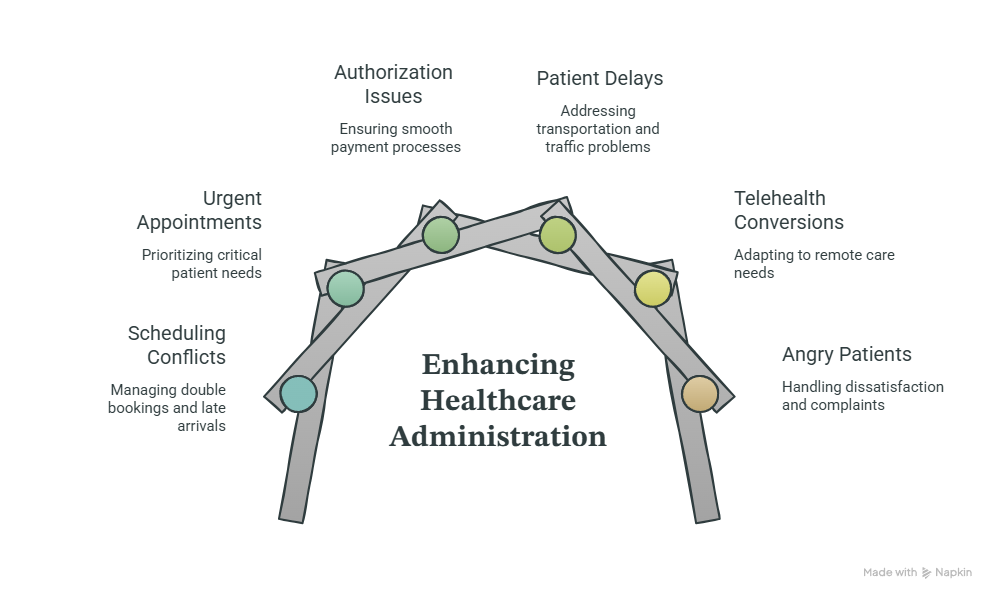
Prevention begins with measuring causes rather than counting total incidents. A clinic may report 60 monthly reschedules, yet the useful question is why they occurred. Separate provider absences, patient cancellations, template errors, authorization delays, room conflicts, staffing shortages, duplicate records, telehealth failures, and incorrect visit types.
Track these operational indicators:
Double bookings by provider and scheduler
Template overrides by reason
Percentage of visits rescheduled within 48 hours
Authorization-related postponements
Average time required to resolve a conflict
Percentage of conflicts resolved during the first patient contact
Late-arrival acceptance and rescheduling rates
Patient complaints connected to scheduling
Unused slots after late cancellations
Waitlist fill rate
Third-next-available appointment
Urgent requests redirected because capacity was unavailable
These metrics should connect with patient satisfaction measures. A clinic may achieve high schedule utilization while creating long waits, rushed visits, and repeated disruption. Efficiency should support reliable access and safe care.
Standardize high-risk workflows
Create written procedures for double bookings, urgent add-ons, late arrivals, provider absences, authorization delays, interpreter needs, equipment conflicts, telehealth conversions, and weather closures. Strong medical administrative policies define decision authority, required documentation, escalation timelines, and patient communication expectations.
Use technology with disciplined configuration
Software cannot repair a poorly designed workflow automatically. Appointment types, durations, resources, permissions, alerts, and templates must reflect actual operations. Train staff on EMR shortcuts, common EMR software problems, and accurate patient record updates.
Use approved patient communication applications for reminders, confirmations, waitlist outreach, and schedule changes. Messages should include the appointment date, time, location or virtual method, provider, preparation instructions, and a clear response pathway.
Train staff through realistic scenarios
Schedulers build judgment through guided practice. Training should include competing urgent requests, angry patients, language barriers, incomplete authorizations, provider absences, late arrivals, and ambiguous symptoms. Each exercise should require the learner to identify role boundaries, select an escalation pathway, communicate the resolution, and write a defensible note.
Knowledge of top scheduling terms, professional email etiquette, HIPAA privacy terminology, and time management principles gives staff the vocabulary and discipline required for fast decisions.
Review patterns without creating a blame culture
A recurring conflict often reflects system design. One scheduler may create more errors because they handle the highest volume, receive the most complex calls, or work with poorly configured provider templates. Audits should examine context, training, workload, permissions, and workflow design.
Use risk management strategies to determine which failures could harm patients, expose protected information, create financial losses, or damage trust. Corrective action should include ownership, deadlines, testing, and follow-up measurement.
6. Frequently Asked Questions
-
Administrative staff may apply approved scheduling rules, though decisions involving symptoms, clinical urgency, postoperative timing, medication risk, or medical deterioration should be escalated to licensed clinical personnel. The escalation path should identify who makes the decision, how quickly they must respond, and what the scheduler should do while waiting. The emergency appointment management guide provides a useful framework for separating administrative coordination from clinical judgment.
-
The note should include the original appointment details, the conflict identified, relevant operational facts, clinical escalation when applicable, the person who approved the change, options offered, the patient’s response, the final appointment details, and any pending follow-up. Staff should follow medical records management and clinical documentation improvement principles by recording objective facts and avoiding blame, speculation, or unnecessary personal details.
-
Clarify the patient’s main barrier, such as transportation, work, provider preference, childcare, language support, or urgency. Confirm that each offered option is genuinely available. Explain any safety or policy limits, document the refusal, and escalate when delay may affect care. Active listening and effective patient communication often reveal a workable option that was hidden by the patient’s initial frustration.
-
The scheduler should follow the clinic’s approved urgent-add-on process. Clinical staff should determine medical priority, and an authorized person should approve any override affecting provider workload, staffing, room capacity, or patient safety. The decision should be documented before the appointment is promised. Independent symptom interpretation can expose the patient and organization to avoidable risk under established legal responsibilities for medical administrators.
-
Start by reviewing provider templates, booking permissions, appointment types, recurring rules, interfaces, duplicate patient records, and manual overrides. Require a reason for every override and audit patterns by provider, location, day, and staff member. Training in scheduling software mastery and practice management systems helps staff distinguish true availability from slots that appear open because of configuration errors.
-
Track the frequency, timing, reasons, patient impact, and affected visit types. Protect time-sensitive patients, avoid repeatedly displacing the same individuals, and involve practice leadership when patterns continue. Offer confirmed alternatives, nearby locations, qualified clinicians, or telehealth when appropriate. Repeated disruptions should be evaluated through medical office productivity and patient satisfaction reviews.
