

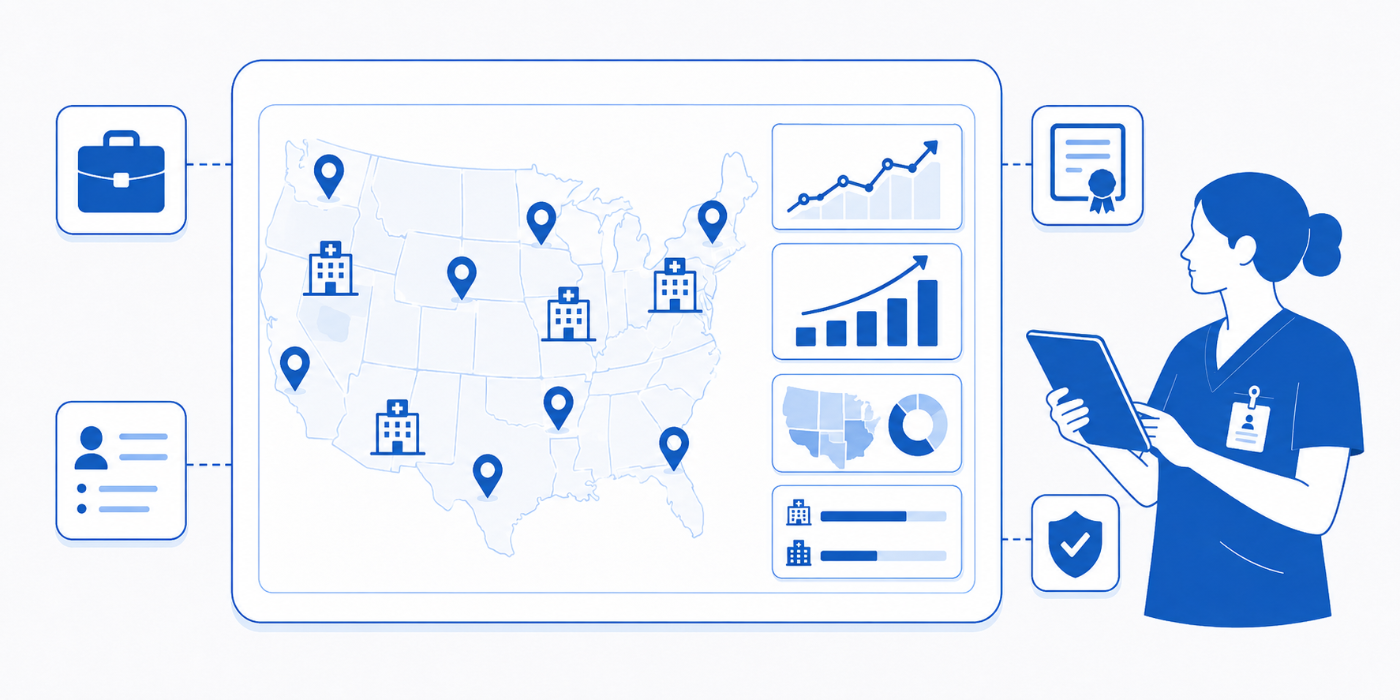
Interactive Infographic: CMAA Employment Trends Across the U.S.
CMAA employment trends are easiest to understand when you stop reading job demand as one national number and start reading it as a workflow map. A strong medical administrative assistant career plan connects state demand, patient access pressure, scheduling complexity, billing accuracy, privacy expectations, and employer technology adoption. BLS data shows medical assistants are projected to grow 12% from 2024 to 2034, with about 112,300 openings per year, while O*NET classifies medical secretaries and administrative assistants as a Bright Outlook occupation.
1. What the CMAA Employment Trend Map Really Shows in 2026–27
The strongest CMAA opportunities are forming around one painful operational problem: healthcare organizations need people who can keep patients moving through the system without creating scheduling errors, claim delays, privacy risks, or provider workflow friction. That is why a candidate who understands patient intake procedures, insurance verification, appointment scheduling best practices, front desk operations, and patient privacy communication becomes more valuable than someone who can only answer phones.
The employment map has three layers. The first layer is volume: large healthcare states and major metro corridors naturally produce more openings because they have more clinics, hospitals, urgent care sites, outpatient centers, telehealth operations, and specialty groups. The second layer is workflow complexity: high-volume markets need people who can manage scheduling conflicts, patient communication, medical billing terms, CPT code basics, and ICD-10 code awareness without freezing when the waiting room fills up.
The third layer is role expansion. CMAA-linked roles increasingly sit beside EMR systems, patient portals, remote care workflows, payer rules, access metrics, and front-end revenue cycle tasks. BLS notes that medical assistants commonly perform administrative work such as scheduling appointments, coding information, contacting insurance companies, and entering patient information into medical records; employers also rely on confidentiality and accurate records. That makes EMR integration tools, healthcare portal terms, telehealth administration, virtual patient management, and risk management strategies practical job-market signals, rather than extra study topics.
| # | Trend Signal | Where It Shows Up | Why It Matters for CMAAs | Best ACMSO Skill Resource |
|---|---|---|---|---|
| 1 | High volume Large clinic networks | California, Texas, Florida, New York, Pennsylvania | More sites create more intake, scheduling, referral, portal, and records work. | Front desk operations |
| 2 | Access pressure Patient access roles | Hospital systems and outpatient networks | Access teams need clean registration, insurance capture, and appointment flow. | Patient intake procedures |
| 3 | Revenue cycle Front-end claim prevention | Specialty clinics, urgent care, primary care | Small demographic and eligibility mistakes can become denials. | Denial management |
| 4 | Remote care Telehealth admin expansion | Virtual care groups, hybrid clinics, telehealth platforms | Remote visits require portal readiness, patient communication, and privacy control. | Telehealth administration |
| 5 | Digital workflow EMR-heavy offices | Multi-provider practices and health systems | Employers want staff who can move inside the EMR without creating record clutter. | EMR integration tools |
| 6 | Privacy risk HIPAA-sensitive communication | All patient-facing offices | One careless voicemail, portal message, or screen exposure can create compliance risk. | HIPAA privacy terms |
| 7 | Scheduling density Provider template pressure | Primary care, dermatology, cardiology, orthopedics | Good scheduling protects provider time and reduces patient complaints. | Scheduling best practices |
| 8 | Urgent care Walk-in traffic | Retail clinics and urgent care chains | Fast check-in needs accuracy under pressure, especially when patients arrive frustrated. | Emergency appointment management |
| 9 | Specialty growth Referral-heavy workflows | Ortho, GI, OB-GYN, pediatrics, ophthalmology | Referral, authorization, and follow-up gaps cost clinics time and revenue. | Outpatient specialty networks |
| 10 | Patient experience Complaint handling | Front desk, call center, access center | Admin behavior shapes wait-time perception before clinical care begins. | Handling patient complaints |
| 11 | Portal adoption Message triage | Primary care and large group practices | Portal queues need correct routing, clean language, and privacy discipline. | Healthcare portal terms |
| 12 | Claims accuracy Billing awareness | Clinics with lean billing teams | CMAAs who understand billing handoffs prevent avoidable rework. | Medical billing terms |
| 13 | Coding literacy CPT and ICD awareness | Procedure-heavy practices | Administrative staff do better when they understand the language billers and coders use. | CPT code reference |
| 14 | Automation AI and admin tools | Modern practices, MSOs, remote teams | Technology raises the value of staff who can verify, correct, and coordinate outputs. | Medical admin technology |
| 15 | Workforce mobility Career ladders | Health systems and physician groups | Entry roles can lead toward lead admin, access supervisor, billing support, or scribe-adjacent tracks. | CMAA career progression |
| 16 | Salary pressure Wage comparison | Competitive metro markets | Candidates need to connect skills to pay conversations, not just years of experience. | Negotiate CMAA salary |
| 17 | Remote roles Distributed teams | Telehealth companies and centralized admin teams | Remote jobs reward written clarity, tool discipline, and self-managed productivity. | Remote healthcare employers |
| 18 | Compliance Legal responsibility | All regulated healthcare settings | Medical admin errors can become privacy, billing, access, or documentation problems. | Legal responsibilities for CMAAs |
| 19 | Soft skill filter De-escalation | High-volume front desks and call centers | Patients bring fear, anger, confusion, and billing frustration to admin staff first. | De-escalation techniques |
| 20 | Productivity Time management | Lean offices with cross-trained admin teams | Employers notice who can prioritize urgent work without dropping routine tasks. | Time management mastery |
| 21 | Certification filter Job-readiness proof | Entry-level and promotion-focused roles | Certification helps when it is paired with workflow evidence and interview language. | Certification exam strategies |
| 22 | Interview proof Scenario questions | Hospitals, clinics, access centers | Hiring managers test how candidates respond to difficult patients and broken workflows. | Medical admin interview prep |
| 23 | Resume proof Skills packaging | Competitive applicant pools | A generic resume hides the exact operational skills employers are trying to hire. | Standout CMAA resume |
| 24 | Patient flow Coordination roles | Busy outpatient offices | Patient flow breaks when registration, scheduling, records, and follow-up operate separately. | Patient care coordination |
| 25 | Ergonomics Sustainable admin work | Call centers, front desks, remote admin roles | High admin volume burns people out when workstation habits and workflow design are ignored. | Medical office ergonomics |
| 26 | Staffing tools Office coordination | Multi-location clinics and shift-based teams | Coverage gaps create patient delays, phone backlog, and rushed documentation handoffs. | Admin staff scheduling tools |
| 27 | Records release Information control | Primary care, specialty care, legal/insurance requests | Records work requires precision because the wrong release creates serious risk. | Medical records release tools |
| 28 | Professional growth Networking | Local chapters, webinars, conferences, online groups | CMAAs who track industry shifts can apply before demand becomes crowded. | Professional organizations |
| 29 | Employer research Targeted applications | Hospital systems, MSOs, clinics, recruiters | Better applications start with knowing which organizations actually hire admin talent. | Health systems by state |
| 30 | Exam-to-job bridge 30-day study plan | New candidates and career changers | Passing an exam matters more when study time also builds job-ready vocabulary. | 30-day certification study schedule |
2. How to Read the U.S. CMAA Opportunity Map Without Chasing the Wrong Jobs
A CMAA employment infographic should help candidates read demand correctly. High demand does not automatically mean an easy job search in every city. Some markets have more openings, but also more applicants. Some smaller markets have fewer postings, but stronger employer urgency because one trained administrative hire can reduce phone delays, missed eligibility checks, referral leakage, and patient complaints. That is why candidates should pair broad labor-market data with local employer research through top hospitals hiring medical scribes, physician groups hiring medical scribes, urgent care and retail clinic brands, community health centers, and healthcare recruiters.
The safest way to read the map is by role family. “CMAA” may appear directly in some postings, but many employers use titles such as medical receptionist, patient access representative, registration specialist, scheduling coordinator, clinic office assistant, unit clerk, referral coordinator, or medical office specialist. O*NET’s medical secretaries and administrative assistants profile includes job titles such as Medical Office Specialist, Front Desk Receptionist, Medical Receptionist, Physician Office Specialist, Unit Clerk, and Ward Clerk. This means candidates should search across medical admin assistant professional organizations, online communities for CMAAs, medical administration conferences, CMAA job market reports, and medical administration workforce trends instead of relying on one keyword.
The next layer is employer setting. BLS reports that medical assistants are concentrated heavily in physicians’ offices, hospitals, outpatient care centers, and offices of other health practitioners. For CMAA candidates, that pattern translates into practical job-search buckets: physician offices reward broad front-office range, hospitals reward compliance and access discipline, outpatient centers reward speed and coordination, and specialty groups reward referral accuracy. A smart applicant links each setting to proof: active listening techniques for patients, healthcare CRM terms for organized follow-up, secure patient scheduling tools for access workflows, patient communication apps for modern contact channels, and medical admin time tracking tools for productivity.
3. The Skills Employers Are Separating From Basic Front Desk Work
The old version of medical administration was often treated as clerical support. The stronger 2026–27 version looks closer to operational control. Employers need people who can protect the appointment template, collect accurate patient information, communicate without escalating conflict, maintain privacy, support billing handoffs, and keep providers from drowning in avoidable admin noise. That is where effective patient communication, empathy in healthcare administration, de-escalation techniques, handling difficult conversations, and handling patient complaints legally become employment assets.
The first skill gap is intake accuracy. Many offices lose time because the front desk captures incomplete demographics, skips eligibility questions, misses a secondary insurance detail, enters the wrong contact preference, or fails to clarify the reason for visit. Those mistakes feel small at the desk, then explode later as claim rework, provider confusion, patient frustration, and delayed follow-up. CMAAs who study patient record updates, insurance claims management, mastering CPT codes, billing code changes, and risk management strategies can speak to the real cost of inaccurate front-end work.
The second skill gap is system fluency. Employers do not want someone who panics when the scheduling screen changes, the portal queue spikes, or a patient needs help resetting access before a telehealth visit. They want someone who can learn tools quickly, document cleanly, escalate correctly, and avoid risky shortcuts. That is why top EMR platforms, resolving EMR software issues, top EMR shortcuts, telehealth platforms, and predictive analytics in medical administration strengthen a CMAA employment profile.
4. Where CMAA Demand Is Growing Fastest by Setting, State Type, and Workflow
CMAA demand is strongest where patient volume meets administrative risk. Large states matter because they contain dense networks of hospitals, urgent care brands, specialty practices, outpatient centers, and physician groups. Yet the practical opportunity depends on workflow type. A candidate applying to a hospital access department needs a different pitch than someone applying to a dermatology clinic, pediatric office, telehealth company, or primary care network. Use top health systems by state, top physician groups and MSOs, top primary care networks, top pediatric and women’s health networks, and top urgent care chains to organize the search by setting.
Hospitals and health systems tend to value reliability, process discipline, compliance awareness, and the ability to work inside layered workflows. A candidate should prepare examples involving registration accuracy, patient identity checks, privacy-safe communication, escalation rules, and coordination with clinical staff. The best preparation stack includes HIPAA updates for CMAAs, legal responsibilities for CMAAs, patient privacy essentials, infection control in medical offices, and creating medical admin policies.
Outpatient and specialty practices tend to value speed, patient warmth, payer awareness, and follow-up consistency. A weak admin hire lets unanswered portal messages, unclear referrals, missed pre-visit instructions, and appointment gaps pile up until the provider feels the impact. A strong CMAA candidate can explain how they would handle patient flow, protect provider schedules, and reduce rework. That means building fluency in orthopedic and sports medicine groups, dermatology and ophthalmology practices, specialty documentation templates, medical terminology mastery, and complex medical term memorization.
Remote and hybrid healthcare employers create a different opportunity. These roles require written clarity, independence, privacy discipline, comfort with portals, and the ability to manage work without constant in-person supervision. Candidates should show they can handle asynchronous tasks, communicate clearly, track unresolved items, and avoid vague updates. Useful preparation includes remote medical scribe market growth, telehealth expansion, medical scribes and telemedicine, secure scheduling tools, and best collaboration tools for medical office teams.

5. How to Turn Employment Trends Into a 30-Day Career Action Plan
The best CMAA job strategy starts with a tight role target. Pick three job titles, three employer settings, and one state or metro area before rewriting your resume. A candidate who says “I want any medical admin job” gives the hiring manager extra work. A candidate who says “I can support patient intake, scheduling, insurance verification, portal communication, and privacy-safe front desk workflow in a busy outpatient clinic” sounds ready. Build that message with CMAA certification career earnings, CMAA salary report data, CMAA salary growth, CMAA career progression, and salary negotiation guidance.
For days 1–7, audit your local market. Search for five titles: medical administrative assistant, patient access representative, medical receptionist, scheduling coordinator, and clinic office assistant. Save ten postings and highlight repeated skills. Most candidates skip this step and then wonder why their resume sounds generic. Match repeated employer language to proof from medical admin interview preparation, standout CMAA resume building, medical admin communities, healthcare recruiting platforms, and CMAA job market demand.
For days 8–15, build a proof bank. Write short examples for five scenarios: an angry patient, a scheduling conflict, an insurance verification issue, a privacy-sensitive conversation, and an EMR correction. These examples become resume bullets, interview stories, and confidence anchors. Practice with active listening, patient communication, de-escalation, EMR compliance training, and medical records release tools.
For days 16–30, apply in clusters. Send tailored applications to one employer type at a time: hospitals first, then clinics, then specialty groups, then telehealth or centralized admin teams. This keeps your resume language focused. Track every application, follow-up date, skill keyword, and interview question. Strengthen weak areas with CMAA exam study scheduling, ACMSO certification exam strategies, medical terminology tutorials, scheduling software mastery, and organizing a medical office.
6. FAQs: CMAA Employment Trends Across the U.S.
-
The strongest opportunities usually appear where healthcare volume, outpatient growth, hospital density, urgent care expansion, and patient access hiring overlap. Large states such as California, Texas, Florida, New York, and Pennsylvania often have broad healthcare ecosystems, while smaller states can still offer strong opportunities when local hospitals, community health centers, or specialty practices have staffing shortages. Use state-level health system research, top cities hiring healthcare support roles, medical administration workforce trends, and CMAA demand reports before choosing where to apply.
-
CMAA-linked work appears across hospitals, physician offices, outpatient centers, urgent care, specialty clinics, telehealth teams, and centralized access departments. BLS data for medical assistants shows physicians’ offices, hospitals, outpatient care centers, and other health practitioner offices as major employment settings. For a stronger strategy, compare hospital hiring directories, primary care networks, urgent care brands, and telehealth companies.
-
The fastest differentiators are intake accuracy, scheduling judgment, insurance verification awareness, HIPAA-safe communication, EMR comfort, patient de-escalation, and clean follow-up habits. Employers feel pain when patients are scheduled incorrectly, eligibility is missed, messages are routed poorly, or privacy boundaries are handled casually. Build a stronger profile through insurance verification examples, HIPAA terms for CMAAs, scheduling terms, patient communication examples, and EMR issue resolution.
-
Use trend data to focus your search instead of applying randomly. Pick a region, identify the dominant employer types, study their repeated job-posting language, then match your resume to those workflows. If postings mention scheduling, insurance, phones, portals, HIPAA, and EMR experience, your resume should show those exact strengths through examples. Start with resume building, interview preparation, time management, and office productivity.
-
Technology changes the work more than it removes the need for good administrative judgment. Patient portals, scheduling systems, EMRs, automated reminders, and analytics tools still need trained staff to verify information, fix errors, communicate with patients, escalate problems, and protect privacy. Candidates who study medical administrative assistants and technology, AI medical scribe tools, voice recognition tools, and predictive analytics opportunities can position themselves as tool-ready rather than tool-threatened.
-
Choose one job setting and build proof for it. For hospitals, focus on registration, HIPAA, patient access, and escalation. For clinics, focus on scheduling, intake, communication, and insurance verification. For telehealth, focus on portals, remote communication, privacy, and digital workflow. Then apply with a targeted resume, not a general one. Use CMAA certification strategies, 30-day study planning, medical terminology mastery, and career progression planning to turn trend awareness into a real application strategy.
