

Medical Admin Front Desk Etiquette: Interactive Guide & Terms
Medical front desk etiquette shapes how patients judge the entire practice before they meet a clinician. Every greeting, identity check, scheduling explanation, privacy safeguard, and handoff affects trust. Strong etiquette combines front desk operations, effective patient communication, accurate patient intake procedures, and disciplined patient privacy communication. This guide provides practical terminology, scripts, workflow standards, interactive examples, and recovery techniques for handling busy reception areas professionally without sacrificing accuracy, confidentiality, accessibility, or patient safety.
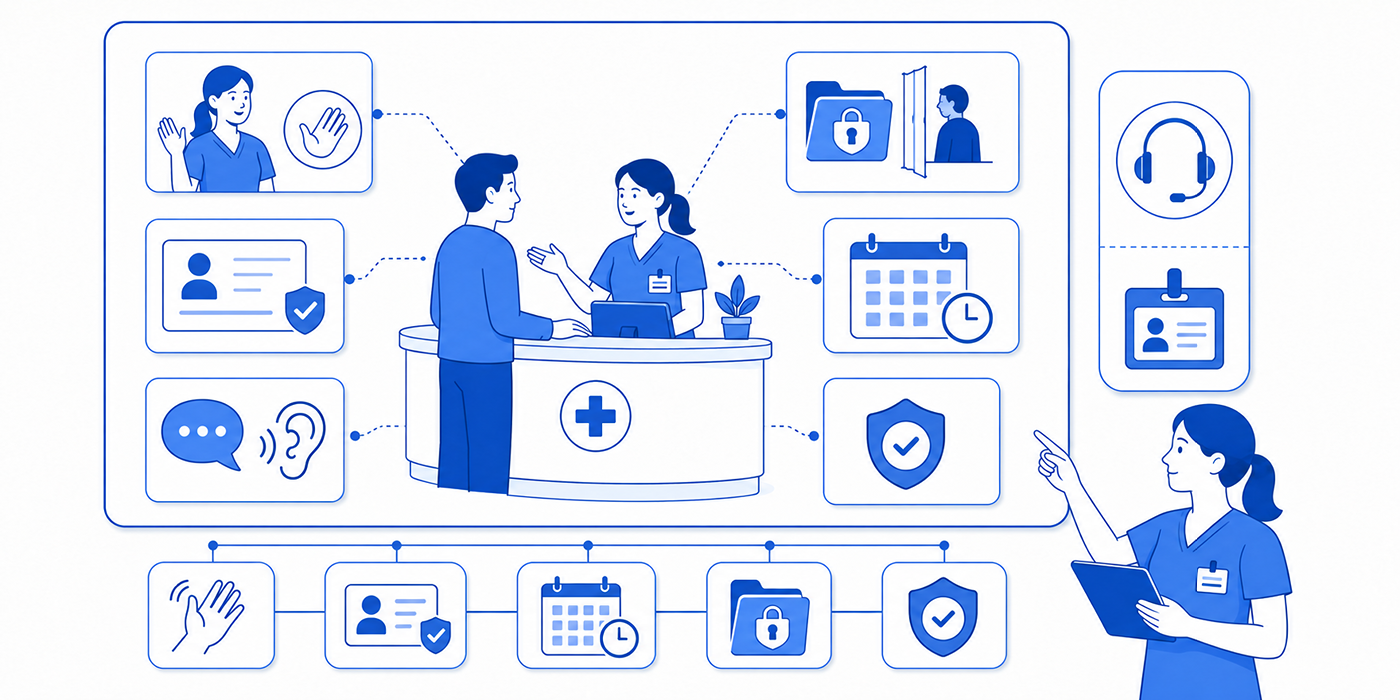
1. What Professional Front Desk Etiquette Means in Healthcare
Medical front desk etiquette is the consistent use of respectful communication, privacy-conscious behavior, accurate administration, and clear boundaries at every patient contact point. It covers in-person greetings, telephone calls, check-in, demographic verification, insurance questions, appointment changes, portal assistance, payment discussions, visitor management, complaint handling, and clinical escalation. A dependable front desk connects medical administrative workflows, appointment scheduling best practices, insurance verification, and patient portal management without making patients understand the practice’s internal complexity.
Patients often approach the desk while experiencing pain, uncertainty, financial pressure, sensory overload, transportation problems, or fear about their health. Their first concern may sound administrative while carrying a clinical or emotional risk. “I cannot wait any longer” may involve childcare or worsening symptoms. “Why do you need that information again?” may reflect identity-theft concerns or frustration caused by duplicate paperwork. Skilled staff use active listening techniques, empathy in healthcare administration, medical office triage terminology, and patient education methods to uncover the operational need before choosing a response.
Professional etiquette begins with acknowledgment. A patient who enters an unattended-looking reception area should receive visual or verbal recognition quickly, even when the employee is finishing another task. A brief statement such as, “I will be with you as soon as I complete this confidential call,” establishes awareness and protects the current interaction. Ignoring the patient creates uncertainty, encourages repeated interruptions, and increases pressure on the employee. Reliable acknowledgment should be built into daily office procedures, medical office organization, time-management systems, and team collaboration practices.
Privacy remains part of etiquette during every front-desk exchange. Employees should control voice volume, screen visibility, printed documents, sign-in information, payment discussions, and conversations involving diagnoses or procedures. HHS explains that covered entities should use reasonable safeguards to reduce incidental disclosures, while recognizing that healthcare environments cannot remove every possibility of information being overheard. Patient sign-in sheets may be used when unnecessary medical details are excluded and appropriate safeguards are applied.
A privacy-conscious employee can say, “I need to review part of your account privately. Let us move to the side desk,” before discussing an explanation of benefits, insurance denial, prior authorization, or sensitive patient record update. The employee preserves dignity while completing the task.
Accessibility also belongs within front desk etiquette. Some patients need qualified interpreters, captioning, accessible electronic information, written instructions, larger print, extra processing time, or another communication aid. ADA guidance states that covered entities must provide auxiliary aids and services when needed for effective communication with people who have vision, hearing, or speech disabilities. The appropriate support depends on the person’s needs, the communication method, and the complexity of the exchange.
Front desk teams should know how to arrange medical interpreter services, support accessible telehealth platforms, communicate with cultural competence, and record relevant needs within the practice management system. Treating a communication barrier as stubbornness can delay care and damage trust before the actual appointment begins.
Etiquette also requires role discipline. Administrative staff can explain processes, collect information, schedule services, route messages, and apply approved policies. Symptom interpretation, medical recommendations, medication decisions, urgency determinations, and treatment instructions belong to appropriately qualified clinical personnel. When a patient asks, “Can this wait until next week?” the safest administrative response is, “I cannot determine clinical urgency, so I will route your concern through our clinical review process.” That response supports emergency appointment management, accurate medical office triage, compliant medical record documentation, and clear legal responsibilities for CMAAs.
| # | Term | Practical Definition | Common Etiquette Failure | Professional Response Standard |
|---|---|---|---|---|
| 1 | Immediate acknowledgment | Recognizing a patient’s presence before the full interaction can begin. | Continuing to type without eye contact or explanation. | Greet the patient and explain when assistance will begin under the front desk workflow. |
| 2 | Professional greeting | A respectful opening that identifies the employee or practice and offers assistance. | Beginning with “Name?” or “What do you need?” | Use a complete opening: “Good morning. Welcome. How may I assist you?” |
| 3 | Identity verification | Confirming the correct patient through approved identifiers before accessing or discussing information. | Using recognition, room number, or surname alone. | Follow approved patient intake procedures. |
| 4 | Privacy-conscious volume | Speaking loudly enough for the patient while limiting unnecessary exposure. | Announcing diagnoses, balances, or appointment types across the waiting room. | Lower the voice and move detailed conversations to a more private area. |
| 5 | Neutral language | Clear wording that avoids blame, judgment, sarcasm, or emotional labels. | Calling a patient careless, noncompliant, difficult, or irresponsible. | Describe the process and observable facts through effective patient communication. |
| 6 | Active listening | Listening for the patient’s central concern, confirming it, and responding to the actual request. | Interrupting before the patient explains the problem. | Summarize the concern using active listening techniques. |
| 7 | Empathic acknowledgment | Recognizing the impact of a problem without promising an unavailable outcome. | Responding to frustration with “That is our policy.” | Say, “I understand why that delay has created a problem,” then explain the next step. |
| 8 | Expectation setting | Giving realistic information about timing, process, ownership, and possible outcomes. | Promising a callback or approval that another employee controls. | Use accurate timeframes supported by administrative workflows. |
| 9 | Warm transfer | Connecting the patient to another employee after sharing enough context to prevent repetition. | Transferring without explanation or sending the patient between extensions. | Confirm availability, introduce the issue, and explain the destination. |
| 10 | Closed-loop handoff | Confirming that a task reached the correct owner and received follow-through. | Saying “I sent a message” without tracking its status. | Assign ownership through the practice management system. |
| 11 | Queue transparency | Giving realistic information about delays without disclosing another patient’s circumstances. | Claiming “The doctor will be right with you” when no estimate is available. | Provide the known delay, available options, and the next update time. |
| 12 | Service recovery | A structured response to a preventable service failure. | Defending the practice after a missed callback or incorrect appointment entry. | Acknowledge, correct, assign ownership, and follow the complaint process. |
| 13 | Boundary statement | A calm explanation of behavior required for the interaction to continue. | Arguing with a patient who uses insults or threats. | State the limit and apply approved de-escalation techniques. |
| 14 | Clinical redirection | Routing symptom or treatment questions to appropriately qualified clinical personnel. | Offering personal advice about urgency, medication, or treatment. | Use the established medical office triage process. |
| 15 | Minimum-necessary discussion | Limiting front-desk conversation to information needed for the current task. | Reading unrelated chart details while confirming an appointment. | Apply the patient privacy communication process. |
| 16 | Accessible communication | Adapting communication so patients with disabilities can receive and convey information effectively. | Speaking only to a companion instead of the patient. | Arrange the appropriate aid and communicate directly with the patient. |
| 17 | Language access | Providing appropriate assistance for patients who communicate best in another language. | Using an untrained visitor for a complex or sensitive discussion. | Arrange qualified medical interpreter services. |
| 18 | Cultural humility | Approaching differences with respectful questions instead of assumptions. | Judging eye contact, family involvement, pronunciation, dress, or communication style. | Use the cultural competence framework. |
| 19 | Call ownership | Maintaining responsibility until the caller reaches the correct resource or receives a defined next step. | Transferring repeatedly or asking the caller to start again. | Use a warm handoff and record unresolved work. |
| 20 | Hold etiquette | Requesting permission, explaining the reason, and returning within a reasonable interval. | Placing the caller on hold without warning. | Ask permission and offer a callback when the wait may be extended. |
| 21 | Scheduling integrity | Protecting appointment accuracy, clinical priority, and policy consistency. | Creating hidden slots or displacing another patient under pressure. | Use approved scheduling-conflict procedures. |
| 22 | Insurance explanation | Explaining known administrative information while distinguishing it from payer decisions. | Guaranteeing coverage, payment, or claim approval. | Use verified information and the insurance verification workflow. |
| 23 | Payment discretion | Discussing balances and payment options without exposing financial information publicly. | Announcing an overdue balance within earshot of other patients. | Move the discussion and apply relevant medical billing procedures. |
| 24 | Proxy verification | Confirming another person’s authority before sharing information or granting account access. | Assuming a spouse, adult child, or caregiver has unrestricted permission. | Review authorization and formal portal proxy access. |
| 25 | Objective documentation | Recording observable facts, requests, actions, ownership, and outcomes. | Writing emotional labels such as “rude,” “crazy,” or “impossible.” | Apply clinical documentation improvement principles. |
| 26 | Safety escalation | Activating trained support when behavior creates a credible threat or immediate danger. | Continuing an argument after threats or physical intimidation begin. | Follow the organization’s risk-management plan. |
| 27 | Visible workload control | Organizing screens, documents, calls, and queues so the desk appears controlled and confidential. | Leaving charts, sticky notes, labels, or forms exposed. | Improve the area through medical office ergonomics. |
| 28 | Portal redirection | Guiding patients toward secure digital functions while offering help with access barriers. | Saying “Use the portal” without explaining registration or alternatives. | Provide support using the healthcare portal workflow. |
| 29 | Teach-back | Asking the patient to explain the next step in their own words to confirm clarity. | Ending after giving several instructions rapidly. | Use clear patient education techniques. |
| 30 | Professional closure | Ending the interaction with a summary, ownership, timeframe, and respectful final statement. | Finishing with “That is all I can do.” | Confirm the action, expected update, and contact route before closing. |
2. The FIRST Framework for Every Front Desk Interaction
A consistent framework helps staff remain professional when the waiting room is full, the phone queue is growing, and several patients need immediate attention. Use FIRST for routine and high-pressure encounters:
F — Focus and acknowledge
I — Identify the patient and immediate need
R — Respect privacy, access needs, and boundaries
S — Solve within your role or escalate
T — Track the outcome and close clearly
F — Focus and acknowledge
Pause competing tasks enough to make eye contact, greet the patient, and establish order. When you are already assisting someone, protect that interaction while recognizing the new arrival:
“Good afternoon. I will assist you as soon as I finish this patient’s check-in.”
This wording avoids exposing information about the current patient and reassures the new arrival. Staff should coordinate desk coverage through medical admin scheduling tools, time-tracking systems, office procedure checklists, and team collaboration tools so acknowledgment does not depend on one overwhelmed employee.
Focus also means removing avoidable distractions. Personal phones, side conversations, food, loud typing, or visible frustration can make patients feel that their concern is inconvenient. Staff should complete one critical verification step before switching tasks. Frequent partial attention increases the risk of opening the wrong chart, entering information in the wrong account, or sending a request to the wrong employee. Organized EMR workflows, reliable EMR integration tools, accurate patient record updates, and clear medical office policies reduce these errors.
I — Identify the patient and immediate need
Use approved identifiers before opening a record or discussing protected information. Ask the patient to provide information rather than announcing it publicly:
“Please tell me your full name and date of birth.”
Avoid, “Are you Sarah Jones born March 4?” because another person could agree. Once identity is established, determine the immediate purpose: check-in, appointment change, billing question, portal access, form request, referral, clinical message, or complaint. This step connects patient intake procedures, appointment scheduling terminology, healthcare CRM records, and medical administrative workflows.
When the request includes symptoms, urgent language, confusion, breathing difficulty, severe pain, altered behavior, or another clinical warning sign, stop treating the encounter as a standard service question. Route it through the organization’s medical office triage process, emergency appointment workflow, risk-management procedure, and clinical chain of command.
R — Respect privacy, access needs, and boundaries
Choose the environment and communication method before discussing details. Move sensitive billing, test, diagnosis, medication, and family-authorization conversations away from the open waiting area. Keep screens angled away from public traffic, collect printed pages immediately, and avoid leaving labels or schedules visible. HHS permits necessary healthcare communication in treatment settings while requiring reasonable safeguards against avoidable disclosures.
Respect also includes communication access. Ask the patient which language or communication method works best, then use appropriate medical interpreter services, accessible patient communication tools, suitable telehealth administration, and culturally responsive patient education. Speak directly to the patient when a companion or interpreter is present.
Boundaries remain respectful when they are concise and enforceable:
“I can continue helping with the appointment. I need us to speak without personal insults.”
For repeated disruption, follow the approved difficult-conversation process, de-escalation techniques, complaint procedure, and crisis communication protocol.
S — Solve within your role or escalate
Give the patient the available options, the responsible owner, and a realistic timeframe. Avoid vague promises such as “Someone will call soon.” Use:
“I am sending this to the referral coordinator now. The expected review window is one business day. I will document your preferred callback number.”
Solutions may involve appointment scheduling tools, prior authorization workflows, insurance claims management, or medical records-release tools. Give only options supported by policy and current availability.
Escalate when the request exceeds your authority, the patient reports clinical deterioration, privacy permissions remain unclear, a system error blocks safe completion, or behavior creates a safety concern. OSHA identifies threats, harassment, intimidation, verbal abuse, and physical assault within the spectrum of workplace violence. Healthcare employers are encouraged to train staff to recognize, report, and respond to potentially violent situations through established prevention programs.
T — Track the outcome and close clearly
Document the request, information verified, action taken, owner, timeframe, communication preference, and any unresolved concern. A closed-loop front desk does not rely on memory, loose paper, personal inboxes, or verbal promises. Use the practice management system, accurate medical records management, structured patient portal workflows, and clear medical office policies.
Close with a summary:
“Your appointment remains scheduled for Tuesday at 9:20 a.m. I have sent the insurance question to our verification team. You should receive an update through the portal by tomorrow afternoon.”
Then use teach-back when the instructions are complex:
“To make sure I explained everything clearly, please tell me what you expect to happen next.”
3. Front Desk Communication Standards for Common Contact Channels
In-person reception
Stand or sit with an open posture, make culturally appropriate eye contact, and avoid pointing sharply, sighing, or showing visible annoyance. Keep the desk surface controlled so the patient sees an organized workspace rather than exposed forms, labels, and handwritten notes. A strong reception area combines medical office ergonomics, front desk checklists, infection-control procedures, and reliable office inventory management.
Replace abrupt questions with complete requests:
“May I see your photo identification and insurance card?”
“Please review these details and tell me what needs updating.”
“I will move this conversation to a more private area.”
“I need a clinical team member to review that symptom question.”
“Here are the appointment options currently available.”
These phrases preserve authority while supporting effective patient communication, patient intake accuracy, appointment scheduling integrity, and patient privacy.
Telephone etiquette
Answer with the practice name, your name, and an offer of assistance. Speak at a controlled pace and verify the caller before discussing patient information. When a call requires research, ask permission before placing the caller on hold:
“May I place you on a brief hold while I verify that information?”
When the wait could become long, offer a callback and confirm the number. Avoid blind transfers. Use a warm transfer whenever possible:
“I am connecting you with our billing coordinator. I will explain that you are calling about the denial dated May 12 so you do not need to start again.”
This approach supports medical claims processing, denial management, revenue-cycle communication, and dependable team collaboration.
Scheduling conversations
State available options accurately and avoid creating the impression that anger changes clinical priority. When a preferred time is unavailable, offer two or three workable choices:
“The first standard appointment is Thursday at 2:40 p.m. I can also place you on tomorrow’s cancellation list or send your symptom concern for clinical review.”
Do not invent availability, reserve unofficial slots, or displace another patient. Use consistent scheduling terminology, scheduling-conflict procedures, emergency appointment management, and scheduling software workflows.
Insurance and payment discussions
Explain what the practice has verified and which decisions remain with the payer. Avoid guaranteeing coverage, final cost, authorization, or claim payment. A responsible statement is:
“The insurer’s system currently shows active coverage. Benefits and payment remain subject to the plan’s processing rules. I can explain the information we received and the next verification step.”
Use the correct insurance verification terms, coordination-of-benefits procedures, EOB terminology, and medical billing language. Move balance discussions away from other patients.
Family members and companions
Address the patient first whenever possible. Ask which people the patient wants involved and which topics may be discussed. HHS guidance permits providers to communicate with family, friends, or others involved in care or payment under defined circumstances, including when the patient agrees, does not object, or professional judgment supports limited sharing. Information shared should remain relevant to that person’s involvement.
A useful script is:
“Would you like this person to remain while we discuss your appointment and account information?”
Then clarify the scope. Permission to assist with appointment scheduling may differ from permission to receive clinical documentation, access the patient portal, or obtain medical records.
Portal and digital communication
Guide patients toward secure tools while recognizing access barriers. “Use the portal” gives no value when the patient cannot register, has forgotten the password, lacks proxy access, or needs an urgent clinical route. Ask which step failed, confirm identity, explain the recovery path, and offer the approved alternative.
Use secure healthcare portal workflows, appropriate patient communication applications, integrated EMR tools, and accessible virtual patient management. Keep clinical and protected information out of personal messaging accounts and public social-media conversations.
4. Interactive Front Desk Scenarios and Professional Scripts
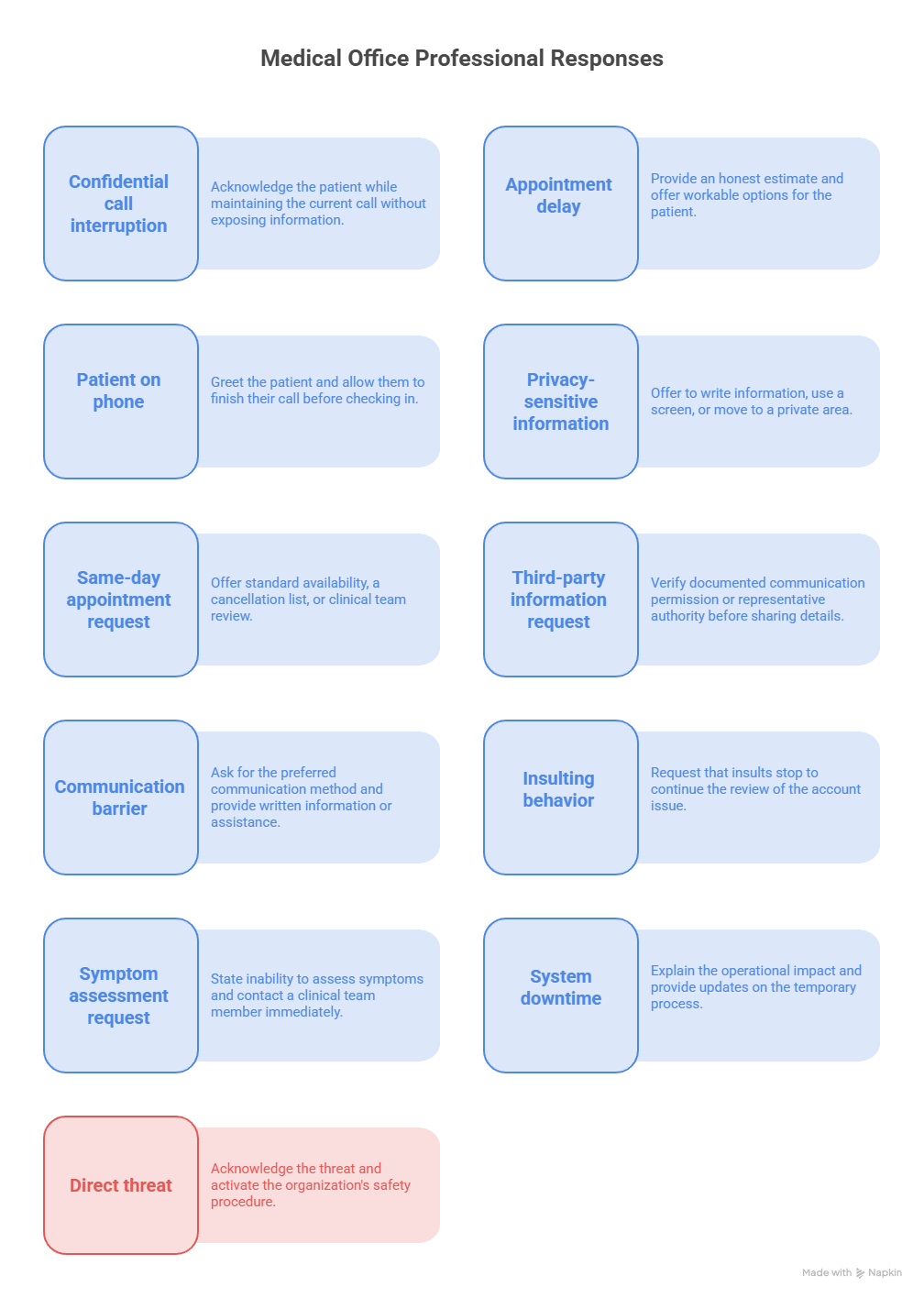
Scenario 1: A patient enters while the receptionist is on a confidential call
The employee keeps looking at the computer and gives no sign that the arriving patient has been noticed. Within a minute, the patient interrupts loudly.
Professional response:
“Welcome. I will assist you as soon as I finish this confidential call. Thank you for waiting.”
The employee should avoid placing the caller on hold automatically, exposing the caller’s information, or mouthing questions to the arriving patient while listening to the call. Acknowledgment restores order while preserving the existing interaction. This approach supports confidential communication, controlled front desk operations, professional time management, and accurate patient intake.
Scenario 2: The appointment is running 45 minutes late
Patient: “Why did you schedule me at 10:00 if nobody was going to see me?”
A defensive explanation about emergencies or the clinician’s workload may intensify the encounter. The patient needs acknowledgment, an honest estimate, and workable options.
Professional response:
“You were scheduled for 10:00, and we should have updated you when the delay increased. The current estimate is another 20 to 30 minutes. I can keep your place, check whether rescheduling is practical, or ask whether another approved option is available.”
Avoid sharing another patient’s medical circumstances to explain the delay. Use appointment scheduling best practices, patient satisfaction principles, scheduling-conflict procedures, and service-recovery techniques.
Scenario 3: A patient reaches the desk while talking on a mobile phone
Avoid demanding that the patient end the call unless privacy, safety, or workflow conditions require it. Greet the patient and give them control over when check-in begins.
Professional response:
“Good morning. I am ready to check you in when you finish your call.”
When identity verification or protected information will be discussed, wait until the patient can participate privately. The employee protects patient privacy, accurate intake procedures, respectful patient communication, and an orderly medical office workflow.
Scenario 4: The patient refuses to state personal information aloud
Patient: “I am not saying my address and date of birth where everyone can hear.”
Professional response:
“I understand. You may write the information here, verify it on this screen, or move with me to the private check-in area.”
The employee should avoid telling the patient that everyone must follow the same process. Offer an approved privacy-conscious method and protect any written information immediately. HHS guidance supports the use of reasonable safeguards tailored to the environment and communication.
This response applies HIPAA privacy terminology, patient confidentiality standards, medical office ergonomics, and front desk procedures.
Scenario 5: A patient demands a same-day appointment
Patient: “I know the doctor has time. Put me in today.”
Professional response:
“The available standard appointment is tomorrow at 3:10 p.m. I can also place you on today’s cancellation list or send your symptoms to the clinical team for review. Which option should I begin?”
The employee avoids inventing capacity, displacing another patient, or deciding clinical priority. The response protects scheduling integrity, emergency appointment management, medical office triage, and secure scheduling workflows.
Scenario 6: A parent wants information from an adult child’s account
Parent: “I have always handled her appointments. Tell me what the doctor ordered.”
Professional response:
“I understand that you have supported her care. I need to verify what communication permission or representative authority is documented before discussing information from the account.”
Avoid confirming orders, diagnoses, results, or treatment details while reviewing authority. A history of involvement does not define the present scope of permitted communication. Use patient confidentiality guidance, patient portal proxy procedures, HIPAA communication terms, and medical records policies.
Scenario 7: A patient cannot hear the receptionist clearly
The receptionist repeats the same sentence more loudly while the patient becomes embarrassed.
Professional response:
“What communication method works best for you? I can provide written information and arrange the appropriate assistance for this discussion.”
Shouting can expose information and may still fail to create effective communication. Follow the patient’s needs and the facility’s accessible-communication procedure. ADA guidance emphasizes communication that is equally clear and understandable and may require appropriate aids or services.
Use accessible patient education, suitable telehealth platforms, qualified medical interpreter services, and documented communication preferences.
Scenario 8: The patient becomes insulting after a billing problem
Patient: “You people are incompetent. Nobody here knows what they are doing.”
Professional response:
“I can review the billing issue and explain the next step. I need the personal insults to stop so we can continue.”
When the behavior stops, return to the account issue. When it continues, follow the organization’s escalation and call-termination or in-person safety procedure. Avoid sarcasm, a raised voice, public embarrassment, or retaliatory delays. Apply de-escalation techniques, difficult-conversation procedures, patient complaint management, and risk-management controls.
Scenario 9: A patient asks whether a symptom is serious
Patient: “I have had chest pressure since this morning. Can I wait for the appointment tomorrow?”
Professional response:
“I cannot assess the seriousness of symptoms. I am contacting a clinical team member immediately through our urgent review process.”
Administrative etiquette requires urgent redirection rather than a casual answer, reassurance, or prediction. Stay with the approved workflow, collect only information the protocol requires, and alert the appropriate person. Use medical office triage terminology, emergency appointment procedures, legal responsibilities, and accurate clinical documentation.
Scenario 10: The system is down and the waiting room is filling
Avoid repeatedly telling patients, “The computer is down.” Explain the operational impact and the temporary process.
Professional response:
“Our registration system is temporarily unavailable. We are using our downtime procedure and will provide another update in 15 minutes. I can confirm your arrival now, although full check-in may take longer.”
The team should protect paper records, avoid duplicate entries, track arrival order, and reconcile data after restoration. This response relies on medical office policies, EMR issue resolution, daily office checklists, and organized medical records management.
Scenario 11: A patient makes a direct threat
Patient: “If nobody fixes this today, someone here is going to regret it.”
Professional response:
“I heard the threat you made. I am activating our safety procedure.”
Once a credible threat appears, the interaction moves into the organization’s safety response. Maintain distance, preserve access to an exit, alert trained support, and avoid prolonged debate. OSHA recognizes workplace violence as a healthcare hazard ranging from threats and verbal abuse to physical assault.
Follow the practice’s crisis communication process, risk-management strategy, legal responsibility framework, and objective incident documentation procedures.
5. Building a Front Desk Culture Patients Can Trust
Front desk etiquette weakens when it depends on individual personality. A dependable practice converts good behavior into visible systems, scripts, responsibilities, escalation thresholds, and performance measures. Every employee should know who owns check-in delays, portal-access problems, referral questions, insurance verification, clinical messages, records requests, payment disputes, privacy concerns, and safety events.
Create role-specific standards through medical administrative policies, daily office checklists, workflow terminology, and front desk operations guidance. Employees should be able to locate the correct action during pressure without relying on informal memory.
Measure communication failures that create repeat frustration
Useful front desk indicators include:
Patients receiving delay updates within the defined interval
Percentage of messages assigned to a named owner
Calls transferred more than once
Abandoned calls
Registration corrections after check-in
Scheduling errors by category
Portal-access problems resolved on first contact
Privacy near misses and reported incidents
Complaints involving staff tone or unclear explanations
Tasks remaining unclosed at the end of the day
Interpreter or accessibility needs documented correctly
Follow-up promises completed within the stated timeframe
These indicators connect patient satisfaction metrics, medical admin time tracking, practice management systems, and healthcare CRM terminology. Measurements should identify process failures before they become personal blame.
Coach with observable behavior
“Be friendlier” gives employees no reliable action. Useful coaching identifies behavior:
Acknowledge each arrival before returning to the current task.
Ask permission before placing a caller on hold.
Give the next update time during delays.
Move balance discussions away from the waiting line.
Offer two approved scheduling alternatives.
Summarize the request before transferring.
Record the task owner and expected completion time.
Use one boundary statement before escalating verbal abuse.
Route symptom questions through clinical review.
Confirm understanding before closing complex interactions.
This coaching can be reinforced through active listening training, empathy scenarios, de-escalation practice, and professional communication examples.
Redesign the environment around privacy and flow
The desk layout can either support etiquette or undermine it. Screens visible from the waiting line, printers positioned in public areas, overlapping phone and check-in conversations, unclear queues, and inadequate space for private discussions create predictable failures. Review the environment through medical office ergonomics tools, medical office organization, infection-control guidance, and office inventory management.
Useful changes include privacy filters, controlled printer access, clear queue markers, a private discussion point, secure document bins, lowered phone volume, accessible counter sections, translated signage, and discreet staff-alert methods. HHS has documented corrective examples involving waiting-room safeguards, reinforcing the importance of operational controls in public-facing healthcare spaces.
Protect staff from constant emotional overload
Professionalism becomes harder when employees face uninterrupted queues, unclear authority, repeated abuse, inadequate staffing, and no recovery time after serious incidents. Supervisors should establish backup coverage, break procedures, escalation support, post-incident review, and clear limits on threatening behavior.
OSHA’s healthcare workplace-violence guidance emphasizes written prevention programs, employee involvement, hazard assessment, controls, training, and recordkeeping. Front desk workers should know how to recognize escalating behavior and activate assistance without seeking permission through a slow chain.
Combine staff scheduling tools, team collaboration systems, risk-management strategies, and time-management practices. A supported employee can remain composed, accurate, and respectful during pressure.
6. Frequently Asked Question
-
Use a complete, respectful greeting that acknowledges the patient and offers assistance:
“Good morning. Welcome to the practice. How may I help you today?”
When the employee is already occupied, say:
“Welcome. I will assist you as soon as I finish this confidential interaction.”
Avoid opening with “Name?” or continuing to type without acknowledgment. The greeting should lead directly into approved patient intake procedures, front desk operations, privacy-conscious verification, and effective patient communication.
-
Acknowledge the delay before the patient must repeatedly ask. Give the current estimate, explain when the next update will occur, and offer realistic alternatives:
“The clinician is running approximately 30 minutes behind. I will update you again in 15 minutes. You may continue waiting, discuss rescheduling, or ask me to check another approved option.”
Avoid blaming clinical staff or disclosing another patient’s circumstances. Follow appointment scheduling best practices, scheduling-conflict procedures, patient satisfaction guidance, and time-management standards.
-
HHS guidance permits healthcare practices to call patient names in waiting areas and use sign-in sheets when reasonable safeguards are applied and unnecessary medical information is excluded. The practice should assess its environment and limit avoidable disclosure.
Call only the information required by policy, avoid announcing the diagnosis or procedure, and consider alternative methods for patients with documented privacy concerns. Apply HIPAA privacy terminology, patient confidentiality procedures, front desk safeguards, and medical office ergonomics.
-
Lower your pace, acknowledge the specific concern, identify the outcome requiring attention, and offer available options. Use:
“I understand that the missed callback has caused a serious inconvenience. I will review the message history and identify the correct next step.”
When personal insults begin, state a boundary. When threats or physical intimidation appear, activate the safety procedure. Follow de-escalation techniques, difficult-conversation guidance, complaint-management procedures, and crisis communication protocols.
-
Move the conversation away from the open waiting line, lower your voice, and use neutral wording:
“I need to review an account item with you privately. We can step to the side desk, or I can provide the secure billing contact.”
Avoid announcing the amount, overdue status, service type, claim denial, or insurance problem publicly. Use accurate medical billing terminology, EOB guidance, revenue-cycle procedures, and patient privacy safeguards.
-
Administrative staff should route clinical questions through the approved clinical process. A question that sounds simple can depend on symptoms, medications, history, examination findings, or treatment instructions unavailable to the receptionist.
Use:
“I cannot determine the clinical answer, but I can send your concern to the appropriate team member now.”
Follow medical office triage terminology, emergency appointment procedures, legal responsibility guidance, and accurate medical administrative workflows.
