

Phoenix Healthcare Opportunities: CMAA Career Insights
Phoenix can be a strong market for CMAA candidates because the healthcare ecosystem includes hospitals, specialty clinics, urgent care centers, primary care networks, telehealth teams, patient access departments, and medical office operations roles. The challenge is knowing where your certification creates the most leverage.
A CMAA path becomes more valuable when you connect local opportunity with practical readiness. That means building skills in patient intake procedures, appointment scheduling best practices, insurance verification, HIPAA privacy terms, and CMAA exam strategy before you start applying.
1. Why Phoenix Can Be a Strong CMAA Market
Phoenix-area healthcare runs on access, scheduling, insurance, referrals, records, and patient communication. Those are exactly the areas where a prepared CMAA can become useful fast. A clinic can have excellent providers and modern systems, yet the patient experience still breaks when check-in is messy, insurance is unclear, appointment slots are poorly managed, or portal messages get ignored. That gives CMAA candidates a real career opening, especially when they understand front desk operations, healthcare portal terms, effective patient communication, healthcare CRM terms, and medical admin time tracking tools.
The real pain point for new applicants is that “medical administrative assistant” can mean many different jobs. One posting may focus on phones and scheduling. Another may involve referrals, patient records, insurance verification, prior authorization support, telehealth coordination, or medical reception. A candidate who only says “I am certified” sounds replaceable. A candidate who can explain scheduling conflicts, emergency appointment management, patient privacy communication, active listening techniques, and de-escalation techniques looks ready for the real desk.
Phoenix also gives CMAA candidates several practical entry points. Large systems may offer structure and training. Specialty clinics may give faster responsibility. Urgent care offices may build speed. Telehealth roles may reward portal fluency and remote communication. Patient access jobs may lead toward operations. That is why your preparation should connect to secure patient scheduling tools, patient communication apps, virtual patient management, telehealth administration, and CMAA employment trends.
2. Phoenix CMAA Roles That Create the Most Practical Career Leverage
The most useful Phoenix CMAA jobs are the ones that build transferable proof. A basic front-desk role can become powerful when it gives you scheduling, insurance, patient communication, portal support, and records experience. Employers need people who can handle volume without becoming sloppy. That means every task should build a skill story. Checking in patients proves accuracy. Handling phones proves communication. Fixing appointment issues proves judgment. Updating records proves compliance awareness. A candidate can strengthen that story through patient record update training, EMR integration tools, resolving EMR software issues, top EMR shortcuts, and scheduling software mastery.
Patient access roles are especially important because they sit at the intersection of care, data, and revenue. A patient access worker must confirm identity, understand insurance basics, gather accurate information, communicate expectations, and prevent avoidable delays. One typo can create billing problems. One unclear instruction can create a missed appointment. One weak privacy habit can create compliance risk. That is why Phoenix candidates should study insurance claims management, denial management, top medical billing terms, CPT code basics, and legal responsibilities for CMAAs.
Specialty clinic roles can also be strong career builders. Orthopedics, dermatology, ophthalmology, pediatrics, women’s health, cardiology, and GI offices often need administrative staff who understand appointment types, referral logic, imaging records, follow-up timing, and patient concerns. This is where a CMAA can stop sounding entry-level. A candidate who learns the workflow behind specialty visits can speak better in interviews and adapt faster on the job. Preparation should include medical terminology memorization, ICD-10 code reference, mastering CPT codes, risk management strategies, and handling patient complaints professionally.
3. Skills Phoenix Employers Notice Before They Notice Your Certificate
Certification helps you enter the conversation, but skill signals help you win the interview. Phoenix employers want to hear how you handle the messy parts of real medical offices: late patients, full schedules, unclear insurance, angry callers, missing forms, confusing portal messages, and private information. A strong CMAA candidate should be able to explain how they would verify details, escalate issues, protect privacy, and keep a calm tone under pressure. That requires more than memorizing terms. It requires practice with difficult patient conversations, empathy in healthcare administration, patient satisfaction impact, infection control in medical offices, and regulatory changes for CMAAs.
Scheduling is one of the highest-value skills because it affects everyone. A bad schedule pressures providers, irritates patients, strains front-desk staff, and creates late-day chaos. Strong CMAAs understand appointment types, visit lengths, provider preferences, cancellation gaps, urgent slots, follow-up timing, and no-show patterns. That is why Phoenix candidates should study top scheduling terms, appointment scheduling tools, secure scheduling tools, directory of staff scheduling tools, and collaboration tools for medical office teams.
Communication is the second major skill signal. Many entry-level applicants say they are “good with people,” yet healthcare communication has a higher standard. You must be warm without oversharing, firm without sounding cold, clear without sounding rushed, and private without making the patient feel dismissed. Phoenix’s busy offices need CMAAs who can explain next steps, calm frustrated patients, and document interactions cleanly. Build that strength with active listening, effective patient communication, patient privacy communication, de-escalation techniques, and healthcare CRM terms.
4. How to Position Yourself for Better Phoenix CMAA Opportunities
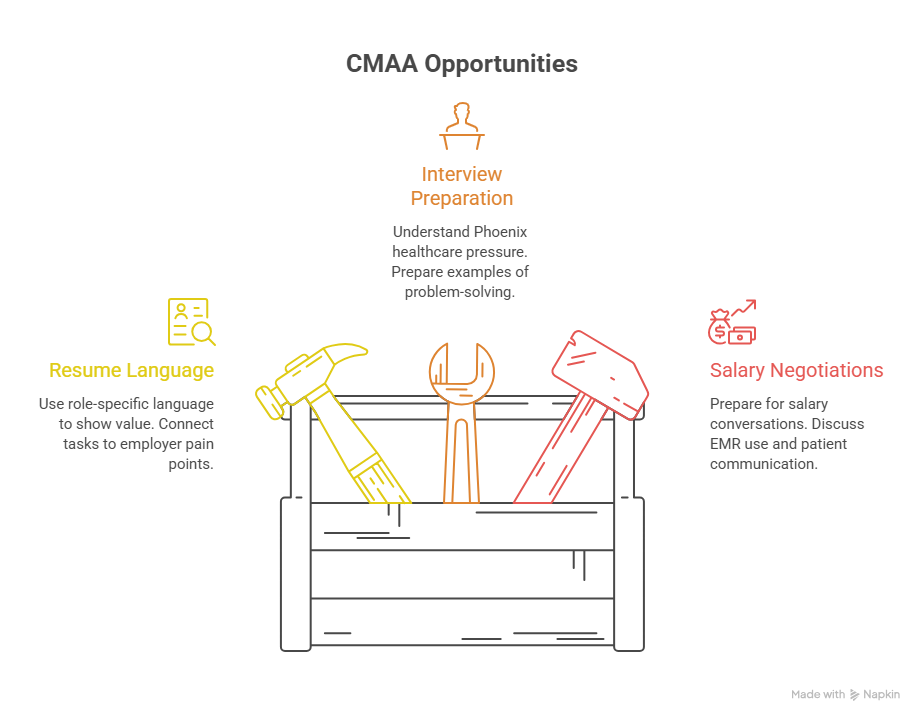
A stronger Phoenix CMAA application starts with role-specific language. Instead of writing a resume that says “front desk, phones, scheduling,” show the value behind those tasks. Say you can verify patient information, protect privacy, route calls correctly, manage appointment flow, support insurance checks, update records, and communicate next steps clearly. Those phrases connect directly to employer pain. Build that resume with CMAA resume guidance, medical admin interview preparation, how to stand out in CMAA interviews, real-life CMAA exam experiences, and top CMAA exam questions.
Your interview should also show that you understand Phoenix healthcare pressure. A busy clinic wants someone who can prevent small problems from turning into provider delays, patient complaints, billing issues, or compliance concerns. Prepare examples around missed appointments, upset patients, insurance confusion, incomplete intake forms, duplicate records, and portal access problems. Each example should show calm communication, accurate documentation, and appropriate escalation. Strengthen those examples with handling patient complaints, legal responsibilities, risk management, medical admin policies and procedures, and medical office organization.
Salary conversations require a careful strategy. Phoenix offers can vary by employer type, schedule, experience, specialty, bilingual communication needs, patient access complexity, and technology expectations. A candidate who has only basic phone experience has limited leverage. A candidate who can discuss EMR use, insurance verification, referral tracking, schedule management, records release, and patient communication has stronger leverage. Prepare with CMAA salary negotiation, best cities and states for CMAA careers, predictive analytics in medical administration, professional organizations for medical admins, and medical administration conferences.
5. The Best CMAA Career Path Strategy for Phoenix Candidates
The best strategy is to choose a lane, build proof, then move upward. A new CMAA can start in front desk, scheduling, urgent care reception, patient access, or specialty office support. The goal is to collect practical evidence: fewer scheduling errors, smoother check-ins, better patient communication, cleaner records, stronger insurance verification, faster portal support, and better team coordination. Keep a private log of your wins. That log can later support raises, interviews, promotions, and role changes. Use time management mastery, medical office ergonomics, online communities for CMAAs, medical admin collaboration tools, and medical office productivity to improve your day-to-day performance.
A second smart move is to pair CMAA skills with one specialty. General administrative ability gets you started. Specialty understanding helps you stand out. Pediatrics rewards caregiver communication. Orthopedics rewards records and imaging awareness. OB/GYN rewards privacy and sensitivity. Dermatology rewards appointment type accuracy. Urgent care rewards speed. Telehealth rewards portal and virtual communication skill. Patient access rewards data accuracy and insurance confidence. Your training should match the role you want next, using telehealth platforms, virtual patient management, records release tools, insurance verification examples, and patient intake procedures.
A third move is to keep studying after certification. The Phoenix market can reward candidates who move from basic admin support into workflow ownership. That means learning how schedules affect revenue, how patient access affects satisfaction, how records affect continuity of care, how insurance affects collections, and how communication affects trust. Strong CMAAs eventually become team leads, office coordinators, patient access specialists, referral coordinators, billing support staff, telehealth coordinators, or practice management assistants. Keep your growth organized through ACMSO exam study planning, first-try certification strategies, CMAA certification tips, CMAA vs medical assistant certification, and CMAA employment trends.
6. FAQs About Phoenix CMAA Career Opportunities
-
Phoenix can be a useful market for CMAA candidates because the area has many healthcare settings where administrative support is essential, including hospitals, specialty offices, urgent care centers, primary care clinics, telehealth teams, and patient access departments. The strongest starting point depends on your skill profile. Candidates who need structure may prefer larger organizations, while candidates who want faster responsibility may prefer specialty offices. Prepare with front desk operations, appointment scheduling, patient intake, and CMAA career trends.
-
Good beginner lanes include medical receptionist, appointment scheduler, patient service representative, front desk assistant, urgent care registration support, and clinic administrative assistant. These roles build the core skills employers want: communication, accuracy, scheduling, patient data handling, and privacy awareness. A beginner should study scheduling terms, HIPAA terms, patient communication, and medical admin interview preparation.
-
Make your resume task-specific and outcome-driven. Instead of listing general office duties, show that you can verify patient information, schedule accurately, handle privacy-sensitive communication, update records, support insurance checks, and manage difficult conversations professionally. Add proof from training, internships, volunteer work, or previous customer service roles. Strengthen the resume with CMAA resume building, how to stand out in interviews, active listening techniques, and patient privacy communication.
-
The strongest leverage usually comes from insurance verification, EMR confidence, scheduling accuracy, referral coordination, patient access knowledge, records management, and calm communication under pressure. Employers notice candidates who reduce errors and save time. Build those skills through insurance verification, EMR integration tools, patient record updates, denial management, and medical billing terms.
-
Yes. CMAA work can lead toward patient access coordination, office coordination, scheduling supervision, referral support, billing support, telehealth administration, and practice management assistance. Growth becomes easier when you document workflow wins and learn why office systems succeed or fail. Build that path with medical office organization, medical admin policies, professional organizations, and predictive analytics in medical administration.
-
Telehealth and remote admin roles can be useful for candidates who are strong with portals, scheduling systems, digital communication, and independent follow-up. These jobs require discipline because supervisors may see your results more than your effort. Candidates should build confidence in telehealth administration, telehealth platforms, healthcare portals, and virtual patient management before applying.
