

Verbal Communication Skills: Terms & Interactive Training
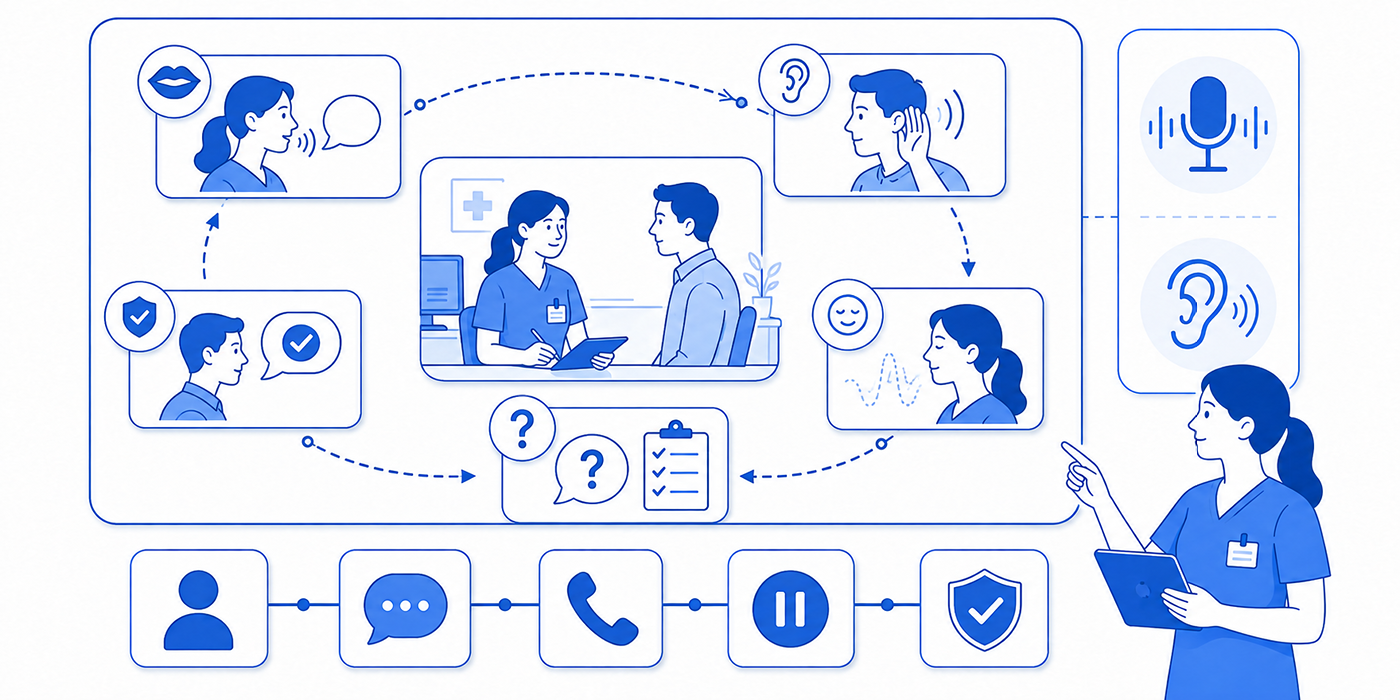
In a medical office, verbal communication determines whether patients understand instructions, trust the team, disclose important details, and complete the next step correctly. Strong communication combines active listening, precise language, controlled tone, and clear ownership of follow-up. It also protects patient confidentiality, strengthens bedside manner, supports effective patient communication, and prepares administrative professionals for emotionally difficult interactions requiring de-escalation skills.
1. Why Verbal Communication Requires Clinical-Level Precision
Medical administrative professionals speak at the intersection of patient anxiety, operational pressure, privacy requirements, and clinical uncertainty. A vague sentence can send a patient to the wrong location, cause a missed fasting requirement, create false expectations about insurance coverage, or leave an urgent symptom buried inside a routine scheduling request. Communication therefore deserves the same disciplined approach used in patient intake procedures, appointment scheduling, medical office triage, insurance verification, and patient record updates.
Every high-quality conversation should accomplish five outcomes: establish who is speaking, identify the actual request, detect urgency, explain the next step, and confirm understanding. Missing any one of these outcomes creates operational friction. A caller who says, “I need to see the doctor,” may require a routine appointment, medication guidance, post-procedure follow-up, or immediate escalation. A trained professional uses clarifying questions, follows the organization’s emergency appointment process, protects information through HIPAA-aware communication, and records the outcome through an accurate medical administrative workflow.
Precision also requires control over promises. Statements such as “Your insurance will cover it,” “The doctor will call today,” or “That symptom sounds normal” can create financial, clinical, and legal exposure. Safer language identifies the current facts, explains the pending action, and assigns ownership. The wording should align with legal responsibilities for CMAAs, organizational risk-management practices, established medical compliance terms, and the boundaries covered in patient privacy communication.
| # | Term | Working Definition | Common Failure Point | Practical Training Drill |
|---|---|---|---|---|
| 1 | Active listening | Giving full attention to the patient’s words, emotion, pace, and implied concern before preparing a response. | Interrupting after hearing the first request and missing the concern underneath it. | Review active-listening techniques, then summarize a mock caller’s request in one accurate sentence. |
| 2 | Reflective listening | Restating the patient’s emotional or practical concern to confirm that it has been understood. | Repeating words mechanically without acknowledging frustration, fear, or uncertainty. | Pair each simulated complaint with a reflection drawn from professional complaint handling. |
| 3 | Paraphrasing | Expressing the speaker’s message in clearer language while preserving its original meaning. | Changing important details such as symptom timing, appointment type, or callback preference. | Paraphrase three sample requests and compare them against the principles in effective patient communication. |
| 4 | Clarifying question | A focused question used to resolve ambiguity before taking action. | Using broad questions when the team needs a specific date, symptom, provider, location, or service. | Convert vague statements into focused questions using the workflow in patient intake procedures. |
| 5 | Open-ended question | A question that allows the patient to explain the situation in their own words. | Asking several yes-or-no questions that fragment the patient’s story. | Begin with “Please describe what happened,” then organize the answer through medical office triage terminology. |
| 6 | Closed-loop communication | A process in which the receiver repeats the instruction and the sender confirms accuracy. | Assuming a patient, coworker, or provider heard and understood an instruction. | Practice callback instructions using the confirmation methods in daily office procedure checklists. |
| 7 | Teach-back | Asking a patient to explain the next step in their own words. | Asking “Do you understand?” and receiving an automatic yes. | Use a scheduling example from appointment scheduling best practices and ask the learner to repeat the date, location, and preparation. |
| 8 | Chunk-and-check | Delivering information in short sections and confirming comprehension after each section. | Giving five instructions in one uninterrupted explanation. | Break a complex process from the prior authorization guide into three short verbal steps. |
| 9 | Signposting | Using verbal transitions that show the listener where the conversation is going. | Changing topics abruptly and leaving the patient unsure about the current step. | Practice phrases such as “First I will verify your information” during a mock insurance verification call. |
| 10 | Plain language | Everyday wording that communicates medical or administrative information without unnecessary jargon. | Using payer, coding, portal, or clinical terminology that the patient cannot interpret. | Translate five terms from the medical terminology guide into patient-friendly explanations. |
| 11 | Tone | The emotional quality conveyed through the voice, including calmness, respect, confidence, and patience. | Using technically correct words with an irritated, dismissive, or rushed delivery. | Record the same sentence in three tones, then compare the results with bedside-manner scenarios. |
| 12 | Pace | The speed at which information is spoken. | Speaking rapidly during busy periods and forcing the patient to request repetition. | Read an appointment-preparation script at a controlled pace using patient education principles. |
| 13 | Volume control | Adjusting vocal loudness to the environment, patient need, and privacy risk. | Speaking loudly enough for nearby patients to hear protected information. | Role-play a crowded waiting room using the safeguards in patient privacy communication. |
| 14 | Vocal warmth | A calm, attentive vocal quality that communicates willingness to help. | Sounding scripted, detached, or impatient during routine interactions. | Practice a greeting and closing aligned with empathy in healthcare administration. |
| 15 | Empathy statement | A brief acknowledgment of the patient’s experience or emotional burden. | Using generic sympathy that fails to address the stated concern. | Create situation-specific responses using the examples in empathy scenarios. |
| 16 | Validation | Recognizing that the patient’s concern deserves attention, even when the requested outcome remains unavailable. | Debating the patient’s feelings or defending the organization too early. | Respond to a delayed appointment using difficult-conversation strategies. |
| 17 | Boundary statement | A respectful explanation of what behavior, request, or action the office can accept. | Allowing abusive language to continue or responding with personal hostility. | Draft three boundaries based on de-escalation techniques. |
| 18 | Scope-of-role statement | Language that separates administrative responsibilities from clinical judgment. | Interpreting symptoms, recommending treatment, or presenting assumptions as medical guidance. | Practice safe redirection using CMAA legal responsibilities. |
| 19 | Expectation setting | Explaining likely timelines, dependencies, and possible next steps without guaranteeing an outcome. | Promising provider callbacks, insurance approval, or immediate resolution. | Build realistic scripts using the stages in prior authorization workflows. |
| 20 | Ownership language | Clear wording that identifies who will complete an action and how the patient will receive an update. | Ending with “Someone will get back to you” and leaving the request ownerless. | Assign a named role, channel, and timeframe using medical administrative workflow terms. |
| 21 | Escalation cue | A word, symptom, behavior, or circumstance requiring transfer to a supervisor, clinician, or emergency pathway. | Treating every request as a standard scheduling or messaging task. | Identify escalation triggers from emergency appointment management. |
| 22 | Safety-netting | Clear guidance about what the patient should do if circumstances worsen before the planned response occurs. | Ending a call without an approved contingency pathway. | Use office-approved language aligned with triage scenarios. |
| 23 | Privacy check | Confirming that the communication setting and recipient are appropriate before sharing protected information. | Discussing sensitive details at an open desk, through an unverified caller, or on an unsafe voicemail. | Review the verbal safeguards in HIPAA and patient privacy terms. |
| 24 | Identity verification | Using approved identifiers before accessing or disclosing patient information. | Relying on recognition, caller ID, or a single easily guessed detail. | Simulate phone verification using patient confidentiality guidance. |
| 25 | Interpreter pause | Speaking in complete, concise segments that allow accurate interpretation. | Using long explanations, side conversations, idioms, or overlapping speech. | Practice six-second segments with the medical interpreter services dictionary. |
| 26 | Cultural humility | An ongoing willingness to ask, listen, and adapt without assuming beliefs, preferences, or understanding. | Using stereotypes to predict health literacy, decision-making, or family involvement. | Complete a role-play based on cultural competence in medical administration. |
| 27 | De-escalation | Reducing emotional intensity through calm delivery, acknowledgment, boundaries, and controlled options. | Matching the caller’s volume, correcting minor details, or issuing premature warnings. | Use the sequence in the interactive de-escalation guide. |
| 28 | Service recovery | A structured response that acknowledges failure, clarifies impact, offers an available remedy, and confirms follow-up. | Apologizing without fixing ownership or explaining the corrective action. | Rebuild a failed callback using patient complaint procedures. |
| 29 | Handoff language | A concise transfer of the patient’s identity, request, urgency, completed actions, and remaining need. | Transferring the call without context and forcing the patient to repeat everything. | Practice a five-part handoff using medical office collaboration principles. |
| 30 | Documentation echo-back | Reading back critical details before saving a message or ending the call. | Recording the wrong pharmacy, callback number, symptom onset, provider, or appointment date. | Apply echo-back during a mock message, then verify it with medical chart audit standards. |
2. Turning Communication Terms Into Reliable Patient-Facing Language
Knowing communication vocabulary provides a foundation. Performance depends on choosing the right technique at the exact moment when confusion, anxiety, or time pressure appears. During front-desk operations, an open-ended question should uncover the full request, while a clarifying question should isolate the action required. During appointment conflict management, validation should reduce defensiveness, while expectation setting should define the available options. During telehealth administration, signposting should guide patients through login, consent, troubleshooting, and clinician connection.
A dependable verbal structure is Acknowledge, Clarify, Act, Confirm. First, acknowledge the person’s concern: “I understand that you have already called twice and still need an answer.” Next, clarify the exact unresolved issue: “Are you waiting for the prescription to be approved, sent, or corrected?” Then explain the action: “I will route this message to the clinical team with the pharmacy details and your preferred callback number.” Finally, confirm the plan: “Please tell me which number we should use and what you will do if your symptoms worsen before the team responds.” This structure supports difficult patient conversations, crisis communication, patient satisfaction, risk management, and defensible medical records management.
Plain language deserves special attention because patients often hesitate to admit confusion. “Your claim was adjudicated with patient responsibility applied to the deductible” may be accurate within revenue cycle management, yet most patients need a clearer explanation: “Your insurer processed the claim and applied this amount to the part of your deductible that you still owe.” The same translation skill applies to an Explanation of Benefits, coordination of benefits, medical claims processing, and denial management.
Administrative professionals also need phrases that preserve scope. When a patient asks whether a symptom is serious, a safe response is: “I can document exactly what you are experiencing and connect your message to the appropriate clinical pathway.” When a patient demands a guaranteed appointment, use: “I can review the available schedule, identify the earliest approved option, and follow our escalation process if your concern meets urgent criteria.” These responses reinforce CMAA legal responsibilities, medical compliance, emergency appointment protocols, and accurate scheduling terminology.
3. Interactive Training Scenarios for Real Medical Office Conversations
Verbal communication improves fastest through short, repeated scenarios with clear scoring criteria. General feedback such as “sound more professional” gives learners little direction. A stronger training method scores five observable behaviors: accurate opening, effective question choice, privacy protection, ownership of the next action, and confirmation of understanding. Supervisors can connect these behaviors to daily office procedures, medical office productivity, patient portal management, healthcare CRM terminology, and medical administrative workflow.
Scenario 1: The patient says the office “lost” a referral.
The weak response is defensive: “We never received it.” A stronger response gathers evidence and preserves cooperation:
“I can hear how frustrating this delay has been. I will check the referral queue, confirm the sending provider, and verify the fax or electronic destination. Please tell me when it was sent and which specialty you were referred to.”
The learner should then state who will investigate, when an update is expected, and what information the patient should prepare. This scenario develops active listening, patient complaint management, medical records release skills, collaboration practices, and clear professional communication.
Scenario 2: A patient demands an immediate appointment.
The administrator should avoid debating whether the request is urgent. The correct task is to collect the approved information and route it safely:
“I will ask a few focused questions so I can follow the correct scheduling pathway. Please describe the main reason you need to be seen today, when it started, and whether anything has changed quickly.”
The exercise should test whether the learner recognizes escalation cues, avoids clinical interpretation, uses approved emergency language, and explains the scheduling outcome. Relevant preparation includes medical office triage, scheduling conflict resolution, emergency appointment management, scheduling software mastery, and telemedicine basics.
Scenario 3: A patient cannot understand an insurance denial.
The learner should separate verified facts from assumptions:
“The claim status shows a denial code, and the next step depends on the reason attached to that code. I can explain the wording shown in the account, confirm whether the office has a correction pending, and identify whether the insurer needs information from you.”
This exercise combines plain language, expectation setting, and financial empathy. It should draw on insurance verification, medical billing terms, claims processing, denial management, and CPT code training.
Scenario 4: A family member asks for results.
The learner should verify authority before discussing any protected information:
“I will first confirm the patient’s identity and the permissions recorded on the account. Once that is verified, I can explain which information our office is authorized to discuss with you.”
The scoring rubric should examine identity verification, privacy-safe volume, account documentation, and escalation when authorization remains unclear. This scenario connects directly with HIPAA terminology, patient confidentiality, privacy communication checklists, legal responsibility, and regulatory changes.
4. Managing Anger, Urgency, Privacy, and Clinical Boundaries
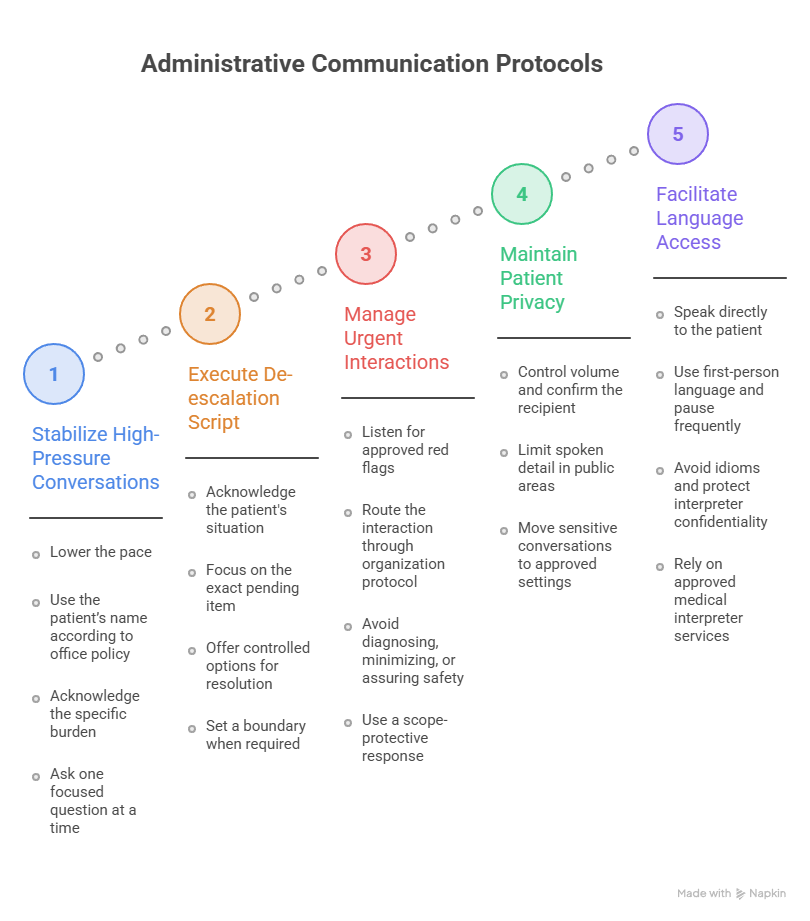
High-pressure conversations often fail because the administrator tries to solve the entire problem before stabilizing the interaction. The first task is to create enough structure for accurate information exchange. Lower the pace, use the patient’s name according to office policy, acknowledge the specific burden, and ask one focused question at a time. This sequence supports de-escalation, crisis communication, active listening, difficult conversation management, and professional patient complaint handling.
A useful de-escalation script follows four moves:
Acknowledge: “You have been waiting for an answer, and the delay has affected your ability to plan.”
Focus: “I want to identify the exact item still pending.”
Offer controlled options: “I can send an urgent follow-up message, check whether another appointment is available, or connect you with the appropriate supervisor.”
Set a boundary when required: “I will continue helping while we keep the conversation respectful.”
These moves reduce argument loops and preserve action. They also align with empathy in healthcare administration, bedside manner principles, patient satisfaction metrics, medical office policies, and risk-management strategies.
Urgency requires a different skill set. Administrative professionals should listen for approved red flags and route the interaction through the organization’s protocol. They should avoid diagnosing, minimizing, or assuring the patient that waiting is safe. A scope-protective response is: “Your description needs review through our clinical pathway. I will document your exact words and follow the office’s escalation procedure now.” Training should incorporate medical office triage terminology, emergency appointment management, telemedicine basics, virtual patient management, and medical compliance.
Privacy risks frequently emerge through ordinary speech. Staff may call out full names in waiting rooms, discuss appointment reasons within earshot, leave detailed voicemail messages, or disclose information to relatives without verified permission. A privacy-aware communicator controls volume, confirms the recipient, limits spoken detail, and moves sensitive conversations to an approved setting. These practices should follow patient confidentiality guidance, HIPAA privacy terminology, patient privacy communication, patient portal management, and secure patient communication applications.
Language access adds another layer. Staff should speak directly to the patient, use first-person language, pause frequently, avoid idioms, and protect interpreter confidentiality. Family members may introduce omissions, emotional filtering, or privacy concerns, especially during sensitive conversations. Administrative teams should rely on approved medical interpreter services, apply cultural competence principles, strengthen patient education, and confirm understanding through effective patient communication.
5. Building a Measurable Verbal Communication Training Program
A useful training program measures behaviors that supervisors can hear. Begin with a baseline role-play covering scheduling, privacy, an upset patient, and a complex administrative explanation. Score each interaction from zero to two on eight competencies: opening, listening, clarification, plain language, empathy, scope control, action ownership, and confirmation. The baseline can be aligned with front-desk operations, appointment scheduling, patient satisfaction, daily procedure checklists, and medical administrative workflow.
Training should then use short cycles rather than occasional lectures. A ten-minute daily drill can target one skill: Monday for clarifying questions, Tuesday for plain-language translation, Wednesday for de-escalation, Thursday for privacy, and Friday for closed-loop communication. Learners should receive one specific correction and repeat the scenario immediately. This approach can be integrated with medical terminology mastery, CMAA exam preparation, medical office organization, time-management training, and professional development resources.
Supervisors should also audit outcomes rather than relying only on call etiquette. Strong verbal communication should produce fewer repeated explanations, fewer misrouted messages, more complete callback documentation, cleaner appointment preparation, and fewer complaints involving uncertainty or dismissive treatment. These indicators can be reviewed alongside medical chart audits, EMR compliance training, patient satisfaction metrics, medical coding error prevention, and risk-management procedures.
A strong coaching note should describe the observed behavior, its operational consequence, and the replacement behavior. For example: “The caller explained the same problem three times because the opening question was too narrow. Begin the next call with one open-ended question, summarize the request, and then ask for the missing detail.” This feedback is more actionable than “improve listening.” Managers can reinforce it through professional organizations, CMAA online communities, medical administration workshops, career-development planning, and structured medical admin policies.
6. Frequently Asked Questions About Verbal Communication Skills
-
Active listening should come first because every later action depends on understanding the correct request. Staff should listen for the stated need, emotional pressure, missing information, urgency cues, and the patient’s preferred next step. A strong learner then paraphrases the request before acting. This foundation supports effective patient communication, patient intake procedures, medical office triage, appointment scheduling, and accurate medical administrative workflows.
-
Acknowledge the patient’s experience and its impact while avoiding unverified conclusions. A useful response is: “I understand that the delay has caused additional stress, and I will review the account so we can identify the next available action.” This recognizes the burden and creates ownership. Staff should study empathy in healthcare administration, professional complaint handling, risk management, legal responsibilities, and difficult patient conversations.
-
State what has been completed, what remains pending, who owns the next action, and when the patient should contact the office again if no update arrives. A strong script is: “Your request was sent to the clinical team this morning. It remains pending review. I am adding a follow-up message now, and we will use the phone number ending in 4821 for the response.” This approach strengthens ownership language, patient satisfaction, healthcare CRM use, collaboration workflows, and professional communication.
-
State the administrative role, document the concern accurately, and route it through the approved clinical pathway. A useful response is: “I can record your symptoms in your own words and send the message for clinical review. I will also follow the office’s urgent-response procedure if your answers meet the escalation criteria.” This protects scope while keeping the patient connected to care. Relevant training includes medical office triage, emergency appointment management, CMAA legal responsibilities, medical compliance, and telehealth administration.
-
Frame teach-back as a quality check on the explanation. Say: “I want to make sure I explained everything clearly. Please walk me through what you will do when you arrive and which documents you will bring.” This places responsibility on the communicator and gives the patient room to reveal confusion. The technique improves patient education, appointment scheduling accuracy, patient intake, cultural competence, and interpreter-supported communication.
-
Use an approved interpreter whenever language differences could affect informed understanding, privacy, consent, safety, or the accuracy of administrative and clinical information. Staff should follow organizational policy rather than relying automatically on relatives, children, or untrained bilingual employees. Effective interpreter use requires short speech segments, direct communication with the patient, and careful confirmation. Review medical interpreter services, cultural competence, patient confidentiality, patient education, and privacy communication.
