

Dealing with Difficult Patients: Interactive Definitions & Examples
Dealing with a difficult patient requires rapid judgment, controlled communication, and a reliable safety process. Medical administrative professionals must identify the real source of friction, apply effective de-escalation techniques, protect patient privacy, set enforceable boundaries, and preserve access to appropriate care. Strong active listening can resolve many encounters, while threats, discrimination, clinical deterioration, and severe impairment require immediate escalation. This guide supplies definitions, decision points, scripts, documentation standards, and difficult-conversation strategies for handling high-friction interactions professionally.
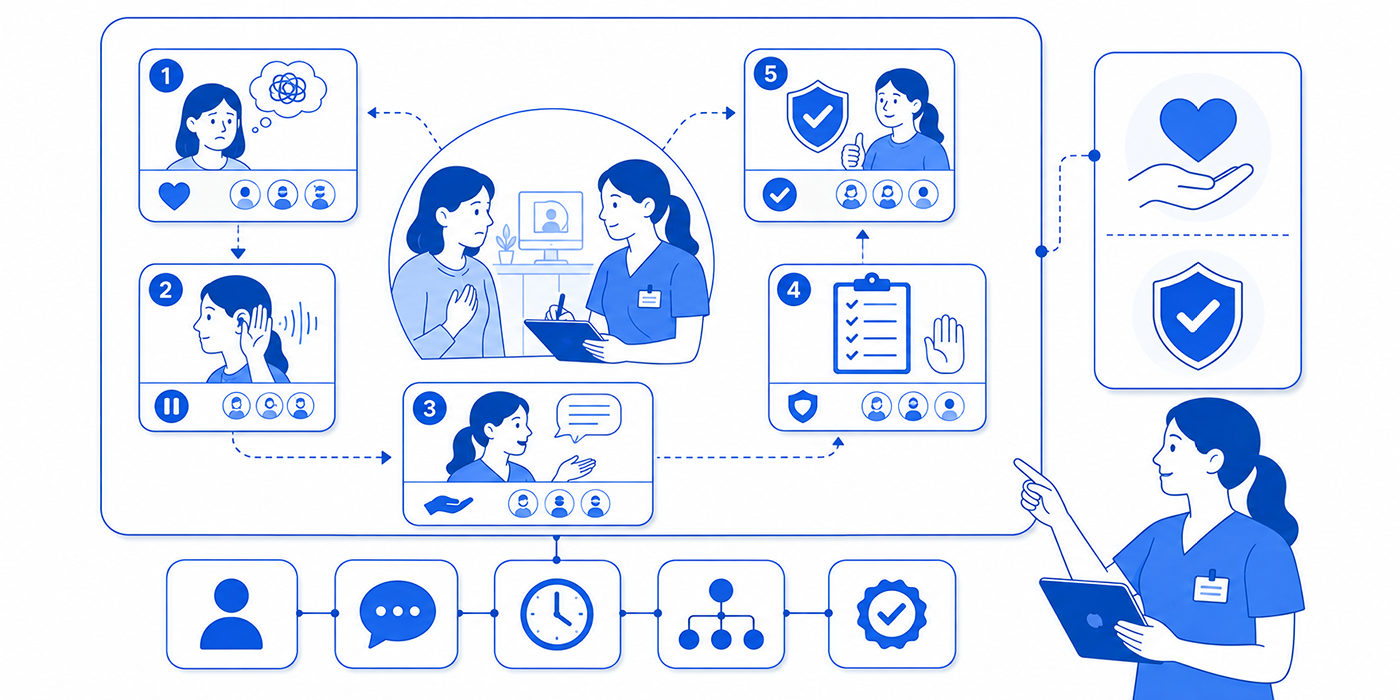
1. What “Difficult” Means in a Healthcare Encounter
The word “difficult” should describe the interaction occurring at a particular moment. A patient may appear demanding, hostile, repetitive, withdrawn, distrustful, or unwilling to cooperate because pain, fear, grief, confusion, financial pressure, previous discrimination, delayed care, or unclear instructions have exceeded their coping capacity. Professionals trained in empathy-based administration, patient communication, bedside manner, and cultural competence investigate these pressures before deciding how the encounter should proceed.
This distinction protects decision quality. Once staff mentally classify someone as “a problem patient,” every question may sound argumentative, every request may seem unreasonable, and every expression of pain may receive less attention. A safer approach separates the observable behavior from assumptions about character. “Patient raised their voice after learning the appointment was delayed by 75 minutes” provides actionable information. “Patient was crazy and impossible” supplies no clinical or operational value and weakens medical record quality, risk management, chart audit readiness, and legal defensibility.
A difficult encounter can also reveal an unrecognized clinical concern. Sudden agitation, confusion, slurred speech, breathlessness, altered consciousness, unusual aggression, or an inability to answer basic questions may require clinical assessment rather than prolonged customer-service discussion. Front-desk and administrative personnel should follow the organization’s medical office triage, emergency appointment management, daily procedure checklists, and escalation policies instead of attempting to interpret symptoms independently.
Safety receives priority whenever behavior includes credible threats, stalking, intimidation, property destruction, attempted entry into restricted areas, weapon references, physical contact, or deliberate obstruction of care. OSHA defines workplace violence broadly enough to include threats, harassment, intimidation, verbal abuse, and physical assault in healthcare settings. Staff training, reliable reporting systems, adequate staffing, and de-escalation procedures form part of effective workplace-violence prevention.
The following interactive dictionary gives medical administrative teams a shared vocabulary for discussing these encounters without relying on vague or emotionally loaded labels.
| # | Term | Practical Definition | How It May Appear | Best First Response |
|---|---|---|---|---|
| 1 | Difficult encounter | A high-friction interaction that challenges communication, workflow, boundaries, safety, or access to care. | The patient repeatedly interrupts, rejects every option, or becomes increasingly agitated. | Identify the immediate concern through active listening. |
| 2 | Trigger | An event, phrase, delay, environment, or perceived threat that increases distress. | A billing surprise, long wait, painful procedure, or dismissive-sounding response changes the patient’s behavior. | Name the concern and use clear patient communication. |
| 3 | Emotional flooding | A level of emotional arousal that reduces the person’s ability to process explanations or options. | The patient repeats the same statement, speaks rapidly, cries, or cannot follow a detailed explanation. | Slow the interaction, lower stimulation, and give one point at a time. |
| 4 | Escalation | A progressive increase in agitation, hostility, threatening behavior, or loss of control. | Voice volume rises, personal insults begin, pacing increases, or the patient moves closer to staff. | Shift from service recovery to the approved crisis communication process. |
| 5 | De-escalation | Communication and environmental actions intended to reduce arousal and restore safe problem-solving. | Staff lower their voice, create physical space, acknowledge distress, and present limited choices. | Apply established de-escalation techniques. |
| 6 | Validation | Recognition that the patient’s emotion or concern is understandable from their perspective. | “I understand why an unexplained delay would be frustrating.” | Validate the impact while preserving factual accuracy and professional boundaries. |
| 7 | Acknowledgment | A statement showing that staff heard and understood the concern. | “You expected the prescription request to be reviewed yesterday.” | Follow acknowledgment with a specific next step and timeframe. |
| 8 | Reflective listening | Restating the core concern in neutral language to confirm understanding. | “Your main concern is reaching the clinician before you travel tomorrow.” | Use the principles in the active-listening guide. |
| 9 | Boundary statement | A concise explanation of behavior that must stop and the conditions for continuing assistance. | “I can continue helping when we speak without personal insults.” | State the boundary once, then explain the consequence calmly. |
| 10 | Limit setting | The process of defining available actions, prohibited behavior, and predictable consequences. | A patient demands an unavailable appointment and refuses every clinically appropriate alternative. | Use the approved scheduling-conflict process. |
| 11 | Choice architecture | Presenting a small number of safe, realistic options that restore a sense of control. | “We can book tomorrow morning, place you on today’s cancellation list, or send the concern for triage.” | Offer two or three options supported by scheduling policy. |
| 12 | Broken-record technique | Calm repetition of the same boundary or available option without entering a circular argument. | The patient asks six different ways for staff to override a policy. | Repeat the decision, available options, and escalation route using consistent wording. |
| 13 | Service recovery | Actions used to address a preventable service failure and rebuild trust. | The practice failed to notify a patient that the clinician was unavailable. | Acknowledge the failure, correct it, and follow the complaint-resolution process. |
| 14 | Grievance | A formal complaint requiring review under the organization’s defined process. | The patient alleges discrimination, unsafe care, privacy exposure, or repeated unresolved service failures. | Explain how to submit the grievance and document where it was routed. |
| 15 | Threat assessment | A structured evaluation of threatening words, behavior, capability, proximity, and immediacy. | The patient names a target, states an intended action, or reaches into a concealed area after making threats. | Activate the facility’s risk-management protocol immediately. |
| 16 | Safety cue | An observable behavior indicating increased potential for violence or rapid deterioration. | Clenched fists, blocked exits, fixation on one employee, property damage, or sudden silence after intense agitation. | Create distance, preserve an exit route, summon trained assistance, and follow policy. |
| 17 | Trauma-informed response | An approach that emphasizes safety, predictability, choice, dignity, and reduced re-traumatization. | The patient becomes distressed when touched unexpectedly or when instructions feel controlling. | Explain each step, request permission where appropriate, and offer realistic choices. |
| 18 | Cultural humility | Ongoing awareness that staff may lack full knowledge of a patient’s cultural experience or communication norms. | Eye contact, family involvement, decision-making, pain expression, or personal space differs from staff expectations. | Use respectful questions and the cultural competence guide. |
| 19 | Limited English proficiency | Limited ability to read, write, speak, or understand English sufficiently for effective healthcare communication. | The patient agrees automatically, answers inconsistently, or relies on a relative for complex clinical explanations. | Arrange appropriate medical interpreter services. |
| 20 | Qualified interpreter | A person able to interpret accurately, effectively, impartially, and with appropriate healthcare vocabulary. | A trained in-person, video, or telephone interpreter supports communication. | Follow the organization’s language-access and confidentiality procedures. |
| 21 | Communication disability | A hearing, vision, speech, cognitive, or related disability affecting communication. | The patient needs sign-language interpretation, large print, written choices, extra processing time, or another aid. | Arrange an effective communication method appropriate to the individual. |
| 22 | Privacy boundary | A limit on what staff may discuss, where it may be discussed, and with whom. | A family member demands results while standing in a crowded reception area. | Move the conversation and apply privacy communication procedures. |
| 23 | Authorized representative | A person whose authority to act for or receive information about a patient has been established. | A spouse, parent, guardian, power-of-attorney holder, or other representative requests information. | Verify identity, authority, scope, and the patient’s documented preferences. |
| 24 | Capacity concern | A concern that the patient may be unable to understand, appreciate, reason through, or communicate a healthcare decision. | The patient appears severely confused, disoriented, intoxicated, or unable to retain basic information. | Notify an appropriate licensed clinician through the established chain of command. |
| 25 | Clinical redirection | Moving a symptom-related question from administrative discussion to an appropriately qualified clinician. | The patient demands that a receptionist decide whether chest pain can wait until tomorrow. | Use approved triage escalation without offering clinical advice. |
| 26 | Care-delay communication | A structured explanation of a delay, its known cause, revised expectation, and available alternatives. | The patient has waited beyond the original appointment time and has received no update. | Give a realistic timeframe and follow front-desk operating standards. |
| 27 | Repeated demand | A request repeated after staff have explained the decision, options, and escalation route. | The patient keeps demanding an unavailable clinician, prescription, form, discount, or appointment. | Use one consistent response and involve a supervisor at the defined threshold. |
| 28 | Neutral documentation | Objective recording of observable actions, direct statements, interventions, and outcomes. | The note records voice volume, exact threat, staff response, notifications, and disposition. | Apply clinical documentation improvement principles. |
| 29 | Chain of command | The approved sequence for obtaining higher-level clinical, administrative, security, or leadership support. | The frontline employee cannot resolve the issue within their authority. | Escalate through the defined medical administrative workflow. |
| 30 | Closed-loop follow-through | Confirmation that the promised action was completed and communicated to the responsible person. | A supervisor accepts the complaint, the clinician receives the message, and the patient gets a documented update. | Track ownership through the practice management system. |
2. How to Read the Behavior Before You Respond
The first visible behavior rarely tells the entire story. A patient shouting about a late appointment may be afraid of losing hourly wages. Someone demanding an immediate refill may have misunderstood the refill process, run out of medication, or received no response to an earlier message. A family member interrupting every answer may be frightened, accustomed to managing the patient’s care, or unaware of HIPAA communication boundaries. Strong staff members combine patient intake information, portal history, scheduling records, and current observation before selecting a response.
Use five questions during the first few seconds:
Does the patient show a possible medical or cognitive change? Sudden confusion, slurred speech, severe breathlessness, collapse, altered awareness, or unusual aggression requires rapid clinical escalation under the office’s triage terminology, emergency procedures, workflow protocols, and daily office checklists.
Can the person currently process information? Rapid speech, repetitive accusations, sobbing, pacing, or constant interruption may indicate emotional flooding. Detailed explanations will usually overload the encounter further. Begin with one reflective sentence, one immediate objective, and one next step. The same clarity principles used in patient education, effective communication, professional email etiquette, and telehealth administration apply here.
Is a communication barrier driving the conflict? A patient may appear uncooperative when instructions exceed their health literacy, the interpreter connection has failed, a hearing disability has gone unaccommodated, or a family member is filtering the conversation. HHS identifies language assistance as an important component of meaningful access for people with limited English proficiency, while ADA guidance requires effective communication for people with communication disabilities. Use qualified medical interpreter services, accessible telehealth platforms, suitable patient communication tools, and a documented privacy process.
Does the patient need resolution, recognition, or control? Resolution means correcting a concrete problem. Recognition means hearing the impact before discussing the solution. Control means providing appropriate choices after the patient feels trapped. A useful diagnostic question is: “Which part of this needs attention first—the delay, the information you received, or the next available option?” That question uses active listening, supports patient satisfaction, reduces scheduling conflict, and creates a manageable decision.
Has the interaction crossed into a safety event? Insults and frustration require boundaries. Threats, physical intimidation, blocked exits, stalking, property destruction, unwanted contact, or weapon references require a safety response. Staff should use the facility’s alert system, contact trained personnel, preserve distance, keep an exit route available, and follow the organization’s crisis communication, risk management, legal responsibility, and incident-reporting policies.
Avoid trying to win the argument. Administrative professionals gain control through structure: one speaker, one issue, one boundary, two or three options, one owner, and one timeframe. This structure reduces circular conversation and protects the patient from receiving different promises from multiple staff members. It also strengthens team collaboration, task ownership, office productivity, and policy consistency.
3. The CALMER Response Framework for Medical Admin Teams
A reliable framework protects staff from improvising under pressure. CALMER stands for Check safety, Acknowledge, Locate the issue, Make boundaries clear, Execute the next step, and Record the outcome. It can be adapted to telephone calls, reception desks, portal messages, billing discussions, delayed appointments, and virtual patient management.
C — Check safety and regulate your delivery
Before discussing the complaint, scan the environment. Identify exits, nearby patients, available colleagues, physical barriers, and the location of panic buttons or alert systems. Maintain appropriate distance and avoid becoming cornered. Use the organization’s safety code when risk indicators appear. Your voice should become slower and quieter rather than matching the patient’s intensity. A stable tone supports de-escalation, crisis communication, front-desk operations, and risk control.
Use a brief opening: “I want to understand the immediate concern. Please give me one moment to review what happened.” This creates a pause, communicates intent, and prevents premature promises.
A — Acknowledge the impact
Acknowledgment should identify the patient’s experience without confirming facts that remain unverified. Useful statements include:
“You have been waiting longer than the timeframe you were given.”
“You expected a call yesterday and have had to contact us again.”
“You are worried that this delay could affect your medication.”
“You received different information from two members of our team.”
These responses demonstrate empathy, improve bedside manner, support patient satisfaction, and create space for effective complaint handling.
Avoid reflexive apologies that imply responsibility before the facts are known. Choose precise wording: “I am sorry this delay has added stress” addresses the impact. After confirming an internal error, use accountable language: “We failed to send the update we promised. I am escalating this now and will document the correction.”
L — Locate the single issue requiring action
Angry patients often present several months of dissatisfaction in one uninterrupted account. Listen for the decision that must happen today. Ask: “Which outcome needs attention first?” Then summarize: “The immediate issue is whether the clinician can review your message before the pharmacy closes.”
This step prevents a conversation about appointment delays, portal access, billing, staff attitude, referrals, and prescription requests from becoming one unsolvable complaint. Route each component through the proper healthcare portal workflow, prior authorization process, insurance verification workflow, or appointment scheduling procedure.
M — Make boundaries and choices clear
A boundary has three parts: the behavior, the condition for continuing, and the consequence.
“I can continue reviewing the account with you. Personal insults must stop. If they continue, I will end the call and ask my supervisor to follow up through the documented complaint process.”
The wording stays calm, specific, and enforceable. Avoid threats, lectures, sarcasm, or consequences outside your authority. When the patient remains engaged, offer realistic choices:
“I can send the message for nurse review, book the next available appointment, or place you on today’s cancellation list. Which option would you like me to start?”
Choice supports scheduling conflict resolution, emergency appointment management, patient communication, and consistent office procedures.
E — Execute, escalate, and close the loop
Name the owner, action, timeframe, and backup plan:
“I am sending this to the triage nurse now. The expected review window is two hours. I will call you by 3:30 p.m. with an update, even if the clinical review is still pending.”
Never promise a clinical decision, approval, prescription, refund, appointment, or response time that depends on another person unless the process supports that promise. Track the task through the practice management system, use appropriate EMR integration tools, maintain accurate patient record updates, and follow established medical administrative workflows.
AHRQ describes check-back as a closed-loop communication method used to verify exchanged information. Teach-back similarly allows staff to determine whether the patient understood instructions and next steps. Close with: “To make sure I explained this clearly, please tell me what will happen next and when you expect our update.”
R — Record the encounter and review system failures
Document observable behavior, the central concern, staff interventions, boundaries, options offered, individuals notified, patient response, and final disposition. Record direct quotations when the exact language carries safety or legal significance. Use objective documentation terminology, follow EHR and EMR standards, protect patient confidentiality, and separate clinical documentation from an internal incident report according to policy.
4. Interactive Scenarios: Scripts for High-Friction Encounters
Scenario 1: The patient has waited far beyond the promised time
Patient: “I have been sitting here for over an hour. Nobody cares about my time.”
A weak response focuses on defending the practice: “The doctor is busy, and everyone has to wait.” That wording gives the patient no useful information and increases the sense of powerlessness.
Professional response: “You were scheduled for 10:00, and we failed to update you when the delay increased. The current estimate is another 25 minutes. I can keep your place, check whether another clinician has availability, or help you reschedule without another call. Which option works best?”
This response identifies the failure, gives a realistic estimate, and presents controlled choices. It applies appointment scheduling best practices, front-desk procedures, patient satisfaction principles, and time-management discipline.
Scenario 2: The patient demands a prescription decision from administrative staff
Patient: “I am out of medication. Tell the pharmacy to fill it right now.”
Professional response: “I can hear that running out has created an urgent concern. Prescription decisions require review by a licensed clinician. I will mark the message for clinical review and confirm the pharmacy information now. Tell me whether you are experiencing symptoms that your care team instructed you to treat as urgent.”
The administrator avoids offering medical advice, promising approval, or minimizing the concern. Any reported symptom is routed through medical office triage, while the request is entered through the correct EMR workflow, patient record process, and clinical documentation standards.
Scenario 3: The patient begins insulting a staff member
Patient: “You are useless. Put someone competent on the phone.”
Professional response: “I can help review the appointment issue. I will continue the call while we speak without personal insults. If the insults continue, I will end the call and ask a supervisor to contact you through our complaint process.”
Pause after the statement. Repeating lengthy warnings gives the patient more material to debate. When the behavior stops, return directly to the actionable issue. When it continues, apply the stated consequence under the practice’s difficult-conversation procedure, complaint policy, crisis communication standard, and risk-management plan.
Scenario 4: A relative demands private information
Family member: “I am her husband. Tell me what the test showed.”
Professional response: “I understand that you are concerned. I need to verify what information the patient has authorized us to share and confirm your identity before discussing her record. I can check the authorization now or explain how she can update her communication preferences.”
HIPAA permits certain disclosures to family, friends, and others involved in care under defined circumstances, including information directly relevant to that person’s involvement. Staff must apply the patient’s expressed preferences, verify the circumstances, and follow organizational policy. The interaction should follow patient confidentiality standards, privacy communication guidance, HIPAA terminology, and the practice’s portal-management process.
Scenario 5: Language difficulty is being mistaken for refusal
The patient repeatedly says “yes” while completing the wrong section of a form and appears irritated when corrected.
Professional response: “I want to make sure we provide this information in the language you understand best. Which language do you prefer for healthcare discussions? I can connect a qualified interpreter.”
Important healthcare communication may require competent language assistance, and HHS cautions against relying routinely on relatives—especially children—when qualified assistance is needed. Use medical interpreter services, appropriate patient intake procedures, accessible patient education, and secure telehealth communication.
Scenario 6: The patient rejects every appointment option
Patient: “Those times are unacceptable. You need to make the doctor see me today.”
Professional response: “The available options I can offer are 4:30 tomorrow, the cancellation list for today, or a message to the clinical team to determine whether triage is appropriate. I can begin any of those now.”
When the patient repeats the demand, use the same wording. Avoid creating false availability, removing another patient, or implying that anger changes clinical priority. The response protects appointment scheduling standards, emergency appointment procedures, scheduling software accuracy, and equitable front-desk operations.
Scenario 7: An angry patient shows possible impairment
The patient smells strongly of alcohol, is unsteady, repeats questions, and attempts to leave after reporting severe symptoms.
Professional response: “I am concerned about your immediate safety. I am asking a clinical team member to assess you now. Please remain seated while I contact them.”
Administrative staff should avoid diagnosing intoxication, judging decision-making capacity, physically blocking the patient, or independently deciding that the symptoms can wait. Escalate through the approved medical triage, emergency management, legal responsibility, and documentation workflow.
Scenario 8: The patient makes a direct threat
Patient: “If that doctor does not come out, somebody is going to get hurt.”
Professional response: “I hear that you have made a threat to harm someone. I am contacting our safety team now.”
At this point, extended negotiation can increase exposure. Maintain distance, avoid blocking the exit, alert nearby staff discreetly, move other patients when feasible, and activate the facility’s emergency response. Use trained security or emergency services according to policy. The incident requires risk-management reporting, objective medical records terminology, established crisis procedures, and leadership review.
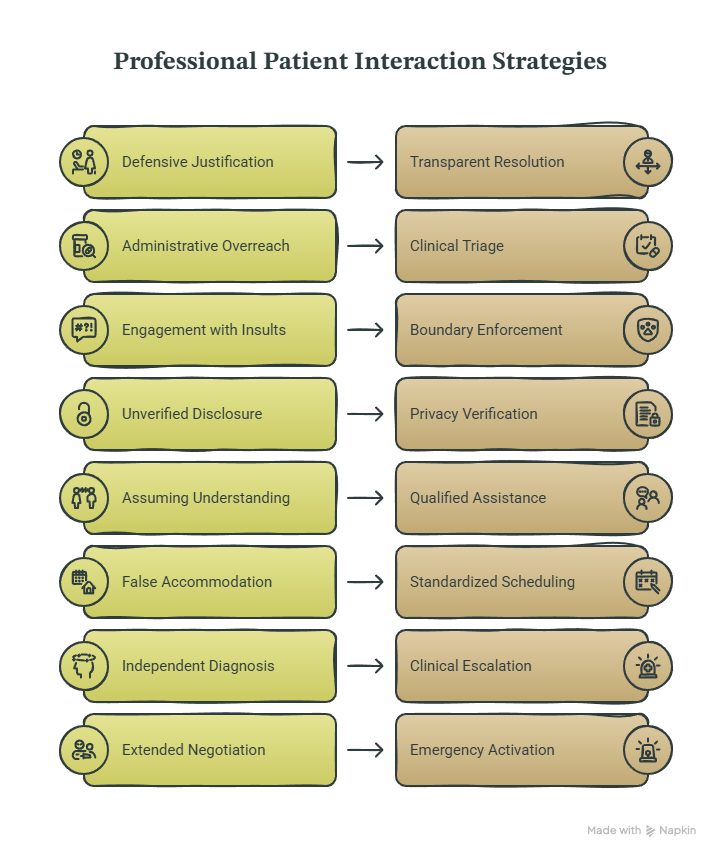
5. Documentation, Escalation, and Team Protection
Documentation should allow another professional to reconstruct the encounter without guessing. Record the date, time, location, people present, patient’s stated concern, observable behavior, relevant direct quotations, options offered, boundaries communicated, assistance requested, notifications made, patient response, and final disposition. The entry should align with medical chart audit standards, clinical documentation improvement, EHR and EMR terminology, and medical records management.
Write: “Patient stood approximately two feet from the reception desk, pointed toward Employee A, and stated, ‘I will come back and deal with you.’ Supervisor and security were notified at 2:14 p.m.”
Avoid: “Patient became insane and dangerous.”
The first version records actions, distance, words, and response. The second supplies an unsupported judgment. Neutral language also reduces the risk that emotionally charged descriptions will shape future care unfairly.
The clinical record and internal incident report serve different functions. The clinical record may include information relevant to care, communication, safety, and disposition. The incident report supports internal safety review, workplace response, and quality improvement. Follow the organization’s policy regarding where each detail belongs. Protect both through HIPAA compliance, patient privacy communication, legal responsibility standards, and secure records-release procedures.
Escalation thresholds should be written before an emergency occurs. Staff need to know when to contact a supervisor, licensed clinician, security officer, risk manager, practice administrator, emergency services, or law enforcement. A useful policy defines specific triggers, including credible threats, physical contact, weapons, stalking, property destruction, repeated discriminatory abuse, severe impairment, suspected clinical deterioration, unauthorized entry, or refusal to follow a safety instruction.
AHRQ’s CUS method provides clear language for escalating a safety concern: state that you are concerned, explain why you are uncomfortable, and identify the safety issue. When the concern remains unresolved, the tool directs staff to notify a supervisor. This structure can support team collaboration, office policy development, workflow accountability, and CMAA risk management.
Patient rights continue during difficult encounters. Complaints should enter the appropriate grievance process, privacy should be preserved, disability-related communication needs should be accommodated, and urgent medical concerns should receive the required clinical response. CMS patient-rights standards also restrict the use of restraint or seclusion as coercion, discipline, staff convenience, or retaliation. Administrative staff should never improvise physical intervention outside their role, training, and facility policy.
After a serious event, conduct a short operational review:
Which trigger first became visible?
Did staff recognize the change from frustration to safety risk?
Were language, disability, privacy, or health-literacy needs addressed?
Did multiple employees give conflicting information?
Was the alert process easy to activate?
Did the responsible employee complete the promised follow-up?
Does a policy, staffing, scheduling, or technology failure require correction?
This review transforms an individual incident into stronger medical office organization, clearer daily procedures, improved staff scheduling, and more reliable patient communication systems.
6. Frequently Asked Questions
-
Begin with a short statement that acknowledges the immediate concern and creates structure: “I can see that this has become frustrating. Tell me the most urgent part so I can identify the correct next step.” Keep your voice slow, avoid interrupting the first concise explanation, and reflect the main concern back. Then move into a specific de-escalation technique, active-listening response, patient communication process, or crisis protocol, depending on the risk level.
-
Frustration often remains focused on an outcome, such as an appointment, bill, form, prescription request, or delay. Safety risk becomes more likely when behavior includes a named target, stated intention to harm, weapon reference, physical approach, blocked exit, stalking, property damage, fixation on one employee, or refusal to respect physical boundaries. Use the organization’s risk-management strategy, legal responsibility guide, crisis communication terminology, and workplace-violence procedure rather than relying on instinct alone.
-
A staff member may follow the organization’s approved boundary and call-termination policy. Give one clear warning when circumstances permit: “I can continue helping while we speak respectfully. If the personal insults continue, I will end the call and document the available follow-up route.” Apply the stated consequence consistently, preserve access to appropriate clinical communication, and route unresolved concerns through the patient complaint process, difficult-conversation workflow, professional communication standard, and supervisory chain of command.
-
Use a precise, accountable apology after confirming the service failure: “We failed to send the update we promised, and that caused you to make an unnecessary trip. I am correcting the scheduling issue now and will document the follow-up.” Pair the apology with action, ownership, and timeframe. Avoid vague language that sounds scripted. Effective service recovery should connect with patient satisfaction measurement, front-desk workflow, appointment scheduling standards, and complaint management.
-
Move the conversation away from public areas, verify the person’s identity, determine their authority or involvement, review the patient’s preferences, and disclose only information permitted under applicable policy and law. Use a neutral explanation: “I need to verify the patient’s communication authorization before discussing the record.” Follow the organization’s patient confidentiality guidance, HIPAA terminology, privacy communication checklist, and portal-management process.
-
Ask the patient which communication method or language they prefer, then arrange the appropriate qualified assistance. Avoid treating repeated misunderstanding as refusal. A person who uses sign language, has limited English proficiency, needs large print, uses an assistive device, or requires additional processing time may need a different communication pathway. Use medical interpreter services, accessible telehealth tools, clear patient education, and culturally responsive administrative communication.
