

Therapeutic Communication Techniques: Interactive Definitions
Therapeutic communication helps healthcare professionals reduce confusion, uncover patient concerns, preserve dignity, and guide each interaction toward a safe next step. Medical administrative teams use active listening techniques, purposeful questions, emotional acknowledgment, clear patient education, respectful boundaries, and accurate follow-through during check-in, scheduling, billing, telehealth, and complaint resolution. This interactive guide explains the essential terms, practical scripts, common communication failures, and escalation rules needed to strengthen effective patient communication while protecting patient confidentiality.
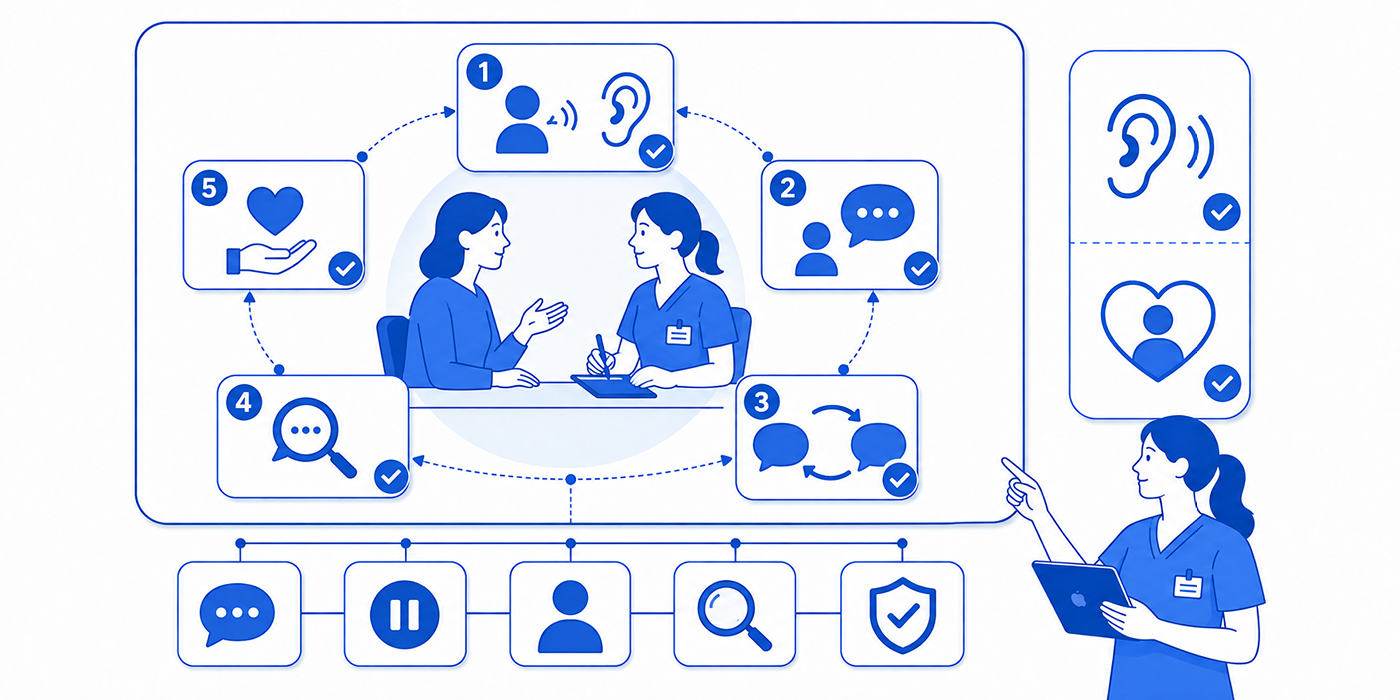
1. What Therapeutic Communication Means in Medical Administration
Therapeutic communication is a purposeful, patient-centered approach that helps a person feel heard, understand relevant information, express concerns, and participate in an appropriate next step. For medical administrative professionals, it appears during patient intake procedures, appointment changes, insurance conversations, referral coordination, front-desk operations, portal support, records requests, and difficult encounters.
The technique chosen should match the patient’s immediate need. A distressed patient may first need emotional acknowledgment. A confused patient may need information divided into smaller steps. A person who repeatedly asks the same question may need teach-back, written instructions, or a qualified interpreter. A caller describing symptoms requires clinical redirection rather than an administrative opinion.
The Agency for Healthcare Research and Quality recommends slowing down, using qualified interpreters, limiting explanations to a small number of key points, and checking clarity through teach-back. During teach-back, the patient explains the information or required action in their own words, allowing the professional to identify gaps in the original explanation.
Therapeutic communication also requires role clarity. Medical administrative professionals can explain office processes, verify information, offer approved options, route messages, and document concerns. Clinical assessment, diagnosis, medication recommendations, interpretation of results, and treatment decisions must be transferred to appropriately qualified personnel through the organization’s medical administrative workflow, emergency appointment process, or clinical chain of command.
The four outcomes of a therapeutic interaction
A useful exchange should produce at least one measurable outcome:
Understanding: The patient can explain what will happen next.
Emotional regulation: The patient becomes able to process options.
Action: A specific task receives an owner and timeframe.
Safety: A clinical, privacy, accessibility, or behavioral risk reaches the correct person.
An interaction can sound polite while failing every outcome. “Someone will get back to you” leaves ownership, timing, urgency, and communication method unresolved. A stronger response states: “I am routing your message to the triage nurse now. The expected review window is two hours, and the team will call the mobile number ending in 4821.” This supports closed-loop communication, accurate patient record updates, and reliable practice management workflows.
Therapeutic communication requires accessibility
Communication quality depends on whether the patient can receive, understand, and respond to the information. Patients with limited English proficiency may require appropriate language assistance, while patients with hearing, vision, speech, or other communication disabilities may require auxiliary aids or accessible formats. HHS supports language assistance to reduce communication barriers, and ADA guidance requires effective communication through suitable aids or services when needed.
Medical teams should arrange medical interpreter services, accessible telehealth administration, suitable patient communication applications, and culturally responsive patient education without treating communication barriers as refusal or lack of cooperation.
| # | Technique | Practical Definition | Useful Example | Common Communication Failure |
|---|---|---|---|---|
| 1 | Active listening | Giving focused attention to identify the patient’s concern, meaning, and requested outcome. | “Tell me which part of the scheduling problem needs attention first.” | Interrupting before applying active listening techniques. |
| 2 | Attending behavior | Using posture, eye contact, facial expression, and controlled attention to signal presence. | Turning away from the computer and facing the patient during an important explanation. | Typing continuously while discussing a sensitive concern. |
| 3 | Open-ended question | A question that allows the patient to explain an experience or concern in their own words. | “What happened when you tried to access the portal?” | Asking several narrow questions before understanding the main problem. |
| 4 | Closed-ended question | A focused question used to confirm a specific fact or complete a verification step. | “Is the mobile number ending in 4821 still correct?” | Using closed questions for an emotionally complex complaint. |
| 5 | Clarification | Requesting additional detail when the meaning, timeline, or requested action remains unclear. | “When you say the message disappeared, was it before or after you pressed send?” | Assuming the patient’s meaning and entering the wrong portal request. |
| 6 | Reflection | Restating the central emotion or concern so the patient can confirm or correct it. | “You are worried the referral delay could affect your appointment.” | Repeating the patient’s exact words without identifying their meaning. |
| 7 | Paraphrasing | Restating the patient’s message in concise, neutral language. | “Your main concern is receiving the form before tomorrow’s deadline.” | Changing the patient’s request while summarizing it. |
| 8 | Summarization | Combining the key facts, decisions, and next steps at a transition or conclusion. | “We updated your address, sent the referral question, and scheduled a callback for Friday.” | Ending without confirming the workflow outcome. |
| 9 | Validation | Recognizing that an emotion or concern is understandable from the patient’s perspective. | “An unexplained delay would be frustrating, especially after you arranged transportation.” | Agreeing with unverified allegations instead of validating the impact. |
| 10 | Empathic acknowledgment | Naming the effect of a situation while maintaining accuracy and professional boundaries. | “I can hear how stressful this repeated billing issue has become.” | Using a scripted apology without reviewing the patient’s actual concern. |
| 11 | Therapeutic silence | A purposeful pause that allows the patient to process information or continue speaking. | Remaining quietly attentive after a patient becomes tearful. | Filling every pause with advice, reassurance, or administrative detail. |
| 12 | Focusing | Guiding a broad or circular discussion toward the issue requiring immediate action. | “Let us address today’s medication message first, then document the billing complaint.” | Attempting to resolve every historical concern in one conversation. |
| 13 | Exploring | Inviting relevant detail that helps reveal the patient’s barrier or priority. | “What makes the available appointment times difficult for you?” | Assuming the patient is simply refusing the scheduling options. |
| 14 | Plain language | Using familiar words and short explanations instead of unexplained technical terms. | “Your insurer needs more information before deciding whether it will cover the service.” | Using unexplained prior authorization terminology. |
| 15 | Chunking | Dividing complex information into small, manageable sections. | Explaining registration, insurance, and preparation instructions one stage at a time. | Delivering six instructions rapidly during patient intake. |
| 16 | Teach-back | Asking the patient to explain the information or next step in their own words. | “Please tell me how you will submit the form so I can check that I explained it clearly.” | Asking, “Do you understand?” and accepting an automatic yes. |
| 17 | Offering choice | Presenting a limited set of realistic options supported by policy. | “I can schedule Thursday, add you to the cancellation list, or send the concern for clinical review.” | Offering options unavailable within the scheduling workflow. |
| 18 | Expectation setting | Explaining timing, responsibility, process limits, and possible outcomes accurately. | “The billing team reviews these requests within two business days.” | Promising an approval or callback controlled by someone else. |
| 19 | Boundary setting | Defining the behavior required for a safe and productive interaction. | “I can continue helping when we speak without personal insults.” | Arguing after the encounter requires de-escalation. |
| 20 | Clinical redirection | Transferring symptom, urgency, medication, or treatment questions to qualified clinical personnel. | “I am sending that symptom concern to the triage nurse now.” | Giving informal clinical advice outside the administrative role. |
| 21 | Normalization | Reducing shame by explaining that a concern or question is understandable within the situation. | “Many patients need help distinguishing the portal inbox from appointment requests.” | Dismissing the concern with “Everyone finds this difficult.” |
| 22 | Permission seeking | Asking before discussing sensitive information, involving another person, or changing the communication method. | “May I discuss the billing issue while your family member is present?” | Assuming consent and exposing confidential information. |
| 23 | Trauma-informed communication | Using safety, predictability, transparency, choice, and collaboration to reduce avoidable distress. | Explaining each verification step before requesting sensitive information. | Using controlling language without explaining the process. |
| 24 | Cultural humility | Approaching differences with respectful inquiry and awareness of one’s own assumptions. | “Who would you like involved when we discuss appointment planning?” | Assuming family roles through appearance, language, or cultural stereotypes. |
| 25 | Language access | Providing appropriate assistance when the patient communicates most effectively in another language. | Connecting a qualified interpreter before explaining a complex form. | Using a child or untrained visitor instead of interpreter services. |
| 26 | Accessible communication | Adapting the method or format for a patient with a communication disability. | Providing captioning, accessible electronic text, or another appropriate aid. | Speaking only to the patient’s companion. |
| 27 | Service recovery | Acknowledging and correcting a preventable administrative failure. | “We entered the wrong date. I have corrected it and confirmed the updated appointment.” | Defending the practice instead of applying the complaint process. |
| 28 | Closed-loop communication | Confirming that information reached the correct person and produced the intended action. | Verifying that the nurse received the message and documenting the response timeframe. | Assuming that sending a message completes the task. |
| 29 | Objective documentation | Recording observable facts, direct statements, actions, ownership, and outcomes. | “Patient repeated the request three times and accepted supervisor follow-up.” | Using emotional labels instead of documentation standards. |
| 30 | Professional closure | Ending with a concise summary of the action, owner, timeframe, and contact route. | “Your request is with records management, and you will receive a portal update by Friday.” | Ending with “Someone will contact you” and no trackable next step. |
2. The CONNECT Framework for Therapeutic Patient Conversations
A repeatable framework prevents staff from improvising when patients are anxious, angry, confused, embarrassed, or overwhelmed. Use CONNECT during front-desk interactions, telephone calls, portal support, scheduling disputes, and virtual patient management:
C — Create attention and safety
O — Open the conversation
N — Name the concern
N — Narrow the immediate need
E — Explain options clearly
C — Confirm understanding
T — Track and transition
C — Create attention and safety
Pause competing tasks, acknowledge the patient, protect privacy, and assess whether the interaction can continue in its current setting. A patient discussing a sensitive diagnosis, balance, test, family conflict, or insurance denial may need a private area. A patient showing sudden confusion, breathlessness, severe distress, or altered behavior may require immediate medical office triage.
Use: “I want to give this the attention it needs. Let us move to the side desk where we can speak more privately.”
Trauma-informed approaches emphasize safety, trustworthiness, collaboration, empowerment, voice, choice, and responsiveness to cultural and historical factors. Explaining what will happen before requesting information can reduce uncertainty and strengthen patient control.
O — Open the conversation
Begin with one broad question:
“What would be most helpful for us to address today?”
This question gives the patient room to explain their priority. Follow it with targeted clarification through active listening, effective patient communication, and appropriate patient intake procedures.
Avoid opening with several administrative questions when the patient is visibly distressed. First establish the concern; then collect the information needed to act.
N — Name the concern
Reflect the central issue in neutral language:
“You expected the referral to be sent last week, and you are concerned that the specialist appointment may be lost.”
Naming the concern shows that staff heard both the event and its impact. It also gives the patient an opportunity to correct the interpretation. This approach strengthens empathy in healthcare administration, patient satisfaction, and accurate medical administrative documentation.
N — Narrow the immediate need
Patients may present scheduling, billing, clinical, privacy, and communication problems together. Ask which part requires action first:
“Which issue creates the most immediate risk for you—the appointment deadline, the missing referral, or the unanswered symptom message?”
Then separate each task into its proper pathway. A symptom message enters clinical triage. A missing authorization follows the prior authorization workflow. A claim question enters insurance verification or denial management.
E — Explain options clearly
Give two or three realistic choices and explain their differences:
“I can send the request for clinical review today, schedule the next standard appointment, or add you to the cancellation list. Clinical review determines urgency; the cancellation list depends on availability.”
Use plain language, accurate scheduling terminology, and approved scheduling-conflict procedures. Avoid offering hidden appointments, guaranteed payer decisions, clinical conclusions, or timeframes unsupported by the workflow.
C — Confirm understanding
Ask the patient to explain the plan:
“To make sure I explained this clearly, please tell me what you expect to happen next.”
Teach-back evaluates the clarity of the professional’s explanation. It should feel collaborative rather than like a test. AHRQ advises beginning with the most important information, using plain language, limiting the number of key points, and asking patients to explain the plan in their own words.
When understanding remains incomplete, rephrase the information instead of repeating the same sentence more loudly. Use medical interpreter services, accessible formats, written steps, or secure patient portal instructions as appropriate.
T — Track and transition
Record the request, recipient, action, owner, timeframe, preferred contact method, and unresolved risks. Use the practice management system, EMR integration tools, and appropriate patient record updates.
Close with a complete transition:
“The referral coordinator now owns this request. The expected update is tomorrow afternoon, and the message will appear in your portal. Call the office sooner if the clinical team’s instructions tell you to do so.”
3. Techniques That Build Trust—and Responses That Damage It
Use reflection instead of premature reassurance
When a patient says, “I am terrified that the test means something serious,” a reflexive response such as “I am sure everything is fine” exceeds administrative knowledge and may feel dismissive.
Use:
“Waiting for more information is creating a great deal of anxiety. I can confirm how and when the clinical team will communicate the results.”
This response acknowledges the emotion, preserves professional boundaries, protects clinical documentation accuracy, and gives the patient an actionable next step through the patient portal or clinical messaging process.
Use clarification instead of assumption
A patient says, “The pharmacy never received it.”
Use:
“Which medication request are you referring to, when was it discussed, and which pharmacy should receive it?”
The employee can then verify the medical record, route the issue through the correct EMR workflow, and avoid promising a prescription decision.
Use validation without endorsing unverified claims
A patient says, “Your office deliberately ignored me.”
Use:
“You contacted us several times and did not receive the response you expected. I will review the message history and identify where the follow-up stopped.”
The employee validates the experience and investigates the allegation. This supports service recovery, risk management, patient satisfaction improvement, and objective chart auditing.
Use therapeutic silence without abandoning the patient
When a patient becomes tearful, pause, remain attentive, and offer a simple opening:
“Take the time you need. I am here, and we can continue when you are ready.”
Silence becomes unhelpful when the employee turns away, resumes unrelated work, or leaves without explanation. Maintain attentive nonverbal communication, preserve confidential communication, and assess whether clinical or crisis escalation is required.
Use boundaries before the interaction becomes unsafe
When a patient uses personal insults:
“I can continue reviewing the appointment problem. Personal insults must stop so we can work through the options.”
When behavior escalates into credible threats, intimidation, physical contact, blocked exits, or weapon references, activate the organization’s crisis communication process, risk-management plan, and emergency procedures. Extended therapeutic dialogue should not delay a required safety response.
4. Interactive Therapeutic Communication Scenarios and Scripts
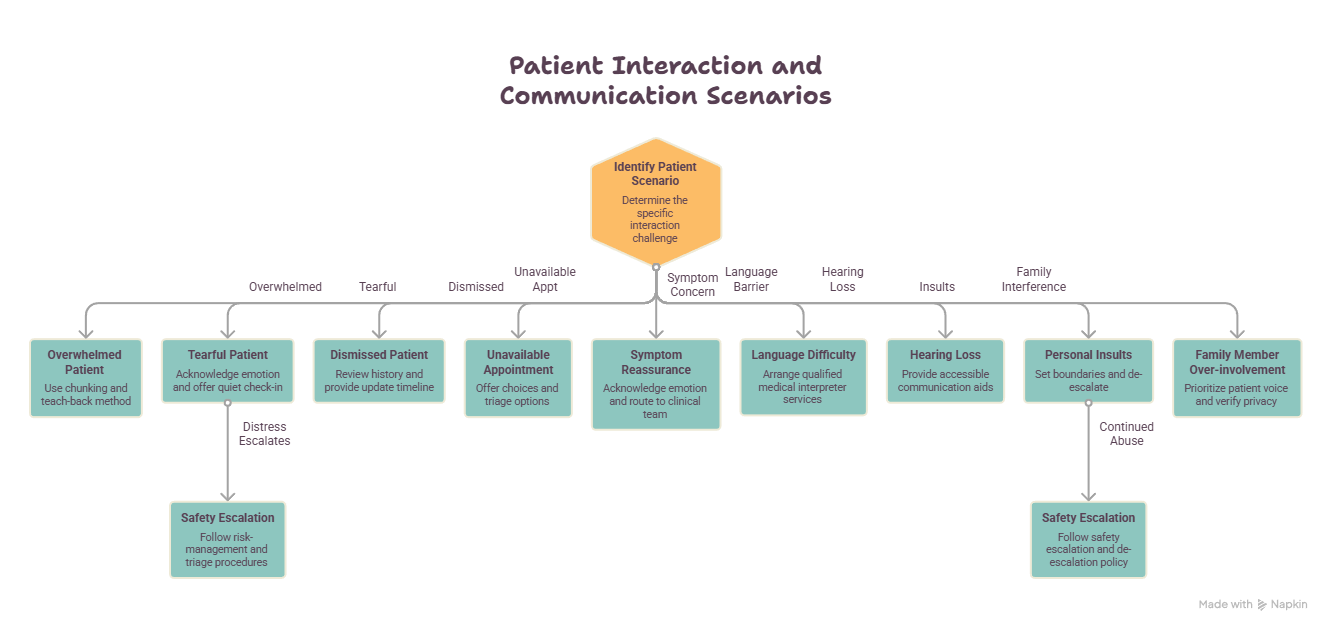
Scenario 1: The patient is overwhelmed by several instructions
Patient: “I cannot remember all of this. What am I supposed to do first?”
Professional response:
“Let us reduce this to two steps. First, complete the insurance form. Second, send it through the portal by Thursday. Please tell me those two steps in your own words so I can check that I explained them clearly.”
This response uses chunking and teach-back. It supports patient education, accurate insurance verification, secure portal management, and reliable administrative follow-through.
Scenario 2: The patient becomes tearful at check-in
Patient: “I almost cancelled. I am scared about what they might find.”
Professional response:
“This appointment is bringing up a lot of fear.”
Pause.
“I can complete the check-in quietly and let the clinical team know you are feeling distressed.”
The employee acknowledges the emotion and avoids offering predictions. When the distress suggests immediate clinical or safety concerns, escalate through medical office triage, crisis communication, and the practice’s risk-management procedure.
Scenario 3: A patient feels dismissed after repeated calls
Patient: “I have called four times. Nobody here cares.”
Professional response:
“You contacted the office several times and still lack a clear answer. I will review the message history, identify who owns the request, and give you a specific update time.”
Avoid arguing over the number of calls before investigating. The response supports patient complaint handling, patient satisfaction improvement, healthcare CRM tracking, and accurate patient record updates.
Scenario 4: A patient demands an unavailable appointment
Patient: “You need to fit me in today.”
Professional response:
“The current options are tomorrow at 3:20, today’s cancellation list, or clinical review if symptoms may require a different level of urgency. Which option should I start?”
This offers choice while preserving scheduling integrity, scheduling-conflict procedures, emergency appointment management, and equitable front-desk operations.
Scenario 5: A patient asks for reassurance about symptoms
Patient: “This probably means nothing serious, right?”
Professional response:
“I understand why you want reassurance. I cannot assess what the symptom means, so I am sending your concern to the clinical team through the urgent review process.”
The response acknowledges the emotional need and protects clinical boundaries. It connects the patient with medical office triage, appropriate clinical documentation, legal responsibilities, and the approved EMR workflow.
Scenario 6: Language difficulty is affecting consent and understanding
The patient agrees with every statement while completing forms incorrectly.
Professional response:
“I want to make sure we communicate in the language you understand best. Which language do you prefer for healthcare discussions? I will arrange qualified assistance.”
HHS identifies language assistance as an important mechanism for meaningful access for people with limited English proficiency.
Use qualified medical interpreter services, culturally responsive patient communication, accurate patient intake procedures, and appropriate patient education.
Scenario 7: A patient with hearing loss cannot follow the conversation
Speaking louder increases exposure while the patient still misses important details.
Professional response:
“What communication method works best for you? We can arrange the appropriate aid or service and provide the information in an accessible format.”
ADA guidance explains that effective communication may require qualified interpreters, real-time captioning, accessible electronic documents, or another suitable aid based on the individual and the complexity of the exchange.
Document the communication need and coordinate accessible telehealth platforms, patient communication tools, patient portal support, and appropriate interpreter services.
Scenario 8: The patient begins using personal insults
Patient: “You are completely useless.”
Professional response:
“I can continue helping with the records request. Personal insults must stop so we can complete the next step.”
When the patient regains control, return to the actionable issue. Continued verbal abuse or escalating behavior requires the approved difficult-conversation process, de-escalation techniques, complaint procedure, and safety escalation policy.
Scenario 9: A family member answers every question
Professional response:
“I appreciate your support. I would like to hear from the patient first, and then we can include the information they want you to provide.”
Ask the patient which topics may be discussed and verify the family member’s role before sharing protected information. Follow patient confidentiality guidance, privacy communication procedures, portal proxy rules, and appropriate medical records-release controls.
5. Documentation, Coaching, and Quality Standards
Therapeutic communication should produce documentation that another employee can use. Record the patient’s central concern, relevant facts, communication barrier, interpreter or accessibility support, options offered, selected action, task owner, timeframe, clinical escalation, boundary statement, and outcome. Apply clinical documentation improvement, medical records management, EMR compliance, and chart-audit standards.
A useful note states:
“Patient reported inability to understand portal instructions. Qualified Spanish interpreter connected by video. Registration steps explained in two sections. Patient accurately described the login and message-submission process through teach-back.”
A weak note states:
“Patient confused; issue explained.”
The first entry shows the barrier, intervention, comprehension check, and outcome. The second provides no evidence that communication became effective.
Coach observable behaviors
Managers should replace vague instructions such as “show more empathy” with specific actions:
Pause typing during the patient’s central explanation.
Ask one open-ended question before collecting details.
Reflect the main concern in neutral language.
Give no more than three options at once.
Explain one process stage before moving to the next.
Ask for teach-back after complex instructions.
Use qualified language assistance when needed.
State a boundary before continuing an abusive interaction.
Transfer clinical questions through the approved pathway.
Close with an owner, action, and timeframe.
These behaviors can be reinforced through active-listening training, empathy scenarios, patient education guidance, and professional communication examples.
Measure communication quality through outcomes
Useful indicators include:
Percentage of complex instructions confirmed through teach-back
Repeat calls caused by unclear instructions
Messages without an assigned owner
Complaints involving staff tone or unexplained delays
Interpreter needs identified during scheduling
Accessibility requests completed before appointments
Tasks closed within the promised timeframe
Clinical concerns routed correctly
Portal requests resolved on first contact
Incidents involving privacy exposure
Scheduling options explained consistently
Patient understanding documented after major transitions
These measures connect patient satisfaction metrics, medical admin time tracking, practice management systems, and stronger medical office organization.
6. Frequently Asked Questions
-
Active listening provides the foundation because it reveals the patient’s actual concern before staff select a response. Give the patient focused attention, identify the emotion and requested outcome, clarify unclear facts, and summarize the issue. Combine active listening techniques with empathic communication, accurate patient intake, and a trackable administrative workflow.
-
Reflection identifies the emotion or meaning: “You are worried the delay could affect your treatment.” Paraphrasing restates the factual message: “You called twice and still need confirmation that the referral was sent.” Both techniques strengthen effective patient communication, complaint handling, patient satisfaction, and objective documentation.
-
Maintain attentive posture, allow the patient time to process, and resume with a simple invitation such as, “Take the time you need. We can continue when you are ready.” Silence should preserve connection. When distress signals a clinical or safety concern, activate medical office triage, crisis communication, risk management, or the appropriate emergency process.
-
Acknowledge the documented experience or emotional impact: “You contacted the office several times and still lack an answer.” Then investigate the claim through the practice management system, healthcare CRM, patient record, and established complaint workflow.
-
Use teach-back after complex instructions, portal guidance, appointment preparation, records-release steps, insurance requirements, medication-message routing, and other exchanges where misunderstanding could cause delay or harm. Ask the patient to explain the plan in their own words. AHRQ identifies teach-back as a method for confirming that information has been explained clearly.
Support teach-back with plain-language patient education, portal management, appointment scheduling guidance, and accurate patient record updates.
-
Avoid false reassurance, blame, unexplained jargon, vague promises, personal judgment, and statements outside the administrative role. Risky phrases include “Calm down,” “That is just our policy,” “You should have called sooner,” “I am sure it is fine,” and “Someone will contact you.” Replace them with de-escalation language, clear patient communication, realistic expectation setting, and trackable next steps.
