

Medical Transcription Terms: Interactive Dictionary & Examples
Medical transcription converts recorded clinical speech into an accurate, structured, reviewable document. Every phrase must preserve the speaker’s meaning while satisfying clinical documentation standards, patient confidentiality requirements, specialty conventions, and the organization’s correction policy. A single omitted negation, misplaced decimal, or confused sound-alike term can distort the record. This interactive guide connects essential transcription vocabulary with realistic decisions, quality controls, medical terminology training, and practical examples for medical transcriptionists, scribes, and administrative professionals.
1. What Medical Transcription Accuracy Actually Requires
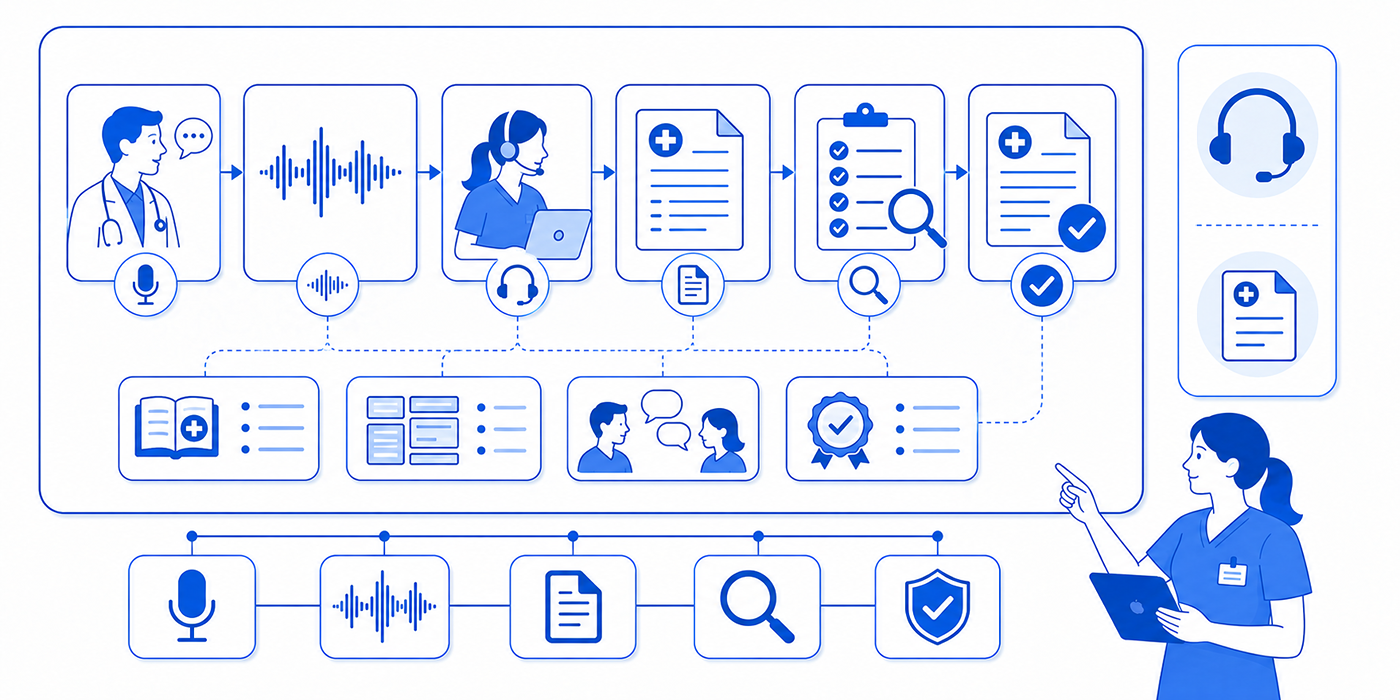
Medical transcription begins with faithful capture, then adds disciplined interpretation, formatting, verification, and escalation. The transcriptionist must determine what was dictated, where it belongs, whether the wording conflicts with surrounding information, and when uncertainty requires review. These decisions overlap with EMR and charting terminology, medical records management, clinical documentation improvement, and medical chart audit procedures.
Four layers determine whether a transcript is dependable:
Lexical accuracy: The words, numbers, names, measurements, and abbreviations match the dictation.
Clinical accuracy: Terminology remains anatomically, pharmacologically, and contextually coherent.
Structural accuracy: Information appears in the correct report section and follows the required template.
Record integrity: Corrections, signatures, versions, timestamps, and access activity remain traceable.
Lexical accuracy alone cannot protect a record. A perfectly typed word can still be clinically incorrect when a sound-alike term was chosen. “Ileum” and “ilium,” “peroneal” and “perineal,” or “dysphagia” and “dysphasia” may sound similar under poor audio conditions while carrying entirely different meanings. Strong medical terminology mastery, knowledge of specialty documentation templates, familiarity with ICD-10 terminology, and an understanding of CPT documentation context help the transcriptionist detect these mismatches without inventing content.
The transcript must also preserve diagnostic certainty. “Possible pneumonia,” “pneumonia cannot be excluded,” and “pneumonia” represent different clinical statements. Removing uncertainty can change how subsequent clinicians interpret the encounter and may contribute to medical coding errors, unsupported claims, or inaccurate problem-list entries. Knowledge of clinical documentation improvement terms, medical claims processing, revenue cycle terminology, and chart audit controls clarifies why certainty language must remain intact.
A transcriptionist also needs firm boundaries. Context can support verification, spelling selection, and error recognition. Context cannot authorize the transcriptionist to create an undocumented diagnosis, supply a missing dosage, or silently repair a clinical contradiction. Unresolved content should follow an approved flagging or escalation process. These boundaries protect legal responsibilities for medical administrative staff, HIPAA compliance, patient privacy communication, and the integrity of electronic health records.
| # | Transcription Term | Operational Definition | Practical Example | Error or Risk Controlled | Related ACMSO Skill |
|---|---|---|---|---|---|
| 1 | Dictation | Recorded or live speech intended for conversion into clinical documentation | A physician records an operative report after surgery | Confusing conversational speech with report-ready content | Clinical documentation terms |
| 2 | Verbatim Transcription | Capture of dictated speech with repetitions and verbal irregularities retained according to policy | A legal-sensitive report preserves the speaker’s exact phrasing | Unapproved editing of the speaker’s meaning | Legal responsibilities |
| 3 | Intelligent Verbatim | Removal of fillers and false starts while preserving every clinical fact and level of certainty | “Um, the patient, the patient denies fever” becomes “The patient denies fever” | Deleting meaningful qualifiers while cleaning speech | Terminology mastery |
| 4 | Edited Transcription | Policy-authorized correction of grammar and organization without altering clinical meaning | Fragmented dictation is organized into complete report sections | Turning stylistic editing into undocumented clinical revision | CDI definitions |
| 5 | Turnaround Time | Elapsed time between receipt of dictation and availability of the completed transcript | A STAT report receives a shorter deadline than a routine clinic note | Allowing routine work to delay urgent documentation | Time management |
| 6 | STAT Dictation | Report assigned the highest approved processing priority | An urgent operative report is moved ahead of routine backlog | Priority labels being applied inconsistently | Administrative workflow |
| 7 | Timestamp | Recorded position in an audio file or time associated with a documentation event | An unclear medication is flagged at 04:17 in the recording | Forcing reviewers to replay the full dictation | Records management |
| 8 | Speaker Identification | Verified association of dictated content with the correct author or participant | Consultant and resident statements are attributed correctly | Assigning one clinician’s statement to another | Team communication |
| 9 | Speaker Diarization | Separation of an audio recording into segments associated with different speakers | A system distinguishes the provider, patient, and caregiver | Merging statements from separate speakers | Patient communication |
| 10 | Blank | Approved placeholder indicating content that could not be resolved confidently | An unclear drug name is flagged with its timestamp | Guessing clinically significant information | Risk management |
| 11 | Flag | Marker directing uncertain or contradictory content to an authorized reviewer | A dosage conflict is sent to the provider’s review queue | Letting unresolved content appear final | Chart audit checklist |
| 12 | Critical Error | Defect capable of materially affecting patient identification, treatment, medication, diagnosis, or safety | “No allergy to penicillin” becomes “allergy to penicillin” | Treating all mistakes as equally consequential | Error scenarios |
| 13 | Major Error | Meaningful defect that affects document clarity, completeness, or usability | A relevant procedure detail is placed in the wrong section | Underestimating structural inaccuracies | Documentation improvement |
| 14 | Minor Error | Low-risk defect that does not change clinical meaning | A nonclinical punctuation error appears in narrative text | Inflating error rates without weighting impact | Documentation accuracy |
| 15 | Quality Assurance | Structured review used to detect, classify, correct, and prevent transcription defects | A reviewer scores terminology, omissions, formatting, and critical errors | Relying on spellcheck as the only safeguard | Quality auditing |
| 16 | Quality Score | Weighted measure of transcript performance under a defined scoring methodology | Critical omissions receive greater weight than punctuation defects | Using a score whose calculation is unclear | Metric interpretation |
| 17 | Template | Predesigned structure containing required report sections and formatting | An operative template separates findings, procedure, and complications | Misplacing clinically important information | Template libraries |
| 18 | Macro | Stored text inserted through a command, shortcut, or trigger | A standard examination structure is inserted for editing | Leaving default findings that were never dictated | EMR shortcuts |
| 19 | Text Expander | Tool that converts an abbreviation or command into a longer text string | A shortcut inserts a commonly used report heading | Triggering the wrong stored phrase | EMR tools |
| 20 | Speech Recognition | Technology that converts spoken audio into machine-generated text | Software creates a draft that receives human review | Assuming fluent output is clinically accurate | AI and automation |
| 21 | Front-End Speech Recognition | Speech-generated text reviewed and corrected directly by the dictating clinician | The provider edits the note before signing | Unclear responsibility for final review | EHR and EMR terms |
| 22 | Back-End Speech Recognition | Machine-generated draft routed to a transcriptionist or editor before provider review | An editor compares the automated draft with the audio | Editing text without replaying uncertain audio | AI-driven documentation |
| 23 | Confidence Score | System-generated estimate of certainty for recognized words or phrases | Low-confidence medication text receives additional review | Treating probability as proof of correctness | Predictive analytics |
| 24 | Audit Trail | Chronological record of access, editing, review, approval, and correction events | The EHR records who changed a report after review | Untraceable alterations to the record | Compliance terms |
| 25 | Version Control | Management of successive document versions and their approval status | The system preserves draft, corrected, and signed versions | Overwriting the history of a material change | Record control |
| 26 | Addendum | Additional information appended to an existing record through an authorized process | The provider adds a missing follow-up instruction after signing | Disguising later information as part of the original entry | Record updates |
| 27 | Amendment | Formal modification of information already entered in a health record | A confirmed factual error is corrected under policy | Silent alteration of finalized documentation | Legal documentation |
| 28 | Authentication | Confirmation by the authorized author that the document is complete and attributable | The provider electronically signs the reviewed report | Treating an unsigned draft as final | HIPAA terms |
| 29 | Protected Health Information | Individually identifiable health information protected under applicable privacy requirements | A recording includes the patient’s name, diagnosis, and date of service | Sharing audio or transcripts through unauthorized channels | Privacy terminology |
| 30 | Minimum Necessary | Principle limiting access, use, and disclosure to information required for an authorized purpose | A transcriptionist accesses only assigned records | Unnecessary exposure of patient information | Privacy checklist |
2. The Medical Transcription Workflow From Audio to Authenticated Record
A reliable workflow begins before anyone presses play. The assignment should already identify the correct patient, encounter, author, report type, service date, priority level, and destination record. A mislabeled audio file can generate an accurate transcript inside the wrong chart, creating a patient-identification failure with consequences across EHR and EMR workflows, medical records management, claims processing, and patient confidentiality.
Assignment validation
Before transcription, confirm every identifier available within the authorized system. The patient name, medical record number, encounter date, provider, specialty, and report type should agree. A discrepancy belongs in an exception queue with a named owner and resolution path. Copying identifiers from an unrelated open window introduces avoidable risk. Strong patient intake procedures, accurate patient record updates, consistent front-desk operations, and clear medical administrative workflows reduce upstream identification errors.
First-pass transcription
The first pass captures complete meaning and report structure. The transcriptionist listens for section changes, diagnostic certainty, negations, laterality, medication names, doses, routes, frequencies, units, dates, laboratory values, and follow-up instructions. Difficult audio should be replayed in a short surrounding segment because cadence and context often clarify word boundaries. The goal is a coherent draft aligned with clinical documentation terminology, specialty template conventions, medical terminology resources, and applicable EMR charting terms.
Contextual verification
Verification uses internal evidence from the dictation and authorized record. If the speaker says “left knee” throughout the report and one unclear phrase sounds like “right knee,” the inconsistency should trigger review. The transcriptionist should examine the operative title, indication, findings, and dictated laterality while respecting the organization’s correction boundaries. Orthopedic scribing principles, surgical documentation practices, clinical documentation improvement, and risk-management procedures support this cross-check.
External reference materials should come from approved, reliable sources. A search result can suggest a spelling, while the authorized record must determine the patient-specific fact. Drug databases, institutional provider directories, specialty dictionaries, and approved style references help verify terminology. Random autocomplete suggestions can introduce plausible-looking errors. A disciplined reviewer connects medical terminology training, CPT terminology, ICD-10 definitions, and medical coding error awareness without coding from implication.
Second-pass review
The second pass should use a different mental lens. Review patient identity, report type, dates, laterality, negations, measurements, dosages, allergies, diagnosis language, procedure details, blanks, and formatting. Reading the transcript without audio exposes grammatical or structural problems; comparing the transcript with audio exposes omissions and substitutions. Both review modes strengthen documentation accuracy, medical chart auditing, clinical documentation quality, and records compliance.
Speech-recognition drafts demand especially active review. Fluent sentences can hide substitutions that pass spelling and grammar checks. A system may convert “no evidence of metastasis” into “evidence of metastasis,” select the wrong drug, or copy an earlier template phrase into the current report. AI and automation in medical administration, the future of AI-driven documentation, EMR integration tools, and regulatory developments affecting scribes all reinforce the need for accountable human review.
Escalation, delivery, and authentication
Every unresolved blank should include enough information for efficient review: timestamp, report section, likely category, and surrounding phrase. “Unclear at 03:14, medication name in discharge plan” gives the reviewer a useful starting point. A blank without context transfers unnecessary work and risks being overlooked.
After quality review, the transcript enters the destination system with the correct status. Draft, pending review, corrected, authenticated, and amended must remain distinguishable. Provider authentication establishes authorship and final responsibility under organizational policy. These controls support record-update compliance, legal documentation responsibilities, HIPAA terminology, and defensible medical chart audits.
3. Interactive Transcription Examples and High-Risk Decisions
Example 1: Anatomy sound-alikes
Audio heard: “Tenderness over the right ilium.”
Possible confusion: Ileum.
Correct reasoning: The ilium is part of the pelvis; the ileum is part of the small intestine. The surrounding discussion of hip pain supports “ilium.” Anatomy, specialty, and sentence context converge on the same term. This reasoning draws on medical terminology mastery, orthopedic documentation, clinical charting terms, and specialty template resources.
Example 2: A dropped negation
Audio heard: “The patient has no known history of seizures.”
Unsafe transcript: “The patient has a known history of seizures.”
The missing word “no” reverses the clinical meaning. Negations require a dedicated review pass because they are short, frequently unstressed, and highly consequential. The reviewer should compare the phrase directly with the audio and check whether another section creates a contradiction. Clinical documentation improvement, chart-audit procedures, risk-management strategies, and medical coding error scenarios show why negation errors deserve critical weighting.
Example 3: Diagnostic certainty
Audio heard: “Findings may represent early osteomyelitis.”
Unsafe edit: “Findings represent early osteomyelitis.”
“May represent” communicates diagnostic uncertainty. Removing it converts a possibility into a positive statement. The transcript should preserve the original certainty and flag any internal conflict that requires provider clarification. This principle affects CDI terminology, ICD-10 understanding, claims-processing accuracy, and denial-management decisions.
Example 4: Medication number ambiguity
Audio heard: “Start medication at zero point five milligrams nightly.”
The transcript should follow the organization’s approved numeric style, preserve the dictated unit and frequency, and verify that the decimal has not become “5 mg.” A leading zero commonly helps make an amount below one easier to recognize; local policy controls final formatting. The transcriptionist should flag any unclear drug, dose, route, or frequency instead of calculating a replacement. Medical compliance terms, documentation accuracy practices, risk-management controls, and chart audit techniques support this approach.
Example 5: Template contradiction
A normal examination macro inserts “No focal neurological deficit.” Later, the provider dictates “Mild left facial droop is present.”
The positive dictated finding requires review against the imported default. Leaving both statements produces an internally inconsistent note; deleting either without authority can exceed the transcriptionist’s role. The conflict should be handled through the approved correction or clarification path. This is a common risk within EMR shortcut use, specialty documentation templates, patient record updates, and clinical documentation review.
Example 6: Background speaker contamination
The provider dictates an assessment while another clinician discusses medication nearby. Speech recognition inserts fragments of the background conversation into the report.
The editor should identify changes in voice, cadence, volume, and context; compare the generated text with the audio; and remove content that clearly belongs to another speaker under the authorized workflow. Any uncertain attribution should be escalated. This protects team communication accuracy, patient confidentiality, medical-record integrity, and HIPAA compliance for scribes.
Example 7: Unresolved proper name
The speaker mentions a consulting physician, but the surname remains unclear after replay. Several providers have similar names.
Guessing from familiarity can send a report to the wrong clinician. The transcriptionist should check the authorized provider directory, referral data, and encounter context, then flag the name if uncertainty remains. Accurate routing depends on professional team communication, medical records management, secure patient communication, and legal documentation controls.
Which transcription problem puts your accuracy under the greatest pressure?
Select the transcription challenge that creates the greatest risk in your workflow.
Build specialty-specific sound-alike lists and verify each uncertain term against anatomy, report type, and surrounding findings.
Add a dedicated numeric review pass covering decimals, units, laterality, dates, ranges, and medication frequencies.
Compare high-risk sections directly with audio and prioritize negations, diagnoses, medications, allergies, and follow-up instructions.
Require active review of every imported macro and remove unsupported defaults through the approved editing workflow.
Use timestamped blanks and a defined escalation route; speed should never convert uncertainty into undocumented clinical content.
4. A Defensible Quality-Assurance and Error-Correction Framework
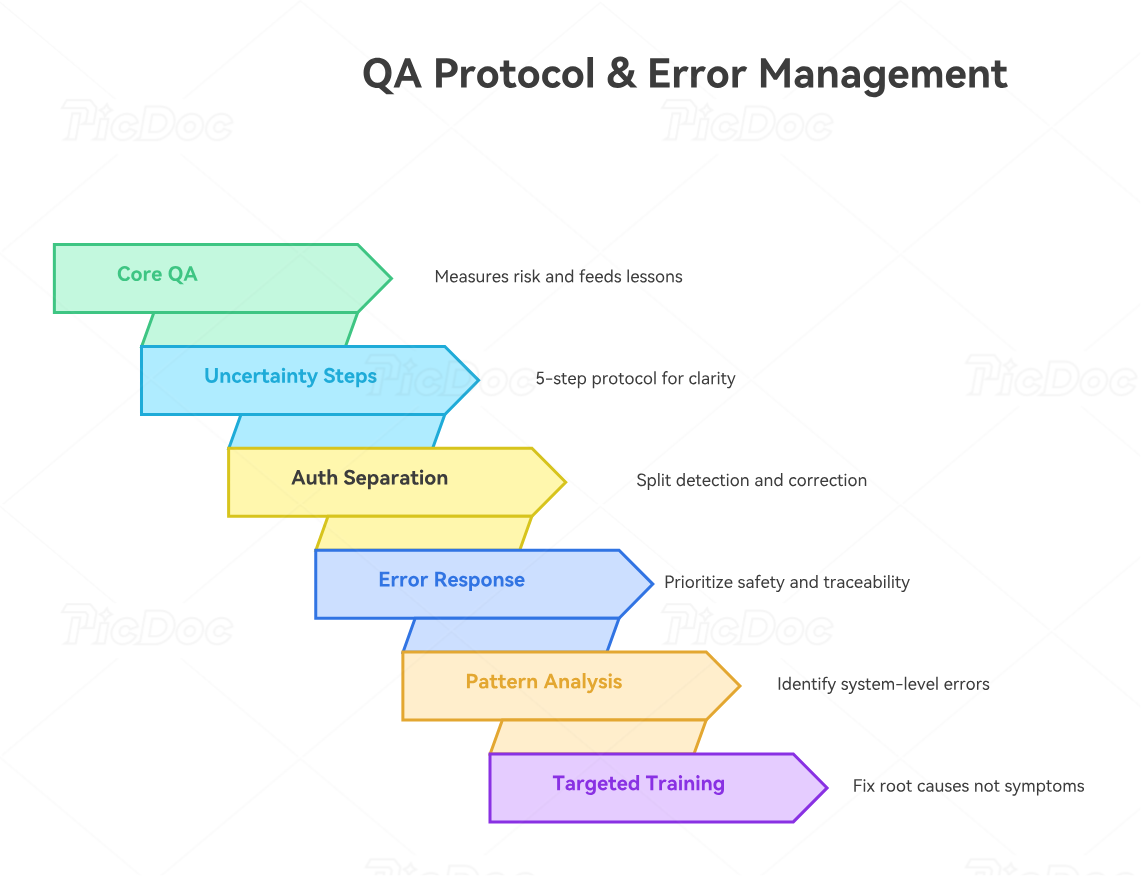
A strong QA program measures risk, identifies recurring causes, corrects affected records through an approved process, and feeds lessons back into training. A raw error count gives limited insight because a missing comma and a reversed allergy statement carry different consequences. Weighted scoring should reflect patient identification, medication, diagnosis, laterality, procedure, laboratory value, omission, terminology, formatting, and privacy risks. This aligns chart-audit terminology, medical coding error analysis, risk-management strategies, and documentation accuracy goals.
Use a five-step uncertainty protocol
1. Localize the uncertainty. Identify the exact timestamp, report section, and content category. “Unclear word” provides little value; “unclear medication name at 02:48 in discharge medications” focuses the review.
2. Replay strategically. Listen to the phrase, the full sentence, and the surrounding passage. Adjust playback tools permitted by the organization while preserving the source audio.
3. Triangulate context. Compare anatomy, specialty, grammar, diagnosis, procedure, medication context, and authorized record information.
4. Apply scope boundaries. Make only the corrections permitted by the transcription policy. Preserve uncertainty whenever evidence remains insufficient.
5. Escalate with evidence. Send the timestamp, candidate interpretation, conflicting information, and reason for concern to the correct reviewer.
This protocol combines active listening techniques, professional team communication, medical terminology skills, and legal documentation responsibilities. It also reduces the emotional pressure to produce a complete-looking transcript at the expense of record integrity.
Separate detection from correction authority
The person who identifies an error may lack authority to alter the final record. Policies should specify who can correct drafts, return reports to providers, create amendments, append addenda, or change authenticated documentation. Each material action should leave a traceable history. Patient-record update training, medical compliance definitions, EHR and EMR controls, and medical records management help formalize those boundaries.
When an error reaches a signed report, the response should prioritize patient safety and correct routing. The team may need to notify the authorized clinician, follow the amendment policy, determine whether downstream recipients received the inaccurate version, and document the resolution. Quietly overwriting a report destroys accountability. Clear risk-management procedures, healthcare compliance terminology, records-release controls, and legal responsibilities support a defensible response.
Analyze error pattern
Recurring errors often reveal a system problem. Medication substitutions may cluster around one speech-recognition model; missing sections may trace to a poorly designed template; identification errors may begin in scheduling; and excessive blanks may involve one microphone, specialty, or dictator. Useful analysis segments errors by author, report type, specialty, template, technology, audio source, shift, severity, and transcription stage.
Training should target the mechanism behind the defect. A terminology quiz will have little effect when the actual cause is distorted audio. A microphone correction will have little effect when staff misunderstand diagnostic certainty. Combining medical admin time tracking, predictive analytics, office workflow organization, and effective policy development helps teams correct causes instead of repeatedly correcting symptoms.
5. Specialty Transcription, Technology, Privacy, and Skill Development
Every specialty changes the vocabulary, report structure, risk pattern, and expected turnaround. Emergency documentation prioritizes rapid chronology, medical decision-making, procedures, and disposition. Surgical transcription demands exact anatomy, laterality, instruments, findings, complications, specimens, and postoperative plans. Cardiology adds measurements, rhythm terminology, device language, and medication complexity. Oncology introduces staging, pathology, treatment cycles, response language, and longitudinal comparison.
A transcriptionist moving between specialties should build structured reference sets rather than depend on memory alone. Useful sets include report-type templates, common procedures, anatomy, medications, sound-alikes, abbreviations, provider preferences, escalation contacts, and prohibited shortcuts. ACMSO’s resources on emergency-room scribing, cardiology scribing skills, orthopedic documentation, and advanced oncology scribing provide useful specialty foundations.
Technology should be evaluated by the errors it creates and prevents. Speech recognition can reduce initial typing while increasing the need for substitution detection. Templates can improve completeness while creating copied-forward contradictions. Text expanders can accelerate repetitive structure while inserting the wrong phrase after an accidental trigger. EHR integration can eliminate re-entry while mapping information to an incorrect field. These trade-offs connect medical admin automation, emerging healthcare technology, EMR integration tools, and the future of medical documentation.
Privacy controls should cover recording, transmission, storage, access, playback, temporary files, remote work, disposal, and incident reporting. Headphones do not protect privacy when the screen remains visible to others or downloaded audio remains on an unmanaged device. Staff should use only authorized systems and follow role-based access requirements. HIPAA terms for medical scribes, patient confidentiality guidance, privacy communication essentials, and medical compliance definitions should shape the full transcription environment.
Skill development should combine deliberate listening, terminology study, specialty exposure, error review, and timed practice. Transcribing rapidly during practice creates limited improvement when the learner never studies the cause of corrections. Maintain an error log containing the audio pattern, incorrect interpretation, correct term, contextual clue, error category, and prevention strategy. This turns individual mistakes into reusable judgment.
Career preparation should also demonstrate accuracy under realistic conditions. A candidate can discuss QA scores, difficult-audio protocols, specialty familiarity, privacy habits, template review, and escalation judgment during interviews. These competencies strengthen medical scribe interview preparation, a standout CMAA résumé, certification exam readiness, and long-term medical scribe career development.
6. FAQs About Medical Transcription Terms and Workflows
-
A medical transcriptionist generally converts recorded or speech-generated dictation into a structured report and may edit machine-generated drafts. A medical scribe commonly documents an encounter in real time or near real time under an approved workflow. Duties vary across employers, specialties, and systems, so the actual job description controls the boundary. Compare medical scribe and CMAA roles, review essential medical scribe terminology, study medical scribe career skills, and understand EMR charting vocabulary.
-
The transcript should use a timestamped blank or approved flag whenever the evidence remains insufficient. Context may help resolve terminology when anatomy, grammar, specialty, and the authorized record all support the same conclusion. Confidence created by familiarity alone provides weak protection. Follow the organization’s escalation policy, risk-management guidance, chart-audit procedures, medical terminology training, and legal documentation responsibilities.
-
The transcriptionist should identify and escalate the suspected error according to policy. Correction authority depends on the document’s status, the organization’s rules, and the type of issue involved. A typo within permitted editorial scope differs from conflicting laterality, dosage, diagnosis, or treatment instructions. Traceable clarification protects clinical documentation integrity, patient-record compliance, legal responsibilities, and medical chart auditing.
-
Patient identity, allergies, medications, dosages, units, diagnostic certainty, laterality, procedure names, measurements, dates, laboratory values, complications, and follow-up instructions deserve focused review because errors can materially affect care. High-risk sections vary by specialty and report type. Surgical scribing guidance, cardiology documentation skills, oncology scribing practices, and emergency-room scribing help identify specialty-specific priorities.
-
Review them against the audio with special attention to clinically plausible substitutions, omitted negations, medications, diagnoses, names, numbers, laterality, and template conflicts. Smooth grammar provides little assurance of clinical accuracy. Low-confidence markings can guide attention, while high-confidence text still requires appropriate review. This discipline connects AI and automation knowledge, future documentation trends, EMR integration skills, and documentation accuracy practices.
-
An addendum generally appends additional information to an existing entry. An amendment formally modifies information already recorded. Organizations may define and implement these actions differently, especially after authentication. The applicable policy should specify authorship, date, reason, visibility, approval, and preservation of the original record. Review patient-record update compliance, medical records management, medical compliance terms, and legal responsibilities for administrative staff.
