

The Ultimate Guide to Getting Your Medical Scribe Certification in Indonesia: All You Need to Know in 2026-2027
Getting a medical scribe certification in Indonesia in 2026-2027 means preparing for a healthcare system where digital records, patient privacy, telehealth, clinic speed, and accurate provider support matter more every year. Indonesian candidates need more than typing speed. They need medical terminology, EMR awareness, clear documentation judgment, and the discipline to protect patient information while working under pressure. This guide explains the certification path, exam preparation strategy, career options, and practical skills that help you become a serious medical scribe candidate in Indonesia.
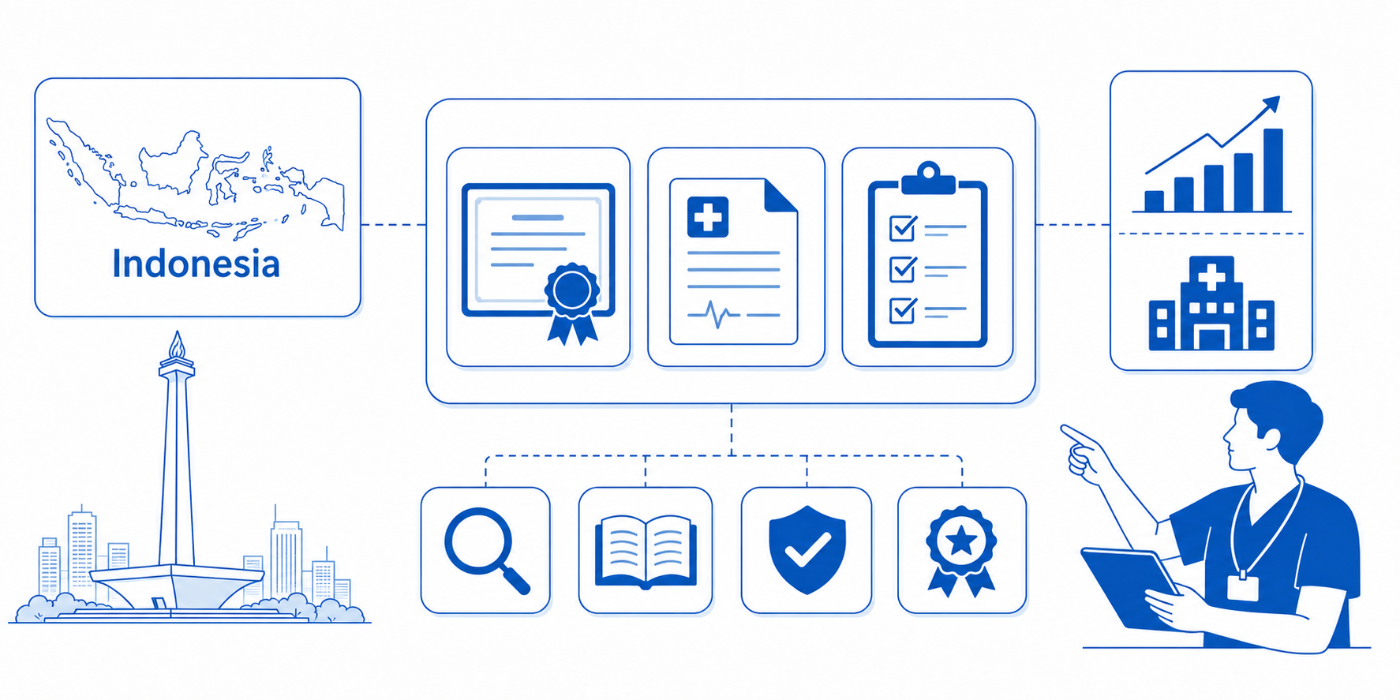
1. Why Medical Scribe Certification Matters in Indonesia in 2026-2027
Indonesia’s healthcare documentation environment is becoming more digital, more connected, and more demanding. Clinics, hospitals, telehealth teams, specialist practices, and outsourced documentation employers need candidates who understand clinical documentation terms, EMR and charting terms, telehealth platforms, patient privacy communication, and medical terminology mastery.
A medical scribe certification gives Indonesian candidates a structured way to prove readiness for clinical note support. The role may appear under different names: medical scribe, clinical documentation assistant, virtual medical assistant, physician documentation support, medical transcription support, or healthcare documentation assistant. The title can shift by employer, yet the core pressure stays consistent: listen accurately, capture the provider’s meaning, organize the chart cleanly, avoid privacy mistakes, and support the care team without making the clinician redo your work. That is why candidates should use medical scribe certification FAQs, realistic scribe exam questions, scribe exam confidence guidance, ACMSO study scheduling, and first-try certification strategies.
The strongest candidates treat certification as practical job proof. They understand that documentation touches medical language, appointment flow, insurance details, provider communication, patient portals, and compliance habits. A scribe who can support notes while understanding patient intake procedures, healthcare portal terms, insurance verification terms, front desk operations, and appointment scheduling best practices becomes far more useful in a real Indonesian clinic than someone who only memorized definitions.
2. The Best Certification Pathway for Indonesian Medical Scribe Candidates
The best pathway starts with role clarity. A medical scribe supports documentation. A clinician diagnoses, treats, and makes clinical decisions. A medical admin professional may manage scheduling, insurance, portals, and patient communication. Indonesian healthcare employers may blend these duties, especially in private clinics, telehealth teams, outsourced documentation companies, and smaller practices. Your certification plan should train the documentation core while also building adjacent knowledge through front desk operations, patient intake procedures, healthcare CRM terms, secure patient scheduling, and medical records release tools.
Start with terminology. Indonesian candidates often need to move between Bahasa Indonesia patient explanations, English clinical terms, local clinic language, and EMR fields. That creates a real risk: the word is heard, yet the meaning is placed in the wrong section of the note. “History of,” “suspected,” “denies,” “rule out,” “worsening,” “follow up,” “referred,” and “previously treated” all change documentation meaning. Build that precision with medical terminology mastery, complex medical term memorization, clinical documentation terms, EMR charting terms, and patient privacy terms.
Then learn note construction. Practice chief complaint, HPI, review of systems, physical exam, assessment, plan, medication changes, referrals, follow-up instructions, lab review, and return precautions. The goal is a note that helps the provider move faster. If your HPI hides the timeline, your plan misses follow-up, or your assessment overstates uncertainty, the clinician has to repair your work. Use realistic medical scribe exam questions, medical scribe exam confidence guidance, documentation template libraries, interactive patient record updates, and EMR productivity shortcuts.
Finally, prepare for applications. Employers want proof that you can handle rushed provider speech, uncertain information, patient privacy, wrong-chart risk, telehealth audio problems, and specialty vocabulary. Your resume should highlight certification, note accuracy, EMR awareness, privacy discipline, language strengths, typing speed if strong, and specialty interest. Your interview answers should explain how you prevent documentation errors, ask for clarification, and protect patient information. Use medical scribe job interview prep, top scribe interview questions, standout resume guidance, healthcare recruiter directories, and medical scribe staffing agencies.
3. Skills Indonesian Employers Expect From Certified Medical Scribes
Indonesian employers need scribes who reduce provider workload without creating new chart problems. Speed helps, but accuracy decides whether you become trusted. A fast scribe who misses negatives, confuses symptoms with diagnoses, or copies information into the wrong section becomes risky. A trained scribe understands what belongs in the note, what needs provider confirmation, and what should be left out. Build that skill through clinical documentation terms, EMR issue resolution, EHR platform awareness, voice recognition software guidance, and future scribing trends.
The first expected skill is clinical listening. A provider may move quickly from the patient’s complaint to medication history, prior treatment, exam findings, diagnosis discussion, and follow-up plan. The scribe has to catch details that change care: left versus right, acute versus chronic, new versus recurrent, denied symptoms, failed medications, allergies, referral reason, and return precautions. This is where many beginners panic because they try to write everything instead of organizing meaning. Train this with realistic scribe exam cases, medical terminology tutorials, scribe certification FAQs, recent exam experience guidance, and 30-day study planning.
The second expected skill is privacy-safe behavior. A scribe may see patient identity details, complaints, medication lists, lab results, referral notes, insurance information, and sensitive diagnoses. Employers need candidates who avoid screenshots, casual sharing, unsecured notes, open screens, public Wi-Fi risks, wrong-recipient messages, and wrong-chart entries. Remote scribes need an even stronger private workspace routine. Strengthen this with patient privacy communication, legal responsibilities for CMAAs, risk management strategies, handling patient complaints legally, and healthcare portal terms.
The third expected skill is specialty adaptability. Indonesian clinics and hospitals may need documentation support in family medicine, internal medicine, emergency care, pediatrics, OB-GYN, dermatology, ophthalmology, orthopedics, cardiology, and telehealth follow-up. Each specialty has its own note rhythm. Orthopedics needs laterality and mechanism. Dermatology needs lesion detail. Pediatrics needs age-aware context. Cardiology needs risk factors and symptom timing. Prepare with orthopedic scribe groups, dermatology and ophthalmology practices, pediatric and women’s health networks, primary care scribe networks, and specialty outpatient networks.
4. How to Prepare for the Medical Scribe Certification Exam Step by Step
A serious study plan should train recognition, structure, speed, and judgment. Many candidates read definitions and feel ready, then freeze during mock encounters because real documentation requires fast organization. Start with vocabulary, then learn chart sections, then practice timed cases, then review every error. Use medical terminology mastery, medical term memorization, documentation terms, EMR charting terms, and ACMSO exam strategy.
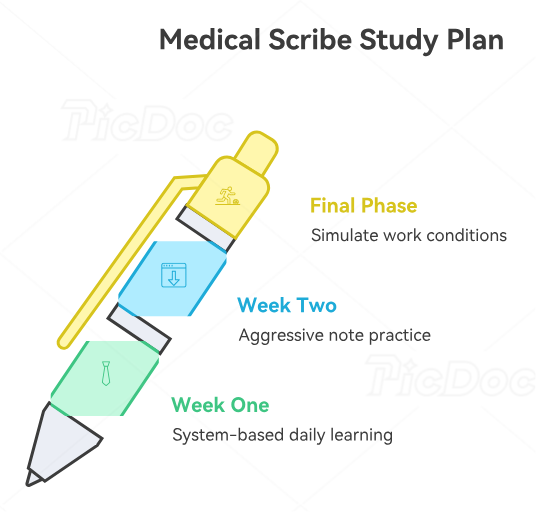
In week one, study one body system per day and connect it to common complaints. For example, respiratory notes need cough, fever, shortness of breath, sputum, duration, exposure, and red flags. Musculoskeletal notes need injury mechanism, laterality, range of motion, swelling, pain severity, and functional limitation. GI notes need onset, location, bowel changes, vomiting, fever, food triggers, and hydration risk. This system-based approach works well with patient intake procedures, ICD-10 code awareness, CPT code basics, medical billing terms, and insurance claim management.
In week two, practice note sections aggressively. Take a mock encounter and build the chief complaint, HPI, ROS, exam, assessment, plan, medication changes, referral, and follow-up. Mark every mistake by category: wrong section, missing negative, unclear timeline, vague symptom, overconfident diagnosis, missing medication detail, weak plan, wrong laterality, or privacy-risk habit. This error log becomes your personal training map. Pair it with documentation template libraries, interactive patient record updates, EMR productivity shortcuts, EMR issue resolution, and EHR platform guidance.
In your final phase, simulate work conditions. Listen once, write the note, review for missing details, and explain why each detail belongs where you placed it. Practice how you would respond to unclear provider speech, telehealth audio problems, wrong-chart risk, uncertain diagnosis wording, and patient privacy concerns. This final layer should connect directly with medical scribe exam questions, scribe certification FAQs, medical scribe interview prep, top scribe interview questions, and standout resume guidance.
5. Career Opportunities After Medical Scribe Certification in Indonesia
After certification, Indonesian candidates can target private clinics, hospitals, telehealth companies, specialist practices, outpatient centers, health-tech teams, remote documentation vendors, and medical admin-scribe hybrid roles. Some jobs may be local. Others may support international providers from Indonesia. The right path depends on your English confidence, Bahasa Indonesia clinical communication, EMR comfort, typing speed, privacy discipline, and specialty interest. Search broadly through medical scribe staffing agencies, international scribe employers, health systems hiring scribes, healthcare recruiters, and top hospitals hiring scribes.
Jakarta may offer the widest mix of private hospitals, health-tech companies, telehealth employers, and specialist clinics. Surabaya, Bandung, Medan, Yogyakarta, Bali, Makassar, and other major centers can offer strong clinical exposure through outpatient practices, hospital networks, and hybrid admin roles. Smaller cities may still provide valuable experience if the role includes intake, scheduling, documentation, portal support, insurance coordination, and records handling. Strengthen that hybrid readiness with appointment scheduling tools, secure patient scheduling, medical records release tools, medical admin time tracking tools, and collaboration tools for medical office teams.
Specialty choice can increase your value. A general scribe can support common visits, while a specialty-ready scribe can handle complex language with fewer corrections. Orthopedics, dermatology, ophthalmology, pediatrics, OB-GYN, cardiology, internal medicine, emergency care, and hospital medicine each require focused vocabulary and note rhythm. Use specialty outpatient networks, orthopedic groups, dermatology and ophthalmology practices, pediatric and OB-GYN networks, and primary care networks to plan your niche.
AI-assisted documentation will also shape 2026-2027 opportunities. Voice recognition and automated note tools can draft text, but trained scribes still matter because someone must verify meaning, catch contradictions, correct missing details, and protect privacy. The future scribe acts as a documentation quality filter. Build that future-ready profile with voice recognition software, future trends in medical scribing, telehealth administration, virtual patient management, and patient communication apps.
6. FAQs About Medical Scribe Certification in Indonesia
-
Medical scribe certification is useful when it proves documentation readiness, medical terminology strength, EMR familiarity, privacy discipline, and provider-support judgment. Indonesian employers may use different job titles, so candidates should search for medical scribe, clinical documentation assistant, virtual medical assistant, medical transcription support, and healthcare documentation roles. Build readiness with medical scribe certification FAQs, scribe exam confidence guidance, scribe interview questions, and top hospitals hiring scribes.
-
Medical scribe certification should be treated as documentation-skill proof. Any regulated clinical role, licensed healthcare practice, or employer-specific classification requirement should be checked directly with the hiring organization and relevant Indonesian authority. A scribe credential is strongest when it supports safe note-taking, privacy awareness, EMR confidence, and provider assistance. Prepare responsibly with legal responsibilities for medical admins, risk management strategies, patient privacy essentials, and regulations shaping scribe roles.
-
Start with medical terminology, chart sections, abbreviations, HPI structure, review of systems, physical exam language, assessment-and-plan logic, EMR navigation, and privacy-safe behavior. Indonesian candidates should also practice moving between Bahasa Indonesia patient language and English medical terminology without changing clinical meaning. Begin with medical terminology mastery, must-know documentation terms, EMR charting terms, and 30-day ACMSO study planning.
-
A clinical background helps, but many candidates can build readiness through structured terminology study, mock documentation practice, privacy training, and strong interview preparation. Employers care about whether you can listen accurately, protect patient information, organize notes correctly, and work calmly under provider pace. Candidates from admin, science, pharmacy-assistant, nursing-prep, customer service, or health IT backgrounds can build a solid pathway through patient intake procedures, active listening techniques, effective patient communication, and scribe-to-physician journeys.
-
Primary care, telehealth, urgent care, and general outpatient clinics are practical starting points because they expose you to common complaints, medication lists, follow-ups, referrals, lab review, and patient instructions. Specialty roles become easier after you build vocabulary depth and note structure. Explore primary care scribe networks, urgent care scribe opportunities, specialty outpatient networks, and pediatric and women’s health networks.
-
Preparation time depends on your starting point. A health-science student may need a focused review period, while a beginner may need several weeks of terminology, chart structure, privacy, and timed-note practice. The best schedule includes daily terminology review, mock cases, error tracking, and final interview-style scenario preparation. Use 30-day study planning, first-try exam strategies, memorization techniques, and real exam experience guidance.
