

The Ultimate Guide to Getting Your Medical Scribe Certification in South Africa: All You Need to Know in 2026-2027
Medical scribe certification in South Africa can open a practical route into healthcare documentation, remote clinical support, and stronger career positioning for students, graduates, and healthcare admin professionals. The real advantage comes from learning how to document accurately, protect patient information, understand EMR workflows, and translate fast clinical conversations into clean notes.
This guide breaks down the certification path, the skills employers value, the mistakes that weaken applications, and the study plan South African learners should follow in 2026-2027.
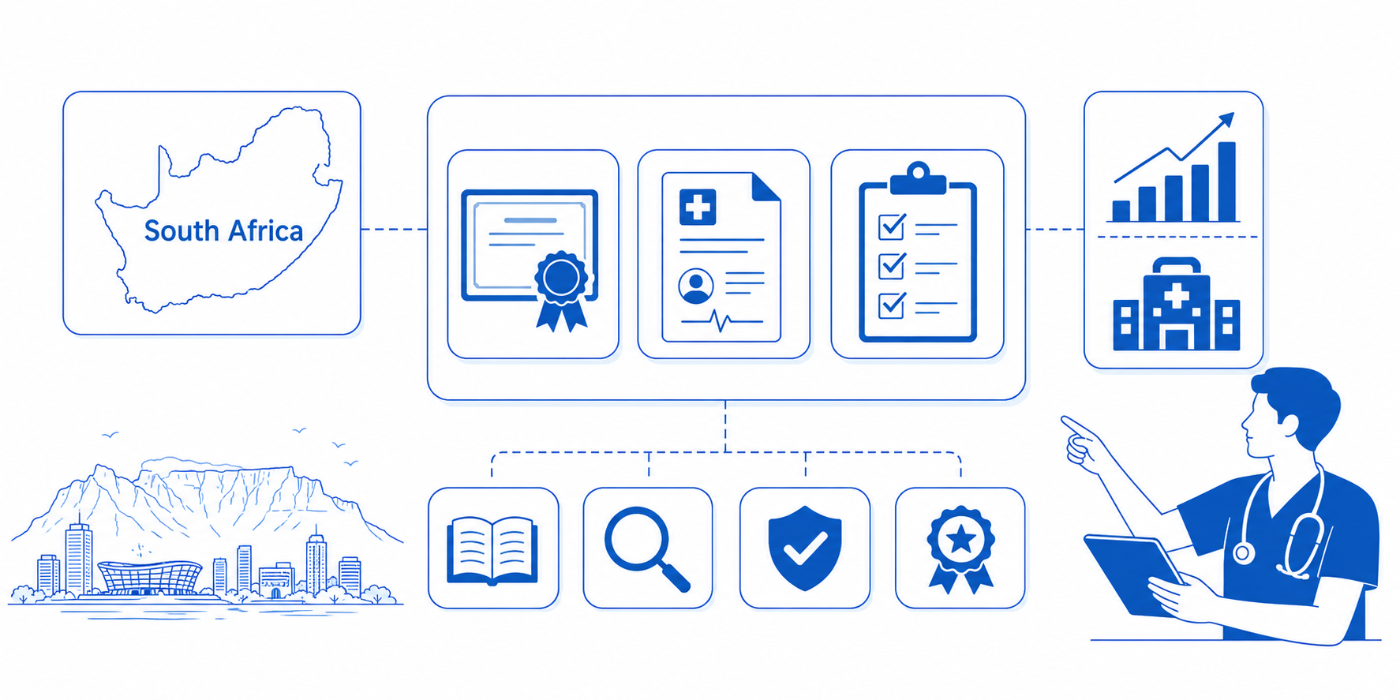
1. Why Medical Scribe Certification in South Africa Matters in 2026-2027
A strong medical scribe certification gives South African learners a structured way to prove documentation readiness. That matters because many healthcare candidates have biology knowledge, clinic exposure, or admin experience, yet still struggle with clinical documentation terms, EMR charting language, medical terminology, and privacy expectations when the pace becomes real.
For South African candidates, scribing can support several routes: remote medical scribe work, private practice documentation support, hospital administration growth, pre-med exposure, clinical research support, and international healthcare documentation roles. A certificate becomes valuable when it trains you beyond definitions and forces you to practice HPI structure, patient intake procedures, ICD-10 awareness, and CPT code familiarity.
The biggest pain point is false confidence. A learner may understand the term “shortness of breath,” then miss the difference between a patient complaint, a provider impression, a confirmed diagnosis, a ruled-out condition, and a follow-up plan. That weakness becomes dangerous in real documentation. Good preparation connects scribe exam prep, realistic scribe exam questions, specialty note templates, and interview preparation.
In 2026-2027, the strongest candidates will treat certification as a skill-building system. They will build a practice portfolio, learn charting logic, understand privacy, practice timed notes, and research employers through medical scribe companies, international scribe employers, healthcare recruiter platforms, and top hospitals hiring scribes.
| # | South Africa Learner Situation | Certification Priority | Proof You Should Build | ACMSO Resource to Use |
|---|---|---|---|---|
| 1 | Health sciences student wanting clinical exposure | SOAP structure, HPI accuracy, medical vocabulary | 10 timed notes across common primary-care visits | Scribe documentation terms |
| 2 | Candidate seeking remote scribe work | Listening speed, privacy, EMR navigation | Remote-shift readiness checklist | International scribe employers |
| 3 | Clinic admin assistant moving into documentation | Patient intake, chart sections, scheduling context | Front-office-to-scribe transition map | Front desk operations |
| 4 | Candidate weak in medical vocabulary | Prefixes, suffixes, body systems, abbreviations | Daily terminology flashcard bank | Medical terminology mastery |
| 5 | Candidate struggling with diagnosis language | ICD-10 awareness and documentation specificity | Condition-term mini dictionary | ICD-10 dictionary |
| 6 | Candidate confused by procedure codes | CPT concept familiarity | Procedure vocabulary examples | CPT code guide |
| 7 | Candidate targeting private GP practices | Primary-care HPI, follow-up, medication changes | Primary-care note bank | Primary care scribe networks |
| 8 | Candidate targeting urgent care documentation | Rapid complaint sorting and red-flag negatives | Timed urgent-care notes | Emergency and urgent care roles |
| 9 | Candidate interested in telehealth support | Virtual visit flow, portal language, remote etiquette | Telemedicine encounter templates | Scribes and telemedicine |
| 10 | Candidate anxious about privacy rules | Confidentiality, access control, secure workspace | Privacy scenario answer sheet | Patient privacy essentials |
| 11 | Candidate choosing a certification course | Curriculum depth and practice volume | Course comparison scorecard | Scribe training courses |
| 12 | Candidate preparing for exam-style questions | Weak-area review and timed drills | 30-day study calendar | 30-day study schedule |
| 13 | Candidate interested in cardiology, ortho, or GI | Specialty vocabulary and template selection | Specialty glossary with sample notes | Outpatient specialty networks |
| 14 | Candidate interested in dermatology | Lesion descriptions and exam wording | Dermatology phrase bank | Dermatology and ophthalmology roles |
| 15 | Candidate interested in orthopedics | Musculoskeletal exam language | Joint exam documentation set | Orthopedic scribe groups |
| 16 | Candidate interested in hospital-based support | Progress note structure and plan clarity | Daily inpatient-style practice notes | Hospitalist scribe groups |
| 17 | Candidate seeking academic hospital exposure | Teaching-hospital workflow and accuracy | Academic-style encounter summaries | Academic medical centers |
| 18 | Candidate interested in pediatrics or women’s health | Age-specific history and sensitive phrasing | Pediatric and OB/GYN phrase list | Pediatric and OB/GYN networks |
| 19 | Candidate weak in EMR workflows | Chart sections, orders, results, problem lists | Mock EMR workflow checklist | EMR/EHR platforms |
| 20 | Candidate preparing for interviews | Scenario answers and correction mindset | Interview answer bank | Scribe interview prep |
| 21 | Candidate with patient-facing admin experience | Communication, empathy, de-escalation | Patient scenario response sheet | Patient communication terms |
| 22 | Candidate supporting appointment workflows | Scheduling vocabulary and conflict handling | Appointment workflow examples | Appointment scheduling best practices |
| 23 | Candidate preparing for AI-assisted documentation | Human review and note correction | AI-note cleanup samples | Future scribing trends |
| 24 | Candidate building a pre-med or health career profile | Clinical exposure and reflective learning | Gap-year portfolio summary | Pre-med scribe pipelines |
| 25 | Candidate applying through recruiters | Resume keywords and portfolio proof | One-page scribe resume plus note samples | Healthcare recruiter platforms |
| 26 | Candidate wanting clinic operations knowledge | Patient flow, records, task ownership | Clinic workflow map | Medical office productivity |
2. How to Choose the Right Medical Scribe Certification in South Africa
Start with the course outcomes. A valuable program should teach medical terminology, clinical note structure, EMR charting, privacy discipline, and specialty documentation. A shallow course teaches labels. A serious course trains decisions: where the complaint belongs, which details matter, what to leave out, what to clarify, and how to avoid turning a provider’s impression into a confirmed diagnosis.
South African learners should also separate documentation certification from licensed clinical practice. A medical scribe credential should support charting and workflow readiness. It should never be presented as permission to diagnose, treat, prescribe, or perform duties reserved for regulated health professionals. This distinction protects the learner, the patient, and the employer. It also strengthens your interview answers because it shows you understand professional boundaries, documentation limits, and clinical accountability.
Course comparison should focus on practice volume. Ask whether the program includes timed note exercises, correction feedback, abbreviations, common complaints, specialty examples, privacy scenarios, and exam-style questions. Pair any course with scribe certification FAQs, ACMSO exam strategies, medical scribe exam confidence, and realistic medical scribe questions.
Strong certification planning should also match your target role. A remote scribe applicant needs typing speed, audio comprehension, secure workspace habits, and time-zone stamina. A clinic-based applicant needs patient-flow awareness, intake vocabulary, appointment context, and records discipline. A research-track candidate may benefit from clinical research site exposure, healthcare CRM terms, medical records release tools, and patient record updates.
3. Skills South African Candidates Must Build Before Applying
The first skill is clinical listening. Many candidates can read a note slowly, yet struggle when a provider speaks quickly, changes direction, or lists multiple negatives in one sentence. Practice with complaint-based drills: chest pain, abdominal pain, headache, cough, back pain, rash, medication refill, follow-up visit, and post-procedure review. Support this with dictation software knowledge, medical terminology memorization, documentation template libraries, and EMR platform awareness.
The second skill is HPI precision. Weak notes say, “patient has pain.” Strong notes capture onset, location, duration, character, aggravating factors, relieving factors, severity, associated symptoms, relevant negatives, prior treatment, and follow-up context. That level of detail helps the provider, supports continuity, and reduces cleanup work. Use patient intake procedures, healthcare portal terms, telehealth platform terms, and virtual patient management to understand the full visit flow.
The third skill is privacy discipline. South African candidates should treat health information as sensitive from day one. A remote workspace needs private audio, locked screens, secure passwords, careful file handling, and clean communication habits. A clinic workspace needs discretion around patient names, screens, printed notes, and phone conversations. Strengthen this with patient privacy essentials, HIPAA terms for scribes, legal responsibilities, and risk management strategies.
The fourth skill is correction maturity. Beginners often guess when a phrase is unclear. Strong scribes flag uncertainty, ask precise clarification, and maintain clean documentation boundaries. Your personal QA checklist should ask: Is the chief complaint clear? Are pertinent negatives captured? Are patient-stated symptoms separated from provider assessment? Is the plan complete? Are follow-up instructions documented? Practice with interview questions scribes should expect, scribe interview prep, medical scribe certification FAQs, and real-life exam experiences.
4. Step-by-Step Certification Plan for South Africa-Based Learners
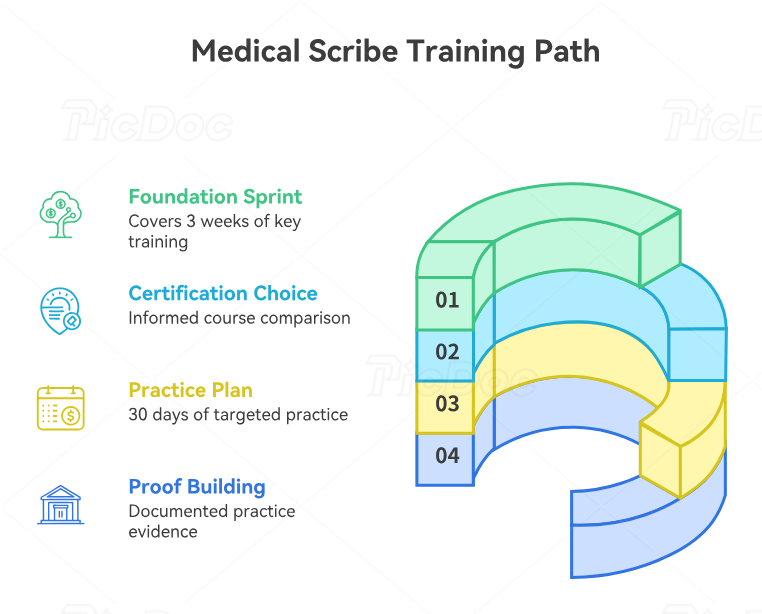
Start with a foundation sprint. Spend the first week on medical terminology mastery, body systems, common abbreviations, and documentation vocabulary. Spend the second week on HPI and charting terms, EMR concepts, and patient intake workflows. Spend the third week on privacy, telehealth, and specialty documentation.
Choose your certification after that foundation. You will compare courses more clearly when you already understand the core skill areas. Look for training that includes practice notes, realistic case examples, privacy scenarios, exam questions, specialty workflows, and interview readiness. Use medical scribe training courses, ACMSO certification exam strategies, scribe certification FAQs, and exam confidence preparation.
Next, build a 30-day practice plan. Days 1-7 should focus on terminology and HPI structure. Days 8-14 should focus on ROS, physical exam organization, and assessment-plan clarity. Days 15-21 should focus on specialty templates using outpatient specialty networks, primary care networks, orthopedic scribe groups, and dermatology and ophthalmology roles. Days 22-30 should focus on timed mock questions, note corrections, and interview answers.
Build proof as you study. Keep a folder with de-identified practice notes, a terminology log, a specialty phrase bank, privacy scenario responses, and a one-page resume summary. A certificate alone may get attention, while proof of practice helps you survive screening. Use building a standout resume, interview preparation for medical admin roles, scribe interview prep, and healthcare recruiter platforms.
5. Career Paths, Remote Work Options, and Mistakes to Avoid
South African candidates can use scribe certification for several career directions. Remote scribing can fit candidates with strong English, stable internet, quiet workspace, time-zone flexibility, and documentation discipline. Clinic-based support can fit candidates who already understand patient flow, appointment systems, and records handling. Healthcare administration candidates can combine scribing with appointment scheduling, insurance verification, patient communication, and de-escalation techniques.
Remote candidates should prepare for the realities behind the job description. Scribing can involve long listening periods, fast note turnaround, repeated corrections, provider-specific preferences, and strict confidentiality. A polished application should mention certification, typing speed if strong, medical terminology, EMR exposure, remote setup, privacy training, and specialty practice. Research medical scribe companies, health systems hiring scribes, urgent care brands hiring scribes, and community health centers to understand the wider market.
Avoid weak training shortcuts. The first mistake is memorizing definitions without writing notes. The second mistake is relying on templates without understanding the patient story. The third mistake is underestimating privacy. The fourth mistake is applying before you can explain how you handle unclear audio, conflicting symptoms, missing plan details, or provider corrections. Fix those gaps with realistic exam questions, specialty documentation templates, patient record updates, and risk management strategies.
AI-assisted documentation will also change expectations in 2026-2027. The best scribes will know how to review machine-generated drafts, spot contradictions, clean up vague phrasing, and protect accuracy. This makes human judgment more important. Study future trends in medical scribing, voice recognition tools, telehealth administration, and predictive analytics in medical administration to stay ahead.
6. FAQs About Medical Scribe Certification in South Africa
-
Yes. It can help South African learners prove documentation readiness, especially when they want remote scribe roles, clinic documentation support, healthcare administration growth, or pre-med exposure. The value improves when certification is paired with medical terminology mastery, EMR platform knowledge, scribe exam practice, and interview preparation.
-
A scribe certificate should be treated as a documentation and workflow credential. It should support charting skills, clinical vocabulary, privacy habits, and provider support. It should never be used as permission to diagnose, treat, prescribe, or present yourself as a regulated clinician. Keep that boundary clear when using documentation terms, privacy resources, and legal responsibility guidance.
-
A focused learner can often prepare in 30 to 60 days, depending on their starting vocabulary, typing speed, and clinical exposure. Beginners should spend extra time on medical terms, EMR charting, realistic exam questions, and 30-day certification planning.
-
Remote scribe roles require listening accuracy, typing stamina, medical vocabulary, HPI structure, privacy discipline, time-zone reliability, and clean communication. Candidates should strengthen dictation tool awareness, telemedicine scribing, international employer research, and healthcare recruiter visibility.
-
Add your certification, medical terminology training, EMR exposure, typing speed if strong, privacy training, specialty practice, sample-note portfolio, and remote-work setup. A stronger resume also shows proof of practice through scribe interview answers, resume-building guidance, top medical scribe companies, and top hospitals hiring scribes.
-
Write timed notes, review them against a checklist, and track repeated mistakes. Focus on missing negatives, vague HPI details, incomplete plans, unclear follow-up, and confusing patient statements with provider assessments. Use specialty templates, scribe documentation terms, realistic scribe questions, and EMR troubleshooting skills.
