

The Ultimate Guide to Getting Your Medical Scribe Certification in Nigeria: All You Need to Know in 2026-2027
Nigeria-based medical scribe candidates have a strong opening in 2026-2027 because healthcare documentation, remote clinical support, telehealth assistance, and offshore scribe work all reward one thing: reliable chart accuracy under pressure. Certification gives your training a clear structure, especially when you connect medical terminology mastery, EMR charting terms, clinical documentation skills, and scribe exam preparation into one career plan.
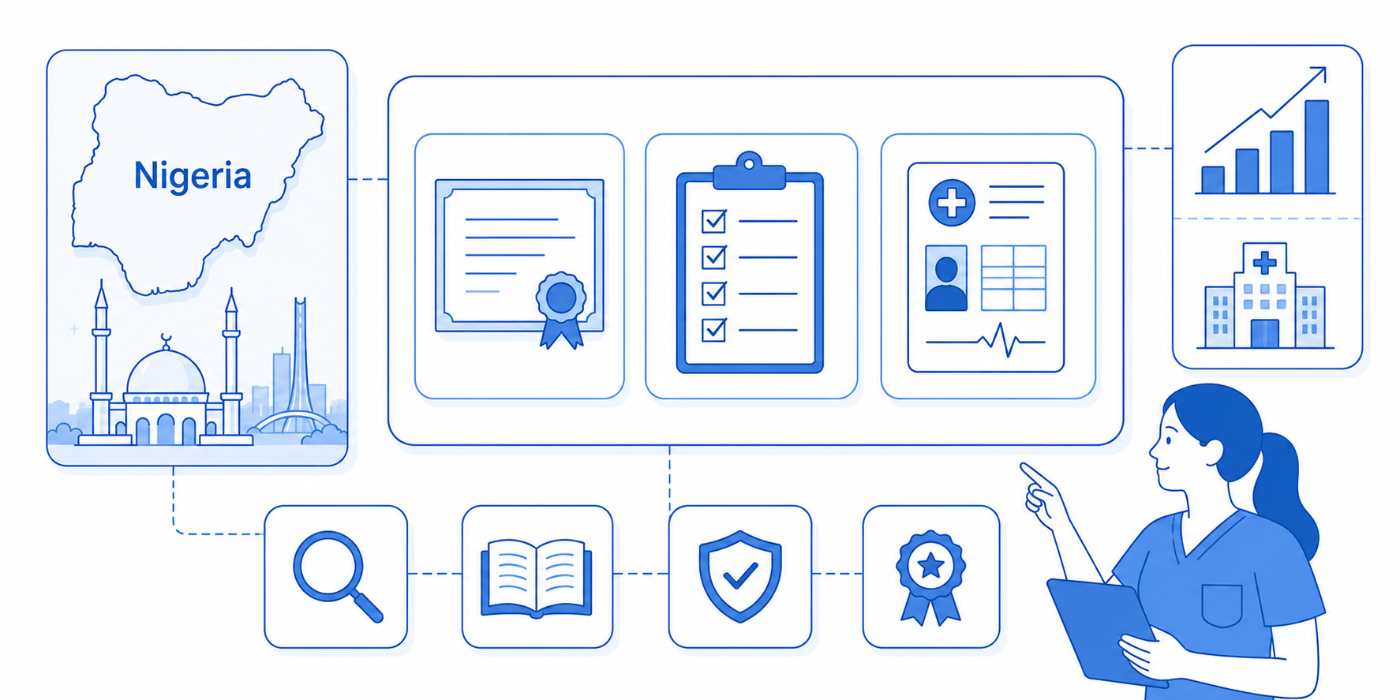
1. Why Medical Scribe Certification Matters in Nigeria in 2026-2027
Medical scribe certification in Nigeria matters because employers need proof that you can listen, understand clinical language, organize provider reasoning, protect patient information, and produce notes that save time instead of creating cleanup work. A candidate who studies only medical words may still struggle when a provider jumps from symptoms to exam findings, orders, diagnosis, counseling, and follow-up in one fast conversation. That is where structured preparation through realistic medical scribe exam questions, medical scribe certification FAQs, documentation template libraries, and HIPAA compliance for scribes becomes valuable.
For Nigerian students, medical graduates, allied health professionals, and career changers, the certification journey should create practical job evidence. The goal is to show that you can write a clear HPI, identify relevant negatives, understand specialty patterns, handle EMR language, respect privacy boundaries, and explain your workflow during interviews. You can build that evidence by combining medical scribe training courses, ICD-10 code awareness, CPT code basics, patient intake procedures, and scribe interview preparation.
The biggest pain point for many new scribes is the gap between “I understand medicine” and “I can document a live encounter correctly.” A chest pain note needs timeline, severity, associated symptoms, risk factors, exam details, provider impression, orders, patient instructions, and follow-up. A rash note needs location, appearance, duration, exposure history, treatment tried, procedure detail, and return precautions. Certification helps you move from scattered recall into repeatable chart judgment using top EMR/EHR platforms, voice recognition and dictation tools, specialty documentation templates, and future scribing trends.
2. The Best Certification Path for Nigeria-Based Candidates
The best certification path begins with a clear target: local healthcare documentation, remote medical scribing, healthcare administration, telehealth support, clinical research support, or pre-medical career development. Each target needs a different emphasis, although the core remains the same: medical terminology, clinical documentation, EMR understanding, privacy discipline, and medical scribe exam confidence.
A Nigerian MBBS graduate may use scribing to strengthen clinical reasoning, medical English, documentation exposure, and remote-work credibility. A life sciences graduate may use certification to enter healthcare documentation without waiting for a clinical license. A healthcare admin candidate may use scribe training to understand how clinical notes connect with scheduling, claims, patient communication, and records. That wider angle becomes stronger when paired with medical billing terms, insurance verification examples, front desk operations terms, patient communication terms, and healthcare portal terms.
Choose a certification program that teaches practical charting rather than passive reading. A strong program should include sample encounters, note-building exercises, privacy scenarios, medical terminology drills, EMR vocabulary, specialty templates, assessment-plan logic, and interview preparation. Your prep library should include top medical scribe certification courses, realistic scribe exam questions, ACMSO certification strategies, scribe certification FAQs, and medical scribe job interview prep.
The strongest Nigeria-based applicants also research employers while studying. This helps you avoid a weak certificate-only profile. Look at what scribe companies, hospitals, urgent care groups, telehealth teams, and offshore employers expect before you write your resume. Review top medical scribe companies, international offshore scribe employers, healthcare recruiters posting scribe roles, top hospitals hiring medical scribes, and health systems hiring scribes.
3. What You Need to Study Before the Certification Exam
Your study plan should begin with the language of clinical care. Learn common complaints, body systems, medications, procedures, provider abbreviations, and normal-versus-abnormal findings. The purpose is speed. During a real encounter, you have seconds to recognize that “SOB” belongs to respiratory history, “denies fever” may be a relevant negative, and “left lateral malleolus tenderness” belongs in a structured injury note. Build that speed with medical term memorization, scribe terminology tools, clinical documentation terms, ICD-10 references, and CPT code references.
Next, master note sections. The chief complaint gives the entry point. The HPI carries the story. ROS captures symptom review. The physical exam records provider findings. The assessment names the provider’s impression. The plan captures tests, treatment, counseling, follow-up, and return precautions. Many beginners mix patient statements with provider conclusions, which can make a chart unsafe or confusing. Practice clean separation using documentation template libraries, EMR charting terms, EMR platform guides, patient record compliance training, and common EMR issue resolution.
Then study specialty patterns. Primary care rewards chronic disease tracking, medication review, prevention, and follow-up. Urgent care rewards speed and disposition clarity. Pediatrics requires careful handling of caregiver-reported history. Orthopedics needs mechanism, laterality, imaging, and procedure detail. Dermatology requires visual specificity. Use primary care scribe networks, urgent care brands, pediatric scribe training, orthopedic groups, and dermatology and ophthalmology practices.
Privacy and professionalism need dedicated time. Remote scribing creates serious risk when a candidate works in a shared room, leaves a screen open, stores notes casually, uses personal messaging for patient details, or talks about encounters outside the workflow. Certification prep should train you to think like a trusted documentation professional. Study HIPAA compliance for medical scribes, patient privacy communication essentials, HIPAA terms for scribes, legal responsibilities for medical admins, and risk management strategies.
4. A 30-Day Study Plan for Nigeria-Based Medical Scribe Candidates
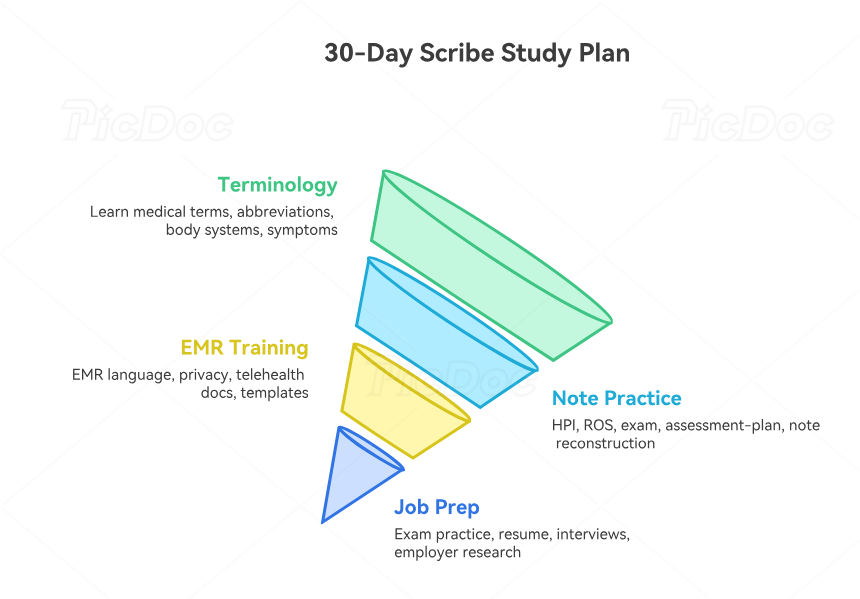
A practical 30-day plan works better than random late-night studying. Days 1-7 should cover medical terminology, common abbreviations, body systems, and symptom vocabulary. Days 8-14 should focus on HPI structure, ROS, physical exam organization, assessment-plan logic, and sample note reconstruction. Days 15-21 should cover EMR language, privacy, telehealth documentation, dictation cleanup, and specialty templates. Days 22-30 should be exam practice, resume building, interview scenarios, and employer research using ACMSO’s 30-day study schedule, medical scribe exam tips, first-try certification strategies, realistic scribe questions, and certification FAQs.
Your daily work should produce visible output. Write one sample HPI from a short case. Rewrite one messy note into a clean chart. Review five medical terms. Practice one privacy scenario. Answer one interview question aloud. Over 30 days, this becomes a portfolio of proof. Use documentation terms for scribes, specialty-specific templates, EMR shortcuts, patient record update training, and voice recognition tools to make practice realistic.
Build a Nigeria-friendly remote-work setup during your study month. A quiet workspace, reliable connection, headset, password manager, professional email, updated CV, and secure workflow matter when you apply to offshore teams. Employers may care about your ability to work consistently during assigned hours, follow client-specific charting rules, and protect sensitive information. Strengthen this layer with telehealth platform definitions, healthcare CRM terms, healthcare portal terms, secure patient scheduling tools, and virtual patient management.
The final week should feel like job preparation. Take timed quizzes, review mistakes, refine your resume, prepare interview answers, and make a shortlist of employer types. Your answer to “Why should we hire you as a scribe?” should include training, note examples, specialty exposure, privacy habits, remote-work readiness, and willingness to follow provider-specific rules. Prepare with building a standout resume, scribe job interview prep, top scribe interview questions, real-life exam experiences, and top hospitals hiring scribes.
5. How to Turn Certification Into Scribe Jobs and Career Growth
After certification, your application should show more than completion. Add specific skills: HPI drafting, ROS organization, physical exam formatting, assessment-plan support, EMR terminology, privacy training, specialty template practice, and remote-work readiness. Recruiters scan for proof fast, so your resume should make evidence easy to find. Use top medical scribe companies, health systems hiring scribes, healthcare recruiters, international offshore employers, and pre-med gap-year scribe pipelines.
Your sample notes can separate you from other beginners. Create clean practice notes for chest pain, sore throat, diabetes follow-up, pediatric fever, ankle injury, skin rash, headache, medication refill, abdominal pain, and post-procedure follow-up. Keep them de-identified and based on practice scenarios. This gives you talking points during interviews and shows your ability to apply training. Build those examples with primary care documentation resources, urgent care documentation exposure, pediatric documentation guidance, orthopedic scribe resources, and specialty cheat sheets.
Interview answers should be practical. When asked what you would do if you miss part of the encounter, say you would follow the account’s clarification process, avoid guessing, mark uncertainty according to policy, and confirm missing clinical details through the approved channel. When asked about privacy, explain your workspace, screen-lock habits, access control, and secure communication rules. Practice with medical scribe interview questions, step-by-step difficult conversation handling, active listening techniques, de-escalation techniques, and patient privacy communication essentials.
Long-term, medical scribing can support several career directions: clinical documentation improvement, healthcare administration, medical coding, patient access, telehealth coordination, clinical research coordination, and future physician pathways. A scribe who understands note quality, coding awareness, workflow, patient communication, and data tools becomes more useful over time. Explore clinical research scribe-to-CRC tracks, medical billing terms, denial management basics, telehealth administration, and predictive analytics in medical administration.
6. FAQs About Medical Scribe Certification in Nigeria
-
Yes. Medical scribe certification can help Nigeria-based candidates build structured proof of medical terminology, clinical documentation, EMR vocabulary, privacy discipline, and remote-work readiness. It is especially useful when paired with medical terminology mastery, clinical documentation terms, EMR charting terms, HIPAA compliance training, and realistic scribe exam questions.
-
A Nigeria-based candidate can target remote documentation roles when they can show strong English listening, secure home-office habits, time-zone flexibility, reliable internet, and certification-backed documentation skills. Start by researching international offshore scribe employers, medical scribe staffing companies, healthcare recruiters, telemedicine scribe workflows, and scribe interview preparation.
-
Start with medical terminology, then move to chart structure, EMR vocabulary, privacy rules, specialty templates, and timed practice questions. This order helps you understand the language before you try to write complete notes. Use medical term memorization, documentation terms, patient intake procedures, EMR platform guides, and practice exam questions.
-
Many scribes come from medical, science, allied health, nursing, pharmacy, public health, and administrative backgrounds. Employers usually care about documentation accuracy, listening skill, privacy behavior, professionalism, and the ability to follow provider-specific workflows. Build those skills with scribe training courses, ACMSO certification strategies, 30-day study planning, certification FAQs, and job interview prep.
-
Primary care, urgent care, pediatrics, orthopedics, dermatology, and telehealth are excellent starting areas because they teach different documentation patterns. Beginners should compare primary care scribe networks, urgent care employer guides, pediatric scribe guidance, orthopedic scribe groups, and dermatology and ophthalmology practices.
-
Turn your certification into proof. Build a focused resume, prepare de-identified sample notes from practice cases, rehearse scenario-based interview answers, research employers, and show privacy-ready remote-work habits. Use standout resume guidance, scribe interview questions, medical scribe job interview prep, top hospitals hiring scribes, and future scribing trends.
