

The Ultimate Guide to Getting Your Medical Scribe Certification in UAE: All You Need to Know in 2026-2027
Getting a medical scribe certification in the UAE can open the door to hospital documentation, outpatient clinic support, telehealth workflows, and health information roles across Dubai, Abu Dhabi, Sharjah, and the Northern Emirates. The key is understanding what certification proves, what UAE employers actually screen for, and how to avoid confusing scribe training with regulated clinical licensing. This guide breaks down the path using practical skills like medical terminology mastery, EMR charting terms, HIPAA-style privacy discipline, and accurate clinical documentation.

1. What Medical Scribe Certification Means in the UAE in 2026-2027
A medical scribe certification tells employers that you can listen to clinical encounters, understand provider language, organize patient information, and support clean documentation inside an EMR or EHR. In the UAE, this matters because hospitals, private clinics, telehealth teams, specialty practices, and medical records departments need people who can reduce provider documentation burden without damaging accuracy. A certificate also helps new candidates prove structured preparation, especially when they are competing with applicants who already have hospital administration, nursing support, coding, transcription, or medical records experience.
The first pain point is confusion. Many candidates search for “medical scribe certification UAE” expecting one single government pathway. The better way to think about it is layered. Your medical scribe training course proves documentation readiness. Your medical terminology knowledge proves you can follow clinical language. Your EMR platform awareness proves you can work inside digital records. Your patient privacy training proves you understand confidentiality. Any licensing requirement depends on the exact role, employer, emirate, and professional category.
This distinction protects you from wasting money. A scribe role may sit under documentation support, health information management, medical administration, transcription, patient coordination, or physician support. Some employers may prefer candidates with healthcare degrees. Some may train internally. Some may ask for UAE experience. Some may list EMR, ICD-10, CPT, insurance, or hospital documentation exposure. Before paying for any program, compare its curriculum against real work: ICD-10 code awareness, CPT code basics, clinical documentation terms, telehealth platform fluency, and patient communication standards.
| # | Certification Step / Skill Area | Why It Matters in the UAE | What to Practice | 2026-27 Career Angle |
|---|---|---|---|---|
| 1 | Role research | UAE employers may use different titles for scribe-like work. | Search medical scribe, clinical documentation assistant, medical records, transcription, physician assistant support, and health information roles. | Build a wider job search instead of relying on one title. |
| 2 | Certification selection | A strong course gives structure before hospital applications. | Compare curriculum against medical scribe training courses. | Choose proof-heavy training over vague certificates. |
| 3 | Medical terminology | Provider speech moves fast and often uses abbreviations. | Use medical terminology mastery drills daily. | Terminology confidence helps in multispecialty clinics. |
| 4 | EMR fundamentals | Digital charting is central to UAE hospital and clinic operations. | Study EMR and charting terms. | EMR language makes your resume stronger. |
| 5 | SOAP note structure | Scribes must organize information clearly. | Practice HPI, ROS, exam, assessment, plan, and follow-up sections. | Clean note structure reduces provider cleanup. |
| 6 | HPI capture | Weak HPI detail creates unclear documentation. | Practice onset, location, duration, severity, modifiers, associated symptoms, and context. | HPI precision is a major interview talking point. |
| 7 | Assessment vs impression | Documentation must separate confirmed details from provider reasoning. | Review documentation templates. | This skill protects note quality in specialty settings. |
| 8 | ICD-10 awareness | Scribes often encounter diagnosis language and code-linked documentation. | Use the ICD-10 dictionary. | Diagnosis awareness supports billing-adjacent roles. |
| 9 | CPT awareness | Procedure-heavy clinics need documentation that supports visit type clarity. | Study CPT code basics. | Useful for orthopedics, dermatology, cardiology, and surgery clinics. |
| 10 | Privacy discipline | Patient data handling is critical in every UAE healthcare setting. | Build habits with privacy and compliance training. | Privacy language strengthens employer trust. |
| 11 | Telehealth documentation | Virtual care creates different documentation and identity-check pressures. | Review scribes and telemedicine. | Useful for remote and hybrid UAE roles. |
| 12 | Voice recognition tools | AI and dictation tools are changing provider documentation workflows. | Compare voice recognition software. | Shows you understand modern documentation support. |
| 13 | Specialty exposure | UAE private hospitals often run specialty-heavy outpatient services. | Study specialty note patterns for cardiology, ortho, pediatrics, OB/GYN, dermatology, and ophthalmology. | Specialty language helps target premium clinics. |
| 14 | Emergency and urgent care notes | Fast encounters demand speed and accuracy. | Review emergency and urgent care workflows. | Helpful for high-volume hospital environments. |
| 15 | Academic hospital readiness | Teaching hospitals may involve complex documentation culture. | Study academic medical center patterns. | Useful for large UAE hospital systems. |
| 16 | Patient intake awareness | Scribes often depend on accurate intake details. | Review patient intake procedures. | Improves cross-functional clinic understanding. |
| 17 | Insurance vocabulary | UAE clinics may expect awareness of payer and approval workflows. | Study insurance verification. | Insurance fluency helps in admin-scribe hybrid jobs. |
| 18 | Patient communication | Multicultural clinics require clear, respectful language. | Use patient communication examples. | English clarity and cultural professionalism matter. |
| 19 | Difficult conversations | Patients may be anxious about waiting, costs, referrals, and reports. | Review difficult conversation handling. | Useful for front-office plus documentation roles. |
| 20 | Clinical research awareness | Some UAE healthcare groups connect care delivery with research operations. | Explore scribe-to-CRC pathways. | Good long-term move for detail-focused candidates. |
| 21 | Resume positioning | Certification needs proof on paper. | Use resume-building strategy. | Translate training into workflow outcomes. |
| 22 | Interview preparation | Employers test judgment, speed, confidentiality, and accuracy. | Practice with scribe interview questions. | Prepare examples from charting pressure. |
| 23 | Exam practice | Certification exams reward repeated scenario practice. | Use realistic scribe exam questions. | Build speed before exam day. |
| 24 | First-job targeting | International candidates need smart entry points. | Compare hospitals, private clinics, staffing firms, and offshore documentation employers. | Apply across multiple UAE role labels. |
| 25 | Employer research | Not every scribe role teaches the same skills. | Use scribe employer research. | Target roles that build transferable documentation experience. |
| 26 | Regulatory check | Some healthcare titles need authority approval depending on scope. | Ask the employer whether the role is administrative, documentation support, or regulated healthcare practice. | Prevents licensing confusion before relocation or onboarding. |
| 27 | Portfolio building | New candidates need samples without using real patient data. | Create de-identified practice notes, terminology sheets, and specialty templates. | A clean portfolio makes training visible. |
2. Step-by-Step Path to Getting Medical Scribe Certified in the UAE
Start with the role target, then choose the certificate. A Dubai outpatient clinic, an Abu Dhabi hospital, a telehealth vendor, and a medical records department may all value scribe training differently. Create a shortlist of role titles before you enroll: medical scribe, clinical documentation assistant, medical transcriptionist, medical records officer, patient coordinator, health information assistant, physician documentation support, and telehealth documentation assistant. Then compare each job description against medical scribe certification FAQs, scribe exam confidence strategies, realistic exam questions, and medical scribe interview prep.
Next, check the curriculum line by line. A serious certification should cover medical terminology, anatomy basics, common abbreviations, chart sections, HPI capture, review of systems, physical exam terminology, assessment and plan documentation, EMR use, provider communication, privacy, legal boundaries, and common specialty workflows. Weak programs sell a certificate without enough practice. Strong programs force you to build notes from messy encounters, identify missing details, and correct documentation errors. Pair the course with top EMR platforms, clinical documentation terms, HIPAA terms for scribes, and documentation template libraries.
Then build a 30- to 60-day study routine. Spend the first phase on terminology and chart anatomy. Spend the second phase on practice notes. Spend the third phase on timed documentation. Spend the final phase on exam questions, weak-topic review, and interview language. Your daily routine should include 20 minutes of terminology, 30 minutes of note-writing, 15 minutes of EMR or template review, and 15 minutes of privacy or coding vocabulary. The ACMSO resources on 30-day certification study planning, memorizing complex medical terms, first-try exam strategies, and medical scribe exam questions can turn your preparation into a repeatable system.
After certification, organize your proof. Employers need more than “certified” on a resume. Build a small portfolio with de-identified sample notes, specialty terminology sheets, EMR vocabulary, before-and-after note corrections, and a one-page workflow statement explaining how you support providers. Never use real patient details. Keep every sample fictional, de-identified, and training-only. This portfolio helps UAE employers see practical readiness, especially when your past experience comes from another country or from medical administration rather than scribing. Add relevant proof from patient intake training, patient privacy communication, EMR compliance, and scribe career journeys.
3. Skills UAE Employers Will Expect After Certification
UAE healthcare employers serve an international patient base, so English clarity is a major advantage. Arabic can strengthen your profile, especially in patient-facing settings, though many documentation roles rely heavily on English medical terminology. The real test is whether you can understand accents, abbreviations, specialty vocabulary, and fast provider reasoning without turning the note into a messy transcript. A scribe listens for clinical meaning. That means you capture relevant positives, pertinent negatives, timelines, exam findings, orders, follow-ups, and provider instructions. Build this ability through clinical documentation vocabulary, medical terminology practice, EMR charting basics, and provider dictation tools.
Speed matters, but accuracy decides whether you survive the role. The most dangerous scribe mistakes usually come from rushing: mixing patient history with provider assessment, missing negated symptoms, placing information in the wrong section, over-documenting irrelevant details, or copying forward outdated information. In a busy UAE clinic, the pressure can feel sharper because patients may be moving between insurance approvals, labs, imaging, specialist referrals, and follow-up windows. Use risk management strategies, record update training, legal responsibility basics, and regulatory change awareness to develop safer habits.
Specialty knowledge gives your certification more market value. Orthopedics requires injury mechanisms, imaging language, procedures, and follow-up timing. Cardiology requires symptom detail, risk factors, testing history, and medication clarity. Dermatology and ophthalmology demand procedure vocabulary and body-location precision. Pediatrics requires guardian communication and developmental context. OB/GYN needs privacy-sensitive documentation and timeline accuracy. Candidates who understand specialty pressure can target better roles using orthopedic and sports medicine employer research, dermatology and ophthalmology practice research, pediatric and women’s health networks, and primary care networks.
4. Where to Use Your Certification in Dubai, Abu Dhabi, and Other Emirates
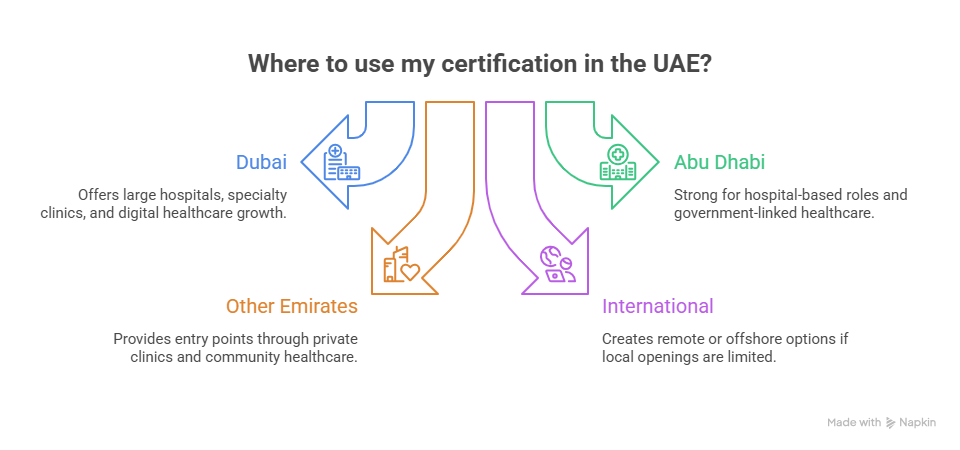
Dubai is often attractive for candidates because it has large private hospitals, specialty clinics, international patient traffic, and digital healthcare growth. A medical scribe certificate can support applications for outpatient documentation, clinical assistant support, health information, medical records, telehealth coordination, and physician documentation roles. The best approach is to search broadly across hospital career pages, private clinic groups, medical staffing platforms, and UAE job boards. Match your resume language to the posting. If the role mentions EMR, charting, patient history, medical terminology, transcription, or clinical documentation, connect your certification to those duties through EMR integration tools, telehealth administration, virtual patient management, and medical records release workflows.
Abu Dhabi can be strong for hospital-based roles, health information management, specialty medicine, and government-linked healthcare environments. The application process may feel more formal, especially where job titles overlap with regulated professional categories. Ask direct questions before assuming requirements. Does the employer classify the job as medical administration, documentation support, medical transcription, health information, clinical assistance, or a licensed clinical title? Does the role require a UAE health authority evaluation, prior hospital experience, or an internal training period? Use healthcare compliance resources, medical scribe regulation updates, clinical research pathways, and hospitalist group research to understand role depth.
Sharjah, Ajman, Ras Al Khaimah, Fujairah, and Umm Al Quwain may offer different entry points, especially through private clinics, medical centers, community healthcare, telehealth support, and administrative documentation teams. These markets may have fewer “medical scribe” postings under that exact title, so search for adjacent roles. Health information assistant, medical transcriptionist, patient coordinator, medical secretary, clinic documentation assistant, and records support can still build relevant experience. Candidates who combine scribe certification with front desk operations, appointment scheduling, insurance verification, and patient portal workflows can compete for hybrid roles that need both documentation and office awareness.
International and offshore opportunities also matter. Some scribe employers support providers in the United States, United Kingdom, Gulf region, or international telemedicine market from remote or offshore teams. For UAE-based candidates, that can create options if local openings are limited or if relocation timing is uncertain. Build your profile around English medical terminology, time-zone flexibility, documentation speed, internet reliability, confidentiality, and specialty exposure. Research international scribe employers, healthcare recruiters, pre-med scribe pipelines, and hospitals hiring scribes before choosing your job-search lane.
5. How to Build a UAE-Ready Resume, Portfolio, and Interview Story
Your resume should make one message impossible to miss: you can improve provider documentation without creating patient safety, privacy, or workflow problems. Replace generic phrases with proof. Instead of “completed medical scribe course,” write “trained in HPI capture, SOAP note structure, EMR documentation, medical terminology, privacy-safe record handling, and specialty note workflows.” Instead of “good communication skills,” write “experienced in clarifying patient history, organizing provider instructions, and maintaining respectful patient-facing communication.” Use scribe resume strategy, medical scribe interview prep, standing out in healthcare interviews, and medical admin interview preparation to make your application sharper.
A UAE-ready portfolio can separate you from candidates who only list a certificate. Include fictional sample notes for primary care, urgent care, orthopedics, dermatology, cardiology, pediatrics, and telehealth. Add a terminology sheet, a list of EMR sections you understand, a privacy checklist, and a short explanation of how you handle unclear provider dictation. Keep all samples fictional. Use simulated cases instead of real patient data. This gives hiring managers something tangible to evaluate. Strengthen the portfolio with template libraries, urgent care documentation pathways, specialty network research, and telemedicine scribe guidance.
For interviews, prepare stories around pressure. A provider speaks quickly and corrects themselves. A patient gives a long history with missing dates. A telehealth visit has audio issues. A clinic runs behind. A chart has outdated medication information. A candidate who can explain their judgment in these moments will sound more credible than someone who only says they are detail-oriented. Use examples that show listening, verification, organization, confidentiality, and escalation. Connect your answers to active listening techniques, de-escalation techniques, handling patient complaints, and patient satisfaction impact.
Finally, plan your first 90 days after certification. Apply to at least four lanes: hospitals, specialty clinics, telehealth employers, and medical records or health information roles. Track the title, emirate, employer, duties, licensing language, EMR requirements, salary range, shift pattern, and follow-up date. Keep improving while you apply. Add ICD-10 awareness, CPT vocabulary, insurance basics, and specialty templates. Read UAE postings weekly and adjust your resume wording. Use medical scribe career FAQs, future trends in medical scribing, medical administration communities, and professional organization directories to keep your job search active and informed.
6. FAQs About Medical Scribe Certification in UAE
-
Medical scribe certification is best understood as an employer-facing career credential unless the exact job title falls under a regulated healthcare professional category. Many documentation, transcription, medical records, and physician support roles may value certification because it proves training in medical terminology, clinical documentation, EMR charting, and privacy discipline. Always ask the employer whether the role is documentation support, medical administration, health information, or a regulated clinical title.
-
Choose a certification that teaches real note-writing, not just definitions. A strong program should cover HPI, SOAP notes, review of systems, exam terminology, assessment and plan structure, EMR workflows, specialty documentation, privacy, and practice exams. Compare options through medical scribe training courses, scribe exam questions, exam confidence strategies, and first-try exam preparation.
-
You can compete better by building proof before applying. Create fictional sample notes, learn medical terminology, practice timed documentation, understand EMR sections, and prepare interview stories about accuracy, confidentiality, and provider support. UAE employers may prefer local healthcare experience, yet strong training plus a clean portfolio can help you enter through medical records, transcription, patient coordination, telehealth support, or clinic documentation roles. Use resume-building guidance, scribe interview questions, patient intake procedures, and EMR compliance training.
-
Search for medical scribe, clinical documentation assistant, medical transcriptionist, medical records officer, health information assistant, patient coordinator, medical secretary, physician documentation support, clinic documentation assistant, telehealth documentation assistant, and EMR support roles. Some UAE employers may use broader administrative titles while still requiring documentation skills. Expand your search using healthcare recruiter directories, international scribe employers, hospital hiring guides, and telehealth administration resources.
-
A scribe usually does not function as a coder, yet ICD-10 and CPT awareness can improve documentation quality. Understanding diagnosis language, procedure wording, visit complexity, and payer-related documentation pressure helps you create cleaner notes and communicate better with billing-adjacent teams. Start with practical awareness through the ICD-10 dictionary, CPT code guide, CPT training for medical admins, and medical billing terms.
-
Many candidates can prepare in 30 to 60 focused days if they study consistently. A strong routine includes terminology review, note-writing practice, EMR vocabulary, privacy rules, and timed exam questions. Candidates with healthcare experience may move faster. Beginners should spend more time on anatomy terms, common symptoms, chart structure, and specialty workflows. Build your schedule with the 30-day certification plan, medical term memorization guide, exam strategy guide, and medical scribe FAQs.
