

The Ultimate Guide to Getting Your Medical Scribe Certification in India: All You Need to Know in 2026-2027
India is becoming one of the strongest career bases for medical scribes because the role sits at the intersection of clinical documentation, remote healthcare support, EMR accuracy, and international provider workflows. A strong certification gives Indian candidates a way to prove they understand real charting pressure, not just medical vocabulary. This guide shows how to choose training, build exam-ready skills, avoid weak documentation habits, and prepare for local, offshore, specialty, and remote scribe opportunities in 2026-2027.

1. What Medical Scribe Certification Means in India in 2026-2027
A medical scribe certification in India should prove that you can listen like a clinician, document like a trained charting professional, and protect patient information with the discipline expected in modern healthcare environments. Indian candidates often prepare for roles supporting U.S., Gulf, UK-style, telehealth, outpatient, urgent care, specialty, and hospital-based workflows, so the best preparation combines medical terminology mastery, EMR charting terms, HIPAA privacy concepts, and clinical documentation accuracy.
The biggest mistake is treating scribing as typing. Employers care about whether you can capture the HPI cleanly, separate symptoms from diagnoses, avoid adding unsupported clinical meaning, and turn a fast encounter into a defensible note. That is why a strong path should include realistic scribe exam questions, scribe certification FAQs, medical scribe interview preparation, and first-try exam strategies instead of a loose list of anatomy terms.
For India specifically, certification has another layer: you may be competing for offshore documentation roles where your grammar, listening accuracy, time-zone discipline, internet reliability, specialty exposure, and understanding of international healthcare language can decide whether you get shortlisted. Candidates who study international medical scribe employers, voice recognition tools, EMR/EHR platforms, and telemedicine scribing enter interviews with sharper answers than candidates who only memorize abbreviations.
| # | Certification Area | Why It Matters in India | What to Practice | 2026-27 Career Angle |
|---|---|---|---|---|
| 1 | Medical terminology | Indian candidates often support international providers, so pronunciation variants matter. | Roots, suffixes, abbreviations, specialty terms | Strong foundation for offshore roles |
| 2 | HPI structure | Most failed notes break down in chronology, symptom detail, and relevance. | Onset, location, duration, severity, context | Key interview differentiator |
| 3 | ROS discipline | Weak scribes over-document negatives or miss relevant positives. | Pertinent positives and negatives | Useful for ED and urgent care charts |
| 4 | Physical exam language | The exam section must reflect what was actually performed or stated. | Normal findings, abnormal findings, system order | Needed for live-provider support |
| 5 | Assessment and plan | This section exposes whether a candidate understands clinical logic. | Diagnosis list, medication plan, tests, follow-up | Critical for specialty documentation |
| 6 | ICD-10 awareness | Scribes must recognize diagnostic specificity even when they do not code claims. | Common conditions, specificity, laterality | Helps with quality documentation |
| 7 | CPT awareness | Procedure language affects visit clarity, billing support, and note completeness. | Procedure descriptions, modifiers, visit types | Useful for outpatient teams |
| 8 | EMR navigation | Remote scribe productivity depends on moving quickly inside chart sections. | Templates, orders, note sections, shortcuts | Major hiring advantage |
| 9 | HIPAA and privacy | International support teams handle sensitive data under strict client rules. | PHI, minimum necessary, access control | Essential for global clients |
| 10 | Listening accuracy | Accents, speed, background noise, and specialty language create real risk. | Audio drills, medication names, dictation correction | Strong fit for night-shift remote work |
| 11 | Telehealth documentation | Virtual visits require clean consent, context, limitations, and follow-up details. | Remote encounter flow and portal messages | Growing remote-care advantage |
| 12 | Emergency documentation | ED notes move fast and punish vague timelines. | Chief complaint, MDM support, discharge plan | Great for high-speed learners |
| 13 | Primary care workflows | Chronic disease visits require medication, history, and follow-up precision. | Diabetes, hypertension, preventive care | Good entry-level specialty path |
| 14 | Orthopedic notes | Laterality, imaging, injury mechanism, and procedure history must stay exact. | Pain location, ROM, imaging terms | Strong specialty hiring route |
| 15 | Dermatology notes | Lesion description needs location, size, duration, and procedure detail. | Rashes, biopsies, cryotherapy, acne visits | Useful for outpatient scribing |
| 16 | Cardiology notes | Chest pain, risk factors, tests, and medication history require careful order. | EKG, stress test, echo, CAD terms | Premium specialty exposure |
| 17 | Pediatric notes | Age, guardian history, vaccines, and developmental details need clean separation. | Well-child visits, fever, growth history | Good family-care pathway |
| 18 | OB/GYN notes | Sensitive history requires accuracy, privacy, and careful language. | LMP, pregnancy history, screening terms | Specialty growth area |
| 19 | Hospitalist documentation | Inpatient notes require problem lists, daily changes, and care-team clarity. | Progress notes, labs, consults, discharge planning | Advanced documentation track |
| 20 | Clinical research awareness | Some scribes transition toward CRC support and research documentation. | Source notes, visit flow, protocol language | Good long-term career bridge |
| 21 | Insurance basics | Scribes benefit from understanding how documentation supports medical necessity. | Eligibility, authorization, claim language | Useful for admin crossover roles |
| 22 | Patient communication | Clear communication improves intake quality and reduces chart confusion. | Active listening, empathy, escalation phrases | Helps hybrid admin-scribe candidates |
| 23 | Scheduling context | Follow-up instructions lose value when appointment timing is vague. | Follow-up windows, referrals, procedure visits | Good for clinic operations roles |
| 24 | Interview readiness | Employers test judgment, speed, correction habits, and privacy discipline. | Scenario answers, sample notes, typing drills | Direct hiring impact |
| 25 | Resume proof | A certificate works harder when paired with documented skills and examples. | Skills section, tools, specialties, mock charting | Improves shortlist chances |
| 26 | 30-day review plan | Scattered study creates confidence without readiness. | Daily sections, timed notes, error log | Best final exam push |
2. Choose the Right Certification Path: Training, Skill Proof, and Employer Fit
The right certification path starts with the role you want. If you want U.S.-provider remote work from India, prioritize international and offshore scribe employers, EMR platform familiarity, HIPAA compliance for scribes, voice recognition software, and telemedicine documentation. If you want a clinic-side or hospital-side path in India, add patient intake procedures, front desk operations, appointment scheduling best practices, and effective patient communication.
A serious certification path should include four proof layers. First, you need knowledge proof through terminology, anatomy, chart structure, abbreviations, and compliance. Second, you need performance proof through timed note-taking drills and sample chart correction. Third, you need workflow proof through exposure to specialty documentation templates, urgent care workflows, primary care documentation, and hospitalist groups. Fourth, you need hiring proof through a resume, mock interview answers, and a short portfolio of corrected sample notes.
For 2026-2027, the smartest Indian candidates will position themselves as documentation professionals who can reduce clinician load, protect chart accuracy, and function inside digital health environments. Use how to ace your medical scribe certification exam, medical scribe certification FAQs, real-life scribe journeys, and top hospitals hiring medical scribes to connect study decisions with career outcomes. Certification becomes more useful when every module answers a hiring question: Can you document safely, quickly, clearly, and consistently?
3. Build the Skills Indian Scribe Employers Actually Test
Employers rarely care about perfect textbook memory in isolation. They care about what happens when the provider speaks fast, the patient gives history out of order, the diagnosis changes during the visit, and the follow-up instructions come at the end. That is why your preparation should combine complex medical term memorization, clinical documentation terms, EMR charting concepts, ICD-10 reference practice, and CPT code awareness.
Start with HPI because it is the section where most weak notes collapse. A strong HPI shows why the patient came in, when the issue started, how it changed, what makes it better or worse, what relevant negatives were discussed, and what context matters clinically. Then train ROS and physical exam discipline so your notes avoid bloated copy-paste patterns. Use medical terminology tutorials, scribe exam questions, HIPAA terms, and patient privacy essentials to turn raw knowledge into safer charting habits.
The next layer is speed with accuracy. A scribe who types fast and misunderstands the assessment creates risk. A slower scribe who misses follow-up instructions creates operational drag. Build daily drills around five tasks: listen, outline, document, verify, and correct. Practice with EMR shortcuts, EMR software issue resolution, patient record updates, and dictation software tools. Your goal is clean capture under pressure, because a certificate opens the door and skill keeps you inside.
4. India-Specific Job Strategy: Remote, Offshore, Hospital, Specialty, and Gap-Year Tracks
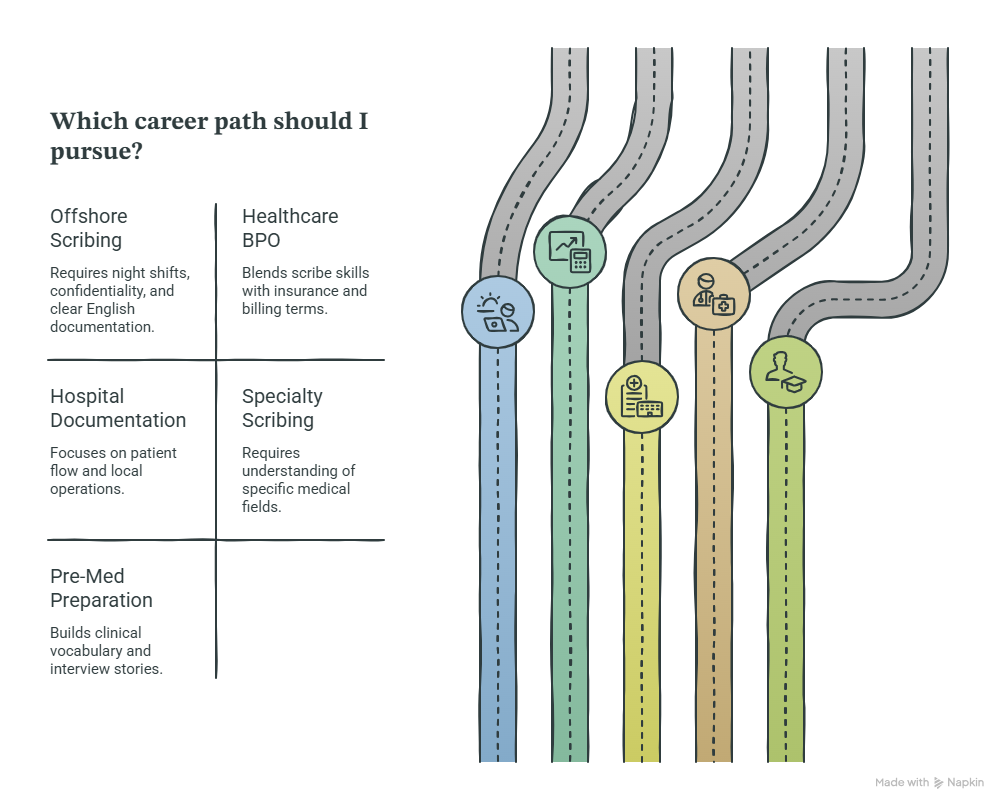
India-based medical scribe candidates usually fit into five career lanes. The first is offshore scribing for international providers, where night shifts, confidentiality, internet stability, and clear English documentation matter. The second is healthcare BPO documentation support, where scribe skills blend with insurance verification, medical billing terms, claims management, and denial management. The third is hospital or clinic documentation support, where patient flow, intake, and local operations matter.
The fourth lane is specialty scribing. A candidate who understands orthopedic and sports medicine groups, dermatology and ophthalmology practices, pediatric and OB/GYN networks, outpatient specialty networks, and clinical research sites can aim beyond generic entry-level roles. The fifth lane is pre-med or healthcare career preparation, where scribing builds clinical vocabulary, documentation exposure, and interview stories for future education or healthcare administration plans.
For job search, build a three-part profile. Your resume should show certification, terminology strength, EMR exposure, typing speed, privacy awareness, and sample note practice. Your interview answers should explain how you handle uncertainty, missing information, provider corrections, and sensitive data. Your application list should include scribe staffing agencies, health systems hiring scribes, academic medical centers, urgent care and retail clinic brands, and healthcare recruiter platforms.
India candidates should also prepare for operational realities. Many remote roles require quiet workspaces, dual-monitor comfort, secure systems, time-zone discipline, and professional escalation. If you are targeting blended admin-scribe roles, strengthen telehealth platform terms, healthcare portal terms, patient communication apps, and virtual patient management. These skills help you answer the real hiring question behind every interview: Can this candidate protect the provider’s time while protecting the chart?
5. 2026-2027 Study Plan: From Beginner to Interview-Ready Scribe
A strong 30-day plan should move from vocabulary to chart logic to timed performance. In week one, master medical roots, abbreviations, body systems, common conditions, and documentation sections. Pair medical terminology mastery with complex medical term memorization, top scribe terms, and EMR charting vocabulary. Make flashcards only for terms you can place inside a real note; vocabulary that never reaches documentation becomes exam clutter.
In week two, move into note architecture. Learn how chief complaint, HPI, ROS, exam, assessment, plan, orders, follow-up, and patient education work together. Use specialty template libraries, ICD-10 dictionary practice, CPT code explanations, and HIPAA compliance guidance. Your end-of-week test should be a mock encounter where you identify what belongs in each section and what should stay out because it was unsupported, unclear, or outside the scribe’s role.
In week three, train under time pressure. Listen to sample clinical scenarios, create rough outlines, then rewrite them into polished chart language. Track recurring errors: missed negations, weak timelines, vague medication details, confused provider impressions, and incomplete follow-up plans. Use 30-day exam scheduling, first-try certification strategies, realistic exam questions, and scribe interview questions. Every wrong answer should become an error-log entry with the reason, correction, and prevention habit.
In week four, prepare for hiring. Build a resume that highlights certification, documentation strengths, EMR exposure, typing speed, privacy discipline, specialty interests, and remote-work readiness. Practice answers for “What would you do if you missed a word?”, “How do you handle conflicting information?”, “How do you protect patient privacy?”, and “How do you manage provider corrections?” Strengthen your profile with resume building guidance, medical admin interview preparation, scribe job interview prep, and career trend insights.
6. FAQs: Medical Scribe Certification in India
-
Yes. Certification is useful because Indian candidates often compete for remote, offshore, specialty, and documentation-support roles where employers need proof of charting knowledge, privacy awareness, and clinical language discipline. A strong candidate should combine medical scribe training, exam confidence strategies, HIPAA knowledge, and EMR charting terms before applying.
-
Many entry-level scribe training paths are accessible to motivated students, especially those with strong English, biology interest, listening accuracy, and disciplined study habits. Students planning healthcare careers should use pre-med gap-year scribe tracks, medical terminology tutorials, scribe exam questions, and real-life scribe journeys to understand the path before committing.
-
The most important skills are clinical listening, HPI structure, medical terminology, EMR navigation, privacy discipline, typing speed, and the ability to separate patient-reported symptoms from provider-confirmed diagnoses. Study clinical documentation terms, ICD-10 codes, CPT codes, and patient privacy communication for a balanced base.
-
Remote opportunities can exist through international scribe companies, healthcare outsourcing teams, and documentation-support employers. Candidates should prepare for time-zone requirements, secure work environments, audio quality, productivity tracking, and client-specific EMR rules. Use international scribe employer directories, scribe staffing agency lists, voice recognition tools, and telemedicine scribe guidance while applying.
-
A focused beginner can often build a strong foundation in 30 to 60 days if they study daily, practice timed notes, review errors, and prepare for interviews alongside exam topics. Use 30-day certification scheduling, first-try exam strategies, medical term memorization, and certification FAQs for a clean preparation structure.
-
Primary care, urgent care, orthopedics, dermatology, pediatrics, OB/GYN, and telehealth are strong learning environments because they expose candidates to repeatable workflows and practical terminology. Build specialty awareness with primary care networks, orthopedic groups, dermatology and ophthalmology practices, and pediatric and women’s health networks.
