

The Ultimate Guide to Getting Your Medical Scribe Certification in Bahrain: All You Need to Know in 2026-2027
Getting your medical scribe certification in Bahrain in 2026-2027 should be treated as a career-positioning move, especially if you want stronger roles in clinics, hospitals, telehealth teams, or international scribe operations. The strongest candidates understand medical scribe training courses, build sharp medical terminology mastery, learn EMR charting terms, and document with HIPAA-style privacy discipline from day one.
In Bahrain, the opportunity is strongest for candidates who can prove accuracy before asking for trust. Certification gives you structure, yet your real edge comes from clean SOAP notes, quick specialty vocabulary, careful listening, and the ability to support physicians without creating documentation risk.

1. What Medical Scribe Certification Means in Bahrain in 2026-2027
A medical scribe certification in Bahrain should prepare you for the daily documentation work that makes or breaks clinical efficiency: listening to the encounter, capturing the history, organizing symptoms, recording exam findings, tracking provider impressions, and turning the plan into a clear note. A weak candidate says they “know typing.” A strong candidate can explain top medical scribe documentation terms, recognize common ICD-10 code logic, understand basic CPT code language, and handle patient intake procedures without slowing the provider down.
The most important mindset shift is simple: certification should make you safer to train. Bahrain-based clinics, Gulf healthcare groups, and remote scribe teams want someone who can enter the workday with fewer risky habits. That means you should know how to separate patient-reported symptoms from provider conclusions, how to record pertinent negatives, how to avoid over-documenting vague impressions, and how to keep privacy language tight through patient privacy communication essentials, healthcare portal terms, and telehealth platform basics.
For 2026-2027, certification also matters because medical documentation is becoming more hybrid. Scribes may support in-person doctors, telemedicine providers, outpatient specialists, hospitalist groups, urgent care teams, or offshore documentation workflows. A Bahrain candidate who studies international scribe employers, telemedicine scribe roles, clinical documentation template libraries, and voice recognition tools becomes more adaptable than someone who studies only generic definitions.
2. Who Should Get Medical Scribe Certified in Bahrain?
Medical scribe certification in Bahrain makes the most sense for five groups: pre-med students, allied health graduates, healthcare admin workers, bilingual candidates comfortable with clinical English, and remote-work applicants targeting international documentation teams. If you want a healthcare role that builds real clinical exposure without placing you in a licensed decision-making position, scribing gives you a structured path into physician workflow, terminology, patient stories, and chart logic. Start with medical scribe certification FAQs, then use realistic scribe exam questions, medical scribe interview prep, and scribe job interview answers to turn certification into employability.
The best candidates in Bahrain will treat certification as proof of workflow readiness. Clinics fear three beginner problems: inaccurate notes, privacy mistakes, and slow chart completion. A candidate who studies EMR integration tools, EMR software issue resolution, top EMR shortcuts, and patient record update compliance sends a stronger signal than someone who only lists “fast typing” on a resume.
Certification is especially valuable if you want to compete beyond Bahrain. Many documentation teams hire across regions, and Gulf-based applicants can position themselves for healthcare support roles connected to Bahrain, Saudi Arabia, Qatar, Kuwait, Oman, the UAE, and offshore scribe models. Compare nearby markets through the ACMSO guides for medical scribe certification in UAE, Saudi Arabia scribe certification, Qatar scribe certification, and Kuwait scribe certification if you want a wider Gulf strategy.
3. What a Strong Bahrain Medical Scribe Certification Program Should Teach
A strong program should train you on the actual work, meaning a certification should cover listening, summarizing, chart organization, clinical terminology, documentation boundaries, privacy, EMR navigation, and specialty-specific patterns. The program should make you comfortable with complaints like chest pain, abdominal pain, fever, dizziness, joint pain, rash, headache, shortness of breath, pregnancy-related concerns, pediatric symptoms, and chronic disease follow-up. Use orthopedic and sports medicine scribe hiring trends, dermatology and ophthalmology scribe networks, primary care scribe networks, and pediatric and women’s health scribe employers to understand how different specialties shape documentation.
The strongest curriculum also teaches what to leave out. Beginner scribes often over-document irrelevant normal findings, miss key negatives, place patient guesses into the assessment, or record uncertain statements as confirmed diagnoses. That creates chart noise, billing confusion, and provider cleanup work. You need practice turning raw encounter language into accurate sections. Build that skill with documentation template libraries, insurance verification examples, medical billing terms, and denial management basics, because documentation quality often affects downstream revenue-cycle work.
For Bahrain specifically, choose training that respects a regulated healthcare environment, employer supervision, privacy expectations, and the difference between documentation support and clinical judgment. A scribe should record what happens, support the provider’s charting process, and follow facility policy. The role works best when you understand legal responsibilities for healthcare admins, risk management strategies, regulatory changes affecting scribe roles, and healthcare CRM terms, since modern documentation rarely sits in isolation.
4. Step-by-Step Path to Getting Medical Scribe Certified in Bahrain
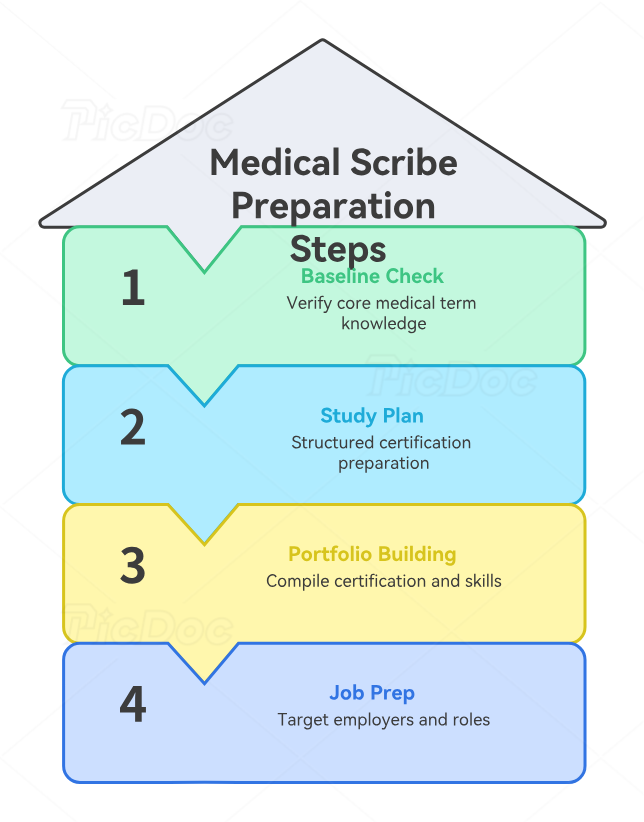
Start with a brutally honest baseline check. Can you define HPI, ROS, PE, MDM, assessment, plan, differential diagnosis, chief complaint, pertinent negative, chronic condition, acute exacerbation, and follow-up instruction without guessing? Can you listen to a two-minute clinical scenario and organize it into chart sections? If the answer feels shaky, begin with how to memorize complex medical terms, medical terminology tutorials, top scribe documentation terms, and medical scribe certification FAQs.
Next, choose a certification path with enough practice. A good study plan should include daily terminology review, weekly note-writing drills, EMR vocabulary study, privacy scenarios, mock encounters, and timed exam questions. Use the 30-day ACMSO certification study schedule, first-try exam strategies, realistic exam questions, and scribe exam confidence guide to avoid shallow memorization.
After certification, build an application portfolio. Include your certification, typing speed if strong, sample de-identified note structures, EMR vocabulary, specialties studied, privacy training, and any healthcare exposure. Then prepare for employers through top hospitals hiring medical scribes, health systems hiring scribes by state, medical scribe companies worldwide, and healthcare recruiters posting scribe roles. Bahrain candidates should also search for adjacent titles such as clinical documentation assistant, physician documentation assistant, virtual medical scribe, patient documentation coordinator, and healthcare documentation specialist.
5. How to Use Certification to Get Hired in Bahrain or Remote Scribe Roles
The hiring challenge in Bahrain is usually proof. Employers want to know whether you can survive real workflow pressure: fast speech, incomplete patient histories, unfamiliar abbreviations, accents, background noise, rushed follow-ups, and provider preferences. Your resume should show the exact areas you can support, such as outpatient documentation, telehealth charting, urgent care notes, specialist terminology, EMR navigation, privacy discipline, and patient intake. Strengthen that positioning with building a standout healthcare resume, interview preparation for medical admin roles, medical scribe interview questions, and how to stand out in healthcare job interviews.
Your interview answers should sound practical. Instead of saying you are “detail-oriented,” explain how you capture onset, location, duration, severity, modifying factors, associated symptoms, and pertinent negatives inside an HPI. Instead of saying you understand privacy, explain chart-access discipline, patient identifiers, secure communication, and why casual sharing damages trust. Use patient privacy essentials, top HIPAA terms, de-escalation techniques, and active listening techniques to create answers that feel grounded in clinic reality.
Remote roles require even tighter discipline. You may be judged on audio comprehension, secure workspace habits, software comfort, responsiveness, and written English. Prepare with telehealth administration skills, virtual patient management, patient communication apps, and best collaboration tools for medical office teams. A Bahrain-based applicant who can prove quiet workspace setup, confidentiality, fast note turnaround, and specialty readiness has a much stronger remote profile than someone who relies only on a certificate title.
6. FAQs About Medical Scribe Certification in Bahrain
-
Requirements depend on the employer, role scope, facility policy, and whether the position is local, remote, or international. Certification is valuable because it proves structured preparation in clinical documentation, EMR charting, medical terminology, and privacy compliance. For Bahrain-based onsite roles, always confirm the employer’s local onboarding requirements, facility access rules, and documentation scope before assuming certification alone covers every requirement.
-
Start with medical terminology and chart structure. Learn common symptoms, abbreviations, body systems, SOAP notes, HPI structure, ROS language, exam wording, assessment language, and plan documentation. Then move into ICD-10 awareness, CPT basics, patient intake procedures, and realistic scribe exam practice. This order works because it builds comprehension before speed.
-
Yes, certification can support remote applications when paired with strong English documentation skills, secure workspace habits, fast listening, EMR vocabulary, and interview readiness. Remote employers often care about accuracy, privacy, software comfort, and turnaround time. Strengthen your remote profile with medical scribes and telemedicine, telehealth platforms, virtual patient management, and international scribe employers.
-
A focused beginner can often build a strong foundation in 30 to 60 days with daily study, terminology drills, charting practice, and exam review. Candidates with healthcare exposure may move faster, while candidates new to clinical vocabulary should spend extra time on complex medical terms, scribe exam strategies, 30-day certification planning, and exam confidence preparation.
-
The biggest mistakes are vague HPI documentation, missing pertinent negatives, mixing patient statements with provider conclusions, copying irrelevant template text, ignoring privacy rules, and finishing charts too slowly. These issues make providers lose confidence quickly. Fix them through documentation templates, EMR shortcuts, patient privacy communication, and time management mastery.
-
After certification, build a job-ready package: a focused resume, a list of target employers, three sample interview stories, specialty vocabulary notes, and a weekly application plan. Use top hospitals hiring medical scribes, medical scribe companies worldwide, healthcare recruiters, and from scribe to physician journeys to turn certification into a practical career move.
