

The Ultimate Guide to Getting Your Medical Scribe Certification in Massachusetts: All You Need to Know in 2025-2026
Massachusetts is one of the strongest places to build a medical scribe career because the state rewards sharp documentation, fast EHR confidence, privacy discipline, and specialty awareness. A strong certification plan helps you move from basic note-taking into real clinical documentation value, especially if you use focused resources like medical scribe certification training, medical terminology mastery, HIPAA compliance for scribes, and realistic scribe exam questions.
1. Why Medical Scribe Certification Matters in Massachusetts in 2025-2026
Massachusetts scribe candidates compete in a healthcare market where hospitals, outpatient groups, telehealth teams, urgent care brands, and academic medical centers expect far more than “good typing.” Your certification should prove that you can listen under pressure, capture medically relevant facts, protect patient information, use EHR workflows cleanly, and understand the difference between what the patient says, what the provider observes, and what the provider decides. That is why your prep should combine top scribe certification courses, top EMR platforms for scribes, must-know charting terms, documentation vocabulary, and HIPAA terms for scribes.
The biggest mistake Massachusetts applicants make is treating certification as a certificate to collect rather than a job-readiness system. A Boston, Cambridge, Worcester, Springfield, or Lowell employer wants evidence that you can survive a rushed clinic session without creating vague HPIs, missing pertinent negatives, mixing up impressions with confirmed diagnoses, or leaving the provider with an unsigned mess. Massachusetts rules also emphasize medical records that are complete, timely, legible, and adequate for diagnosis and treatment, with general retention requirements that make documentation quality a serious operational issue.
Current scribe job postings show the same practical pattern. A ScribeAmerica Boston listing references requirements such as a high school diploma or equivalent, being at least 18, English fluency, listening and communication skills, and a 40+ WPM typing speed, while a Boston Medical Center listing describes real-time charting, note preparation, accurate documentation, follow-up activities, and successful completion of a scribe course as required. That means your plan should build proof across interview preparation, scribe exam confidence, medical scribe FAQs, EHR troubleshooting, and telemedicine scribing.
| # | Certification Planning Area | Massachusetts Action Step | What It Protects You From | ACMSO Resource |
|---|---|---|---|---|
| 1 | Role clarity | Learn the scribe scope before applying to Boston-area hospitals. | Overstepping into clinical decision-making. | Medical scribe certification FAQs |
| 2 | Terminology foundation | Master prefixes, suffixes, abbreviations, symptoms, and exam language. | Mishearing clinical terms during fast encounters. | Medical terminology mastery |
| 3 | Documentation language | Study chief complaint, HPI, ROS, PE, assessment, and plan structure. | Writing notes that sound busy but lack clinical usefulness. | Terms scribes must master |
| 4 | EHR confidence | Learn common EHR sections before your first training shift. | Freezing when asked to update a chart quickly. | Top EMR/EHR platforms |
| 5 | Typing speed | Build toward clean, accurate real-time entry. | Missing details because your fingers cannot keep up. | EMR shortcuts |
| 6 | HIPAA discipline | Study PHI, access control, minimum necessary, and patient privacy. | Privacy errors that damage trust immediately. | HIPAA compliance for scribes |
| 7 | Coding awareness | Understand ICD-10 and CPT enough to support accurate documentation. | Leaving notes too vague for downstream billing review. | ICD-10 code dictionary |
| 8 | Procedure language | Learn common CPT-driven documentation expectations. | Under-documenting procedures, modifiers, and visit complexity. | CPT codes explained |
| 9 | Patient intake | Learn intake flow so the note begins with clean context. | Confusing demographics, complaint, history, and visit purpose. | Patient intake procedures |
| 10 | Communication | Practice listening for patient language and provider interpretation. | Turning human stories into flat, incomplete notes. | Patient communication terms |
| 11 | Telehealth readiness | Prepare for virtual visits, remote workflows, and portal-based follow-up. | Missing key details because the visit happens through a screen. | Scribes and telemedicine |
| 12 | Portal fluency | Understand patient portal terminology and message workflows. | Losing track of follow-up instructions and record access steps. | Healthcare portal terms |
| 13 | Specialty selection | Pick two specialties to study deeply before applying. | Sounding generic in interviews. | Outpatient specialty networks |
| 14 | Emergency care pace | Study ED note speed, prioritization, and high-volume encounter flow. | Becoming overwhelmed by rapid provider movement. | ED and urgent care directory |
| 15 | Teaching hospital awareness | Prepare for academic language, residents, fellows, and layered teams. | Getting lost in multi-provider conversations. | Academic medical centers |
| 16 | Dermatology and ophthalmology | Learn lesion, exam, imaging, vision, and follow-up language. | Creating thin notes in detail-heavy specialties. | Dermatology and ophthalmology practices |
| 17 | Orthopedics | Study laterality, imaging, injury mechanism, range of motion, and plan language. | Missing specificity that changes the usefulness of the note. | Orthopedic scribe groups |
| 18 | Primary care | Practice multi-problem visits, chronic care updates, screening, and medication lists. | Losing structure when one visit has five concerns. | Primary care scribe networks |
| 19 | Pediatrics and women’s health | Study age-specific histories, guardian communication, OB/GYN terms, and sensitive documentation. | Handling sensitive encounters without enough vocabulary. | Pediatric and OB/GYN networks |
| 20 | Template literacy | Build familiarity with common specialty note templates. | Stuffing notes with boilerplate that fails the visit. | Documentation template libraries |
| 21 | Voice recognition awareness | Understand how dictation tools change provider expectations. | Competing with automation without adding human judgment. | Voice recognition tools |
| 22 | Certification exam prep | Use practice questions to find weak spots before test day. | Passing memorization quizzes while failing realistic scenarios. | Realistic scribe exam questions |
| 23 | Study scheduling | Use a 30-day plan with terminology, charting, privacy, and practice notes. | Cramming without building usable speed. | 30-day certification schedule |
| 24 | Resume proof | Show typing speed, EHR exposure, HIPAA training, certification, and specialty interest. | Submitting a resume that sounds like every other pre-health applicant. | Standout healthcare resume guide |
| 25 | Interview readiness | Prepare examples about accuracy, confidentiality, speed, and provider support. | Giving vague answers when asked about pressure. | Scribe interview prep |
| 26 | Employer targeting | Apply across hospitals, urgent care, specialty groups, staffing firms, and teaching clinics. | Relying on one job board and waiting too long. | Hospitals hiring scribes |
| 27 | Staffing agency strategy | Use staffing firms for entry-level openings and training pathways. | Missing high-volume opportunities. | Scribe staffing agencies |
| 28 | Long-term pathway | Map your scribe role toward pre-med, CRC, admin, informatics, or clinical operations goals. | Treating the first scribe job as the finish line. | From scribe to physician |
2. Step-by-Step Certification Path for Massachusetts Scribe Candidates
Start by deciding which type of scribe role you want: emergency department, outpatient specialty, primary care, telehealth, academic medicine, or hybrid admin-scribe support. Each setting rewards a different skill mix. ED roles demand speed and prioritization; outpatient roles demand clean follow-up and specialty language; academic centers demand comfort around layered teams; telehealth demands calm listening and screen-based workflow discipline. Use emergency department and urgent care roles, outpatient specialty scribe networks, academic medical center opportunities, telehealth administration basics, and medical scribes in telemedicine to choose your lane before you study.
Next, build your knowledge stack in the right order. Start with medical terminology because every charting mistake becomes more expensive when the vocabulary is weak. Then move into anatomy, common abbreviations, clinical note structure, HIPAA, EHR navigation, specialty templates, ICD-10 awareness, and CPT awareness. A candidate who studies complex medical terms, ICD-10 code context, CPT code basics, medical billing terms, and documentation template libraries can speak more intelligently in interviews because they understand how the note travels beyond the room.
Then choose a certification program that tests real scribe judgment rather than passive reading. Your course should include documentation sections, realistic scenarios, privacy training, EHR exposure, terminology, provider workflow, and exam-style practice. A weak course leaves you with vocabulary fragments; a strong one teaches you how to capture the encounter without adding your own clinical conclusions. Pair ACMSO exam strategies, scribe exam confidence tips, realistic exam questions, medical scribe certification FAQs, and top scribe courses so your prep feels like job training, not trivia.
Finally, create proof. Massachusetts employers care about whether you can perform on shift, so document your typing speed, certification status, HIPAA knowledge, EHR familiarity, specialty interest, and ability to write clean sample notes. Use your resume to show outcomes: “trained in SOAP note structure,” “practiced HPI capture,” “completed HIPAA modules,” “familiar with Epic-style EHR navigation,” or “prepared for outpatient specialty documentation.” Then prepare answers using scribe job interview questions, interview preparation for scribe roles, standout healthcare resume guidance, healthcare recruiters posting scribe roles, and hospitals hiring medical scribes.
3. Skills Massachusetts Employers Will Expect After Certification
The first skill is accurate HPI capture. In a busy Massachusetts clinic, a provider may move from chest pain to medication history to imaging results to follow-up within minutes. Your job is to catch onset, location, duration, severity, modifying factors, associated symptoms, prior treatment, pertinent negatives, and patient context without turning the note into a transcript. Use terms scribes must master, medical terminology tools, patient communication examples, active listening techniques, and patient intake procedures to build that listening muscle.
The second skill is clinical humility. A scribe documents what the provider says and what belongs in the record; the scribe does not diagnose, interpret independently, or create medical judgment. CMS guidance describes scribes as documentation support rather than providers of items or services, and the treating physician or practitioner’s signature indicates affirmation of the note. That makes your wording discipline essential. Study HIPAA privacy terms, HIPAA compliance, regulations shaping scribe roles, patient privacy communication, and risk management strategies.
The third skill is EHR fluency. Many new scribes lose credibility because they can describe documentation theory but struggle to navigate labs, imaging, medication lists, order queues, referrals, follow-up tasks, and previous notes. A certification plan should expose you to EHR sections, charting shortcuts, template logic, patient portals, telehealth platforms, and common troubleshooting situations. Use EMR/EHR platforms, EMR integration tools, EMR shortcuts, record update training, and EHR issue resolution before your first shift.
The fourth skill is privacy reflex. HIPAA sets national standards for protecting medical records and individually identifiable health information, so every scribe must understand how PHI appears in conversations, screens, printed documents, patient portals, referrals, and messages. In Massachusetts, where teaching clinics and specialty centers may involve multiple team members, your privacy habits should be automatic: lock screens, avoid casual hallway details, confirm access rules, and treat every chart as need-to-know. Strengthen this through patient privacy essentials, HIPAA terms for administrative assistants, legal responsibilities, patient record compliance training, and healthcare portal terms.
4. Best Massachusetts Job Settings After Medical Scribe Certification
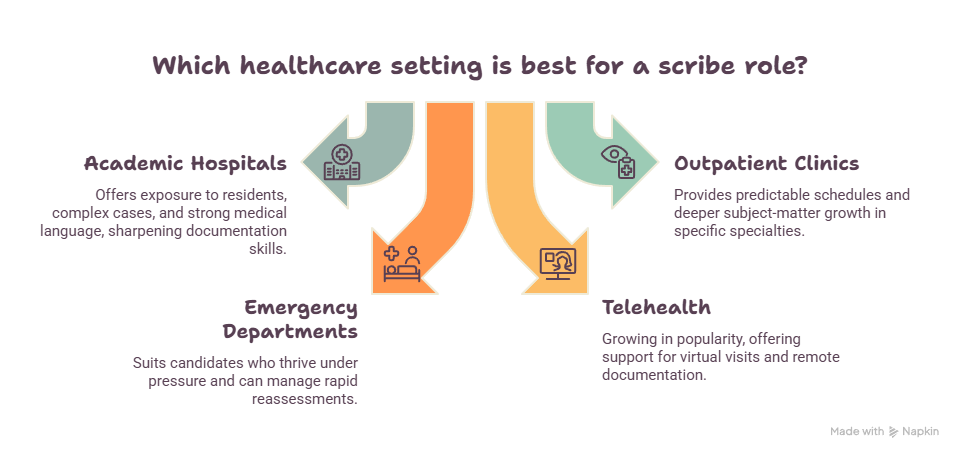
Boston-area academic and teaching hospitals are excellent for candidates who want exposure to residents, fellows, complex cases, specialty clinics, and strong medical language. These settings can sharpen your documentation faster because every encounter may include more context, more decision points, and more downstream coordination. Prepare with academic medical center scribe lists, top hospitals hiring scribes, clinical research sites with scribe-to-CRC tracks, medical scribe companies, and healthcare recruiters.
Outpatient specialty clinics are often the best fit for Massachusetts candidates who want predictable schedules and deeper subject-matter growth. Cardiology, orthopedics, dermatology, ophthalmology, GI, women’s health, pediatrics, and primary care all use different note patterns. Your advantage comes from walking into the interview with specialty vocabulary already chosen. Use outpatient specialty networks, dermatology and ophthalmology practices, orthopedic and sports medicine groups, primary care networks, and pediatric and women’s health networks.
Emergency departments and urgent care centers suit candidates who can stay calm when the room moves quickly. The pressure is different: incomplete histories, rapid reassessments, changing plans, multiple providers, and time-sensitive documentation. If you choose this lane, study triage language, symptom timelines, pertinent negatives, reassessment documentation, discharge instructions, and handoff clarity. ACMSO resources such as emergency department and urgent care chains, urgent care and retail clinic brands, emergency appointment management, appointment scheduling conflicts, and de-escalation techniques can help you prepare for the patient-flow side of the job.
Telehealth and hybrid documentation roles are growing because providers need support across video visits, portal follow-ups, remote documentation, and digital records. A Massachusetts candidate who can handle virtual visits, portal language, privacy rules, and clean follow-up instructions may stand out beyond classic in-room scribe applicants. Prepare with telehealth platforms, virtual patient management, telehealth administration, patient communication apps, and healthcare CRM terms.
5. Your 30-60-90 Day Massachusetts Certification and Job Plan
For the first 30 days, focus on building the base that prevents embarrassment later. Spend the first week on terminology, abbreviations, anatomy, and documentation sections. Spend the second week on HIPAA, PHI, patient privacy, and record access. Spend the third week writing sample SOAP notes from mock encounters. Spend the fourth week on certification review, timed practice, and weak-area repair. Use 30-day ACMSO exam scheduling, ACMSO first-try strategies, medical terms memorization, realistic scribe exam questions, and CMAA exam tips if you also want admin-side strength.
For days 31 to 60, build job proof. Measure your typing speed, create a one-page documentation skills sheet, prepare two sample notes, choose two specialty lanes, and rewrite your resume around evidence. Replace weak claims like “good communicator” with proof such as “trained in HPI structure,” “completed HIPAA-focused documentation modules,” “familiar with EHR navigation,” and “prepared for outpatient specialty workflows.” Use standout resume guidance, medical admin interview preparation, scribe interview prep, how to stand out in interviews, and healthcare talent platforms.
For days 61 to 90, apply strategically across Massachusetts. Target Boston and Cambridge for academic and specialty exposure, Worcester and Springfield for broad health-system opportunities, and surrounding suburbs for outpatient clinics, urgent care groups, dermatology practices, orthopedic groups, primary care offices, and telehealth support roles. Send tailored applications that name the setting and show relevant preparation. A dermatology application should mention lesion terminology and image-linked workflows; an ED application should mention speed and prioritization; a primary care application should mention multi-problem visit structure. Use top health systems hiring scribes, top hospitals hiring scribes, urgent care brands, community health centers, and pre-med gap-year programs.
The final step is interview conversion. Prepare five stories: a time you handled pressure, a time you protected confidentiality, a time you learned complex terminology, a time you corrected an error, and a time you supported a team. Then connect every answer back to the scribe job: accuracy, speed, privacy, scope, provider support, and patient flow. Review medical scribe interview questions, expert scribe interview answers, patient communication scenarios, empathy in healthcare administration, and difficult patient conversations before speaking with recruiters or clinic managers.
6. FAQs: Getting Your Medical Scribe Certification in Massachusetts
-
Massachusetts scribe hiring is mainly employer-driven, so candidates should focus on certification, documentation training, privacy knowledge, typing speed, and EHR readiness. The smarter move is to prepare for the standards employers actually list: completion of a scribe course, accurate real-time charting, follow-up support, communication skills, and confidentiality. Pair scribe certification FAQs, top certification courses, HIPAA compliance, and scribe exam questions with the exact job description you are targeting.
-
A focused candidate can build a solid foundation in 30 to 60 days, then spend the next month applying, interviewing, and refining specialty knowledge. The timeline depends on your starting point. A pre-med student with strong biology may need more EHR practice; a medical admin assistant may need deeper anatomy and note structure. Use 30-day exam prep, medical terminology tools, EMR platform awareness, and first-try certification strategies.
-
Choose the setting based on your career goal. Emergency departments build speed, outpatient specialties build deep vocabulary, academic centers build exposure to complex care teams, primary care builds broad clinical pattern recognition, and telehealth builds digital workflow strength. Review ED and urgent care opportunities, outpatient specialty networks, academic medical centers, and telemedicine scribe workflows.
-
Start with terminology, then note structure, then privacy, then EHR workflow, then specialty scenarios. Many candidates jump straight into practice questions and discover that they cannot explain why an HPI is weak or why a plan section is incomplete. Build your base through medical term memorization, must-know documentation terms, HIPAA terms, EHR charting terms, and realistic exam practice.
-
Certification gives you a language for proving readiness. Instead of saying you are interested in healthcare, you can explain how you trained in HPI capture, HIPAA privacy, chart structure, EHR navigation, and specialty documentation. Bring examples from scribe interview prep, interview questions scribes should expect, standout resume guidance, and healthcare recruiter directories.
-
The biggest mistake is writing notes that look full while missing the exact details the provider needs later. Length alone does not create quality. A strong note captures the reason for the visit, medically relevant history, objective details, provider assessment, orders, follow-up, and patient instructions with clean boundaries. Strengthen this with documentation templates, CPT code awareness, ICD-10 code context, and patient record compliance training.
