

Informed Consent: Interactive Dictionary & Practical Scenarios
Informed consent protects patient autonomy by turning a proposed treatment, procedure, disclosure, or research activity into an understandable decision. Medical administrative professionals often coordinate forms, interpreters, witnesses, electronic signatures, surrogate documentation, and record routing around that decision. Their accuracy supports patient confidentiality, medical compliance, patient education, effective patient communication, and defensible medical records management.
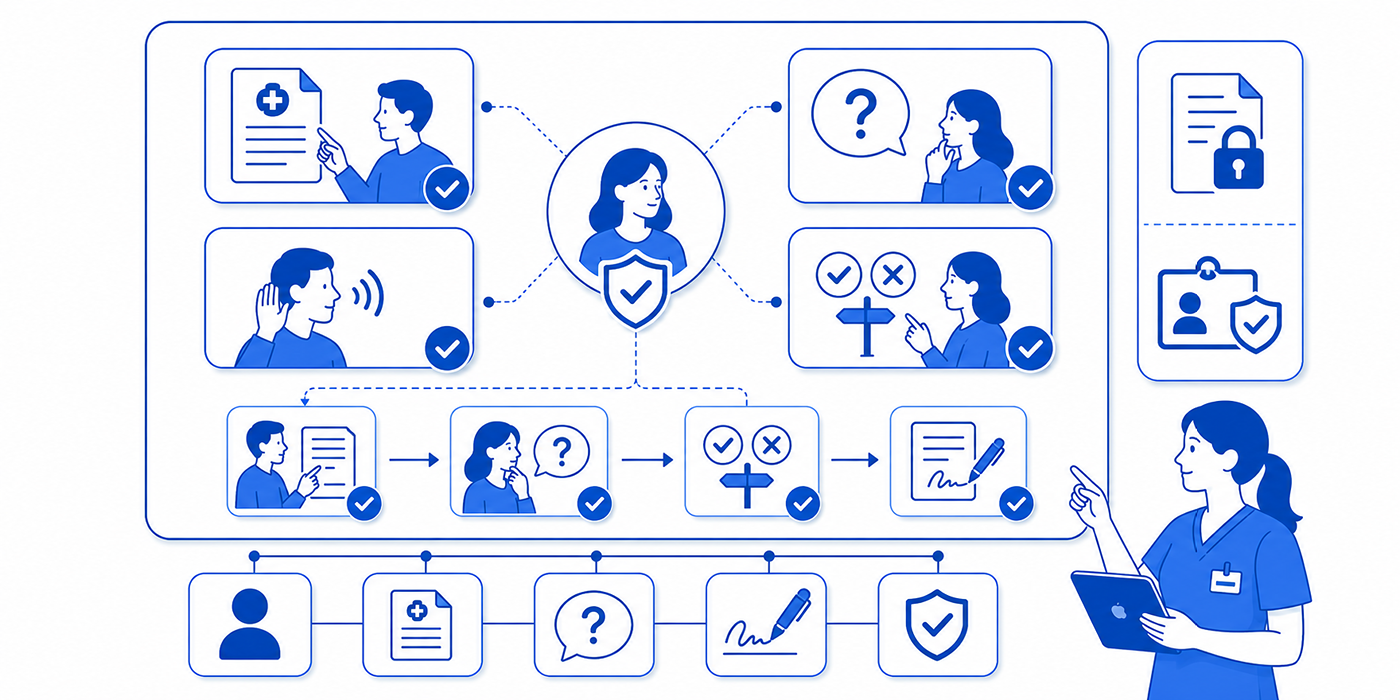
1. What Informed Consent Actually Requires in Healthcare
Informed consent develops through communication between a patient and the clinician responsible for the proposed intervention. The clinician explains the relevant diagnosis or clinical situation, the recommended action, anticipated benefits, material risks, reasonable alternatives, and the possible consequences of declining care. The patient then has an opportunity to ask questions and reach a voluntary decision. The AMA describes the result of this exchange as the patient’s authorization or agreement to undergo a specific medical intervention.
Administrative professionals strengthen this process by confirming that the correct form reaches the correct patient, checking whether required fields are complete, arranging medical interpreter services, maintaining patient privacy, routing clinical questions appropriately, and preserving the final document within the electronic health record. Their responsibilities must follow organizational policy, applicable law, and defined legal responsibilities for CMAAs.
A consent form records part of the process. The surrounding conversation establishes whether the patient received understandable information, had room to consider it, and made the decision voluntarily. HHS describes disclosure, comprehension, and voluntariness as central features of informed consent in human-subject research and emphasizes that a signed document alone cannot establish an adequate consent process. These principles also help healthcare teams evaluate the quality of clinical consent conversations.
Several operational failures can weaken consent. The wrong procedure may appear on the form. A sedated patient may be asked to sign. A relative may interpret highly sensitive information without the approved process. A staff member may describe the signature as “just paperwork.” A clinician’s unanswered question may be routed as an administrative issue. Each failure affects risk management, medical chart audits, patient satisfaction, and overall clinical documentation improvement.
The safest workflow separates administrative facilitation from clinical explanation. An administrator may identify missing signatures, verify demographic information, arrange a qualified interpreter, explain where to sign according to policy, and contact the responsible clinician when substantive questions arise. Questions about expected outcomes, individualized risks, treatment alternatives, or whether the patient should proceed belong with an appropriately qualified clinician. This boundary supports effective patient communication, medical administrative workflow, medical compliance training, and accurate patient record updates.
| # | Term | Practical Definition | Administrative Risk | Correct Workflow Response |
|---|---|---|---|---|
| 1 | Informed consent | A voluntary authorization reached after relevant information has been communicated and understood. | Treating the form as complete while the patient still has unanswered clinical questions. | Pause processing and route substantive questions through the approved medical administrative workflow. |
| 2 | Disclosure | Communication of the information reasonably needed for a decision, including purpose, benefits, risks, and alternatives. | Using a generic explanation that omits procedure-specific information. | Contact the responsible clinician and apply the organization’s medical compliance process. |
| 3 | Understanding | The patient’s ability to grasp the information and relate it to the decision being made. | Assuming a nod, signature, or polite “yes” proves comprehension. | Use approved communication support and reinforce patient education techniques. |
| 4 | Voluntariness | A decision made free from coercion, manipulation, or improper pressure. | Rushing the patient because the schedule is delayed or the procedure room is ready. | Create appropriate decision space and follow risk-management procedures. |
| 5 | Decision-making capacity | A patient’s ability to understand relevant information, appreciate consequences, reason about options, and communicate a choice. | Making an informal capacity judgment based on age, diagnosis, disability, accent, or appearance. | Refer concerns to the designated clinician under the organization’s legal responsibility framework. |
| 6 | Legal competence | A legal determination of a person’s authority to make decisions. | Using “capacity” and “competence” as interchangeable legal conclusions. | Use the terminology approved in local policy and document through the medical records workflow. |
| 7 | Material risk | A risk that could reasonably influence a patient’s decision about the proposed care. | Attempting to explain personalized clinical risk from a standard form. | Route the question to the responsible provider using effective patient communication. |
| 8 | Anticipated benefit | The expected favorable outcome or purpose associated with the proposed intervention. | Presenting a potential benefit as a guaranteed result. | Use scope-aware language and follow established legal communication practices. |
| 9 | Reasonable alternatives | Other clinically relevant options, which may include postponing or declining the proposed intervention. | Suggesting that the patient has only one available choice. | Request clinician follow-up and document the question through the EHR or EMR. |
| 10 | Refusal of treatment | A patient’s decision to decline a recommended intervention after receiving appropriate information. | Arguing, shaming, or pressuring the patient to reverse the decision. | Notify the clinician and follow the office’s policies and procedures. |
| 11 | Withdrawal of consent | A patient’s decision to revoke previously granted permission before or during an ongoing process, subject to clinical realities and applicable rules. | Assuming an earlier signature permanently settles the decision. | Stop the administrative workflow where appropriate and alert the clinical team through approved collaboration channels. |
| 12 | Express consent | Permission communicated directly through spoken, written, or authorized electronic means. | Accepting a casual statement without checking whether formal documentation is required. | Confirm the required format under the organization’s compliance requirements. |
| 13 | Implied consent | Permission inferred from conduct in limited circumstances recognized by policy and law. | Applying implied consent to a procedure that requires express authorization. | Escalate uncertainty and review the applicable legal responsibilities. |
| 14 | General consent | Broad authorization covering routine services defined by the organization. | Using general consent as authorization for a separately consented procedure. | Match the service to the correct document using a daily procedure checklist. |
| 15 | Procedure-specific consent | Authorization tied to a defined intervention, site, provider, and clinical purpose. | Failing to identify discrepancies between the schedule and the form. | Compare documents against the appointment record and escalate inconsistencies. |
| 16 | Surrogate decision-maker | A person authorized to make healthcare decisions for a patient who lacks decision-making capacity. | Assuming the closest relative automatically holds authority. | Verify authority through policy, law, and documented patient confidentiality controls. |
| 17 | Legally authorized representative | A person or body authorized under applicable law to provide consent in a defined context. | Accepting verbal claims of authority without checking documentation. | Verify the record and follow the organization’s records-management procedure. |
| 18 | Advance directive | A document expressing healthcare preferences or naming a decision-maker for future circumstances. | Overlooking an available directive when the patient cannot communicate. | Locate and route the document using secure medical-record tools. |
| 19 | Parental permission | Authorization by a parent or guardian for a minor’s care or research participation where applicable. | Failing to verify guardianship, custody limitations, or legal exceptions. | Apply the approved verification process and consult risk-management guidance. |
| 20 | Assent | A developmentally appropriate affirmative agreement from a child or another person who lacks full legal authority to consent. | Treating silence, fear, or lack of resistance as meaningful agreement. | Support age-appropriate communication through pediatric communication knowledge. |
| 21 | Emergency exception | A narrowly defined circumstance in which urgent treatment may proceed without ordinary consent when legal and clinical requirements are met. | Using “emergency” as a broad shortcut for incomplete documentation. | Activate the approved pathway and follow emergency management procedures. |
| 22 | Qualified medical interpreter | A trained language professional who supports accurate and confidential healthcare communication. | Using a child, relative, or unqualified employee for a complex consent discussion. | Arrange approved medical interpreter services. |
| 23 | Teach-back | A technique that asks the patient to explain essential information in their own words. | Asking “Do you understand?” and accepting an automatic yes. | Use respectful prompts aligned with active listening techniques. |
| 24 | Plain language | Clear, familiar wording that reduces unnecessary medical and legal jargon. | Reading complex form language without checking whether it is meaningful to the patient. | Apply concepts from the patient education guide. |
| 25 | Coercion | An improper threat or force that compromises voluntary decision-making. | Telling the patient that care, access, or benefits will be lost without a valid basis. | Pause the process and report the concern through medical compliance channels. |
| 26 | Undue influence | Excessive or inappropriate pressure that distorts a person’s freedom to decide. | Using authority, incentives, family pressure, or urgency to push agreement. | Protect decision space and use de-escalation principles where needed. |
| 27 | Witness | A person who observes a specified part of the consent or signature process when policy requires it. | Assuming the witness certifies clinical understanding or advises the patient. | Clarify the witness function through the organization’s consent policy. |
| 28 | Electronic consent | A consent process supported or documented through an approved digital system. | Using an unsecured link, incorrect patient account, or incomplete electronic record. | Verify identity and follow healthcare portal safeguards. |
| 29 | Consent documentation | The recorded evidence of the discussion, decision, signatures, date, time, participants, and required supporting information. | Scanning a form into the wrong chart or leaving outdated versions active. | Use medical chart audit controls. |
| 30 | Re-consent | A renewed consent process triggered by significant changes, expiration, altered capacity, or policy requirements. | Relying on an old authorization after the relevant circumstances have changed. | Flag the case and apply the current regulatory and organizational requirements. |
2. How the Informed Consent Workflow Should Operate
A reliable consent workflow begins before the patient reaches the treatment room. Scheduling staff should identify whether the service commonly requires procedure-specific consent, language assistance, guardian documentation, transportation planning, or advance preparation. These details should be coordinated through appointment scheduling best practices, patient intake procedures, front-desk operations, and secure patient communication tools.
Pre-visit preparation
The administrative record should identify the scheduled intervention accurately enough to retrieve the correct documents without attempting to make clinical interpretations. Staff should check the patient’s preferred language, communication accommodations, legal name, date of birth, responsible party, and any authority documents already held in the record. This preparation reduces same-day delays and supports patient portal management, medical records management, medical office organization, and time-management mastery.
A language preference recorded months earlier should still be confirmed. Patients may speak conversational English comfortably while preferring an interpreter for complex risk discussions. A qualified interpreter can reduce omitted details, protect confidentiality, and support meaningful questions. Staff should follow the procedures in medical interpreter services, cultural competence, patient education, and patient privacy communication.
Identity and document verification
At check-in, staff should confirm identity using the organization’s approved identifiers before presenting consent materials or discussing protected information. The document must correspond to the intended patient, intervention, and current version. Incorrect names, laterality, dates, provider details, or form versions require escalation. These controls connect with HIPAA and patient privacy terms, patient confidentiality, medical chart audits, and EMR compliance training.
Staff should avoid directing the patient to sign immediately. A safer introduction is: “This document relates to the procedure scheduled today. Please review it carefully. The clinical team will address questions about the procedure, its risks, benefits, and alternatives before you decide.” This wording protects voluntariness and maintains the administrator’s role. It also reflects effective patient communication, bedside manner, medical compliance, and risk-management strategies.
Clinical discussion and comprehension
The qualified clinician should provide the clinical explanation and respond to individualized questions. Staff can create the conditions needed for that conversation: privacy, adequate time, interpretation, accessible materials, and the correct participants. HHS guidance for research consent emphasizes understandable language, sufficient opportunity for consideration, questions, and conditions that minimize coercion or undue influence. These same quality controls provide a strong operational model for clinical consent workflows.
Teach-back can reveal whether an explanation worked. The clinician might ask, “To make sure I explained this clearly, please tell me what procedure we discussed and what concerns you would contact us about.” AHRQ describes teach-back as asking patients or caregivers to explain essential information or required actions in their own words. Staff can strengthen related skills through active listening, verbal communication training, patient education, and medical terminology mastery.
Signature and record completion
After the required discussion and decision, the appropriate parties complete the document according to policy. Staff should check required signatures, dates, times, witness fields, interpreter details, and supporting documentation without altering substantive content. The record must then reach the correct chart location through secure EHR integration, medical records management, patient record update training, and medical chart audit procedures.
3. Practical Informed Consent Scenarios and Best Responses
Scenario 1: “Just tell me where to sign”
A patient arrives late for a procedure and says, “I trust the doctor. Just show me where to sign.” The office is behind schedule, and the treatment room is ready.
The administrator should avoid framing the document as a routine obstacle. A strong response is:
“I can show you the document connected to today’s procedure. Please take the time you need to review it. The clinical team must address any questions about what is planned, the expected benefits, possible risks, and available alternatives before you make your decision.”
This response preserves the patient’s opportunity to consider the information while keeping the administrator within scope. The scenario should be trained alongside time-management mastery, patient education, medical compliance terms, risk-management strategies, and effective patient communication.
Scenario 2: The patient asks whether the procedure is dangerous
A patient points to a paragraph listing complications and asks the front-desk employee, “How likely is this to happen to me?”
The administrator should route the individualized clinical question promptly:
“That is an important question for the clinician performing the procedure. I will let the clinical team know that you want to discuss your personal risk before making a decision.”
A rushed answer based on general knowledge could mislead the patient. The response should follow legal responsibilities for CMAAs, medical terminology boundaries, clinical documentation improvement, patient communication principles, and medical compliance requirements.
Scenario 3: A family member wants to translate
A patient with limited English proficiency arrives with an adult relative who says, “I translate everything for her.” The proposed procedure involves sensitive information and meaningful risk.
A policy-aligned response is:
“We will arrange our approved medical interpreter so the information and your questions can be communicated accurately and privately. Your family member can remain involved according to your preference and our policy.”
This protects accuracy and gives the patient direct access to the conversation. Staff should apply medical interpreter services, patient confidentiality, cultural competence, active listening techniques, and patient privacy communication.
Scenario 4: The form and schedule disagree
The schedule lists a right-sided procedure, while the consent form identifies the left side.
The administrator should stop the document workflow and avoid correcting the form independently:
“I found a discrepancy between the scheduled information and the consent document. I am pausing the process so the responsible clinical team can verify the correct information.”
This is a high-value safety action. Staff should record the discrepancy according to policy and use medical chart audit controls, EMR issue-resolution procedures, medical administrative workflow, risk-management strategies, and daily office checklists.
Scenario 5: The patient changes their mind
A patient signs a form, waits several minutes, and then says, “I do not want to go through with this.”
A useful response is:
“I will notify the clinical team immediately so they can discuss your decision with you and document the next step.”
Staff should avoid pressuring the patient, debating the reason, or suggesting that the signed document removes the ability to raise concerns. The workflow should follow difficult conversation management, de-escalation techniques, patient complaint handling, medical records management, and legal responsibility guidance.
4. Consent Challenges Involving Capacity, Minors, Surrogates, and Emergencies
Decision-making capacity may be affected by illness, injury, medication, intoxication, cognitive impairment, severe distress, or other circumstances. Administrative staff should observe and report concerns without declaring whether a patient possesses capacity. A statement such as “The patient appears confused about why the procedure is being performed and cannot repeat the basic plan” gives the clinical team useful information. A statement such as “The patient is incompetent” makes an unsupported legal conclusion. Staff should rely on medical documentation terminology, legal responsibility guidance, clinical documentation improvement, and risk-management procedures.
A patient’s diagnosis alone does not settle capacity for every decision. Capacity may vary according to the decision’s complexity and the patient’s current condition. When concerns arise, staff should pause routine processing, protect the patient’s privacy, and contact the designated clinical decision-maker. AMA guidance places assessment of the patient’s ability to understand and make an independent, voluntary decision within the physician’s informed-consent responsibilities.
Minors and parental authority
Consent involving minors requires attention to age, jurisdiction, treatment type, custody arrangements, guardianship, and organizational policy. Staff should verify the identity and authority of the adult providing permission. They should also determine whether the child’s assent, confidential discussion, or independent authorization is required under the applicable pathway. Guessing from family relationships creates serious risk. Verification should follow patient confidentiality guidance, pediatric scribing knowledge, patient intake procedures, and medical records management.
Assent respects the child’s developing ability to understand and participate. Staff can support the process through age-appropriate language, calm introductions, and enough time for the clinical team to answer questions. Silence should never be translated automatically into agreement. The child’s behavior, questions, and expressed concerns should be communicated accurately through active listening, empathy in healthcare administration, bedside manner, and effective patient communication.
Surrogates and representatives
When a patient cannot provide consent, the authorized decision-maker must be identified according to applicable law and policy. The person who accompanies the patient may lack decision-making authority. A spouse, adult child, caregiver, emergency contact, power-of-attorney agent, court-appointed guardian, and legally authorized representative can hold different powers. Staff should examine the actual documentation, identify restrictions, and escalate uncertainty. This work depends on medical records release tools, patient confidentiality, HIPAA privacy terminology, and medical compliance procedures.
A useful administrative phrase is:
“I need to verify the authority documented in the patient’s record before we proceed. I will review the available documents and contact the appropriate clinical or legal resource if anything remains unclear.”
This language protects the patient and avoids accusing the accompanying person of misrepresentation. It also reflects professional communication, de-escalation skills, difficult conversation management, and patient privacy communication.
Emergency circumstances
Emergency consent rules are narrow, fact-specific, and dependent on applicable law and organizational policy. Administrative personnel should activate the established emergency pathway, locate available authority documents, identify potential representatives, record contact attempts, and avoid delaying urgent clinical escalation. They should never independently decide that ordinary consent requirements can be bypassed. Their role centers on rapid coordination through emergency appointment management, crisis communication, medical office triage, and medical administrative workflow.

5. Documentation, Electronic Consent, and Audit Readiness
Consent documentation should allow a reviewer to reconstruct the process without relying on memory. Depending on the procedure and policy, the record may need to show the patient’s identity, the intervention, the responsible clinician, the decision-maker, signatures, date, time, witness, interpreter, supporting authority, questions raised, and any refusal or withdrawal. The exact requirements vary, so staff should use current approved forms and local procedures. Strong documentation depends on medical chart audits, medical records management, clinical documentation improvement, and EMR compliance training.
A clean signature cannot repair a defective workflow. Auditors may ask whether the correct version was used, whether the form was signed before the intervention, whether required participants were present, whether an interpreter was documented, and whether inconsistencies were resolved. Staff should inspect these fields through structured daily office checklists, medical office organization, risk-management strategies, and medical compliance references.
Electronic consent introduces additional operational risks. The system must associate the consent with the correct person and episode of care. Patients may sign through the wrong portal account, skip embedded information, use a shared device, or encounter inaccessible content. The office should establish identity verification, version control, signature authentication, accessibility, secure storage, and escalation for technical failure. These controls connect with healthcare portal terminology, telehealth platforms, EMR integration tools, and secure patient communication applications.
HHS guidance for research consent permits electronic signatures under appropriate circumstances while emphasizing applicable jurisdictional law, IRB consideration, signature legitimacy, record production, and the participant’s ability to retain the consent document. Clinical organizations should similarly confirm that their electronic consent systems comply with the rules governing their location, service, and patient population.
Version control deserves particular attention. An outdated form may omit newly recognized risks, revised alternatives, updated privacy language, or changed contact information. Staff should remove obsolete templates from active folders, prevent uncontrolled local copies, and establish a clear owner for publishing approved versions. This process can be supported by medical admin policies, collaboration tools, medical office workflow terminology, and regulatory change tracking.
A monthly consent audit can review a sample of cases for five high-impact controls: correct patient and procedure, current document version, complete signatures and timestamps, documented interpreter or representative authority, and evidence that unresolved questions reached the clinician. Trends should drive retraining. Repeated missing interpreter fields point toward a scheduling failure. Repeated late signatures suggest workflow timing problems. Repeated procedure mismatches indicate weak document reconciliation. These findings should feed into time-management training, front-desk operations, medical chart audits, and risk-management improvement.
6. Frequently Asked Questions About Informed Consent
-
A signed form documents an important part of the process. Meaningful consent also requires appropriate communication, an opportunity to ask questions, sufficient understanding, voluntariness, and authorization by the patient or valid representative. HHS guidance for research states that a signed document alone does not establish an adequate consent process. Medical offices should support the complete process through patient education, effective patient communication, medical compliance, and medical records management.
-
Administrative staff can help patients access the document, identify the appropriate clinician, arrange interpretation, and explain administrative steps according to policy. Individualized explanations of clinical risks, benefits, alternatives, expected outcomes, and treatment recommendations should be directed to a qualified clinician. This boundary protects accuracy and follows legal responsibilities for CMAAs, medical terminology training, risk-management procedures, and clinical documentation improvement.
-
Staff should encourage the patient to review the material and provide access to the responsible clinician for questions. A useful statement is: “Please take the time you need to review this information. The clinical team will discuss any questions before you decide.” Staff should avoid rushing the patient or describing the form as routine paperwork. The response should reflect patient education principles, active listening, bedside manner, and medical compliance guidance.
-
Organizations should use qualified medical interpreters whenever language barriers could affect understanding, privacy, safety, or voluntariness. Rules concerning family interpretation can vary by circumstance and policy. Staff should avoid assuming that convenience makes a relative suitable for a complex consent conversation. They should arrange medical interpreter services, apply patient confidentiality safeguards, support cultural competence, and follow patient privacy communication.
-
The workflow should stop until the responsible team resolves the discrepancy. Staff should avoid crossing out substantive information, guessing the intended procedure, or asking the patient to sign both versions. The discrepancy should be communicated and documented through medical chart audit procedures, EMR issue resolution, medical administrative workflow, and risk-management controls.
-
A patient can raise concerns, change their decision, or request that the process stop. The clinical implications depend on timing, the intervention, and the patient’s condition. Administrative staff should notify the responsible clinician immediately and document the communication according to policy. They should use difficult conversation strategies, de-escalation techniques, medical records management, and legal responsibility guidance.
