

Medical Scribe Certification Worth the Money? Reddit Reviews vs Employer Requirements in 2026
Medical scribe certification can be a smart investment in 2026, but its value depends on which hiring problem you need it to solve. Current employer postings show that many entry-level roles still hire without an independent credential, while stronger training can help candidates who lack clinical experience, medical terminology, documentation practice, or direct referrals. Before paying, compare certification against actual medical scribe interview expectations, current medical scribe employment trends, evolving scribe regulatory requirements, and the skills employers genuinely screen.
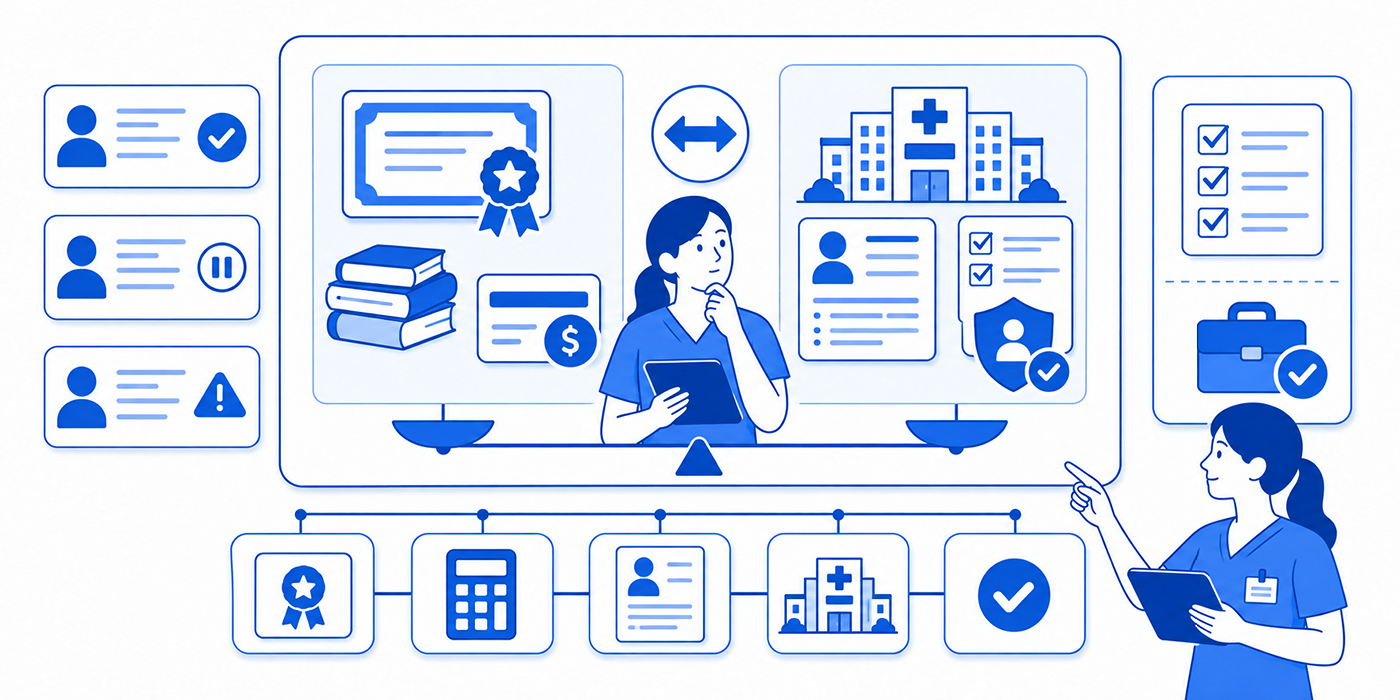
1. Is Medical Scribe Certification Worth the Money in 2026? Start With What Employers Actually Buy
The central question is less complicated than the internet makes it sound: a medical scribe certificate has financial value when the training behind it closes a real hiring gap.
A certificate alone cannot compensate for weak listening, poor medical terminology, slow charting, unreliable availability, or an inability to turn a rapid clinical conversation into an accurate note. Employers need someone who can function inside a documentation workflow. That means understanding medical transcription terminology, maintaining confidential communication, demonstrating strong written communication in medical administration, and navigating the professional expectations covered in medical admin professionalism.
Current hiring evidence makes that distinction unusually clear.
A current ScribeAmerica listing asks for a high school diploma or equivalent, age 18+, U.S. work authorization, 40+ WPM typing, English fluency, listening and communication ability, flexible availability, and potentially vaccination records. Independent medical scribe certification does not appear among the listed minimum requirements. The company also emphasizes its own training program.
ProScribe's current requirements similarly emphasize a high school diploma, a healthcare career track, college status, a six-month commitment, at least two shifts or 16 hours weekly, professionalism, confidentiality, communication, attention to detail, and the ability to learn medical terminology. Again, an outside certification is absent from its published core qualifications.
That tells a prospective scribe exactly where to focus. Someone preparing through verbal communication training, team communication skills, patient interaction scripts, and realistic medical administrative workflows may create more hiring value than someone who simply buys the fastest certificate available and cannot demonstrate those competencies.
The regulatory picture reinforces this.
The Joint Commission's April 2026 guidance says organizations should ensure documentation assistants receive education or training in medical terminology, HIPAA, billing/coding/reimbursement, EMR navigation, computerized order entry, clinical decision support, and appropriate order-handling procedures. Organizations must define minimum qualifications in their own job descriptions and provide orientation plus ongoing education. The guidance recognizes that scribes may be unlicensed, certified, or licensed personnel rather than establishing one universal scribe credential.
For applicants, that makes secure messaging knowledge, revenue cycle terminology, healthcare automation literacy, and accurate medical office triage terminology commercially relevant competencies rather than decorative additions to a résumé.
Certification therefore has three possible values:
Knowledge value: it teaches skills you currently lack.
Proof value: it gives an employer evidence that structured learning occurred.
access value: it may strengthen a weak résumé where experience, referrals, or healthcare education are missing.
Its ROI falls sharply when the program produces only the third item on paper while failing to deliver the first two in practice.
That distinction becomes especially important for international applicants. Someone exploring medical scribe certification in Pakistan, medical scribe certification in India, medical scribe certification in the Philippines, or medical scribe certification in Bangladesh may need more portable evidence of documentation competence because they are competing for remote work without the same local referral networks available to U.S. pre-health students.
Before spending a dollar, compare the program against the actual employer screen.
| # | Hiring Signal | What Employers Need to Know | Can Certification Help? | Best Applicant Move |
|---|---|---|---|---|
| 1 | High school diploma/GED | Basic education threshold | Usually irrelevant | Confirm the posting before paying for extra credentials |
| 2 | Minimum age | Often 18+ | No | Check eligibility first |
| 3 | Work authorization | Employer-specific legal eligibility | No | Never assume certification changes work authorization |
| 4 | Typing speed | Can you keep pace with encounters? | Only if timed practice is included | Benchmark yourself before applying |
| 5 | Listening accuracy | Can you capture fast clinical speech correctly? | Yes, with audio simulations | Practice realistic encounters |
| 6 | Medical terminology | Can you understand clinical language at speed? | High value | Prioritize applied terminology over memorization |
| 7 | Anatomy and physiology | Can you follow clinical reasoning? | Moderate to high | Study terminology in anatomical context |
| 8 | HPI documentation | Can you organize the patient's story? | High if practice-based | Produce sample HPIs from simulated cases |
| 9 | Pertinent negatives | Can you distinguish relevant negatives from noise? | High | Practice specialty-specific cases |
| 10 | ROS structure | Can you document consistently without inventing findings? | Useful | Learn employer-specific documentation rules |
| 11 | Assessment vs diagnosis | Can you preserve provider meaning accurately? | High | Train against ambiguous examples |
| 12 | Assessment and plan | Can you capture treatment, orders and follow-up accurately? | High | Practice complete encounters |
| 13 | EMR navigation | Can you document efficiently inside a structured record? | High if simulated | Choose training with workflow practice |
| 14 | HIPAA awareness | Can you protect PHI? | Important | Learn practical privacy scenarios |
| 15 | Order-entry boundaries | Do you understand authorization and verification? | Important | Study role boundaries, not shortcuts |
| 16 | Billing/coding awareness | Do you understand documentation consequences? | Useful | Learn enough to document accurately within scope |
| 17 | Confidentiality | Can you handle sensitive information professionally? | Useful | Prepare scenario-based interview answers |
| 18 | Written English | Are your notes clear and grammatically controlled? | Only with feedback | Get practice notes reviewed |
| 19 | Verbal communication | Can you clarify uncertainty professionally? | Moderate | Practice concise clarification language |
| 20 | Attention to detail | Can you catch contradictions and omissions? | Only through applied training | Use timed error-detection drills |
| 21 | Schedule availability | Can you cover the provider's real schedule? | No | Fix availability before buying credentials |
| 22 | Time commitment | Will you stay long enough to justify training? | No | Check six- or twelve-month expectations |
| 23 | Specialty familiarity | Can you handle specialty-specific vocabulary? | Potentially high | Match training to target specialty |
| 24 | Prior scribe experience | Have you already proved you can perform? | Usually lower incremental value | Lead with experience and measurable skills |
| 25 | Clinical background | How steep will your learning curve be? | More useful for complete beginners | Identify specific knowledge gaps first |
| 26 | Employer training | Does the company already train new hires? | May duplicate training | Investigate before paying independently |
| 27 | BLS requirement | Some hybrid patient-facing roles require it | Scribe certification may not satisfy it | Read the exact credential requirement |
| 28 | Remote-work readiness | Can you protect PHI and work reliably from home? | Partly | Build privacy, hardware and connectivity readiness |
| 29 | Interview performance | Can you prove judgment under pressure? | Indirectly | Prepare evidence-based answers |
| 30 | Independent certification | Does it reduce uncertainty about your readiness? | Depends entirely on program quality and employer | Buy training outcomes, not letters after your name |
2. Reddit Reviews vs Employer Requirements: Where the Advice Is Right, Incomplete, or Outdated
Reddit's dominant advice is easy to understand: apply first because many scribe employers will train you.
A January 2025 r/medicalscribe discussion included several working scribes telling a beginner that certification was unnecessary and that entry-level employers commonly provide training. A June 2026 thread about remote scribing produced similar advice: the applicant was told they could apply directly without first buying a certificate.
That advice is strongly supported for candidates targeting large entry-level vendors. Current ScribeAmerica vacancies explicitly advertise training while screening for practical qualifications such as 40+ WPM typing, communication, English fluency and schedule flexibility. ProScribe's requirements similarly center on education, availability, professionalism and learnability.
A candidate who already understands medical administrative workflows, knows how to communicate through secure healthcare messaging, can demonstrate professional medical front desk etiquette, and has prepared for medical scribe interview questions can therefore have a rational reason to apply before buying additional training.
The problem comes when Reddit turns “this employer did not require certification” into “certification can never create value.”
Those are different claims.
Scribe-X currently describes paid training as part of its employment pathway and includes medical scribe certification within its first-stage development program. That model shows how employers themselves may value standardized preparation while choosing to provide it after hiring rather than demanding that the applicant buy it beforehand.
A certification program can consequently be useful for someone who cannot easily access company training, wants preparation before a demanding assessment, is competing for direct-hire work, or needs stronger proof of competence. The practical test is whether it develops competencies also visible in medical transcription terminology, telemedicine fundamentals, confidential healthcare communication, and patient interaction workflows.
Reddit is particularly useful for revealing a second pain point: getting hired and enjoying the job are separate problems.
Recent 2026 discussions mention low pay, lengthy hiring processes, demanding schedules, variable management and the reality that many people use scribing primarily for healthcare exposure. Other users describe significant value from observing physicians, understanding medical decision-making and building relationships that may eventually support letters of recommendation.
That means certification ROI should never be calculated using the credential alone. A pre-med applicant might value exposure to physicians, documentation experience and clinical environments alongside wages. Someone pursuing a permanent administrative career may instead compare scribing against CMAA career pathways, broader revenue cycle management, prior authorization work, or more operations-focused healthcare automation roles.
A Reddit reviewer saying “save your money” may therefore be perfectly correct for their route and still offer incomplete advice for yours.
The strongest 2026 decision process combines community experience with job-posting evidence.
Read Reddit to identify hidden frustrations. Read employer requirements to identify hiring gates. Use medical scribe salary trends to understand the economic ceiling, medical scribe hiring locations to understand opportunity, scribe regulatory updates to understand compliance, and medical scribe interview preparation to convert preparation into actual applications.
3. The ROI Test: When Medical Scribe Certification Actually Pays Off
The fastest way to evaluate a certification is to stop asking whether it is “recognized” in the abstract and calculate what must happen after you purchase it.
Suppose training costs $400.
If the certificate produces no additional interviews, does not improve your assessment performance, teaches skills you already know and results in the same entry-level wage, the financial return is weak.
Suppose instead that structured training improves your medical terminology, teaches you how to build an HPI, exposes you to EMR workflows, helps you understand privacy, gives you realistic documentation practice and materially shortens the time between application and employment. The same $400 can produce useful economic value.
A simple framework is:
Certification ROI = hiring advantage + skill value + time saved + career value − tuition − study-time cost − duplicated employer training
The overlooked variable is time to employment.
A current ScribeAmerica Iowa posting advertised $15–$17 per hour, while another current ScribeAmerica listing in Illinois showed $15 per hour. Those figures vary by location and should never be treated as a universal scribe wage, but they demonstrate why shaving several weeks off a job search can matter economically.
Imagine a candidate expects 16 hours of work per week at $15 per hour. Three additional weeks of employment equal $720 in gross earnings. If a $400 program genuinely causes that faster outcome, there is a plausible break-even case. If the candidate would have been hired on the same date after free employer training, the $400 created little direct financial return.
This is why applicants should evaluate medical scribe employment trends, study medical scribe interview expectations, strengthen verbal communication skills, and improve written medical communication before assuming another credential is the missing variable.
Certification has stronger ROI for five types of applicants
Complete beginners can benefit when they genuinely need structured instruction in medical transcription concepts, patient communication, confidentiality, and clinical workflow terminology.
Career changers without healthcare coursework may need proof that they have deliberately built healthcare-specific competence rather than submitting a résumé containing only unrelated experience.
International candidates often face a harder proof problem. Someone exploring opportunities from the UAE, Saudi Arabia, Nigeria, or South Africa may need to demonstrate familiarity with documentation conventions before a remote client considers them.
Direct-hire applicants can benefit because a physician practice lacking a giant scribe company's training infrastructure may place more weight on prior preparation.
Applicants repeatedly failing assessments or interviews should identify the precise failure. If the problem is terminology, documentation structure, HIPAA judgment, or chart organization, structured training may be worth far more than endlessly submitting the same application.
The poor-ROI candidates are easier to identify too.
Someone already employed as a competent scribe has experience that directly demonstrates performance. Someone with a confirmed employer-paid training pathway may duplicate training by purchasing another program. Someone whose applications fail because of limited availability, work authorization, geographic restrictions, typing speed, or schedule conflicts will gain little by solving the wrong problem with a certificate.
The same logic applies when comparing scribing with CMAA roles, medical office triage, virtual check-in work, or prior authorization workflows. The credential should serve the job path. The job path should determine the training investment.
4. What Employers Actually Screen For After You Apply
The most expensive certification mistake is preparing for the credential while neglecting the interview and assessment that determine whether anybody hires you.
Current employers reveal the hierarchy.
ScribeAmerica publishes a 40+ WPM typing expectation in multiple current listings. ProScribe emphasizes communication, confidentiality, attention to detail, medical terminology and the ability to work in a fast-paced environment. A current Summit Health/CityMD scribe posting requires a high school diploma or GED, BLS within 30 days of hire, and at least 45 WPM, while the position itself can include rooming patients, taking vital signs and assisting with procedure setups.
That CityMD example is particularly valuable because it exposes another hiring trap: jobs sharing the title “medical scribe” may contain materially different responsibilities.
Someone preparing only for pure documentation may struggle in a hybrid role that includes patient-facing responsibilities. Before applying, study the employer's exact job description and compare it against medical front desk etiquette, bedside manner for administrative staff, rapport-building techniques, and patient education terminology.
Your documentation accuracy matters more than your certificate title
A capable scribe needs to distinguish:
what the patient reports
what the provider observes
what has been confirmed
what remains a differential or impression
what belongs in the history
what belongs in the assessment
what belongs in the plan
what should be clarified rather than guessed
That is why competence in therapeutic communication, informed consent terminology, medical interpreter workflows, and professional communication under pressure strengthens documentation judgment even when those topics do not appear as certification requirements.
The distinction between uncertainty and invention is especially important.
If a physician says something too quickly, the correct response is clarification through the permitted workflow. A scribe who silently guesses can create a clinically significant documentation error. Training in assertive medical communication, team communication, verbal communication, and professional email etiquette develops the professional behavior needed to resolve uncertainty safely.
Joint Commission guidance places exactly this kind of competency above superficial credential collecting. It identifies unqualified staff, unclear responsibilities, inappropriate EMR log-ins and inadequate provider verification as quality and safety risks. It also expects organizations to provide ongoing training and periodically assess competence.
Build a proof portfolio before you apply
A first-time applicant can create a private training portfolio containing:
timed typing results
de-identified mock HPIs
SOAP-style practice notes
terminology quizzes
error-correction exercises
simulated specialty encounters
privacy scenarios
chart-completion drills
interview answers
documented training completion
Never place real patient data in a portfolio.
Use medical transcription terminology to strengthen vocabulary, confidential communication scenarios to test privacy judgment, healthcare automation terminology to understand modern documentation systems, and medical administrative workflows to understand where the scribe fits within the larger care process.
That portfolio creates something a bare credential cannot: evidence of how you work.

5. A 2026 Decision Framework: Who Should Pay for Certification and Who Should Apply First
Use employer evidence before making the purchasing decision.
Apply first when you already meet the practical requirements
Apply directly when you have strong medical terminology, adequate typing speed, good listening accuracy, schedule flexibility, basic healthcare familiarity and access to employers providing formal training.
Start with current medical scribe hiring locations, compare medical scribe salary trends, prepare with medical scribe interview questions, and review regulatory changes affecting scribes.
Then apply to several realistic employers.
If you receive interviews and pass assessments, the market has already answered your certification question.
Consider certification when your skill gap is measurable
Certification becomes more rational when you cannot confidently:
convert a messy patient narrative into a structured HPI
recognize common terminology at conversational speed
distinguish provider assessment from patient speculation
document a plan without adding information
navigate common EMR concepts
explain basic HIPAA responsibilities
understand documentation's relationship to billing and coding
maintain accuracy while working quickly
Those gaps align closely with the competency areas described by the Joint Commission.
Training can then be reinforced through revenue cycle management concepts, superbill terminology, explanation of benefits terminology, and prior authorization workflows so you understand why precise documentation has downstream consequences.
International applicants should evaluate portability separately
A certificate cannot erase geographic restrictions imposed by an employer. ScribeAmerica's U.S. postings, for example, specify U.S. work authorization.
International applicants should therefore evaluate remote employment and independent contracting separately from U.S.-based on-site jobs.
Country-specific preparation can help candidates understand local pathways through guides for Australia, New Zealand, Ireland, Kuwait, Oman, Bahrain, and Egypt.
For remote work, strengthen telemedicine knowledge, secure healthcare messaging, virtual check-in systems, and confidential communication skills. Remote documentation exposes employers to privacy and operational risks, so evidence of disciplined workflows can become commercially important.
Use a five-question purchase test
Before paying for any program, ask:
1. Which job requirement will this course help me satisfy?
2. What practical work will I complete before earning the credential?
3. Does the program test documentation performance or mainly content recall?
4. Could my target employer provide equivalent training after hiring me?
5. What evidence will I possess afterward besides the certificate itself?
A good program should leave you better at written clinical communication, professional medical communication, medical terminology and transcription, and real-world team communication.
If your only post-course improvement is a new line on LinkedIn, the economic case is weak.
The strongest 2026 strategy is therefore sequential: audit your target jobs, test your existing skills, apply where training is provided, identify the precise barrier, and pay for structured training when that training addresses the barrier.
That approach protects you from spending hundreds of dollars trying to solve an availability problem, a typing problem, a work-authorization problem or a poor application strategy with the wrong credential.
6. FAQs: Medical Scribe Certification Worth and Employer Requirements in 2026
-
There is no single universal certification requirement covering every medical scribe role in the United States. The Joint Commission's current guidance recognizes documentation assistants who may be unlicensed, certified or licensed and places substantial emphasis on employer-defined qualifications, training and continuing competency.
Candidates should still check the exact employer, jurisdiction and duties involved. A pure documentation role can have different requirements from a hybrid role involving patient care. Review current scribe regulatory updates, compare medical scribe and CMAA responsibilities, and understand medical office triage terminology before assuming that every “scribe” vacancy has the same scope.
-
Current ScribeAmerica job listings reviewed for this article do not list independent certification among the basic requirements. They emphasize a high school diploma or equivalent, minimum age, work authorization, 40+ WPM typing, communication, English fluency and schedule availability, while advertising company training.
Applicants can therefore spend preparation time on medical scribe interview questions, medical transcription terminology, professional communication, and clinical workflow knowledge.
-
Many Reddit contributors entered the profession through companies that provided their own training. That experience matches the hiring model used by several major scribe employers. Recent discussions in 2025 and 2026 continue to include users advising beginners to apply directly to entry-level companies before paying for outside training.
Treat those experiences as evidence about specific pathways. A beginner without terminology knowledge, an international applicant, a direct-hire candidate and an experienced U.S. pre-med applicant face different proof problems. Use medical scribe employment data, hiring-location research, interview preparation, and telemedicine terminology alongside community advice.
-
Yes, when the program materially improves job-relevant skills.
A complete beginner can benefit from structured practice in medical transcription terminology, confidential healthcare communication, patient interaction techniques, and medical administrative workflows. The useful output is faster comprehension, cleaner notes, stronger privacy judgment and better interview performance.
-
The answer depends on the employer, although several current postings explicitly specify typing performance while omitting independent certification. ScribeAmerica currently lists 40+ WPM. A Summit Health/CityMD posting reviewed for this article specifies at least 45 WPM.
Typing speed alone still cannot make someone competent. Scribes must combine pace with written communication accuracy, medical terminology, confidential communication, and disciplined team communication.
-
It can have greater signaling value when the applicant lacks local experience or referrals, although each employer's requirements remain decisive. Remote scribes also need strong privacy behavior, reliable technology, clear communication and familiarity with virtual workflows.
Prepare through telemedicine basics, secure messaging in healthcare, virtual check-in systems, and healthcare automation terminology so the credential sits on top of practical remote-readiness.
