

AI Scribes Are Replacing Human Scribes: What Reddit Is Seeing and Which Medical Scribe Skills Still Protect Your Career
AI scribe displacement has moved from a theoretical career concern to a real workforce issue in 2026. Medical scribes on Reddit are reporting contract losses, reduced hours, hybrid human-AI workflows, and full replacement at some sites. At the same time, emerging evidence shows important limits in AI-generated documentation. Scribes who understand medical transcription, clinical communication, healthcare automation, and medical administrative workflow can reposition themselves around the weaknesses that AI still creates.
1. AI Scribes Are Already Replacing Some Human Scribes—Here Is What the Evidence Actually Shows
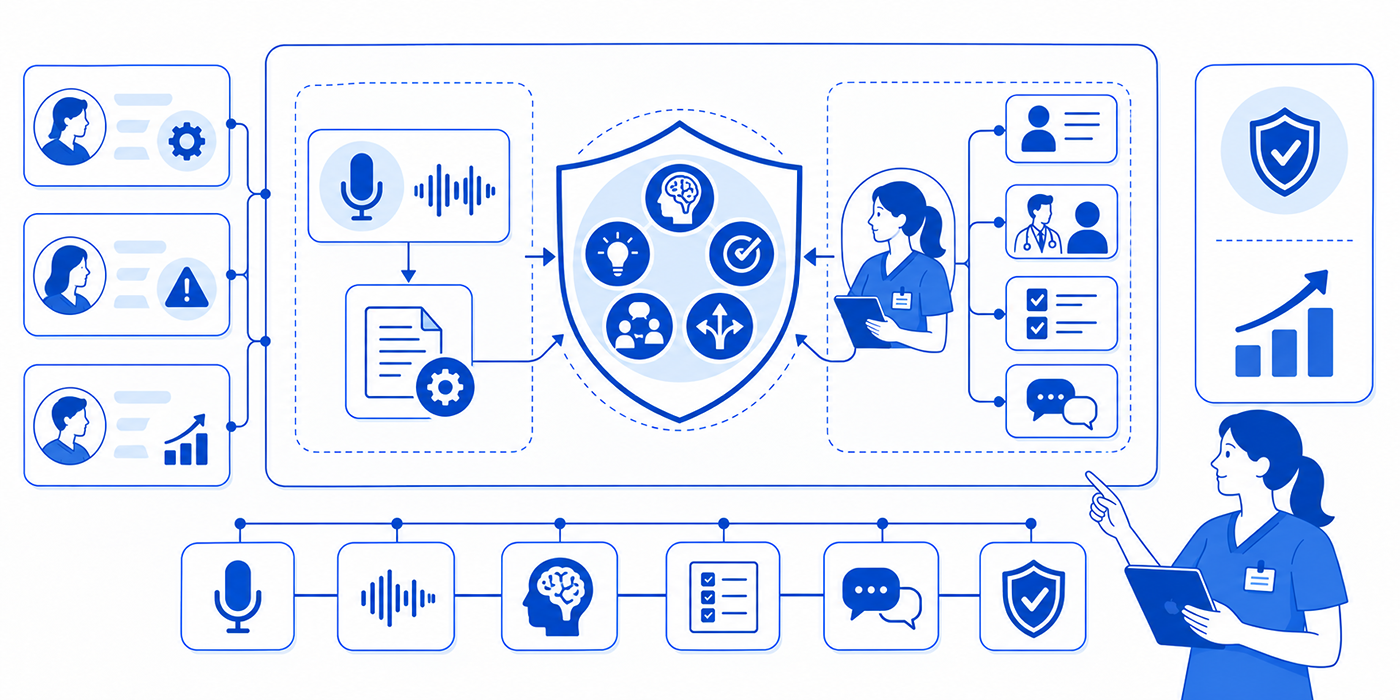
The economic case for ambient AI is strong enough that every medical scribe should take the transition seriously. A 2026 JAMA Network Open commentary described ambient AI scribes as the most widely implemented generative-AI application in healthcare. The technology records clinician-patient conversations, generates a structured draft, and sends that draft to the clinician for review. Studies have also associated AI scribe adoption with reduced documentation burden and lower clinician burnout.
That matters because traditional scribes have always been hired partly to solve physician documentation burden, convert encounters into usable medical transcription, support efficient medical administrative workflows, and preserve clearer team communication. When software can perform the first draft at scale without recruiting, scheduling, training, turnover, or shift coverage problems, the lowest-complexity scribe positions become economically vulnerable.
Reddit is already showing that vulnerability. In March 2026, one r/medicalscribe poster reported that roughly 100–200 scribes in a major hospital network had been displaced by AI. Another commenter in the same thread said their own scribes were scheduled to be retired in June because of AI. These are individual reports rather than independently verified workforce statistics, yet they align with earlier posts describing hospitals and physician groups terminating or shrinking human scribe programs.
Another scribe described watching AI gradually absorb sections of the chart until the human role became largely fact-checking, followed by notice that the facility expected to replace scribes within 30–60 days. That progression deserves attention: AI can shrink a job before eliminating the job title.
A scribe who spends most of a shift converting spoken words into basic HPI text faces greater exposure than someone who can identify contradictions, understand medical office triage, interpret patient communication, manage complex clinical terminology, navigate the EHR, recognize incomplete documentation, and understand the downstream effects of inaccurate records on prior authorization or the revenue cycle.
The research also shows why declaring the human scribe obsolete would be premature. A 2026 study covering 198,178 emergency-department encounters across four hospitals found that ambient AI reduced adjusted attending documentation time by 1.6 minutes per note compared with no scribe. Human scribes reduced it by 3.3 minutes. Clinical productivity measured through wRVUs did not significantly differ among the groups.
An even more direct 2026 comparison of 710 ED visits found physicians spent substantially more time in the EHR notes section when working with AI than with human scribes: 4.3 versus 1.8 minutes per adult encounter and 3.5 versus 1.6 minutes per pediatric encounter. Physicians also had to contribute a much larger portion of the final note when AI was used.
That leaves a very specific career lesson. Pure transcription value is collapsing faster than documentation judgment. Skills involving confidential communication, informed consent, medical interpreter workflows, professional communication, context, verification, escalation, and workflow increasingly determine how defensible a human scribe remains.
| # | Scribe Task or Capability | AI Replacement Pressure | Human Advantage That Still Matters | Best 2026 Career Move |
|---|---|---|---|---|
| 1 | Basic encounter transcription | Very high | Detect omissions and mistranscriptions | Build advanced medical transcription QA skills |
| 2 | Routine HPI drafting | Very high | Clinical chronology and relevance | Practice patient encounter structuring |
| 3 | Routine ROS capture | High | Knowing what was actually addressed | Strengthen clinical listening |
| 4 | Generating generic note prose | Very high | Conciseness and provider-specific style | Master precise written communication |
| 5 | Basic note formatting | High | Understanding local templates and workflows | Learn medical workflow design |
| 6 | Medication-name capture | Medium-high | Spotting sound-alike medication errors | Develop terminology verification |
| 7 | Laterality capture | Medium | Recognizing left/right contradictions | Train for documentation accuracy |
| 8 | Complex medical terminology | Medium | Contextual interpretation | Build specialty-level transcription knowledge |
| 9 | High-acuity ED documentation | Medium | Tracking rapidly changing events | Study crisis communication |
| 10 | Phone-based symptom documentation | Medium | Escalation judgment and clarification | Learn phone triage communication |
| 11 | Interpreter-assisted encounters | Lower | Multi-speaker context and communication nuance | Learn medical interpreter workflows |
| 12 | Consent-related documentation | Medium | Separating discussion from valid consent | Master informed-consent documentation |
| 13 | Sensitive-information handling | Low-medium | Privacy-aware workflow judgment | Strengthen confidential communication |
| 14 | Secure clinical messaging | Medium | Knowing what belongs in which channel | Learn secure messaging workflows |
| 15 | Patient-history clarification | Medium | Detecting contradictions and ambiguity | Build rapport-building skills |
| 16 | Difficult-patient encounters | Lower | Interpreting emotion and chaotic dialogue | Study difficult-patient communication |
| 17 | Provider preference adaptation | Medium | Rapidly learning individual workflows | Develop team communication |
| 18 | AI-generated note review | Growing opportunity | Clinical-context verification | Combine QA with healthcare automation knowledge |
| 19 | Order and result tracking | Lower-medium | Understanding workflow state | Learn workflow dependencies |
| 20 | Follow-up documentation | Medium | Connecting plan, responsibility, and timing | Strengthen patient education knowledge |
| 21 | Prior-authorization support | Lower | Finding documentation required by payer workflows | Learn prior authorization |
| 22 | Revenue-cycle awareness | Lower | Seeing downstream documentation consequences | Study revenue cycle management |
| 23 | Billing-document consistency | Medium | Recognizing missing supporting information | Understand superbill workflows |
| 24 | Insurance-document navigation | Lower | Connecting clinical and administrative records | Learn EOB terminology |
| 25 | Telehealth documentation | High for simple visits | Managing workflow limitations and escalation | Study telemedicine fundamentals |
| 26 | Scheduling and coordination | Medium | Resolving exceptions and competing priorities | Build scheduling-conflict skills |
| 27 | Front-desk cross-training | Lower | Handling unpredictable patient needs | Learn front-desk operations |
| 28 | Clinical team coordination | Lower | Human escalation and accountability | Strengthen professional assertiveness |
| 29 | AI implementation support | Growing opportunity | Understanding both clinical and software workflow | Study healthcare automation tools |
| 30 | Documentation-quality auditing | Growing opportunity | Finding clinically consequential errors | Track scribe regulatory updates |
2. What Reddit Is Seeing: Layoffs, Hybrid Workflows and “Human Fact-Checker” Roles
Reddit provides something formal adoption studies cannot: an early view of how technology changes individual jobs before workforce statistics catch up. The evidence is anecdotal, so it should be treated as a signal of implementation patterns, rather than a measurement of national scribe employment.
The first pattern is straightforward displacement. Posts from 2024 through 2026 describe physician groups and hospitals ending human scribe arrangements after implementing AI. One December 2025 discussion included users reporting personal displacement, team-wide displacement, and movement from outpatient scribing into emergency-department work after AI adoption.
For anyone watching medical scribe employment trends, that creates a critical distinction between scribe demand and documentation-assistance demand. Healthcare still wants faster chart completion, reduced physician burnout, better workflow efficiency, and more reliable written documentation. Employers can increasingly pursue those outcomes through a combination of people and software.
The second pattern is partial automation. A human may remain employed while AI generates the HPI, drafts portions of the note, or produces the first version of the entire encounter. The human then checks facts, reorganizes the note, corrects terminology, fixes laterality, removes irrelevant material, and adds workflow information the ambient system could not capture.
That role can feel like a downgrade if the scribe continues thinking like a typist. It becomes much more valuable when approached as documentation quality assurance. Knowing medical terminology, confidential communication, secure messaging, and patient interaction structure makes the reviewer capable of finding mistakes that affect care, continuity, coding, and liability.
The third pattern is specialty dependence. A July 2026 Reddit comment from an orthopedic scribe described an AI system confusing left and right shoulders and failing to organize the examination in the physician's preferred format. The physician reportedly used AI primarily for new-patient HPI capture while the human scribe handled the remaining documentation and reviewed the AI-generated section.
That example explains why specialty knowledge has increasing value. A competent scribe needs enough professional communication, medical transcription knowledge, non-verbal communication awareness, and clinical context to know when a polished sentence contains the wrong body side, diagnosis status, symptom chronology, medication, or examination finding.
The fourth pattern is note-cleanup fatigue. Reddit users have complained about long, formal, bloated AI notes requiring substantial editing. One emergency-medicine commenter said physicians disliked AI notes that captured every complaint instead of producing the selective documentation they wanted.
This is where advanced written communication, verbal communication, rapport interpretation, and understanding of provider workflows become commercially useful. The valuable human increasingly edits for clinical signal, rather than grammar.
3. Where AI Scribes Still Break: The Failure Modes Humans Need to Understand
The strongest career strategy starts with the actual failure modes of ambient documentation.
NHS England's updated 2026 guidance warns that AI-enabled ambient scribing systems can struggle with complex clinical terminology, abbreviations, rapidly spoken dialogue, accents, regional dialects, contextual interpretation, completeness, workflow integration, and automation bias. It specifically highlights the risk of a hypothetical patient statement being interpreted as a confirmed diagnosis.
That is precisely why advanced medical transcription remains valuable. Hearing “possible,” “rule out,” “history of,” “family history of,” “denies,” “suspected,” and “confirmed” requires more than converting audio into sentences. The clinical meaning changes when one qualifier disappears.
Laterality is another high-risk weakness. An AI system that turns “left shoulder” into “right shoulder” may produce a note that reads beautifully while being clinically wrong. A skilled reviewer trained in written communication, clinical terminology, and medical office triage learns to cross-check body side, diagnosis, examination, imaging, procedures, and plan.
Negation errors can be even more dangerous. “No chest pain” and “chest pain” differ by two letters and a large clinical consequence. The same problem applies to allergies, suicidal ideation, anticoagulant use, pregnancy, fever, trauma history, neurologic deficits, and medication adherence. Strong crisis communication, phone triage, and patient interaction skills help humans recognize which details carry disproportionate risk.
Speaker attribution creates another problem. Complex encounters may include the patient, physician, parent, spouse, nurse, interpreter, trainee, and specialist. The software has to determine who said what and which statement deserves chart status. This becomes especially relevant in medical interpreter services, informed consent, therapeutic communication, and difficult patient communication.
Real-world adoption data suggest clinicians already behave cautiously around some of these complexities. In one 2026 Stanford emergency-department study, ambient AI was used in only 976 of 8,740 eligible encounters, and usage was concentrated in lower-acuity cases, telemedicine/vertical-care settings, and encounters that did not require interpreters.
That pattern is important for career planning. Higher-complexity work involving phone triage, crisis communication, interpreter-assisted encounters, confidential communication, and workflow exceptions demands more contextual reasoning.
Privacy and governance also create human work. NHS England's guidance identifies risks involving data leakage, confidentiality, externally hosted environments, data-protection assessments, integration failures, and error monitoring. Medical scribes who understand secure messaging, confidential communication, professionalism, and current regulatory updates can contribute to safer implementation instead of competing with the software on typing speed.
The regulatory direction reinforces that point. July 2026 MHRA guidance states that clinicians remain responsible for reviewing and verifying AI-generated transcripts, summaries, and other outputs before those outputs are used in patient care.
A human who becomes excellent at verification therefore occupies a more defensible part of the workflow.
4. The 10 Medical Scribe Skills Most Likely to Protect Your Career
The safest response to AI adoption is to become more useful inside an AI-enabled workflow. Employers gain little from paying a human to duplicate what an ambient tool already performs cheaply. They gain considerably more from someone who catches the system's errors, handles exceptions, understands the EHR, supports clinicians, and protects documentation quality.
1. Clinical-context verification
Learn to audit whether a statement belongs in the chart exactly as written. Distinguish symptoms from diagnoses, patient speculation from clinician assessment, past history from current problems, and negatives from positives. Advanced medical transcription, patient interaction, written communication, and verbal communication form the foundation.
A generic editor corrects grammar. A clinical documentation reviewer asks, “Can every important statement be traced to what actually happened?”
2. Error-pattern recognition
Create a mental checklist for AI failure: wrong laterality, wrong medication, wrong dose, wrong speaker, invented diagnosis, lost negation, omitted modifier, duplicated symptom, unsupported certainty, incorrect chronology, and copied-forward inconsistency. Understanding regulatory updates, professional documentation, medical office triage, and crisis communication helps you prioritize errors by clinical consequence.
Speed matters here, because nobody wants AI that saves five minutes and requires ten minutes of review.
3. Specialty-specific documentation knowledge
A cardiology note, orthopedic examination, dermatology visit, psychiatric assessment, pediatric encounter, and emergency chart have different documentation logic. Specialty depth makes you harder to commoditize because you can detect when the generated note sounds plausible while violating the physician's actual workflow.
Combine specialty knowledge with medical transcription terminology, team communication, bedside manner awareness, and patient education. You become capable of judging documentation within its clinical setting.
4. EHR navigation beyond the note
Ambient systems primarily hear conversations. Valuable human work often exists outside the microphone: reviewing previous visits, finding historical imaging, recognizing pending orders, following referrals, locating medication changes, checking specialist notes, and understanding which workflow step still requires action.
This is where medical administrative workflow, healthcare automation, secure messaging, and prior authorization become career-protective knowledge.
5. High-acuity documentation
Emergency departments expose ambient systems to interruptions, overlapping conversations, procedures, rapid reassessments, consultants, medication administration, evolving differential diagnoses, and changing disposition plans. A scribe who tracks that sequence accurately provides more than transcription.
Build capability through crisis communication, assertiveness in medical administration, team communication, and medical office triage.
6. Interpreter and multi-speaker encounter competence
AI performance can become harder to trust when conversations involve interpreters, overlapping speech, family members, poor historians, soft-spoken patients, accents, or emotionally charged exchanges. The Stanford study's lower AI use in interpreted encounters is therefore worth noticing.
Learn medical interpreter services, therapeutic communication, rapport building, and non-verbal communication.
7. Privacy, consent and AI governance awareness
Understand how patient consent, recording, storage, access, confidentiality, and approved AI tools fit together. An employee who casually uploads clinical information into an unapproved general-purpose AI system creates far more risk than value.
Strengthen your knowledge of confidential communication, informed consent, secure healthcare messaging, and current regulatory developments.
8. Downstream revenue-cycle awareness
Documentation errors can propagate. A missing detail can create trouble later for coding, billing, authorization, claim review, or medical necessity documentation. Scribes who understand that downstream chain can review charts more intelligently.
Study revenue cycle management, prior authorization workflows, superbills, and EOB terminology. This moves your knowledge beyond the encounter note.
9. Provider-facing communication
A strong AI-era scribe needs to communicate problems quickly: “The AI captured right knee, while the exam and imaging are left knee,” or “The assessment states confirmed pneumonia, while the provider described it as suspected.” That requires tact, confidence, and precision.
Build professionalism, assertiveness, professional email etiquette, and team communication. Silent error recognition protects nobody if you cannot escalate the issue effectively.
10. AI workflow literacy
Know what the system captures, what it generates, where humans review it, how corrections occur, how templates behave, and which information remains outside the AI workflow. Study healthcare automation tools, virtual check-in systems, telemedicine basics, and secure messaging systems.
Your goal is to become the person who understands where automation works, where it fails, and what the workflow needs next.

5. A 90-Day Plan to Move From Vulnerable Scribe to AI-Resilient Documentation Professional
Waiting until an employer announces an AI rollout wastes the most valuable preparation window. Build transferable evidence while you still have access to real clinical workflows.
Days 1–30: Audit your current job. Keep a private, non-PHI skills log. Record categories of work rather than patient information: terminology corrections, note-structure problems, workflow exceptions, communication tasks, EHR functions, referral tracking, interpreter encounters, documentation discrepancies, and provider preferences.
Compare that list with medical transcription skills, medical administrative workflows, team communication competencies, and healthcare automation knowledge. Identify which pieces of your job would disappear first if AI generated every initial note tomorrow.
Days 31–60: Build an AI-QA skill stack. Practice reviewing synthetic or training notes for laterality, chronology, medications, diagnoses, negatives, unsupported statements, redundant prose, and omitted follow-up. Learn confidential communication, informed consent, regulatory updates, and secure messaging so your AI literacy includes governance.
Then cross-train one adjacent workflow. Good choices include prior authorization, medical office triage, revenue cycle management, telemedicine, patient access, referrals, or administrative coordination.
Reddit already contains reports of scribe companies branching into MA-style work and moving displaced scribes into other healthcare functions. The more workflows you can support, the harder it becomes for one software implementation to erase your entire value proposition.
Days 61–90: Rewrite your professional identity. Stop presenting yourself as someone who merely “documented physician encounters.” Describe concrete outcomes:
Reviewed encounter documentation for clinical consistency and completeness.
Identified discrepancies in terminology, laterality, chronology, and note structure.
Adapted documentation to specialty and provider workflows.
Supported high-volume EHR workflows and real-time clinical teams.
Maintained confidentiality and appropriate handling of sensitive information.
Coordinated documentation with follow-up, referral, and administrative processes.
Worked alongside automated documentation technology where applicable.
Your preparation for medical scribe interviews should then emphasize judgment, workflow knowledge, reliability, and adaptability. If opportunities in your market shift, explore the difference between medical scribe and CMAA roles, examine cities and states hiring medical scribes, and compare current scribe employment and salary trends.
For internationally based or remote candidates, the same principle applies. Someone exploring scribing in India, Pakistan, the Philippines, or Saudi Arabia should evaluate how much of a prospective role involves commodity transcription versus higher-value clinical documentation support.
A useful interview question for 2026 is: “How does your organization currently use ambient AI, and where do human documentation staff fit into review, workflow support, and quality assurance?”
The answer tells you more about job durability than the title “medical scribe.”
6. FAQs About AI Scribes Replacing Human Medical Scribes
-
AI is already replacing some human scribe positions, and broader ambient-AI adoption makes further displacement likely. The pace will vary by specialty, workflow, employer economics, provider preference, implementation quality, and case complexity.
Research also shows that human scribes can still outperform AI on important workflow measures. In the four-hospital 2026 ED study, human scribes were associated with a larger reduction in physician documentation time than ambient AI.
Career resilience therefore comes from moving toward documentation quality, clinical communication, workflow expertise, and healthcare automation.
-
It can still provide valuable exposure when the job gives you genuine access to clinical reasoning, physician workflow, patient encounters, terminology, and healthcare operations. A position consisting largely of correcting generic AI prose offers a weaker experience than a role involving active team communication, patient interaction, medical office triage, and complex documentation workflows.
Premeds should evaluate the actual responsibilities, provider contact, learning environment, schedule, pay, turnover risk, and AI adoption plan before accepting the job.
-
Roles become more defensible as complexity rises. High-acuity emergency encounters, complicated specialty workflows, interpreter-assisted consultations, multi-speaker visits, difficult patient interactions, detailed chart review, EHR coordination, and AI-generated-note auditing all create additional human value.
A 2026 Stanford study found ambient AI use concentrated in lower-acuity encounters and visits without interpreters, which offers a useful clue about current implementation preferences.
Build depth in crisis communication, medical interpreter services, therapeutic communication, and medical transcription.
-
Yes. Refusing to learn the technology leaves you competing with it from the weakest possible position.
Learn how ambient systems capture conversations, generate drafts, handle templates, integrate with the EHR, and fail. Then strengthen healthcare automation, secure messaging, confidential communication, and regulatory awareness.
Employers implementing AI need people who can recognize when a technically fluent output is clinically unreliable.
-
Start preparing immediately. Ask about redeployment, internal transfers, AI-review functions, MA-style duties, patient-access work, referrals, care coordination, front desk operations, or other clinical-support positions. Reddit users displaced by AI have described transfers and searches for adjacent healthcare roles, showing why early preparation matters.
Update your resume around transferable skills such as medical administrative workflow, patient communication, front-desk etiquette, and scheduling conflict management.
Do this while you still have employment, references, and access to internal opportunities.
-
Certification can strengthen your baseline credibility, terminology knowledge, documentation foundation, and competitiveness for employers that value trained candidates. Automation decisions usually operate at the workflow and economic level, so a credential alone provides limited insulation from technological substitution.
The stronger strategy combines certification with medical transcription proficiency, EHR workflow knowledge, professional communication, and AI-tool literacy.
A credential helps prove training. Your ability to solve problems around the technology determines how useful you remain after the technology arrives.
