

The Ultimate Guide to Getting Your Medical Scribe Certification in Pakistan: All You Need to Know in 2026-2027
Medical scribe certification in Pakistan can become a strong career bridge for students, graduates, healthcare support workers, and remote documentation professionals who want global-ready clinical documentation skills. The smartest path in 2026-2027 is clear: build medical terminology accuracy, EMR confidence, privacy discipline, and specialty note-writing speed before applying for remote, hospital, clinic, or international scribe roles.
This guide shows how Pakistani learners can plan certification, practice documentation, avoid weak training choices, and turn preparation into job-ready proof.
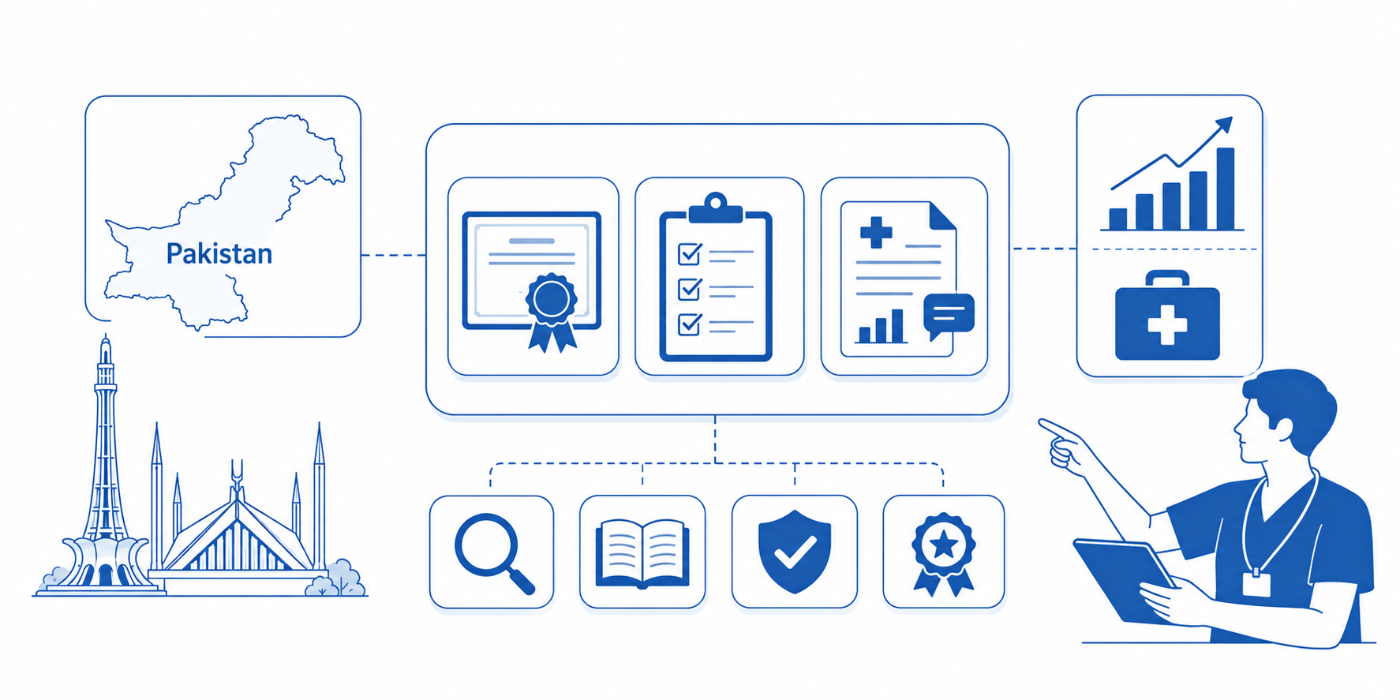
1. Why Medical Scribe Certification in Pakistan Matters in 2026-2027
A strong medical scribe certification gives Pakistani candidates a structured way to prove they can listen, understand, organize, and document clinical encounters with accuracy. That matters because many beginners start with decent English, science background, or pre-med ambition, then struggle when real documentation requires medical terminology mastery, EMR charting vocabulary, and disciplined HIPAA-style privacy habits under time pressure.
In Pakistan, the opportunity is especially practical for MBBS students, foreign medical graduates, life science graduates, allied health learners, and English-fluent professionals who want remote healthcare exposure. A scribe role can strengthen clinical listening, patient intake understanding, ICD-10 awareness, and CPT code familiarity, even when the job itself focuses on documentation rather than billing.
The biggest mistake Pakistani learners make is choosing a certificate that looks attractive on paper while leaving them weak in live-note thinking. A useful program should train chief complaint capture, HPI structure, review of systems, physical exam phrasing, assessment-plan logic, and specialty documentation templates. The certificate should help you survive a busy clinic note, a fast physician accent, a telemedicine visit, and a quality review where one missing negative can change the meaning of the chart.
For 2026-2027, your goal should be job-readiness across three lanes: local healthcare support, remote international scribing, and future clinical career leverage. That means combining scribe exam preparation, realistic practice questions, medical scribe interview prep, and employer research through international scribe employers.
| # | Pakistan Learner Situation | Certification Priority | Proof You Should Build | ACMSO Resource to Use |
|---|---|---|---|---|
| 1 | MBBS student wanting remote clinical exposure | HPI, ROS, assessment-plan structure | 10 timed SOAP notes across common complaints | Scribe documentation terms |
| 2 | Foreign medical graduate waiting for licensing pathway | Clinical terminology and specialty abbreviations | Terminology flashcards plus specialty note samples | Medical terminology mastery |
| 3 | Life sciences graduate entering healthcare documentation | Foundational anatomy, symptoms, and chart flow | Body-system vocabulary map | Scribe training courses |
| 4 | Remote job seeker targeting offshore scribe employers | Accent listening, speed, privacy, EMR navigation | Mock remote shift portfolio | International scribe employers |
| 5 | Candidate weak in diagnosis and procedure language | ICD-10 and CPT awareness | 20-code mini dictionary with examples | ICD-10 dictionary |
| 6 | Candidate applying to outpatient clinic roles | Family medicine, internal medicine, follow-up plans | Primary-care note bank | Primary care scribe networks |
| 7 | Candidate targeting emergency or urgent care scribing | Rapid triage language and red-flag symptoms | Timed ED-style documentation drills | Emergency scribe employers |
| 8 | Candidate targeting telemedicine documentation | Virtual visit flow and patient portal language | Telehealth encounter templates | Scribes and telemedicine |
| 9 | Candidate with strong English but weak medical listening | Accents, abbreviations, speed, provider phrasing | Audio-to-note practice log | Dictation software guide |
| 10 | Candidate anxious about privacy questions | Confidentiality, minimum necessary access, audit trails | Privacy scenario answers | HIPAA compliance for scribes |
| 11 | Beginner choosing between courses | Curriculum depth, testing style, practice volume | Course comparison sheet | Certification FAQs |
| 12 | Candidate preparing for certification exam | Practice questions and weak-area review | 30-day study calendar | 30-day study schedule |
| 13 | Candidate aiming for specialty clinics | Orthopedic, cardio, dermatology, ophthalmology terms | Specialty glossary with sample notes | Specialty scribe networks |
| 14 | Candidate interested in dermatology or ophthalmology | Lesion description, visual exam terms, follow-up wording | Clinic-specific template set | Dermatology and ophthalmology roles |
| 15 | Candidate interested in orthopedics | Musculoskeletal exam language | Joint exam phrase bank | Orthopedic scribe groups |
| 16 | Candidate targeting hospitalist documentation | Assessment-plan clarity and inpatient updates | Daily progress note samples | Hospitalist scribe groups |
| 17 | Candidate who wants academic hospital exposure | Teaching-hospital workflow and precise terminology | Academic-style encounter summaries | Academic medical centers |
| 18 | Candidate interested in pediatrics or women’s health | Age-specific history, pregnancy terms, parent communication | Specialty-safe phrase list | Pediatric and OB/GYN networks |
| 19 | Candidate weak in EMR navigation | Chart sections, orders, results, problem lists | Mock EMR workflow checklist | EMR/EHR platforms |
| 20 | Candidate facing interview anxiety | Scenario answers, correction mindset, shift reliability | Interview answer bank | Scribe interview prep |
| 21 | Candidate with admin background | Scheduling, intake, insurance vocabulary | Front-office-to-scribe transition plan | Front desk operations |
| 22 | Candidate who wants healthcare communication strength | Patient phrasing and professional tone | Communication scenario log | Patient communication terms |
| 23 | Candidate preparing for AI-assisted documentation | Human review, accuracy checks, dictation cleanup | AI-note correction samples | Future scribing trends |
| 24 | Candidate planning a pre-med gap year | Clinical exposure, reference-building, reflection | Gap-year scribe portfolio | Pre-med scribe pipelines |
| 25 | Candidate wanting recruiter visibility | Resume keywords, portfolio proof, interview readiness | One-page scribe resume plus note samples | Healthcare recruiter platforms |
2. How to Choose the Right Medical Scribe Certification in Pakistan
Start with curriculum depth. A course worth your time should cover clinical documentation terms, EMR charting concepts, privacy expectations, and specialty workflows. A weak course simply explains what a scribe does. A strong course makes you practice how a scribe thinks when the provider speaks fast, the patient changes the story, and the plan includes labs, imaging, referrals, medication changes, and follow-up.
A Pakistani candidate should also check whether the course prepares them for international workflows. Many remote scribe roles are tied to US-style documentation habits, so your training should include SOAP notes, HPI quality, ROS phrasing, physical exam organization, and assessment-plan defensibility. Pair the certification with realistic scribe exam questions, certification exam confidence drills, and ACMSO certification study planning so your preparation has structure.
Your course should also train chart quality. Employers care about whether you can separate patient-stated symptoms from provider impressions, avoid inventing details, flag unclear information, and protect confidential data. Use HIPAA compliance for scribes, regulatory changes affecting scribe roles, and patient privacy communication guidance as extra layers around the certificate.
The best certification plan creates proof you can show. Keep a folder with de-identified practice notes, terminology sheets, specialty templates, mock EMR workflow screenshots if available, interview answers, and a study log. This turns your certificate into a portfolio. It also helps when applying through top medical scribe companies, health systems hiring scribes, and top hospitals hiring medical scribes.
3. Skills Pakistani Candidates Must Build Before Applying
The first skill is listening accuracy. Many applicants can understand textbook English, then collapse when a provider dictates “intermittent epigastric pain radiating to the back” or says “denies chest pain, shortness of breath, nausea, vomiting” at speed. Daily listening practice should connect with medical terminology drills, voice recognition and dictation tools, and specialty documentation templates.
The second skill is clinical organization. A good note has a clean complaint, a specific HPI, relevant positives, pertinent negatives, exam findings, assessment, and plan. When a patient says three things at once, the scribe must sort the timeline, location, severity, modifying factors, associated symptoms, and follow-up instructions. Use patient intake procedures, insurance verification terms, healthcare portal terms, and telehealth platform terms to understand the wider workflow around the chart.
The third skill is correction discipline. Beginners often panic when their note has gaps. Experienced scribes mark unclear phrases, ask targeted clarification, and avoid guessing. Build that habit with a personal QA checklist: chief complaint present, HPI complete, ROS consistent, exam aligned, assessment distinct, plan actionable, follow-up included, and privacy protected. Combine scribe interview questions, medical scribe job interview prep, and medical scribe certification FAQs so your answers sound practical rather than memorized.
The fourth skill is shift reliability. Pakistani remote candidates may work across time zones, especially for offshore documentation roles. That means your study plan should test late-night focus, headset quality, internet backup, typing stamina, and privacy-safe workspace setup. Research international offshore scribe employers, healthcare recruiter platforms, and telemedicine scribe opportunities before sending applications.
4. Step-by-Step Certification Plan for Pakistan-Based Learners
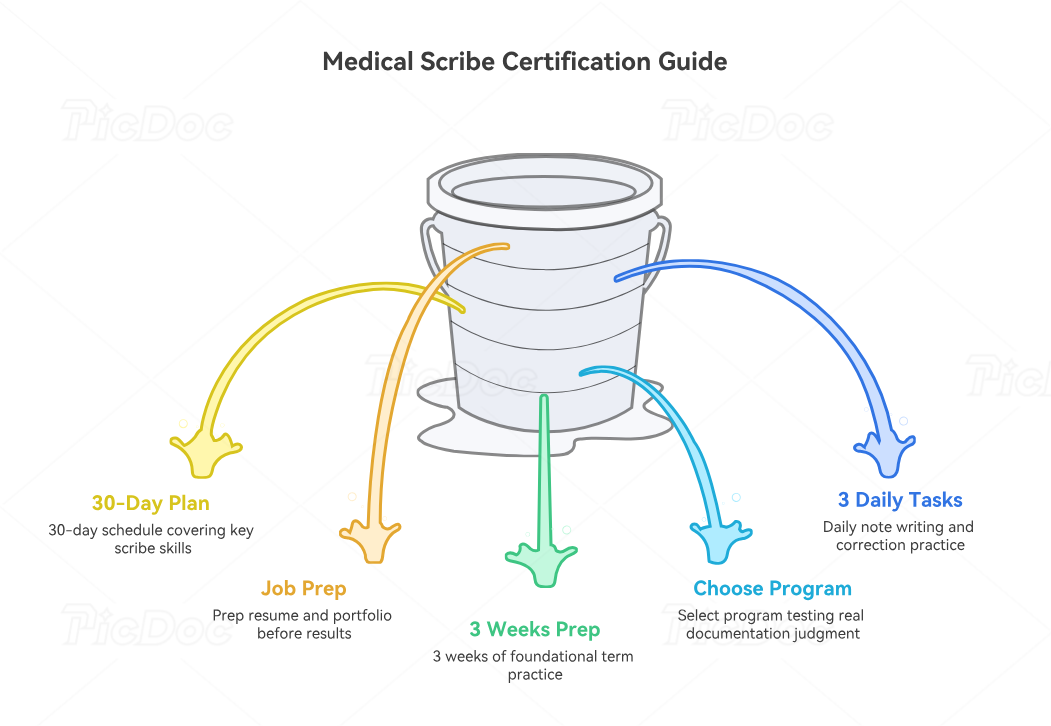
Step one: build your foundation before buying the certificate. Spend one week reviewing medical terminology, one week practicing documentation terms, and one week studying EMR and charting terms. This prevents the common trap where learners enroll first, then spend the course trying to catch up with basic vocabulary.
Step two: choose a certification program that tests real documentation judgment. Look for modules on clinical note structure, privacy, SOAP documentation, common abbreviations, chart correction, provider communication, and specialty workflows. Use top medical scribe training courses, ACMSO exam strategies, and medical scribe certification FAQs to compare options with less guesswork.
Step three: create a 30-day schedule. Days 1-7 should focus on terminology and body systems. Days 8-14 should focus on HPI, ROS, exam, assessment, and plan. Days 15-21 should focus on specialty notes using cardiology, ortho, GI, and outpatient networks, primary care networks, and pediatric and OB/GYN networks. Days 22-30 should focus on timed mock exams, privacy scenarios, and interview answers.
Step four: practice notes every day. Write one short note, one full note, and one correction exercise daily. Mark every gap you missed: onset, duration, severity, medication name, allergy, associated symptom, follow-up time, or red-flag negative. This is where realistic medical scribe exam questions, specialty templates, and EMR platform familiarity become practical.
Step five: prepare your job materials before the certificate result arrives. Your resume should mention certification, typing speed if strong, medical terminology, EMR exposure, privacy training, remote-work readiness, and specialty practice. Build a simple portfolio summary with de-identified sample exercises, then prepare answers using medical scribe job interview prep, interview questions scribes should expect, and from scribe to physician journeys if your long-term goal is medical school, residency, licensing, or clinical advancement.
5. Jobs, Career Paths, and Mistakes to Avoid
Pakistan-based scribe candidates can target several pathways after certification. Remote medical scribing is the most obvious route for English-fluent candidates with strong internet, quiet workspace, and time-zone flexibility. Local clinic documentation support can also build experience, especially for learners who want patient-flow familiarity. Candidates with strong admin skills can combine scribing with appointment scheduling knowledge, front desk operations, patient communication, and de-escalation techniques.
The strongest applications connect certification with employer needs. A recruiter wants to know whether you can protect patient information, handle corrections professionally, type accurately, learn templates quickly, and stay calm when notes pile up. Use top scribe companies, urgent care and retail clinic brands, community health centers, and clinical research sites to understand where scribe experience can lead.
Avoid three damaging mistakes. First, avoid treating the certificate as the final achievement. Employers care about performance after the certificate. Second, avoid copying templates blindly. A template helps only when the patient story fits. Third, avoid weak privacy habits. Remote work demands clean device access, private workspace, careful file handling, and disciplined communication. Strengthen this area with HIPAA terms for scribes, patient privacy essentials, and legal responsibilities for medical admin teams.
For 2026-2027, AI documentation tools will keep changing the role. That increases the value of human review skills. A certified scribe who can catch contradictions, refine HPI details, spot missing negatives, and clean up AI-generated draft notes becomes more useful. Study future trends in medical scribing, voice recognition tools, and regulatory and compliance changes so your skills stay durable.
6. FAQs About Medical Scribe Certification in Pakistan
-
Yes. It is useful for Pakistani learners who want remote healthcare documentation roles, clinical exposure, stronger medical vocabulary, and structured proof of scribe readiness. The value increases when you combine certification with EMR knowledge, medical terminology practice, and scribe interview preparation.
-
Many scribe pathways focus on documentation skill, terminology, English comprehension, privacy discipline, and trainability. A medical background helps, especially for MBBS students and graduates, yet non-physician candidates can build readiness through scribe training courses, documentation terms, and realistic scribe questions.
-
A focused learner can prepare in 30 to 60 days if they study daily. Beginners should spend extra time on medical terminology, EMR charting, HIPAA-style privacy, and timed notes before attempting exam-style practice.
-
The highest-value skills are fast listening, accurate HPI capture, strong English grammar, medical vocabulary, privacy discipline, typing stamina, correction habits, and EMR confidence. Candidates should study dictation tools, telemedicine scribing, and international offshore employers.
-
Include your certification, medical terminology training, EMR exposure, typing speed if impressive, privacy training, specialty practice, mock note portfolio, and availability for remote shifts. Support your applications with healthcare recruiter platforms, top scribe companies, and interview preparation resources.
-
The most common problem is weak proof. They mention certification, then struggle to explain how they would handle missing information, privacy concerns, conflicting symptoms, or a rushed provider. Fix this by practicing exam questions, documentation templates, and medical scribe interview answers before applying.
