

Interactive Infographic: Medical Scribe Employment & Salary Trends
Medical scribing keeps expanding because providers still need documentation support, health systems still need cleaner chart flow, and patients still expect faster encounters. At the same time, pay is shifting unevenly across specialties, care settings, remote models, and local labor markets. That creates confusion for new scribes who want clarity before they invest time in training, certification, and job applications.
This guide breaks down the employment and salary trends that actually shape opportunity. It also connects those trends to hiring strategy, specialization, interview prep, skill-building, and long-term career positioning through resources like top medical scribe companies, health systems hiring medical scribes by state, medical scribe training courses and certifications, and interactive future trends in medical scribing.

1. Why Medical Scribe Employment Trends Matter More Than Ever
A lot of aspiring scribes look at the role too narrowly. They see a job title, a single pay number, and a general idea of “clinical exposure.” That misses the real picture. Medical scribe employment has split into several distinct lanes, including emergency departments, outpatient specialty clinics, virtual scribing teams, academic medical centers, hospitalist groups, urgent care chains, and offshore documentation operations. Each lane rewards a different mix of speed, charting quality, schedule flexibility, and specialty familiarity. That is why it helps to study emergency department and urgent care scribe employers, academic medical centers using scribes, hospitalist groups hiring scribes, and international or offshore employers before assuming the market is flat.
Salary trends also make more sense once you understand what employers are really paying for. They are paying for reduced provider burden, faster documentation turnaround, cleaner notes, stronger EMR fluency, better specialty adaptation, and lower training friction. A scribe who can handle high-volume orthopedics, a fast-paced urgent care shift, or a complex multi-problem internal medicine encounter becomes more valuable than a scribe who only knows the title of the role. That is where top 20 medical scribe documentation terms, EMR and charting terms for scribes, medical terminology mastery, and HIPAA compliance for medical scribes start influencing earnings in a very practical way.
One of the biggest mistakes new candidates make is treating salary as a fixed number instead of a moving outcome. Pay can rise when you shift into a harder specialty, learn a demanding EMR, take evening or weekend schedules, build remote documentation accuracy, or enter a larger employer with stronger workflow maturity. Pay can stall when you stay generic, apply too narrowly, ignore faster-growing settings, or show weak documentation skill during interviews. A smart job seeker tracks specialty networks hiring scribes, primary care and internal medicine networks, dermatology and ophthalmology practices hiring scribes, and orthopedic and sports medicine groups hiring scribes because those employers often reveal where better opportunities are clustering.
2. The Employment and Salary Patterns Every Medical Scribe Should Understand
The most useful salary trend insight is that employers rarely pay for “interest.” They pay for reduced friction. If you can jump into a chart, recognize what belongs in the HPI, distinguish patient-reported symptoms from provider interpretation, and keep the record clean under time pressure, your value rises faster. That is why how to ace your medical scribe certification exam, realistic medical scribe exam questions, medical scribe certification FAQs, and interview preparation for medical scribes matter so much. They help transform you from “trainable” into “useful quickly,” and that changes how employers look at you.
Another major trend is that specialization keeps creating wage separation. A general entry-level role may get you into the field, but specialty-heavy environments often create stronger leverage once you prove you can keep up. Orthopedics, cardiology, GI, hospital medicine, pediatrics, women’s health, dermatology, ophthalmology, and urgent care all carry different note rhythms and vocabulary loads. Candidates who prepare for those demands in advance can step into jobs with more confidence and sometimes better compensation logic. That is why a smart candidate studies specialty-specific documentation template libraries, clinical research sites with scribe-to-CRC tracks, pediatric and women’s health hiring networks, and outpatient specialty networks instead of applying blindly.
Technology is another salary variable people underestimate. Employers want scribes who can function around major EHR systems, work cleanly with templates, and support providers who may use dictation or voice-recognition workflows. A scribe who understands common platforms and documentation tools imposes less training cost on the employer, and that makes the candidate more competitive. Preparation here can come from top EMR and EHR platforms every medical scribe should know, voice recognition and dictation software for clinicians and scribes, EMR charting terms scribes need to understand clearly, and top terms medical scribes must master for accurate documentation.
3. Where Medical Scribe Demand Is Growing Fastest
The broadest demand continues to come from systems where provider time is under constant pressure. Emergency departments and urgent care centers fit that pattern because their throughput depends heavily on keeping charting from slowing down the encounter. That is why emergency departments and urgent care chains for scribe jobs, urgent care and retail clinic brands hiring scribes, top hospitals hiring medical scribes, and health systems hiring medical scribes by state remain valuable starting points if you want a faster-moving labor market.
Strong opportunity also continues inside specialty networks. Cardiology, orthopedics, ophthalmology, dermatology, GI, hospital medicine, family medicine, internal medicine, pediatrics, and women’s health all rely on accurate documentation, yet each one punishes vague preparation in a different way. A cardiology note carries its own logic. An orthopedic encounter moves differently from a primary care visit. A hospitalist documentation flow demands sharper follow-up structure. Candidates who recognize those differences early often compete better than candidates who rely on generic enthusiasm. That is exactly why orthopedic and sports medicine groups hiring scribes, dermatology and ophthalmology practices, primary care and internal medicine networks, and hospitalist groups hiring scribes should shape how you target the market.
Remote and offshore employment also remains part of the conversation, especially for candidates who need location flexibility or want to widen their options. That said, remote availability alone should never be your only filter. Some remote jobs offer strong process discipline and long-term growth. Others mainly offer access and convenience. A smart candidate studies training quality, note review rigor, supervision, specialty exposure, and promotion paths before choosing. Use international and offshore medical scribe employers, medical scribes and telemedicine, how regulations and compliance changes are shaping medical scribe roles, and future trends in medical scribing opportunities to judge remote paths more intelligently.
4. What Salary Trends Really Mean for New, Experienced, and Remote Scribes
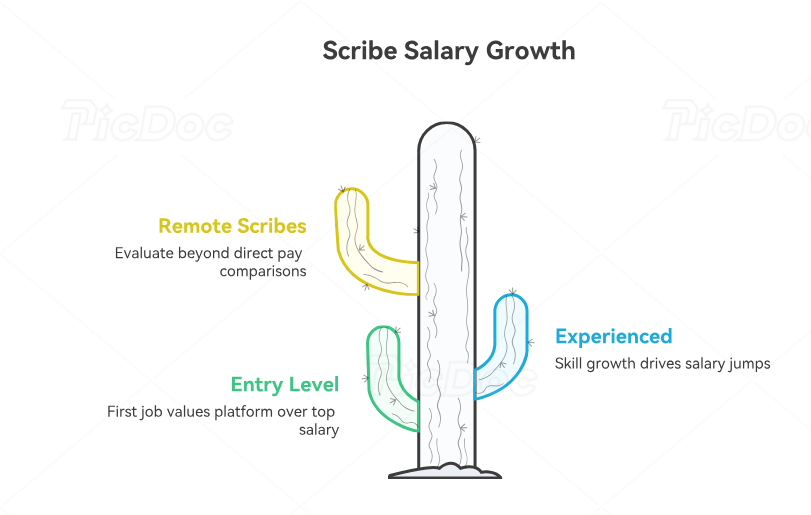
For entry-level scribes, the most important salary lesson is that the first job is often about platform value more than top pay. You need the first role to give you live exposure, documentation pressure, provider feedback, and resume evidence. If you focus only on the highest visible wage without thinking about training quality, you can end up in a role that pays slightly better but leaves you less employable a year later. A better early strategy is to combine medical scribe training and certification resources, pre-med gap-year programs with scribe tracks, medical scribe job interview prep, and healthcare recruiters and talent platforms posting scribe roles so your first offer creates momentum.
For experienced scribes, salary trends become more about leverage. Once you can document confidently, your next pay jump usually comes from one of five things: tougher specialty value, stronger employer scale, broader shift flexibility, remote workflow strength, or cleaner interview proof. This is where people either drift or grow. The scribes who grow start treating themselves like specialists in training. They sharpen vocabulary, understand how providers want notes structured, learn a new setting, and pursue employers whose workflow complexity actually rewards the skill. Resources like top hospitals hiring medical scribes, top health systems hiring medical scribes by state, clinical research site tracks for scribes, and from scribe to physician journeys help you see how that growth story can unfold.
For remote or internationally distributed scribes, salary interpretation needs even more caution. Location differences, employment model differences, and workflow maturity differences can distort direct comparisons. A remote role that looks attractive on schedule flexibility can still become frustrating if the training is weak, the note review is inconsistent, or the provider expectations are poorly structured. A safer approach is to look at total career value: specialty exposure, training support, compliance discipline, quality of supervision, and the chance to move into stronger future roles. Candidates should evaluate remote options using international and offshore medical scribe employers, medical scribes and telemedicine, HIPAA guidance for scribes, and regulatory changes shaping the role before judging a role by pay alone.
5. How to Use Employment and Salary Trends to Build a Stronger Medical Scribe Career
The smartest way to use trend data is to turn it into a job-search system. Start by choosing three target lanes instead of one. For example, you might target emergency medicine, orthopedic groups, and remote telemedicine support. Or you might target primary care networks, academic medical centers, and hospitalist teams. This widens your opportunity set while keeping your prep focused. It also helps you tailor your language. A resume for urgent care should highlight pace and documentation flow. A resume for orthopedics should signal specialty vocabulary preparation. A resume for hospital medicine should show structure and reliability. You can map those lanes using emergency and urgent care hiring directories, orthopedic hiring groups, primary care networks, and academic medical centers using scribes.
Next, tie your learning directly to the hiring signals you want to benefit from. If specialties are paying more attention to candidates who arrive semi-prepared, then study the vocabulary and chart patterns before you apply. If employers are screening hard for note accuracy, practice note logic. If EMR familiarity creates faster hiring confidence, learn the systems that dominate the market. That is where top EHR platforms every scribe should know, documentation cheat sheets and template libraries, medical terminology tutorials, realistic exam questions for scribes, and medical scribe certification prep become direct salary tools, not just study aids.
Then strengthen the parts of your profile that employers use to predict long-term usefulness. They want to know whether you can survive the workload, follow the provider’s logic, protect privacy, and learn quickly without constant correction. A weak application usually sounds generic. A strong application shows understanding of chart flow, specialty interest, documentation discipline, and adaptability. Support that with medical scribe interview questions and expert answers, interview preparation for medical scribes, must-know HIPAA terms for scribes, and future trends in medical scribing so your interviews show genuine role readiness.
Finally, think one move ahead. The best employment decision is rarely the one with the simplest application. It is the one that creates stronger next-step proof. If you want medical school or PA school, you may care more about exposure and learning density. If you want research, look for scribe-to-CRC bridges. If you want a long-term documentation career, look for settings that reward specialization and technology fluency. If you want flexible remote work, prioritize disciplined employers with growth paths. That is why it helps to compare clinical research tracks for scribes, top medical scribe companies, telemedicine-focused scribing guidance, and real-life journeys from scribe to physician before locking yourself into a path that looks easy but grows slowly.
6. FAQs About Medical Scribe Employment and Salary Trends
-
The biggest drivers are provider documentation burden, rising visit volume in fast-moving care settings, specialty clinic growth, telemedicine support needs, and the need for cleaner chart flow. You can see those patterns more clearly by studying health systems hiring medical scribes by state, emergency departments and urgent care employers, specialty networks hiring scribes, and future trends in medical scribing opportunities.
-
Pay differences usually reflect specialty complexity, employer scale, shift difficulty, training burden, documentation quality expectations, and market competition. A scribe with stronger specialty preparation and cleaner EMR confidence often becomes more valuable than a scribe who only meets the minimum. Improve that value through specialty template libraries, EMR platform knowledge, medical terminology mastery, and medical scribe certification prep.
-
Yes, remote jobs still matter, especially for candidates who need wider geographic reach or prefer virtual workflows. The smart move is to evaluate training quality, supervision, compliance rigor, specialty exposure, and long-term advancement instead of looking at convenience alone. Helpful resources include international and offshore scribe employers, medical scribes and telemedicine, HIPAA compliance guidance for scribes, and regulations shaping scribe roles.
-
Emergency departments, urgent care chains, primary care networks, large health systems, and structured scribe companies often provide the clearest entry routes because they hire at scale and usually have repeatable workflows. Start your search with top medical scribe companies, top hospitals hiring scribes, urgent care and retail clinic brands, and primary care and internal medicine networks.
-
Improve documentation readiness, strengthen specialty familiarity, study major EHR workflows, prepare stronger interview examples, and widen your employer search. These steps usually do more for your earning potential than sending more generic applications. Build around realistic exam questions, interview prep for scribes, medical scribe job interview expert answers, and healthcare recruiter directories posting scribe roles.
-
Certification usually helps most at the screening and readiness stage. It signals seriousness, gives structure to your learning, and can make employers more confident that you will ramp faster. The best value comes when certification is paired with actual documentation practice. Start with top medical scribe training courses and certifications, how to ace your certification exam, medical scribe certification FAQs, and top documentation terms medical scribes must master.
