

Why Is It So Hard to Get a Medical Scribe Job? Reddit Hiring Stories, Rejection Patterns & a 2026 Fix-It Plan
Getting a medical scribe job in 2026 can feel absurdly difficult for a position that often advertises no prior experience required. The contradiction disappears once you understand how hiring actually works. Employers are screening for schedule fit, reliability, typing ability, commitment length, location, and readiness for medical documentation, clinical communication, confidentiality, and fast-moving medical administrative workflow. Many applicants are qualified academically and still fail because they are solving the wrong hiring problem.
1. Why Getting a Medical Scribe Job Feels So Difficult in 2026
The first hiring reality is counterintuitive: “entry level” does not mean “easy to schedule.”
Current ScribeAmerica postings explicitly advertise positions requiring no previous scribing experience and provide training. A current Boston posting requires a high-school diploma, U.S. work authorization, English fluency, strong communication, a typing speed of at least 40 WPM, and flexible availability. The work includes recording histories, examinations and treatments, maintaining EHR information, tracking tests, protecting records, and supporting physicians.
That tells applicants where the real screening pressure sits. Employers can teach medical terminology, chart structure, written clinical communication, EHR conventions, HIPAA-sensitive communication, and site-specific medical workflow. They have much less flexibility when a physician needs coverage Wednesday from 8 a.m. to 5 p.m. and the applicant has chemistry laboratory during that exact period.
ProScribe makes this matching mechanism unusually explicit. Its current requirements include college sophomore status or higher, a pre-health track, at least a six-month commitment, and the ability to work two shifts or 16 hours weekly. Its hiring process evaluates the resume, application, typing test, video interview, availability and ability to commit to available shifts before an offer is made.
This explains one of the most painful applicant experiences: you can be intelligent, medically motivated and technically qualified while still being unusable for the particular opening.
A July 2026 Reddit applicant reported being rejected after a video interview specifically because their class schedule prevented availability on two weekdays. A chief scribe responding in the discussion warned applicants against claiming completely open availability and changing it after training because the available site hours may have been assigned specifically around what the applicant originally promised.
That pattern should change how you interpret rejection. A rejection may reflect site-fit failure rather than candidate-quality failure.
Your biology coursework, 80-WPM typing speed, professionalism, familiarity with patient communication, knowledge of medical office triage, and understanding of team communication cannot create a Thursday morning slot in your calendar.
Applicants also underestimate how operationally specific scribe coverage can be. A current ScribeAmerica emergency-department posting seeks two to three shifts per week and warns that shifts may include overnights. Another current Maryland listing says outpatient work often follows weekday office hours while emergency departments operate around the clock and typically require two to three part-time shifts weekly.
A student who writes “available evenings and weekends” may therefore appear flexible in ordinary retail hiring while being incompatible with a clinic whose physicians need scribes Monday, Wednesday and Friday from 8:00 to 5:00.
The second problem is that scribing attracts exactly the kind of candidates who have restrictive schedules. Premeds frequently have laboratories, research, volunteering, MCAT preparation and demanding science courses. The employer simultaneously needs predictable coverage. That tension creates rejection even among otherwise strong candidates.
The third problem is timing. Applying in May for a job you want to start in June leaves little room for screening, interview preparation, onboarding, vaccination documentation, training and site placement. ProScribe currently says its training process averages about a month after hiring.
A delayed start can therefore consume most of a student's summer before the first independent shift occurs.
2. Reddit Rejection Stories Reveal the Same Hiring Patterns Again and Again
Reddit is especially useful here because applicants reveal details that a generic rejection email never provides. Individual posts cannot tell us the national rejection rate, although they expose recurring operational problems worth testing against employer requirements.
Availability appears repeatedly.
A February 2026 r/medicalscribe poster had anatomy experience, clinic volunteering and an interest in paid clinical work, yet offered mainly weekend availability. They reported interviewing and receiving no final response. The discussion quickly focused on searching urgent-care practices or direct physician offices whose operating hours matched the applicant's schedule.
That is more useful than telling the student to obtain another certificate. If the bottleneck is time coverage, spending money on certification leaves the bottleneck untouched.
Medical scribing requires dependable team communication, accurate medical transcription, disciplined written communication, professional provider interaction, and familiarity with fast clinical workflows. Yet those strengths only become relevant after the employer knows you can physically cover the shift.
A different April 2026 poster reported waiting two weeks after applying and completing a video application despite extremely fast typing and several large blocks of availability. The applicant worried that a delayed response would eliminate the summer they had planned to use for clinical experience.
That case highlights another problem: silence and rejection are different events.
Scribe programs often match candidates to specific local contracts. Hiring therefore involves more than passing an interview. Your application may be acceptable while the site has no compatible opening, a provider schedule is changing, onboarding capacity is limited, or the hiring team has not completed placement.
An April 2026 employee described a dramatically longer process, reporting roughly three months of onboarding before additional delays in on-site training. That is one person's experience rather than a universal timeline, yet it demonstrates how dangerous it can be to build an entire clinical-experience plan around one pending application.
This is where professional email etiquette becomes useful. Follow up clearly, maintain assertive communication, document important correspondence, preserve professionalism, and continue pursuing alternatives instead of repeatedly refreshing one inbox.
The worst strategy is emotionally treating an application as employment before you have a confirmed placement and start date.
Reddit also reveals why applicants overvalue previous medical exposure. A former chief scribe commenting on a 2025 rejection discussion said availability had been the principal reason they rejected candidates when schedules failed to match local sites.
That aligns with ProScribe's published process, which explicitly says an offer depends partly on availability to commit to the shifts actually open.
Think like an operations manager. A clinic needs someone who arrives consistently, absorbs medical terminology, understands confidential communication, follows professional standards, documents efficiently, and remains long enough to justify training. Your impressive résumé can strengthen that proposition. It cannot replace it.
3. The Medical Scribe Résumé and Interview Mistakes That Quietly Kill Applications
A strong scribe résumé needs to prove operational reliability, not simply academic ambition.
“Premed biology major with a passion for healthcare” describes thousands of applicants. A recruiter receives far more useful information from evidence that you handled 40 customer interactions per shift, entered research data without errors, maintained confidential files, balanced multiple deadlines, or documented technical information accurately.
Those experiences map directly onto written communication, medical transcription discipline, confidentiality, professional conduct, and team communication.
Students with research experience should translate it properly. “Undergraduate researcher” is a title. “Maintained accurate specimen records, followed standardized protocols, reconciled discrepancies and communicated findings to a multidisciplinary team” is evidence.
Customer-service work can be equally valuable. A barista who handles a rush while remembering modifications, prioritizing orders, correcting mistakes and communicating with coworkers already possesses elements of the listening, prioritization and composure required during difficult patient interactions, crisis communication, rapport building, and rapid clinical communication.
The interview requires the same translation.
Current Reddit discussions about ScribeAmerica interviews describe short interviews focused largely on motivation, availability, future healthcare goals, multitasking and situational judgment rather than advanced technical medicine.
Prepare for questions such as:
Why do you want to become a medical scribe?
What will you do when you miss a piece of information?
How do you respond when several tasks arrive simultaneously?
How will you maintain confidentiality?
Tell me about a time accuracy mattered.
How would you manage a stressful physician or fast-paced encounter?
How long can you commit?
What exact days and hours can you consistently work?
Strong answers should demonstrate professionalism, assertiveness, precise verbal communication, reliable team communication, and sensitivity around confidential information.
Your answer to “Why scribing?” also needs more depth than “I need clinical hours for medical school.”
Explain that you want exposure to physician reasoning, patient interactions, clinical documentation, medical office triage, diagnostic workflow and bedside communication. That answer demonstrates that you understand the job rather than viewing the employer as an hour dispenser for AMCAS.
Typing deserves dedicated preparation as well. ScribeAmerica currently lists 40+ WPM as a requirement in multiple openings. ProScribe includes a typing test during application screening.
Practice beyond ordinary prose. Listen to clinical-style speech while typing, distinguish medications from symptoms, handle unfamiliar terms without losing the rest of the sentence, and learn common HPI structures. Study medical transcription terminology, written medical communication, patient interaction language, medical administrative workflow, and clinical professionalism.
Speed gets you through the gate. Listening accuracy keeps you useful once the encounter starts.
4. The 2026 Fix-It Plan: Diagnose Your Bottleneck Before Sending Another Application
Sending 40 copies of the same weak application creates 40 opportunities for the same rejection.
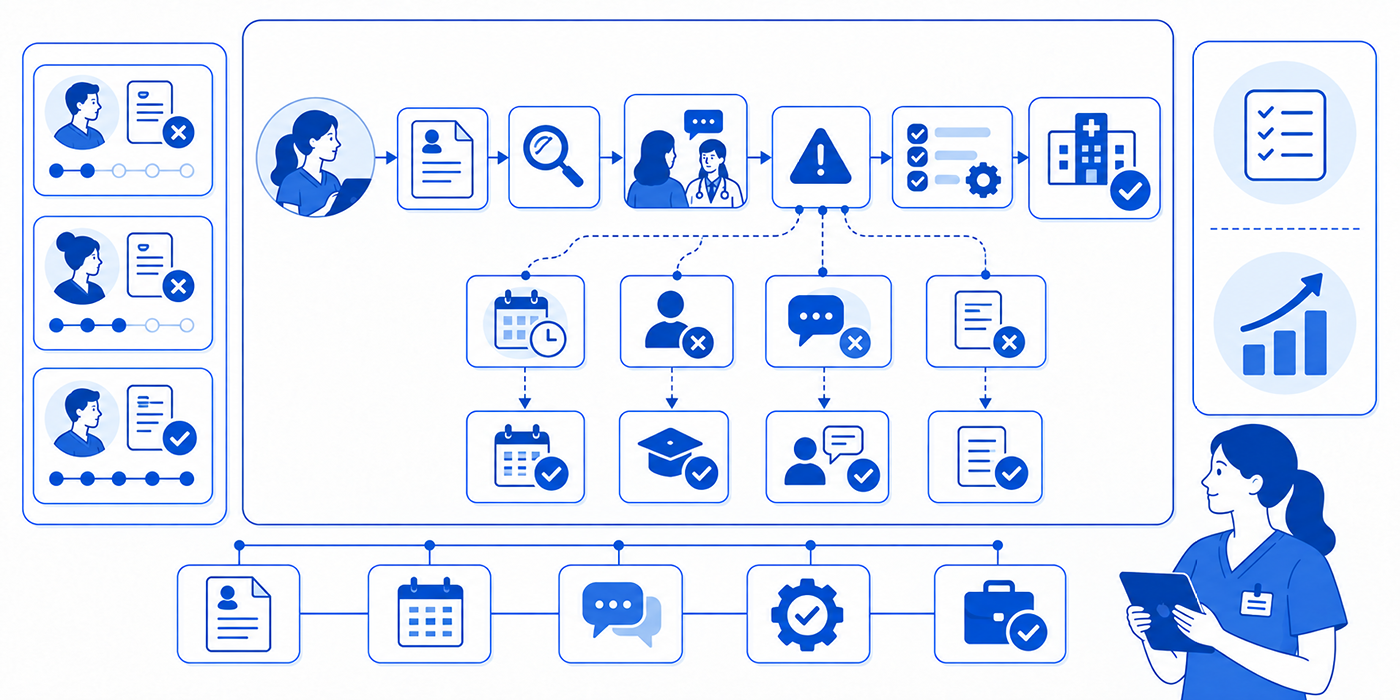
Build a diagnostic hiring funnel instead.
Step 1: Audit your availability first
Write your real semester schedule in blocks. Employers need usable blocks, not an impressive total number of theoretical hours.
“Twenty hours available weekly” could mean five four-hour gaps that cover zero physician shifts. Two complete weekdays may be much more valuable.
Separate your search by setting. Outpatient practices usually align with business hours. Emergency departments create more evening, overnight and weekend possibilities. Current ScribeAmerica materials explicitly describe this difference.
Where daytime availability is impossible, target emergency medicine, urgent care, weekend specialty clinics, telehealth and direct-practice roles rather than repeatedly applying to weekday offices.
This is scheduling conflict management applied to your own career. The same discipline required for appointment scheduling, virtual check-in, medical workflow, and team communication can prevent wasted applications.
Step 2: Build a three-lane application pipeline
Lane A: national scribe companies. Apply to positions whose posted schedule genuinely fits you.
Lane B: direct physician practices. Search cardiology, dermatology, orthopedics, ophthalmology, ENT, primary care, urgent care and other groups individually. Direct-office roles may combine documentation with scheduling, calls, referrals or other administrative responsibilities. A May 2026 Reddit poster described being hired directly by a physician and initially learning MA-style tasks, front-desk work, phone handling, scheduling and referrals alongside the scribe role.
That broader role can reward knowledge of phone communication, front-desk etiquette, patient interaction, secure messaging, and medical administrative workflow.
Lane C: adjacent clinical jobs. Search patient care technician, clinical assistant, care navigator, non-certified MA positions where permitted, patient transporter, rehabilitation aide, hospice roles and clinical-research positions with patient contact.
This lane prevents one changing occupation from controlling your entire premed timeline.
Step 3: Apply to actual sites, not generic aspirations
Track:
employer
specific location
specialty
date posted
shift requirement
minimum commitment
typing requirement
application date
recruiter contact
interview date
follow-up date
status
next action
Once you do this, rejection patterns become visible. Ten rejections from weekday clinics while you have weekday classes tells you something. Five interviews with zero offers tells you something different. Twenty applications with zero interviews suggests a résumé, location, eligibility or screening problem.
Step 4: Use a professional follow-up sequence
After approximately five to seven business days without an update, send one concise email reaffirming interest, confirming availability and asking whether additional information is required.
Apply professional email etiquette, concise written communication, respectful assertiveness, and consistent professionalism.
Then continue applying elsewhere.
Waiting passively for six weeks does not make an employer more likely to hire you.

5. AI, Site Closures and the New Hiring Reality Applicants Need to Plan Around
Some 2026 rejections have nothing to do with résumé quality.
Human scribing is operating inside a documentation market being changed by healthcare automation. That does not make every human scribe position disappear, although it creates genuine uncertainty around particular contracts and locations.
A June 2026 r/premed discussion attracted concern specifically because scribing has traditionally provided clinical employment without requiring an expensive EMT or MA certification. Posters worried that ambient AI would reduce one of the most accessible entry routes.
Another 2026 scribe reported that two emergency-department placements were being terminated after implementation of AI scribing programs. That is anecdotal evidence from one worker, though it illustrates a real applicant risk: a listing can exist in a labor market where the underlying documentation model is changing quickly.
This makes diversification essential.
Develop skills that remain useful across human and hybrid workflows: medical terminology, healthcare automation literacy, clinical communication, documentation accuracy, patient interaction, and current medical-scribe regulatory knowledge.
You should also understand the difference between a job search problem and a market problem.
If 40 human-scribe openings exist within commuting range and none interview you, improve the application.
If three openings exist and all require hours you cannot work, improve the targeting.
If a local hospital has ended its human-scribe program, stop trying to résumé-optimize your way into a position that has ceased to exist.
Search ACMSO's medical scribe hiring map, review current employment and salary trends, prepare through medical scribe interview questions, understand changing scribe regulations, and compare medical scribe and CMAA roles before locking yourself into one route.
The most dangerous applicant mindset is believing, “I need a scribe job specifically.”
Your actual premed objective may be paid clinical exposure, physician access, deeper understanding of healthcare, stronger patient communication, experience with bedside manner, exposure to therapeutic communication, and enough sustained involvement to explain why medicine fits you.
Several jobs can accomplish those objectives.
Keep scribing in your strategy. Avoid making it your only strategy.
6. FAQs About Getting a Medical Scribe Job in 2026
-
Start with availability and site matching before assuming the problem is your résumé. Current ScribeAmerica listings require flexible availability, while ProScribe explicitly says offers depend partly on your ability to commit to available shifts.
Review your typing speed, commitment length, commute, application timing and interview performance next. Prepare through medical scribe interview questions, strengthen professional communication, learn medical terminology, and understand medical administrative workflow.
-
Yes. Current ScribeAmerica postings explicitly state that previous experience is unnecessary and that training is provided.
Your application still needs to demonstrate transferable skills. Reliability, precise listening, typing, written communication, confidentiality awareness, professionalism, and strong team communication can come from research, service, customer-facing jobs and academics.
-
It can be decisive.
ProScribe requires at least two shifts or 16 hours weekly and a minimum six-month commitment, and its published application process says availability to commit to open shifts influences whether an offer is extended.
ScribeAmerica's current listings similarly emphasize flexible availability, and some emergency-department openings require two to three weekly shifts that may include overnight coverage.
Use truthful availability and understand scheduling conflicts before applying.
-
Give the availability you can genuinely maintain.
A July 2026 Reddit applicant specifically discussed being rejected for schedule limitations, while a chief scribe responding warned that falsely presenting open availability can create a situation where training is completed for shifts the employee ultimately cannot cover.
Reliability is part of medical professionalism, team communication, scheduling management, and effective clinical workflow.
-
Requirements vary by employer and site. Current ScribeAmerica postings list 40+ WPM, while ProScribe includes a typing assessment in its application process.
Build accuracy alongside speed. Real scribing involves unfamiliar medical terminology, rapid verbal communication, structured written documentation, and constant awareness of confidential information.
-
Continue applying immediately. One application should never stop the rest of your search.
Some 2026 Reddit posters have reported waits of weeks or much longer during hiring and onboarding. ProScribe separately says its training itself averages about one month after hiring.
Use disciplined professional email communication, maintain assertive follow-up, and keep building your application pipeline.
