

ScribeAmerica vs Private Practice Scribe Jobs: Reddit Pay, Training, Workload & Career Value Compared
Choosing between ScribeAmerica and a private-practice scribe job can change your hourly pay, training quality, physician access, schedule, and the usefulness of the experience for a future healthcare career. Current 2026 postings show ScribeAmerica providing structured paid training and broad entry-level access, while some direct clinic roles advertise materially higher wages and deeper specialty responsibilities. The smartest comparison uses actual medical scribe salary trends, medical scribe hiring patterns, clinical workflow expectations, and the career value you need the job to produce.
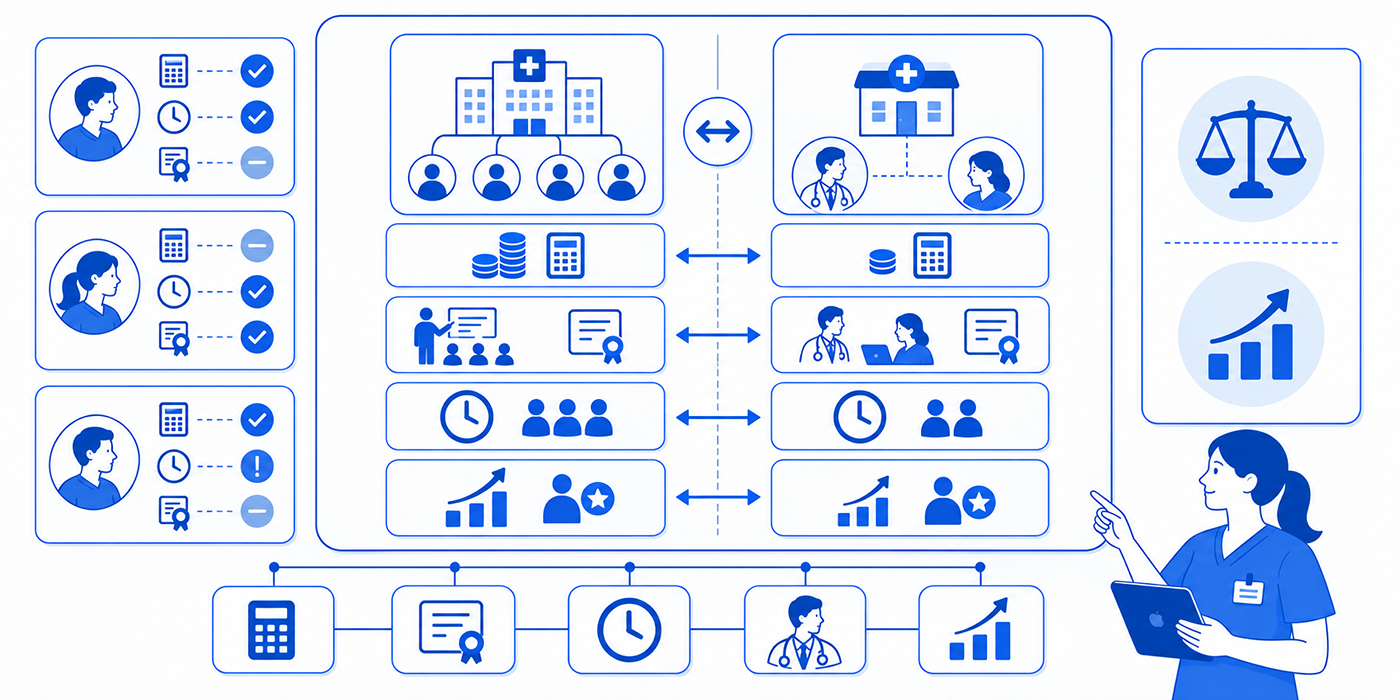
1. ScribeAmerica vs Private Practice Scribe Jobs in 2026: The Real Trade-Off
For a first-time scribe, ScribeAmerica's strongest advantage is infrastructure. Current company postings advertise positions requiring no prior experience, paid training through Scribe University plus hands-on clinical instruction, full- and part-time opportunities, physician exposure, and placements across multiple specialties. Its current careers page showed more than 120 medical-scribe vacancies when reviewed, spanning states and settings from emergency medicine to outpatient clinics.
That structure can be enormously valuable when you still need to learn medical transcription fundamentals, understand medical administrative workflow, develop reliable team communication, and build the professionalism expected in medical administration. A company with an established training pathway can absorb some of the risk employers usually associate with a candidate who has never opened an EHR.
Private practices operate with a different economic model. A physician group may hire one scribe specifically for a provider, specialty, or tightly defined clinic schedule. Current postings demonstrate how attractive that can become. A private ophthalmology practice in Maryland recently advertised $23–$28 per hour, full-time daytime work and benefits. Colorado Pain Care advertised $20–$25 per hour with a four-day weekday schedule and no evenings, weekends, or on-call work. A current urology scribe/assistant opportunity listed through Columbia's School of General Studies pays $22 per hour and asks for a long-term commitment.
Those examples should be interpreted alongside medical scribe employment trends, medical scribe interview preparation, practical written clinical communication, and confidential healthcare communication. Higher-paying direct-practice roles frequently expect the applicant to arrive with more usable skill.
The pay difference is visible even in broader 2026 market data. ZipRecruiter reported an average of $18.26 per hour for private-practice medical scribe jobs as of August 24, 2026, with most wages falling roughly between $15 and $20 per hour. Meanwhile, current ScribeAmerica examples reviewed for this article include $15 per hour in Alton, Illinois, $16 in Boston, and $18 in Wailuku, Hawaii. Geography, minimum-wage laws, specialty, experience and employer type all influence these figures, so a national average should never be treated as an offer prediction.
Reddit reports show the same dispersion. In an April 2026 wage discussion, one private family-medicine scribe in Washington reported earning $23.47 per hour, while commenters reported figures ranging from approximately $10 to the low $20s depending on employer, specialty and state. One commenter identifying as a chief scribe reported $17 per hour.
Pay still tells only part of the story. A $23 role with uncontrolled scheduling conflicts, vague responsibilities, weak patient communication, poor rapport with providers, and constant after-hours chart completion can deliver worse value than a $16 role with predictable shifts, excellent mentorship and usable clinical exposure.
The core comparison for 2026 therefore looks like this: ScribeAmerica tends to lower the barrier to entry through standardized recruiting and training, while a strong private-practice position can offer higher compensation, deeper physician continuity and more specialized responsibility once you are competitive enough to obtain it.
| # | Decision Factor | ScribeAmerica | Private Practice | What the Applicant Should Verify |
|---|---|---|---|---|
| 1 | Entry-level access | Strong; many roles advertise no experience required | Highly variable | Minimum experience in the actual posting |
| 2 | Training structure | Standardized company training | May range from excellent mentorship to informal shadowing | Who trains you and for how long |
| 3 | Training pay | Current listings explicitly advertise paid training | Employer-specific | Get compensation terms in writing |
| 4 | Starting pay | Often near local entry-level market rates | Can be substantially higher in skilled roles | Hourly rate after training |
| 5 | Pay progression | Depends on site and advancement | May be negotiable with increased duties | Raise schedule and promotion criteria |
| 6 | Specialty options | Broad national network | Usually concentrated in one practice specialty | Whether specialty matches your career goal |
| 7 | Provider continuity | May work with one or several providers | Often closer long-term provider pairing | Who you will actually scribe for |
| 8 | Schedule predictability | Varies sharply by ED versus outpatient placement | Often stronger in weekday clinics | Actual recurring shift pattern |
| 9 | Night/weekend exposure | Common in emergency settings | Less common in many outpatient practices | Evening, weekend and holiday requirements |
| 10 | Patient volume | Can be very high in ED placements | Predictable in some clinics, intense in others | Patients per provider per day |
| 11 | Role boundaries | Company and site protocols provide structure | Can broaden substantially | Exact duties beyond documentation |
| 12 | EMR exposure | Site-dependent | Usually one practice system | EHR and onboarding support |
| 13 | Medical terminology training | Built into training pathway | May expect prior fluency | Assessment expectations before day one |
| 14 | Management layer | Chief scribes and company operations may sit between scribe and clinic | Often direct relationship with practice manager or physician | Who resolves workload and scheduling problems |
| 15 | Transfer options | Potential access to other company sites | Usually limited to the practice | Transfer process and available sites |
| 16 | Physician mentorship | Highly placement-dependent | Can become exceptionally strong with one physician | Expected provider interaction outside charting |
| 17 | Letter-of-recommendation potential | Strong when provider relationship develops | Often strong with sustained direct physician access | Provider continuity and commitment length |
| 18 | Clinical exposure | Excellent in many ED and outpatient sites | Excellent when role stays close to physician workflow | How much of the encounter you actually observe |
| 19 | Breadth of disease exposure | Especially broad in emergency medicine | Greater depth within one specialty | Breadth versus specialty depth |
| 20 | Administrative exposure | Depends on placement | Can include referrals, results and broader clinic workflow | Whether duties support your career target |
| 21 | Benefits | Current listings show benefits for qualifying full-time staff | Ranges from none to full benefits | Eligibility, PTO, insurance and retirement |
| 22 | Resume recognition | Large recognizable scribe organization | Specific specialty experience may carry strong relevance | What your next employer values |
| 23 | Advancement pathway | Potential trainer, leadership and operational roles | May lead into MA, operations or specialty support work | Real promotion history within the employer |
| 24 | Provider preference burden | Can vary by assignment | Often intense because one provider's preferences dominate | Expected note style and turnaround time |
| 25 | Workload escalation risk | Site-dependent | Potentially higher in lean practices | Pre-charting, post-charting and administrative duties |
| 26 | HR support | Centralized corporate resources | May be a small office manager or outsourced HR | Escalation process for workplace problems |
| 27 | AI displacement exposure | Can change when contracted sites adopt ambient AI | Depends on individual practice technology strategy | Whether the role is temporary, hybrid or long-term |
| 28 | Job security | Larger network can create reassignment possibilities | Closely tied to practice finances and provider need | Contract duration and reassignment options |
| 29 | Best fit for beginners | Usually strong | Strong when formal training is included | Training quality and supervision |
| 30 | Best fit for experienced scribes | Useful when schedule, location or advancement fits | Often attractive for pay and specialty depth | Total compensation and role quality |
2. Pay Compared: Why Private Practice Can Pay More—and Why the Job May Ask More From You
The wage evidence creates the first major separation.
ScribeAmerica's current listings reviewed for this comparison show $15 per hour in Alton, $16 in Boston and $18 in Wailuku. Each of those postings advertises paid training and accepts candidates without prior professional scribing experience.
That combination matters. Employers are absorbing the cost of teaching medical terminology, EHR-centered administrative workflow, appropriate confidential communication, and fast-paced team communication. Entry-level wage levels partly reflect a labor model designed to recruit inexperienced pre-health candidates and turn them into deployable scribes.
Private-practice postings can price experience differently. The Maryland ophthalmology opening at $23–$28 requires experience. A current Phoenix-area scribe posting serving healthcare practices lists $19–$22 and requires at least one year of recent scribe experience. An Insight Global posting for a California surgical clinic lists an estimated $18–$22 range and describes high-volume work requiring rapid documentation, multitasking and clinical operations support.
That gives experienced candidates a powerful strategy: use early scribing employment to become competent in medical transcription, refine verbal communication, learn professional clinical communication, and understand medical office triage, then compete for employers willing to pay for immediately usable experience.
Reddit anecdotes support this progression. One 2025 commenter reported moving from $16.80 to $18.50 after switching to a private clinic. Another California commenter reported $26 per hour while covering additional clinic responsibilities. A separate commenter reported $10 per hour at ScribeAmerica. These are individual reports rather than controlled compensation data, yet they reveal how employer type and scope can create large wage spreads.
The pain point appears when applicants chase the largest hourly number and miss unpaid labor hidden around the shift.
Ask whether you are expected to pre-chart before clinic, remain after the last patient, correct unfinished notes at home, check results later, answer messages between shifts, or complete mandatory training off the clock. A 2024 Reddit poster described shifts originally presented as eight hours turning into extraordinarily long days after substantial pre-charting and post-charting were added. That account represents one person's experience, yet it illustrates why written schedule expectations matter.
The Department of Labor states that employees generally must be compensated for work they are suffered or permitted to perform. Required training related to the employee's job ordinarily counts as working time unless all four regulatory conditions for exclusion are satisfied.
A Reddit user describing a private practice in 2023 said the employer wanted two weeks of unpaid shadow training. Commenters immediately flagged it as abnormal. Anyone presented with a similar arrangement should compare the facts with applicable federal and state wage rules rather than assuming “shadowing” automatically removes compensation requirements.
This is where knowledge of professional boundaries, assertive healthcare communication, scheduling conflict management, and written communication protects your paycheck as much as it protects your reputation.
Calculate the effective hourly rate:
Effective hourly rate = total weekly compensation ÷ all compensable working time
A $22 job producing 45 paid hours may be attractive. A nominal $22 job demanding ten additional hours of uncompensated cleanup would create a very different economic result.
3. Training Compared: ScribeAmerica Offers Structure, Private Practice Offers Specialization
ScribeAmerica currently advertises paid training through Scribe University and hands-on clinical instruction. Its postings require 40+ WPM typing, strong listening and communication, English fluency and schedule flexibility, while explicitly stating that experience is unnecessary.
For a beginner, that structure can close several dangerous gaps at once. You need enough medical transcription knowledge to recognize unfamiliar language, enough written medical communication to build readable notes, enough confidential communication training to handle PHI correctly, and enough understanding of healthcare administrative workflow to know what happens before and after the encounter.
Private-practice training varies much more. A well-run specialty practice may pair you directly with an experienced scribe, physician, PA or clinic manager and teach you the exact documentation patterns used in that specialty. You can become exceptionally strong in ophthalmology, orthopedics, urology, primary care or another field because every shift reinforces the same disease patterns, terminology, medications, procedures and provider preferences.
That depth can strengthen your understanding of patient education, therapeutic communication, bedside manner, and patient interaction because you repeatedly watch the same clinicians handle recurring clinical problems.
The risk is training by improvisation.
A lean practice may need productivity immediately. You might be shown the EHR for a few shifts and then expected to master one provider's templates, abbreviations, order workflows and preferred note structure while the patient schedule keeps moving. If the physician sees 20–30 patients daily, the learning curve can become brutal.
A June 2026 Reddit poster working in a private primary-care clinic described seeing roughly 20 patients daily and using AI-assisted documentation for one physician while manually documenting with another provider. The user also described editing notes, adding details and working with orders and chart organization. That experience illustrates how quickly modern scribe jobs can become hybrid human-AI workflow roles.
The Joint Commission's updated April 2026 guidance says documentation assistants should receive education or training covering medical terminology, HIPAA, billing/coding/reimbursement principles, EHR navigation, computerized order entry and appropriate methods for pending orders. It also says organizations should define allowable responsibilities in job descriptions and periodically assess competency.
That makes familiarity with healthcare automation tools, revenue cycle terminology, prior authorization workflows, and secure messaging increasingly valuable even when your job title simply says “scribe.”
Order entry deserves particular attention. Joint Commission guidance allows documentation assistants to enter orders at a licensed practitioner's direction under organizational policies, with provider verification and appropriate pending/submission workflows. Scope can also depend on state rules, certification and the employee's defined duties.
Before accepting either type of job, ask five training questions:
How many hours of classroom or online training occur before floor training?
How many supervised clinical shifts occur before solo work?
Is every required training hour paid?
What happens if I fail the first competency assessment?
Who supports me when a provider's documentation preference conflicts with what I learned?
Applicants who can discuss team communication, professional assertiveness, medical transcription accuracy, and clinical workflow intelligently during the interview can evaluate the employer while the employer evaluates them.
4. Workload and Scheduling: The Employer Name Matters Less Than the Actual Site
“ScribeAmerica workload” is almost impossible to describe with one number because a weekday women's-health clinic and a level-one trauma center create radically different working conditions.
A current Boston ScribeAmerica posting describes weekday outpatient work roughly between 7 a.m. and 5 p.m. The company's Alton listing describes emergency-department work with varying shifts and possible overnights. Another company posting explains that outpatient sites often operate weekday office hours while EDs run around the clock.
That difference affects far more than sleep. An ED scribe can encounter rapid turnover, undifferentiated complaints, frequent imaging, consultations, procedures and constantly changing priorities. It can accelerate medical terminology mastery, sharpen crisis communication, strengthen team communication, and teach the realities of medical office triage concepts.
The pressure can also expose every weakness in your note-building process.
A Reddit user who joined ScribeAmerica in late 2024 described a provider who moved extremely quickly and had highly specific note preferences. The poster reported additional responsibilities involving treatment notes, referrals, labs and scans while still adapting to the provider.
Another April 2026 ScribeAmerica Reddit review from someone with experience in level-one and level-two trauma centers complained about minimum-wage compensation, limited weekly shifts and management issues. The same user had two placements affected by transitions to AI scribing.
These stories reveal the part applicants often miss: your experience is produced by the site, provider, chief scribe, schedule and specialty simultaneously.
Private practice has its own workload trap. A small clinic may employ fewer specialized administrative staff. The scribe can gradually become the person who knows how to find results, prepare charts, coordinate referrals, handle inbox items, pend orders and fix anything connected with the provider's workflow. Those responsibilities can build valuable prior authorization knowledge, revenue cycle awareness, secure messaging skills, and understanding of medical administrative workflow.
Role expansion deserves compensation, training and clear boundaries.
A stronger private-practice role can also deliver excellent lifestyle consistency. Colorado Pain Care's current posting, for example, advertises a Monday-through-Thursday schedule from 7 a.m. to 5 p.m., with no weekends, evenings or on-call obligations. A Central Florida pain-management scribe/assistant posting advertises Monday through Friday from 7 a.m. to 4 p.m. at $20–$21 per hour.
That predictability can be decisive for a premed protecting MCAT study time or a student balancing demanding coursework.
Before saying yes to either employer, ask for the schedule reality:
average patients per shift
expected chart completion time
pre-charting requirement
post-shift documentation
lunch and break expectations
number of providers per scribe
weekend and holiday frequency
minimum weekly shifts
schedule publication timeline
procedure-day workload
expected inbox or results work
duties performed outside the examination room
A candidate familiar with scheduling conflict management, professional verbal communication, appropriate assertiveness in medical administration, and professional email etiquette can ask those questions without sounding difficult.

5. Career Value: Which Scribe Job Builds the Better Premed or Healthcare Story?
A scribe job becomes valuable when it changes what you can understand, demonstrate and explain after hundreds of encounters.
ScribeAmerica markets its roles toward students pursuing medicine, PA studies and other health professions, emphasizing direct exposure to physicians, patient encounters and clinical decision-making. Its national network also creates access to emergency medicine, primary care, orthopedics, cardiology and other specialties.
For someone trying to enter healthcare from zero, that pathway can build competency in patient interaction, bedside manner, therapeutic communication, and the documentation workflow that connects patient history to clinical decisions.
Emergency-department work can be especially powerful for breadth. You may watch physicians distinguish benign complaints from emergencies, prioritize investigations, reassess risk and coordinate specialists. That can give a future medical-school applicant far more material to reflect upon than a generic statement about “loving healthcare.”
Private practice can create depth and continuity.
Working beside the same physician for twelve months may allow you to understand how chronic conditions evolve, how treatment plans change, how physicians build trust, how diagnostic uncertainty is communicated, and how follow-up decisions depend on previous results. That repeated exposure strengthens rapport-building knowledge, patient education skills, understanding of difficult patient encounters, and appreciation of confidential communication.
It can also strengthen physician mentorship.
A February 2026 Reddit user worried that AI would replace their ScribeAmerica placement. One commenter said they had worked around a year before being replaced and still considered the experience worthwhile because they developed a strong physician relationship and expected a letter of recommendation.
That illustrates how career value should be measured.
Instead of asking, “Which company looks better on my résumé?” ask:
Which role gives me the highest probability of developing valuable clinical judgment, strong physician relationships, documented responsibility and experiences I can explain specifically?
Someone interested in emergency medicine may gain more from a fast hospital placement. Someone targeting dermatology may benefit from a private dermatology practice. Someone exploring healthcare administration might favor a role touching revenue cycle management, prior authorization, virtual check-in systems, and healthcare automation.
Career longevity also deserves attention. A September 2025 Reddit commenter said they had moved to a private practice paying considerably more than ScribeAmerica after deciding against professional school. Another user in the same discussion described enjoying remote ScribeAmerica work despite having no intention of pursuing medical school.
For a longer-term career, compare scribing with CMAA roles, broader medical administrative workflows, telemedicine operations, and healthcare automation tools. Those adjacent skills can create an exit path if pure documentation jobs shrink.
A practical decision rule
Choose ScribeAmerica when you need structured entry, paid training, broad placement access or your first credible clinical job.
Target private practice when you already possess strong scribing fundamentals and can secure higher pay, predictable scheduling, specialty depth or unusually close physician mentorship.
Then vet the specific offer.
Compare current medical scribe salaries, examine where scribes are being hired, prepare for medical scribe interviews, and review 2026–27 regulatory developments before accepting.
The employer category gives you a starting hypothesis. The actual provider, workload, hourly rate, training system, responsibilities and mentorship determine whether the job is worth your time.
6. FAQs: ScribeAmerica vs Private Practice Scribe Jobs
-
Current 2026 examples show several private-practice positions paying above the ScribeAmerica openings reviewed for this article. ScribeAmerica examples ranged from $15 to $18 per hour, while current direct or practice-oriented opportunities include ranges such as $20–$25 and $23–$28. Private-practice pay remains highly variable, and higher-paying positions frequently seek previous experience.
Use medical scribe salary trends, hiring-location data, interview preparation, and medical transcription training when deciding whether you can realistically compete for the higher-paying tier.
-
ScribeAmerica has a clear advantage for many complete beginners because current postings explicitly say prior experience is unnecessary and advertise paid training.
A beginner should still strengthen medical terminology, professional communication, clinical workflow knowledge, and confidential communication before floor training.
-
Workload depends on provider volume, specialty, duties, documentation expectations and schedule. A four-day outpatient pain practice may provide a controlled routine, while a high-volume ophthalmology, orthopedic or surgical practice can demand very rapid documentation and extensive specialty knowledge.
Review medical office triage concepts, team communication, patient interaction, and professional assertiveness before entering a demanding specialty practice.
-
Provider continuity usually creates the strongest opportunity. A private practice where you work beside the same physician several days each week can create excellent longitudinal mentorship. A ScribeAmerica placement can produce the same result when you are consistently assigned to physicians who see your work over time.
Build strong relationships through professionalism, rapport-building, team communication, and dependable written clinical communication.
-
Current ScribeAmerica postings specifically advertise paid training through Scribe University and hands-on clinical instruction.
Applicants should still confirm the rate, number of training hours and when regular compensation begins. Knowledge of medical transcription, clinical workflow, secure communication, and professional conduct can make that training period substantially easier.
-
Required job-related training for employees can constitute compensable work time under the FLSA. The Department of Labor states that training can be excluded from working time only when specific conditions are satisfied, including voluntary attendance and other requirements. State law can provide additional protections.
Ask for the arrangement in writing and verify the rules applicable to your situation. Strong written communication, professional assertiveness, scheduling communication, and professional email etiquette help you clarify the arrangement professionally.
