

Is Medical Scribing Still Worth It for Premeds in 2026? Reddit Experiences, Clinical-Hour Value & Hiring Reality
Medical scribing can still be one of the highest-yield entry points into clinical medicine for a premed in 2026, especially when certification costs, class schedules, and limited experience shut the door on other jobs. A strong scribe position exposes you to medical transcription, clinical workflow, team communication, physician decision-making, and real patient encounters. Its 2026 value depends heavily on the setting, responsibilities, physician access, schedule, and how well the experience complements the rest of your premed portfolio.
1. Is Medical Scribing Still Worth It for Premeds in 2026?
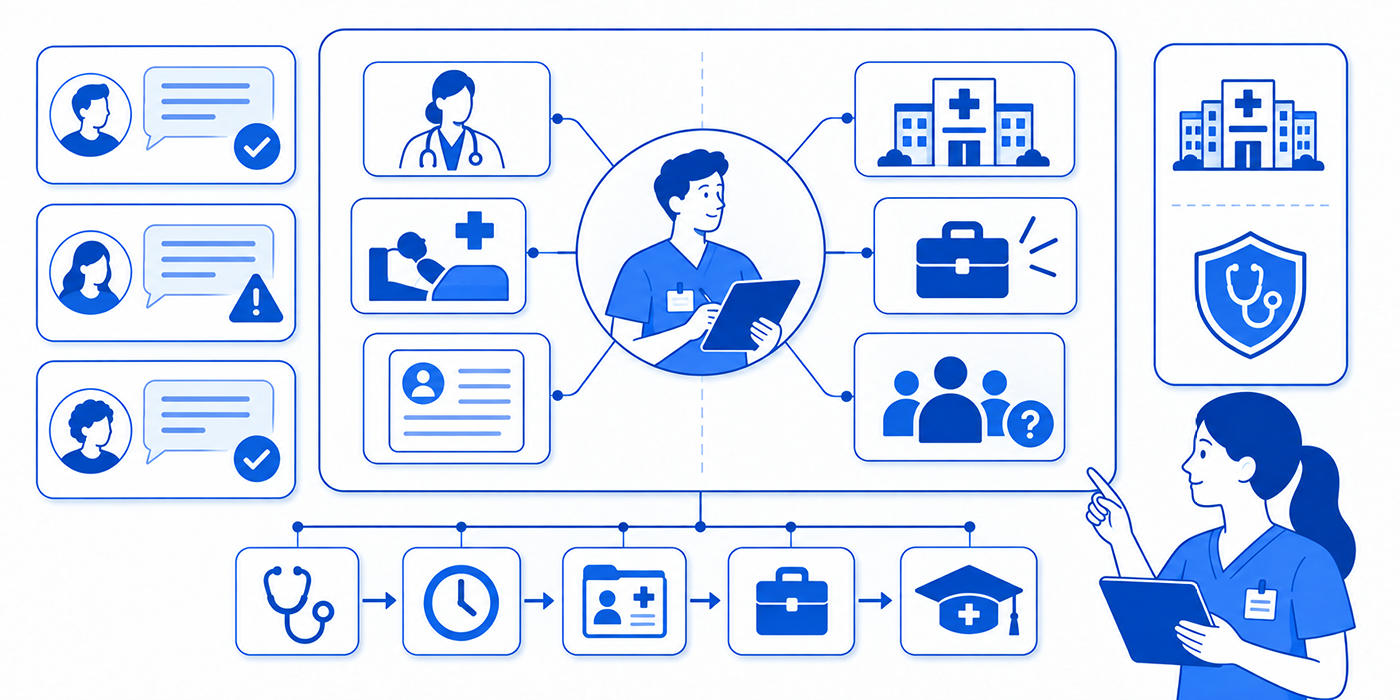
For the right student, yes—medical scribing remains valuable clinical employment in 2026. Its strongest advantage comes from proximity to physicians. During hundreds of encounters, an in-person scribe can watch a doctor turn a scattered patient story into an HPI, prioritize pertinent positives and negatives, construct a differential diagnosis, order testing, consult another service, reassess risk, and produce a defensible plan. That repeated exposure teaches more than medical terminology. It develops an understanding of written clinical communication, confidential communication, professionalism in medical settings, and the relationship between documentation and actual patient care.
The current AMCAS structure supports the value of this kind of work. For the 2027 application cycle, applicants can classify experiences under Paid Employment – Medical/Clinical, and AAMC instructs students to choose the category that best represents the work they actually performed. The application also records completed and anticipated hours and allows applicants to designate particularly meaningful experiences. Princeton's current prehealth advising material specifically lists scribing as an example of paid medical/clinical employment.
That distinction matters because premed forums often reduce the entire issue to “Does scribing count as clinical hours?” The better question is what did those hours allow you to understand, contribute, and explain? A student who learns patient interaction, observes effective bedside manner, understands how doctors handle difficult patient encounters, and watches therapeutic communication under pressure can develop a much richer view of medicine than the hour total alone suggests.
UCLA's admissions guidance has explicitly cited medical scribing as a useful route to clinical experience and emphasizes the quality of the experience over simply accumulating hours. Its current admissions materials also value sustained clinical experience, interpersonal skill, healthcare-delivery awareness, and commitment to medicine.
Scribing has a ceiling, however. A traditional scribe usually does not take vital signs, perform EKGs, assist with transfers, provide wound care, draw blood, or independently care for patients. Premeds who already understand physician workflow may gain more incremental value from direct patient responsibilities. A student whose entire clinical portfolio consists of silently documenting encounters can also have fewer stories demonstrating personal responsibility for vulnerable patients, rapport building, non-verbal communication, patient education, and assertive communication.
The result is a straightforward 2026 rule: a good in-person scribe job remains highly useful for physician exposure and clinical reasoning; its application value rises further when the rest of your portfolio demonstrates genuine patient-facing service.
| # | Clinical Experience | Patient Contact | What You Learn Best | 2026 Premed Value |
|---|---|---|---|---|
| 1 | Emergency-department scribe | Present for encounters; limited hands-on care | Acute decision-making, differential diagnosis, consults, disposition | Excellent physician-side exposure across many conditions |
| 2 | Primary-care scribe | Regular patient encounters | Continuity, prevention, chronic disease, longitudinal care | Strong for understanding everyday physician practice |
| 3 | Specialty-clinic scribe | Regular but specialty-specific | Deep specialty vocabulary, treatment pathways, follow-up | Excellent depth; narrower disease exposure |
| 4 | Inpatient scribe | Clinical environment exposure | Rounds, consults, multidisciplinary care, changing plans | High learning value where positions remain available |
| 5 | Remote telescribe | Indirect | Documentation, terminology, EHR structure | Useful employment; weaker patient-environment exposure |
| 6 | Ophthalmology scribe | Moderate | Specialized exams, procedures, chronic follow-up | Strong when physician mentorship is available |
| 7 | Orthopedic scribe | Moderate | Imaging, musculoskeletal exams, procedural decision-making | Good specialty exposure with procedure-observation potential |
| 8 | Cardiology scribe | Moderate | Risk assessment, diagnostics, chronic disease management | Strong clinical-reasoning exposure |
| 9 | Dermatology scribe | Moderate | Pattern recognition, procedures, treatment follow-up | Good specialty depth; narrower general medicine exposure |
| 10 | Urgent-care scribe | Frequent | Fast outpatient assessment, minor procedures, disposition | Excellent balance of volume and clinical variety |
| 11 | Certified nursing assistant | Very high | Bedside care, dignity, communication, basic patient needs | Excellent patient-facing experience |
| 12 | Patient-care technician | Very high | Vitals, mobility, bedside workflow, team care | Among the strongest hands-on options |
| 13 | Medical assistant | High | Rooming, histories, vitals, procedures, outpatient operations | Excellent clinical breadth where certification allows entry |
| 14 | EMT | Very high | Assessment, responsibility, emergency communication, uncertainty | Exceptionally strong hands-on experience |
| 15 | Emergency-department technician | Very high | EKGs, procedures, vitals, acute teamwork | Outstanding where hiring requirements are achievable |
| 16 | Phlebotomist | High | Procedural skill, patient reassurance, safety | Strong direct-contact option |
| 17 | Hospice volunteer | High interpersonal contact | End-of-life care, listening, family dynamics, empathy | Extremely meaningful when duties involve patients directly |
| 18 | Bedside hospital volunteer | Variable | Patient needs, hospital environment, service | Value depends heavily on actual responsibilities |
| 19 | Free-clinic volunteer | Moderate to high | Access barriers, underserved care, patient communication | Strong service-plus-clinical combination |
| 20 | Patient transporter | Frequent | Patient interaction, hospital geography, multidisciplinary workflow | Accessible bridge into clinical employment |
| 21 | Clinical-research assistant | Variable | Consent, protocols, research workflow, data quality | Excellent when genuine patient contact is built into duties |
| 22 | Medical interpreter | Very high | Communication barriers, cultural humility, clinical conversations | Powerful experience when properly trained and qualified |
| 23 | Medical front-desk role | Administrative contact | Scheduling, insurance, communication, operations | Healthcare exposure; clinical classification depends on duties |
| 24 | Telehealth clinical support | Virtual | Digital workflow, patient communication, remote care | Useful where responsibilities remain meaningfully clinical |
| 25 | Care navigator | High communication contact | Access barriers, referrals, continuity, health-system navigation | Strong systems-focused clinical exposure |
| 26 | Rehabilitation aide/PT tech | High | Mobility, recovery, functional limitations, patient motivation | Strong direct-contact experience |
| 27 | Dialysis technician | Very high | Chronic illness, procedural care, longitudinal relationships | High clinical responsibility with training requirements |
| 28 | Home-health aide | Very high | Daily function, chronic disease, social determinants, caregiving | Powerful patient-centered experience |
| 29 | Personal-care assistant/caregiver | Very high | Trust, dependence, disability, daily patient needs | High narrative value when responsibilities are substantial |
| 30 | Physician shadowing | Observation only | Career exploration and physician workflow | Useful career confirmation; less active than employment |
2. How Admissions Committees Actually Value Medical Scribing Hours
A common premed mistake is treating every hour as an interchangeable admissions token. AMCAS itself tells applicants that medical schools are interested in quality rather than quantity, and the Work/Activities section gives applicants limited space to explain what each experience involved. That means 800 hours of passive documentation can produce less useful application material than 350 hours where the student developed clinical communication, understood patient confidentiality, watched effective crisis communication, and learned how healthcare teams manage competing priorities.
The strongest scribing experiences usually contain four elements.
First, you can explain your actual responsibility. “I documented visits” gives an admissions reader very little information. A stronger description may explain that you followed several physicians through a high-volume emergency department, documented histories and reassessments, tracked laboratory and imaging results, observed consultations, and saw how changes in clinical information altered the assessment and disposition. Those details demonstrate familiarity with medical office triage, medical administrative workflow, written medical communication, and the real consequences of documentation accuracy.
Second, you can explain what you learned about patients. The patient may be speaking primarily to the physician, yet the scribe still witnesses fear, confusion, language barriers, disagreement, financial limitations, family dynamics, and uncertainty. Paying attention to rapport-building techniques, medical interpreter use, patient education, therapeutic communication, and informed consent gives the experience substantially more intellectual depth.
Third, you can explain what you learned about being a physician. Scribing reveals the invisible parts of medicine. You see the interruption from a critical result, the phone call to a consultant, the reassessment after treatment, the uncertainty behind a differential, the effort required to explain risk, and the documentation burden that contributes to physician burnout. You also witness team communication, professional communication, secure messaging, and the pressure of maintaining a reliable medical record while moving through a packed schedule.
Fourth, the experience changes how you think. AAMC's current Work and Activities Guide encourages applicants to consider the transformative nature of their most meaningful experiences, including what they learned, the impact they made, and their personal growth. A strong scribing entry therefore needs reflection. Admissions committees already know that scribes type notes. Your application becomes more interesting when you can explain how exposure to bedside manner, difficult patient conversations, non-verbal communication, and patient-centered interaction changed your understanding of the physician's responsibility.
This also explains why a magic number such as “500 clinical hours” can mislead premeds. U.S. MD admissions do not operate with one universal minimum number of scribing hours. Applicants should build enough sustained exposure to demonstrate informed commitment to medicine and enough depth to discuss meaningful encounters. UCLA's current guidance explicitly values sustained clinical experience, while AAMC tells applicants to prioritize significant experiences over filling every available slot.
3. What Reddit Experiences Reveal About Scribing in 2026
Recent Reddit discussions show a surprisingly consistent pattern once the extreme opinions are filtered out. Premeds who enjoy scribing tend to value physician proximity, broad exposure, accessible entry requirements, specialty insight, and mentorship. Students who regret it tend to mention low wages, weak patient contact, difficult scheduling, inconsistent management, limited local openings, and fear that AI will shrink the job market.
A July 2026 r/premed discussion is especially revealing. One participant who had worked both as an ER scribe and an EMT described the two jobs as providing very different perspectives. The EMT role created direct responsibility for patients and stronger exposure to their circumstances. Scribing provided close observation of physicians, specialty interactions, and day-to-day medical decision-making. Other commenters praised scribing's accessibility while pointing out difficulty finding nearby part-time positions compatible with college schedules.
That distinction is useful for students deciding between medical scribing and more hands-on work. Scribing can make you fluent in clinical documentation, expose you to medical office triage, sharpen your understanding of verbal communication, and show you how doctors structure patient interactions. An EMT, CNA, PCT, or MA usually places more responsibility for patient-facing tasks in your own hands.
Another June 2026 Reddit discussion focused specifically on whether having roughly 500 scribing hours was enough. The responses repeatedly suggested that scribing remains worthwhile, while several users recommended adding some patient-facing experience where possible. One particularly useful takeaway was that scribing becomes highly complementary when the student already has another source of direct patient exposure.
The setting also changes the experience dramatically. Recent Reddit users working in emergency departments described watching procedures, observing medical decision-making across numerous specialties, and seeing acute medicine unfold. Outpatient scribes described closer relationships with a smaller number of doctors and easier opportunities to understand continuity, private-practice workflow, mentorship, and potential shadowing. That variation mirrors the differences between front-desk workflow, appointment scheduling, secure healthcare messaging, telemedicine, and high-acuity emergency documentation.
Pay remains one of the clearest pain points. Current 2026 employee reviews repeatedly describe scribing as a valuable healthcare entry point while criticizing compensation. Indeed's current ScribeAmerica listings also show substantial geographic variation, with examples ranging from the mid-teens to around $18–$21 per hour in some markets. Premeds should therefore compare the learning return against local wages, transportation costs, shift length, and opportunity cost. ACMSO's broader medical scribe employment and salary trends can help frame that calculation before accepting a role.
The strongest Reddit lesson is practical: “medical scribe” is a job title, while the actual experience is determined by the site. A supportive physician in a busy clinic can teach you professionalism, rapport building, clinical communication, documentation discipline, and real healthcare workflow. A poorly managed remote assignment with unstable hours can deliver far less.
4. The 2026 Hiring Reality: Human Scribe Jobs Still Exist, While AI Is Reshaping the Market
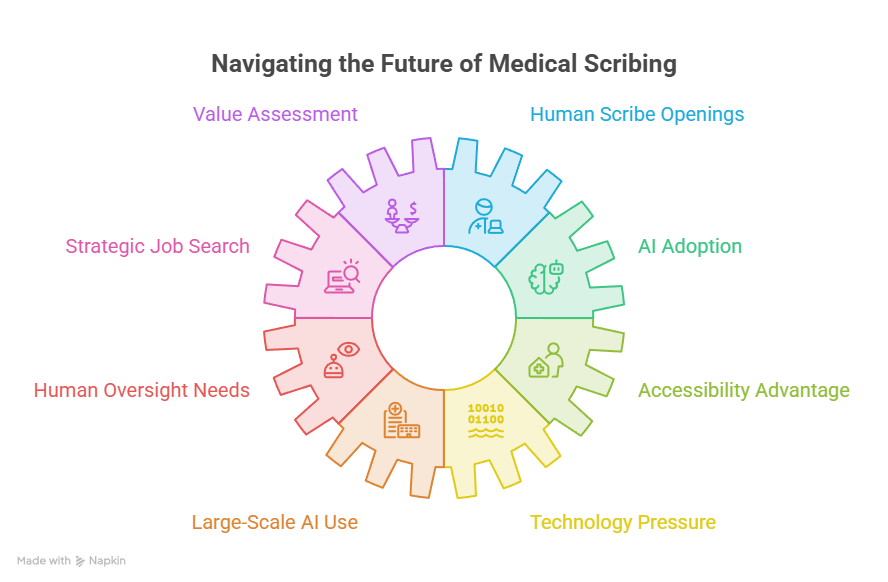
Premeds entering scribing in 2026 need to understand two realities simultaneously: human-scribe openings remain available, and ambient AI adoption is accelerating quickly.
ScribeAmerica's current job listings still include entry-level positions requiring a high-school diploma, age 18+, strong English skills, and around 40 WPM typing speed, with paid training and positions advertised as requiring no previous scribing experience. A current emergency-department listing also advertises part-time schedules of roughly two to three shifts per week. Another current Maryland posting lists both part-time and full-time options and compensation of $18 per hour.
That accessibility remains one of scribing's biggest advantages over roles that require paid coursework, licensure, or state-specific certification. Students can enter healthcare while developing medical terminology, confidential communication, professional conduct, team communication, and familiarity with clinical workflows without first spending months obtaining another credential.
Yet the technology pressure is substantial. The AMA's 2026 physician AI research found that 28% of surveyed physicians were already using AI for documentation of billing codes, medical charts, or visit notes. Among physicians for whom that use case was relevant, the report shows a combined 61% already using it or expecting incorporation within the year. That trend directly affects traditional scribe labor because healthcare automation increasingly targets the same medical documentation burden that created many human-scribe programs.
Large health systems have already demonstrated the scale. The Permanente Medical Group reported more than 2.5 million encounters using ambient AI over a 63-week evaluation, involving 7,260 physicians. Physicians experienced reductions in note-taking time and after-hours documentation. For a premed choosing between a long-term scribing plan and another clinical pathway, that level of adoption deserves attention.
Human documentation knowledge still has practical value because AI-generated notes require oversight. Ambient systems can misinterpret information or produce inaccurate details, and physicians remain responsible for reviewing clinical documentation. The AMA has documented hallucination examples where an AI system incorrectly converted a future prostate exam into a completed exam and misinterpreted a conversation about hands, feet, and mouth as a diagnosis. Understanding documentation accuracy, confidential communication, healthcare automation, and evolving medical-scribe regulatory issues may therefore become even more useful as documentation workflows evolve.
Students should consequently evaluate each opening rather than assuming every scribe market is healthy. Search hospital career pages, independent practices, specialty groups, urgent-care centers, emergency departments, and established scribe companies. Use strong medical-scribe interview preparation, understand medical administrative workflow, and ask specifically about shift commitments, provider assignment, training, cancellation policy, AI rollout plans, patient volume, and opportunities for long-term physician interaction.
A job offering two inconvenient twelve-hour shifts, unpredictable cancellations, an hour-long commute, and minimal physician interaction can become extremely expensive once transportation, lost study time, sleep disruption, and low wages are considered. The same title at a nearby outpatient practice with stable hours, close physician mentorship, diverse patients, exposure to patient education, and strong professional communication can deliver excellent premed value.
5. Scribe vs CNA vs EMT vs MA: Choose the Experience That Fixes Your Weakest Application Area
The smartest premed strategy starts by asking: What am I currently missing?
A first-year student with zero clinical exposure, limited money for certification, and strong curiosity about physician work may get tremendous value from scribing. The position can rapidly build familiarity with clinical terminology, medical documentation, patient-provider communication, healthcare teamwork, and the realities behind physician burnout.
A junior who already has 500 hours of scribing, extensive physician exposure, and almost no direct interaction with patients may gain more from CNA, PCT, EMT, MA, hospice, free-clinic, or patient-care work. Those roles can create experiences involving vulnerability, responsibility, discomfort, fear, trust, bedside manner, therapeutic communication, rapport building, and difficult moments that require the student to respond personally.
That complementarity is visible in current Reddit discussions. Premeds who have done both scribing and EMT work frequently describe the jobs as teaching different parts of medicine: one reveals physician cognition and workflow, while the other puts the student closer to direct responsibility for patients.
For many students, the strongest portfolio therefore follows a sequence.
You might spend an academic year scribing, become comfortable with medical workflow, learn clinical communication, build a professional relationship with physicians, and then transition into a more patient-facing position during a gap year. Another student may continue scribing while adding weekly hospice or free-clinic service. Someone already employed as an MA or EMT may use occasional physician shadowing to develop the physician-side perspective that scribes receive every shift.
The setting should also influence your choice. Emergency-department scribing tends to offer high patient volume, broad pathology, rapid reassessment, consultations, and exposure to crisis communication and triage terminology. Primary-care scribing exposes you to prevention, chronic disease, continuity, patient education, and long-term relationships. Specialty scribing can create deep knowledge and close mentorship, especially when the same physician works with you repeatedly.
Remote telescribing deserves a separate calculation. It can teach medical transcription, telemedicine workflow, secure healthcare communication, documentation discipline, and EHR structure. It generally provides less environmental exposure to patients, staff dynamics, body language, bedside behavior, and day-to-day hospital operations. An applicant relying heavily on remote scribing should consider adding an in-person experience involving patient interaction, non-verbal communication, or direct community service.
Your GPA and MCAT also belong in the calculation. A clinical job becomes counterproductive when irregular overnight shifts repeatedly destroy academic performance. The admissions return from another 300 hours can be modest once you already have substantial, meaningful exposure. Strong applicants allocate time across academics, clinical work, service, research where relevant, leadership, and personal commitments. AAMC gives applicants space for up to 15 experiences and specifically advises them to enter significant experiences rather than maximizing quantity.
Before accepting a scribe offer, evaluate five practical questions: Will I regularly observe physicians with patients? Will I understand clinical reasoning rather than simply transcribe words? Can I sustain the schedule without hurting school? Will the role expose me to professional healthcare communication and team-based care? Does this experience fill a genuine gap in my application?
When those answers are strong, scribing remains a highly defensible premed choice in 2026.
6. FAQs About Medical Scribing for Premeds in 2026
-
Medical scribing is commonly categorized on AMCAS as Paid Employment – Medical/Clinical when the actual work fits that description. The 2027 AMCAS application includes that experience category, and Princeton's current prehealth advising materials specifically give scribing as an example.
Your duties remain important. An in-person scribe following physicians through patient encounters, documenting histories and assessments, monitoring results, and participating in clinical workflow has a straightforward medical/clinical employment description. Skills involving medical transcription, confidential communication, team communication, and patient interaction strengthen the clinical context.
-
Each role develops a different admissions asset. CNA, EMT, PCT, and many MA positions usually provide more direct responsibility for patient care. Scribing often provides deeper continuous exposure to physician reasoning, documentation, differentials, consultations, and treatment planning.
A student already strong in patient interaction, therapeutic communication, and hands-on care may benefit greatly from physician-side exposure. A student with hundreds of hours documenting physicians and little direct patient responsibility may gain more by adding a hands-on role. Recent Reddit users with experience in both scribing and EMS describe exactly this division of learning.
-
There is no universal U.S. medical-school requirement for a specific number of scribing hours. AAMC emphasizes significant experiences and quality, and medical schools evaluate experiences within the broader application.
Think in terms of depth. You need enough sustained involvement to understand medical workflow, recognize strong bedside communication, observe informed consent, follow team communication, and explain how the experience changed your understanding of medicine. Once you can do that convincingly, another experience may produce a larger marginal benefit than accumulating scribing hours indefinitely.
-
Remote telescribing can provide legitimate healthcare employment and substantial exposure to clinical documentation, medical terminology, telemedicine, secure messaging, and EHR workflows.
In-person scribing typically adds environmental learning that remote work cannot reproduce fully: body language, waiting-room pressures, teamwork, interruptions, physical examination flow, family interactions, and non-verbal communication. Premeds whose main clinical job is remote can strengthen their portfolio with in-person patient-facing volunteering or employment.
-
AI is already changing the market. AMA's 2026 research found 28% of surveyed physicians using AI for billing-code, chart, or visit-note documentation, with substantial additional near-term adoption expected. Large health systems have also deployed ambient documentation at considerable scale.
Human-scribe openings remain active in September 2026, including entry-level and part-time positions advertised by major employers. Premeds should treat healthcare automation as a genuine career-market variable and evaluate each site's stability before committing. Knowledge of documentation accuracy and current regulatory changes may become increasingly useful as human and AI documentation workflows converge.
-
Scribing can expose a student to far more physician behavior than ordinary short-term shadowing because the student may work alongside doctors for hundreds of hours. You may observe clinical reasoning, patient communication, bedside manner, consultations, documentation, and team-based workflow.
AMCAS still maintains a distinct Physician Shadowing/Clinical Observation category alongside Paid Employment – Medical/Clinical. A small amount of dedicated shadowing can therefore remain useful, particularly when it broadens specialty exposure. Keep the experiences accurately categorized and avoid double-counting the same hours.
