

Why Medical Scribes Quit: Reddit Exit Stories, Red Flags & Questions to Ask Before Accepting a Job
Medical scribing promises physician exposure, stronger clinical vocabulary, and an early look at how healthcare works. Yet Reddit exit stories describe scribes leaving after three shifts, losing hours they were promised, or watching their grades suffer while earning barely enough to cover living costs. The biggest lesson is that job quality depends heavily on the specific site, provider, trainer, and employment arrangement. Before accepting an offer, you need to test those variables. This guide turns recurring complaints into concrete screening questions, warning signs, and decisions you can defend.

1. Why Medical Scribes Actually Quit: What Reddit Exit Stories Reveal
Exit story one: Three shifts, two conflicting trainers, and a breaking point
In September 2025, a new emergency-department scribe described leaving after three floor shifts. One trainer taught a workable note-taking approach; another criticized that approach, demanded more complete real-time prose, and assigned a heavy patient load during an eleven-hour shift. The new hire felt overwhelmed and quit. The practical warning is training inconsistency: when instructors grade conflicting methods without explaining the site's standard, beginners cannot reliably improve. Ask who owns training decisions, which charting accuracy standards apply, and how disagreements are resolved. A structured floor-training recovery plan should exist before a trainee is treated as independently productive.
Exit story two: A full-time promise that became an unpredictable paycheck
An April 2025 scribe described accepting an outpatient role with an expectation of full-time hours, only to have another hire take an increasing share of the schedule. The reported consequence was uncertainty about whether the original hours would materialize. This is why you must distinguish regularly scheduled hours, an informal forecast, and a written guarantee. Review company-versus-private-practice employment models, ask who controls your assigned shifts, and obtain written clarification before building a rent budget around expected work. Your scheduling conflict procedures matter as much as the advertised hourly wage.
Exit story three: Onboarding consumed the applicant's available months
In April 2026, another Reddit poster reported nearly three months of onboarding followed by further delays in site training and last-minute scheduling messages. For a student with a limited gap year, delayed placement can destroy the original clinical-hours plan. Request a target start date, remaining onboarding requirements, and the site's confirmed training capacity. If nobody can identify the person responsible for placement, keep other applications active. Our guide to scribe hiring delays helps distinguish a genuine offer from an indefinite candidate pipeline.
Exit story four: The chart backlog followed the worker home
A June 2024 oncology trainee wrote that multiple charts remained unfinished at the scheduled end of the shift and that a trainer suggested clocking out before completing notes at home. This raises two serious concerns: timekeeping and protected clinical information. In the United States, covered nonexempt employees generally must be paid for all hours worked, including work an employer permits after a scheduled shift; required job-related training is also generally compensable. Never send patient records to a personal account or perform charting outside approved systems. Examine the employer's medical compliance procedures, patient privacy controls, and medical-records management workflow.
Exit story five: The provider relationship became hostile
In July 2024, a premed with approximately 250 scribing hours reported a physician using profanity and pounding a desk, then worried that leaving would hurt medical-school admissions. A supportive supervisor, reassignment pathway, and documented incident process can change the outcome. Learn the employer's expectations for professional workplace communication, assertive escalation, and crisis communication. There is a meaningful distinction between a physician correcting an inaccurate note and a physician humiliating a worker.
Reddit posts are self-selected firsthand reports, not a representative turnover survey. They still reveal situations worth investigating. Some scribes report excellent mentorship and valuable clinical exposure for MD/DO applications. The aim is to identify the conditions behind both outcomes before you commit.
| # | Risk to verify | Exact interview question | Reassuring answer | Red flag |
|---|---|---|---|---|
| 1 | Base pay | What exact hourly rate is in my offer? | Written rate and any differential | “Competitive” with no figure |
| 2 | Paid training | Which onboarding and floor-training hours are paid? | Specific paid stages and timekeeping | Unclear or off-the-clock requirements |
| 3 | Start date | When can I start actual site shifts? | Dated timeline and identified coordinator | Indefinite placement queue |
| 4 | Site assignment | Is my specific clinic or ED placement confirmed? | Named site and approval status | Offer without available placement |
| 5 | Weekly hours | How many hours are guaranteed versus estimated? | Range, guarantee status, written policy | Verbal “full-time” promise only |
| 6 | Shift end time | How often do scribes finish past scheduled time? | Typical and high-volume end times | “Leave when every chart is done” |
| 7 | Clocking policy | How is extra charting time recorded? | All permitted working time recorded | Requests to work after clock-out |
| 8 | Overtime | Who authorizes overtime and how is it paid? | Written escalation and payroll process | Unpaid “professionalism” expectations |
| 9 | Break coverage | Who covers patients during meal and rest breaks? | Named coverage procedure | Breaks depend entirely on provider mood |
| 10 | Night rotation | Are overnight or quick-turnaround shifts required? | Advance schedule and recovery spacing | Unspecified overnight rotations |
| 11 | Travel changes | Can I be reassigned to a distant site? | Defined radius, notice, travel rules | Any-site reassignment without notice |
| 12 | Callouts | How are sick calls and emergency coverage managed? | Central coverage, realistic notice rules | Worker personally blamed for all gaps |
| 13 | Trainer continuity | Who trains me and can methods change by trainer? | Lead trainer and shared rubric | Contradictory rules with punitive scores |
| 14 | Floor shifts | How many supervised shifts before solo coverage? | Published plan with extensions available | Immediate solo work regardless of readiness |
| 15 | EHR access | Will I have live EHR access during training? | Access arranged before graded tasks | Evaluation without the necessary tools |
| 16 | Accuracy rubric | How are HPI, ROS, exam, and plan checked? | Specific rubric plus examples | “Just be faster” feedback only |
| 17 | Provider feedback | How can I clarify dictation or ambiguous findings? | Safe clarification channel | Pressure to guess diagnoses |
| 18 | Supervisor escalation | Who handles repeated disrespect from providers? | Named manager and documented transfer path | No process beyond “deal with it” |
| 19 | Chart approval | Who reviews and signs the final note? | Clinician review and signoff | Scribe expected to diagnose or sign |
| 20 | Scope boundaries | Am I assigned clinical tasks outside scribing? | Written role, competency, supervision | Untrained treatment or advice requests |
| 21 | Privacy setup | Can charts be completed on personal devices? | Approved secured system and access controls | Personal email or uncontrolled files |
| 22 | Patient volume | What are typical and peak patients per provider? | Actual range by shift and specialty | Only a vague “fast-paced” label |
| 23 | Provider load | Will I support one provider or several? | Defined allocation and backup | Multiple providers with no prioritization |
| 24 | Template quality | Are approved note templates available? | Examples, updates, local guidance | Create all documentation from scratch |
| 25 | Performance reviews | How soon do I receive actionable feedback? | Scheduled check-ins and example notes | Surprise termination targets |
| 26 | Class schedules | Can my exam weeks and MCAT dates be protected? | Written availability boundaries | Mandatory scheduling during exams |
| 27 | Letters | May physicians write letters if they know my work? | Possible, based on genuine relationship | Promises of guaranteed recommendations |
| 28 | AI changes | Is the site adopting ambient AI documentation? | Honest contract and role-transition plan | Avoidance of known staffing changes |
| 29 | Resignation | What notice or repayment terms apply? | Written terms available before signature | Surprise fees or shifting notice rules |
| 30 | Growth options | Can strong scribes move to other sites or duties? | Real examples and eligibility criteria | Growth promised without openings |
| 31 | Remote technology | What audio, internet, and privacy setup is provided? | Equipment, support, backup procedures | Unusable audio with punitive metrics |
| 32 | Management response | Who answers payroll, training, and scheduling issues? | Named contact and response timeframe | Repeatedly unanswered inquiries |
2. The Red Flags That Matter Most Before You Accept a Scribe Offer
The 32-point checklist above is designed for interviews and offer comparisons. Prioritize its answers by severity, likelihood, and reversibility. An inconvenient parking arrangement is usually reversible; pressure to guess clinical findings or work off the clock deserves immediate scrutiny. Use these four screening categories.
Financial red flags: Low pay becomes unstable pay
Calculate earnings using written expected hours, not optimistic projections. Suppose an offer pays $15 per hour for 24 paid hours weekly: gross wages would be $360 before taxes. If commuting and recovery consume another six hours, the role yields only $12 per hour of your total committed time for personal planning purposes. That second figure is a personal time-value calculation, not an employment-law wage rate. Compare this against low-pay scribing trade-offs, private-practice alternatives, and the opportunity cost of gap-year scribing.
Red flags include a changing hourly rate, training pay that nobody can explain, disappearing shifts, or a requirement to purchase a scribe certification without evidence that the employer recognizes it. Request the offer letter, payroll schedule, and complete training-versus-certification cost comparison before spending money.
Operational red flags: The workday has no predictable boundary
Emergency departments run continuously, yet a scribe's schedule should still have a documented coverage process. Ask for the median and longest typical shift, whether charts routinely remain open at handoff, and how late work is recorded. Pair those answers with a realistic ED-versus-outpatient workload comparison, scribe burnout warning signs, and your own MCAT study timetable. A shift that regularly overruns by two hours may displace an entire evening of focused study.
Training red flags: Speed is measured before competence is built
Good training provides shadowing, supervised chart ownership, feedback on factual omissions, and a clear route to solo work. Ask for sample training milestones: how many histories should a beginner complete independently, how is HPI specificity assessed, and what happens when documentation errors recur? A manager who can describe an actual training remediation process offers more useful evidence than one who promises a “supportive culture.” Candidates with no prior healthcare experience especially need this clarity.
Clinical-integrity red flags: The scribe is pushed beyond documentation
The provider remains responsible for clinical assessment and decisions. A scribe should clarify ambiguous speech, follow approved encounter documentation templates, and flag apparent inconsistencies through appropriate team communication. Being asked to invent review-of-systems findings, upgrade a possible diagnosis to a confirmed diagnosis, or enter orders without appropriate authorization indicates a serious scope-of-practice problem. Verify how patient confidentiality is protected and who ultimately reviews and signs each note.
3. Questions to Ask the Employer, Trainer, and Working Scribes
An interview has three evidence levels. Recruiters know the offer and payroll framework; site managers know coverage and training; working scribes know whether those policies survive a busy Tuesday. Ask each person questions within their knowledge instead of expecting a recruiter to know the actual chart backlog.
Ask the recruiter: “Is this opening tied to a confirmed site and start date? What are the guaranteed and typical weekly hours? Which training activities are paid? Can I review the written resignation terms?” Follow up in writing using precise professional email communication. If the recruiter repeatedly avoids these basics, compare other medical scribe employers before accepting. Keep your job-search strategy active until the start is genuinely confirmed.
Ask the site manager: “How many supervised shifts do new scribes normally receive? What percentage of notes are expected to be complete before the clinician moves on? How are disputed trainer evaluations handled? Who helps if a provider repeatedly refuses clarification?” Listen for specific processes involving verbal clarification, written chart feedback, and workplace assertiveness. Ask how typing accuracy and speed are evaluated separately; a high word-per-minute number cannot compensate for incorrect medical content.
Ask a current scribe, if the employer permits contact: “When did your last three shifts actually end? Did you take breaks? What was the most useful correction your trainer gave? Have you seen someone transferred away from an unsuitable provider?” The answers should describe observable practices. A working scribe who can explain safe patient interactions, privacy expectations, and realistic specialty-specific workflow gives you a better preview than marketing claims.
The strongest follow-up question is: “Can you show me what happens when a new scribe falls behind?” A credible answer includes a named supervisor, a chart-status handoff, paid timekeeping, and tailored retraining. A weak answer makes the trainee personally responsible for systemic understaffing. For ophthalmic scribing, request examples of specialty-specific testing; for remote scribing, request an audio-quality test and a technical failure protocol.
4. Should You Quit, Transfer, Renegotiate, or Stay? A Decision Framework
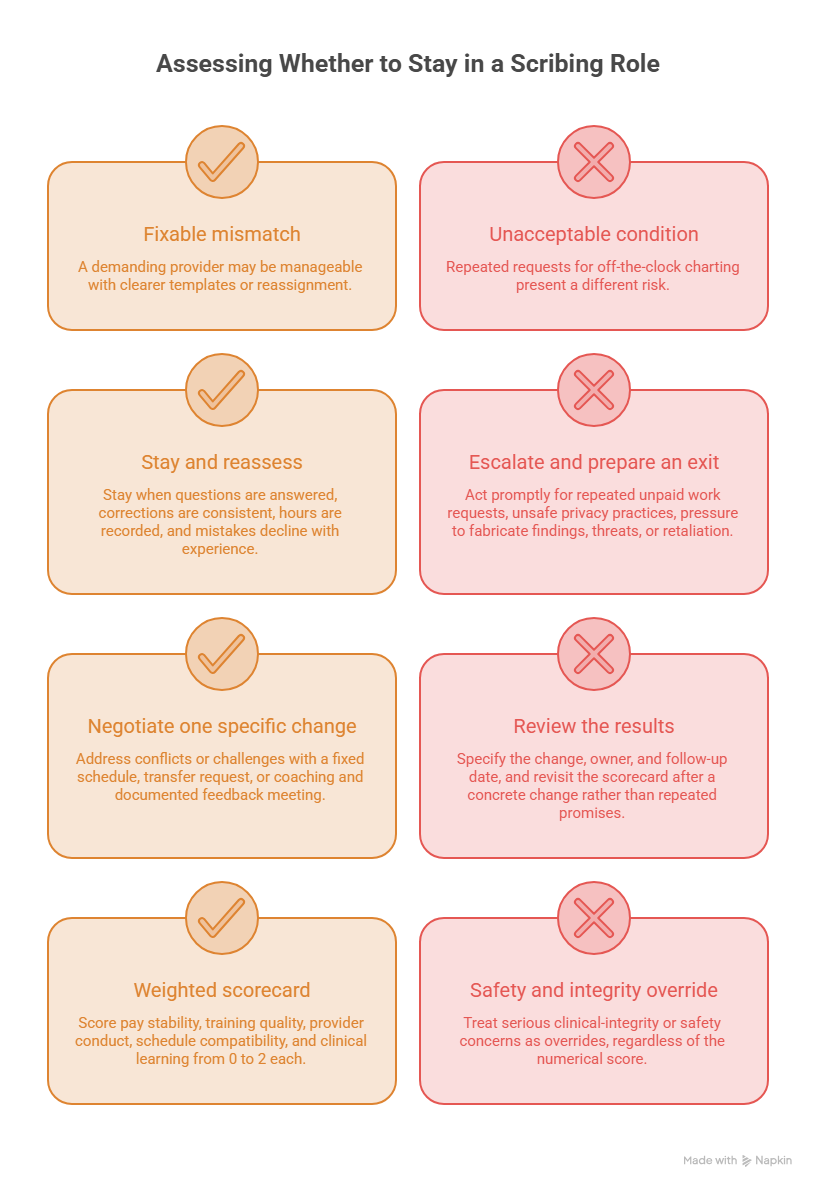
Start by separating a fixable mismatch from an unacceptable condition. One demanding orthopedic provider may be manageable with clearer templates or reassignment; a site that repeatedly asks for off-the-clock charting presents a different risk. The decision should protect both patient documentation and your long-term goals.
Green: Stay, learn, and reassess after a defined period
Staying makes sense when the supervisor answers questions, corrections are consistent, work hours are recorded, and new mistakes decline as experience grows. Give yourself a defined skills-development window, such as four weeks, with weekly review of typing accuracy, clinical terminology, and provider communication. The milestone is demonstrable improvement, not an arbitrary patient count. Track errors corrected, questions resolved, and the quality of medical-record documentation.
Yellow: Negotiate one specific change, then review results
If the role is educational but your shifts conflict with exams, propose a fixed schedule through the next test date. If one specialty is persistently overwhelming, request a transfer and compare emergency versus outpatient scribing or specialty learning opportunities. If your provider relationship is weak but the organization is responsive, request coaching in rapport-building and a documented feedback meeting. Specify the change, owner, and follow-up date in an assertive professional message.
Red: Escalate promptly and prepare an exit
Repeated unpaid work requests, unsafe privacy practices, pressure to fabricate findings, threats, and retaliation after good-faith reporting warrant stronger action. Preserve your own schedule, pay records, and written employment communications without copying protected patient information. Follow the employer's reporting channels and seek appropriate labor, compliance, or legal guidance when necessary. Your HIPAA-related confidentiality responsibilities, medical compliance duties, and scope boundaries continue to apply when a workplace dispute occurs.
Use a weighted scorecard: assign each category—pay stability, training quality, provider conduct, schedule compatibility, and clinical learning—a score from 0 to 2. A total of 8–10 supports staying; 5–7 calls for a targeted change and review; 0–4 suggests actively seeking alternatives. Treat serious clinical-integrity or safety concerns as overrides, regardless of the numerical score. This is a personal screening tool, not a validated turnover predictor. Revisit the score after a concrete change rather than accepting repeated promises.
5. Leaving Without Damaging Your Clinical Experience or Future Applications
Protect the evidence of what you learned
Before departing, create a de-identified experience log recording specialties observed, approximate verified hours, skills developed, and reflections on care delivery. Avoid patient names, dates of birth, record numbers, or recognizable clinical anecdotes. These notes can help you explain medical scribing as clinical experience and develop honest medical-school application descriptions. Medical schools differ in expectations, and the quality of reflection matters alongside documented hours. A departure after 250 hours does not automatically invalidate those experiences or create an admissions penalty.
If you built a genuine relationship with a physician, ask whether they can discuss your reliability, growth, and clinical communication skills. Review guidance on earning a meaningful physician recommendation. A supervisor who knows your work well is more useful than a prominent physician who barely knows you. Never make continued exposure to abuse the price of a prospective letter.
Build the next step before resigning when circumstances allow
Compare three practical pathways. A better-run private clinic may retain the value of physician-facing scribing. A medical assistant role may provide different patient interaction, depending on duties and credentials. Remote medical scribing may reduce commuting while introducing audio, training, and privacy challenges. For applicants who already have extensive experience, preserving grades, MCAT preparation, and finances may generate more value than another low-paid clinical shift; examine the regrets premeds report and when to move on from low pay.
Resign professionally and resolve payroll details
Read the actual offer terms, applicable policy, and local employment law before deciding on notice. Reddit claims of mandatory four-, six-, or eight-week notice should never substitute for the agreement governing your situation. Send a concise professional resignation email stating your last working date, request written acknowledgment, and ask how final wages, accrued benefits if applicable, and outstanding expenses will be processed. Arrange a proper chart handoff inside the approved system, and maintain confidential communication throughout your departure.
Plan for the possibility that the underlying occupation changes. Reports of clinics adopting AI documentation create another sensible interview question: how will the specific site use human scribes over the next year? Explore AI's effects on scribe employment and the value of transferable healthcare automation skills. In a changing market, a job that builds judgment, accurate documentation, and strong relationships deserves more weight than one that merely accumulates hours.
6. FAQs About Why Medical Scribes Quit
-
A short tenure may invite questions if it appears in your application, but there is no universal medical-school rule requiring a minimum scribe tenure. Explain what you learned, how you handled the transition, and what you did afterward. Admissions reviewers value meaningful experiences; the clinical-hours discussion and MD/DO experience context can help you frame the decision. If you leave almost immediately, accurately report the limited work performed rather than exaggerating your exposure.
-
First ask whether your trainer provides a consistent charting rubric, access to the EHR, supervised practice, and actionable feedback. Falling behind early is common; persistent contradictory instructions are more concerning. Use a targeted floor-training improvement plan, practice medical transcription accuracy, and request review of one HPI, one assessment, and one plan. If performance criteria keep changing or support is refused, evaluate a different site.
-
Clarify the timekeeping requirement in writing and record all hours actually worked. Under U.S. federal law, covered nonexempt employees generally must be compensated for work the employer suffers or permits, including work past scheduled hours; state protections may be stronger. Complete charts only through authorized, privacy-compliant systems. Check the employer's medical compliance guidance, privacy rules, and approved documentation workflow. Seek payroll or labor advice if an unresolved discrepancy continues.
-
Often, subject to vacancies, supervision, and employer policy. Orthopedics, emergency medicine, primary care, and ophthalmology differ in terminology, pace, and documentation style, while provider expectations vary within each field. Compare specialty-specific clinical learning, ED and outpatient workloads, and ophthalmic documentation requirements. Request the transfer process and training support before accepting another placement.
-
Set a budget floor, maximum weekly time commitment, and a learning goal. Compare gross earnings, transport costs, study displacement, and genuine clinical responsibilities against competing roles. Our scribe pay ROI guide, gap-year evaluation, and scribe-versus-medical-assistant comparison provide useful benchmarks. Reassess after the first month using your actual paystubs, completed hours, and learning log.
-
Ask: “When a new scribe is behind on charts, what exactly happens?” The answer exposes the training culture, provider expectations, paid work boundaries, and quality controls in one conversation. Follow it with questions about the training assessment process, team escalation routes, and burnout safeguards. The best employer can describe how it protects chart quality while helping the worker develop competence.
