

First Medical Scribe Job With Zero Healthcare Experience: Reddit Advice, Resume Proof & Skills Employers Actually Screen For
Getting your first medical scribe job with zero healthcare experience is still realistic in 2026. Current ScribeAmerica openings explicitly advertise “no experience required” and paid training, while recent Reddit experiences show applicants entering from unrelated degrees, research, hospitality, and first-job backgrounds. The harder problem is proving that you can learn quickly, document accurately, communicate professionally, and survive a fast clinical workflow. Employers screen for transferable evidence: medical terminology, written communication, professionalism, team communication, and measurable typing ability.
1. Can You Actually Get a Medical Scribe Job With Zero Healthcare Experience?
Yes, and current employer evidence makes that clearer than online job descriptions sometimes do.
Multiple active ScribeAmerica medical-scribe listings reviewed in September 2026 state “No experience required — we’ll train you!” and advertise paid training through Scribe University plus clinical instruction. A current South Carolina listing requires a high-school diploma or equivalent, while other active postings use the same no-experience hiring language.
ScribeAmerica's own hiring guidance also says prior healthcare experience is often unnecessary. It identifies attention to detail, listening ability, adaptability, typing proficiency, customer-service experience, and comfort with software as useful evidence for applicants starting from zero.
That changes the question you should ask.
Instead of asking, “How can I compete when I have never worked in healthcare?”, ask:
“What evidence can I give an employer that I can become clinically useful quickly?”
A recruiter can train you on a particular EHR. Teaching basic reliability, careful listening, professional behavior, or willingness to receive correction is harder. Someone who understands professional email etiquette, practices precise verbal communication, learns medical transcription terminology, and understands basic confidential communication can arrive at an interview with credible preparation despite having zero paid clinical employment.
Your biggest disadvantage is unfamiliarity, not the empty healthcare section
A first-time scribe has several predictable learning gaps:
unfamiliar medical terminology,
no EHR experience,
limited understanding of note structure,
difficulty separating relevant clinical information from conversational noise,
slow typing under simultaneous listening pressure,
uncertainty about professional boundaries,
unfamiliarity with provider communication,
and no experience functioning inside a clinical team.
Each gap can be reduced before your first shift.
Learning medical administrative workflow helps you understand where documentation fits. Studying patient interaction scripts exposes you to clinical conversations. Understanding informed consent and confidential healthcare communication gives you the professional context many completely inexperienced applicants lack.
“Preferred experience” should not automatically stop you from applying
A valuable Reddit discussion involved a scribe lead who had participated in hiring. Their advice was to apply even when a listing requested prior office experience. They specifically recommended putting medical terminology, typing speed, technological ability, and any healthcare familiarity on the resume and said they had hired applicants without prior scribing or office experience.
That is anecdotal hiring insight rather than universal employer policy, but it illustrates an important distinction:
Required qualifications can eliminate you. Preferred qualifications describe the employer's ideal candidate.
Read those words carefully.
If a listing requires a license, geographic eligibility, language proficiency, work authorization, or a specific credential, respect it. If it says “one year preferred,” your application may still be competitive when your medical terminology knowledge, clinical writing ability, technology competence, and professional communication compensate.
Typing speed is one of the easiest weaknesses to prove away
ScribeAmerica says medical-scribe roles commonly seek approximately 40–70 WPM, while 70 WPM or more is often considered an excellent target. A current bilingual ScribeAmerica opening requires at least 40 WPM, strong listening and communication skills, flexible availability, and the ability to work at a computer for extended periods.
Do not put “fast typist” on your resume.
Put:
Typing: 68 WPM, 97% accuracy
That is proof.
Then build the harder layer by practicing medical transcription, written clinical communication, verbal listening skills, and accurate patient-interaction documentation.
| # | What Employers Screen | Weak Resume Evidence | Strong Zero-Experience Proof | How to Improve It |
|---|---|---|---|---|
| 1 | Typing speed | “Good computer skills” | Verified WPM and accuracy | Practice timed medical transcription |
| 2 | Listening accuracy | “Good listener” | Accurate notes from recorded mock encounters | Build verbal communication skills |
| 3 | Medical terminology | “Interested in medicine” | Medical terminology course or demonstrated study | Master medical terminology |
| 4 | Anatomy knowledge | Biology major only | Relevant A&P coursework or independent study | Connect anatomy with documentation terminology |
| 5 | Written accuracy | “Strong writer” | Editing, research, tutoring, or documentation experience | Study written clinical communication |
| 6 | Attention to detail | “Detail-oriented” | Quality-control, lab, inventory, data, or proofreading examples | Show an error you prevented or caught |
| 7 | Confidentiality | No privacy evidence | Experience handling private records, student data, research data, or customer information | Learn confidential communication |
| 8 | Technology comfort | “Microsoft Office” | Multiple systems learned quickly | Study healthcare automation concepts |
| 9 | Multitasking | “Great multitasker” | Managed customers, records, phone calls, or coursework simultaneously | Explain competing-priority decisions |
| 10 | Reliability | “Hard worker” | Long-term job, attendance record, leadership duty, recurring commitment | Quantify tenure and responsibility |
| 11 | Schedule fit | “Flexible” | Exact recurring availability | Understand scheduling conflicts |
| 12 | Professional communication | “People person” | Customer service, tutoring, reception, teaching, leadership | Build medical professionalism |
| 13 | Team communication | “Team player” | Coordinated with managers, peers, customers, faculty, or research teams | Learn team communication |
| 14 | Learning speed | “Quick learner” | Example of mastering unfamiliar software or technical material quickly | Prepare one interview story with measurable results |
| 15 | Ability to accept correction | No evidence | Example of feedback improving accuracy or performance | Show coachability during interviews |
| 16 | Fast-paced work | “Works under pressure” | Restaurant, retail, call center, event, laboratory, or deadline-heavy experience | Describe volume and accuracy together |
| 17 | Patient-facing potential | No healthcare contact | Customer service showing patience, tact, and de-escalation | Practice difficult-patient communication |
| 18 | Rapport | Generic interpersonal claim | Tutoring, mentoring, service, hospitality, or advising | Study rapport building |
| 19 | Clinical note structure | Never seen a note | Can explain HPI, ROS, exam, assessment and plan at a basic level | Learn clinical documentation structure |
| 20 | EHR readiness | No EHR access | Understands workflow concepts and has learned other software quickly | Study medical workflow |
| 21 | Privacy awareness | “Know HIPAA” with no context | Can explain why patient information must stay within authorized systems | Learn secure healthcare messaging |
| 22 | Provider communication | No professional examples | Experience communicating concise updates to supervisors | Practice professional assertiveness |
| 23 | Email professionalism | Casual application messages | Concise, error-free recruiter correspondence | Use professional email etiquette |
| 24 | Medical motivation | “I want clinical hours” | Specific interest in documentation, clinical reasoning and physician workflow | Explain why scribing specifically fits your goals |
| 25 | Availability duration | Leaving timeline unclear | Can commit for the requested period | State availability honestly |
| 26 | Handling difficult conversations | No example | Customer conflict resolved calmly | Learn crisis communication |
| 27 | Administrative organization | “Organized” | Managed calendars, records, files, deadlines, or appointments | Learn scheduling workflows |
| 28 | Telephone communication | No phone evidence | Reception, customer support, outreach, or call handling | Study phone triage communication |
| 29 | Interview preparation | Improvised answers | Prepared examples covering accuracy, conflict, learning and reliability | Use medical scribe interview preparation |
| 30 | Overall readiness | Resume asks employer to “take a chance” | Resume proves trainability before experience exists | Build several small proofs instead of one vague claim |
2. What Medical Scribe Employers Actually Screen For Before Experience
The entry-level hiring bar becomes easier to understand when you look at what current employers describe.
ScribeAmerica's qualification guidance emphasizes a high-school diploma, medical terminology, basic anatomy and physiology, communication, attention to detail, technical proficiency, EHR familiarity, and adaptability. Its broader job-requirement guidance also highlights typing ability, multitasking, biology knowledge, and communication.
You therefore need to stop treating experience as one giant yes-or-no variable.
Employers are evaluating smaller signals.
Can you hear something once and record it correctly?
Medical scribing depends on active listening. A clinician may speak quickly while examining a patient, interrupt themselves, return to an earlier detail, dictate medication changes, and move directly into the plan.
Build this skill through verbal communication training, medical transcription practice, patient interaction terminology, and awareness of non-verbal communication.
Practice by listening to medically appropriate educational scenarios and producing concise notes. Check whether you missed negations, laterality, medications, durations, or chronology.
Can you learn vocabulary fast enough?
You do not need to arrive knowing every diagnosis. You should demonstrate that unfamiliar terminology will not paralyze you.
Learn common prefixes, suffixes, abbreviations, anatomical directions, disease categories, medications, laboratory terminology, and basic note sections. Build from medical transcription terminology, then connect it with medical office triage terminology, patient education terminology, and telemedicine basics.
A Reddit applicant who reported getting hired directly by urgent care without prior experience specifically mentioned having taken medical terminology. Another commenter who described starting from essentially no job or anatomy background said much of their practical learning happened after hiring.
Can you keep up without destroying accuracy?
Typing 90 WPM means little if medication names, negatives, dates, or body sides are wrong.
A useful benchmark is sustainable speed with accuracy. If you currently type 42 WPM accurately, improve to 50, then 60. Combine typing practice with written communication, medical transcription, professional documentation habits, and basic clinical workflow.
Can your schedule actually solve the employer's staffing problem?
This is one of the most underappreciated entry-level filters.
A Reddit commenter discussing no-experience hiring said demand matters and suggested that full-time availability can improve an applicant's chances. Their workplace had hired someone whose previous experience was hotel front-desk work because the location needed coverage.
Current ScribeAmerica openings also specify concrete shift structures. One outpatient posting seeks part-time employees for two to three shifts weekly or full-time employees for three to four shifts, largely during weekday clinic hours.
A recruiter choosing between two trainable applicants may prefer the person who can actually cover the physician.
State your schedule precisely. Pair that operational reliability with knowledge of scheduling conflicts, team communication, professional email etiquette, and medical administrative workflow.
3. What Reddit Gets Right About Breaking the “No Experience, No Job” Loop
The recurring Reddit complaint is painfully logical: every scribe job seems to want experience, yet nobody can get experience without a first scribe job.
Real hiring appears messier than that.
A 2024 r/medicalscribe applicant described receiving no interviews despite research experience and an interest in medicine. Responses included people reporting that they had been hired with zero healthcare experience, including one person with no prior job, no anatomy course, and a sociology degree. Another said their workplace had hired a former hotel desk clerk.
Another Reddit discussion about resume content for someone without healthcare experience advised keeping meaningful research or unrelated work because entry-level employers may care about reliability and willingness to learn. Relevant coursework such as medical terminology or physiology was also suggested as useful evidence.
That advice is valuable because inexperienced candidates often make the wrong resume move: they delete almost everything that is unrelated to medicine and leave themselves with half an empty page.
Your restaurant job is evidence if you translate it correctly
“Worked cashier at restaurant” provides weak information.
“Processed high-volume customer orders while maintaining payment accuracy, coordinating simultaneous requests, and resolving service issues during peak periods” demonstrates:
speed,
accuracy,
communication,
multitasking,
composure,
and reliability.
Those same underlying capabilities matter when learning patient communication, handling difficult patient interactions, working within clinical teams, and maintaining professionalism.
Your research experience is evidence if you focus on precision
Research can prove that you follow protocols, maintain data integrity, document methods, work with technical terminology, correct errors, and communicate findings.
Those are useful precursors to medical documentation, written clinical communication, confidential data handling, and healthcare workflow.
Your tutoring job is evidence if you focus on communication
Tutoring demonstrates that you can listen, identify misunderstanding, change your explanation, communicate technical material clearly, and maintain patience.
Those abilities transfer into patient education, rapport building, verbal communication, and professional team communication.
The hiring process itself can eliminate applicants after the offer
Applicants also need to prepare for the period between acceptance and independent shifts.
A September 2026 Reddit poster said they had been hired into a scribe position and completed training but were dismissed after failing to achieve a required 95% final-exam score. That is one individual's experience rather than an industry-wide threshold, but it highlights something important: getting an offer does not guarantee successful onboarding.
Medical terminology, note structure, training exams, typing performance, and floor training deserve serious preparation. Build medical transcription skills, understand clinical workflows, practice written communication, and familiarize yourself with professional healthcare communication before the training clock starts.
4. How to Build a Medical Scribe Resume When You Have Zero Healthcare Experience
Your resume has one job: make the recruiter believe that training you is a reasonable risk.
Do not apologize for your lack of healthcare experience. Use the page to prove the underlying abilities the job requires.
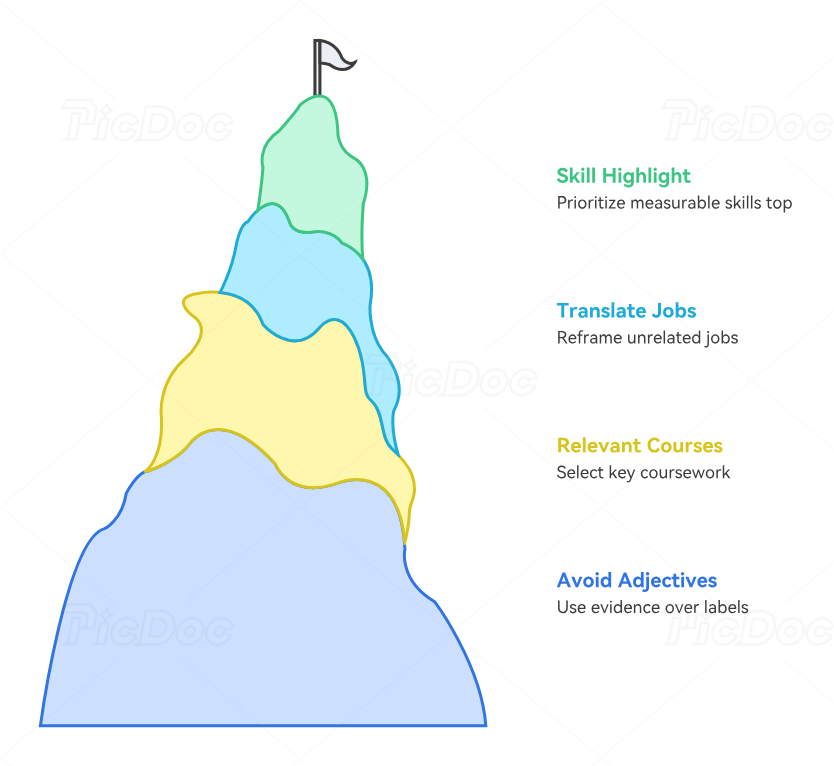
Put measurable skills near the top
A useful skills section might contain:
Typing: 63 WPM, 97% accuracy
Relevant knowledge: Medical terminology, basic anatomy and physiology, SOAP-note structure
Technology: Google Workspace, Microsoft Office, database software, rapid software onboarding
Communication: Customer service, professional email communication, technical writing
Languages: English plus additional clinically useful languages, where genuinely fluent
Current ScribeAmerica guidance confirms that employers value medical terminology, anatomy, communication, technology, adaptability, attention to detail, and typing capability.
Support those claims by studying medical transcription terminology, professional email etiquette, written communication, and professional medical-admin behavior.
Translate unrelated jobs instead of hiding them
Suppose your previous job was retail.
A weak bullet says:
Assisted customers and worked cash register.
A stronger bullet says:
Managed simultaneous customer requests and transaction records during high-volume shifts while maintaining accuracy and escalating exceptions to supervisors.
That bullet demonstrates workflow management, attention, communication, and escalation.
If you worked reception:
Coordinated appointments, answered high-volume calls, maintained confidential records, and communicated schedule changes accurately across staff and clients.
That maps naturally onto front-desk etiquette, scheduling conflict management, phone communication, and confidential communication.
If you conducted research:
Maintained accurate experimental records, followed detailed protocols, identified data inconsistencies, and communicated findings within a multidisciplinary research team.
That supports your readiness for medical transcription, team communication, written documentation, and precise healthcare administrative workflow.
Add relevant coursework selectively
Relevant coursework can help when your employment section contains no medicine.
Useful examples include:
anatomy and physiology,
medical terminology,
biology,
physiology,
pharmacology,
health sciences,
psychology,
neuroscience,
pathophysiology,
or health informatics.
A Reddit discussion specifically recommended medical terminology and anatomy-related coursework for a candidate without healthcare experience.
Do not fill half your resume with every biology class you have taken. Choose courses that signal readiness for clinical terminology, patient communication, medical office workflow, or telemedicine documentation.
Stop writing personality adjectives without proof
Delete phrases such as:
“hard-working,”
“passionate,”
“great communicator,”
“fast learner,”
“detail-oriented,”
“team player.”
Those qualities matter. Unsupported labels waste space.
Prove team communication through coordination. Prove assertiveness through escalation. Prove professional communication through responsibilities. Prove rapport skills through mentoring or customer-facing work.
Evidence beats adjectives.
5. A 30-Day Plan to Become Competitive Before Your First Scribe Interview
You can substantially change your candidacy in one month without inventing healthcare experience.
Days 1–7: Fix typing and terminology
Test your baseline typing speed three times. Record the median result.
Spend the next week improving speed while protecting accuracy. ScribeAmerica says medical-scribe expectations commonly fall around 40–70 WPM, with 70+ representing a strong level.
At the same time, build a terminology foundation through medical transcription terms, basic medical office triage terminology, patient education language, and clinical communication.
Focus on abbreviations, body systems, directions, common conditions, medication classes, and frequently used chart language.
Days 8–14: Learn how a clinical encounter becomes a note
Understand the purpose of:
Chief complaint → HPI → history → ROS → examination → assessment → plan
Learn the difference between patient-reported information, objective findings, and physician assessment.
Then practice turning mock encounters into structured documentation. Strengthen written communication, medical transcription, patient interaction understanding, and awareness of informed consent.
Your goal is understanding information hierarchy, not pretending to practice medicine.
Days 15–21: Rebuild your resume around proof
Take every previous job, leadership role, research project, volunteer activity, or university responsibility and ask:
Which medical-scribe competency does this prove?
Map experience to:
accuracy,
speed,
confidentiality,
communication,
technology,
organization,
reliability,
teamwork,
rapid learning,
conflict handling,
and documentation.
Use professional email communication, medical professionalism, team communication, and medical administrative workflow as skill frameworks.
Days 22–30: Prepare for the interview and training gate
Practice answers to:
Why medical scribing?
How do you respond when you do not understand a term?
How do you protect confidential information?
Tell me about a time you received difficult feedback.
Describe a time you had several urgent tasks at once.
What is your typing speed?
How long can you commit to this position?
How would you respond if you noticed documentation that seemed inconsistent?
Use medical scribe interview preparation, confidential communication, professional assertiveness, and clinical-team communication to prepare substantive answers.
Finally, apply intelligently.
Large scribe organizations may offer structured entry-level training. Private practices may value schedule fit and direct communication. Urgent-care groups may move faster when they have immediate staffing needs. Current ScribeAmerica vacancies across multiple states explicitly advertise no-experience entry routes, while Reddit experiences also describe direct clinic and urgent-care hires.
If your first ten applications produce nothing, diagnose the funnel.
Zero interviews suggests resume, geography, schedule, or targeting problems.
Interviews without offers suggest your communication or examples need improvement.
Offers followed by failed training suggest terminology, testing, documentation, or typing readiness needs work.
Treat each rejection as information about which stage is failing instead of interpreting every rejection as proof that zero-experience applicants cannot get hired.
6. FAQs About Getting Your First Medical Scribe Job With No Experience
-
Yes. Current ScribeAmerica job listings explicitly advertise no experience required and provide paid training. Its hiring guidance also states that many employers train new scribes and may prioritize adaptability, attention to detail, listening ability, typing proficiency, customer service, and software familiarity.
Improve your candidacy through medical terminology, written communication, professionalism, and medical administrative workflow.
-
Requirements vary by employer. ScribeAmerica says medical-scribe positions commonly seek approximately 40–70 WPM, and 70+ WPM can be considered an excellent level. A current bilingual ScribeAmerica listing requires at least 40 WPM.
Accuracy remains essential. Combine speed with medical transcription practice, clinical listening, written communication, and familiarity with patient encounters.
-
A certification can provide structured training, yet current entry-level employers may hire and train candidates without previous experience. ScribeAmerica currently advertises paid training on multiple listings.
Before paying for a credential solely to become employable, inspect actual job requirements in your market. Improving medical terminology, clinical communication, professional behavior, and typing performance may address the hiring screen more directly.
-
Keep experiences that demonstrate relevant capabilities.
Retail can prove speed, accuracy, communication, and conflict management. Research can prove documentation, protocol adherence, and attention to detail. Tutoring can prove communication and learning. Hospitality can demonstrate composure, scheduling, and customer interaction.
Translate those experiences toward team communication, rapport building, professional communication, and medical workflow readiness.
Reddit hiring discussions similarly advise applicants without healthcare experience to retain meaningful work or research experience and emphasize reliability, relevant coursework, typing, and technology skills.
-
Absolutely.
Current ScribeAmerica qualification guidance describes medical terminology plus basic anatomy and physiology as foundational knowledge.
Medical terminology also accelerates nearly every other scribe skill. It improves medical transcription, strengthens written documentation, makes patient interactions easier to follow, and helps you understand clinical workflow.
-
“No experience required” means previous healthcare employment is not mandatory. Employers can still compare candidates on typing speed, schedule availability, interview performance, communication, geography, terminology knowledge, technology comfort, reliability, and training performance.
One recent Reddit poster with a biochemistry degree described repeated clinical-job rejections, while another earlier applicant reported being hired with essentially no healthcare background. Those contrasting experiences show how uneven entry-level hiring can be.
Strengthen interview preparation, medical terminology, professional communication, and scheduling reliability rather than assuming experience is always the missing variable.
