

Why Medical Scribe Applicants Fail Interviews: Reddit Experiences, Weak Answers & the Skills Hiring Teams Try to Detect
Medical-scribe interviews can look deceptively easy. Applicants often prepare medical terminology for hours, then lose the opportunity because their answers expose weaker signals: unreliable availability, poor listening, vague motivation, rambling communication, or little understanding of what accurate documentation demands. Anyone already struggling with medical-scribe hiring barriers should understand that employers are screening for trainability as much as knowledge. Strong written communication, clinical professionalism, and team communication often matter more than memorizing obscure terminology.
1. Why Medical Scribe Applicants Fail Interviews Even When the Questions Seem Easy
The first mistake is assuming a medical-scribe interview is mainly a medical-knowledge test. Current ScribeAmerica postings require a typing speed of at least 40 WPM, fluent English, strong listening and communication, flexible availability, and the ability to work at a computer for extended periods. ProScribe similarly uses an application, typing assessment, video interview, and recruiter discussion covering responsibilities, availability, and training.
Those requirements explain why interview questions that sound basic can carry significant weight. Someone preparing only medical transcription terminology, healthcare communication vocabulary, or patient-interaction techniques can miss what the interviewer is actually measuring: can this person listen accurately, communicate concisely, accept correction, protect confidential information, and reliably show up when the physician needs coverage?
A May 2026 Reddit discussion about a ScribeAmerica video interview illustrates this. Applicants reported relatively straightforward questions about future goals, interest in scribing, availability, pressure, and simple workflow situations rather than difficult technical medicine. One example involved how an applicant would respond if the scribe computer was not ready for the shift. That question tests more than technology. A strong answer demonstrates calm troubleshooting, early communication, backup thinking, and professional assertiveness without becoming disruptive.
Availability can be decisive. In another Reddit account, an applicant said they were rejected after disclosing highly restricted hours. Others described interviews centered heavily on location, shift commitment, future plans, and typing speed. That makes scheduling conflict management, realistic availability, professional email communication, and reliability legitimate hiring criteria rather than administrative details.
The second major failure is answering from the applicant's perspective only. Saying, “I need clinical hours for medical school,” explains why you want the job. It tells the employer very little about why you will become a useful scribe. Employers invest in training, need schedules covered, and depend on accurate records. A stronger candidate connects premedical motivation with clinical documentation, learning physician communication, improving professional teamwork, and helping clinicians maintain reliable documentation.
The third failure is giving generic claims without evidence. “I work well under pressure” is almost worthless by itself. “I am detail-oriented” proves nothing. “I am a fast learner” becomes persuasive only when attached to a concrete example showing adaptation, correction, organization, or accurate written communication. Hiring teams want behavioral evidence because scribing involves real-time listening, rapid documentation, confidential clinical information, competing demands, and frequent feedback from providers.
Another common mistake is treating confidence as permission to exaggerate. Applicants with little clinical experience sometimes overstate their ability to understand diagnoses, interpret findings, or manage patients. A scribe supports documentation within a defined role. Demonstrating respect for scope, informed-consent boundaries, professionalism, and secure handling of patient information makes a candidate safer and more credible.
Finally, applicants can fail because they confuse enthusiasm with verbosity. A scribe must capture important information efficiently. An interview answer that takes three minutes to communicate a thirty-second idea can signal weak prioritization. Concise verbal communication, careful listening, accurate written communication, and appropriate non-verbal communication all become part of the unofficial audition.
| # | Interview Signal | Weak Answer or Behavior | What the Hiring Team May Infer | Stronger Evidence to Give |
|---|---|---|---|---|
| 1 | Motivation | “I need clinical hours.” | Applicant sees job mainly as a checkbox | Connect clinical learning with accurate documentation and provider support |
| 2 | Role knowledge | Cannot explain what a scribe does | Low preparation | Explain real-time documentation, EHR work and physician support accurately |
| 3 | Availability | Vague or heavily restricted schedule | Coverage risk | State exact sustainable availability and known constraints |
| 4 | Commitment | Suggests leaving within weeks | Training investment may be wasted | Give a realistic timeline you can actually honor |
| 5 | Typing ability | Does not know approximate WPM | May struggle with real-time documentation | Know tested speed and prioritize accuracy alongside speed |
| 6 | Listening | Frequently misunderstands interviewer | Clinical information may be missed | Listen fully, clarify briefly, answer precisely |
| 7 | Conciseness | Two-minute answer to a simple question | Weak information prioritization | Use situation, action and result without unnecessary background |
| 8 | Accuracy | Values speed above correctness | Documentation risk | Explain how you verify unclear information rather than guessing |
| 9 | Attention to detail | Simply claims to be detail-oriented | Unproven competency | Give an example where catching a detail prevented an error |
| 10 | Multitasking | Claims to “do everything at once” | May confuse multitasking with disorganization | Explain prioritization under competing demands |
| 11 | Pressure | “Stress never affects me.” | Low self-awareness | Describe a method for staying accurate under pressure |
| 12 | Feedback | Becomes defensive about correction | Training may be difficult | Show how previous feedback changed your performance |
| 13 | Trainability | Acts as though prior coursework means little training is needed | Overconfidence | Show curiosity and willingness to learn site-specific workflow |
| 14 | Technical failure | Panics when equipment fails | Poor operational resilience | Troubleshoot, communicate early and use approved backup procedures |
| 15 | Privacy | Casually discusses patient information | Confidentiality risk | Demonstrate disciplined handling of sensitive information |
| 16 | Scope | Suggests diagnosing or advising patients | Does not understand professional boundaries | Describe documentation support without inflating authority |
| 17 | Teamwork | Talks only about individual achievement | May struggle in clinical teams | Give evidence of coordinating successfully with others |
| 18 | Conflict | Blames previous coworkers | Potential interpersonal risk | Describe calm clarification and problem resolution |
| 19 | Initiative | Waits passively whenever something breaks | Requires constant supervision | Take appropriate action while respecting escalation rules |
| 20 | Medical terminology | Pretends to know unfamiliar terminology | Unsafe guessing | Explain how you verify unfamiliar language accurately |
| 21 | Career goals | Describes scribing as meaningless résumé padding | Low engagement | Connect future healthcare goals with present learning |
| 22 | Reliability | Mentions frequent lateness casually | Coverage problem | Provide evidence of punctuality and planning |
| 23 | Schedule honesty | Promises availability that will disappear after hiring | Future turnover risk | Give sustainable availability rather than maximum theoretical availability |
| 24 | Remote readiness | No backup plan for internet or equipment problems | High telescribe disruption risk | Know your workspace, connectivity and escalation plan |
| 25 | Patient interaction | Uses overly casual language | Weak clinical professionalism | Demonstrate respectful, calm communication |
| 26 | Research | Knows nothing about employer or setting | Low genuine interest | Understand setting, schedule model and core responsibilities |
| 27 | Adaptability | Needs everything to happen exactly as planned | Clinical workflow may overwhelm them | Show how you adjust while preserving accuracy |
| 28 | Questions for interviewer | Asks only about perks immediately | Transactional interest | Ask about training, workflow, feedback and provider assignment |
| 29 | Self-awareness | Cannot name a development area | May struggle with feedback | Choose a genuine weakness with a clear improvement system |
| 30 | Overall hireability | Sounds intelligent but unpredictable | High training and retention risk | Show competence, consistency, humility and dependable availability together |
2. Reddit Interview Experiences Show That “Easy Questions” Still Eliminate Applicants
Reddit interview reports reveal a recurring pattern: scribe interviews are often straightforward, yet outcomes can hinge on small signals applicants underestimate. A 2024 applicant reported being rejected after a first video interview, practicing common questions, appearing more engaged and enthusiastic during a second attempt, and then receiving an offer. Another applicant in the same discussion attributed rejection primarily to restricted availability. The lesson is valuable for anyone facing medical-scribe rejection: knowledge may get attention, while professional communication, schedule fit, and non-verbal communication can decide whether you appear employable.
Other Reddit threads show interviews focused on typing speed, location, commuting distance, availability, pressure, and technical scenarios such as a frozen computer or disrupted EHR access. Those questions map directly onto current job requirements. ScribeAmerica currently advertises a 40+ WPM typing requirement alongside strong listening, communication, and schedule flexibility. Applicants practicing medical terminology should therefore spend equal time strengthening verbal communication, scheduling reliability, and calm responses to healthcare technology problems.
ProScribe's current application process makes the same hierarchy visible. Candidates submit an application and typing test, complete a video interview if selected, then discuss responsibilities, availability, and training with a recruiter. The company states that offers depend on the application, interview, typing performance, and ability to commit to available shifts. Someone can therefore demonstrate excellent medical transcription knowledge, understand confidential healthcare communication, and show strong patient rapport awareness, yet still be commercially difficult to hire if the schedule does not match the actual vacancy.
This explains why applicants sometimes leave an interview believing they “answered everything correctly” and still receive a rejection. Interviews are matching exercises, not school exams. A correct answer cannot fix a schedule mismatch. Excellent enthusiasm cannot compensate for inadequate typing. Strong terminology cannot erase poor written communication. Charisma cannot substitute for confidentiality awareness, and impressive premed ambitions cannot replace dependable team communication.
Applicants also need to distinguish employer inconsistency from interview failure. Reddit includes examples of slow onboarding, delayed responses, no-show recruiters, and locations that seemed to have limited openings despite active advertisements. Someone researching why medical-scribe hiring feels difficult should therefore improve their interview while continuing to apply elsewhere. Strong professional email follow-up, assertive communication, and sensible scheduling communication help without assuming every silence reflects personal failure.
Another Reddit experience is particularly instructive: a ProScribe applicant described receiving only 30 seconds to prepare some video responses and limited retakes. One question asked about receiving constructive criticism and how the applicant responded. That is exactly the kind of question that differentiates candidates who merely know medical terminology from candidates capable of receiving physician correction, maintaining professionalism, adapting their written communication, and improving performance without defensiveness.
3. The Skills Hiring Teams Are Really Trying to Detect
The most important hidden interview skill is accurate listening under compression. Medical scribes may hear histories, symptoms, medications, physical findings, test results, diagnoses, and plans while the encounter continues. Employers therefore care whether you can identify important information, retain context, and avoid inventing what you missed. Strong preparation combines medical transcription practice, disciplined verbal listening, precise written communication, and appropriate clarification within professional boundaries.
The second hidden skill is error behavior. Interviewers know new scribes will make mistakes. They need evidence that you handle uncertainty safely. A weak candidate guesses at an unfamiliar drug, abbreviation, or phrase because they want to appear knowledgeable. A stronger candidate recognizes uncertainty, verifies appropriately, follows site workflow, accepts correction, and avoids compromising confidential patient information. That same discipline appears in good team communication, professional assertiveness, and careful secure messaging.
The third is trainability. ScribeAmerica's current postings explicitly offer training, while ProScribe's process assesses applicants before they enter employer-specific training. Interviewers therefore need someone who can learn rapidly without behaving as though introductory anatomy coursework has already made them clinically competent. An applicant familiar with patient education, informed-consent concepts, bedside communication, and medical transcription gains an advantage when that knowledge is paired with humility.
The fourth skill is workflow resilience. A frozen computer, late provider, sudden room change, urgent case, unfamiliar EHR screen, or disrupted connection can derail a candidate who needs ideal conditions. Interview scenarios test whether you preserve accuracy while adjusting. Someone experienced with healthcare automation, virtual check-in systems, secure healthcare messaging, and scheduling conflicts can explain a calm process rather than improvising recklessly.
The fifth is communication calibration. Clinical environments require different communication modes with physicians, patients, supervisors, front-desk staff, and other team members. An applicant should understand the difference between friendly conversation and professional patient interaction, between confidence and appropriate assertiveness, between empathy and overstepping therapeutic communication boundaries, and between speed and careless verbal communication.
The sixth is reliability over aspiration. Premed applicants often believe their ambition makes them attractive. Employers may appreciate long-term healthcare goals, but the immediate operational question remains: will this person consistently cover required shifts after training? Someone comparing remote medical scribe jobs, private-practice scribing, and large-company positions should give availability that can survive exams, holidays, transportation issues, and predictable scheduling conflicts.
4. How to Fix the Weak Answers That Commonly Lose Scribe Interviews
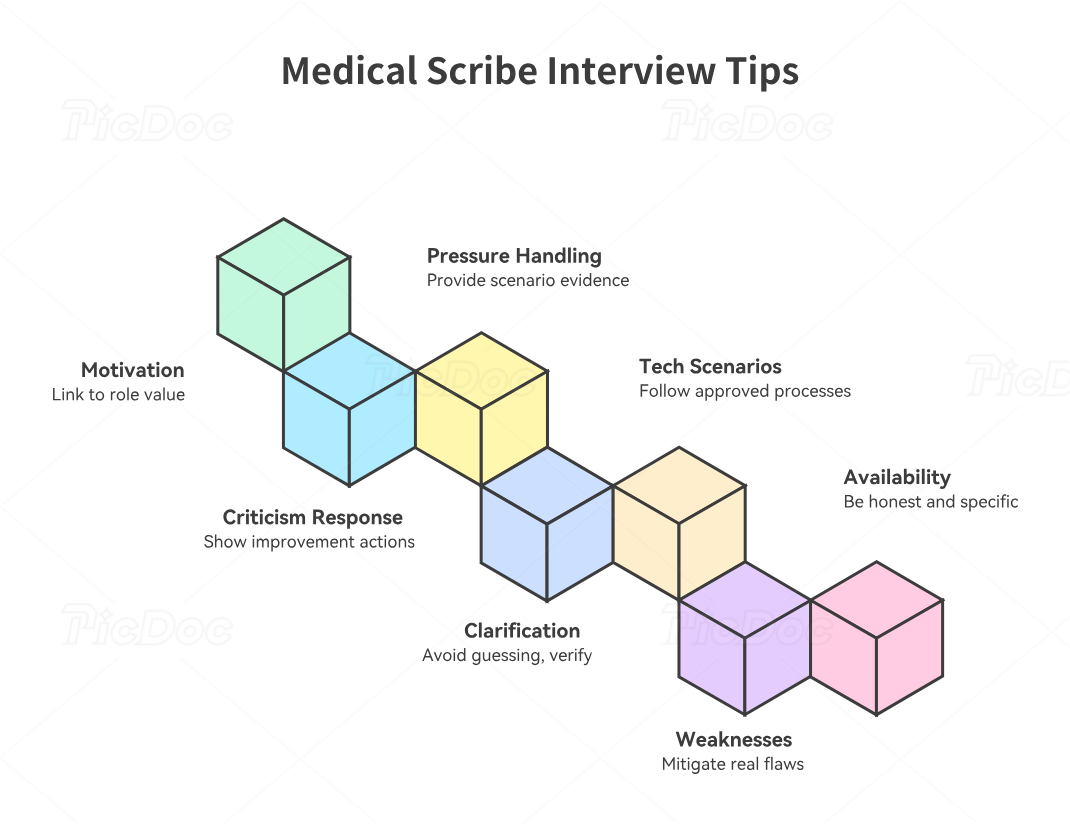
Start with “Why do you want to become a medical scribe?” The weakest answer stops at medical-school experience. A stronger answer explains that you want sustained exposure to physician workflow while building medical transcription accuracy, understanding patient communication, learning team communication, and becoming reliable at documenting clinical encounters. The employer can see your personal motivation and the value you intend to provide.
For “How do you handle pressure?”, avoid describing yourself as naturally calm. Give evidence. Explain a situation where several demands arrived simultaneously, how you identified the highest-risk task, communicated about delays, protected accuracy, and completed the work. This shows the same prioritization required in crisis communication, professional teamwork, assertive communication, and high-volume clinical documentation.
For constructive criticism, hiring teams need evidence that correction improves you. Describe the feedback, the specific behavior you changed, and the measurable or observable improvement. Avoid spending half the answer proving the critic was wrong. Clinical documentation is reviewed and corrected constantly. Someone who can receive feedback while maintaining professionalism, improve written communication, and communicate through team channels is much easier to train.
For technology scenarios, your response should demonstrate process rather than technical heroics. If the computer freezes, protect the encounter, use approved troubleshooting steps, communicate the problem promptly, follow the site's backup workflow, and document accurately once access returns. A candidate familiar with healthcare automation, secure messaging, virtual clinical workflows, and professional communication should still avoid inventing a technical procedure they were never trained to perform.
For “What would you do if you did not understand something the physician said?”, the key phrase is do not guess. Explain that you would preserve the workflow, seek clarification at an appropriate moment or follow the site's verification process, and ensure the final documentation is accurate. This demonstrates medical transcription discipline, professional assertiveness, confidentiality awareness, and responsible team communication.
Availability needs equally careful preparation. Saying “I'm flexible” and then revealing five restrictions wastes everyone's time. Map your classes, commute, exams, recurring commitments, and transportation first. If you are considering remote medical scribing, account for internet reliability and a private workspace. If you are considering emergency-department work, account for evenings and weekends. Strong scheduling communication, professional email etiquette, and realistic assertiveness are more valuable than promising impossible flexibility.
Weakness questions require similar precision. Avoid disguised strengths such as “I care too much” or “I'm too detail-oriented.” Choose a real weakness that does not undermine the core job, then explain your mitigation system. Someone who used to become overwhelmed by multiple deadlines could describe using prioritization and written tracking. Someone uncomfortable speaking up could explain developing assertive communication, clearer verbal communication, and stronger professional interactions.
5. A Better Medical Scribe Interview Preparation System
Begin preparation by studying the role rather than memorizing answers. A current ScribeAmerica job description includes documenting patient histories, examinations and treatments, using EHR systems, tracking results, maintaining accurate records, protecting privacy, and supporting healthcare-team workflow. Read those responsibilities alongside ACMSO resources on medical transcription, confidential communication, team communication, and professionalism. Your interview answers should naturally reflect those responsibilities.
Next, test your typing under realistic conditions. ScribeAmerica currently advertises 40+ WPM as a requirement in multiple locations. Raw speed alone is insufficient. Practice accurate punctuation, unfamiliar vocabulary, capitalization, and sustained listening. Pair typing practice with medical terminology, written communication, confidential documentation awareness, and concise verbal communication.
Prepare six or seven evidence stories that can be adapted across behavioral questions. You need examples covering pressure, teamwork, feedback, an error, conflict, learning something difficult, and reliability. Each story should be short enough to deliver clearly. Use enough context to understand the problem, spend most of the answer on your actions, and finish with the result or lesson. This approach naturally demonstrates team communication, professional assertiveness, crisis communication, and workplace professionalism.
For a video interview, practice looking into the camera, starting answers promptly, and finishing before you begin repeating yourself. Reddit reports show some prerecorded interviews offer limited thinking time, making memorized essays dangerous because an unexpected question can break the script. Use adaptable ideas instead. Strong non-verbal communication, natural verbal communication, clear professional language, and concise written responses create a more credible impression than reciting polished paragraphs.
Research the specific employment model. A ScribeAmerica versus private-practice comparison raises different questions than a remote scribe application. Ask about training duration, shift structure, typical provider assignment, expected weekly commitment, feedback, and whether the position is live or asynchronous. Understanding virtual check-in workflows and healthcare automation is particularly useful for remote roles.
Applicants should also prepare for the financial conversation without making compensation their entire interview identity. Research the local market, understand the advertised rate, and ask professional questions when appropriate. Anyone evaluating whether low medical-scribe pay is worth the experience should consider learning, scheduling, commuting, physician exposure, and progression alongside wage. Using professional email etiquette, assertive communication, and mature team communication keeps legitimate questions professional.
Finally, follow up correctly. A brief thank-you or status inquiry should reference the interview, confirm continued interest, and remain concise. If an employer is slow, follow up once professionally and continue applying. Reddit reports show onboarding delays and inconsistent communication can occur independently of candidate quality. Strong professional email etiquette, written communication, appropriate assertiveness, and realistic expectations prevent one employer's silence from freezing your entire job search.
6. FAQs About Medical Scribe Interviews
-
Recent Reddit experiences mention motivation for scribing, future healthcare goals, availability, typing speed, working under pressure, handling technical problems, and situational questions. Earlier applicants also reported questions about commuting distance and how long they could commit to the role.
Prepare around medical transcription, team communication, professionalism, and scheduling reliability, since these competencies connect directly to the actual job.
-
Some employers use terminology, typing, or training assessments during the hiring process, while many interviews focus more heavily on motivation, availability, communication, and scenarios. Reddit reports vary significantly by employer and location.
Study medical transcription terminology, but allocate preparation to written communication, confidentiality, and professional communication as well.
-
Yes. Availability can materially affect hiring because employers need applicants who match actual coverage requirements. ProScribe states that shift availability is considered alongside the application, interview, and typing test when offers are made, while current ScribeAmerica postings explicitly request flexible scheduling.
Use scheduling conflict management, clear professional email communication, assertive communication, and realistic planning rather than promising shifts you cannot sustain.
-
Current ScribeAmerica listings specify 40+ WPM in multiple markets. Individual employers can set different standards.
Candidates should train accuracy alongside speed because medical transcription, written clinical communication, secure documentation, and precise team communication all lose value when speed creates errors.
-
Connect your healthcare goals with the work itself. Explain your interest in physician workflow, clinical documentation, patient encounters, healthcare-team communication, and developing reliable professional skills.
Applicants researching whether medical scribing is worth it can naturally mention learning medical transcription, observing patient education, understanding bedside communication, and becoming dependable within a clinical team.
-
A combination of unreliable availability, careless communication, and weak respect for accuracy creates a particularly serious problem. Scribes handle sensitive information inside fast-moving clinical workflows, so an applicant who appears likely to guess, arrive inconsistently, resist correction, or communicate poorly creates training risk.
Strong confidential communication, professionalism, assertiveness without overstepping, and reliable team communication directly address those concerns.
