

Failed Medical Scribe Training or Floor Training? Reddit Reasons People Struggle and a Recovery Plan Before Your Next Shift
Failing a medical scribe training benchmark can feel brutal when you entered the job hoping to build clinical experience, learn medical documentation, and strengthen your premed profile. Floor training exposes gaps that online coursework cannot fully reproduce: real patient speech, provider speed, unfamiliar EHR navigation, competing charts, specialty terminology, and constant prioritization. Reddit stories reveal a consistent pattern. People often struggle because several small workflow weaknesses compound simultaneously. Recovery becomes much easier once you identify the exact failure mode instead of simply trying to “study harder.”
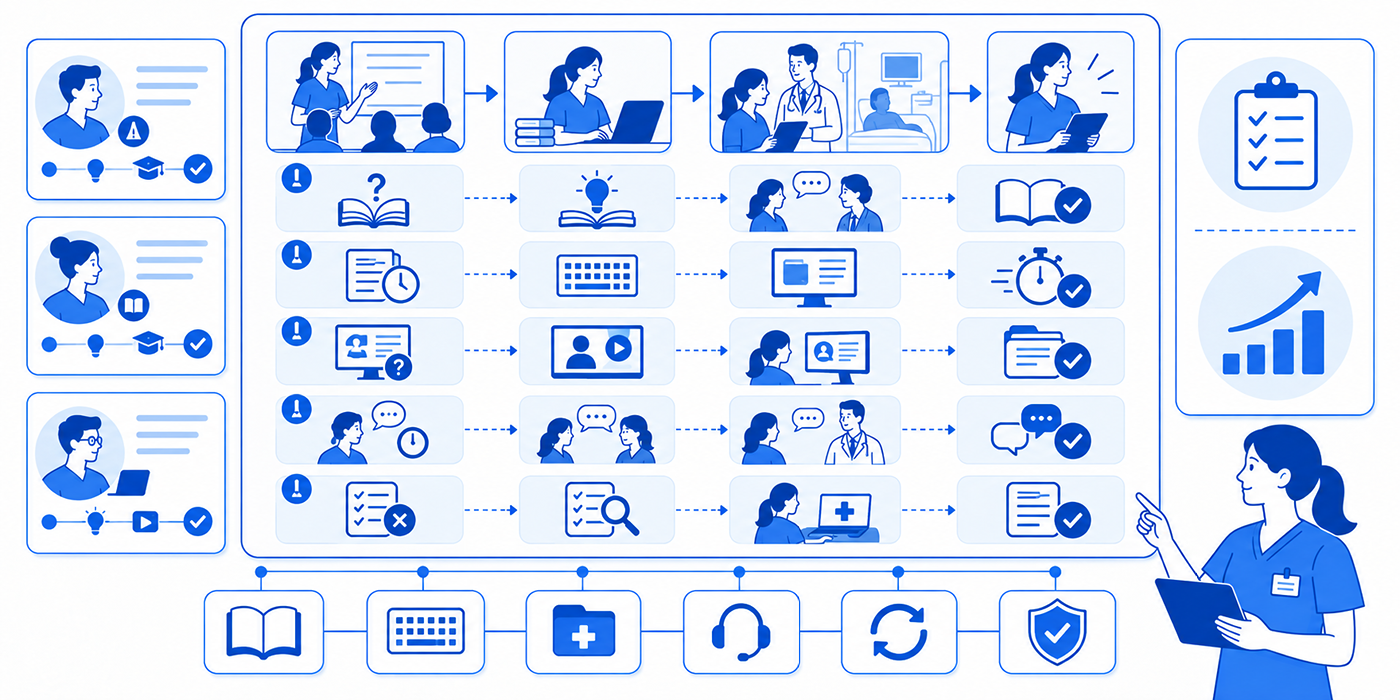
1. Why Medical Scribe Floor Training Feels So Much Harder Than Classroom Training
Online or classroom preparation teaches information in separated pieces. You learn medical terminology, documentation concepts, privacy expectations, and sometimes basic chart structure. Floor training demands that you combine those pieces while a real encounter keeps moving.
A patient may describe symptoms chronologically out of order. A family member interrupts. The physician asks a question that suddenly changes the story. The provider moves directly into the examination and starts dictating findings. Another result arrives from the previous patient. You are simultaneously trying to maintain written clinical communication, understand verbal communication, protect confidential information, and follow the site's documentation workflow.
That integration is why someone can score well in training modules and struggle during the first floor shifts.
A June 2026 r/medicalscribe discussion captures this transition. A new ScribeAmerica trainee worried about being too slow, asking too many questions, and forgetting anatomy and abbreviations before floor training. One commenter emphasized that site-specific training begins when the trainee works with the actual physician because formatting preferences vary significantly between providers. Another warned about losing track of earlier patients once the department becomes busy.
That last problem is especially important.
Many struggling trainees think their weakness is typing speed. Their real problem is workflow state management.
Suppose you have five active charts. Patient one needs an imaging result added. Patient two's HPI is complete but the physician has not dictated the plan. Patient three needs a reassessment. Patient four just arrived. Patient five's diagnosis changed after laboratory results.
If you hold all five states in your head, cognitive load rises quickly. A simple approved tracking system can therefore improve performance more than another hour of random terminology review. Strong team communication, professional communication, and organized medical transcription all depend on knowing exactly what remains unfinished.
A 2019 Reddit poster described needing roughly 25–30 minutes per chart after six training shifts and feeling overwhelmed because they had never worked in a hospital. Responses focused on specialty terminology, templates, EHR shortcuts, and practice. The original poster later reported failing floor training, while another commenter noted that scribing performance is a separate skill from eventual performance as a physician.
That distinction matters for premeds. Floor training evaluates whether you can perform a particular documentation workflow safely and quickly enough within that site's timeline. Your broader abilities in medicine involve many additional competencies, including rapport building, patient education, bedside manner, teamwork, reasoning, resilience, and communication.
The eight failure modes hiding behind “I’m too slow”
When trainees say they cannot keep up, the cause usually falls into one or more categories:
HPI construction is too slow. You collect the facts but spend several minutes reorganizing them after leaving the room.
Listening accuracy is weak. You hear most of the encounter but miss medication names, medical terms, chronology, pertinent details, or provider dictation.
EHR navigation consumes time. You know what belongs in the chart but cannot quickly reach the correct field, result, template, or prior note.
Medical terminology is not automatic. Every unfamiliar word forces a mental pause, slowing both listening and typing. Improving medical terminology fluency therefore produces gains beyond spelling.
Patient tracking breaks down. You can document one encounter well but lose unfinished tasks when several patients overlap.
Provider preferences are unclear. You repeatedly redo work because one physician wants a different structure than another.
Feedback is too broad. “Be faster” gives you no actionable target. Useful feedback sounds more like “finish most of the HPI while the patient is speaking” or “stop opening three EHR windows to find one result.”
Anxiety consumes working memory. You know more than you can access because you are simultaneously monitoring your trainer, worrying about termination, and trying to avoid every mistake.
A March 2026 Reddit trainee described completing four floor-training shifts and handling roughly 80–90% of charting, yet still worried because many items on the training checklist remained marked “needs improvement.” That experience illustrates why trainees should request specific benchmark feedback instead of trying to interpret a large number of vague improvement markers.
| # | Training Problem | Likely Root Cause | What to Practice Before Next Shift | What Improvement Should Look Like |
|---|---|---|---|---|
| 1 | HPI takes too long | Writing after the encounter instead of during it | Practice real-time chronological HPI construction | Most of the HPI exists when you leave the room |
| 2 | You miss terminology | Specialty vocabulary is not automatic | Review terms actually encountered at your site | Fewer pauses to decode familiar conditions and procedures |
| 3 | You lose patients | No external chart-status system | Create a privacy-compliant task tracker | You always know which chart needs what next |
| 4 | You miss dictation | Listening and typing compete for attention | Practice short clinical dictation drills | Less need to reconstruct what was said |
| 5 | You enter the wrong detail in HPI | Weak distinction between patient history and later findings | Practice separating history, exam, results and plan | Information consistently lands in the correct section |
| 6 | You constantly ask where things are in the EHR | Navigation pathways are not memorized | Map common workflows from memory | Routine fields require little conscious search |
| 7 | You keep rewriting notes | Provider preference mismatch | Build a provider-preference sheet | Corrections become smaller and less repetitive |
| 8 | You type every patient word | Weak clinical compression | Practice turning narratives into concise timelines | Notes become shorter without losing relevant facts |
| 9 | You omit key HPI facts | No mental framework for symptom history | Practice complaint-specific information categories | Fewer trainer prompts for missing context |
| 10 | You cannot finish previous charts | Poor task prioritization | Practice choosing the highest-value next action | Open charts stop multiplying uncontrollably |
| 11 | You freeze when corrected | Feedback triggers anxiety | Translate each correction into one workflow rule | Correction improves the next chart immediately |
| 12 | Your spelling is slow | Clinical words are unfamiliar motor patterns | Type specialty vocabulary repeatedly | Common terms become automatic |
| 13 | You miss reassessments | Patient tracking ends after initial encounter | Track pending results and reassessments | Follow-up events reach the correct chart promptly |
| 14 | You rely on trainer rescue | Workflow has not become independent | Attempt the task before asking for confirmation | Questions shift from “what do I do?” to targeted clarification |
| 15 | You are slow only with one physician | Provider-specific mismatch | Study that provider's preferred workflow | Performance gap narrows with that provider |
| 16 | You forget prior feedback | Too many corrections at once | Create a top-five error list | Repeated errors fall sharply |
| 17 | Your charts are accurate but very slow | Over-editing | Separate required accuracy from stylistic polishing | Less rewriting with preserved accuracy |
| 18 | You finish fast but make many errors | Speed exceeds comprehension | Add brief accuracy checkpoints | Error rate falls without major time increase |
| 19 | You cannot hear the physician | Positioning, speed, accent or environment | Practice concise clarification language | You verify uncertainty instead of guessing |
| 20 | You guess when unsure | Fear of appearing inexperienced | Practice professional clarification | Uncertain details are confirmed rather than invented |
| 21 | Different trainers contradict each other | Training inconsistency | Ask which standard the site or provider ultimately expects | You stop switching methods every shift |
| 22 | You panic during mock solo | Evaluation pressure disrupts automatic skills | Rehearse the first 10 minutes of your workflow | You start predictably instead of scrambling |
| 23 | You forget tasks after interruptions | No interruption-recovery cue | Mark exactly where work stopped | You resume quickly after interruptions |
| 24 | You cannot prioritize results | Limited familiarity with site workflow | Ask trainer what events require immediate chart action | Fewer low-value interruptions |
| 25 | Your trainer repeatedly fixes the same issue | Feedback is not being converted into behavior | Write one concrete rule after each correction | Same-category corrections decline shift by shift |
| 26 | You understand charts but cannot keep pace | Workflow efficiency rather than knowledge gap | Time each major chart component | You know exactly where minutes are being lost |
| 27 | You struggle only in the ED | Environment may exceed current processing speed | Consider slower outpatient cross-training | Accuracy and learning improve in lower-volume workflow |
| 28 | Online training feels irrelevant | Knowledge has not been translated into site-specific behavior | Review concepts through actual site examples | Theory starts supporting real workflow decisions |
| 29 | You feel worse after every shift | Feedback may lack prioritization or support | Request three highest-priority improvements | You leave knowing exactly what success means next shift |
| 30 | You failed the mock solo | One or more competencies remain below solo threshold | Obtain benchmark-specific feedback and request options | Your recovery plan targets observable deficiencies |
2. Diagnose Exactly Why You Are Struggling Before You Practice Anything Else
The worst recovery strategy is broad review.
A trainee who failed because of EHR navigation gains little from spending three hours rereading anatomy. Someone who understands the EHR but writes every HPI from scratch after leaving the room needs workflow practice rather than another medical scribe certification review.
Start with your last training shift and reconstruct the moments where performance broke down.
Was the problem accuracy?
Accuracy failures include placing information in the wrong section, misunderstanding medical terminology, omitting an important detail, adding something that was never stated, confusing historical information with today's complaint, or incorrectly capturing provider dictation.
This category deserves immediate attention because speed becomes irrelevant when a chart is unreliable.
Use medical transcription practice to improve recognition. Strengthen written communication so you can preserve meaning while compressing a patient's story. Use professional assertiveness when clarification is required.
Most importantly, never repair uncertainty by guessing.
If you did not hear the dose, ask according to site workflow. If you are unsure whether the provider said “left” or “right,” verify. If the physician never stated a diagnosis, do not independently upgrade a possibility into one. Accurate confidential clinical communication requires restraint as much as speed.
Was the problem HPI construction?
A 2020 Reddit trainee who failed their final scheduled training shift identified several specific problems: weak patient tracking, difficulty recording imaging and EKG information, HPI problems, inaccurate inclusion of events, and slow Epic navigation. They were advised to practice turning the patient's presentation into a coherent story rather than simply accumulating disconnected facts.
That is one of the highest-value HPI improvements.
During an encounter, identify:
Why is the patient here?
When did the problem begin?
How did it develop?
Which symptoms meaningfully define it?
What context changes interpretation?
What happened before arrival?
What has already been tried?
What relevant information did the provider actually obtain?
The goal is clinical organization rather than prose perfection.
A patient may speak for three minutes while providing thirty separate facts. Your job is to preserve the medically relevant story accurately. Strong patient communication awareness, verbal listening, and medical terminology allow you to organize that story while it is happening.
Was the problem speed?
Measure speed by component, not by chart.
A chart taking twenty minutes tells you very little.
You need to know whether those twenty minutes were spent on:
HPI construction
EHR navigation
searching prior records
physical-exam documentation
results
provider dictation
assessment and plan
editing
recovering after interruptions
or waiting for information.
One Reddit head trainer explained that their site expected trainees to progressively complete more of the chart independently and emphasized writing the HPI during the encounter rather than collecting rough notes and constructing the entire HPI afterward. The same commenter stressed that expectations were site-dependent and that improvement potential, professionalism, and effort mattered alongside raw output.
That advice points toward a useful rule:
Remove rework before trying to type faster.
A 70-WPM typist who repeatedly reconstructs encounters can fall behind a 50-WPM typist who builds the correct note once.
Was the problem EHR navigation?
EHR speed improves through route memorization.
You should know the pathway to the fields and information you use constantly: today's encounter, prior notes, relevant results, imaging, medications, documented history, templates, reassessment areas, and whichever sections your site requires scribes to maintain.
Only use functions, templates, shortcuts, and smart phrases authorized by your organization. Healthcare automation tools can reduce repetitive work, while safe medical documentation still requires careful verification.
A trainee who spends thirty seconds searching for something fifteen times during a shift loses almost eight minutes to one navigation weakness.
Multiply that by five inefficient workflows and the apparent “typing problem” starts looking very different.
Was the problem training inconsistency?
A 2020 Reddit poster described receiving conflicting advice from different trainers, including disagreement about whether early training should prioritize chart quality or production speed. The trainee then struggled during mock solo when the evaluator's expectations differed from previous guidance.
When trainers conflict, ask a higher-level question:
“Which method should I use when I am working independently at this site?”
That keeps the conversation focused on the operational standard.
Use professional verbal communication, assertiveness, and team communication to resolve contradictory instructions early. Quietly changing your method every time a new trainer arrives creates unnecessary instability.
3. Your 24-Hour Recovery Plan Before the Next Floor-Training Shift
You do not need to relearn all of medicine before tomorrow.
You need to remove the highest-frequency errors that are currently slowing or disqualifying you.
Step 1: Reduce your feedback to three priorities
Write down every correction from the previous shift.
Then rank them by:
frequency – how often does this happen?
risk – how serious is the error?
time cost – how much backlog does it create?
Your top three might become:
Finish most HPI construction inside the room.
Track pending charts and reassessments externally through the site's approved method.
Ask immediately when provider dictation is unclear.
This is far more useful than carrying fourteen vague weaknesses into your next shift.
Strong professional communication also means asking your trainer for priorities. Try: “I reviewed yesterday's feedback. Which three changes would most improve my readiness for solo work?”
That question converts evaluation into an actionable learning plan.
Step 2: Build an error log, not a study notebook
Create four columns:
Error
Why it happened
Correct rule
How I will prevent recurrence
Example:
“Forgot reassessment” → moved to next patient and relied on memory → pending reassessments must remain visible on tracker → do not mentally close chart until pending status is resolved.
That type of reflection strengthens team communication, written communication, and actual job performance simultaneously.
Step 3: Drill only the terminology your site uses
Random medical vocabulary offers low return the night before floor training.
If you are in orthopedics, review the anatomy, procedures, symptoms, and common terminology appearing in your actual charts. Emergency medicine requires a broader set. Gastroenterology, cardiology, dermatology, ophthalmology, and primary care create different vocabulary demands.
Build your review around medical transcription terminology you have already heard.
Then type those words.
Recognition and keyboard fluency are separate skills.
Step 4: Rehearse the HPI under time pressure
Take a short fictional patient narrative and create a concise HPI while listening once.
Then compare your result against four questions:
Did I preserve chronology?
Did I include clinically relevant associated details that were actually given?
Did I introduce anything that was never stated?
Did I waste time polishing sentences that were already clear?
Repeat.
This simultaneously trains medical listening, written clinical communication, and medical transcription.
Step 5: Rehearse the EHR route from memory
You may be unable to access the real EHR outside work. You can still mentally reconstruct the workflow.
Where does the encounter open?
Where does the HPI go?
Where do you locate results?
Where does your provider expect reassessments?
What fields are frequently forgotten?
Which site-approved templates save time?
This builds procedural memory.
Step 6: Prepare clarification language
Trainees lose time when they notice uncertainty and then spend five minutes deciding whether to ask.
Prepare concise phrases such as:
“Could you repeat the last diagnosis for me?”
“Was that left or right?”
“For this chart, do you want that result included in the reassessment?”
“Should I use your usual template here?”
These are examples of professional assertiveness, team communication, and efficient verbal communication.
Step 7: Sleep instead of panic-studying
A sleep-deprived trainee gains little from memorizing forty additional abbreviations at 2 a.m. if attention collapses during the actual shift.
Floor training tests sustained attention, working memory, listening, navigation, and prioritization. Those functions need recovery.
4. What to Do During Your Next Floor-Training Shift to Show Clear Improvement
Your trainer needs evidence that feedback changes your behavior.
That means your next shift should look visibly different.
Before the first patient
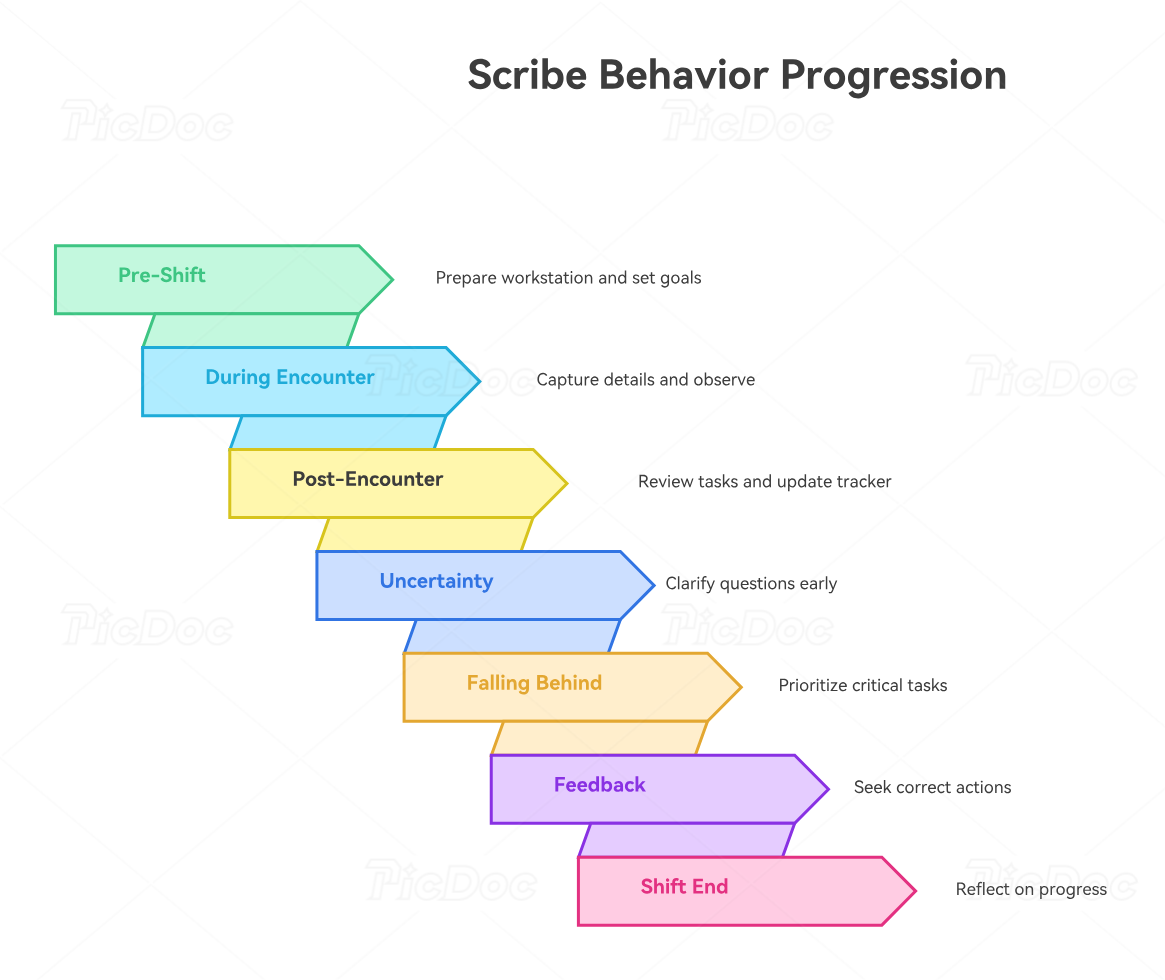
Arrive with enough time to establish your workstation according to site policy. Confirm your login works. Open approved tools. Review the provider's known documentation preferences. Clarify anything unusually important from the previous training shift.
Use professionalism before the workload begins.
A strong opening question is:
“Yesterday my three main issues were HPI speed, tracking pending charts, and confirming dictation. I'm focusing on those today. Is there anything else you want me prioritizing?”
That gives the trainer a framework for evaluating improvement.
During the patient encounter
Capture the story while it unfolds.
Listen for the complaint, timeline, major associated details, relevant context, and interventions already attempted. Use your medical terminology knowledge to avoid unnecessary pauses. Use strong written communication to organize rather than transcribe every sentence verbatim.
Watch the physician's interaction too. Scribing can build substantial knowledge of bedside manner, patient education, rapport building, non-verbal communication, and therapeutic communication once documentation stops consuming all of your attention.
Immediately after the encounter
Ask yourself three questions:
What is complete?
What is pending?
What requires clarification?
Then update your approved tracker.
This three-question routine prevents unfinished tasks from disappearing as soon as the next patient appears.
When you are uncertain
Clarify early.
Waiting until six charts later forces both you and the provider to reconstruct the encounter. Efficient team communication keeps questions close to the event.
Your goal is not zero questions.
Your goal is better questions.
Early trainees ask:
“What am I supposed to do?”
Improving trainees ask:
“I entered the HPI and examination. The imaging is still pending. Should I leave the reassessment open until the result returns?”
That shift signals growing independence.
When you fall behind
Stop reacting randomly.
Identify the chart closest to closure.
Finish work that requires information you currently have.
Flag charts waiting on provider input.
Avoid spending five minutes cosmetically polishing one HPI while three clinically important tasks remain unresolved.
The strongest medical scribe skills increasingly involve workflow awareness, information validation, clinical organization, and quality control. Those capabilities also become more valuable as healthcare automation and AI-generated documentation expand.
During feedback
Do not defend every mistake.
Ask what the correct behavior should be next time.
A 2024 Reddit thread included a floor trainer who said feeling overwhelmed during training was extremely common and that most trainees did not feel comfortable working independently immediately. The trainer described the skill eventually becoming much more automatic with repetition.
Useful training therefore depends heavily on trajectory.
If your first shift required constant prompting, your third should require less.
If you missed ten pieces of provider dictation, the next shift should show fewer.
If your trainer closed half your charts, that dependency should shrink.
Progress is measurable.
At the end of the shift
Ask three specific questions:
What improved most today?
What still prevents me from being safe independently?
What should I prioritize before the next shift?
This is stronger than asking, “Did I do okay?”
It demonstrates professional communication, assertiveness, and ownership of your development.
5. What to Do If You Failed Your Mock Solo or Were Told You May Not Pass Training
A failed mock solo gives you useful diagnostic information if the employer still offers another attempt.
A 2025 Reddit poster described reaching a tenth ED training shift and struggling with HPI accuracy despite improvement. Their trainer discussed possible cross-training because the ED's pace might not fit their current performance.
Cross-training can be a strong option.
Someone may struggle in a high-volume ED while performing very well in outpatient medicine, where patient flow, provider continuity, and documentation structure are more predictable. Comparing private-practice scribing with larger scribe-company jobs can also reveal how dramatically workflow differs across settings.
Ask whether additional training is available
Some sites provide extra shifts. Others have fixed training limits.
A 2020 Reddit poster who did not pass their scheduled final shift reported being advised to complete one or two additional training shifts.
Ask clearly:
“What specific benchmarks did I miss?”
“Can I receive another supervised shift?”
“Is cross-training at another site or specialty available?”
“Which performance issues would I need to correct before another assessment?”
Those questions are much stronger than asking for “another chance” without a plan.
Separate a skill mismatch from a training failure
A 2021 Reddit poster described receiving positive feedback through most floor training and then performing poorly during an assessment with a different trainer and provider in a much more distracting environment. The poster was ultimately terminated. A commenter who identified themselves as a chief scribe said their own site often accommodated trainees who needed additional shifts, illustrating substantial site-to-site variability.
Training quality therefore belongs in your postmortem.
Ask whether:
you received consistent instruction
your logins worked from the beginning
you had enough actual charting practice
feedback was specific
different trainers gave conflicting standards
the mock solo resembled normal training conditions
you were taught the provider's preferences
and you had enough opportunities to correct identified weaknesses.
Indeed reviews have also described inconsistent floor-training experiences tied to different trainers and physicians, while ScribeAmerica has publicly responded that its classroom and floor-training programs are intended to prepare scribes for independent work.
If employment is discontinued
Treat the outcome as information.
You now know whether you struggle with high-volume documentation, real-time listening, EHR navigation, multitasking, or the specific culture of that workplace.
That can guide your next move.
You could apply to a slower outpatient practice, investigate remote medical scribe jobs, pursue better-fit clinical exposure, strengthen medical transcription, or choose a role with more direct patient interaction.
Do not fabricate an explanation during future interviews.
Keep it concise:
You completed training, struggled to meet the required real-time documentation benchmark within the training period, identified the underlying weaknesses, and have since worked on them.
That framing demonstrates accountability.
Consider whether scribing still fits your goals
Premeds often become emotionally attached to scribing because it appears to be the standard route to clinical exposure.
There are many alternatives.
Someone who thrives through direct interaction may gain more from work requiring rapport building, patient education, therapeutic communication, dealing with difficult patients, or crisis communication.
Someone who still wants scribing should investigate why medical-scribe applicants struggle to get hired, whether medical-scribe certification is worth paying for, whether remote scribing better matches their strengths, and how AI scribing changes the skills employers value.
Failing one training process measures your readiness for one operational standard at one point in time. Your next decision should be based on the actual weakness uncovered and the clinical experience you still need.
6. FAQs
-
Yes. Reddit contains years of posts from trainees who passed online training and then felt overwhelmed by real-world charting, medical terminology, EHR navigation, HPI construction, provider speed, and patient tracking. A 2026 thread from a trainee preparing for ScribeAmerica floor training attracted responses emphasizing how site-specific the real job becomes once you work with actual physicians.
The productive response is to identify which skill is failing first.
If your issue is terminology, strengthen medical transcription vocabulary. If it is listening, work on verbal communication. If it is tracking, externalize pending tasks. If conflicting instructions are the problem, use professional assertiveness and team communication to clarify the site's actual standard.
-
Yes. Classroom and online training assess knowledge under controlled conditions. Floor training adds real patient speech, provider preferences, EHR navigation, interruptions, competing charts, and time pressure.
Reddit includes accounts from trainees who passed their initial coursework and later struggled during floor training or mock solo. One 2024 poster described substantial improvement during a month of training but still faced possible termination because several performance details remained below the employer's solo threshold.
Preparing for floor work therefore requires more than reviewing medical terminology. Practice written clinical communication, accurate listening, EHR workflow, patient tracking, and provider-specific documentation habits.
-
Practice constructing the HPI while listening, rather than taking disconnected notes and rewriting the entire encounter afterward.
Use short fictional clinical narratives. Listen once. Build the timeline in real time. Then check whether you preserved the patient's complaint, chronology, relevant associated details, context, and interventions without adding information that was never stated.
This combines medical transcription, verbal communication, and written clinical communication.
A Reddit trainer specifically identified delayed HPI construction as a common reason new scribes fall behind because writing the full HPI after leaving the room creates immediate backlog.
-
Ask when the employer permits additional supervised shifts and you can identify specific deficiencies that another shift could realistically address.
Your request should include the plan:
“I understand that my HPI speed and patient tracking were below benchmark. I have practiced both and would like one additional supervised shift to demonstrate improvement. Is that available?”
That combines accountability with professional communication and assertiveness.
Reddit reports show substantial variation between sites. Some trainees describe receiving extra shifts, while others report fixed training limits or termination after unsuccessful mock solos.
-
Document the conflict and ask which standard controls when you work independently.
Phrase it professionally:
“Trainer A recommended this approach, while yesterday I was advised to use this other structure. Which method does this provider or site want me to use going forward?”
That avoids turning the conversation into a complaint while protecting you from repeatedly changing your workflow.
Inconsistent trainer expectations appear in Reddit discussions and employee reviews, particularly around chart speed, formatting, and provider preferences.
Good team communication, professional assertiveness, and written communication become especially valuable when training itself is inconsistent.
-
A failed scribe-training process reflects performance in a specific documentation job under a specific workflow and timeline. Medical training ultimately demands a much broader set of capabilities.
The strongest response is to understand what the experience taught you.
Perhaps you need better medical terminology, stronger professional communication, more direct patient interaction, a lower-volume environment, or an entirely different form of premed clinical experience.
One Reddit discussion included a commenter who said they knew physicians who had previously failed scribe training, emphasizing how different real-time scribing is from the broader competencies required in medicine.
