

Medical Scribe Burnout Is Real: Reddit Stories on 8–12 Hour Shifts, Breaks, Workload & How to Survive
Medical scribe burnout often starts with a job that looked perfect on paper: clinical exposure, physician access, paid healthcare experience, and hundreds of hours for a medical-school application. Then come eight-hour shifts without a real meal break, twelve-hour days spent chasing unfinished notes, unpredictable end times, and the pressure of maintaining accurate clinical documentation while mentally exhausted. Reddit stories show that burnout can emerge from workload design, staffing, provider pace, and scheduling rather than a lack of resilience or interest in medicine.

1. Why Medical Scribe Burnout Hits Premeds So Hard
Medical scribing has an unusual workload because the job looks physically simple while demanding almost continuous cognitive attention. A scribe may simultaneously listen to a patient, identify the clinically relevant details, structure the HPI, track pertinent negatives, recognize terminology, follow a provider's reasoning, update the assessment and plan, and maintain accurate written clinical communication.
That workload becomes significantly harder when the physician has already moved to the next patient while the previous chart remains unfinished.
For new scribes, the first major pain point is usually cognitive backlog. One unfinished note becomes two. Two become four. You start the next encounter while mentally retaining information from the previous patient. Accuracy becomes harder precisely when speed becomes more important. Strong medical transcription skills, verbal communication, team communication, and professional communication reduce friction, but they cannot compensate indefinitely for excessive volume.
A January 2025 r/medicalscribe post illustrates the extreme end of this problem. One urgent-care scribe described seeing 45 patients within six hours during a winter surge and estimated producing 60–80 notes during a twelve-hour day. The poster described regularly skipping meals and finishing shifts mentally drained. That is one person's experience rather than an industry benchmark, but it demonstrates how patient volume can turn a potentially valuable educational experience into sustained cognitive overload.
Another Reddit discussion demonstrates why the phrase "eight-hour shift" can be misleading. One scribe reported being hired expecting two eight-hour days each week, only to describe substantial pre-charting and post-charting that stretched the practical commitment dramatically beyond the scheduled clinic hours. Other scribes responding to the thread described much more manageable eight-hour schedules with downtime, reinforcing an important point: medical scribe workload varies enormously by site, specialty, provider, and expectations.
The educational value can also obscure the warning signs. Premeds tolerate difficult conditions because they are gaining physician exposure, learning professional bedside communication, observing patient education, improving clinical terminology, and potentially building relationships for future recommendations.
That creates a dangerous calculation: "I am exhausted, but this is helping my application."
The better question is whether the marginal clinical value of the next shift exceeds what that shift is taking from you.
If repeated scribe shifts are reducing MCAT preparation, damaging grades, eliminating meaningful sleep, making you dread clinical environments, or leaving you too depleted for patient-centered communication, the experience has started competing against the application it was supposed to strengthen.
| # | Scribe Burnout Signal | What May Be Causing It | Best Immediate Response | When It Becomes a Red Flag |
|---|---|---|---|---|
| 1 | Constantly finishing charts late | Volume exceeds current charting speed | Identify which note sections create the backlog | Late completion remains routine after proficiency develops |
| 2 | Skipping lunch repeatedly | No workload coverage or break culture | Clarify break expectations with management | Eating becomes incompatible with normal shifts |
| 3 | Dreading every upcoming shift | Accumulated fatigue or environmental mismatch | Separate temporary fatigue from persistent aversion | Dread persists after rest and schedule reduction |
| 4 | Missing details you normally catch | Attention depletion | Slow down critical chart checkpoints | Accuracy repeatedly deteriorates with workload |
| 5 | No time to use the restroom | Continuous patient flow | Discuss coverage and micro-break opportunities | Basic needs are routinely deferred for an entire shift |
| 6 | Staying one or more hours late | Documentation spillover | Track why each chart remained unfinished | Scheduled hours consistently understate real workload |
| 7 | Grades start slipping | Work is consuming academic recovery time | Reduce shifts quickly | Clinical hours are actively weakening your academic record |
| 8 | MCAT studying becomes inconsistent | Shift recovery consumes study blocks | Protect fixed MCAT days | Work repeatedly overrides your study plan |
| 9 | Chart quality worsens late in the day | Sustained cognitive fatigue | Use structured end-of-note checks | Fatigue routinely threatens documentation accuracy |
| 10 | Provider pace feels impossible | Poor provider-scribe speed match | Request feedback or different pairing | Experienced scribes also cannot sustainably keep up |
| 11 | You cannot mentally leave work afterward | High cognitive or emotional carryover | Build a consistent post-shift decompression routine | Recovery never occurs before the next shift |
| 12 | Meals are routinely delayed for hours | Workflow has no protected pause | Carry accessible food where workplace rules allow | The system depends on workers skipping meals |
| 13 | You are chronically sleep-deprived | Early, late or rotating shifts | Reduce schedule variability | There is insufficient recovery between obligations |
| 14 | You are doing substantial unpaid preparation | Pre-charting expectations were poorly defined | Document actual work time and clarify policy | Hidden work materially changes the job you accepted |
| 15 | Every provider uses different preferences | High switching cost | Keep provider-specific preference notes | Training provides no usable standardization |
| 16 | You feel constantly behind | Too many open cognitive loops | Use a chart-status tracker | Tracking improves organization but workload remains impossible |
| 17 | You fear asking for help | Punitive workplace culture | Use specific, professional escalation | Safety or accuracy concerns cannot be raised safely |
| 18 | You have stopped learning | Survival mode has replaced observation | Measure learning, not hours alone | The job provides workload without educational growth |
| 19 | Small corrections feel overwhelming | Reduced emotional bandwidth | Assess sleep and workload first | Normal feedback repeatedly triggers disproportionate distress |
| 20 | You rush critical documentation | Speed pressure exceeds safe workflow | Protect high-risk note sections from shortcuts | Accuracy is implicitly sacrificed for throughput |
| 21 | You are expected to perform unfamiliar extra duties | Role expansion | Clarify duties, training and scope | Responsibility expands without proper preparation |
| 22 | You are working through illness | Attendance pressure or understaffing | Use established absence procedures | Fear prevents appropriate health-related absence |
| 23 | You resent patients arriving | Severe depletion | Reduce workload and recover | Cynicism persists across multiple shifts |
| 24 | One difficult shift ruins the next day | Recovery cost exceeds scheduled hours | Count recovery time when evaluating workload | A part-time job functionally consumes full days |
| 25 | You stay because quitting feels bad for med school | Application anxiety | Evaluate the role by competency value | Fear becomes the primary reason you remain |
| 26 | You never receive feedback | Weak training loop | Request targeted chart review | You are judged on standards nobody explains |
| 27 | You cannot remember patient details by late shift | Working-memory saturation | Externalize chart-status tracking | Information overload routinely compromises performance |
| 28 | You have no predictable end time | Provider schedule and chart closure variability | Ask for realistic historical end-time ranges | You cannot reliably plan school or recovery afterward |
| 29 | A day off does not restore you | Burnout may be extending beyond acute fatigue | Reassess total workload inside and outside work | Reduced hours and meaningful rest produce little improvement |
| 30 | The job makes medicine itself feel intolerable | Workplace conditions may be contaminating career perception | Compare experiences in a different clinical environment | You cannot separate the profession from one dysfunctional workplace |
2. Eight-to-Twelve-Hour Shifts Feel Different When You Cannot Mentally Disengage
An eight-hour scribe shift is fundamentally different from eight hours of work that contains natural stopping points.
Each new patient can create another unfinished cognitive loop. The scribe has to remember whether the HPI documentation is complete, whether a relevant negative belongs in the note, whether test results returned, whether the provider changed the diagnosis, and whether the plan requires clarification. Meanwhile, the next patient may already be describing an entirely different complaint.
That is why "only two shifts per week" can still feel exhausting.
A Reddit thread from 2024 described a new scribe struggling with a workload that reportedly expanded from expected eight-hour shifts into extremely long days after pre-charting and post-charting were included. Responses from other scribes described much healthier schedules, including normal eight-hour shifts, periods of downtime, and no routine expectation to work for hours before or afterward.
This variation matters. Long shifts themselves are only one variable. Shift density matters too.
An eight-hour outpatient day with predictable appointments, functioning templates, a provider who pauses between patients, and competent team communication can be manageable.
An eight-hour emergency or urgent-care shift with relentless turnover, no meaningful pause, constant interruptions, unfamiliar providers, rapidly changing diagnoses, and unfinished charts can feel much longer.
NIOSH identifies long and unpredictable hours as healthcare-worker stressors and notes that time on task, sleep debt, and circadian timing contribute to fatigue. Its training materials also identify rest breaks as a strategy for reducing fatigue associated with prolonged time on task.
The practical lesson for scribes is important: fatigue is a workflow variable that affects performance.
When fatigue rises, a scribe may become slower at differentiating patient language from provider interpretation, maintaining confidential documentation, recognizing medical terminology, and capturing precise written communication. That creates a vicious cycle.
Fatigue slows documentation.
Slower documentation creates backlog.
Backlog creates stress.
Stress consumes working memory.
Reduced working memory makes documentation even slower.
The strongest scribes break that cycle by reducing unnecessary cognitive load rather than attempting to "try harder."
Maintain a compact patient tracker permitted by your workplace. Know which chart sections must be completed in real time and which can safely wait. Learn provider preferences instead of rediscovering them on every encounter. Use approved EHR templates correctly. Ask concise clarification questions while the clinical reasoning is still fresh. Strengthen assertive communication so uncertainty does not sit unresolved for three hours.
If several physicians rotate through your schedule, create provider-specific workflow habits. One physician may dictate the plan after every encounter. Another may finish several encounters before reviewing anything. One may expect highly detailed HPI language while another wants compressed documentation. Adapting to those patterns can significantly reduce unnecessary rework and improve professional collaboration.
Premeds should also count recovery time when deciding whether a schedule is sustainable.
A twelve-hour Saturday shift does not consume only twelve hours if you lose the evening to exhaustion and half of Sunday recovering. A late emergency-department shift can disrupt sleep and destroy the next morning's study block. A shift that repeatedly runs one hour late can make an evening class, research obligation, or medical-school preparation unreliable.
That hidden cost is where many premeds miscalculate their workload.
3. Breaks, Meals and Constant Patient Flow Can Decide Whether the Job Is Sustainable
Reddit discussions repeatedly return to one deceptively simple issue: breaks.
In one r/medicalscribe discussion, a trainee asked whether receiving no break during an eight-hour emergency-department shift was normal. Responses included scribes describing twelve-hour shifts without formal breaks, while another person explained that taking a break could leave them substantially behind.
A separate emergency-scribing discussion showed how variable this can be. One scribe described having no formal breaks beyond occasional gaps in patient flow. Another described having no formal lunch while using naturally occurring downtime to eat or briefly step away.
More recently, a July 2026 Reddit poster described an orthopedic scribe position involving eight-hour shifts, no designated lunch break, limited workspace, and even a lack of chairs for the scribes. The discussion again suggests that local workplace culture can determine whether the same "medical scribe" title means a sustainable clinical experience or a draining one.
Employment rules for meal and rest periods vary by jurisdiction, worker classification, shift length, and other factors, so scribes should verify the rules that apply where they actually work rather than treating Reddit comments as legal guidance.
From a performance perspective, however, the value of recovery is much clearer. NIOSH materials encourage healthcare managers to create opportunities for regular breaks and note research associating work breaks with lower injury risk. During high-demand healthcare conditions, NIOSH has also recommended strategies that allow short breaks approximately every two hours and cautioned about extended shifts beyond twelve hours because of fatigue-related risk.
For scribes, a "break" does not always need to mean leaving the department for thirty minutes. Operational reality may create smaller windows. When workplace rules permit, even five minutes to drink water, eat something, use the restroom, stand away from the screen, or reset your chart queue can reduce the sense of an uninterrupted ten-hour sprint.
The deeper problem appears when the workflow structurally depends on you never stepping away.
A healthy high-volume environment can still use clear team communication, realistic coverage, appropriate professional assertiveness, and effective scheduling conflict management. An unhealthy system treats skipped meals, delayed bathroom trips, and routine unpaid overtime as evidence that someone is "dedicated."
Those conditions can eventually undermine the exact skills a scribe is supposed to develop: accurate clinical documentation, careful professional communication, appropriate confidential communication, and attentive observation of patient care.
A June 2026 Reddit story captures the operational version of this problem. A new scribe-tech described being the only assistant with one physician and one front-desk worker for several hours, managing patients continuously, struggling in an unfamiliar site, staying well beyond the expected end of the shift, and reaching the evening having eaten only a second meal because there had been no meaningful opportunity for a break.
That situation should prompt more useful questions than "Am I tough enough?"
Ask:
Can staffing realistically support the patient volume?
Was the workload appropriate for your level of training?
Does management know how frequently breaks disappear?
Are extra responsibilities being added beyond what you were trained to perform?
Can another scribe cover briefly during the busiest stretches?
Does the provider understand when the chart queue has become unsafe or unmanageable?
Do you know how to communicate overload before documentation accuracy collapses?
Learning assertiveness in medical administration, maintaining professionalism, and handling difficult workplace communication are practical survival skills here. Silence does not automatically demonstrate professionalism.
4. How to Survive Medical Scribe Burnout Without Sacrificing Accuracy
Burnout advice becomes useless when it consists of "sleep more" and "practice self-care" while the underlying workflow remains broken.
Scribes need operational fixes.
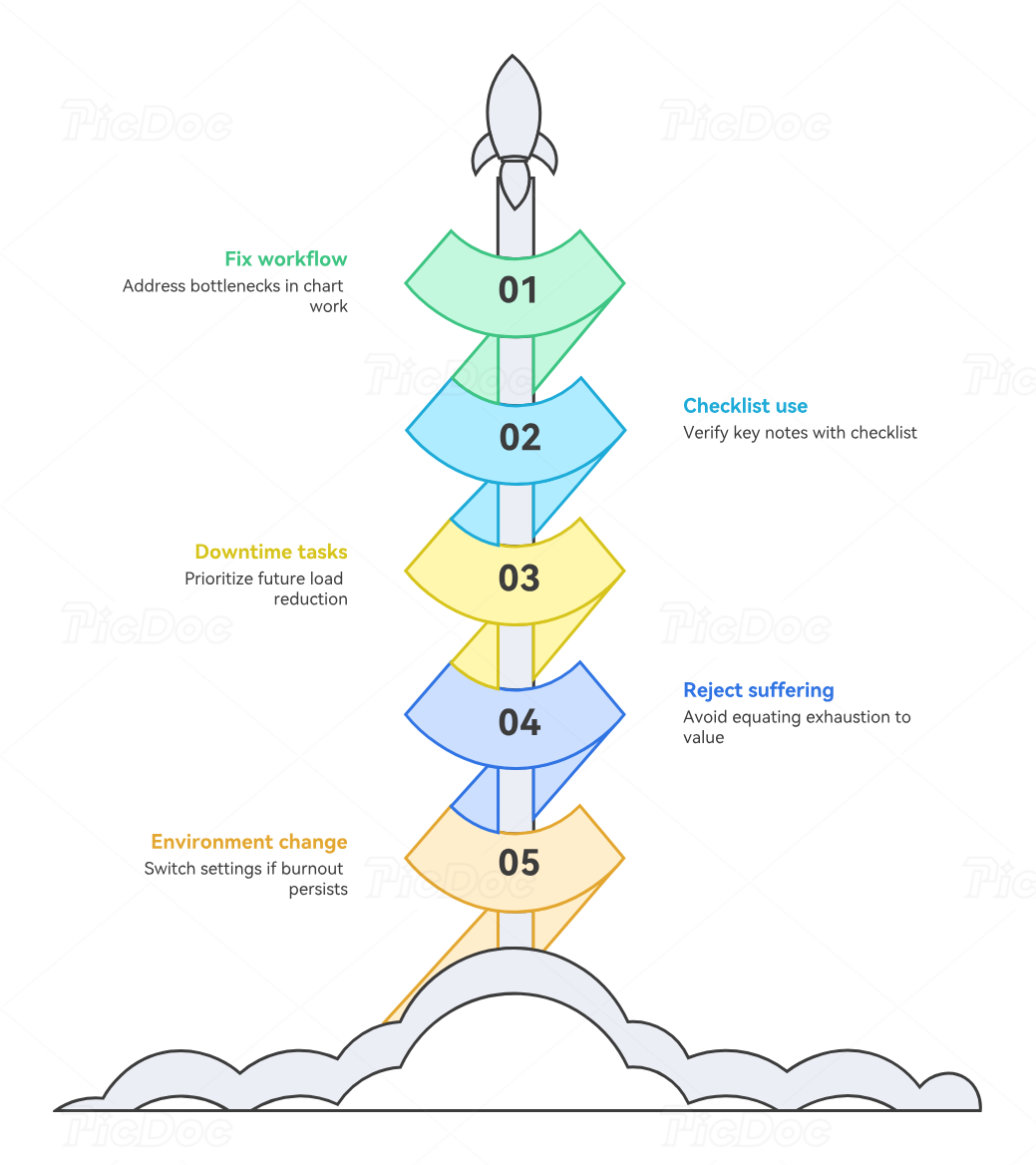
Start by identifying the exact bottleneck in your chart.
If your HPI is slow because you are trying to transcribe every word, improve your ability to distinguish the patient's narrative from clinically relevant details. Strong medical transcription requires compression without distortion.
If assessment and plan documentation causes the backlog, clarify how your provider communicates final diagnoses, orders, follow-up, and return precautions. Confusing provider impressions with confirmed diagnoses is a documentation risk, particularly when the scribe is mentally overloaded. Developing stronger written communication and verbal clarification skills can remove minutes of later reconstruction.
If different providers are the problem, build a preference system.
Record permitted workflow preferences rather than protected patient information: preferred HPI structure, terminology, order of note sections, whether the physician dictates the physical examination immediately, when they review the plan, and common corrections. This turns repeated confusion into reusable knowledge and strengthens team communication.
If your workload explodes because questions accumulate, ask earlier.
A twenty-second clarification after the encounter can prevent ten minutes of uncertainty later. Good professional assertiveness sounds specific: "For patient three, should I document the imaging result under today's assessment or keep it in the prior-history section?" That is more efficient than saying, "I'm confused about the chart."
Protect accuracy with a closing checklist
Fatigued scribes need external safeguards because working memory becomes less reliable under pressure.
Before mentally closing an encounter, verify the essential pieces required by your site and provider. Depending on your permitted responsibilities, this may include the chief complaint, HPI, relevant review or examination documentation, results, clinical impression, plan, follow-up, and unresolved provider questions.
This is where mastery of medical terminology, written clinical communication, confidential communication, and professional documentation standards becomes protective rather than academic.
Use downtime deliberately
During a lull, choose the task that removes the greatest future cognitive load.
Close nearly finished notes before starting low-priority cleanup. Resolve unanswered provider questions while the physician still remembers the case. Prepare approved templates for predictable upcoming encounters. Refill water or eat when there is a genuine window rather than assuming another opportunity will appear thirty minutes later.
Emergency and urgent-care volume is unpredictable. A quiet period is operational capacity.
Stop measuring competence by suffering
One of the most damaging premed habits is treating exhaustion as proof that an experience is valuable.
A difficult learning curve can be worth enduring when each week brings meaningful improvement. Reddit scribes often describe the job becoming dramatically easier after several months as terminology, templates and provider habits become automatic. One 2024 discussion described new scribing as initially overwhelming but much easier after the workflow "clicked," while patient volume still varied dramatically by specialty and provider.
Persistent burnout follows a different pattern.
A March 2026 Reddit poster with almost three years of scribing experience described burnout that continued even after reducing hours and taking a month away. They also mentioned medical-school uncertainty and MCAT preparation, illustrating how burnout can reflect the combined load of work, application pressure and academics rather than one difficult shift.
When reduced hours, greater skill, and meaningful rest fail to improve the experience, the correct intervention may be changing the environment rather than optimizing harder.
That could mean moving from an ED to outpatient medicine, comparing private-practice and large-company scribing, investigating remote scribe work, reducing shifts, or choosing a different clinical role entirely.
5. When Burnout Means You Should Reduce Hours, Change Sites or Leave Scribing
Premeds frequently stay in bad scribe positions because they fear losing clinical hours.
That fear misunderstands the purpose of the experience.
Medical schools benefit from seeing that you have meaningful clinical exposure and understand patient care. They do not need evidence that you can endure unlimited dysfunctional shifts. A sustainable medical scribing experience should strengthen your understanding of medicine, clinical communication, patient interaction, and healthcare teamwork.
Consider reducing hours first when you still enjoy the clinical environment, continue learning, like your providers, and primarily struggle with total volume. One fewer shift can protect sleep, academics, MCAT preparation, and enthusiasm for the work.
Consider changing providers or sites when the problem is highly localized. One physician may see twice as many patients as another. One clinic may offer structured lunch coverage while another offers none. One supervisor may provide detailed feedback while another expects new scribes to infer standards. Understanding ScribeAmerica versus private-practice jobs can help applicants recognize how dramatically the same job title can vary.
Consider leaving scribing when the experience is creating more damage than development.
Warning signs include repeatedly falling asleep while driving or studying, major academic deterioration, persistent anxiety before shifts, inability to recover between shifts, unsafe pressure around documentation, significant role expansion without training, or a workplace culture in which legitimate concerns cannot be raised through professional communication.
One older r/premed account described back-to-back nine- to ten-hour training shifts with very little time between them and severe exhaustion affecting the poster's physical safety and academics. The individual still enjoyed relationships with providers and learning about patient care, which demonstrates an important distinction: you can value medicine while rejecting a particular working environment.
Leaving also does not erase what you learned.
You retain experience with medical terminology, patient confidentiality, physician communication, bedside interactions, and real-world clinical workflow. You can carry those skills into medical assisting, EMT work, clinical research, hospice, patient transport, phlebotomy, or another patient-facing experience.
Students considering a switch should first identify what they want more of.
If you want greater direct patient contact, look for roles that build rapport, therapeutic communication, patient education skills, and confidence dealing with difficult patients.
If you still love scribing but hate commuting or late clinic hours, compare remote medical scribe opportunities.
If your concern is long-term job security, develop skills beyond fast typing as AI scribes reshape documentation and healthcare automation tools become more sophisticated.
If the current employer is the problem, investigate medical-scribe hiring barriers and alternatives before assuming every site will reproduce your current experience.
The strongest decision is the one that protects both your immediate performance and the reason you became a scribe in the first place: gaining meaningful exposure to medicine.
6. FAQs
-
Eight- and twelve-hour shifts both exist in medical scribing, especially in emergency departments and other settings that operate beyond standard clinic hours. The workload inside those hours varies dramatically. Reddit accounts describe everything from manageable eight-hour shifts with downtime to twelve-hour days of continuous documentation and extremely high patient volumes.
Applicants should therefore ask about patient volume, provider pace, scheduled versus actual end time, downtime, meal-break practices, pre-charting, post-charting, and provider coverage before accepting an offer.
A long shift may still produce excellent clinical experience when the workflow supports accurate medical documentation, effective team communication, and reasonable recovery.
-
Reddit reports suggest that some scribes experience shifts without formal breaks, particularly in high-volume environments, while others have formal lunches or use natural downtime between patients.
That variation makes the employer and local work rules important. Meal and rest requirements differ by jurisdiction, so employees should check the rules that actually apply to them.
Operationally, regular recovery opportunities matter because prolonged time on task contributes to fatigue, while NIOSH guidance recognizes rest breaks as one strategy for reducing fatigue-related risk.
Scribes should use assertive professional communication and scheduling communication when normal workload repeatedly prevents basic breaks.
-
New-scribe stress usually improves as your medical terminology, charting speed, provider familiarity, and clinical communication skills improve.
Burnout tends to become more persistent. You may dread shifts despite being competent, feel emotionally depleted even after easier days, lose interest in cases that previously interested you, become cynical, struggle to recover during days off, or notice work affecting academics and relationships.
A Reddit poster with almost three years of scribing experience described burnout that persisted despite reducing hours and taking substantial time away, showing why burnout can continue after the beginner learning curve has ended.
-
First identify which note component creates the backlog. Improve your medical transcription workflow, learn approved templates, maintain a chart-status tracker, and ask concise clarification questions before uncertainty accumulates.
Next, learn the provider's predictable habits. Efficient team communication, written documentation, and professional assertiveness can substantially reduce rework.
If an experienced, competent scribe still cannot maintain accurate documentation at the expected volume, workload design may be the larger problem. Speed should never depend on inventing information, guessing at a physician's assessment, or silently sacrificing documentation quality.
-
Reducing hours can be strategically smart when shifts are consuming high-quality study time, disrupting sleep, or requiring substantial recovery afterward.
The value of another 100 medical scribe hours should be compared with what those hours cost academically. Once you already have meaningful clinical documentation experience, physician exposure, professional communication, and enough time in the role to discuss what you learned, additional hours can produce diminishing returns.
Protecting MCAT preparation or grades can be more valuable than maintaining an unnecessarily aggressive work schedule.
-
Start by identifying whether the problem is total hours, one provider, one site, poor scheduling, inadequate breaks, weak training, low pay, or the work itself.
Changing only the factor causing burnout may preserve the parts of scribing you value. You could reduce shifts, transfer sites, compare private-practice scribe jobs, investigate remote medical scribing, or pursue a patient-facing alternative.
Persistent exhaustion, deteriorating academics, unsafe fatigue, repeated inability to meet basic needs during shifts, or a workplace where documentation concerns cannot be raised through professional communication are stronger signals that the situation requires meaningful change.
