

Medical Scribe Certification vs On-the-Job Training: Reddit Experiences, Cost, Speed & Employer Recognition Compared
Choosing between a medical scribe certification and employer training sounds simple until money, hiring speed, experience requirements, and employer recognition enter the picture. Some medical scribe jobs explicitly train beginners, while other roles favor applicants who already understand medical terminology, clinical documentation, EHR workflows, and professional communication. The right choice in 2026 depends on what is blocking you from employment: missing knowledge, missing proof, missing experience, or simply applying to the wrong employers.

1. Medical Scribe Certification vs On-the-Job Training: What Are You Actually Comparing?
The biggest mistake is treating certification and on-the-job training as interchangeable products. They solve different problems.
A medical scribe certification or formal training program can give an applicant structured exposure to medical terminology, anatomy, chart organization, EHR concepts, HIPAA, confidential communication, documentation standards, medications, procedures, and other foundational material before that applicant is responsible for a live chart.
A strong program can therefore reduce the “I have absolutely no idea what anyone is saying” phase that many beginners encounter during their first medical scribe position. That can be particularly useful for career changers, international candidates, students without substantial healthcare coursework, and applicants targeting remote scribe jobs where employers may have less appetite for teaching fundamentals from zero.
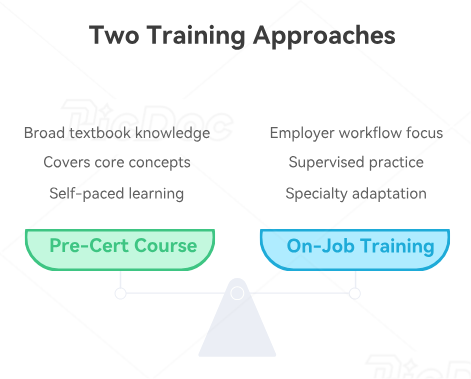
On-the-job training, by contrast, teaches you inside the environment where you will actually work. You learn the employer's EHR, the provider's preferred note style, commonly used templates, local procedures, specialty vocabulary, escalation channels, and expectations around team communication. That specificity is difficult for any generic certification course to reproduce.
Current ScribeAmerica listings make this distinction concrete. A September 2026 posting states that no experience is required and that employees receive paid training through Scribe University and hands-on clinical instruction.
That is powerful if your goal is simply to enter medical scribing for clinical experience without spending hundreds or thousands of dollars before receiving a paycheck.
Formal certification becomes more interesting when your target employer does not provide that runway.
Current job-market examples show certification and formal training appearing as a preferred qualification rather than a universal gate. One medical-scribe posting supporting U.S. physicians lists certification as advantageous, while another cardiology-focused position lists relevant certification or formal medical-scribe training as preferred alongside actual experience, terminology, EHR familiarity, and clinical workflow knowledge.
That distinction matters.
A credential can strengthen the proof side of your résumé. It cannot automatically create real scribe experience, provider references, EHR fluency under pressure, or the ability to maintain accurate written communication through eight consecutive patient encounters.
The practical comparison therefore looks like this:
Certification asks: “Can this applicant demonstrate that they have studied the job?”
On-the-job training asks: “Can this employee perform the job in our workflow?”
Employers may care about both, but the second question eventually becomes decisive.
This also explains why somebody researching whether medical scribe certification is worth the money should begin with actual job postings rather than a course sales page. If your ten target employers all provide training, buying expensive preparation may deliver weak marginal value. If most demand previous training, EHR familiarity, medical transcription skills, or experience, structured preparation becomes easier to justify.
| Decision Factor | Certification / Formal Training | On-the-Job Training | What Applicants Should Do |
|---|---|---|---|
| Upfront cost | Can range from exam-only fees to four-figure training | Can be employer-funded or paid training | Calculate total cash cost before enrolling |
| Income during training | Usually none while independently studying | May be paid depending on employer | Compare opportunity cost, not tuition alone |
| Entry speed | Can improve readiness before applying | Fastest when employer hires beginners immediately | Search employers before purchasing training |
| Medical terminology | Structured foundation | Often learned in context | Formal study helps applicants starting from zero |
| EHR familiarity | Usually conceptual, simulated, or platform-limited | Direct exposure to employer's system | Real workflow experience usually wins |
| Provider preferences | Cannot realistically teach your future physician | Learned directly during floor training | Expect adaptation after any course |
| Clinical speed | Can practice charting before employment | Developed under real patient volume | Simulation cannot fully replace floor exposure |
| Employer recognition | Varies by credential and employer | Internal training is automatically relevant to that employer | Verify recognition before paying |
| Resume signal | Can prove intentional preparation | Becomes stronger after real work begins | Experience usually compounds the signal |
| Applicant with no healthcare background | Can reduce the initial knowledge gap | May feel intense if training moves quickly | Consider structured prep if fundamentals are weak |
| Premed with strong science background | May duplicate existing knowledge | Can efficiently convert knowledge into workflow skill | Target employers offering strong floor training |
| International applicant | Can demonstrate U.S.-documentation preparation | Availability varies geographically | Credential may carry more value where experience is expected |
| Remote applicant | Can strengthen proof of readiness | Remote training can vary significantly | Prioritize charting, audio, EHR, and accuracy practice |
| Specialty preparation | Useful when specialty modules are relevant | Highly specific to actual specialty | Avoid paying for irrelevant specialty material |
| Networking | Depends heavily on provider | Creates direct relationships with clinicians and managers | Employment has stronger relationship value |
| Reference potential | Instructor references may be possible | Provider or supervisor references may develop | Real performance creates stronger evidence |
| Risk of wasted money | High if target employers do not value credential | Lower direct tuition risk | Audit 20 local openings first |
| Risk of weak training | Varies by curriculum quality | Varies by site, trainer, and provider | Investigate both before committing |
| Long-term value | Provides a portable credential if recognized | Provides portable experience and references | Best outcome is often training plus experience |
| Best fit | Applicant who needs structured proof or foundational preparation | Applicant who can access a quality beginner-friendly employer | Choose based on the hiring bottleneck |
2. How Much Does Medical Scribe Certification Cost Compared With Employer Training?
The word “certification” hides several very different expenses.
At the low end, an applicant may pay only for a certification examination. AHDPG currently lists its Medical Scribe Certification Exam at $185 for an individual candidate, with an optional practice exam priced at $39.95. The credential is valid for two years, after which recertification requires passing the then-current examination again.
Formal training can cost substantially more.
AHDPG currently lists a medical-scribe program for practicing allied-health professionals at approximately $1,006.62 and its Medical Scribe Professional program at approximately $2,026.78.
Those prices illustrate why candidates should separate certification exam, training program, and employment training when researching medical scribe certification costs.
A $185 examination and a $2,000 educational program answer different needs.
The exam attempts to validate knowledge.
The training program attempts to build knowledge.
An employer's internal training attempts to turn knowledge into that employer's actual clinical documentation workflow.
This is where the financial comparison becomes more interesting.
Suppose you spend $1,500 preparing for a role that would have hired you with no experience and paid you to train. Your true cost exceeds $1,500 because you also delayed earning income.
Current ScribeAmerica postings explicitly advertise paid training and hands-on clinical instruction for applicants with no prior experience.
For somebody whose main objective is accumulating clinical hours before medical school, that route can be economically compelling. You begin developing patient communication awareness, professionalism, team communication, EHR familiarity, and physician relationships while earning money.
The calculation changes when you repeatedly apply and receive no interviews.
If you have submitted 40 applications for entry-level medical scribe jobs, your résumé lacks healthcare evidence, your medical vocabulary is weak, and your target employers favor prepared applicants, a credible training program could reduce a genuine competitiveness gap.
That is different from buying certification because somebody told you “all scribes need it.”
Calculate the full cost, not the sticker price
Assume Course A costs $700.
Your actual investment may also include:
Study time × the value of your time + exam fees + renewal costs + software/material costs + delayed wages.
If you spend 100 hours completing a course, those hours could have been used for classes, MCAT preparation while scribing, volunteering, applications, interviewing, or working.
That does not make formal training wasteful. It means the return should be measurable.
Ask whether the program materially improves your ability to perform:
accurate HPI documentation
chart organization
medical terminology recognition
listening while typing
EHR navigation
HIPAA and confidential communication
provider clarification
clinical workflow interpretation
specialty vocabulary
A certificate without those capabilities creates a résumé line.
A program that develops them creates employability.
This distinction is especially important for candidates pursuing remote medical scribe work, where employers may expect greater independence, reliable verbal comprehension, and comfort with digital healthcare communication.
3. What Reddit Experiences Say About Certification and Company Training
Reddit sentiment leans heavily toward getting hired first when a reputable employer will train you, but that advice needs context.
In one medical-scribe discussion, multiple commenters told an applicant that certification was unnecessary because many companies train new scribes internally. One commenter said they completed their scribe training on the job and only later obtained formal certification because a new hospital required it.
That experience captures one of the strongest arguments for delaying certification:
You can discover whether your actual career path requires it after entering the field.
Another Reddit user asked whether spending roughly $400 on an online scribe certification was worthwhile. The advice again favored employer training for candidates planning to join a large scribe organization.
A separate discussion described roughly a month of company training followed by supervised evaluation shifts before independent work.
That model offers something pre-employment coursework cannot completely reproduce: progressive responsibility under real workflow pressure.
During live training, you discover whether you can maintain typing accuracy, separate relevant from irrelevant information, follow the provider's rhythm, use assertive communication when clarification is necessary, and maintain professional behavior when you fall behind.
That final point matters because knowing material and performing under load are different skills.
A September 2026 Reddit post from a ScribeAmerica trainee described feeling overwhelmed during floor training in a busy oncology clinic because the physician saw many patients and the new scribe struggled to keep up with notes.
The lesson is valuable for anyone deciding between certification and employment:
Formal preparation can reduce the knowledge shock. It cannot remove the adaptation shock.
You may know the definition of review of systems and understand medical transcription terminology, yet still struggle when a physician changes direction mid-sentence, a patient interrupts, the EHR template differs from training, and the next appointment is already waiting.
Reddit also contains a recurring second theme: experience becomes more valuable than training once you have entered the market.
One commenter responding to a candidate who wanted to complete company training and immediately seek better pay argued that salary leverage comes primarily from actual experience, rather than simply completing training.
That fits current hiring evidence.
Some roles list certification or formal training as preferred, while simultaneously requiring or strongly favoring previous medical-scribe experience, specialty knowledge, EHR familiarity, and U.S. clinical workflow exposure.
For somebody deciding whether low scribe wages are worth accepting, this creates a useful strategic possibility: accept a strong training environment temporarily, develop genuine competency, then use that experience to target better private-practice scribe opportunities.
That strategy only works when the first job actually teaches useful skills. Poor floor training, weak supervision, chaotic scheduling, or limited provider exposure can reduce the value substantially. This is one reason some premeds later report regretting their scribe job choice.
4. Which Option Gets You Job-Ready Faster?
“Fast” has two meanings.
The first is time until you possess basic knowledge.
The second is time until an employer trusts you to work independently.
Certification may win the first race. Quality on-the-job training often wins the second because the employer is directly teaching you how to function inside its workflow.
Imagine Candidate A completes a comprehensive course before applying. They understand medical terminology, HPI structure, medications, confidential communication, documentation principles, and basic EHR concepts.
Candidate B begins with less theoretical preparation but is hired into a structured program with classroom instruction, supervised floor shifts, provider-specific templates, feedback, and direct EHR exposure.
After two months, Candidate A may possess broader textbook knowledge.
Candidate B may be considerably faster at documenting that employer's patients.
The strongest candidate would ideally combine both advantages: foundational preparation plus high-quality supervised experience.
Training speed depends on where your bottleneck sits
If you already have a strong science background, type quickly, understand clinical communication, and have used healthcare terminology extensively, spending months on fundamentals may create limited benefit.
Apply directly to beginner-friendly employers.
If you have never studied anatomy, struggle with clinical vocabulary, have never seen an EHR, and cannot distinguish HPI from assessment and plan, some preparation before floor training may prevent unnecessary failure.
This is particularly relevant for ophthalmic scribe jobs and other specialties with dense terminology. Specialty workflows can overwhelm beginners because they combine general documentation demands with an additional vocabulary layer.
Remote jobs create another challenge. A remote medical scribe may need to interpret imperfect audio, handle multiple platforms, understand secure messaging, maintain digital professional communication, and work with less immediate physical supervision.
That can make structured preparation more valuable even when certification itself is optional.
Measure readiness with performance
Before paying for any certification, test whether you can already do the core work.
Take a mock clinical encounter and attempt to produce a structured note.
Can you identify the chief complaint?
Can you preserve chronology?
Can you separate patient statements from provider conclusions?
Can you recognize medications and common clinical terminology?
Can you protect confidential healthcare information?
Can you maintain accurate written communication?
Can you listen and type simultaneously without losing half the encounter?
Can you communicate a missing detail using appropriate assertiveness?
If most of those answers are yes, your biggest problem may be getting hired, rather than needing another course.
At that point, improve the résumé, application targeting, availability, typing proof, and interviewing strategy. The recurring medical-scribe rejection patterns often involve availability, weak evidence, competitive remote positions, and poor matching between candidate and employer rather than missing certificates alone.
If most answers are no, training becomes easier to justify because it addresses a measurable knowledge deficit.
5. What Do Employers Actually Recognize in 2026?
Employer recognition is where exaggerated certification claims fall apart.
There is no single credential that every medical-scribe employer universally requires.
Current ScribeAmerica roles provide one side of the market: no experience required, employer training provided.
Other current roles provide the other side. Some describe medical-scribe certification as advantageous, some prefer relevant certification or formal training, and some prioritize previous medical scribe experience, specialty exposure, EHR competency, and U.S. healthcare knowledge.
Another current U.S.-healthcare scribe listing asks for prior experience, medical terminology, clinical workflows, EHR familiarity, documentation review, and the ability to work under pressure without identifying a scribe certification as a core requirement.
That pattern tells applicants how employers generally think:
Can you produce accurate work?
A credential can contribute evidence.
Actual experience contributes stronger evidence.
Specialty experience can contribute even stronger evidence when the role is specialized.
This is why the strongest résumé may eventually contain all three:
formal preparation + real clinical documentation experience + specialty-specific competence.
Employer recognition has four levels
The first level is required. You cannot progress without the specified credential.
The second is preferred. Certification strengthens your profile but does not automatically eliminate uncertified applicants.
The third is advantageous/a plus. The employer views it positively, while other evidence may carry equal or greater weight.
The fourth is unmentioned. The employer is screening for skills, experience, availability, education, typing, or EHR familiarity instead.
Read job descriptions literally.
Do not convert “certification preferred” into “certification required.”
Do not interpret “training provided” as “preparation has no value.”
Do not interpret “certification is a plus” as proof that an expensive course guarantees employment.
Candidates should make the same evidence-based decision when evaluating medical scribing versus medical assisting, remote versus in-person scribing, and private practice versus ScribeAmerica.
Audit 20 jobs before buying anything
This is the highest-value action in the entire comparison.
Collect 20 positions you would genuinely accept.
For every job, record whether it asks for:
certification, previous experience, typing speed, EHR knowledge, degree, medical terminology, specialty knowledge, schedule availability, U.S.-healthcare experience, and formal training.
Then count the results.
If 15 of 20 train beginners and none require certification, apply first.
If 12 of 20 favor formal preparation and you repeatedly lack the requested competencies, training becomes more defensible.
If 18 of 20 demand six to twelve months of experience, another certificate may not solve the real problem. You need an employer willing to give you your first experience.
That is when beginner-friendly medical scribing jobs, hospital networks, local practices, and ScribeAmerica-style training routes deserve priority.
Skills still dominate after hiring
Nobody remains employed because their certificate looked impressive on day one.
Retention comes from accurate clinical documentation, strong medical terminology, appropriate team communication, confidentiality, adaptability, reliable attendance, and the ability to learn provider preferences.
Those skills also protect you as AI medical scribes change human scribe work. As routine transcription becomes increasingly automated, human value shifts toward quality assurance, contextual interpretation, discrepancy detection, provider workflow support, professional communication, and documentation judgment.
That makes a skill-heavy training program more defensible than a certificate designed primarily to produce a credential.
6. FAQs About Medical Scribe Certification vs On-the-Job Training
-
Many entry-level employers hire candidates without prior scribe certification. Current ScribeAmerica listings explicitly advertise no experience required and employer-provided paid training.
Other employers list certification or formal training as preferred or advantageous, so applicants should evaluate the specific medical scribe jobs they want. Strong medical terminology, documentation skills, typing, availability, and EHR readiness may matter more than certification for many openings.
-
It can be valuable when it closes a genuine hiring or knowledge gap.
Certification makes more sense when your target roles prefer formal preparation, you have limited healthcare background, or you need structured training in medical transcription, EHR concepts, confidential communication, and clinical workflow.
Applicants whose preferred employers already offer paid beginner training should compare that opportunity against the cost before buying a course. The broader analysis of whether scribe certification is worth the money should always begin with actual employer requirements.
-
Costs depend on whether you are buying an exam or a complete training program.
AHDPG currently lists its certification exam at $185, an optional practice exam at $39.95, and substantially more expensive training programs, including options around $1,006 and $2,027.
Compare the price with employers offering paid training, the quality of clinical documentation education, and how frequently your target roles recognize the credential.
-
It may improve your résumé when lack of preparation is the reason employers hesitate.
Current openings show some employers treating formal training or certification as preferred, while other organizations train inexperienced candidates directly.
Someone struggling with repeated medical scribe job rejection should diagnose the cause first. Poor availability, weak interviewing, limited typing speed, location, competitive remote scribe jobs, or experience requirements will not automatically disappear after certification.
-
On-the-job training has a major advantage because it teaches the exact provider, EHR, specialty, templates, workflow, and team communication environment in which you will work.
A strong formal course can build foundations before that point. Applicants with weak medical terminology, limited healthcare exposure, or no understanding of chart structure may benefit considerably from preparation before live floor training.
The highest-value combination is structured fundamentals followed by supervised real-world practice.
-
Current postings suggest that actual relevant experience frequently carries substantial weight, especially for specialty, remote, and U.S.-healthcare documentation roles. Several listings require or prioritize prior scribing experience while describing certification or formal training as preferred rather than sufficient by itself.
Experience provides evidence that you can maintain written communication, confidentiality, EHR accuracy, provider communication, and productivity under real workload.
