

Medical Scribe Resume Rejected? Reddit Hiring Advice on Missing Proof, Weak Bullets & No-Experience Fixes
A medical scribe rejection can feel irrational when you have strong grades, healthcare ambitions, solid typing speed, and enough availability to work. The problem is often proof. A resume can contain impressive experiences while failing to demonstrate the exact behaviors employers need: accurate listening, fast documentation, reliability, confidentiality, adaptability, and sustained attention. Current applicants discussing medical scribe hiring barriers repeatedly report rejection despite apparent qualifications. Before buying another scribe certification, rebuild the resume around demonstrable evidence and the realities of entry-level medical scribing.
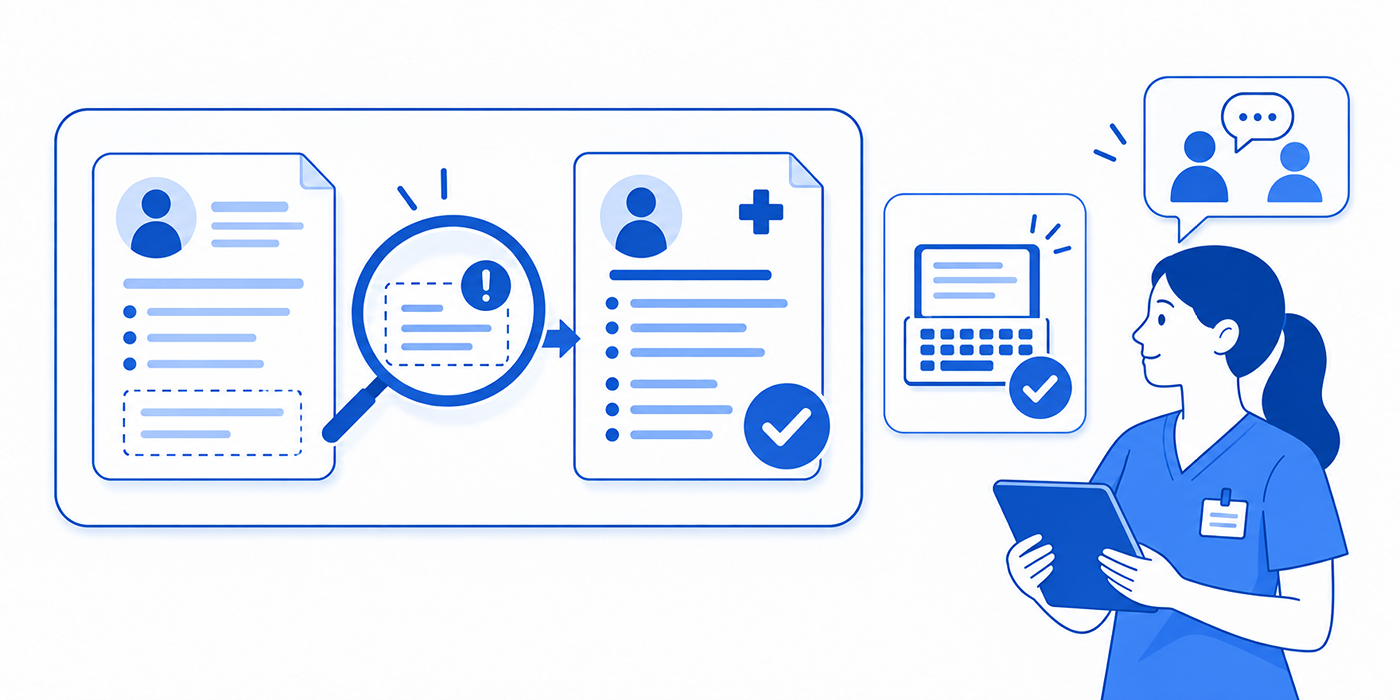
1. Why Does a Medical Scribe Resume Get Rejected Even When You Seem Qualified?
A medical scribe employer has a surprisingly practical hiring problem. The company needs someone who can listen carefully, identify clinically relevant information, type accurately, learn unfamiliar terminology, maintain confidential communication, follow physician preferences, use an EHR, and maintain professionalism in healthcare when the workload becomes uncomfortable. A resume that says "biology major," "premed," or "interested in medicine" proves very little about those behaviors.
Current ScribeAmerica postings make the screening logic unusually clear. A Boston posting available in September 2026 states that prior experience is not required and lists a high-school diploma, English fluency, strong listening and communication, flexible availability, and typing at 40+ WPM among its requirements. It also describes training in medical documentation and EHR use. That means applicants without previous scribing experience can be competitive, but their resume should make transferable evidence easy to find. Relevant verbal communication skills, disciplined written communication, familiarity with medical transcription concepts, and dependable team communication can all become evidence when described properly.
This is where many resumes collapse. A candidate writes:
Assisted customers and completed administrative tasks.
A recruiter still does not know whether that person can handle sensitive information, process competing requests, document details accurately, communicate under pressure, or maintain concentration. Those are the capabilities that connect ordinary work experience to medical scribing responsibilities, patient communication, front-desk healthcare etiquette, and effective clinical teamwork.
The stronger bullet might say:
Processed 50+ customer requests per shift, documented order changes accurately, escalated time-sensitive issues, and maintained confidentiality when handling account information.
That bullet gives the reader evidence of volume, documentation, prioritization, communication, and discretion. None of it falsely claims healthcare experience. Every part maps cleanly to behaviors required in a scribe environment.
Reddit hiring discussions reinforce this distinction. In a 2024 r/medicalscribe thread, an experienced commenter advising an applicant without healthcare experience said they looked for reliability and willingness to work, while recommending relevant coursework and retaining other substantial work or research experience rather than pretending unrelated experience had no value. A 2025 discussion similarly emphasized professionalism, accountability, willingness to improve, and schedule alignment for applicants entering scribing without previous experience.
Availability also creates a hidden rejection problem. In July 2026, a Reddit applicant reported receiving a post-interview rejection specifically because their part-time availability did not fit local needs. A chief scribe responding in the discussion explained that advertised availability needs to reflect what the applicant can genuinely sustain because placement depends on actual site coverage. Current ScribeAmerica listings likewise explicitly request flexible availability, with some ED positions requiring two to three long shifts and occasional overnights.
So when a seemingly good resume gets rejected, audit five separate possibilities: qualification fit, evidence quality, availability fit, location/site demand, and resume clarity. Applicants often attack only the first problem by adding another course or scribe certification, when the real weakness may be buried communication experience, invisible documentation skills, or an application that never demonstrates the reliability required for meaningful clinical experience.
| # | Resume Signal | Weak Version | Evidence-Based Upgrade | Why a Scribe Employer Cares |
|---|---|---|---|---|
| 1 | Typing | Fast typer | State tested typing speed and accuracy when relevant | Makes documentation readiness measurable |
| 2 | Listening | Good listener | Captured instructions or detailed information accurately in a fast environment | Scribes document spoken clinical information continuously |
| 3 | Accuracy | Detail-oriented | Reviewed records, data or transactions for errors before submission | Shows an actual accuracy behavior |
| 4 | Confidentiality | Responsible | Handled sensitive customer, student, research or patient information appropriately | Supports trust around protected information |
| 5 | Multitasking | Good multitasker | Managed simultaneous requests while maintaining documentation accuracy | Closer to real clinic workflow |
| 6 | Volume | Busy workplace | Add customers, calls, records, cases or tasks handled per shift where accurate | Quantifies pace tolerance |
| 7 | Communication | Great communication | Relayed time-sensitive information to supervisors, clients or team members | Shows communication under responsibility |
| 8 | Terminology | Interested in medicine | List relevant anatomy, physiology or medical terminology coursework | Provides evidence of baseline vocabulary |
| 9 | Research | Worked in a lab | Recorded observations, followed protocols and maintained accurate datasets | Connects research habits to documentation |
| 10 | Customer service | Helped customers | Resolved high-volume requests while documenting changes and escalating urgent issues | Shows composure, listening and prioritization |
| 11 | Leadership | Club officer | Coordinated schedules, communicated deadlines and tracked completion | Translates leadership into operational reliability |
| 12 | Volunteering | Volunteered at hospital | Describe patient-facing, navigation, clerical or communication responsibilities | Shows what you actually learned |
| 13 | Reliability | Dependable worker | Trusted with opening, closing, deadlines, shift coverage or independent responsibilities | Evidence beats a personality adjective |
| 14 | Technology | Computer skills | Name relevant record, database, spreadsheet or documentation systems | Signals faster adaptation to EHR workflows |
| 15 | Learning speed | Quick learner | Describe training completed or responsibilities mastered within a defined period | Scribing has a steep onboarding curve |
| 16 | Prioritization | Works under pressure | Prioritized urgent requests while completing scheduled work accurately | Shows judgment during competing demands |
| 17 | Availability | Flexible | State sustainable availability when the application permits it | Site matching often depends heavily on coverage |
| 18 | Career interest | Premed student | Connect healthcare goals to sustained interest in clinical documentation and physician workflow | Shows intentionality without relying on ambition alone |
2. How Do You Fix Weak Medical Scribe Resume Bullets?
Weak bullets describe membership, presence, or assigned duties. Strong bullets reveal the behavior the employer can expect.
"Worked at a front desk" tells the reader where you stood.
"Managed check-in questions, verified information, documented updates, and escalated scheduling conflicts during high-volume periods" demonstrates several behaviors connected to front-desk etiquette, scheduling conflict management, accurate written communication, and effective patient interaction.
Use a simple construction:
Action + environment + difficulty + evidence + relevance.
Suppose you worked in food service:
Weak: Served customers and handled orders.
Better: Managed simultaneous customer orders during high-volume shifts, entered modifications accurately, clarified ambiguous requests, and coordinated corrections with team members.
That demonstrates rapid listening, data entry, clarification, multitasking, and team communication. Those behaviors transfer directly to learning clinical documentation, understanding fast verbal communication, and preserving accuracy while a physician moves quickly.
Research experience is another frequently wasted asset. A bullet such as "helped with research" throws away most of its potential. If truthful, stronger evidence could include maintaining datasets, following protocols, reviewing records, recording observations, reconciling discrepancies, coordinating with investigators, or processing information under standardized procedures. Those abilities connect naturally to medical transcription accuracy, confidential communication, professional healthcare documentation, and the disciplined workflow expected from someone seeking strong clinical experience.
Quantification helps when the number genuinely adds context. "Answered phones" becomes more informative as "managed 40-60 calls per shift" because workload becomes visible. "Entered data" becomes stronger when you can truthfully describe the volume, turnaround requirement, accuracy standard, or number of records involved. Numbers should provide scale, not decoration.
Avoid manufacturing metrics you never tracked. A fabricated "99% accuracy rate" creates more risk than value. Instead, use verifiable details such as number of weekly shifts, typical customer volume, students supervised, records maintained, courses supported, deadlines coordinated, or months of sustained responsibility. Employers evaluating professionalism, assertive communication, rapport-building skills, and documentation reliability need credible evidence more than inflated language.
Also remove empty adjectives whenever a bullet can prove the quality instead. "Excellent communicator," "highly organized," "hardworking," "passionate," "detail-oriented," and "team player" consume valuable space until the experience section demonstrates them. A candidate who documents information accurately, coordinates deadlines, resolves ambiguity, handles confidential data, and manages competing tasks has already shown many of those qualities through behavior.
The same principle applies to medical scribe certification. Certification can strengthen a resume in some circumstances, but a certificate title cannot compensate for weak evidence underneath it. Current ScribeAmerica postings still advertise positions where no experience is required and training is provided. That makes targeted evidence, realistic availability, and employability signals particularly important for candidates trying to enter medical scribing without experience.
3. What Should You Put on a Medical Scribe Resume With No Experience?
"No scribe experience" and "nothing relevant to prove" are very different situations.
An entry-level candidate may already have evidence from coursework, retail, hospitality, tutoring, research, volunteering, reception work, call centers, campus leadership, caregiving, administration, or customer service. Your job is to identify the behaviors that overlap with medical documentation, patient communication, healthcare professionalism, and the listening demands behind medical transcription.
For coursework, prioritize classes that reduce the employer's perceived training burden. Anatomy, physiology, medical terminology, biology, pharmacology, pathophysiology, and health-science courses can be useful when genuinely completed. Reddit advice to no-experience applicants repeatedly mentions relevant coursework because it demonstrates baseline familiarity even when the candidate has never worked as a scribe.
For research, emphasize protocol adherence, records, accuracy, scientific vocabulary, communication, and data integrity. For tutoring, emphasize listening, translating complex information, adapting explanations, and maintaining schedules. For customer service, emphasize clarification, high-volume communication, data entry, conflict management, and composure. For administrative work, emphasize record accuracy, confidential information, digital systems, scheduling, and written correspondence. These experiences can support the same skills later used in secure healthcare messaging, appointment coordination, verbal communication, and clinical team communication.
Hospital volunteering also needs specificity. "Volunteered in emergency department" may sound impressive while revealing almost nothing. Did you guide patients? Restock rooms? Answer calls? Escort families? Coordinate with staff? Maintain privacy? Communicate with anxious visitors? Observe clinical workflow? Each legitimate responsibility can demonstrate a different form of bedside manner, rapport building, non-verbal communication, or confidential communication.
A useful no-experience resume can therefore be built around four evidence buckets: documentation, communication, reliability, and learning capacity.
Documentation asks: Where have you recorded information accurately?
Communication asks: Where have you listened, clarified, relayed, explained, or de-escalated?
Reliability asks: Where were other people depending on you to arrive, complete work, meet deadlines, or maintain coverage?
Learning capacity asks: Where did you quickly master terminology, systems, protocols, technical information, or new responsibilities?
That framework is much stronger than filling the skills section with "Microsoft Office, communication, leadership, teamwork." It also prevents an applicant from thinking a lack of formal healthcare employment automatically requires an expensive credential. Reddit users discussing scribe certification value have repeatedly pointed out that major scribing employers often provide their own training. One Reddit discussion specifically advised a first-year student that prior certification may add limited value compared with continuing to apply and completing the eventual employer's training.
One particularly painful Reddit example from January 2026 involved an IMG who reported applying to 60-70 jobs without receiving a positive response. Commenters raised another issue that can matter for some applicants: a resume can unintentionally signal that the person is likely to leave quickly because their education appears far above the level of the role. You should never conceal required information or misrepresent yourself, but the experience highlights why resume positioning matters. A hiring manager needs to understand why this specific medical scribe job makes sense for you and why you can realistically stay long enough for training to be worthwhile.
4. How Do You Tailor a Medical Scribe Resume to the Actual Job Posting?
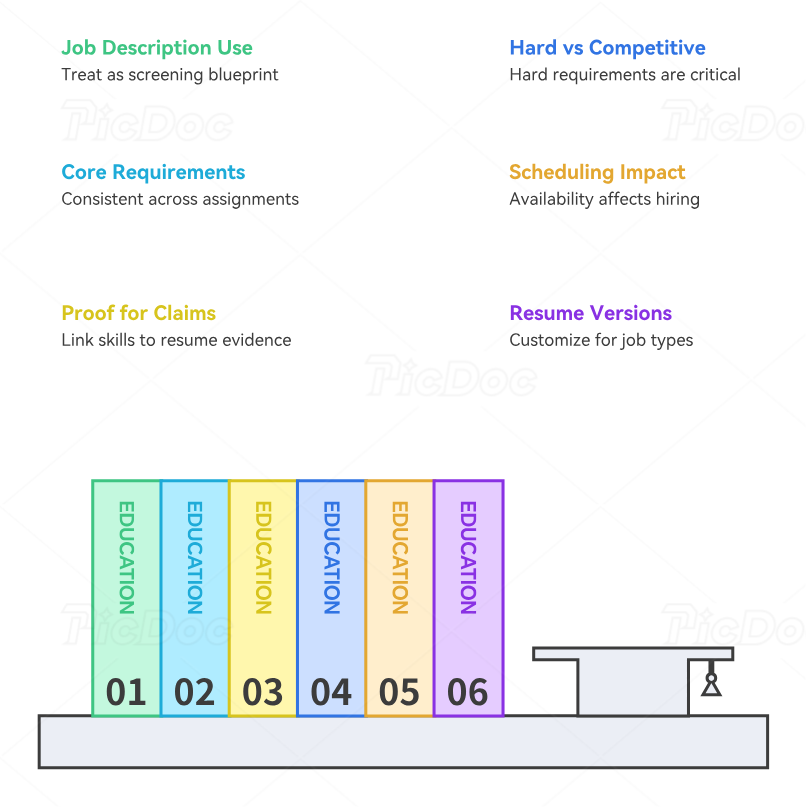
Stop treating the job description as marketing copy. Treat it as a screening blueprint.
A current ScribeAmerica posting asks for 40+ WPM typing, English fluency, strong listening and communication, flexible scheduling, comfort using a computer for extended periods, and the ability to work with physicians while documenting histories, examinations, treatments, tests, and follow-up information. Another current posting lists the same core requirements across potential outpatient and emergency department assignments.
Each requirement should trigger a question about your resume.
If the posting asks for strong listening, where is the proof?
If it asks for communication, which bullet demonstrates it?
If it asks for typing, have you provided an accurate typing speed when appropriate?
If it asks for flexibility, does your application accurately state your usable schedule?
If it emphasizes accurate charts, which experience demonstrates written accuracy?
If it involves patient histories, which experience supports active listening, patient interaction, or structured information capture?
This does not mean copying the advertisement sentence by sentence. Mirroring job language without evidence creates a resume full of claims. The stronger approach is requirement → proof → bullet.
Consider "strong communication skills." Your resume might prove this through handling incoming calls, explaining procedures to students, coordinating with research staff, answering customer questions, resolving scheduling issues, or relaying urgent information to supervisors. Those experiences can connect with phone triage communication principles, assertive communication, team communication, and professional rapport building.
Next, separate hard requirements from competitive advantages. If an employer explicitly requires a diploma, age threshold, work authorization, minimum typing speed, particular availability, or a physical capability, beautifully written bullets cannot override an unmet hard requirement. This is one reason a rejection should never automatically be interpreted as a bad resume.
The 2026 Reddit availability case demonstrates this clearly. The applicant had enough qualifications to reach the interview stage, yet site scheduling compatibility became the decisive issue. A 2025 thread reported something similar from a former chief scribe who said candidates were often rejected when their availability failed to fit local site needs.
Another 2026 applicant reported roughly 90 WPM typing at high accuracy and broad portions of the week available, yet was still waiting after completing a video application. That example should stop you from assuming a fast typing score guarantees hiring. A scribe program may have staffing constraints, local demand, placement delays, scheduling mismatches, or other operational considerations beyond the resume.
This matters when comparing ScribeAmerica with private-practice jobs. A large scribing company may recruit around available contracts and site schedules, while an independent physician practice may care more intensely about specialty experience, consistent weekday coverage, EHR familiarity, or long-term retention. Candidates considering remote medical scribe roles may encounter another applicant pool and different expectations around technology, independent work, secure messaging, and remote professional communication.
Build at least two resume versions when your targets genuinely differ. An ED-focused version can emphasize pace, prioritization, high-volume communication, rapid task switching, and composure. An outpatient version can emphasize longitudinal organization, scheduling, repeated documentation, patient communication, specialty knowledge, and detailed follow-up. Applicants deciding between ED and outpatient scribing should make those differences visible instead of sending an identical generic resume everywhere.
5. What Should You Do After Repeated Medical Scribe Rejections?
After several rejections, stop making random edits. Diagnose the failure point.
If you are rejected before any interview, investigate job fit, availability, resume targeting, basic requirements, location, and whether your application demonstrates the employer's core needs.
If you receive interviews but no offers, the resume has already done enough to move you forward. Focus on interviewing, availability, communication, realistic understanding of the role, and how convincingly you explain your interest in medical scribing.
If you are repeatedly placed on hold or waitlisted, investigate local staffing demand rather than endlessly rewriting bullets. A 2025 Reddit user described being told they had effectively passed the process but were waiting for placement, only to later receive a rejection when their location remained full.
Your 48-hour resume repair should be systematic.
First, delete or rewrite any bullet that merely says "responsible for," "helped with," "worked with," or "assisted with" without explaining the responsibility. Convert each experience into evidence of accuracy, communication, workflow, reliability, technology, confidentiality, or learning.
Second, create a relevance inventory from everything you have actually done. Coursework may support medical terminology. Customer service may support difficult patient communication, listening, and rapport building. Administrative work may support scheduling management, documentation, and confidentiality. Research may support precision, protocols, complex vocabulary, and attention to detail.
Third, verify that every skill claim can survive a follow-up question. If the resume says "EHR," you should be able to identify the system and explain what you did with it. If it says "medical terminology," you should be able to explain where you learned it. If it says "60 WPM," the figure should reflect a realistic test. If it says "HIPAA knowledge," understand what that claim means in practice around confidential communication and secure healthcare messaging.
Fourth, broaden the search intelligently. Apply to local physician groups, health systems, specialty clinics, emergency departments, and appropriate remote scribe jobs rather than depending on one organization. Reddit users who struggled with one large company have repeatedly suggested looking at direct hospital or private-practice positions. Comparing private practice and large scribe companies can uncover very different hiring pathways.
Fifth, decide whether the role still offers enough return. If you spend months chasing a low-paying position that conflicts with classes, produces weak mentorship, and offers limited patient interaction, compare the opportunity with medical assisting for premed, the realities of low medical scribe pay, and common premed regrets about scribing.
Do not allow desperation to turn into dishonest availability or invented clinical experience. The July 2026 Reddit discussion included a chief scribe warning against claiming unrestricted availability and later changing it after placement because the site may have hired specifically to fill those hours. A sustainable schedule produces more value than getting hired into a role you cannot keep.
The objective is a resume that makes one conclusion easy: this applicant can be trained, trusted, and scheduled. Everything else is secondary.
6. FAQs About Medical Scribe Resume Rejections
-
Yes. Current ScribeAmerica listings explicitly advertise some medical scribe roles as requiring no prior experience and providing paid training. Your resume still needs evidence that you can learn quickly, communicate accurately, use computers, maintain reliability, and handle detail-oriented work. Coursework, research, customer service, volunteering, administration, tutoring, or other employment can demonstrate those abilities when written properly. Relevant medical terminology, strong written communication, professional verbal communication, and demonstrated healthcare professionalism can help bridge the experience gap.
-
Include it when your tested speed is relevant to the posting and represents repeatable performance at good accuracy. ScribeAmerica's current listings commonly specify 40+ WPM as a requirement. A verified typing speed can therefore provide useful evidence. Avoid treating WPM as your entire candidacy. A 2026 Reddit applicant reported roughly 90 WPM at high accuracy and still faced uncertainty after applying, demonstrating that medical scribe hiring also depends on factors such as availability, local demand, communication, and placement.
-
Investigate the rejection reason first. A certification may be useful when a specific employer requests or rewards it, but several major scribing positions provide their own training and explicitly accept applicants without experience. Reddit discussions about whether scribe certification is worth the money similarly caution against assuming a certificate automatically solves hiring problems. Fix weak bullets, verify availability, demonstrate documentation ability, and strengthen medical terminology familiarity before buying a credential solely because one application failed.
-
Prioritize skills you can prove: accurate typing, active listening, written communication, verbal communication, confidentiality, computer proficiency, organization, prioritization, reliability, and rapid learning. Add relevant terminology or EHR knowledge only when you genuinely possess it. Employers currently emphasize typing, English fluency, listening, communication, computer use, and schedule flexibility. Evidence from team communication, secure messaging, patient communication, and professional healthcare behavior carries more weight than a long list of unsupported adjectives.
-
A strong resume cannot create a vacancy that fits your schedule. Medical scribe hiring can depend heavily on local site demand and shift coverage. In a July 2026 Reddit case, an applicant said their rejection followed directly from availability that did not match the employer's needs. Another discussion included a former chief scribe who similarly identified availability mismatches as a major reason for rejection. Evaluate the job's actual schedule, compare ED versus outpatient scribing, consider remote scribe options, and apply across multiple employers rather than interpreting every rejection as a resume failure.
-
Keep unrelated experience when it proves relevant behaviors. Retail can demonstrate high-volume communication and accuracy. Restaurant work can demonstrate listening, multitasking, prioritization, and teamwork. Research can demonstrate documentation and protocol adherence. Tutoring can demonstrate communication and rapid interpretation of information. Administrative work can demonstrate scheduling, record management, and confidentiality. Reddit hiring advice to applicants without healthcare backgrounds has specifically encouraged retaining substantial nonmedical experiences when they demonstrate reliability and work ethic. Rewrite them around transferable communication skills, documentation, confidentiality, and teamwork.
