

Gap Year Medical Scribing: Reddit Experiences on Hours, Pay, Applications & Whether It Was Worth It
A gap year spent medical scribing can strengthen an application when the job solves a specific weakness: limited clinical experience, weak physician relationships, thin medical scribe hours, or little exposure to real clinical reasoning. It can also consume hundreds of hours for modest pay while MCAT study, volunteering, research, and application writing compete for the same time. Recent Reddit experiences capture both outcomes. The smartest gap-year plan treats scribing as a targeted application tool with an exit strategy, rather than simply filling the year with clinical employment.

1. What Does Gap-Year Medical Scribing Actually Add to a Premed Application?
The first question is straightforward: what problem in your application is scribing supposed to solve?
If your application currently has strong grades and research alongside minimal patient-facing exposure, a year of medical scribing can fundamentally change what you understand about medicine. You hear histories develop in real time, watch doctors convert symptoms into differential diagnoses, see tests selected under uncertainty, observe treatment plans change as new evidence arrives, and become fluent in medical terminology and clinical documentation.
The AAMC's current AMCAS guidance places substantial emphasis on quality, transformation, impact, learning, and personal growth when applicants describe significant experiences. Applicants can list up to 15 experiences and identify up to three as most meaningful, receiving additional space to explain why those experiences changed them. That makes the value of a gap-year job more sophisticated than accumulating a large number next to “clinical employment.”
A scribe who works 1,500 hours and can only explain that they “learned how doctors document” has extracted relatively little application value. A scribe with fewer hours who can discuss physician communication, difficult patient interactions, clinical teamwork, the limits of documentation, and how observing uncertainty changed their understanding of medicine has something substantially richer.
The AAMC has itself profiled scribing as an experience capable of becoming an applicant's most meaningful activity. Its featured scribe described learning through direct clinical workflow and emphasized proactively asking questions, seeking clarification on unfamiliar diagnoses and terminology, and becoming reliable inside a demanding healthcare environment. Those behaviors also build professionalism, rapport-building skills, confidential communication, and stronger awareness of patient education.
Recent Reddit experiences follow the same pattern. In a May 2026 discussion specifically about scribing during a gap year, one ER/outpatient scribe described seeing minor procedures and physician decision-making directly while finding outpatient practice useful for developing closer physician relationships. Another commenter argued that the provider and setting dramatically influence how educational the job becomes.
A separate May 2026 discussion reached the heart of the decision. One commenter summarized scribing as a poor choice when income is the major priority and a potentially strong choice when the applicant needs clinical exposure or is preparing for a reapplication. Others highlighted easier access to physician mentorship and recommendation letters as a major advantage. One gap-year scribe reported learning more about medicine through scribing than during a prior MA experience, while stressing that provider quality determined much of that value.
This distinction matters when comparing medical scribing with medical assisting, evaluating whether low scribe pay is still worth it, choosing between ScribeAmerica and private-practice jobs, or considering a remote medical scribe position.
The best gap-year scribing experience should leave you with stronger clinical judgment vocabulary, better stories, deeper physician relationships, clearer insight into medicine, and a stronger explanation of why you belong in medical training.
| Gap-Year Situation | Scribing Value | Best Hours Strategy | Main Risk | Smartest Move |
|---|---|---|---|---|
| Almost no clinical experience | Very High | Consistent 20–40 hrs/week | Choosing a low-learning site | Prioritize strong physician exposure |
| Already has 1,000+ clinical hours | Moderate | Part-time if needed | Diminishing returns | Target another application weakness |
| Needs a physician relationship | Very High | Repeat shifts with same doctors | Constant provider rotation | Prefer smaller outpatient teams |
| Needs significant income | Low–Moderate | Only if local wage works | Financial strain | Compare MA, EMT, research and hospital roles |
| Studying full-time for MCAT | Moderate | 8–20 hrs/week initially | Study quality collapse | Protect MCAT blocks first |
| MCAT already completed | High | 20–40 hrs/week | Overworking during application season | Reserve writing time from May onward |
| Reapplicant lacking clinical depth | Very High | Substantial sustained involvement | Superficial “box checking” | Build measurable growth before reapplying |
| Research-heavy applicant | High | 15–30 hrs/week | One-dimensional application | Use scribing to add clinical depth |
| Clinical-heavy applicant with no research | Low–Moderate | Limited maintenance hours | Oversaturating same competency | Consider research instead |
| Needs stronger writing material | High | Consistency matters more than maximum hours | Failing to reflect | Keep a PHI-free reflection log |
| Interested in learning physician workflow | Very High | Regular longitudinal shifts | Mechanical documentation only | Choose teaching-oriented providers |
| Already burned out after college | Low initially | Part-time or delayed start | Turning gap year into another overload year | Build recovery into the plan |
| Needs nonclinical service hours | Moderate | Avoid full-time schedule if it blocks service | Clinical hours crowd out volunteering | Protect weekly community service time |
| Wants specialty exposure | High | Choose specialty strategically | Narrow exposure | Match specialty to learning goal |
| Applying early in gap year | Moderate–High | Start before application if possible | Too few completed hours at submission | Build experience before May/June |
| Applying after full gap year | Very High | Longitudinal 6–12+ months | Stagnation | Seek growth, training or new responsibility |
| Considering remote scribing | Moderate | Flexible around other priorities | Less direct patient/environment exposure | Evaluate provider interaction carefully |
| Has strong application already | Situation-dependent | Choose sustainable hours | Doing more purely for optics | Choose work that adds growth or income |
2. How Many Scribe Hours Should You Work During a Gap Year?
There is no admissions threshold where 500 hours is weak and 1,000 suddenly becomes impressive. AMCAS explicitly tells applicants to prioritize significant experiences and quality rather than quantity. The practical objective is accumulating enough medical scribe experience to demonstrate sustained commitment while preserving time for the parts of your application that still need work.
For a gap-year applicant starting with very little clinical exposure, 20–30 hours per week can accumulate rapidly. Twenty hours weekly for 40 working weeks produces roughly 800 hours. Thirty hours produces roughly 1,200. Full-time employment can push the total substantially higher. At that point, the central question shifts from how many scribe hours you need toward what those hours are actually teaching you.
A 2026 Reddit applicant considering whether to delay applying already reported around 1,020 scribing hours across pediatric ED, adult ED, and dermatology. That profile illustrates how quickly a sustained scribe schedule can build substantial clinical exposure. Additional scribing after that point may still provide value through physician mentorship, stronger clinical communication, leadership, or deeper documentation expertise. Pure hour accumulation begins producing diminishing returns.
Applicants studying for the MCAT need a different calculation. A 2025 Reddit discussion involved a student combining a demanding science schedule, research, and about 20 weekly scribe hours while considering MCAT preparation. Responses focused on protecting GPA and MCAT performance before piling on additional commitments. That lesson applies even more strongly during a gap year: your scribe schedule should fit around the highest-risk application variable.
If your MCAT is unfinished, build backward from your exam. A manageable plan could involve 15–20 weekly scribe hours during intensive MCAT preparation, then increasing to 30–40 after the exam. Someone whose MCAT is complete can devote more time to clinical work, patient communication, physician relationship-building, and perhaps leadership through training new scribes.
Application season requires another reduction. Personal statements, Work and Activities descriptions, school lists, primary submission, secondary essays, CASPer or PREview where required, interview preparation, travel, volunteering, and ordinary life can consume significant time. Working 45 hours while attempting to produce polished secondary essays across many schools is an avoidable source of application damage.
The most productive schedule is therefore phase-based:
MCAT phase: protect study quality.
Pre-application phase: build clinical depth and physician relationships.
Primary-writing phase: reduce unnecessary overtime.
Secondary season: preserve writing bandwidth.
Interview season: maintain enough scheduling flexibility for interviews and preparation.
That approach also reduces the risk behind common premed scribing regrets, prevents poor schedule conflict management, protects professional reliability, and keeps your gap year focused on application improvement rather than raw workload.
3. Is Gap-Year Scribe Pay Worth the Opportunity Cost?
This is where many positive scribing experiences become financially difficult.
A 2026 Reddit wage discussion demonstrates the extraordinary variation in scribe compensation. Reported wages included $10 per hour in an outpatient Kentucky position, $12 in Georgia hematology/oncology, $17 for an ER chief scribe in the Northeast, $21 in California urgent care, $21 in Los Angeles hematology/oncology, $22 with a night differential in California, and $23.47 in a Washington family-medicine private practice. These are self-reported figures rather than a national wage survey, yet they illustrate how strongly employer, geography, setting, specialty, and seniority can affect compensation.
That spread means the question “How much do scribes make?” is less useful than “What am I giving up to earn this wage?”
If you need to pay rent, repay debt, build an emergency fund, finance applications, help family, or save before medical school, low scribe wages can impose a real cost. A different clinical position such as medical assisting may offer stronger compensation in your market. A research coordinator, clinical research assistant, patient-care technician, EMT, CNA, ophthalmic technician, or hospital support role may also solve a larger application or financial problem.
A 2025 Reddit gap-year worker described earning $18 per hour in a scribe role that included substantial billing work and long hours, eventually considering MA or EMT training because the job interfered with studying and felt professionally unsatisfying. That example captures a major hidden cost: an hourly rate can look acceptable while the schedule destroys the rest of your gap-year plan.
Another Reddit user who had taken two gap years described virtual scribing as poorly paid while still crediting it with teaching medical terminology, patient dynamics, clinical reasoning, and helping them build a strong relationship with the same physician over nearly a year. They later entered medical school and viewed the experience positively despite the wage problem.
Those two experiences can coexist because scribing has several forms of compensation:
Cash compensation matters for immediate survival.
Clinical exposure matters when your application lacks it.
Physician access can produce mentorship and a strong recommendation opportunity.
Medical fluency improves your understanding of clinical terminology, healthcare communication, and documentation.
Application material can strengthen your Work and Activities section and interviews.
Calculate the entire package before deciding.
A $15/hour position with one physician who teaches, gives feedback, offers shadowing, introduces you to procedures, and eventually writes an outstanding recommendation may have greater strategic value than a $17/hour position involving repetitive templating and almost no interaction. A $24/hour healthcare job may still be the smarter choice when finances are tight and you already possess extensive clinical exposure.
Also consider how AI scribing is changing human scribe work. A May 2026 Reddit discussion included concerns about fewer positions as AI documentation expands. That makes transferable abilities such as team communication, accuracy, workflow knowledge, secure communication, and clinical judgment increasingly important.
4. How Should You Structure a Gap Year Around Scribing, MCAT Study and Applications?
A strong gap year needs defined outputs, not a vague promise to “improve the application.”
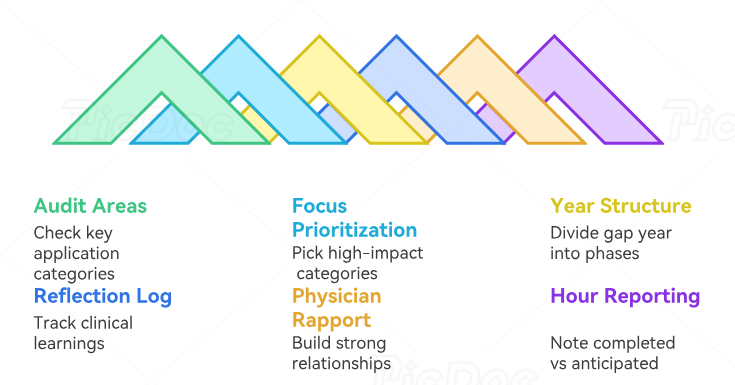
Start by auditing six categories: academics, MCAT, clinical exposure, service, research, letters, and application writing. Identify the one or two categories that would most change your candidacy.
If your clinical experience is already strong, another 1,500 scribe hours may provide less value than research, service, academic repair, or MCAT improvement. If your research portfolio is extensive and you have barely entered a clinical environment, substantial medical scribing experience may be exactly the missing piece.
One useful structure for a single gap year is:
Months 1–3: onboard, learn the specialty, master medical terminology, improve clinical documentation, and establish consistent volunteering.
Months 3–6: deepen physician relationships, take on more responsibility within scope, protect MCAT study blocks, develop stronger team communication, and begin a PHI-free reflection log.
Months 6–9: complete or intensify MCAT preparation, identify potential recommenders, assess whether the job is still adding value, and begin drafting application material.
Months 9–12: submit applications early, reduce overtime during secondary season, continue meaningful clinical work, prepare for interviews, and preserve professional reliability.
A PHI-free reflection log is particularly valuable. Record the lesson, never identifiable patient information. Useful categories include clinical uncertainty, communication failures, a physician teaching moment, teamwork, ethical tension, health-system friction, a diagnostic surprise, or something that challenged your assumptions about medicine.
This turns ordinary shifts into better application material. AMCAS encourages applicants describing most meaningful activities to discuss transformation, impact, learning, and personal growth. Someone who has deliberately reflected for eight months will usually write more precisely than someone attempting to reconstruct 1,200 clinical hours during the week their primary application is due.
Use the same intentionality when developing physician relationships. Strong professional rapport, thoughtful verbal communication, accurate written communication, and dependable clinical teamwork can eventually give a physician substantial firsthand evidence for a recommendation.
Gap-year applicants also need to understand completed versus anticipated hours. The 2027 AMCAS Work and Activities guide contains explicit instructions for reporting completed and anticipated experience hours. This matters if you begin scribing shortly before submitting. Future hours demonstrate continuation, while completed hours represent the exposure you actually possess when schools first review your application.
That difference argues for starting your clinical job early enough to gain meaningful firsthand experience before application writing begins. Three weeks of scribing plus 1,800 projected hours carries a very different evidentiary weight from eight months of completed work with clear growth, patient communication lessons, professional development, and a physician who knows you well.
5. When Is Gap-Year Medical Scribing Actually Worth It?
Scribing becomes especially worthwhile when one job solves several problems simultaneously.
Imagine an applicant who graduates with excellent research, good grades, little clinical employment, minimal physician mentorship, and an unfinished understanding of day-to-day medicine. A strong ER, internal medicine, cardiology, oncology, ophthalmology, or family-practice scribe position can add clinical exposure, expand medical terminology, strengthen professional communication, and create access to physicians who can mentor them.
That is a high-return gap-year role.
A May 2026 Reddit scribe described the ER as “eye opening” for understanding hospital medicine while outpatient scribing provided a window into private-practice operations. Another commenter described ER exposure to procedures and medical decision-making while finding outpatient environments easier for building physician relationships and obtaining shadowing opportunities. Those differences matter when selecting the best scribe specialty for premed.
Scribing becomes less efficient when it duplicates strengths you already possess. An applicant with 2,000 meaningful patient-care hours may gain more from research, service, academic improvement, teaching, public health, or another role that broadens the application. Someone who desperately needs higher income may find low scribe wages impossible to justify. Someone whose MCAT preparation is deteriorating needs to reduce work before allowing a clinical job to undermine the exam.
The same principle applies when comparing medical assisting and scribing. If you want direct hands-on responsibilities, vitals, rooming, injections where permitted, specimen handling, or more tangible patient-care duties, an MA position may better fit your goal. If you want intense exposure to physician reasoning, chart construction, differential diagnosis, and longitudinal interaction with providers, scribing can be unusually strong.
Consider employer structure as well. Private practice versus ScribeAmerica-style employment can influence compensation, scheduling, provider continuity, mentorship, and training. Remote scribing can improve flexibility while reducing the environmental and patient-facing immersion some applicants seek.
The clearest sign that the job remains valuable is continued development. Six months into the role, you should understand more clinical reasoning, communicate more precisely, require fewer corrections, recognize workflow patterns, and possess richer reflections on medicine. Skills such as therapeutic communication, patient education, confidential communication, and professional assertiveness should make more sense because you have repeatedly watched them matter.
The clearest warning sign is stagnation. You are working substantial hours, receiving little feedback, learning almost nothing new, struggling financially, sacrificing higher-priority application needs, and remaining invisible to physicians.
At that point, additional months deserve scrutiny.
A successful gap year should leave your application materially stronger and leave you personally better prepared for medical training. When scribing accomplishes both, the year can have exceptional value.
6. FAQs About Gap-Year Medical Scribing
-
For applicants who need substantial clinical experience, physician exposure, stronger medical terminology, and material for their application, full-time scribing can be highly productive. Twenty-five to 40 weekly hours can generate significant exposure within months while building competence in clinical documentation and healthcare communication.
The financial side requires its own calculation. Recent Reddit wage reports vary dramatically by location and employer, with 2026 examples ranging from around $10 to above $23 per hour. Applicants supporting themselves should compare scribing with MA, EMT, CNA, research, hospital and other healthcare positions before committing.
-
A thousand hours represents substantial sustained exposure. AMCAS guidance emphasizes the significance and quality of experiences rather than prescribing a particular numerical target.
Once you have hundreds of meaningful scribe hours, focus on what changed because of them. Can you discuss patient communication, clinical reasoning, team communication, physician workflow, uncertainty, professionalism, and growth? Those dimensions make the hours meaningful.
An applicant with 1,000 hours may gain more from addressing a weaker area than automatically pursuing 2,000.
-
A full-time schedule can work for some people, although the risk rises when shifts are long, variable, or mentally exhausting. Protect MCAT performance because a clinical job should strengthen your candidacy rather than compromise another major component.
A Reddit discussion involving roughly 20 weekly scribe hours alongside demanding academics and MCAT preparation illustrates how quickly competing responsibilities can stack up. A phased approach is usually cleaner: work fewer hours during intensive study, then increase clinical hours after the exam.
Use strong schedule management, maintain professional reliability, and avoid building the kind of overload that creates common premed scribing regrets.
-
Yes. Physician access is one of scribing's strongest strategic advantages.
Regular shifts allow a doctor to observe your accuracy, consistency, growth, written communication, professional behavior, and ability to function within a clinical team.
Recent Reddit discussions specifically identify recommendation opportunities as an advantage of scribing, particularly when the scribe repeatedly works with the same physician.
Provider continuity matters. A private clinic where you work beside two doctors repeatedly may create stronger relationships than a large department where dozens of physicians rotate through your schedule. Evaluate that factor when comparing private-practice and large-company scribing.
-
The best role depends on the weakness you need to solve.
Scribing excels at physician proximity, medical decision-making, charting, medical terminology, specialty exposure, and recommendation opportunities. MA, EMT and CNA positions frequently provide more hands-on patient-care responsibility.
A May 2026 Reddit discussion framed the difference similarly: commenters viewed scribing as especially strong for observing the physician side of care, while MA, CNA, PCT and EMT roles could provide more direct patient-side responsibility.
Compare medical scribing versus medical assisting, consider your existing clinical experience, assess pay versus clinical ROI, and choose the role that adds the competency your application currently lacks.
-
It can appear superficial when the applicant has accumulated hours without meaningful growth, reflection, responsibility, or understanding.
The Work and Activities section explicitly gives applicants additional space to discuss the transformative nature, impact, learning, and personal growth associated with their most meaningful experiences.
Use your gap year to become meaningfully better at clinical documentation, patient interaction, professional communication, and teamwork. Keep thoughtful PHI-free reflections and seek environments where physicians explain their reasoning.
Then your experience can support a convincing narrative about growth rather than a line item with a large number.
