

Can You Scribe While Studying for the MCAT? Reddit Schedules, Burnout Risks & a Realistic Weekly Time Budget
You can study for the MCAT while working as a medical scribe, but the workable question is how many cognitively useful hours remain after your shifts. A supposedly “part-time” medical scribe job can include 10- or 12-hour shifts, changing schedules, and overnights. Add clinical documentation, commuting, sleep, and ordinary life, and a 20-hour contract can consume far more than 20 usable hours. The solution is a study budget built around energy, shift structure, practice-test requirements, and your actual MCAT baseline.

1. Can You Realistically Scribe and Study for the MCAT at the Same Time?
Yes, and Reddit contains examples ranging from high scorers who successfully combined both to exhausted scribes who eventually reduced their hours. The useful lesson is that “working while studying” describes wildly different weekly realities.
One Reddit user reported scoring 523 while working roughly 20 hours per week as a scribe, studying as a full-time student, and handling other extracurriculars. Their preparation stretched across roughly eight months, and they took April off before an April 27 exam. That is a particularly useful example because it shows the lever many premeds overlook: if you maintain substantial clinical experience, you may need to buy yourself more calendar time rather than force a compressed MCAT schedule.
A very different 2026 Reddit post came from an ER scribe whose shifts could move from 10 a.m.–6 p.m. to 6 a.m.–2 p.m. to a 9 p.m.–9 a.m. overnight. That person was trying to balance MCAT preparation, exercise, family, and irregular work. One response emphasized using small study windows and prioritizing practice questions when time was limited.
Current job postings confirm that this variability is real. A 2026 ScribeAmerica emergency-department listing requires two to three 10-hour shifts weekly, including potentially overnight work, while another requires two to three 12-hour shifts. Other listings describe outpatient schedules around normal weekday hours and ED positions with rotating coverage.
That distinction matters more than the phrase “part-time.”
A student working two predictable eight-hour outpatient shifts can build an MCAT routine around fixed days. A student working two 12-hour ED shifts plus an overnight has to account for disrupted sleep, post-shift recovery, and shifting study windows. Anyone comparing ScribeAmerica and private-practice positions should therefore evaluate schedule architecture, alongside pay, training, and clinical exposure.
The AAMC also frames MCAT planning around the student's existing schedule, baseline knowledge, and remaining weaknesses rather than prescribing one universal number of study hours. It recommends beginning with an assessment of your knowledge, using the official content outline, and cycling through active learning, practice, and review.
That gives you a better decision equation:
Workload you can tolerate = scribe hours + commute/recovery + MCAT hours + sleep + non-negotiable life demands.
Do not calculate only paid hours.
A 12-hour shift may actually occupy:
12 hours working
60–90 minutes preparing and commuting
meals and decompression
potentially disrupted sleep if the shift is late or overnight
reduced study quality the following morning
Someone evaluating whether low medical-scribe pay is worth it should include this hidden time cost. The job may generate valuable medical-school clinical experience, stronger physician communication skills, and familiarity with medical terminology, but those gains become expensive if your MCAT preparation deteriorates for months.
A simple starting range is useful:
10–15 work hours/week: highly compatible with serious MCAT study for many students.
16–24 work hours/week: usually manageable with intentional scheduling and sufficient prep duration.
25–32 work hours/week: possible, but study quality and recovery need active protection.
33–40+ work hours/week: requires considerably more calendar time, exceptional schedule control, or temporary reduction near the exam for many people.
These are planning ranges rather than universal limits. Your diagnostic score, target, prior coursework, commute, class load, family obligations, scribe workload, and whether you work remotely as a medical scribe can move the boundary substantially.
| Weekly Situation | Realistic MCAT Budget | Main Risk | Best Adjustment |
|---|---|---|---|
| 10 scribe hours | 25–35 focused study hours | Overstudying because time feels abundant | Keep one recovery block |
| 15 scribe hours | 22–30 hours | Poor separation between work and study | Use fixed study blocks |
| 20 predictable hours | 18–28 hours | Losing weekends to catch-up work | Protect one full-length day |
| 20 rotating hours | 16–24 hours | Broken routine | Schedule by shift type, not weekday |
| Two 10-hour shifts | 18–26 hours | Trying to study heavily after work | Make shift days maintenance days |
| Two 12-hour shifts | 16–24 hours | Recovery spillover | Avoid heavy studying post-shift |
| Three 8-hour shifts | 15–23 hours | Too many fragmented days | Cluster shifts where possible |
| Three 10-hour shifts | 12–20 hours | Chronic fatigue | Extend prep timeline |
| Three 12-hour shifts | 10–18 hours | Insufficient high-quality practice | Reduce shifts near test date |
| 40-hour outpatient week | 10–16 hours | Evening cognitive fatigue | Use mornings + weekends |
| 40-hour rotating ED week | 8–14 hours | Sleep disruption | Lengthen timeline substantially |
| Night-shift week | Variable | Studying during biological low points | Prioritize sleep anchoring |
| Remote scribing | Potentially 2–5 extra usable hours weekly | Work-study boundaries blur | Preserve a shutdown routine |
| Scribing + full-time classes | Highly individual | Three competing cognitive loads | Use a longer MCAT runway |
| Content-review phase | 12–25 hours | Passive reading consumes the week | Add retrieval and questions early |
| Question-heavy phase | 15–25 hours | Rushing reviews | Budget review time separately |
| Full-length phase | One exam + deep review weekly | No uninterrupted day available | Reserve FL day before accepting shifts |
| 4–6 weeks before exam | Increase high-value practice | Work blocks official-material review | Request fewer shifts early |
| Diagnostic far below goal | More total preparation time needed | Compressing an unrealistic gap | Extend test date before sacrificing sleep |
| Practice scores near goal | Maintain targeted study | Panic-driven overstudying | Protect consistency and recovery |
| Burnout emerging | Reduce volume temporarily | Low-quality hours masquerading as progress | Cut demands before adding study time |
2. What Reddit Schedules Reveal About Working and MCAT Studying
Reddit is most useful here as a collection of real scheduling experiments rather than a source of universal MCAT rules.
The 523 scorer who worked around 20 scribe hours weekly is one useful model. Their preparation stretched over months, they fit review around school and clinical scribing, and they eventually created a work-free final month. The lesson is less “20 hours is the magic number” and more reduce simultaneous pressure by extending the timeline.
Another 2026 thread involved someone studying from May toward a January MCAT while working full time. Responses emphasized consistency across the longer runway rather than trying to manufacture full-time study days around a full-time job. That aligns well with the AAMC's recommendation to build preparation around your schedule and identified weaknesses.
A 2025 Reddit discussion gives another practical model. One commenter described working 20–30 hours per week in clinical work while preparing, while another said a flexible position helped and that they reduced work even further roughly a month before their test.
Three patterns keep appearing across these experiences.
Protect high-energy hours for hard MCAT work
If your medical scribe shift drains your attention through constant listening, written documentation, team communication, and EHR navigation, asking yourself to perform three hours of difficult physics afterward may produce poor returns.
One older Reddit thread from a full-time scribe described staying at the hospital library after work because going home made studying substantially less likely. Another user recommended doing flashcards during small available windows.
That suggests a useful separation:
High-energy study: timed passages, difficult science questions, full-length review, error analysis.
Medium-energy study: targeted content repair, structured review, equation work, CARS review.
Low-energy study: flashcards, reviewing a compact error list, memorization, light recall.
Someone developing medical terminology fluency already understands the benefit of repeated retrieval. Apply the same logic to MCAT studying rather than forcing every study block to look identical.
Use shift days for maintenance, off-days for progression
This is especially useful for ED scribes.
After a 10- or 12-hour shift, a 30–60 minute maintenance block can preserve continuity without pretending your brain has another four high-quality hours available. Use that time for flashcards, reviewing previous errors, a CARS passage, or revisiting a weak concept.
Save two- to four-hour deep blocks for off-days. Protect those blocks as seriously as a scheduled patient encounter.
The same approach works for remote medical scribes, although removing a commute can create additional useful study time. Remote workers still need boundaries because prolonged screen exposure and continuous virtual clinical communication can create its own form of fatigue.
Stop treating every available hour as a study hour
A person may technically have 35 hours outside work and sleep, yet only 18–22 of those may support serious cognitive work after meals, exercise, family responsibilities, errands, and recovery.
This is where many premed schedules become fictional.
They schedule:
Work 8–5. Study 5:30–10:30. Repeat five days. Full-length Saturday. Review Sunday.
The spreadsheet contains enormous study volume. The person executing it often reaches Wednesday already exhausted.
A Reddit user working 38–42 hours weekly as a scribe described studying another two to four hours nightly and feeling burned out while reconsidering the exam timeline. Another commenter who had attempted full-time scribing alongside MCAT prep said the combination had gone poorly and recommended giving yourself much more preparation time.
Students worried that reducing work will weaken their application should remember that the value of medical scribing for premeds depends on the quality and duration of the experience. Once you already have substantial medical scribe hours, an additional 150 hours may carry less marginal value than protecting the preparation needed for an important standardized exam.
3. Burnout Usually Starts With Bad Time Accounting
MCAT burnout while scribing often begins before the student feels “burned out.” It begins when the weekly plan repeatedly demands more cognitive energy than the week can supply.
One warning sign is study debt.
You plan 22 hours. You finish 14. The missing eight hours roll into next week psychologically, even though the calendar has not gained eight additional hours. You respond by eliminating exercise, extending late-night sessions, or turning every free period into MCAT work.
Then your scribe performance starts slipping. You feel more irritated during team communication. You make avoidable documentation errors. You reach your study block already depleted.
That cycle is expensive.
Watch output, not chair time
Two students can both report “20 MCAT hours this week.”
Student A completed targeted practice, deeply reviewed mistakes, repaired identified content gaps, and completed spaced retrieval.
Student B reread chapters while exhausted, highlighted notes, paused constantly, and counted every minute at the desk.
Their logged hours look identical. Their preparation does not.
The AAMC explicitly emphasizes active learning, practice, reflection, and identifying weaknesses rather than passive exposure alone.
Track completed learning outputs:
timed question sets completed
questions thoroughly reviewed
recurring error patterns identified
weak concepts repaired
CARS passages analyzed
full-length exams completed under realistic conditions
full-length mistakes reviewed
retention maintained across previously studied material
This is similar to developing strong written communication. Producing more words provides little value if those words are inaccurate. Likewise, accumulating study hours means little if the material is not being learned or applied.
Sleep loss is a scheduling failure signal
If your plan requires routinely stealing from sleep, adjust the workload or timeline.
That may mean extending preparation by several weeks, reducing medical scribe hours, changing shift availability, or temporarily removing another extracurricular.
The tempting response is to protect every commitment because each one feels important for admissions. The result can be mediocre performance across all of them.
Students balancing medical scribing as clinical experience, volunteering, research, coursework, and MCAT preparation need to distinguish important from time-sensitive.
Your next MCAT test date creates a hard preparation horizon. Your 417th additional clinical scribe hour may have considerably more scheduling flexibility.
Irregular shifts carry a recovery tax
A predictable 20-hour schedule and an irregular 20-hour schedule should not receive the same MCAT budget.
Current ScribeAmerica postings show emergency positions involving 10- and 12-hour shifts, rotating times, and overnight possibilities. A 2026 Reddit ER scribe described exactly this kind of alternating daytime and overnight pattern.
Every major schedule change can disrupt:
sleep timing
meal timing
planned full-length exams
recovery
social commitments
the consistency of morning study blocks
If predictable scheduling matters because of MCAT preparation, an outpatient scribe job may be strategically superior to a more exciting ED assignment. Students evaluating clinical value should include sustainability alongside pathology variety and physician exposure.
4. A Realistic Weekly MCAT Time Budget for Medical Scribes
Start with your fixed work schedule, then assign MCAT tasks according to the cognitive energy each day is likely to provide.
Do not start with “I need 25 study hours” and then force those hours into whatever remains.
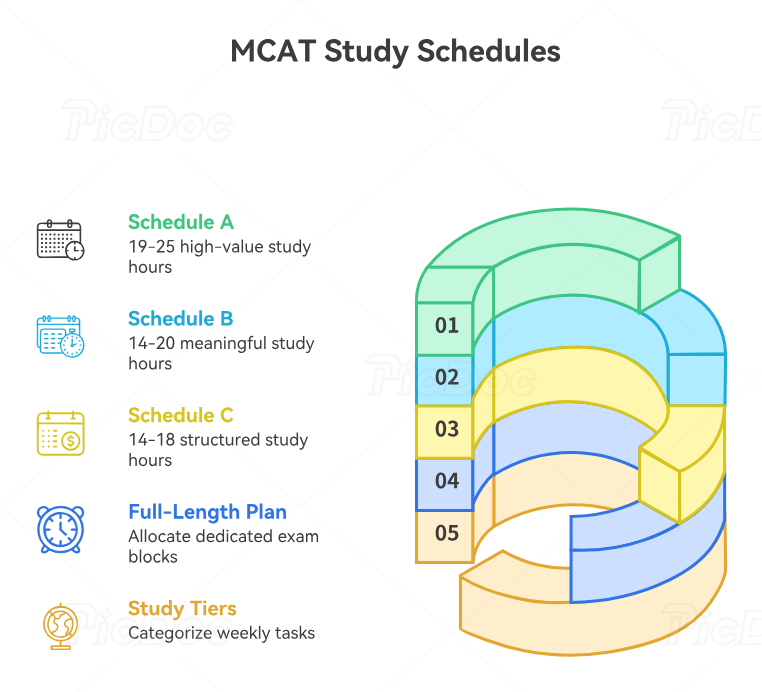
Schedule A: Working 16–20 hours per week
This is one of the strongest combinations for students who need income and continued clinical experience while making MCAT preparation the main priority.
A realistic week might contain:
Monday: 3 hours questions + review
Tuesday: 8–10 hour scribe shift + 45 minutes flashcards
Wednesday: 4 hours MCAT
Thursday: 8–10 hour scribe shift + 45 minutes light review
Friday: 3–4 hours MCAT
Saturday: full-length exam or 5–7 hour deep-study block
Sunday: 3–5 hours full-length review + planning
That creates roughly 19–25 high-value study hours without requiring four difficult hours immediately after every clinical shift.
The workdays can still reinforce medical vocabulary, patient communication, and physician reasoning exposure without forcing the scribe job to compete with every serious MCAT block.
Schedule B: Working 24–30 hours per week
At this level, three strong study days beat seven mediocre study days.
Example:
Monday: 10-hour shift + flashcards
Tuesday: 3-hour question/review block
Wednesday: 10-hour shift + rest
Thursday: 3-hour question/review block
Friday: 8-hour shift + 30-minute recall
Saturday: full-length or 5–7 focused hours
Sunday: 4-hour review + one genuine recovery block
Expect approximately 14–20 meaningful MCAT hours, depending on shift length and recovery.
This can work particularly well across a longer timeline. A student comparing how many scribe hours medical schools need should resist adding unnecessary shifts simply because the employer offers them. More clinical hours can eventually produce diminishing returns while consuming study capacity.
Schedule C: Working 40 hours per week
Full-time work requires a different strategy.
Trying to imitate a full-time MCAT student's schedule generally produces unsustainable evenings. Use morning cognition, small maintenance blocks, and protected weekends.
For a predictable 9–5 schedule:
Monday: 6:00–7:30 a.m. targeted questions
Tuesday: 6:00–7:30 a.m. review
Wednesday: lighter morning or rest
Thursday: 6:00–7:30 a.m. questions
Friday: 45–60 minutes recall/error log
Saturday: 6–8 hours full-length or structured MCAT work
Sunday: 4–5 hours review + recovery
That yields roughly 14–18 hours without requiring nightly 5-hour marathons.
A 2026 Reddit poster working full time as a scribe after scoring 493 described having morning and evening study windows but needing a stronger approach to question practice, stamina, and mistake review. The lesson is important: full-time workers cannot afford low-yield study. Every hour needs a defined job.
Budget full-length exams separately
One of the biggest planning mistakes is writing:
MCAT study: 20 hours/week
and assuming the same allocation works throughout preparation.
During the full-length phase, one practice exam can consume much of a day, and meaningful review can consume another large block. The AAMC recommends taking official practice exams under test-day timing and using results to identify weaknesses before subsequent exams.
Your work schedule therefore needs an uninterruptible block.
If your manager regularly adds shifts with short notice, use assertive workplace communication early. Request stable availability well before your final preparation month. Effective team communication is preferable to repeatedly accepting extra work and then panicking about lost study time.
Create a three-tier study list
Every week, categorize tasks:
Tier 1: Must happen
Full-length exam, FL review, targeted question sets, review of recurring weaknesses.
Tier 2: Should happen
Content reinforcement, spaced repetition, targeted videos, equation review.
Tier 3: Useful if time remains
Extra reading, additional passages, optional resources.
This prevents a chaotic workweek from pushing the highest-value tasks aside.
The approach mirrors good medical documentation workflow: critical information receives priority, while lower-value detail cannot crowd out the core record.
5. When Should You Reduce Scribe Hours Before the MCAT?
Reduce work based on evidence from your preparation, rather than guilt or fear.
A practical trigger is persistent underperformance despite consistent, high-quality study.
If your full-length scores remain materially below your target and you can identify insufficient practice time as the bottleneck, maintaining every scribe shift may be costing more than it provides.
Another trigger is inability to complete and review full-lengths properly.
If Saturday's exam gets squeezed between a Friday overnight shift and a Sunday morning shift, you are no longer reproducing reasonable test conditions. The AAMC notes that the standard U.S. MCAT start time is 8:00 a.m., which makes sleep timing and test-day routine especially relevant during final preparation.
A third trigger is deteriorating job performance.
Repeated documentation mistakes, missed information, poor team communication, irritability with patients, or difficulty maintaining professionalism signal that your total workload may already exceed your sustainable capacity.
A fourth trigger is sleep becoming the balancing variable. When every unexpectedly long shift produces an equally late study session, the plan has no slack.
The better sequence is:
First: remove low-value commitments.
Second: stop accepting optional extra shifts.
Third: request predictable scheduling.
Fourth: reduce weekly work hours if financially possible.
Fifth: move the MCAT if the remaining preparation gap is still unrealistic.
Students often hesitate to reduce scribing because they worry about appearing uncommitted. Yet medical scribing for medical-school applications is judged within the larger application. Protecting the capacity to prepare seriously for the MCAT can be a rational allocation decision.
A Reddit discussion about leaving or reducing a scribe job before the MCAT included suggestions such as asking for temporary leave or dropping to one weekly shift during the final preparation period. Another user who worked while preparing described dramatic lifestyle sacrifices and concluded that combining both was possible but extremely draining.
Ask your manager early
Do not wait until three weeks before your test.
If your exam is eight to twelve weeks away, communicate now:
the dates you need for full-length exams
whether you can work fewer shifts during the final month
whether overnights can be avoided near the exam
whether shifts can be clustered
whether temporary leave exists
how far in advance availability must be submitted
Strong assertive communication, professionalism, and scheduling conflict management make this easier.
Students in remote scribe jobs may have more control over commuting time, while students in hospital roles may have access to more shift configurations. Either way, find out what your employer can actually accommodate before assuming resignation is the only option.
Use this decision rule
Continue your current workload if:
your practice scores are progressing + sleep is stable + full-lengths fit + work quality remains strong.
Reduce something if:
scores are stagnant + study tasks repeatedly go unfinished + sleep is shrinking + work or mental performance is deteriorating.
That framework is far more useful than copying somebody else's 60-hour weekly grind from Reddit.
6. FAQs About Scribing While Studying for the MCAT
-
For many students, roughly 15–25 scribe hours per week provides a workable balance, especially when the schedule is predictable. A Reddit high scorer reported working approximately 20 weekly scribe hours while studying over an extended timeline and ultimately scoring 523.
Treat that as an example rather than a target. Your diagnostic score, desired improvement, class load, commute, and clinical scribe workload should determine your own number.
-
t is possible, but it generally requires a longer preparation timeline and highly selective study methods.
Current full-time and part-time medical scribe positions can involve long or rotating shifts. Reddit contains successful working-student examples alongside multiple reports of severe fatigue and burnout.
A full-time worker should prioritize active practice, mistake review, stable sleep, and protected full-length days over trying to reproduce a full-time student's daily schedule.
-
Quitting is most worth considering when work is the clear bottleneck and your finances allow it.
Before leaving, explore fewer shifts, predictable availability, temporary leave, or moving from full-time to part-time. If you already have substantial scribe clinical hours, protecting MCAT preparation may provide greater marginal value than continuing to accumulate hours at the same rate.
-
Twenty focused hours can be substantial across several months.
The AAMC recommends building preparation around baseline knowledge, weaknesses, active learning, practice, and reflection rather than prescribing a universal hourly requirement.
A 20-hour week filled with timed questions, deep review, spaced retrieval, and targeted content repair can outperform 30 poorly focused hours. Apply the same precision used in clinical documentation: quality changes the value of the volume.
-
Use your highest-energy period for your hardest MCAT work.
For a predictable daytime scribe schedule, morning study can work particularly well because difficult questions happen before a full day of listening and documentation. After work, use lower-intensity tasks if your attention has dropped.
If you work nights, protect sleep first and place MCAT work after your main sleep period rather than automatically forcing it into the conventional morning.
-
Scribing can strengthen familiarity with medical terminology, healthcare context, patient communication, and clinical reasoning.
Those benefits should be treated as adjacent learning rather than MCAT preparation. Your shift does not replace deliberate work on physics, chemistry, biochemistry, biology, psychology/sociology, CARS, timing, or official-style question reasoning.
