

Can Medical Scribing Help You Get a Physician Letter of Recommendation? Reddit Experiences and How to Earn a Strong One
Medical scribing can create one of the strongest opportunities a premed has to earn a physician letter of recommendation because a doctor may observe your reliability, communication, judgment, documentation quality, and growth across hundreds of patient encounters. The value depends heavily on the relationship you build. Students pursuing medical scribing for clinical experience, accumulating meaningful scribe hours, or deciding whether scribing is worth it for premed should treat the potential recommendation as something earned through sustained performance rather than an automatic job benefit.

1. Why Medical Scribing Can Produce an Exceptionally Strong Physician Letter
A powerful recommendation gives admissions committees credible evidence about how you behave when responsibility, uncertainty, pressure, and other people are involved. Medical scribing can provide exactly that environment.
The AAMC explains that letters of evaluation can contextualize an applicant’s attributes, skills, and experiences and give admissions committees a broader perspective on the applicant. Its guidance for letter writers specifically encourages recommenders to explain how long they have known the applicant, the capacity in which they interacted, whether their observations were direct, and specific information about the applicant rather than spending the letter describing the organization or job.
That framework fits a strong scribe relationship unusually well. A physician who has worked beside you for months can potentially describe your written communication, understanding of medical terminology, approach to professional communication, and consistency with medical professionalism. More importantly, that physician may have watched those skills develop across hundreds of real clinical interactions.
Consider the difference between two possible recommendation letters.
One physician can say an applicant shadowed for 20 hours, appeared interested, arrived on time, and asked appropriate questions.
Another physician can say an applicant worked beside them for nine months, learned an unfamiliar specialty, became dependable during high-volume clinics, anticipated documentation needs, accepted corrections without defensiveness, improved note accuracy, communicated appropriately when information was unclear, and remained composed when the schedule collapsed.
The second writer has far more behavioral evidence.
That is where scribing can deliver significant return beyond simply accumulating premed clinical hours. Your daily work can expose a physician to your team communication, ability to build professional rapport, judgment around confidential communication, and response to difficult clinical situations involving patient communication.
Reddit experiences repeatedly show this relationship effect. In a 2025 medical-scribe discussion, several users recommended approaching the provider the scribe worked with most frequently. One commenter said they had asked three physicians and all three agreed and appeared invested. Another emphasized choosing the person capable of writing the stronger letter rather than defaulting to a supervisor with limited direct interaction.
A separate scribe described working with a physician for approximately six months before requesting a recommendation and waiting until the physician appeared confident in the quality of their notes. That reflects the central principle: time creates opportunity, while demonstrated performance creates substance.
| What the Physician Observes | What It Can Demonstrate | How a Scribe Builds Evidence | Letter Strength Risk |
|---|---|---|---|
| Accurate notes | Attention to detail | Reduce repeat corrections over time | High if errors stay repetitive |
| Reliable attendance | Dependability | Arrive prepared and handle scheduling responsibly | High if shifts are frequently missed |
| Fast improvement | Coachability | Apply feedback visibly on future charts | High if the same feedback repeats |
| Clarifying questions | Judgment and communication | Ask concise questions when documentation is ambiguous | Moderate if questions interrupt workflow |
| High-volume performance | Composure under pressure | Maintain quality as patient volume rises | High if accuracy collapses under pace |
| Handling corrections | Maturity | Receive feedback calmly and correct the system causing the error | High if feedback triggers defensiveness |
| Clinical vocabulary growth | Capacity to learn | Master specialty terminology independently | Moderate if vocabulary stagnates |
| Anticipating workflow | Situational awareness | Prepare likely chart sections without overstepping scope | High if anticipation becomes assumption |
| Patient-room conduct | Professional presence | Remain attentive, discreet, and respectful | High after confidentiality or etiquette problems |
| Communication with staff | Teamwork | Interact effectively with MAs, nurses, front desk, and physicians | Moderate when teamwork is invisible |
| Owning mistakes | Integrity | Flag errors promptly and fix them | Very high if mistakes are concealed |
| Understanding clinical reasoning | Intellectual curiosity | Connect history, assessment, testing, and plan | Moderate if work remains purely mechanical |
| Consistency across months | Work ethic | Maintain standards after the novelty disappears | High if performance deteriorates |
| Handling difficult encounters | Emotional maturity | Stay composed around conflict, distress, or uncertainty | High if professionalism slips |
| Growing autonomy | Trustworthiness | Require fewer workflow prompts while respecting scope | Moderate if supervision needs never decrease |
| Curiosity after encounters | Motivation for medicine | Ask thoughtful questions at appropriate times | Moderate if questions feel performative |
| Helping workflow recover | Adaptability | Stay organized through late patients and interruptions | High if disruption consistently causes errors |
| Relationship over time | Authenticity and character | Allow natural conversations about goals and growth | High if the physician barely knows you |
2. How to Earn a Strong Physician Recommendation While You Are Scribing
The strongest strategy begins months before you ask.
Your first priority is becoming easy to trust. Physicians should know that when you are working, the chart will be accurate, essential details will be captured, uncertainties will be clarified, and corrections will be handled promptly. Building that reputation depends heavily on accurate clinical documentation, command of medical transcription terminology, effective verbal communication, and consistent professional behavior.
A scribe who wants a memorable recommendation should think in terms of evidence accumulation.
Suppose a physician corrects five parts of your notes during your first few shifts. Document the pattern privately in your learning notes without recording protected patient information. If several corrections involve pertinent negatives, develop a mental checklist. If the issue involves unfamiliar terminology, strengthen your medical terminology foundation. If the problem involves unclear communication, improve your assertiveness in medical settings, team communication habits, and understanding of professional communication.
Three months later, the physician may remember that you once required substantial correction and now rarely need it. That trajectory can become excellent recommendation material because it demonstrates teachability and growth.
Your relationship also needs genuine human interaction. You do not need to manufacture friendship with the physician. Aim for professional familiarity. Let the doctor know that you are pursuing medicine when it comes up naturally. Ask thoughtful questions during appropriate downtime. Understand how physicians approach patient education, observe their use of therapeutic communication, notice how they establish patient rapport, and learn how they manage difficult patient interactions.
Quality questions can deepen that relationship quickly. Instead of asking something broad such as “Why did you order the test?”, wait for an appropriate moment and ask what specific finding changed the differential or made one test more useful than another.
That demonstrates active learning while respecting workflow.
Your behavior around other staff also counts. Physicians often notice whether scribes treat nurses, MAs, front-desk staff, technicians, and other scribes professionally. Strong front-desk etiquette, appropriate non-verbal communication, reliable team communication, and careful confidential communication can give a physician far more to say about your readiness for a team-based profession.
Finally, protect your academic priorities. Staying in a poorly paid, exhausting role for an additional year solely because you hope for a recommendation can create a bad trade. Premeds should regularly reassess whether low scribe pay remains worthwhile, whether they have accumulated enough medical scribe hours, whether scribe burnout is developing, and whether a different clinical role such as medical assisting would fill a larger gap.
3. Which Physician Should You Ask for the Letter?
Choose the physician who can provide the most specific firsthand evidence about you.
Prestige can tempt applicants into making the wrong choice. A department chair who vaguely recognizes you may produce a weaker evaluation than an ordinary attending who has worked 60 shifts with you, watched you improve, trusted your documentation, discussed medicine with you, and understands why you want to become a physician.
The AAMC’s letter-writing guidance specifically emphasizes explaining the recommender’s relationship with the applicant and focusing on the applicant’s qualities and direct observations. Pre-health advisors featured by the AAMC similarly stress choosing recommenders who know the applicant well and approaching them early.
Reddit illustrates the problem clearly. One premed described spending two years scribing for a highly titled physician who still did not know them particularly well. A previous recommendation from that physician had reportedly resembled a summary of the applicant’s CV, leading the student to question whether the physician’s prestige compensated for the weak personalization.
That is exactly the situation you want to prevent.
If you work in a small outpatient practice, you may have an advantage. Repeated shifts with one or two physicians make it easier to demonstrate professionalism, build rapport, develop stronger communication skills, and show consistent documentation quality. This is one reason the choice between ScribeAmerica and private-practice scribing can affect recommendation opportunities.
A large emergency department creates a different challenge. You may rotate among 15, 20, or even 50 physicians. One Reddit scribe working in a very large ED explained that frequent provider rotation made relationship-building difficult because some physicians barely knew the scribes’ names. Another ED scribe reported rotating among roughly 15 providers and ultimately approaching the physician they had worked with most often after about eight months.
In that environment, concentrate your relationship-building rather than spreading it artificially. Identify two or three physicians you regularly work with. Become reliable for them. Learn their workflow preferences. Ask worthwhile questions during downtime. Make your career goals known naturally.
Remote scribing deserves extra caution. You can still build credibility through remote medical scribe work, precise written communication, careful secure communication, and reliable virtual clinical communication. Relationship depth may take more deliberate effort when nearly every interaction concerns chart completion.
A remote scribe on Reddit who had worked with a physician for roughly a year described this exact limitation: the physician could evaluate work quality, professionalism, and medical terminology skills, while their online format reduced broader personal interaction.
4. How to Ask a Physician for a Strong Letter of Recommendation
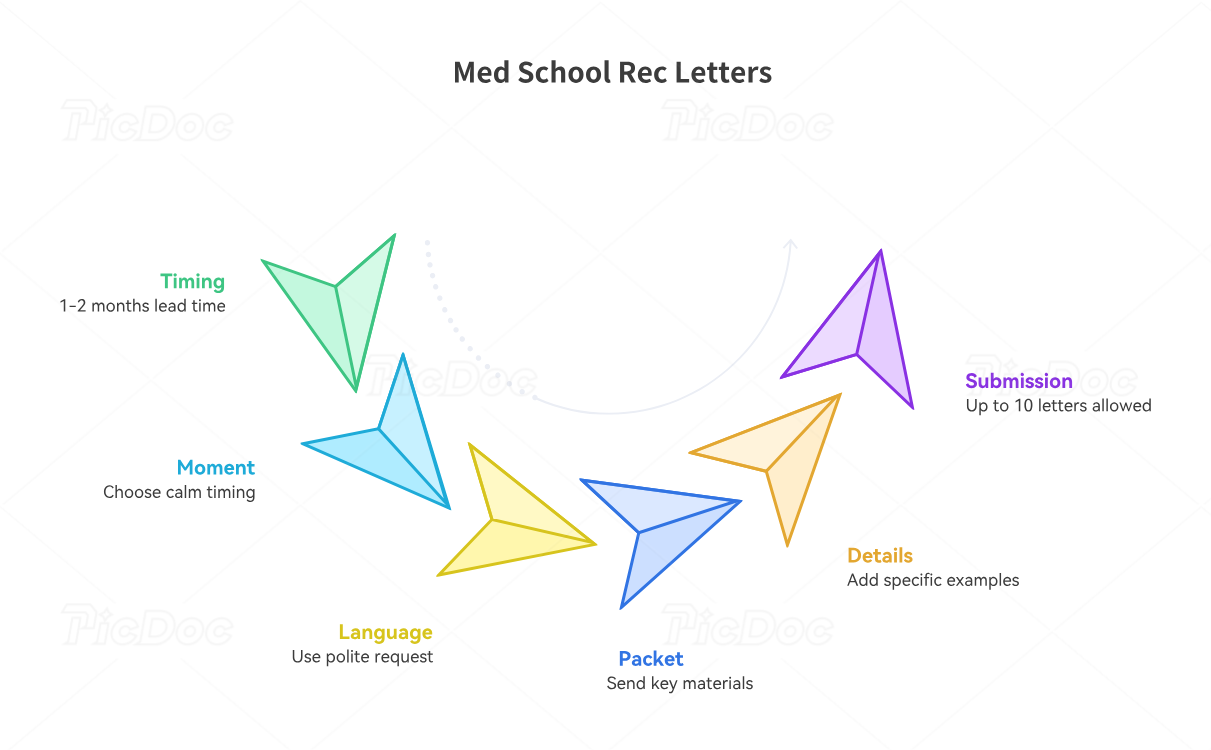
Timing matters.
A physician who genuinely knows your work still needs enough time to write thoughtfully. Several scribe discussions recommend approaching writers well ahead of the deadline. One Reddit user who had worked extensively with two providers for roughly a year said they supplied a resume, cover letter, and AAMC letter-writing guidance and emphasized asking well in advance. Another recommended approximately one to two months of lead time.
Ask during a calm moment, preferably after a shift or by a professional email when in-person timing is impractical. Avoid bringing it up while the physician is already behind, entering a patient room, managing an urgent problem, or trying to finish charts.
Use language that lets the physician evaluate whether they can support you meaningfully:
“Dr. Smith, I’ve really valued working with you and learning from you over the past year. I’m applying to medical school this cycle, and I wanted to ask whether you would feel comfortable writing me a strong letter of recommendation based on our work together.”
The word strong serves an important purpose. It gives a physician who feels unable to write substantively a graceful opportunity to say so.
That protects you from a generic letter.
Once the physician agrees, send a compact recommendation packet. Include your current resume or CV, application timeline, submission instructions, deadline, personal statement draft if available, and a short document reminding them of your work together. The AAMC also provides optional letter-writer guidance that applicants can share with recommenders.
Your reminder document can include:
When you started working together
Approximate frequency of your shared shifts
Major responsibilities you handled
Specific areas where you improved
Meaningful projects or workflow responsibilities
Your motivation for medicine
Two or three experiences that shaped you
Competencies the physician directly observed
Keep every example free of protected patient information.
Your physician already knows what medical scribing involves, so avoid wasting the packet explaining generic duties. Help them retrieve specific evidence. Perhaps you developed particularly strong written documentation, improved difficult team communication, demonstrated thoughtful patient interaction, or became highly dependable with complex medical terminology.
You can also mention moments that demonstrate growth. Perhaps early shifts required extensive correction, yet you developed a process that reduced errors. Perhaps you struggled with rapid encounters and became faster through disciplined medical transcription practice. Perhaps observing informed consent discussions, therapeutic communication, or challenging patient interactions changed how you understood medicine.
Those details give the writer useful material while leaving the evaluation entirely in their hands.
For AMCAS, the applicant identifies letter authors and the letter writer submits the recommendation directly. The AMCAS Letter Service can receive letters electronically from authors and distribute assigned letters to participating schools. Applicants may associate up to 10 letters with their application, which also allows different letters to be targeted to different schools when appropriate.
Individual medical schools can have different letter requirements, so confirm each school’s instructions before deciding that a physician letter will replace another required recommendation.
5. The Mistakes That Turn a Physician Letter Into a Generic Recommendation
The biggest mistake is asking based on title rather than relationship.
A famous surgeon who has seen you four times has limited firsthand material. A community physician who has watched you work twice weekly for a year may be able to describe your reliability, curiosity, communication, judgment, and development in detail.
Another major mistake is waiting until the week before the deadline. Doctors already balance patient care, documentation, administrative work, inboxes, meetings, and call responsibilities. Giving a writer adequate lead time improves the chance that the recommendation receives deliberate attention.
A third mistake is assuming that longevity automatically creates closeness. Working somewhere for a year helps only when the physician has actually observed your work. Someone can accumulate extensive medical scribe hours, develop strong clinical exposure, and still finish with a weak recommendation because frequent provider rotation prevented any one physician from knowing them deeply.
Reddit reflects this tension. One discussion involved a scribe who had worked with a provider for 2.5 years yet described their relationship as limited and dominated by corrections. Commenters advised assessing the physician’s likely enthusiasm rather than assuming the duration guaranteed a strong recommendation.
A fourth mistake is treating every correction as evidence that the physician dislikes you. Physicians often develop strong trust in scribes precisely because they watch them respond intelligently to feedback. Your reaction matters. Apply the correction, improve the process, and maintain professional communication, assertiveness, written accuracy, and dependable team communication.
A fifth mistake is chasing a physician recommendation when another recommender knows you dramatically better. A physician letter can be valuable, yet applicants still need to follow each medical school's specific requirements. Faculty, committee, research, employment, or other letters may satisfy different requirements and reveal different dimensions of your candidacy. AAMC advisors emphasize the importance of choosing people who know the applicant well, while science-faculty recommendations remain particularly important for many applicants.
A sixth mistake is expecting your scribe company to generate the strongest clinical letter automatically. A chief scribe can potentially write a useful recommendation when they supervised you closely. A physician who observed your work across many patient encounters usually has richer clinical evidence to discuss. A 2025 Reddit thread captured this distinction, with commenters repeatedly recommending the provider who knew the scribe’s work best.
This is also worth considering when choosing between large scribe-company positions and private practices, evaluating remote scribe employment, deciding whether scribe certification adds career value, or reconsidering scribing as AI scribes change documentation workflows.
The durable advantage remains the same: a physician has personally seen how you work.
6. FAQs About Getting a Physician Letter Through Medical Scribing
-
There is no universal hour or month requirement for earning a meaningful recommendation. The better question is whether the physician has observed enough of your work to provide specific examples.
Reddit reports include scribes receiving physician recommendations after roughly six months of recurring work, while others waited eight months, a year, or longer.
Ask yourself whether the physician has seen your early learning curve, current documentation quality, reliability, professional communication, and ability to function as part of the clinical team. Six months working together twice weekly can provide stronger evidence than a year spent rotating among dozens of physicians.
-
Choose whoever can write the strongest, most detailed evaluation while satisfying the requirements of the schools receiving it.
A physician may be particularly valuable because they can describe your performance inside a clinical environment, including patient-facing professionalism, clinical documentation, understanding of medical terminology, and team communication.
A chief scribe who directly trained, supervised, evaluated, and promoted you could also provide strong evidence about leadership and dependability. Reddit discussions involving ScribeAmerica repeatedly recommend considering how well each potential writer actually knows your work.
-
Yes, though you need to be deliberate.
Track which attendings you work with most frequently. Identify physicians who know your name, recognize your work, trust your notes, and have observed you during demanding shifts. Build authentic professional relationships around repeated work rather than trying to impress every attending.
Large EDs create a documented pain point for scribes because frequent rotations can limit relationship depth. Your best strategy is to become consistently strong in medical documentation, professionalism, communication, and clinical teamwork so repeated physicians remember your reliability.
-
Yes. Remote scribing can provide substantial evidence regarding your accuracy, dependability, medical vocabulary, responsiveness, and ability to work independently.
The challenge is relationship depth. A remote provider may know your work extremely well while knowing relatively little about your personality, motivations, or interactions beyond documentation. One remote scribe on Reddit described exactly this situation after approximately a year working with a physician.
Strengthen the relationship through reliable remote scribing performance, concise verbal communication, secure healthcare messaging, and professional virtual clinical communication.
-
Take hesitation seriously.
A strong recommendation requires enthusiasm and specific evidence. If the physician says they barely know you, seems uncomfortable, repeatedly avoids the request, or indicates they could only confirm your employment, another writer may serve you better.
This is why asking whether they can provide a strong recommendation is valuable. It creates room for an honest answer.
Continue evaluating your overall application through the quality of your clinical experience, the depth of your scribe hours, your medical scribing ROI, and whether another clinical role offers better relationship-building.
-
Scribing frequently gives the physician more evidence because they are supervising your work rather than simply allowing you to observe theirs.
Through scribing, a physician may observe your documentation skills, professional behavior, communication, reliability, growth, and understanding of clinical workflow. Shadowing can also produce a meaningful relationship when it is longitudinal and includes substantial interaction.
The decisive factor remains specificity of observation. A physician who can describe what you did, how you improved, how you responded under pressure, and why they trust you has the raw material for a substantially stronger letter.
