

Ophthalmic Scribe Jobs in 2026: Reddit Experiences, Skills, Terminology & What Employers Expect Before Day One
Ophthalmic scribing has a steeper specialty-learning curve than many general medical scribe jobs because the language, exam sequence, imaging, laterality, abbreviations, and physician workflow can feel unfamiliar immediately. Employers in 2026 are looking beyond basic medical terminology. They want candidates who can navigate an EHR, recognize ophthalmic findings, maintain precise written communication, protect confidential information, and keep pace without turning physician documentation into another bottleneck.
1. What Does an Ophthalmic Scribe Actually Do in 2026?
An ophthalmic scribe works beside an ophthalmologist, retina specialist, glaucoma specialist, optometrist, or other eye-care provider and translates the encounter into an organized medical record. That sounds similar to ordinary medical transcription, but ophthalmology introduces a distinctive layer of visual findings, eye-specific abbreviations, diagnostic imaging, laterality, measurements, procedures, and highly structured exam components.
A current 2026 Associated Retinal Consultants posting illustrates how broad the job can become. Its ophthalmic scribe/technician role requires retina-specific terminology, accurate history collection, EHR proficiency, fast and accurate keyboarding, procedure and diagnosis-code awareness, OCT work, patient preparation, and strong communication. The posting requires only a high-school diploma at minimum while preferring ophthalmic credentials such as COA, COT, or Ophthalmic Scribe Certification.
That is an important hiring signal for applicants wondering whether medical scribe certification is worth paying for. Certification can improve a résumé, while demonstrated competency in clinical documentation, professional communication, EHR navigation, and ophthalmic terminology often determines whether somebody can actually function in the room.
Another current ophthalmic clinic posting requires accurate documentation of ophthalmic exams and procedures, diagnoses, symptoms, prescriptions, and follow-up instructions while expecting the scribe to anticipate physician needs and multitask effectively. That expectation explains why applicants coming from remote medical scribing, general medicine, or medical assistant work can initially feel overwhelmed even when their basic charting skills are good.
The biggest adjustment is density. An ophthalmologist may rapidly call out anterior-segment findings, pressure, lens status, vitreous findings, optic-nerve appearance, macular abnormalities, peripheral retinal findings, imaging interpretation, diagnosis, and follow-up plan. The scribe must understand enough verbal communication to capture the information accurately while maintaining enough team communication to clarify an ambiguous finding without unnecessarily disrupting clinic flow.
Current postings also reveal that “scribe” may mean different things between practices. One role may be documentation-heavy. Another blends scribing with ophthalmic technician duties, patient education, imaging, room preparation, prescriptions, prior authorization, scheduling, or equipment support. A July 2026 Reddit post reproduced an ophthalmic scribe vacancy involving real-time EHR documentation, exam findings, treatment plans, procedures, diagnostic results, physician interpretation, prescription support, prior authorization, and patient-flow monitoring.
Applicants therefore need to read the job description as carefully as they would evaluate whether low scribe pay is worth accepting. Look specifically for words such as scribe/tech, OCT, workup, refraction, prior authorization, coding, prescriptions, rooming, or patient education. Those phrases tell you whether the employer is hiring a documentation specialist or a hybrid clinical employee who also needs strong patient interaction skills, rapport building, and bedside manner.
| Term / Skill | What You Need to Understand | Why It Matters to a Scribe | Day-One Priority |
|---|---|---|---|
| OD | Right eye | Prevents laterality errors | Critical |
| OS | Left eye | Findings must be assigned correctly | Critical |
| OU | Both eyes | Frequently used throughout eye charts | Critical |
| VA | Visual acuity | Core measure of visual function | Critical |
| IOP | Intraocular pressure | Central to glaucoma assessment | Critical |
| OCT | Optical coherence tomography | Common retina and glaucoma imaging | Critical |
| Fundus | Posterior internal eye structures | Organizes posterior exam findings | High |
| Macula | Central retinal region responsible for detailed vision | Frequent site of retinal pathology | High |
| Optic Disc | Optic-nerve head | Important in glaucoma and neuro-ophthalmic documentation | High |
| C/D Ratio | Cup-to-disc ratio | Common optic-nerve descriptor | High |
| PCIOL | Posterior chamber intraocular lens | Common after cataract surgery | High |
| NS | Often nuclear sclerosis in an ophthalmic context | Common lens finding requiring context | High |
| AMD | Age-related macular degeneration | Common retina diagnosis | High |
| DR | Diabetic retinopathy in appropriate context | Frequently documented retinal disease | High |
| PDR / NPDR | Proliferative / nonproliferative diabetic retinopathy | Disease stage changes documentation and management | High in retina |
| DME | Diabetic macular edema | Frequently paired with OCT findings | High in retina |
| PVD | Posterior vitreous detachment in eye-care context | Common with flashes/floaters evaluations | High |
| RD | Retinal detachment | Potentially urgent retinal pathology | Critical |
| HVF | Humphrey visual field | Common glaucoma and neuro-ophthalmology testing | Medium-High |
| Pachymetry | Corneal-thickness measurement | Can affect glaucoma interpretation | Medium-High |
| Refraction | Measurement of refractive error | Frequent comprehensive-eye workflow component | Medium-High |
| Slit Lamp | Microscope used for detailed eye examination | Physician may dictate findings rapidly during exam | Critical |
| Laterality | Correct assignment to right, left, or both eyes | One wrong side can materially corrupt the record | Critical |
| Provider Preference | Order, phrasing, and level of detail preferred by each physician | Determines real-world efficiency | Critical after orientation |
2. Ophthalmic Terminology You Should Understand Before Your First Shift
The fastest way to make ophthalmology feel less chaotic is to learn the map of the eye before memorizing hundreds of abbreviations. A new scribe who understands cornea → anterior chamber → iris → lens → vitreous → retina → macula → optic nerve can often work out where a dictated finding belongs. That foundational understanding makes medical terminology training, written documentation, and effective provider communication much easier.
Start with laterality. OD refers to the right eye, OS to the left eye, and OU to both eyes. EyeWiki's current visual-acuity guidance uses OD and OS for monocular testing and also distinguishes testing with and without correction. In an ophthalmic chart, laterality deserves the same seriousness you would give confidential communication or correct patient identification. Recording a retinal tear, injection, pressure value, or surgical history under the wrong eye can create a clinically meaningful documentation error.
Then learn the routine exam sequence used by your practice. The exact order varies, but common concepts include visual acuity, pupils, intraocular pressure, external examination, slit-lamp findings, lens findings, vitreous, optic nerve, macula, vessels, and peripheral retina. Learning that order reduces working-memory burden because you begin anticipating where the next dictated finding belongs instead of searching the EHR after every phrase.
This is where strong typing speed becomes useful without becoming the entire job. An ophthalmologist might say several findings in rapid succession. The scribe who recognizes the anatomy can place them quickly. The scribe who hears unfamiliar sounds has to remember the phrase, spell it, determine what it means, locate the correct chart field, and still listen for the next finding.
Learn conditions by specialty
For general ophthalmology, prioritize cataracts, pseudophakia, refractive error, dry eye disease, corneal findings, posterior capsular opacification, and common postoperative terminology.
For retina, learn age-related macular degeneration, diabetic retinopathy, diabetic macular edema, epiretinal membrane, macular hole, posterior vitreous detachment, retinal tear, retinal detachment, vitreous hemorrhage, retinal vein occlusion, OCT terminology, and intravitreal treatment language.
For glaucoma, understand intraocular pressure, optic nerve cupping, cup-to-disc ratio, visual fields, OCT nerve-fiber analysis, open-angle versus angle-closure concepts, target pressure, and common pressure-lowering medication classes.
The need for specialty depth is supported directly by current hiring. Associated Retinal Consultants specifically requires knowledge of retina-specific ophthalmology terminology, while another 2026 ophthalmic position asks for understanding of medical or ophthalmic terminology and accurate spelling while charting.
Applicants should combine that technical learning with patient education, therapeutic communication, and rapport-building skills. A hybrid scribe/technician may need to reinforce instructions, prepare patients for testing, or help maintain flow while remaining within the duties assigned by the employer.
Understand abbreviations without becoming reckless with them
A major beginner mistake is memorizing abbreviations as disconnected flashcards. Learn meaning + context + location in the chart.
IJCAHPO's Ophthalmic Scribe Certification reflects this broader approach. Its examination covers EHRs, history taking, ophthalmic abbreviations, acronyms, anatomy, instruments, patient services, pharmacology, supplemental skills, and terminology. That curriculum gives candidates a useful picture of the knowledge domain even when an employer does not require certification.
The American Academy of Ophthalmology also publishes a dedicated Dictionary of Eye Terminology designed for eye-care staff, including definitions, acronyms, abbreviations, conditions, testing, procedures, and pharmacology.
Study terminology the same way you would develop professional medical communication: prioritize accuracy over showing off. If you are unsure whether “PVD” refers to a posterior vitreous detachment in the provider's context, clarification is safer than silently assuming. Good assertive communication lets you ask concise questions without derailing the encounter.
3. What Reddit Ophthalmic Scribes Say the Job Is Really Like
Reddit experiences reveal a consistent pain point: ophthalmology feels like its own language until patterns begin repeating.
In a 2026 r/Ophthalmology discussion, an experienced ophthalmic technician who had been required to begin scribing described being thrown into the role before feeling adequately trained. A scribe/technician responding to the post emphasized learning each physician's rhythm, preferred order of findings, and assessment-plan phrasing. That person said it took months to feel fast and smooth because workflow was both physician-specific and EHR-specific.
That observation is extremely valuable for somebody preparing for their first scribe position. You can study medical terminology, improve written communication, and practice team communication before hiring. Physician-specific cadence can only be learned after observing the actual provider.
Another ophthalmic scribe described the early experience as difficult because the physician would call out several findings rapidly while the scribe simultaneously tried to remember them and locate the appropriate sections in the EHR. That is exactly where the job becomes harder than a typing test.
The skill is clinical chunking.
Instead of remembering seven disconnected words, an experienced scribe begins hearing groups:
eye → anatomical structure → finding → severity → plan
That turns a stream of unfamiliar information into a predictable documentation architecture.
Reddit discussions also reveal how dramatically workload varies. One remote ophthalmology scribe working with two retina specialists reported seeing approximately 30–40 patients per day and doing substantial pre-charting outside clinic time. The same commenter described loving the assignment, while noting that provider and clinic volume strongly influenced the experience.
That should matter when evaluating remote scribe opportunities, low-paying scribe positions, and whether medical scribing remains worthwhile for premeds. Patient volume alone does not define job quality. Training, physician behavior, chart complexity, pre-charting expectations, overtime, learning value, and opportunities for clinical exposure all affect the real return.
A July 2026 premed discussion adds another useful distinction. Contributors working in ophthalmology said technicians typically receive more direct patient contact, while scribes may learn more from physician decision-making and physician-patient interactions. Another commenter warned that ophthalmology can be difficult for someone without technician experience because the specialty has its own language.
That makes ophthalmic scribing particularly interesting for students comparing a scribe versus medical assistant role. The scribe may spend less time performing hands-on clinical tasks yet gain deeper exposure to assessments, diagnostic interpretation, disease progression, physician reasoning, and treatment planning.
For premeds concerned about how many scribe hours they need, the learning quality matters. Repeated exposure to retina imaging, glaucoma monitoring, cataract decision-making, longitudinal follow-up, and patient communication can generate far more meaningful reflections than simply accumulating hours.
4. What Employers Expect You to Know Before Day One
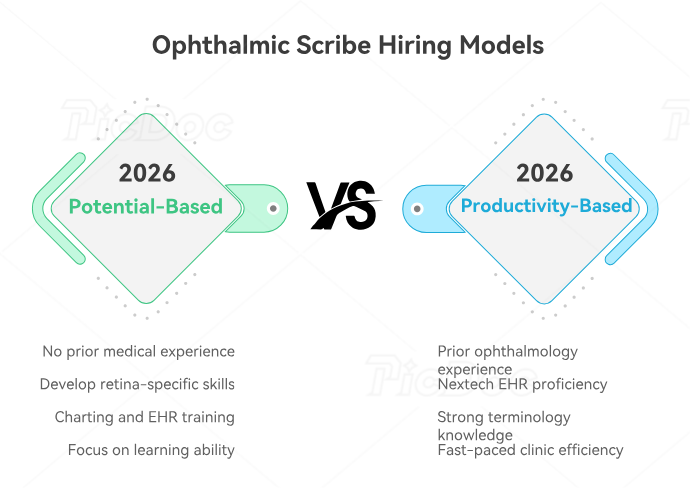
Current 2026 postings show two hiring models operating simultaneously.
The first hires for potential. Associated Retinal Consultants currently advertises an ophthalmic scribe/technician position stating that no prior medical experience is required, although the role itself expects candidates to develop retina-specific knowledge, accurate charting, EHR skills, and ophthalmic workflow competence.
The second hires for immediate productivity. A current Illinois ophthalmic-scribe opening asks for previous ophthalmology documentation experience, Nextech EHR proficiency, strong ophthalmic terminology knowledge, and the ability to work efficiently in a fast-paced clinic.
Applicants need to know which version they are interviewing for.
Expectation 1: You can type accurately while listening
Strong medical-scribe typing matters because ophthalmologists often dictate while examining the patient. Current retina postings explicitly require accurate, fast keyboarding and strong spelling.
Practice medical vocabulary while listening rather than relying exclusively on ordinary typing tests. Pair that mechanical skill with verbal communication and professionalism, because clinical listening involves meaning as much as speed.
Expectation 2: You understand EHR logic
Employers commonly mention EHR competency. Penn Medicine's ophthalmology scribe program includes chart-system training after hire, while current private-practice listings request prior EHR familiarity or specific Nextech experience.
Before starting, understand the difference between history, exam findings, diagnostics, assessment, plan, orders, medications, and follow-up. That structural knowledge transfers even when software changes.
Applicants experienced with virtual check-in systems, secure healthcare messaging, and healthcare automation tools also have an advantage because ophthalmology increasingly relies on interconnected digital workflows.
Expectation 3: You preserve the provider's meaning
Your job is documentation assistance. It is dangerous to upgrade an uncertain impression into a confirmed diagnosis, invent missing details, “clean up” a physician's meaning without authorization, or independently create clinical conclusions.
The Joint Commission emphasizes defined responsibilities, adequate training and competency, proper individual EHR access, and appropriate practitioner verification in documentation-assistance workflows.
That makes confidential communication, informed-consent awareness, and professional medical communication practical job skills rather than résumé filler.
Expectation 4: You can distinguish ambiguity from certainty
If the provider says “possible early AMD,” write within the provider's documented level of certainty. If you hear “OD” but think the finding belongs to OS, clarify rather than silently changing it. If you miss a pressure reading, ask at an appropriate moment rather than guessing.
This is where assertiveness in medical settings becomes valuable. Good scribes ask short, targeted, low-disruption questions.
“Was that OD or OS?”
“Did you want that under assessment?”
“Was the OCT stable or improved?”
Those questions protect documentation quality without turning every encounter into a conversation about the chart.
Expectation 5: You understand physician preference
One physician may dictate from anterior to posterior. Another may switch between eyes. One may want compact assessment language. Another may dictate detailed reasoning. One may heavily use templates. Another may expect extensive free-text documentation.
Reddit's 2026 ophthalmology discussion repeatedly emphasized learning each doctor's rhythm and preferred charting order.
That ability depends on team communication, respectful professional behavior, and enough rapport-building skill to receive correction without becoming defensive.
Expectation 6: You support patient flow
Busy ophthalmology practices can move quickly because technicians perform workups and testing before the physician enters. An efficient scribe knows which chart comes next, which testing has been completed, what prior plan needs review, and which information the physician will likely need.
That overlaps with scheduling conflict management, front-desk etiquette, appointment workflows, and clear patient education.
5. How to Prepare Before Your First Ophthalmic Scribe Shift
The strongest preparation strategy builds recognition, because day-one success rarely depends on memorizing an entire ophthalmology textbook.
Days 1–2: Learn the anatomy map
Be able to identify and explain cornea, anterior chamber, iris, pupil, lens, vitreous, retina, macula, vessels, optic disc, and peripheral retina.
Use medical terminology practice to make spelling automatic. Then type the structures repeatedly in likely chart order.
Days 3–4: Master laterality and essential abbreviations
Start with OD, OS, OU, VA, IOP, OCT, C/D, HVF, PCIOL, PVD, AMD, DR, PDR, NPDR, DME, and RD.
Build each flashcard with four pieces:
abbreviation → full term → meaning → where it appears
This approach strengthens written medical communication while reducing the dangerous habit of memorizing symbols without understanding their context.
Days 5–6: Learn the common diagnoses
Focus on cataracts, glaucoma, diabetic retinopathy, macular degeneration, dry eye, retinal tear/detachment, posterior vitreous detachment, refractive error, and common postoperative states.
For each condition, learn:
What structure is affected? What findings might be discussed? What tests commonly accompany it? What treatments might appear in the plan?
You are building comprehension, not teaching yourself to diagnose.
That distinction keeps you within the role while improving patient communication, clinical professionalism, and your ability to understand physician discussion.
Day 7: Learn testing vocabulary
Understand what OCT, visual field testing, fundus photography, pachymetry, tonometry, visual acuity, refraction, and slit-lamp examination are broadly measuring.
A current CHRISTUS ophthalmic role illustrates how technically broad eye-care positions can become, listing visual acuity, visual fields, keratometry, refraction, Amsler testing, topography, pupil exams, OCT, pachymetry, retinoscopy, and A-scans among relevant technical workups.
Even when your scribe role does not perform those tests, recognizing the vocabulary makes the physician's assessment considerably easier to follow.
Days 8–9: Practice listening and chart placement
Listen to ophthalmology teaching material or mock dictation and categorize each statement as:
history
exam finding
test result
assessment
plan
medication
follow-up
This exercise develops the same cognitive separation required for strong medical transcription, professional documentation, and accurate provider communication.
Day 10: Build your physician-preference sheet
After orientation, create an employer-approved reference containing each provider's recurring preferences:
examination order
common abbreviations
frequently used phrases
preferred assessment format
common follow-up intervals
typical templates
imaging language
procedure documentation patterns
Keep patient-specific protected information out of personal notes. Apply the same confidential communication standards that govern every other part of clinical work.
Days 11–12: Practice correction without panic
Simulate missing information.
Have somebody read a sequence of findings quickly. Intentionally leave one blank. Continue capturing subsequent information. Return to the blank at the end.
This teaches an essential scribe skill: one missed detail does not have to destroy the next five details.
Applicants who become anxious after one missed phrase often stop listening while mentally reconstructing it. Strong assertive communication, team communication, and controlled clarification prevent that cascade.
Days 13–14: Simulate a clinic
Run several mock encounters consecutively.
Review each chart for:
right-versus-left errors,
spelling mistakes,
findings placed in the wrong section,
omitted diagnoses,
altered certainty,
missing testing,
incorrect follow-up instructions,
unsupported information.
This quality-control mindset becomes increasingly valuable as AI scribe technology changes documentation work. The human competitive advantage increasingly lies in understanding context, detecting contradictions, recognizing missing information, and correcting generated documentation rather than simply producing characters faster.
A candidate considering whether medical scribing is still worth it should therefore treat ophthalmic knowledge as transferable capital. Even if one contract disappears or remote scribe hiring changes, experience with specialty documentation, EHRs, imaging, healthcare automation, and precise clinical communication remains valuable.
6. FAQs About Ophthalmic Scribe Jobs in 2026
-
Some employers hire beginners, while others want immediate ophthalmology proficiency. Associated Retinal Consultants currently advertises certain ophthalmic scribe/technician openings with training and no prior medical experience required, while other 2026 listings request prior ophthalmology experience or knowledge of specific EHR platforms.
A beginner can improve considerably before applying by developing medical terminology, typing accuracy, professional communication, and a basic understanding of ophthalmic anatomy.
-
The initial vocabulary curve is often steeper because ophthalmology uses dense specialty terminology, laterality, measurements, imaging, abbreviations, and structured exam findings. Reddit scribes repeatedly describe the specialty as difficult at first and much more manageable after the recurring patterns become familiar.
People with solid medical transcription skills, team communication, and clinical documentation habits generally have a stronger starting point.
-
Prioritize OD, OS, OU, VA, IOP, OCT, C/D, HVF, PCIOL, AMD, DR, PDR, NPDR, DME, PVD, and RD, then expand according to the practice's subspecialties.
Memorize each abbreviation alongside its meaning and clinical context. AAO maintains dedicated ophthalmic terminology resources, while IJCAHPO explicitly includes abbreviations and acronyms within its Ophthalmic Scribe Certification content areas.
Pair terminology study with written communication, medical terminology drills, and professional communication.
-
Certification requirements vary. IJCAHPO offers the Ophthalmic Scribe Certification, and current employers sometimes list OSC, COA, COT, or other credentials as preferred rather than universally mandatory. Penn Medicine's ophthalmology scribe program requires successful hires to complete the JCAHPO ophthalmic scribe certification as part of its program.
Before paying for training, compare the credential against actual target vacancies and the broader question of whether medical scribe certification is worth the money.
-
Some do. Current postings combine documentation with OCT, patient workups, room preparation, imaging, prescriptions, prior authorizations, coding support, or other clinical tasks.
Read each listing carefully when comparing medical scribe and medical assistant roles. A hybrid ophthalmic scribe/technician position can offer broader clinical experience, while a documentation-focused position may provide deeper exposure to physician reasoning.
-
It can provide close exposure to patient encounters, disease progression, diagnostic testing, treatment decisions, and physician reasoning. A 2026 Reddit discussion comparing ophthalmic scribing with technician work suggested that technicians may obtain more direct patient contact while scribes can gain particularly strong exposure to physician-patient interactions and clinical reasoning.
The value depends on what you actually learn and how well you can explain it. Students should think beyond raw scribe-hour totals and focus on meaningful clinical exposure, patient communication, and professional growth.
