

Emergency Department Scribing vs Outpatient Scribing: Reddit Workload, Learning, Pay & Clinical Exposure Compared
Choosing between emergency department and outpatient scribing changes far more than your work address. The setting affects your pace, schedule, physician access, case mix, documentation pressure, and the kind of clinical experience you can eventually discuss in a medical-school application. Premeds deciding whether medical scribing is worth it should evaluate the actual learning environment alongside scribe workload and clinical-hour value. In most cases, the ED wins for breadth and acute decision-making, while outpatient scribing wins for continuity, mentorship, and scheduling stability.
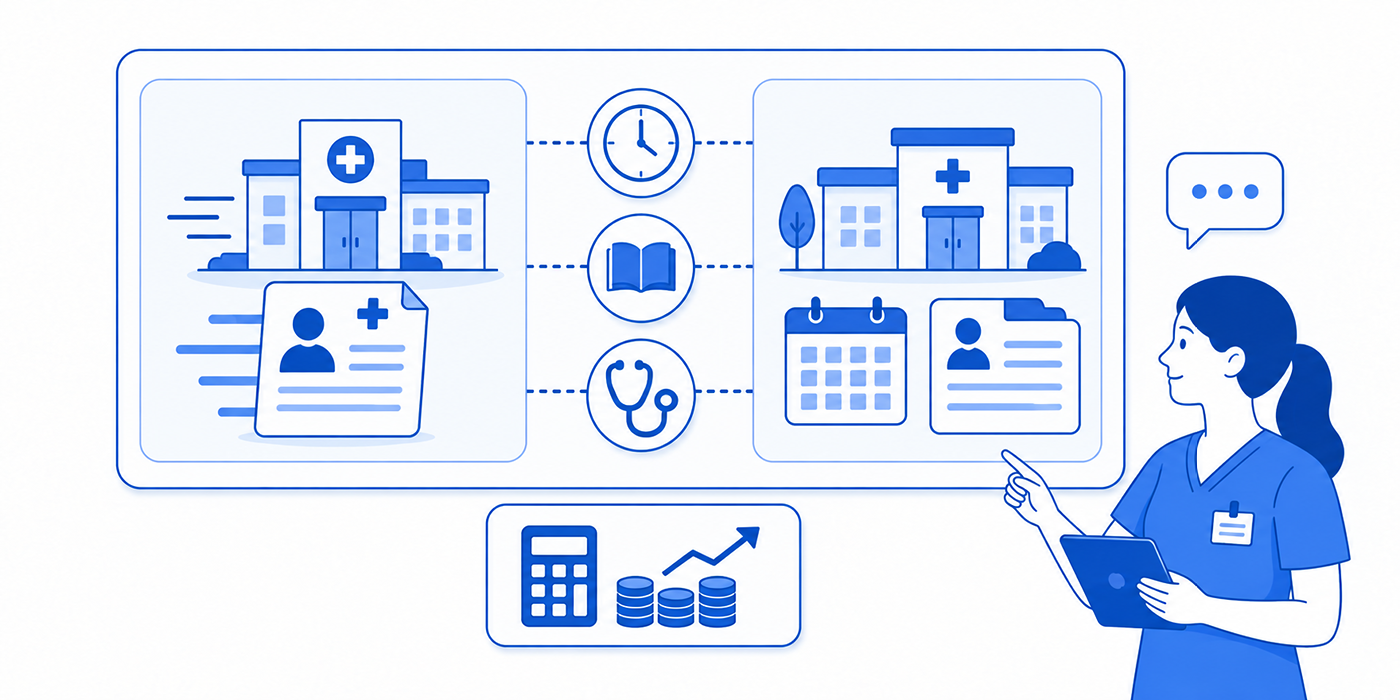
1. Emergency Department vs Outpatient Scribing: What Is the Real Difference?
The most useful distinction is breadth versus depth. Emergency department scribes repeatedly see undifferentiated patients: chest pain before the diagnosis is known, abdominal pain before imaging returns, altered mental status before the workup develops, trauma before disposition, or fever before the physician knows whether the patient goes home or gets admitted. That gives a premed unusually close exposure to real-time clinical reasoning, especially when combined with strong medical terminology, accurate written communication, effective team communication, and disciplined professional communication.
Outpatient scribing usually narrows the diagnostic universe while letting you understand it more deeply. A cardiology scribe may repeatedly see heart failure, arrhythmias, coronary disease, hypertension, medication titration, diagnostic testing, and post-hospital follow-up. An orthopedic scribe may learn injury mechanisms, imaging interpretation, conservative treatment, surgical indications, and post-operative recovery. That repetitive exposure can accelerate mastery of specialty-specific patient histories, strengthen your understanding of patient education, improve rapport-building awareness, and show how therapeutic communication changes across repeated visits.
Recent Reddit experiences capture the tradeoff well. In a May 2026 discussion, one premed described ED scribing as more revealing of hospital medicine, while outpatient work provided insight into how private practices operate. Another commenter who had worked in both environments emphasized the ED's exposure to procedures and medical decision-making while noting that outpatient clinics made it easier to develop stronger physician relationships, potentially opening doors to shadowing and letters of recommendation.
That distinction matters because accumulating hundreds of scribe hours is useful only when the experience produces understanding. AAMC guidance has long emphasized the value of learning from clinical exposure, and its clinical-experience survey found that participating schools cared more about what applicants gained from an experience than simply the raw number of hours. Scribing was among the activities schools reported accepting as clinical exposure. A highly repetitive job with weak physician interaction can therefore produce less developmental value than a smaller number of hours with strong physician exposure, clinical communication, documentation responsibility, and meaningful healthcare-team interaction.
Use the comparison below as a screening tool before accepting either position.
| # | Decision Factor | Emergency Department | Outpatient Clinic | Best Planning Takeaway |
|---|---|---|---|---|
| 1 | Work pace | Variable, surge-driven, sometimes extremely fast | Appointment-driven with more predictable waves | Choose ED if rapid switching energizes you |
| 2 | Case variety | Very broad across organ systems and acuity | Usually narrower and specialty-specific | ED is stronger for breadth |
| 3 | Clinical acuity | Routine complaints through true emergencies | Mostly planned, stable or follow-up care | ED shows triage and escalation particularly well |
| 4 | Charts in progress | Several patients may remain active simultaneously | Usually follows scheduled patient flow | Ask how many charts scribes manage concurrently |
| 5 | Patient continuity | Low | Potentially high | Outpatient is stronger for longitudinal medicine |
| 6 | Schedule predictability | Lower | Usually higher | Outpatient often fits heavy coursework better |
| 7 | Nights/weekends | Common at some sites | Less common in traditional clinics | Protect sleep if GPA or MCAT prep is a priority |
| 8 | Physicians encountered | Potentially many | Often one or a small group repeatedly | Breadth favors ED; relationship depth favors outpatient |
| 9 | LOR potential | Strong if repeated physician pairing occurs | Often easier to cultivate consistently | Ask who you will work with before accepting |
| 10 | Procedures observed | Potentially frequent and varied | Depends heavily on specialty | ED usually offers broader procedural exposure |
| 11 | Specialty breadth | High through consults and varied presentations | Low to moderate | ED is useful when specialty interests remain unclear |
| 12 | Specialty depth | Moderate | Potentially very high | Outpatient wins when the specialty genuinely interests you |
| 13 | Pre-charting | Usually limited by unscheduled arrivals | Can be substantial | Ask whether prep work is paid and scheduled |
| 14 | Interruptions | Frequent | Generally more structured | ED demands stronger task-switching ability |
| 15 | Emotional intensity | Can be high | Usually lower, but specialty-dependent | Consider your tolerance for trauma, death and psychiatric emergencies |
| 16 | Early learning curve | Often steep because pace and case mix change constantly | Steep initially, then patterns become familiar | Training quality can matter more than setting |
| 17 | Pay | Highly employer/location dependent | Highly employer/location dependent | Compare actual offers rather than assuming one setting pays more |
| 18 | Best overall fit | Breadth, acute reasoning, hospital exposure | Depth, mentorship, continuity, routine | Choose according to your learning gap, not prestige |
2. Which Setting Has the Harder Workload?
ED workload is driven by concurrency and unpredictability. A scribe may begin documenting one patient, switch when an unstable patient arrives, return while laboratory results populate, update another chart after imaging, and then capture a disposition conversation. Accurate medical transcription, fast written documentation, concise verbal communication, and reliable team communication all have to continue while priorities change around you. The mental workload comes from preserving each patient's story despite constant interruption.
Current ScribeAmerica postings illustrate the scheduling difference clearly. An emergency-department opening in Illinois advertised various shift times throughout the week and warned that occasional overnight shifts might be required. A current outpatient women's-health opening in Boston advertised Monday-to-Friday daytime work. Those patterns explain why students balancing chemistry labs, exams, research, or MCAT preparation often care as much about scheduling as they do about clinical-hour accumulation, scribe-job value, burnout risk, and low-pay tradeoffs.
Outpatient workload is usually more predictable rather than automatically light. A booked clinic can still mean twenty or thirty patients, rapid room turnover, extensive pre-charting, medication reconciliation, complex histories, procedure documentation, and physician-specific formatting rules. AAMC's profile of an outpatient ENT scribe described physicians seeing roughly 20–35 patients in a typical day and highlighted the learning curve involved in adapting to different physician documentation styles. That workload rewards strong patient-history organization, precise medical terminology, disciplined professionalism, and clear confidential communication.
Reddit also complicates the simplistic idea that every outpatient job is easy. Some scribes describe outpatient clinics as significantly calmer, while others report demanding specialty clinics and heavy preparation workloads. One discussion included someone who had worked ED plus ENT, nephrology, and ophthalmology and found ophthalmology the most stressful of the group. Before accepting a position, ask about patients per hour, pre-charting expectations, chart-close deadlines, number of physicians assigned per shift, break practices, and whether unfinished documentation follows you past scheduled hours. Those answers reveal more about potential scribe burnout than the words "ED" or "outpatient" alone.
3. Where Will You Learn More and Get Better Clinical Exposure?
The ED usually delivers faster diagnostic breadth. You watch physicians build a differential before certainty exists, choose which tests are urgent, reinterpret the plan when results arrive, decide whether a specialist is needed, and determine whether the patient can be discharged safely. That exposure can sharpen your understanding of clinical communication, patient interviewing, documentation accuracy, informed consent, and the difference between a symptom, differential diagnosis, confirmed diagnosis, treatment plan, and disposition.
For premeds who still have little idea which specialty interests them, that breadth has high informational value. A single shift may expose you to emergency medicine, cardiology, neurology, orthopedics, psychiatry, pediatrics, surgery, radiology, and internal medicine through the patients and consultants passing through the department. Reddit users comparing ED and outpatient work repeatedly emphasize this variety, with one experienced ED scribe describing exposure ranging from low-acuity complaints through major emergencies. Another commenter characterized outpatient work as more predictable while emphasizing that ED scribing involved greater variety and higher acuity. That makes ED work especially useful for students questioning whether scribing provides strong clinical experience or considering medical scribing versus medical assisting.
Outpatient clinics produce a different kind of sophistication: pattern recognition over time. Repeated exposure teaches you what stable disease looks like, how treatment changes are evaluated, why medications are escalated or discontinued, how referrals are coordinated, and how chronic illness changes across months rather than minutes. You also see how patient education, rapport building, therapeutic communication, and non-verbal communication affect adherence and long-term care.
Outpatient work can also create stronger mentorship simply because the same scribe and physician may work together repeatedly. That repeated contact gives the physician enough evidence to evaluate your reliability, curiosity, professionalism, improvement, and understanding of medicine. Reddit users who had worked both settings specifically highlighted outpatient work as advantageous for developing physician relationships, shadowing opportunities, and recommendation letters. For a student who already has broad clinical exposure but lacks mentorship, an outpatient specialty can therefore provide more marginal value than another year spent collecting generalized scribe hours.
There is one important limitation in both environments: observation is different from hands-on patient care. Scribes may spend enormous amounts of time around patients and physicians while performing little direct care themselves. A student who specifically wants vitals, specimen collection, mobility assistance, bedside care, or other patient-facing responsibilities may receive greater value from medical assisting instead of scribing. Understanding this distinction prevents the common premed regret of expecting a documentation job to provide the same type of interaction as a direct-care role.
4. Does Emergency Department Scribing Pay More Than Outpatient Scribing?
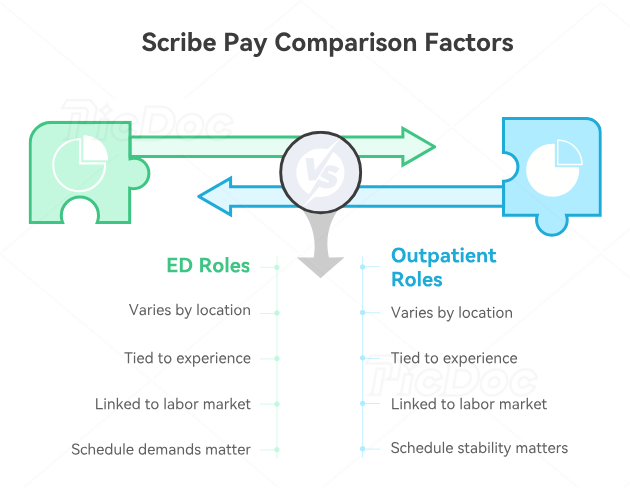
Setting alone is a poor predictor of scribe pay. Employer, city, state minimum wage, experience, staffing model, and local labor competition can matter more. Current ScribeAmerica postings make this easy to see. An ED role in Alton, Illinois listed $15 per hour, while an outpatient women's-health role in Boston listed $16 per hour. These locations are obviously different labor markets, so the figures cannot establish an outpatient premium. More importantly, another current ScribeAmerica posting describes both outpatient and emergency-department scheduling under the same medical-scribe role while advertising compensation of $20.82–$21.30, dependent on qualifications, experience, and location.
The practical lesson is to compare actual offers rather than assuming the ED deserves or automatically receives higher compensation. Read the hourly rate alongside required availability, commute, unpaid preparation, overnight expectations, shift length, training pay, benefits eligibility, and whether extra responsibilities are being added. A seemingly better hourly rate can become poor scribe-job ROI when the job damages grades, sleep, or interview preparation. Someone already questioning whether scribing is worth it should evaluate compensation together with clinical exposure and career value.
Reddit discussions consistently flag low pay as one of scribing's biggest weaknesses across settings. In the 2026 premed discussion comparing experiences, the recurring message was that compensation may be disappointing while individual physicians can make the learning experience unusually worthwhile. Another discussion included outpatient and ED scribes who praised what they learned while still criticizing compensation relative to workload. This is why comparing ScribeAmerica and private-practice positions, understanding medical-scribe hiring barriers, considering remote scribe work, and assessing whether certification adds employer value can materially affect your options.
A strong offer therefore needs to pass two tests: financial sustainability and developmental return. If $1 more per hour comes with constant schedule disruption while another position provides stable hours, close mentorship, strong clinical communication experience, and time to maintain academic performance, the nominally higher wage may be the weaker choice. Conversely, low pay becomes increasingly difficult to justify when the job also provides weak training, repetitive templating, little patient interaction, and no meaningful path toward physician mentorship.
5. Which Scribing Setting Should You Choose for Premed?
Choose the ED when your biggest educational gap is understanding how medicine works before the answer is known. It is particularly valuable for students who want exposure to broad pathology, hospital workflow, consultation, acute decision-making, diagnostic uncertainty, and rapid team communication. It can also help applicants develop stronger examples of observing difficult patient interactions, high-stakes verbal communication, urgent patient education, and changing clinical plans.
Choose outpatient scribing when you would benefit more from specialty depth, repeated mentorship, or a predictable routine. Students carrying a difficult course load or studying for the MCAT may gain more from stable weekdays than from theoretically broader exposure obtained while chronically sleep-deprived. Outpatient work also becomes particularly attractive when you are genuinely interested in a specialty, because repetition can build deeper command of specialty terminology, patient counseling, longitudinal rapport, and precise clinical documentation.
Before saying yes, ask the employer questions that expose the actual job behind the title. Find out how many patients the physician typically sees, how many active charts you may manage, which providers you will work with, how often schedules rotate, whether nights or weekends are mandatory, how long supervised training lasts, how chart quality is audited, whether pre-charting is paid, how breaks work during busy shifts, whether scribes stay after clinic to close charts, and whether physicians commonly mentor pre-health students. Those answers tell you more than generic claims about scribe certification, job competitiveness, remote opportunities, or employer branding.
Also investigate the provider-to-scribe relationship, because it can transform the value of either setting. An ED where you repeatedly work with physicians who explain their reasoning can outperform a prestigious outpatient specialty where you simply populate templates. A small outpatient clinic where physicians invest in your growth can outperform a busy hospital where you remain anonymous. The strongest premed clinical experience is the one that eventually lets you explain how you observed medicine, how your thinking changed, and what you learned about patients rather than merely reporting a large hour total.
AAMC's current guidance specifically lists medical scribing among ways students can gain healthcare experience and describes scribing as an opportunity to work closely with physicians and observe clinical decision-making. That means the better setting is ultimately the one that produces the strongest combination of sustainable workload, meaningful observation, physician access, professional growth, and enough financial practicality to stay in the role long enough to learn from it.
6. FAQs About ED vs Outpatient Medical Scribing
-
ED scribing is often stronger for applicants who need broad exposure because it shows acute presentations, diagnostic uncertainty, hospital workflow, consultations, disposition decisions, and multiple specialties. Outpatient scribing can be equally valuable when it provides deeper physician relationships, longitudinal care, specialty knowledge, and stronger opportunities for mentorship. Medical schools care about what you learned from your clinical experience, so the quality of your scribe experience matters more than choosing the more dramatic setting simply to accumulate clinical hours. A sustainable outpatient role can produce a stronger application story than an ED position that causes burnout and poor academic performance.
-
Usually, ED scribing creates greater unpredictability because patient arrivals, acuity, interruptions, active charts, consultations, and dispositions can overlap. Outpatient clinics generally provide scheduled patient flow, although high-volume specialty clinics can still be extremely demanding. Reddit experiences reflect both patterns: ED scribes frequently describe a steeper initial learning curve and unusual hours, while some outpatient scribes describe specific specialties as surprisingly stressful. Your actual stress level will depend on staffing, training, physician expectations, chart volume, communication demands, documentation requirements, and how effectively the organization prevents premed burnout.
-
There is no reliable rule that ED scribes earn more. Current postings show compensation changing substantially by geographic market, employer, qualifications, and state rather than following a simple ED-versus-outpatient hierarchy. ScribeAmerica itself states that wages may vary based on experience, location, and state. Compare the actual hourly offer alongside shift expectations, paid training, commute, benefits, night requirements, and workload. That calculation gives a better view of low-pay ROI than the setting label. Applicants should also compare private-practice scribe jobs and remote scribe positions before assuming the first offer represents the market.
-
Outpatient clinics frequently have an advantage because you may work with the same physician repeatedly for months, allowing that doctor to observe your reliability, professionalism, curiosity, improvement, and understanding of patient care. Reddit users with experience in both environments have specifically identified this relationship-building advantage. ED scribes can still obtain outstanding letters when scheduling creates repeated pairings with particular physicians. The key is depth of interaction. Strong professionalism, thoughtful verbal communication, reliable team communication, and visible improvement make a physician far better able to write a detailed letter.
-
A strong outpatient position can provide excellent clinical exposure. You may observe dozens of physician-patient encounters each day while learning histories, diagnostic reasoning, medication management, specialty-specific examinations, referrals, procedures, follow-up decisions, and chronic disease management. AAMC's first-person outpatient scribe profile describes close physician collaboration and extensive exposure to clinical decision-making. The bigger question is whether your role lets you understand the encounters rather than functioning as passive template entry. Look for exposure to patient interactions, medical terminology, patient education, and genuine physician reasoning.
-
Consider whether medical assisting may fit better than scribing. Scribing gives exceptional proximity to physician thinking and documentation, while direct-care roles can provide more hands-on responsibility and patient interaction. The choice should follow the gap in your existing experience. Someone who already has substantial bedside exposure may gain more from observing diagnostic reasoning as a scribe. Someone whose entire résumé consists of observation may benefit from a more patient-facing role. Evaluate the decision alongside clinical-hour quality, premed scribing regrets, and the broader question of whether medical scribing still deserves your time.
