

Best Medical Scribe Companies to Work For in 2026: Reddit Experiences Compared by Pay, Training, Flexibility & Support
The best medical scribe company in 2026 depends on the return you need from the job: reliable clinical experience, structured scribe training, flexible scheduling, physician access, or enough pay to make the hours sustainable. Current postings and Reddit experiences show enormous variation even inside the same company. ScribeAmerica, Scribe-X, ProScribe, Scribekick, Scribe.ology, and direct health-system programs all offer viable routes, while placement quality often determines whether medical scribing is worth it.
1. Which Medical Scribe Companies Are Actually Best to Work For in 2026?
For a first-time applicant who needs structured training and the widest geographic access, ScribeAmerica remains one of the strongest entry routes. Its current job pages advertise more than 3,000 locations, paid Scribe University training, hands-on clinical instruction, full- and part-time positions, and work across more than 80 specialties. A current Boston posting lists $16 per hour, while a Bellevue, Washington posting lists $20.82–$21.30, demonstrating how sharply compensation can change by market.
That scale is valuable for candidates struggling with how hard it can be to get a scribe job, especially applicants without prior medical transcription experience, formal medical scribe certification, or extensive healthcare communication experience. The recurring weakness is site variability. Recent Reddit reports range from strong praise for the training to complaints about low wages, delayed floor placement, management turnover, and contracts being disrupted as AI scribes replace portions of human documentation work.
Scribe-X is one of the strongest options for applicants specifically seeking remote work. Its current careers material advertises U.S.-based remote medical-scribe roles, specialty-specific training, ongoing quality coaching, provider assignment, paid training, paid-time-off eligibility, progression milestones, and application-oriented benefits at higher hour thresholds. Its model increasingly combines human judgment with AI-generated documentation, which makes the role relevant to the changing healthcare automation environment while preserving experience in clinical documentation, provider communication, and real patient encounters.
The financial side deserves scrutiny. Reddit experiences have repeatedly reported starting wages around the low teens in some states, and workers have described inconsistent experiences with promised raises or provider placement. A 2026 applicant reported that Scribe-X placement with an actual physician could take roughly two to four weeks after equipment and onboarding, while earlier employees described the benefits of consistent provider schedules alongside concerns about management and contract loss to AI. That combination makes Scribe-X attractive for someone prioritizing remote medical scribe work, predictable commuting costs, physician mentorship, and application-building over maximum immediate earnings.
Scribekick currently has some of the better employee-support signals among the national scribe companies. Indeed shows a 3.8/5 medical-scribe rating, including 3.8 for work-life balance and roughly 3.6–3.7 for management depending on the current review view. Glassdoor reviews from 2026 mention accommodating management, patient trainers, and strong learning value, while repeatedly identifying low pay, limited benefits, provider-placement delays, and AI-related instability as weaknesses. A Reddit commenter who joined Scribekick in 2025 specifically praised training and management support.
That profile can work well for applicants prioritizing work-life balance, supportive team communication, exposure that strengthens premed clinical experience, and a provider relationship capable of producing a recommendation. Applicants who need dependable full-time income should verify guaranteed hours before accepting.
ProScribe deserves consideration for specialty variety and geographic opportunity, especially because current listings include emergency medicine, neurosurgery, family medicine, virtual roles, and multiple shift structures. Current postings surfaced through Indeed include roughly $15.75–$17.75 in Delaware emergency medicine and $17.68–$18.43 in Oregon emergency medicine, though rates vary substantially by location. Reddit and employee-review data remain mixed: some scribes praise flexible scheduling and physicians, while others report slow credentialing, weak communication, modest compensation, and inconsistent training experiences.
For someone comparing ScribeAmerica with private-practice work, evaluating low scribe pay against clinical ROI, or choosing between scribing and medical assisting, ProScribe should be judged by the specific site offer, rather than its national brand alone.
Scribe.ology is particularly interesting for emergency-department exposure. Its 2026 careers page describes structured onboarding, coaching, ongoing feedback, scheduling support, and substantial emergency-medicine operations. It requires at least a six-month part-time commitment and warns that nights, weekends, and holidays can occur. Employee reviews praise clinical exposure while consistently criticizing compensation; Indeed currently estimates medical-scribe pay around $11.78 overall, with some 2026 reviewers reporting approximately $10 at their locations.
Vituity is worth checking whenever it directly operates a scribe program in your market. Its medical-scribe reviews currently sit around 3.9/5 on Indeed, with 3.9 for work-life balance and 3.5 for management. Recent reviews acknowledge a steep learning curve and potentially lengthy onboarding before floor work begins. Candidates wanting intensive emergency-medicine exposure, stronger clinical teamwork, better professional communication, and repeated physician contact should include direct hospital and health-system programs in the search instead of limiting applications to dedicated scribe companies.
| Company / Route | Strongest Advantage | Training / Support Signal | Flexibility | 2026 Watch-Out |
|---|---|---|---|---|
| ScribeAmerica — Outpatient | Huge geographic footprint | Paid Scribe University + floor training | Part- and full-time roles | Pay and management vary heavily by site |
| ScribeAmerica — ED | Broad acute-care exposure | Structured classroom and floor pathway | Often shift based | Nights, weekends, AI contract changes |
| ScribeAmerica — Remote | Entry access without commute | Company training infrastructure | Potentially strong for students | Availability and pay are market specific |
| Scribe-X — Remote Scribe | Dedicated-provider model | Paid specialty training + coaching | Strong remote appeal | Placement timing and lower starting pay |
| Scribe-X — Healthcare Assistant | AI-assisted modern workflow | Quality coaching | Remote | Role may provide different exposure from classic live scribing |
| ProScribe — Emergency Medicine | Strong specialty exposure | Formal training plus site training | Multiple shift windows | Credentialing and communication delays reported |
| ProScribe — Outpatient | Specialty variety | Site-dependent mentorship | Predictable clinic schedules possible | Provider quality strongly determines experience |
| ProScribe — Virtual | Remote specialty jobs | Company onboarding | High if schedule matches provider | Time-off and management experiences vary |
| Scribekick — Virtual | Good support signals | Training and responsive support emphasized | Remote-friendly | Low pay and provider-placement delays reported |
| Scribekick — On-Site | Provider relationship potential | Support team + training | Site specific | Openings may be geographically limited |
| Scribe.ology — ED | Intensive emergency exposure | Structured onboarding + leads | Shift based | Low compensation repeatedly reported |
| Scribe.ology — Clinic | Longitudinal physician exposure | Coaching and feedback | Potentially predictable | Six-month minimum commitment |
| Vituity | Health-system and ED integration | Formal onboarding | Good work-life reviews overall | Onboarding can take months |
| IKS / AQuity Legacy Roles | Remote documentation experience | Historically extensive virtual training | Remote | AI transition and hour stability require careful verification |
| Private Practice Direct Hire | Potentially better pay and mentorship | Highly variable | Often predictable weekday schedule | Training may lack structure |
| Hospital Direct Hire | Better integration and possible benefits | Hospital-specific | Depends on department | May require previous experience |
| Academic Medical Center | Teaching environment and network | Potentially excellent | Department dependent | Competitive hiring |
| Specialty Clinic Direct Hire | Deep specialty learning | Provider-dependent | Often daytime weekday hours | Narrower pathology exposure |
2. ScribeAmerica vs Scribe-X vs ProScribe vs Scribekick: Which One Wins on Pay, Training and Flexibility?
ScribeAmerica wins on infrastructure and entry-level accessibility. Applicants who need their first medical scribe job can benefit from a company willing to teach medical terminology, EHR documentation, confidential communication, and basic clinical professionalism without requiring previous scribing experience. Its current postings explicitly state that experience is unnecessary and training is paid.
The painful variable is site execution. A strong chief scribe, responsive regional manager, stable hospital contract, and predictable provider group can produce an excellent experience. A poorly staffed site can create weeks between training stages, inconsistent schedules, limited support, and frustration. Recent 2026 Reddit discussions include both a former employee calling the training one of the company's strongest features and current applicants worrying about long delays between Scribe University and floor training.
This makes the existing ScribeAmerica versus private-practice comparison particularly important. A lower-paying structured position may still make sense when you need clinical hours, training, physician exposure, and your first credible healthcare reference. The trade weakens once low pay begins causing financial strain or you already possess substantial experience.
Scribe-X wins more clearly for applicants prioritizing remote work plus a consistent provider relationship. Its current model explicitly emphasizes dedicated providers, specialty-specific training, coaching, and progression milestones. That can improve professional rapport, team communication, written documentation, and the possibility of eventually earning a meaningful physician recommendation.
The major question is whether the actual assigned hours and wage support your financial needs. Earlier Reddit reports repeatedly place starting compensation in the low teens in some markets. Workers have also discussed clinics transitioning to AI and the resulting need for reassignment. Someone choosing Scribe-X primarily for remote flexibility should therefore ask whether weekly hours are guaranteed, what happens when a provider leaves, and how quickly the company reassigns a displaced scribe.
ProScribe is strongest when the specific posting fits your specialty and schedule. Current jobs span emergency medicine, neurosurgery, outpatient medicine, and virtual roles. That breadth can produce excellent exposure to clinical decision-making, complex medical documentation, provider communication, and clinical teamwork. Current pay examples in Delaware and Oregon are meaningfully higher than many older Reddit reports, which reinforces how much location matters.
Employee experience still appears highly site-dependent. Recent Indeed reviews describe valuable learning alongside concerns over scheduling, communication, pay, and slow credentialing. A 2025 Reddit commenter described flexible scheduling and an excellent team while also reporting a roughly two-month path from application to in-person training.
Scribekick has the strongest case when management quality and remote work environment matter heavily. Its employee-review scores compare favorably with several competitors, particularly on work-life balance and management, while its own service materials emphasize responsive support and training. That can matter enormously for students balancing scribe work with academics, protecting against scribe burnout, accumulating clinical experience, and developing consistent professional communication.
The weakness remains compensation and placement certainty. Current employee reviews praise people and training while identifying low pay, limited benefits, provider coverage problems, and delays obtaining placement.
3. What Matters More Than the Company Name When Comparing Scribe Jobs?
Guaranteed usable hours matter more than advertised flexibility.
A company can promise part-time work, yet give you one irregular shift weekly. Another can advertise a low hourly wage while consistently providing 25 hours, predictable providers, and easy coverage. A candidate evaluating how many scribe hours they actually need, whether scribing counts as meaningful clinical experience, and whether low pay remains worthwhile should ask for a realistic weekly-hour range, not merely the words “part time.”
Current Reddit wage reports demonstrate the spread. In April 2026, scribes reported figures ranging from about $10 in Kentucky outpatient work and $12 in Georgia hematology/oncology to $21 in California urgent care, $21 in Los Angeles hematology/oncology, $22 with a California night differential, and $23.47 at a Washington family-medicine practice. These are individual reports rather than standardized national rates, yet they show why company averages can hide the actual economics of a specific offer.
Training quality matters most during the first 100–300 hours. Strong training should teach where information belongs in the note, how to distinguish history from assessment, how to capture pertinent negatives, how to handle uncertainty, how to use the EHR, and when to ask a provider for clarification. These capabilities overlap with medical transcription skills, accurate written communication, secure healthcare communication, and appropriate professional assertiveness.
Provider continuity matters enormously for premeds. Working consistently with one physician can create deeper learning, better feedback, and a stronger potential recommendation than rotating anonymously among dozens of providers. A consistent physician sees whether your documentation improves, whether you handle team communication well, whether your professionalism holds under pressure, and whether your understanding of patient communication matures.
Contract stability has become a serious 2026 criterion. Reddit discussions across ScribeAmerica, Scribe-X, and IKS/AQuity include workers whose providers or sites moved toward AI documentation. Anyone entering scribing now should ask what happens if the client ends the contract, whether the scribe is reassigned, whether pay continues during reassignment, and how long recent reassignments have taken. That question directly addresses the risk created by AI medical scribes and rapidly changing healthcare automation.
4. Which Scribe Company Is Best for Premeds, Gap-Year Students and Remote Workers?
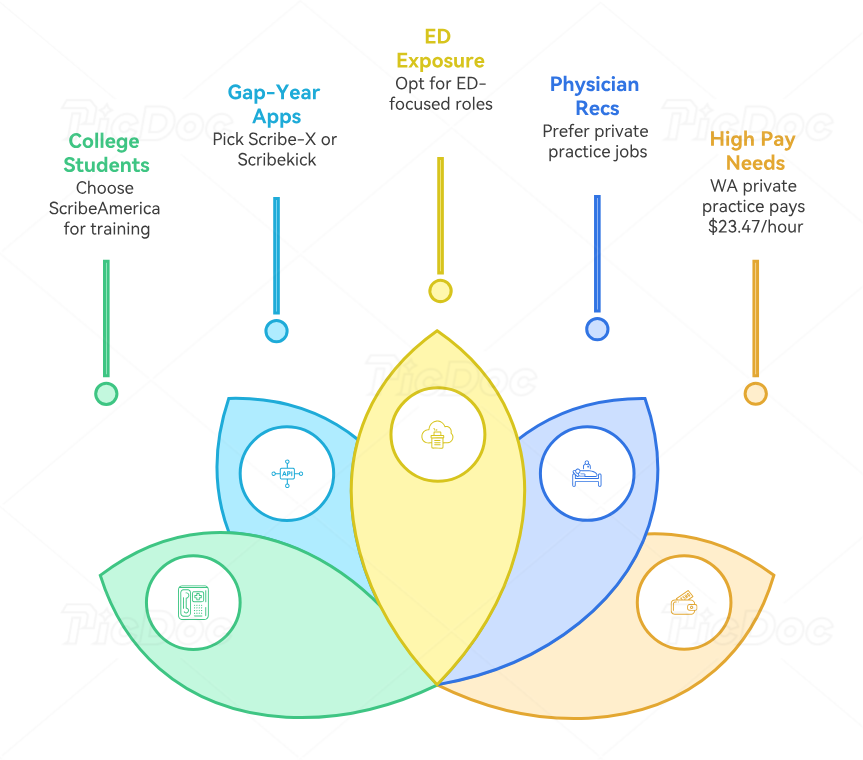
For a college student with little healthcare experience, ScribeAmerica deserves a serious application because the structured training and enormous site network can lower the entry barrier. A student still developing medical terminology, clinical written communication, professionalism, and healthcare communication may benefit more from strong onboarding than from chasing an extra dollar per hour at an unstructured clinic.
For a gap-year applicant who needs remote flexibility, Scribe-X and Scribekick become more attractive. Scribe-X's dedicated-provider concept can facilitate mentorship, while Scribekick currently carries relatively favorable support and work-life review signals. A remote applicant should still understand the limitations of remote medical scribing, especially reduced physical immersion in the clinical environment, dependence on audio/video quality, and the possibility that AI-assisted documentation changes the traditional scribe role.
For someone seeking maximum emergency-medicine exposure, Scribe.ology, Vituity, ProScribe ED roles, or a strong ScribeAmerica ED placement may provide excellent learning. Emergency departments force rapid mastery of clinical communication, complex medical documentation, difficult patient interactions, and careful confidential communication. The schedule can include nights, weekends, holidays, and unpredictable shift lengths, making schedule conflict management important.
For someone who needs a physician recommendation, direct private-practice employment may outperform every national company when the job places you with one or two physicians repeatedly. The opportunity to build professional rapport, demonstrate team communication, improve clinical documentation, and show consistent professional behavior can produce far richer firsthand evidence than frequent provider rotation.
For someone who needs money as much as clinical hours, search direct hospital and private-practice jobs before accepting a national scribe-company offer. Reddit's April 2026 wage discussion included a Washington private-practice scribe reporting $23.47 per hour, substantially above several lower-paying company and regional examples. Comparing scribe pay with clinical ROI, medical assisting versus scribing, premed scribing regrets, and the overall question of whether scribing remains worth it can prevent hundreds of poorly compensated hours.
5. What Should You Ask Before Accepting Any Medical Scribe Job in 2026?
The interview should function as due diligence on the employer.
Ask for the exact wage during classroom training, floor training, and independent work. Some employers historically used different rates during different phases. Ask whether scheduled provider cancellations are paid, whether waiting time between training stages is compensated, and whether the company guarantees a minimum number of weekly hours. Those details determine the actual economics far more accurately than an advertised hourly rate.
Then investigate the placement itself. Ask which specialty you will enter, how many physicians you will regularly support, which EHR they use, typical patient volume, average shift length, and whether the provider works through lunch. Those questions reveal how quickly you will need to develop medical transcription fluency, written documentation skills, patient communication awareness, and clinical teamwork.
Ask how coverage works when you need an exam day, medical-school interview, vacation, or unexpected absence. “Flexible scheduling” has little value when every absence requires you to personally find a replacement from a tiny understaffed pool. Strong scheduling conflict management, clear professional communication, reliable team coordination, and realistic staffing protect both the scribe and provider.
Ask one question that has become essential in 2026: “If this provider or site switches to AI documentation or ends the scribe contract, what happens to me?”
You want a concrete answer. Reassignment within two weeks is very different from indefinite unpaid waiting. Recent Reddit experiences across multiple employers show that AI documentation adoption can alter placements quickly. Applicants should develop transferable healthcare automation skills, clinical communication, and documentation judgment alongside traditional typing speed.
Finally, ask how performance feedback works. A company that grades charts, provides coaching, and explains errors can accelerate development. A company that waits until performance is considered unacceptable before giving meaningful feedback creates unnecessary risk. This matters for applicants building clinical experience, trying to avoid scribe-job rejection patterns, deciding whether certification provides enough preparation, and protecting themselves from common premed scribing regrets.
A strong offer should leave you able to answer five questions clearly before signing: What will I earn? When will I actually start? How many hours will I realistically receive? Who will train and support me? What happens if my placement disappears?
Those answers matter more than the logo on the employment contract.
6. FAQs About the Best Medical Scribe Companies in 2026
-
For entry-level accessibility and training infrastructure, ScribeAmerica remains one of the strongest overall options because of its enormous footprint, paid training, specialty variety, and willingness to hire applicants without prior experience. Current postings show major geographic differences in compensation, including $16 in Boston and above $20 in Bellevue.
Applicants should still compare the actual site against private-practice scribe positions, evaluate pay versus clinical return, consider whether the job builds enough clinical experience, and understand the risk created by AI scribe adoption.
-
Scribe-X deserves a strong look because its current careers platform explicitly recruits U.S.-based remote scribes and advertises structured onboarding, specialty training, provider assignment, ongoing coaching, paid training, and progression benefits. Scribekick also performs relatively well on employee-review measures for work-life balance and management.
Remote applicants should compare remote scribe hiring barriers, medical scribe training requirements, healthcare automation trends, and the value of secure healthcare messaging before choosing a fully virtual role.
-
There is no single national company that consistently produces the highest wage across every market. Geography, state minimum wage, specialty, employer contract, seniority, shift differential, and whether the job is a direct hire can move compensation dramatically.
Current 2026 ScribeAmerica postings range from $16 in Boston to $20.82–$21.30 around Bellevue. Current ProScribe postings surfaced through Indeed include approximately $15.75–$18.43 for certain emergency-department positions. Reddit users have reported private-practice or specialty jobs above $20 in several higher-cost markets.
Applicants should therefore compare low medical scribe pay, ScribeAmerica versus private practice, medical assisting versus scribing, and the amount of clinical experience they still need.
-
ScribeAmerica has one of the clearest formal training pipelines for inexperienced applicants. Its current postings specifically advertise paid Scribe University education followed by hands-on clinical instruction. Scribe-X also advertises structured onboarding, specialty-specific training, ongoing quality coaching, and progressive support.
Strong training should ultimately improve medical transcription, written clinical communication, professional communication, and confidential healthcare communication. Applicants should ask how many supervised charts they complete and how feedback works before being released to work independently.
-
Experiences vary dramatically by location, management, specialty, provider, and contract. Current Reddit discussions include substantial criticism around pay, management, and placement delays alongside positive comments about training, physician relationships, and valuable clinical exposure.
The useful comparison is the specific offer. Evaluate the exact ScribeAmerica versus private-practice trade-off, understand whether medical scribing fits your premed goals, assess clinical-hour needs, and account for the risk of scribe burnout.
-
Direct clinic employment can produce higher pay, closer physician relationships, predictable schedules, and deeper specialty exposure. A national company can provide stronger standardized training, easier entry for inexperienced applicants, replacement coverage, and more infrastructure when something goes wrong.
Someone already comfortable with medical documentation, medical terminology, clinical professionalism, and provider communication may gain more from a strong direct-hire clinic. A first-time scribe may benefit more from a structured employer.
Current Reddit wage data also show why direct employment deserves investigation: one Washington family-medicine scribe reported $23.47 per hour in 2026, while several company and lower-cost-market positions were considerably lower.
