

How Fast Do Medical Scribes Need to Type? Reddit Benchmarks, Accuracy Targets & a 30-Day Practice Plan
Typing speed can decide whether a new scribe keeps pace with a provider or spends the entire shift recovering from a documentation backlog. Current hiring requirements, however, vary considerably by employer and clinical setting. Applicants preparing for a first medical scribe job need to measure more than raw words per minute. Strong medical terminology, accurate written communication, disciplined clinical documentation, and simultaneous listening matter just as much when the encounter becomes fast.
1. How Fast Do Medical Scribes Actually Need to Type in 2026?
A useful starting benchmark is 40 WPM, because current ScribeAmerica job postings explicitly list typing speed of 40+ WPM among their requirements. That gives applicants preparing for a medical scribe interview a documented hiring floor rather than an internet guess. The same postings also require strong listening and communication skills, which reinforces the importance of pairing typing ability with verbal communication and accurate team communication.
Treat 40 WPM as an entry benchmark rather than a comfortable clinical target. A person can score 40 WPM while copying familiar English and still struggle when a physician rapidly describes radiating pain, medication changes, pertinent negatives, imaging findings, and follow-up instructions. Familiarity with medical transcription terminology, structured patient interactions, and clear professional communication changes how efficiently those words become a usable note.
For most beginners, 50–60 WPM with consistently high accuracy is a stronger readiness target. At that range, there is more processing capacity available for deciding where information belongs, recognizing terminology, following the provider, and correcting errors. Applicants targeting demanding emergency departments, high-volume outpatient clinics, or specialties with information-heavy histories should work toward 60–70+ WPM while preserving accuracy.
Reddit experiences support this wider range. In a 2026 discussion, an applicant reported averaging 53 WPM against a stated 40 WPM requirement, while another commenter described a site-specific expectation above 50 WPM. Older discussions similarly show requirements varying between sites, with some users reporting 40, 50, 55, 60, or even 70 WPM expectations.
That variation matters when comparing ScribeAmerica and private-practice scribe jobs. One provider may dictate slowly and use extensive templates. Another may see patients rapidly and expect the scribe to move between HPI, examination findings, results, and disposition without falling behind. A remote medical scribe may face an additional listening burden because audio quality, accents, speaker overlap, and connection quality influence comprehension.
A practical benchmark ladder looks like this:
Under 40 WPM: typing mechanics deserve immediate work before a demanding live workflow.
40–49 WPM: potentially employable for some openings, with limited margin during rapid encounters.
50–59 WPM: workable beginner range when accuracy and listening are strong.
60–69 WPM: solid target for many new scribes.
70–79 WPM: strong clinical buffer for fast providers and dense encounters.
80+ WPM: excellent raw speed, provided documentation accuracy remains high.
The applicant sitting at 48 WPM with excellent medical vocabulary, effective shorthand, strong listening, and controlled error rates can outperform somebody hitting 75 WPM while repeatedly misunderstanding clinical information.
| Benchmark | What It Tells You | Clinical Risk | Best Next Move |
|---|---|---|---|
| Under 30 WPM | Keyboard mechanics consume too much attention | Severe encounter backlog | Rebuild touch-typing mechanics |
| 30–34 WPM | Basic fluency is developing | Rapid providers will outrun capture | Prioritize accuracy and home-row control |
| 35–39 WPM | Approaching common entry thresholds | Little recovery margin | Build sustained 5-minute speed |
| 40–44 WPM | Meets some current employer minimums | Complex encounters can expose weaknesses | Add medical-term drills |
| 45–49 WPM | Reasonable early applicant range | Multitasking may cut effective speed sharply | Practice listening while typing |
| 50–54 WPM | Functional beginner benchmark | Fast specialty vocabulary can create lag | Build terminology automaticity |
| 55–59 WPM | Useful working buffer | Long HPIs may still create backlog | Train encounter-style transcription |
| 60–64 WPM | Strong target for applicants | Errors become the larger concern | Protect 95–98% typing accuracy |
| 65–69 WPM | Good real-time capacity | Weak clinical filtering can still cause delays | Practice extracting relevant facts |
| 70–74 WPM | Strong clinical typing speed | Terminology errors become more visible | Use specialty-specific drills |
| 75–79 WPM | Comfortable buffer for many workflows | Overtyping wastes time | Improve concise capture |
| 80–89 WPM | Excellent raw speed | Speed can hide comprehension mistakes | Audit content accuracy |
| 90+ WPM | High keyboard fluency | Clinical judgment remains limiting factor | Train note architecture and listening |
| 95% Accuracy | Usable training floor | Five errors per 100 keystroke opportunities add correction time | Slow slightly and stabilize |
| 98% Accuracy | Strong typing-practice target | Lower correction burden | Increase speed gradually |
| 60 WPM General Text | Measures keyboard fluency | May overstate clinical readiness | Retest with medical text |
| 60 WPM Medical Text | Better specialty-readiness signal | Listening load remains untested | Add audio transcription |
| 60 WPM While Listening | Strong live-workflow indicator | Information selection still matters | Practice structured HPI capture |
| Fast WPM + Low Accuracy | Speed is inflated by mistakes | Unsafe or inefficient documentation habits | Reduce pace until errors stabilize |
| Moderate WPM + Strong Accuracy | Strong foundation for training | Speed ceiling may appear during volume | Build speed without sacrificing precision |
2. Accuracy Targets Matter More Than Chasing a Flashy WPM Score
ScribeAmerica's July 2026 typing guidance advises learners to slow down until they can consistently maintain roughly 95–98% typing accuracy, then increase speed through repetition and muscle memory. It also recommends regular 15–30 minute practice sessions.
That produces a much better training rule than chasing a single personal-best WPM score.
Suppose you hit 72 WPM once with 91% accuracy. You repeatedly backspace, lose your place, and mistype unfamiliar drug names. Another applicant maintains 60 WPM at 98% accuracy while handling medical terminology and structured written communication comfortably. The second profile creates a stronger foundation for reliable documentation because correction work consumes time and attention.
There is also an important distinction between typing-test accuracy and clinical documentation quality.
Typing accuracy asks whether you pressed the intended keys correctly. Clinical quality asks whether the resulting chart accurately represents the encounter. A scribe can type every word perfectly and still place a symptom under the wrong section, omit a pertinent negative, mishear a medication, convert provider uncertainty into a confirmed diagnosis, or document information the provider never stated.
AHDI's updated healthcare documentation quality guidance recommends a 98% QA score as a minimum industry best-practice standard for documentation created by an HDS or scribe. That QA measurement evaluates documentation quality rather than simple keyboard accuracy.
This distinction should change how you practice.
Train mechanical accuracy through typing drills. Train clinical accuracy through medical transcription exercises, patient communication scenarios, confidential communication, and encounter reconstruction. Train judgment by learning which facts belong in the HPI, ROS, exam, assessment, and plan.
The pain point appears when these three forms of accuracy collide in real time. You hear a provider say that the patient denies fever, reports worsening right-lower-quadrant pain for two days, vomited twice, recently changed medication, and had equivocal imaging elsewhere. Your fingers need to move while your brain performs classification, chronology, terminology recognition, and omission control.
That is why applicants who understand professional medical communication, patient rapport, and therapeutic communication often have an easier time separating conversational noise from clinically meaningful information.
Measure three speeds instead of one
Your training dashboard should contain three separate numbers:
1. General-text WPM.
This measures raw keyboard fluency.
2. Medical-text WPM.
Use passages containing medications, anatomical terminology, symptoms, abbreviations, and clinical phrasing. This exposes weaknesses that ordinary typing tests hide.
3. Listen-and-document WPM.
Play an encounter-style recording and type while listening. This measures the skill closest to actual scribing.
A Reddit user illustrated the gap clearly by reporting 60+ to 70+ WPM on ordinary typing tests while struggling around 45–50 WPM when unfamiliar medical vocabulary was introduced. Another commenter reported that reducing speed initially helped them improve medical-term accuracy.
Applicants preparing for remote scribing should add a fourth measurement: audio-under-friction performance. Practice with ordinary speakers, background noise, variable cadence, and unfamiliar terminology. Combine that with secure messaging awareness, virtual check-in workflows, and professional phone communication because remote documentation frequently happens inside a broader digital workflow.
3. What Reddit Medical Scribes Reveal About Real-World Typing Speed
Reddit discussions become useful when you treat them as field reports rather than universal hiring standards.
One medical scribe reported starting around 50 WPM in neurosurgery and eventually reaching roughly 100–110 WPM after 1.5 years. Other scribes in the same discussion reported approximately 73–79 WPM, while another described progressing from around 30 WPM to 70–100+ WPM depending on the task.
A separate Reddit thread gives an even more useful example because it connects speed to actual floor training. One new scribe reported working around 40–50 WPM and receiving feedback that they were too slow. A commenter said they had started at 51 WPM and reached 72 WPM by their first solo week, while another recommended typing along with HPI practice scenarios or even television dialogue to develop simultaneous listening and typing.
That training method has direct clinical value.
Copying text teaches finger movement. Listening to a speaker while creating a written representation introduces working-memory pressure. Adding medical vocabulary makes the exercise more realistic. Converting that information into a structured note adds the written communication skill employers actually need.
Another Reddit discussion shows why typing technique itself can be overemphasized. Users reported speeds around 86–90 WPM while relying heavily on pointer fingers, and commenters focused primarily on whether the person could maintain speed and accuracy.
Proper touch typing still offers major advantages for most beginners. Looking down at the keyboard steals visual attention from the EHR, provider, patient, results panel, and note structure. Training toward automatic key location frees cognitive bandwidth for patient documentation, non-verbal communication, and the provider's changing priorities.
Reddit also repeatedly highlights shortcuts, SmartPhrases, templates, and shorthand. Experienced scribes describe these tools as major productivity multipliers.
That matters in 2026 because clinical documentation increasingly sits beside healthcare automation tools and AI scribe systems. Future-proof scribe skill comes from fast information capture, strong judgment, clean correction, and the ability to recognize when automated documentation has distorted what actually happened.
A student asking whether medical scribing is worth it for premed should therefore view typing speed as a capacity multiplier. Higher speed gives you room to observe the provider's reasoning, notice communication patterns, learn bedside manner, and understand how a clinical encounter becomes a defensible record.
4. The 30-Day Medical Scribe Typing Practice Plan
A productive 30-day plan trains the bottleneck that appears after ordinary typing becomes automatic: hearing information, understanding it, selecting relevant details, and recording them accurately under time pressure.
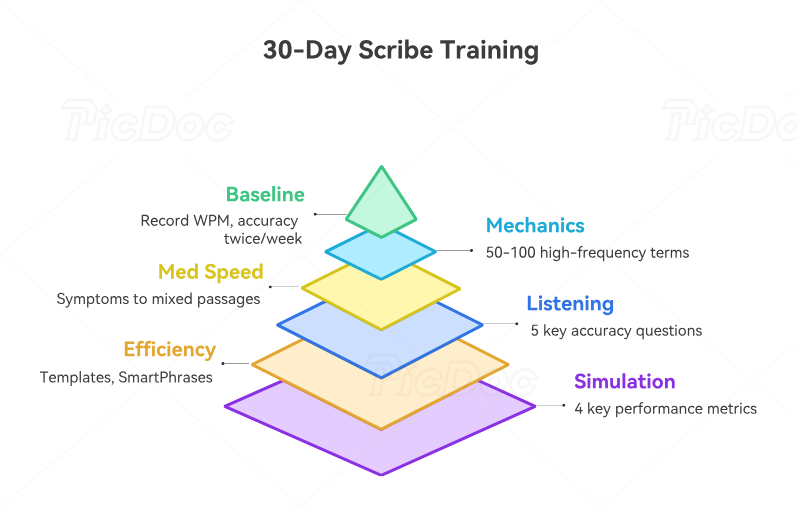
Use 30–40 minutes per day, six days per week. Keep one recovery day. Record general WPM, medical WPM, accuracy, and listening-documentation performance at least twice each week.
Days 1–5: Establish an honest baseline
Day 1: Complete three one-minute general typing tests. Record the median result rather than your highest result. Then complete one five-minute test. A five-minute sample exposes fatigue and inconsistency that a lucky 60-second burst can hide.
Day 2: Repeat the test using medical vocabulary. Pull terms from medical transcription terminology, symptoms, medications, anatomy, diagnostics, and common abbreviations. Record the difference between ordinary WPM and medical WPM.
Day 3: Practice touch typing at a pace where you maintain at least 95–98% accuracy. ScribeAmerica's current guidance specifically emphasizes accuracy before acceleration.
Day 4: Type while listening to a slow healthcare lecture, mock encounter, or clinical explanation. Train your ears and fingers together. Strong verbal communication awareness helps you identify changes in emphasis, uncertainty, and chronology.
Day 5: Review your error log. Categorize errors as wrong key, capitalization, punctuation, unfamiliar terminology, missed word, spelling uncertainty, or attention failure. That error classification tells you what to train next.
Days 6–10: Remove wasted keyboard movement
Spend 10 minutes on controlled typing mechanics, 10 minutes on normal prose, and 10 minutes on clinical terms.
Your goal is smoothness. Watch for repeated backspacing, excessive hand movement, looking down at keys, and pauses before common letter combinations. Strong written medical communication depends on automatic mechanics because clinical attention should remain available for meaning.
During this block, build a personal list of 50–100 high-frequency terms. Include words such as hypertension, tachycardia, abdominal, bilateral, intermittent, tenderness, radiating, denies, prescribed, follow-up, discharge, worsening, onset, associated, and history.
Practice entire phrases as units:
“denies fever or chills”
“worsening over the past three days”
“radiates to the lower back”
“no known drug allergies”
“return precautions discussed”
“follow up with primary care”
Phrase-level fluency gives you more value than repeatedly racing through random words because clinical documentation contains recurring linguistic patterns.
Anyone currently worried about getting hired without extensive experience should also improve professionalism, team communication, and confidential communication during this stage. Employers evaluate the complete documentation worker.
Days 11–15: Train medical-language speed
Now shift at least half your practice toward medical material.
Create themed sessions:
Day 11: symptoms and HPI vocabulary
Day 12: anatomy and physical examination terminology
Day 13: medications and treatment language
Day 14: diagnostic testing and imaging terms
Day 15: mixed medical passage test
During each session, mark unfamiliar terms that caused hesitation. Learn their spelling and meaning before the next session. A word that forces a two-second pause can destroy your rhythm repeatedly across a busy clinic.
This is also where patient education terminology, informed consent concepts, and therapeutic communication become valuable. Familiar clinical language is easier to recognize, spell, compress, and place correctly.
At the end of Day 15, repeat your Day 2 medical-text benchmark under identical conditions. Compare median WPM and accuracy, rather than comparing personal-best scores.
Days 16–20: Add simultaneous listening
This is where your practice should begin resembling work.
Play encounter-style audio at normal speed. Listen once while typing. Avoid pausing every few seconds. When the recording finishes, compare what you captured against the source.
Score yourself on five questions:
Did you preserve chronology?
Did you capture pertinent positives?
Did you capture pertinent negatives?
Did you confuse patient statements with provider conclusions?
Did you preserve uncertainty when the provider used words such as “possible,” “suspect,” or “likely”?
That fifth point is especially important. Converting uncertain clinical reasoning into certainty can materially change the meaning of the record.
Build familiarity with patient interaction scripts, rapport-building language, assertive communication, and difficult-patient communication. Real encounters contain interruptions, corrections, tangents, emotional language, and incomplete answers.
Days 21–25: Train compression and workflow efficiency
Your next gain should come from typing fewer unnecessary characters while preserving meaning.
Practice legal and employer-approved shorthand during initial capture, then convert it into the required final documentation format. Learn the templates, SmartPhrases, text expansion, and automation features authorized by your organization.
Scribes discussing real workflows on Reddit frequently identify templates and SmartPhrases as major productivity tools.
The broader trend toward healthcare automation makes this skill even more useful. Applicants worried that AI scribes could replace human scribes should develop the higher-order skills automation still requires humans to supervise: identifying contradictions, checking context, recognizing missing details, and preserving the provider's intended meaning.
Set a practical objective for this five-day block: finish a mock encounter with less unfinished documentation remaining when the next encounter begins.
That metric closely reflects the real pain of scribing. One unfinished note becomes two. Two become four. Eventually the scribe is reconstructing conversations from memory while the provider continues seeing patients.
Days 26–30: Simulate the job
For your final five days, stop optimizing isolated drills.
Create 30–60 minute simulated scribe sessions.
Process several consecutive mock encounters with limited breaks. Give yourself realistic transitions. Include easy and difficult cases. Mix familiar vocabulary with unfamiliar terminology. Keep your professional documentation habits intact even when your workload rises.
Day 26: three slow encounters
Day 27: three normal-speed encounters
Day 28: four encounters with interruptions
Day 29: full simulation plus editing audit
Day 30: final benchmark and readiness decision
Compare Day 30 against Day 1 using four metrics:
general WPM
medical-text WPM
typing accuracy
percentage of clinically relevant information captured correctly
If your ordinary typing reaches 65 WPM while your medical listening performance stays at 42 WPM, your next month should focus on clinical listening. If your listening performance is strong while typo rates remain high, continue mechanical accuracy work. Training should follow the weakest measured component.
5. How to Know When Your Typing Is Ready for an Actual Medical Scribe Job
Use a readiness test, rather than waiting until you reach an arbitrary 80 or 100 WPM.
Start by checking the employer's actual requirement. Current ScribeAmerica postings demonstrate that 40+ WPM can satisfy a listed application requirement, while Reddit experiences show individual sites and employers may expect higher speeds.
Then test yourself under harder conditions.
A strong applicant should ideally be able to maintain approximately 50–60+ WPM on ordinary text, preserve 95–98% typing accuracy, type medical terminology without collapsing in speed, and follow spoken information while continuing to type. Someone pursuing a demanding ED or specialty environment gains significant protection by moving closer to 60–70+ WPM before independent work.
Your hiring readiness also depends on your ability to recover.
Suppose you miss a sentence. Can you continue following the provider while holding a key detail in working memory? Can you identify an appropriate moment to clarify? Can you recognize information that requires confidential handling? Can you communicate appropriately with the clinical team using strong professional assertiveness?
Those skills become especially important when evaluating remote medical scribe jobs, private-practice scribe roles, or a medical assistant versus medical scribe position. Each environment distributes cognitive load differently.
A useful final test is this:
Complete five mock patient encounters consecutively. Give yourself only realistic transition time. At the end, review every note for missing facts, factual substitutions, spelling errors, misplaced information, and unresolved blanks.
If your fifth encounter remains as accurate and organized as your first, your typing skill is beginning to survive workload rather than simply performing well on a typing website.
That is the benchmark worth chasing.
6. FAQs About Medical Scribe Typing Speed
-
40 WPM currently meets the stated typing requirement on some ScribeAmerica job listings.
Clinical comfort can require more speed depending on patient volume, specialty, provider cadence, templates, and your familiarity with medical terminology. Someone at 40 WPM should continue toward 50–60+ WPM while developing written communication, listening, and note-structure skills.
-
60 WPM is a strong practical target for a new scribe, especially when you can sustain it with approximately 95–98% typing accuracy. ScribeAmerica's current training guidance specifically recommends stabilizing accuracy before pushing speed.
Test your 60 WPM against medical vocabulary and spoken encounters. A general English typing score can overestimate readiness for medical transcription.
-
Many successful scribes report speeds in that range, and Reddit contains examples of experienced scribes reaching 70–100+ WPM after starting substantially slower.
Those speeds provide excellent headroom. Most applicants gain more immediate value from reaching a stable 50–70 WPM while strengthening patient communication, professional communication, and clinical accuracy.
-
For keyboard practice, 95–98% accuracy is a useful target supported by current ScribeAmerica guidance.
Clinical documentation quality requires a separate standard. AHDI recommends a 98% QA score as the minimum industry best-practice standard for documentation created by an HDS or scribe.
Keep the two measurements separate when evaluating your progress.
-
Unfamiliar medical terms increase cognitive processing before the keystroke occurs. You may know where every key sits while still pausing to interpret, spell, or remember words such as “cholecystectomy,” “paresthesia,” or “supraventricular.”
Reddit users have reported substantial gaps between ordinary typing speed and medical-term performance. Building automatic recognition through medical terminology practice gradually closes that gap.
-
Use both, with increasing emphasis on medical material as your mechanics improve.
Random-word and prose tests expose keyboard weaknesses. Medical passages build specialty vocabulary. Audio exercises develop simultaneous listening. Mock notes train clinical organization. Combining those methods prepares you far better for real medical scribe hiring and the workload described in medical scribe burnout experiences.
