

A single compromised login can expose thousands of patient records, disrupt appointments, and prevent clinicians from accessing critical medical information. For medical scribes, healthcare administrators, and front-desk professionals, cybersecurity knowledge directly affects patient safety, HIPAA compliance, and daily operations.
Understanding terms such as phishing, ransomware, encryption, access controls, and electronic protected health information helps healthcare workers recognize threats before they escalate. This practical dictionary explains essential healthcare cybersecurity terminology, connects each concept to real clinical situations, and provides actionable safeguards for protecting patient data, clinical systems, and healthcare organizations.
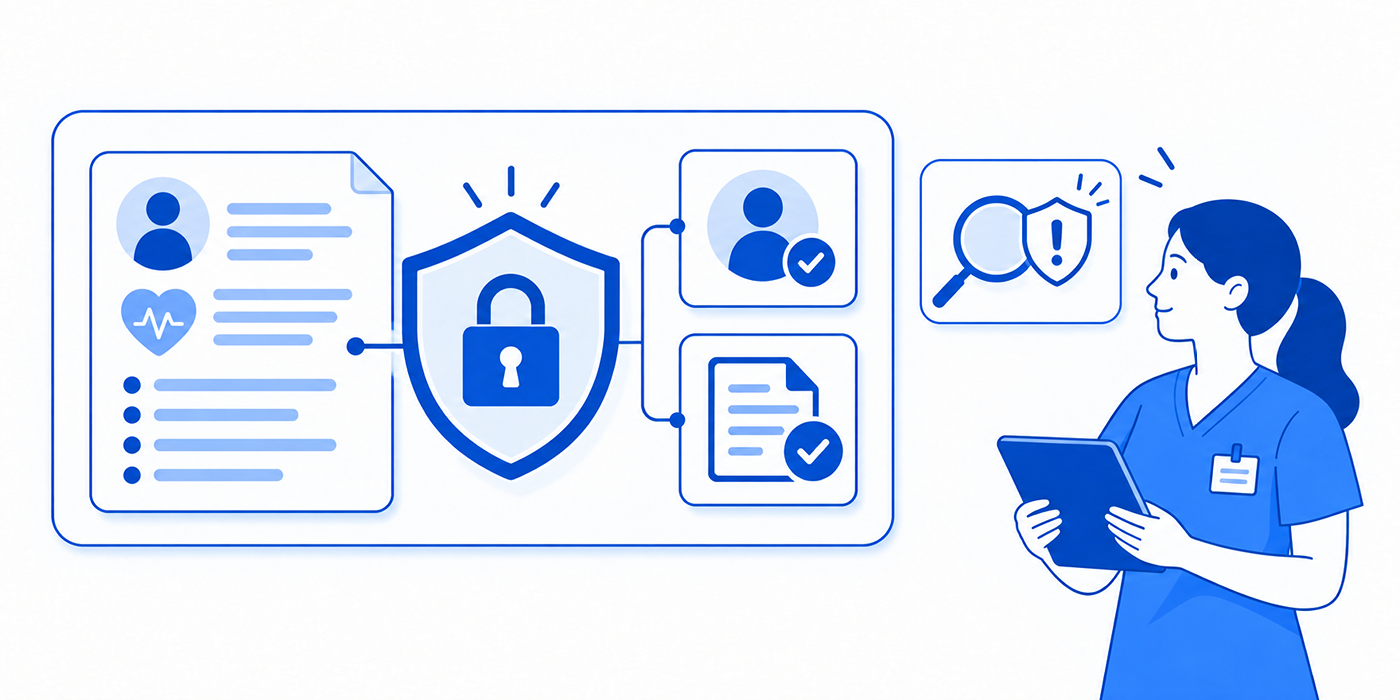
1. Healthcare Cybersecurity Fundamentals: The Terms Every Medical Professional Must Understand
Healthcare cybersecurity protects the confidentiality, integrity, and availability of clinical information and the technologies needed to deliver patient care.
These three principles, known as the CIA triad, form the foundation of information security.
Confidentiality means limiting information access to authorized individuals. A receptionist viewing a celebrity's medical records without a work-related purpose creates a confidentiality concern, even when the employee has valid EHR credentials.
Integrity means protecting information against unauthorized or improper modification. Incorrectly changing an allergy, medication dosage, or clinical assessment can create a patient safety risk.
Availability means ensuring authorized personnel can access the information and systems necessary for care. A ransomware attack that prevents physicians from reviewing medication histories can threaten availability even before investigators determine whether information was stolen.
The distinction becomes especially relevant in medical records management, patient portal administration, and practice management systems.
PHI, ePHI, and PII: Three terms that are frequently confused
Protected Health Information (PHI) refers to individually identifiable health information protected under HIPAA when held or transmitted by a covered entity or business associate, subject to applicable exclusions.
PHI can exist electronically, on paper, or through spoken communication. A patient's name combined with appointment details may qualify as PHI when it identifies the person and relates to healthcare.
Electronic Protected Health Information (ePHI) is PHI maintained or transmitted electronically. It includes information stored in EHRs, eligible cloud systems, digital documentation, and electronic communications.
Personally Identifiable Information (PII) is a broader information-security term describing data that identifies or can identify an individual. Its precise scope depends on the applicable legal or organizational framework.
A driver's license number can be PII without necessarily being PHI in every context. An identifiable clinical record generally involves both personal identifiers and protected health information.
Employees handling confidential patient communication, secure healthcare messages, and medical transcription must understand which information their organization considers sensitive.
HIPAA Security Rule versus organizational best practices
The HIPAA Security Rule requires regulated entities to implement reasonable and appropriate administrative, physical, and technical safeguards for ePHI.
These include risk analysis, workforce security, access controls, audit controls, authentication, and contingency planning.
HHS also publishes Healthcare and Public Health Cybersecurity Performance Goals addressing measures such as multifactor authentication, vulnerability management, strong encryption, and incident preparedness. These goals are voluntary recommendations rather than universally mandatory HIPAA requirements.
A proposed HIPAA Security Rule update published in January 2025 would strengthen several technical requirements. As of October 2026, the federal regulatory agenda continues to treat that update as proposed rulemaking, with final action scheduled for a later date.
Healthcare organizations should distinguish current legal obligations from proposed requirements when developing medical compliance procedures, professional administrative workflows, and patient privacy communication policies.
Healthcare Cybersecurity Dictionary: 35 Essential Terms, Clinical Examples & Protective Actions
| # | Cybersecurity Term | Practical Definition | Healthcare Example | Protective Action |
|---|---|---|---|---|
| 1 | PHI | Individually identifiable health information protected under HIPAA. | Identifiable diagnosis or appointment records. | Use or disclose only as authorized. |
| 2 | ePHI | PHI created, maintained, received, or transmitted electronically. | Patient data inside an EHR. | Use approved systems and devices. |
| 3 | PII | Information capable of identifying a person. | Name, identification number, or birth date. | Apply appropriate data safeguards. |
| 4 | Confidentiality | Protection against unauthorized information disclosure. | Preventing inappropriate chart access. | Restrict access by work responsibility. |
| 5 | Integrity | Protection against improper information alteration. | Preventing inaccurate allergy updates. | Verify changes and maintain audit trails. |
| 6 | Availability | Reliable access to information when needed. | Keeping clinical systems accessible during outages. | Maintain tested recovery procedures. |
| 7 | Phishing | Deceptive messages designed to obtain credentials or trigger malicious actions. | Fake IT email requesting EHR login verification. | Verify through an independent trusted channel. |
| 8 | Spear Phishing | Targeted phishing tailored to a specific recipient. | Fake message impersonating a clinic manager. | Check unusual requests through established contacts. |
| 9 | Smishing | Phishing delivered through text messages. | Fraudulent appointment platform login link. | Open the approved application directly. |
| 10 | Vishing | Voice-based social engineering. | Caller pretending to be EHR technical support. | Call back using verified support numbers. |
| 11 | Ransomware | Malicious software or attack activity that blocks access and demands payment. | Encrypted hospital files and disabled EHR access. | Escalate immediately under the incident plan. |
| 12 | Malware | Software intentionally designed to compromise systems or information. | Infected attachment on a scheduling workstation. | Use managed devices and endpoint protection. |
| 13 | Social Engineering | Manipulation of people into disclosing information or granting access. | Impersonated clinician requesting patient records. | Verify identity and authorization. |
| 14 | MFA | Authentication using two or more different factor categories. | Password plus security key or authenticator. | Prefer phishing-resistant methods where available. |
| 15 | RBAC | Role-based access control assigning permissions according to job roles. | Scribes receive documentation-related privileges. | Review permissions when responsibilities change. |
| 16 | Least Privilege | Providing only permissions needed for authorized tasks. | Receptionist cannot access administrator controls. | Remove unnecessary permissions promptly. |
| 17 | Encryption at Rest | Protection of stored information through cryptographic methods. | Encrypted clinical laptop drive. | Use organization-approved device encryption. |
| 18 | Encryption in Transit | Protection of data while it moves across networks. | Protected communication between portal and server. | Use approved encrypted connections. |
| 19 | Audit Log | Recorded history of relevant system activity. | EHR records who opened a patient chart. | Preserve logs and investigate unusual access. |
| 20 | SIEM | Security information and event management technology. | Centralized analysis of suspicious login activity. | Route alerts to the security team. |
| 21 | EDR | Endpoint detection and response technology. | Detection of suspicious activity on a clinic computer. | Keep approved endpoint agents functioning. |
| 22 | DLP | Data loss prevention controls that detect or restrict risky data movement. | Blocking inappropriate exports of patient files. | Use approved transfer channels. |
| 23 | Zero Trust | Security architecture based on continuous, context-aware verification. | Rechecking access during sensitive EHR actions. | Apply identity and device controls. |
| 24 | Patch Management | Testing and applying updates that fix vulnerabilities. | Updating vulnerable scheduling software. | Follow managed update and change procedures. |
| 25 | Vulnerability | Weakness that a threat could exploit. | Unsupported operating system on a workstation. | Report and remediate through approved channels. |
| 26 | Risk Assessment | Evaluation of threats, vulnerabilities, likelihood, and impact. | Reviewing security risks in patient portal workflows. | Document and prioritize risk treatment. |
| 27 | Business Associate Agreement | HIPAA-required contractual framework for qualifying business associate relationships. | Approved vendor processing ePHI. | Verify agreement before allowing data processing. |
| 28 | Security Incident | Attempted or successful unauthorized access, use, disclosure, modification, destruction, or interference. | Suspicious login attempts against an EHR. | Escalate using the reporting process. |
| 29 | Data Breach | Impermissible PHI use or disclosure that meets HIPAA's breach definition. | Exposure of unsecured patient records. | Initiate documented breach assessment. |
| 30 | Incident Response Plan | Documented process for identifying, managing, and recovering from incidents. | Clinic response to compromised credentials. | Know escalation contacts and assigned duties. |
| 31 | Disaster Recovery | Restoration of technology and information after disruption. | Rebuilding a scheduling server after ransomware. | Test restoration procedures. |
| 32 | Business Continuity | Keeping critical services operating during disruptions. | Using approved downtime registration forms. | Practice secure downtime workflows. |
| 33 | RTO | Recovery time objective: targeted time to restore a service. | Restoring appointment systems within an approved target. | Align targets with patient-care priorities. |
| 34 | RPO | Recovery point objective: maximum targeted acceptable data loss measured in time. | Recovering records from a recent backup. | Test backup frequency and restorability. |
| 35 | Shadow IT | Technology used without organizational approval or oversight. | Saving patient records to personal cloud storage. | Use approved software and request needed tools. |
Training reference for healthcare administrative and clinical documentation staff. Specific controls depend on applicable law, organizational policies, risk analysis, and job responsibilities.
2. Healthcare Cyber Threats Explained Through Real Clinical Situations
Cybersecurity threats become easier to identify when connected to the exact tasks employees perform.
A medical administrator is more likely to encounter a fraudulent appointment message or suspicious insurance document than an obvious demand from a cybercriminal. Attackers exploit routine workflows because employees already expect to receive documents, attachments, and requests from patients, insurers, and colleagues.
Phishing versus legitimate healthcare communication
Imagine receiving an email stating that your EHR password will expire in 15 minutes. The sender displays your organization's familiar logo and asks you to sign in immediately.
The message could be a phishing attempt designed to collect login credentials.
Useful warning indicators include an unexpected login destination, urgency, inconsistent sender information, an unusual attachment, or a request to bypass established security procedures.
The best verification method is to open the EHR through the organization's saved application or contact the IT team using a verified channel.
The same principle applies to professional healthcare email communication, patient portal notifications, and appointment reminder software.
Important: A legitimate-looking sender address or recognizable logo provides insufficient proof of authenticity. Compromised accounts can distribute convincing phishing messages.
Business email compromise and payment diversion
Business email compromise occurs when criminals impersonate or compromise trusted business accounts to redirect payments, obtain sensitive information, or influence transactions.
Suppose a clinic receives an apparent request from a billing partner to change bank details for upcoming payments. The message references an existing contract and previous correspondence.
Staff should verify changes through an independently established contact number and follow the organization's financial approval controls.
Personnel working with coordination of benefits, practice management systems, and written medical administration communication should understand this threat because fraudulent instructions can blend into legitimate financial workflows.
Ransomware and its consequences for patient care
Ransomware incidents may involve stolen credentials, network intrusion, data theft, and the encryption of critical systems.
A healthcare organization might lose access to scheduling tools, pharmacy interfaces, clinical notes, or patient history databases.
The damage extends beyond technical recovery costs. Departments may need to reschedule appointments, redirect patients, or operate with reduced access to clinical information.
During outages, staff should activate approved business continuity procedures instead of improvising unapproved alternatives.
Relevant preparation includes virtual check-in workflows, patient scheduling coordination, and crisis communication procedures.
Credential theft and account takeover
Credential theft occurs when an attacker obtains authentication information through phishing, malware, information exposure, or other means.
Account takeover occurs when someone gains unauthorized control of an account.
A criminal using a legitimate employee account may appear less suspicious than an unknown user attempting direct access.
Healthcare security teams therefore examine login behavior, device status, access history, and other contextual signals.
Employees should use unique credentials, protect authentication factors, and promptly report unexplained login prompts.
These practices matter for remote medical scribing, secure patient messaging, and confidential clinical communication.
An unexpected MFA approval request may indicate that an attacker already knows the password. Reject the prompt and report it through the approved channel.
Insider threats and accidental disclosures
An insider threat can involve malicious behavior, negligent actions, or compromised internal accounts.
Examples include accessing records out of curiosity, sending documentation to the wrong recipient, exporting unauthorized files, or leaving patient information visible on unattended devices.
A medical scribe may need access to charts for active documentation tasks, but unrelated chart browsing creates unnecessary exposure.
Organizations should combine appropriate access permissions, audit controls, employee training, and corrective action procedures.
Understanding patient privacy communication, professionalism in medical administration, and medical compliance requirements helps employees recognize these boundaries.
3. Healthcare Cybersecurity Incident Response: Five Scenarios and the Correct First Actions
Healthcare staff frequently discover possible security incidents before cybersecurity specialists do. Their immediate decisions can affect evidence preservation, patient privacy, and operational recovery.
The practical rule is to recognize, contain within your authorized responsibilities, document, and escalate. Employees should follow their organization's incident response plan and avoid conducting independent technical investigations.
Scenario 1: A medical scribe sends a patient note to the wrong recipient
A scribe accidentally sends a document containing identifiable patient information to an unintended email address.
Immediate actions:
Stop further distribution and notify the designated privacy or security contact promptly.
Preserve the relevant message information and provide the actual recipient, transmission time, and type of data involved.
Follow approved recall, secure deletion request, and containment procedures.
Allow the privacy team to assess whether the disclosure constitutes a reportable breach.
Deleting the message from the sender's mailbox does not establish that the recipient never received it.
This scenario demonstrates the importance of secure written communication, confidential communication requirements, and medical records handling.
Scenario 2: A receptionist receives a suspicious MFA approval request
A front-desk employee receives repeated authentication prompts despite making no attempt to sign in.
The requests may indicate credential compromise or an attempted MFA fatigue attack.
The employee should deny the request, contact IT through a verified channel, and follow instructions for resetting credentials or reviewing account activity.
Repeated prompts should be reported even when access appears unsuccessful.
For teams handling patient check-in, patient portal access, and appointment scheduling, account compromise can interrupt several operational systems simultaneously.
Scenario 3: An EHR becomes unavailable during active patient encounters
Clinicians suddenly cannot access the EHR, and multiple departments report similar failures.
Employees should alert the designated technical and clinical leadership contacts, follow approved downtime procedures, and prioritize patient safety according to organizational instructions.
Downtime documentation must be secured, accurately maintained, and reconciled into the authorized system after restoration.
The organization should clearly assign responsibility for preventing duplicate orders, missing information, and conflicting records.
Knowledge of encounter documentation, patient interaction scripts, and medical records management supports this process.
Scenario 4: A patient reports receiving another patient's records
A patient contacts the clinic after finding another person's laboratory report inside their portal account.
The employee receiving the complaint should record the information through an approved incident-reporting system and notify the privacy or security team promptly.
The employee should avoid requesting unnecessary copies of the exposed information or redistributing screenshots containing PHI.
Authorized personnel must investigate the extent of the disclosure, whether additional records were affected, and what remediation is required.
This scenario highlights weaknesses in patient portal management, patient identity verification, and secure healthcare messaging.
Scenario 5: A staff member discovers an unknown application accessing clinical information
A documentation employee notices that an unfamiliar software extension appears to be connected to their clinical workstation.
The correct response is to stop using the suspicious tool and contact the designated IT or security team.
The employee should avoid uninstalling software, clearing logs, or manipulating the device unless instructed by the response team, because those actions may interfere with investigation.
The same principle applies when identifying unauthorized AI transcription extensions or personal cloud applications.
Staff using healthcare automation tools, medical dictation workflows, and remote clinical documentation systems should verify that each application is approved.
Breach notification matters: HIPAA-covered entities generally must notify affected individuals following a reportable breach of unsecured PHI without unreasonable delay and no later than 60 calendar days after discovery, subject to applicable exceptions and permitted delays. Additional HHS reporting deadlines depend on breach size. Staff should escalate immediately so the responsible team can evaluate legal obligations.
4. Practical Cybersecurity Tips for Medical Scribes, Front-Desk Staff, and Remote Healthcare Workers
Cybersecurity responsibilities differ according to how employees interact with clinical systems. A practical training program should concentrate on the vulnerabilities associated with each role.
Medical scribes: Protect documentation access and clinical accuracy
Medical scribes work close to sensitive patient records and may access information while physicians document assessments.
Each scribe should use an individually assigned account, access only records relevant to authorized duties, and follow approved authentication procedures.
A clinician's request to "just use my login" should be redirected through the proper access-management process.
Scribes should also verify patient identity and encounter context before entering information. Inaccurate documentation can affect both record integrity and clinical safety.
Develop familiarity with medical transcription standards, encounter forms, medical compliance concepts, and patient confidentiality requirements.
When using approved ambient AI documentation systems, confirm that the recording and processing workflow follows organizational policies. Patient conversations and notes should remain within authorized systems.
Front-desk professionals: Secure registration and identity verification
Reception staff routinely manage addresses, phone numbers, demographic details, appointment information, and patient portal access.
Attackers may impersonate patients to obtain account access or request changes to contact information used for verification.
A useful control is to follow a documented identity-verification process before disclosing protected information or modifying sensitive account details.
Staff should also understand when to escalate unusual account requests, especially if a caller pressures them to bypass established procedures.
Knowledge of medical front-desk etiquette, patient interaction templates, virtual check-in security, and appointment reminder systems helps maintain consistent workflows.
Remote healthcare workers: Secure devices, networks, and workspaces
Remote employees may access patient information through cloud platforms, virtual desktops, approved communication systems, or organization-managed devices.
The most important controls include approved endpoint security, strong authentication, controlled software installation, secure connections, and appropriate device management.
A virtual private network can protect traffic according to organizational configuration, but a VPN alone does not establish that every application or endpoint is secure.
Employees should prevent family members or unauthorized individuals from viewing active patient records, avoid storing clinical information on personal drives, and follow the organization's incident reporting procedures.
Review remote medical scribe job requirements, confidential communication protocols, and secure healthcare messaging.
Scheduling and billing staff: Verify financial and demographic changes
Scheduling teams and billing personnel may receive requests to change appointment contact details, insurance information, payment instructions, or access permissions.
These requests can create fraud opportunities when staff rely exclusively on information supplied in the request itself.
Use established verification methods, separation of duties for sensitive changes, and approval workflows where appropriate.
Teams should understand coordination of benefits procedures, patient scheduling conflict management, practice management software, and professional email communication.
Supervisors: Make security reporting operationally realistic
Employees frequently hesitate to report suspected mistakes when they fear blame or do not know whom to contact.
Supervisors should ensure that staff have accessible reporting channels, understand immediate escalation procedures, and receive role-specific training.
A useful exercise is to present a fictional misdirected patient message and ask employees to identify the correct response without accessing actual patient information.
Training should also cover difficult patient interactions, crisis communication, assertive communication, and team communication.
The quality of an incident response often depends on whether ordinary employees know what to do in the first few minutes.

5. A 30-Day Healthcare Cybersecurity Improvement Plan With Measurable Results
Healthcare organizations can use a structured improvement cycle to move from general awareness into documented risk reduction.
NIST Cybersecurity Framework 2.0 organizes cybersecurity activities into six functions: Govern, Identify, Protect, Detect, Respond, and Recover. These provide a practical framework for evaluating preparedness.
Days 1–7: Identify systems, data, and access risks
Create or update an inventory of systems that create, receive, maintain, or transmit ePHI.
Include EHR platforms, scheduling applications, patient portals, approved communication systems, endpoints, and relevant third-party services.
Map which staff groups can access each system, and review accounts belonging to employees who transferred, left the organization, or changed responsibilities.
Check medical records systems, practice management platforms, patient portal tools, and healthcare automation applications.
Measure: Percentage of in-scope systems with a documented owner and reviewed access permissions.
Days 8–14: Strengthen identity and device protection
Prioritize risk-based improvements to authentication, endpoint protection, patch management, and privileged access.
Review whether MFA is enabled for applicable systems, whether administrators use appropriate separate accounts, and whether unsupported devices can access protected information.
Evaluate how employees authenticate when using remote documentation platforms, secure patient messaging, and virtual check-in systems.
Measure: MFA coverage for eligible accounts, unresolved critical vulnerabilities, and overdue access revocations.
Days 15–21: Test incident reporting and downtime procedures
Conduct a tabletop exercise involving a realistic healthcare scenario, such as a compromised receptionist account or an EHR outage.
Assign participants to identify the event, report it, preserve relevant information, notify appropriate leadership, and activate authorized continuity procedures.
Evaluate whether the team knows how to manage patient appointments, clinical encounter records, and crisis communication during a disruption.
Measure: Time from simulated discovery to escalation, percentage of assigned actions completed, and unresolved workflow gaps.
Days 22–30: Validate recovery and third-party safeguards
Verify that critical data can be restored from backups and that recovery procedures address system dependencies and clinical priorities.
Evaluate backup isolation or immutability where appropriate, recovery time objectives, recovery point objectives, and periodic restoration testing.
Review whether vendors handling ePHI have the required business associate agreements and appropriate contractual security provisions.
Cloud storage or AI software may require a BAA when a vendor creates, receives, maintains, or transmits ePHI on behalf of a regulated entity. Encryption alone does not remove that contractual requirement.
Review vendors involved in patient portal management, medical transcription, appointment reminders, and healthcare automation.
Measure: Successful restoration tests, unresolved high-risk vendor findings, and percentage of applicable vendor relationships with documented agreements.
Five cybersecurity metrics worth tracking monthly
Rather than measuring training completion alone, healthcare leaders should monitor operational outcomes:
Access revocation time: How quickly accounts are disabled after separation or role changes.
Phishing reporting performance: How reliably employees recognize and report suspicious communications.
Vulnerability remediation time: How quickly priority security weaknesses are resolved.
Incident escalation time: The interval between discovery and notification of the appropriate response team.
Recovery test success: Whether critical systems can be restored within organizational objectives.
These metrics connect security activity to actual organizational risk.
They can also complement patient satisfaction measurement, administrative professionalism, and effective team communication.
For clinical and administrative employees, the most valuable habit is recognizing when routine work crosses into a security concern and knowing the authorized process for responding.
6. FAQs: Healthcare Cybersecurity Terminology, HIPAA Rules & Practical Security Tips
-
Start with PHI, ePHI, confidentiality, integrity, availability, phishing, ransomware, multifactor authentication, access controls, encryption, audit logs, and incident response.
Together, these concepts explain how patient information is protected and what happens when security controls fail.
Employees working with medical records, patient portals, and confidential communication should understand the specific risks associated with their responsibilities.
-
The HIPAA Privacy Rule governs permitted uses and disclosures of PHI and establishes individual rights concerning protected information.
The HIPAA Security Rule establishes standards for safeguarding ePHI through administrative, physical, and technical controls.
Both are relevant to patient privacy communication and medical compliance responsibilities.
-
The current HIPAA Security Rule requires appropriate authentication procedures and reasonable, appropriate safeguards. Its requirements should be distinguished from the January 2025 proposed updates and voluntary HHS cybersecurity goals.
Organizations may require MFA under internal policy, contractual commitments, or other applicable obligations.
Employees should follow approved authentication procedures when accessing practice management systems and secure patient portals.
-
A security incident includes attempted or successful unauthorized access, use, disclosure, modification, destruction, or interference with information systems.
A HIPAA breach involves an impermissible PHI use or disclosure that meets the regulatory definition, subject to applicable exceptions and risk-assessment provisions.
For example, a blocked malicious login may be a security incident without constituting a reportable PHI breach.
A misdirected email containing patient information requires a documented assessment under confidential communication procedures and medical compliance policies.
-
A covered entity must generally notify affected individuals of a reportable breach of unsecured PHI without unreasonable delay and no later than 60 calendar days following discovery, subject to applicable exceptions and permitted delays.
Breaches affecting 500 or more individuals generally must also be reported to HHS within that period. Breaches involving fewer than 500 individuals can be reported to HHS within 60 calendar days after the end of the calendar year in which they were discovered.
Additional media notification requirements may apply. Business associates generally must notify covered entities without unreasonable delay and no later than 60 days following discovery.
Staff should follow internal reporting procedures immediately rather than waiting for an external notification deadline.
-
Medical scribes may use organization-approved AI documentation systems when the workflow meets applicable privacy, security, contractual, and organizational requirements.
Employees should avoid placing identifiable patient information into personal AI accounts or unauthorized transcription tools.
Understanding AI medical scribe workflows, medical transcription processes, and healthcare automation controls helps staff identify appropriate uses.
