

Healthcare organizations face constant pressure to protect patient records, prevent billing errors, monitor employee credentials, and demonstrate regulatory compliance. A missed training deadline, expired business associate agreement, or unresolved audit finding can expose a practice to financial penalties, operational disruptions, and damaged patient trust.
Healthcare compliance software helps administrators organize these responsibilities through automated tracking, documented approvals, audit workflows, and centralized evidence management. This practical dictionary explains essential compliance software terminology, demonstrates real healthcare scenarios, and provides actionable methods for medical scribes, compliance officers, and administrators to identify risks, evaluate tools, and strengthen regulatory readiness.
1. Healthcare Compliance Software Fundamentals: Essential Terms, Features & Regulatory Concepts
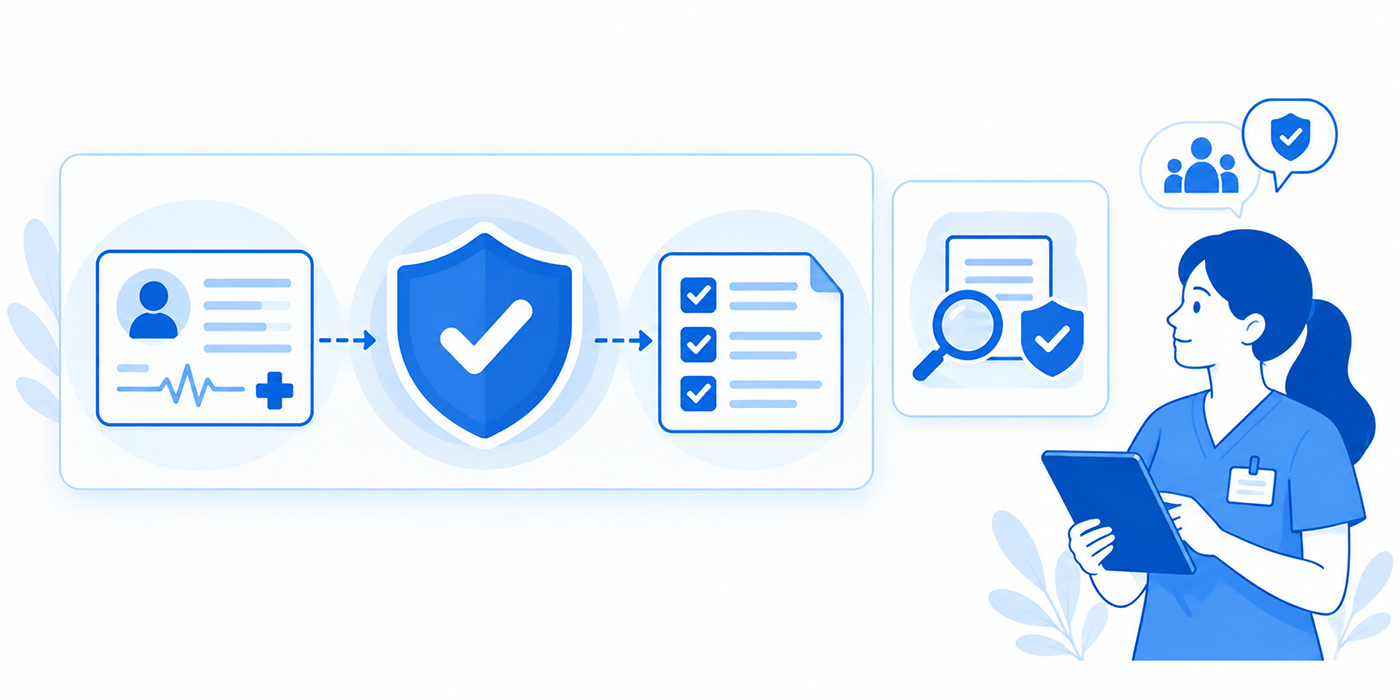
Healthcare compliance software is a category of technology that helps organizations manage regulatory obligations, internal policies, workforce training, risk assessments, incident investigations, and evidence of corrective action.
Its functions typically extend across three operational areas: regulatory compliance, organizational governance, and continuous monitoring.
Regulatory compliance involves obligations arising from HIPAA, applicable billing regulations, fraud-and-abuse laws, state requirements, and specialized healthcare regulations.
Organizational governance covers policies, assigned responsibilities, employee conduct, and leadership oversight.
Continuous monitoring involves reviewing operational activity, identifying exceptions, documenting investigations, and verifying that problems have been corrected.
A compliance platform may integrate with medical records management systems, practice management software, patient portal applications, and healthcare automation tools.
Healthcare compliance software versus EHR software
An Electronic Health Record system primarily supports clinical documentation and patient-care information. Compliance software organizes the activities needed to demonstrate that healthcare operations follow applicable requirements.
For example, an EHR may record when a medical scribe accesses a patient's chart. Compliance software may import that activity, flag unusual access, assign an investigation, and preserve the resulting findings.
This connection is relevant to confidential patient communication, medical documentation accuracy, and patient privacy protection.
The seven elements of an effective healthcare compliance program
The HHS Office of Inspector General's General Compliance Program Guidance identifies seven fundamental elements:
Written policies and procedures.
Compliance leadership and oversight.
Training and education.
Effective communication and disclosure channels.
Enforcement of standards through consequences and incentives.
Risk assessment, auditing, and monitoring.
Responding to detected offenses and developing corrective actions.
These elements provide a practical framework for evaluating software capabilities. OIG's guidance is voluntary and nonbinding; specific legal requirements arise from applicable statutes, regulations, contracts, and organizational obligations.
A good platform should support accountable workflows around these elements. For example, a training module can document whether employees completed medical compliance education, while an incident management module can document the investigation of a patient privacy violation.
The regulatory distinction every administrator must understand
The HIPAA Security Rule requires applicable safeguards to protect electronic protected health information. Its January 2025 proposed revisions remain subject to rulemaking as of October 2026.
Separately, the 2024 final rule updating 42 CFR Part 2, which governs certain substance use disorder records, established a compliance date of February 16, 2026.
Organizations handling covered Part 2 records should therefore evaluate their consent, disclosure, notice, and related compliance workflows against the applicable final requirements.
Software vendors may advertise broad regulatory coverage. Healthcare organizations must still determine which requirements apply to their operations and ensure they can substantiate compliance.
That distinction affects medical records procedures, informed consent workflows, secure healthcare messaging, and professional healthcare administration.
| # | Compliance Term | Practical Definition | Healthcare Example | Software Function |
|---|---|---|---|---|
| 1 | Compliance Management System | Platform for managing regulatory obligations, internal policies, risks, and evidence. | Clinic tracks HIPAA training and internal audits. | Centralized compliance dashboard. |
| 2 | Governance, Risk & Compliance (GRC) | Framework connecting organizational decisions, risks, and compliance obligations. | Hospital links cybersecurity risks with responsible departments. | Risk and control mapping. |
| 3 | Regulatory Obligation Register | Inventory of applicable legal and contractual requirements. | Practice tracks privacy, billing, and licensing obligations. | Requirement ownership and review. |
| 4 | Policy Management | Controlled creation, approval, distribution, and revision of organizational policies. | Clinic updates patient information access procedures. | Version control and acknowledgments. |
| 5 | Policy Attestation | Employee acknowledgment of a policy or required standard. | Medical scribe confirms receipt of confidentiality policy. | Timestamped acknowledgment record. |
| 6 | Compliance Training LMS | Learning Management System for assigning and tracking training. | Receptionists complete annual privacy education. | Training assignments and completion reports. |
| 7 | Risk Assessment | Structured identification and evaluation of threats, vulnerabilities, and potential impact. | Clinic evaluates risks from shared accounts. | Risk register and mitigation assignments. |
| 8 | Risk Register | Documented inventory of identified risks and their status. | Hospital records unresolved access-control weaknesses. | Risk scoring and ownership. |
| 9 | Control Testing | Assessment of whether a safeguard works as intended. | Auditor tests whether former employees retain EHR access. | Testing records and exceptions. |
| 10 | Audit Trail | Recorded history of relevant system actions. | System captures policy approvals and case changes. | Timestamped activity history. |
| 11 | Audit Evidence Repository | Controlled location for documents supporting compliance reviews. | Practice stores approved training and audit records. | Evidence indexing and retrieval. |
| 12 | Corrective Action Plan (CAP) | Documented plan to address an identified deficiency. | Clinic corrects repeated patient identity verification failures. | Tasks, owners, deadlines, and verification. |
| 13 | Root Cause Analysis (RCA) | Investigation into underlying reasons for an event or repeated failure. | Team analyzes recurring wrong-patient documentation. | Investigation workflow and findings. |
| 14 | Incident Management | Process for documenting, investigating, and resolving reported events. | Employee reports accidental disclosure of patient information. | Case assignment and escalation. |
| 15 | Breach Risk Assessment | Evaluation of an impermissible PHI use or disclosure under applicable HIPAA criteria. | Privacy officer assesses a misdirected patient report. | Documented review and decision. |
| 16 | Business Associate Agreement (BAA) | Required HIPAA agreement for qualifying business associate relationships. | Cloud vendor processes ePHI for a covered clinic. | Contract lifecycle and renewal tracking. |
| 17 | Vendor Due Diligence | Review of third-party risk, security, and contractual obligations. | Hospital assesses a transcription software provider. | Questionnaires and approval workflows. |
| 18 | Exclusion Screening | Checking relevant individuals or entities against applicable exclusion lists. | Billing organization checks OIG LEIE records. | Screening evidence and match review. |
| 19 | Credential Monitoring | Tracking the status of professional credentials and required qualifications. | Clinic monitors employee license expiration dates. | Expiration alerts and verification records. |
| 20 | Role-Based Access Control (RBAC) | Permissions assigned according to authorized job responsibilities. | Scribe receives documentation privileges without billing administration access. | Permission review records. |
| 21 | Access Attestation | Periodic confirmation that assigned permissions remain appropriate. | Manager reviews access granted to transferred employees. | Approval and remediation workflow. |
| 22 | Privacy Complaint Management | Tracking complaints involving information privacy and individual rights. | Patient questions unauthorized chart access. | Complaint intake and investigation. |
| 23 | Compliance Hotline | Channel for reporting concerns or suspected misconduct. | Employee reports pressure to alter documentation. | Confidential reporting and case routing. |
| 24 | Non-Retaliation Controls | Policies and oversight intended to protect good-faith reporting. | Employee reports a suspected billing violation. | Restricted case access and follow-up. |
| 25 | Medical Coding Audit | Evaluation of coding accuracy against documentation and applicable rules. | Auditor reviews unsupported diagnosis codes. | Sampling, findings, and corrective action. |
| 26 | Claims Monitoring | Review of billing patterns and potentially problematic claims. | Practice investigates repeated modifier inconsistencies. | Exception reporting and audit queues. |
| 27 | Overpayment Tracking | Management of potential and identified improper payments. | Billing team investigates duplicate Medicare payments. | Investigation dates and repayment tracking. |
| 28 | Document Retention Schedule | Rules governing required preservation and appropriate disposal of records. | Practice maintains designated compliance records. | Retention controls and legal holds. |
| 29 | Consent Management | Tracking applicable consent requirements and their permitted scope. | Organization manages qualifying Part 2 disclosures. | Consent status and disclosure controls. |
| 30 | Regulatory Change Management | Process for reviewing changes in applicable requirements. | Compliance team assesses updated privacy regulations. | Change alerts and impact assessments. |
| 31 | Continuous Monitoring | Repeated or ongoing evaluation of selected compliance controls. | Dashboard identifies overdue risk reviews. | Exception alerts and performance trends. |
| 32 | Key Risk Indicator (KRI) | Metric indicating changing exposure to an identified risk. | Number of unresolved critical access violations increases. | Threshold alerts and trend reports. |
| 33 | Key Performance Indicator (KPI) | Metric measuring progress or performance against an objective. | Percentage of assigned staff training completed on time. | Compliance scorecards. |
| 34 | Regulatory Readiness | Ability to demonstrate compliance activities through reliable documentation. | Clinic prepares records for an external audit. | Evidence export and audit reporting. |
| 35 | Workflow Automation | Rule-based assignment or progression of administrative tasks. | Unresolved findings trigger escalation reminders. | Automated routing and deadlines. |
2. How Healthcare Compliance Software Works: Five Real-World Clinical & Administrative Scenarios
Compliance platforms provide the greatest value when they connect a real operational problem with an accountable investigation, corrective action, and verifiable outcome.
The following scenarios demonstrate how software functions can support everyday medical administration.
Scenario 1: A medical scribe accesses an unrelated patient record
A medical scribe uses valid EHR credentials to view a patient's chart without an authorized work-related purpose.
The EHR records the access event, and a monitoring system identifies an unusual pattern.
The compliance platform creates a case containing the relevant timestamps, account details, system source, and investigation status.
A privacy officer reviews the circumstances, determines whether the activity was authorized, and documents the findings.
If inappropriate access occurred, the response may involve workforce action, retraining, access changes, or a breach assessment, as appropriate.
The case should remain traceable from discovery through final disposition.
This workflow connects patient privacy communication, confidential healthcare communication, medical records administration, and medical compliance procedures.
What software should preserve: Original event evidence, investigation ownership, review decisions, approved corrective actions, and closure verification.
Scenario 2: An employee sends patient information to the wrong recipient
A patient services representative accidentally emails an identifiable laboratory report to an unintended address.
The incident reporting module receives a submission, assigns a case number, records discovery information, and alerts the appropriate privacy personnel.
Under the HIPAA Breach Notification Rule, an impermissible use or disclosure is generally presumed to be a breach unless an applicable exception or documented assessment supports a different determination.
Where applicable, the assessment considers the nature of the information, the recipient, whether the information was acquired or viewed, and mitigation.
The compliance platform can prompt reviewers to address these factors and preserve the resulting determination.
The responsible personnel must evaluate notification duties and deadlines.
For reportable breaches of unsecured PHI, affected-individual notification generally must occur without unreasonable delay and no later than 60 calendar days after discovery, subject to applicable exceptions and permitted delays.
A dashboard should distinguish internal response deadlines from statutory notification requirements.
Relevant workflows include secure healthcare messaging, professional medical email etiquette, confidential communication, and patient records management.
What software should preserve: Disclosure details, risk assessment, containment evidence, notification decisions, and communications.
Scenario 3: A physician's credentials or an employee's training becomes overdue
A medical practice employs clinicians, medical assistants, scribes, and administrative professionals with different training and credential requirements.
A compliance platform tracks relevant renewal dates and assigns training according to the employee's role.
For example, staff members responsible for patient portal management may need targeted instruction on identity verification and secure access.
Medical scribes may require training in medical transcription accuracy, patient confidentiality, and professional clinical documentation.
A reliable system escalates overdue assignments to the responsible supervisor and distinguishes completed training from merely opening a learning module.
Credential management should also recognize that licensing and certification verification may require checks against authoritative sources.
What software should preserve: Required training assignment, relevant policy version, completion evidence, verification results, and follow-up actions.
Scenario 4: A Medicare billing audit identifies potential overpayments
An internal coding review identifies claims with documentation deficiencies, possible duplicate payments, or unsupported coding.
The compliance officer opens an investigation and assigns the billing team to examine the affected transactions.
The platform records how each issue was identified, who reviewed it, how its amount was established, and what repayment or corrective action followed.
Applicable Medicare overpayment rules impose reporting and return obligations, with timing depending on the governing requirements and circumstances. The statutory framework generally addresses reporting and returning identified overpayments within 60 days, or by the applicable cost-report due date where relevant.
Organizations should confirm the applicable current rule and any relevant investigation provisions with their compliance or legal team.
This is why medical coding error analysis, coordination of benefits, encounter form accuracy, and practice management systems matter to compliance operations.
What software should preserve: Claim population, investigation timeline, supporting documentation, calculations, decisions, and repayment evidence.
Scenario 5: A new vendor creates privacy and compliance obligations
A clinic plans to purchase a cloud transcription platform that will process identifiable patient information.
Vendor management software initiates a review of the proposed service, data processing activities, security controls, and contractual responsibilities.
If the provider creates, receives, maintains, or transmits PHI on behalf of a HIPAA-regulated organization, a Business Associate Agreement may be required.
The software can track whether the agreement has been executed, when the relevant review was completed, and whether contractual changes require reassessment.
However, vendor oversight should continue after the initial purchase.
New integrations, subcontractors, data-processing arrangements, or organizational changes can alter risk.
These issues arise frequently in healthcare automation systems, remote medical scribing, secure messaging applications, and patient portal integrations.
What software should preserve: Vendor risk findings, required agreements, approval status, reassessment dates, and contractual responsibilities.
3. Choosing Healthcare Compliance Software: Features, Vendor Questions & Evaluation Criteria
Healthcare organizations should evaluate compliance platforms against their actual risk profile, workforce structure, technical environment, and regulatory responsibilities.
An outpatient clinic may need reliable policy distribution, incident tracking, and basic auditing. A multi-location healthcare group may require more advanced controls across vendors, departments, billing operations, and clinical systems.
Seven capabilities worth prioritizing
1. Centralized regulatory obligation management
The software should let administrators document applicable requirements, assign owners, link policies and controls, and record periodic reviews.
A regulatory library is especially useful when it connects obligations to actual workflows involving medical records, patient privacy procedures, and medical compliance responsibilities.
2. Controlled policy management
Look for version history, review dates, approval workflows, employee acknowledgment, and archived policy copies.
A system should establish which policy applied at the time of a specific incident or training assignment.
3. Confidential incident intake
Employees need accessible reporting channels with appropriate confidentiality protections.
The platform should support restricted case access, escalation, and documentation without exposing sensitive complaint details to unauthorized employees.
This helps staff follow professional communication procedures and crisis communication protocols.
4. Evidence-based audit management
Auditors should be able to record the control tested, evidence examined, exceptions found, assigned corrective action, and closure status.
Export capabilities matter when regulators, external auditors, or internal governance committees request documentation.
5. Workforce and exclusion screening
Healthcare organizations participating in federal healthcare programs may need to address exclusion-related risks.
OIG's List of Excluded Individuals/Entities is updated monthly. Software can automate candidate matching and recurring screening, but possible matches require appropriate verification.
Administrators should document the actual lists searched, screening dates, match-resolution decisions, and follow-up activity.
6. Integrations and secure access
A platform should support the organization's existing identity-management tools, HR systems, and relevant operational applications.
Ask whether integrations preserve the source record, transfer only necessary information, and maintain appropriate authorization.
This is important when connecting practice management software, medical documentation systems, and healthcare automation workflows.
7. Reporting that identifies unresolved risk
Strong dashboards distinguish an unreviewed alert, an active investigation, and a verified corrective action.
A high training-completion percentage may coexist with serious unresolved problems.
Leadership needs visibility into material risk, overdue decisions, recurring failures, and actual remediation.
Vendor evaluation scorecard
Use the following weighting as a practical comparison framework:
Evaluation CategorySuggested WeightWhat to TestRegulatory and workflow coverage25%Can it support applicable obligations and real cases?Security and confidentiality20%Are access, encryption, and vendor safeguards appropriate?Audit evidence and reporting20%Can reviewers reconstruct decisions and actions?System integration15%Does it work reliably with required existing platforms?Staff usability and training10%Can employees complete tasks without excessive manual work?Total cost and vendor support10%Are implementation, maintenance, and export costs clear?
Score each category from 1 to 5, multiply the score by the corresponding weight, and compare the weighted totals.
These weights are illustrative. Organizations should adjust them to their own risk assessments.
Questions to ask during a vendor demonstration
Ask the vendor to demonstrate a complete case involving a fictional patient privacy incident.
The test should show how a staff member reports the event, how the compliance officer receives it, how evidence is protected, how a decision is recorded, and how corrective action is verified.
Also ask:
Can case access be restricted by role and sensitivity?
Can deleted or modified records be audited appropriately?
Can we export our own policies, case histories, and supporting evidence?
How are regulatory updates reviewed and validated?
Does the software manage different record-retention requirements?
Can it link related incidents and recurring control failures?
What happens to evidence if the subscription ends?
Which integrations require additional charges?
How does the vendor handle security incidents?
What implementation and ongoing support does the vendor provide?
A practical demonstration involving patient portal management, medical records administration, and confidential communication procedures reveals more than a generic feature presentation.
4. Implementing Healthcare Compliance Software: A Practical 30-Day Action Plan
Successful implementation begins with the organization's highest-risk workflows rather than trying to automate every compliance activity simultaneously.
A phased approach allows teams to validate controls, identify system weaknesses, and preserve operational continuity.
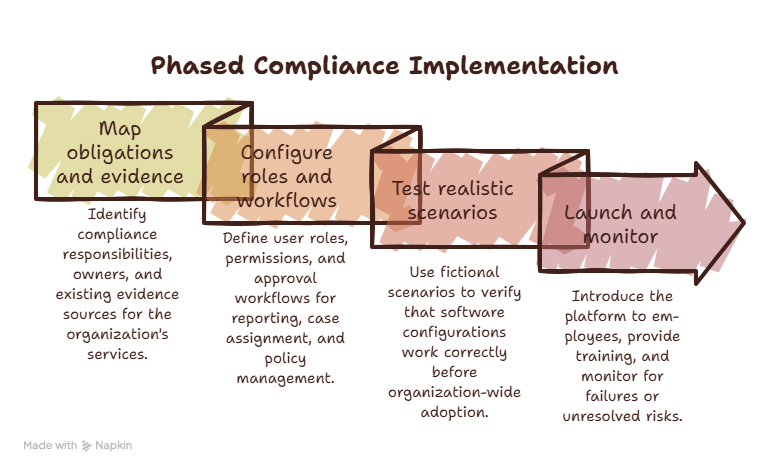
Days 1–7: Map obligations, owners, and existing evidence
Begin by identifying the compliance responsibilities associated with the organization's services.
These may include HIPAA safeguards, billing requirements, workforce credentials, exclusion screening, internal policies, and specialized record protections.
Document the responsible department, current control, available evidence, review frequency, and unresolved deficiencies.
For example, a medical practice may discover that its HR system contains training completion records while its compliance department maintains a separate list of privacy incidents.
The implementation team should determine which system serves as the authoritative source.
Use expertise from medical records management, practice management systems, patient portal operations, medical compliance training, and professional healthcare administration.
Deliverable: A prioritized compliance inventory showing each obligation's owner, evidence source, and review schedule.
Days 8–14: Configure roles, permissions, and approval workflows
Define user roles for compliance officers, privacy personnel, department supervisors, auditors, and employees.
Sensitive investigations should be visible only to personnel with an authorized need for access.
Create workflows for employee reporting, case assignment, approvals, escalation, and closure.
Import policies with appropriate version history and establish rules for updating or replacing them.
Assign role-specific training covering confidential patient communication, informed consent, secure messaging, medical documentation, and medical administrative professionalism.
Deliverable: Approved role permissions and tested incident, training, and policy workflows.
Days 15–21: Test realistic scenarios before organization-wide adoption
Use fictional scenarios to determine whether the configured software works correctly.
Test an employee who reports a misdirected medical document. Confirm that the system records the submission, limits access, assigns the responsible reviewer, and maintains the decision history.
Next, simulate an overdue training requirement and an unresolved billing audit finding.
Verify that the correct supervisor receives the appropriate alert and that the case remains open until its closure criteria are met.
Test whether the system prevents unauthorized personnel from viewing confidential investigation details.
Healthcare organizations should evaluate workflows involving medical coding errors, patient privacy procedures, medical records, and clinical communication.
Deliverable: A test report containing completed scenarios, failed controls, and assigned remediation tasks.
Days 22–30: Launch, monitor, and verify corrective actions
Introduce the platform to relevant employees and provide concise, role-specific training.
Explain how to report concerns, acknowledge policies, complete assignments, and contact the compliance team.
Monitor failed logins, missed assignments, incorrectly routed cases, and incomplete evidence.
Leadership should review any serious unresolved findings before treating the initial rollout as complete.
Relevant operational training includes professional email practices, patient interaction protocols, crisis communication, assertive healthcare communication, and team communication procedures.
Deliverable: A launch review identifying adoption levels, unresolved risks, workflow failures, and the next set of improvements.
5. Healthcare Compliance Automation: AI Capabilities, Audit Metrics & Common Software Mistakes
Compliance automation can reduce repetitive administrative work, improve visibility, and create more consistent records.
Its effectiveness depends on accurate source information, appropriate rules, responsible human review, and reliable evidence.
Where automation creates measurable value
Policy lifecycle management: A platform can alert employees when new policies require acknowledgment and notify owners when periodic reviews are due.
Training administration: Automated assignments can direct employees toward role-specific education instead of sending identical material to every department.
Vendor monitoring: A system can identify expiring contracts or scheduled risk reviews.
Incident triage: Reported issues can be routed to the responsible department according to established classification rules.
Audit preparation: Centralized documentation can reduce time spent searching across spreadsheets, shared drives, and email threads.
These functions support healthcare automation tools, medical compliance procedures, medical records governance, and secure patient communication.
How AI can assist compliance teams
AI-enabled platforms may classify incoming incidents, summarize documents, suggest applicable policies, identify anomalies, or help prepare audit workpapers.
For example, an AI tool might flag a repeated pattern of incomplete documentation across a sample of claims.
A qualified reviewer should determine whether the pattern reflects an actual compliance problem, insufficient documentation, or an error in the model's interpretation.
AI outputs can contain unsupported findings, omit relevant context, and misclassify incidents.
Organizations must also assess whether the tool is approved to receive the information involved.
These concerns connect with AI medical documentation workflows, medical coding accuracy, patient confidentiality requirements, and medical transcription quality.
Five compliance metrics worth tracking
1. On-time training completion rate
Divide the number of assigned employees who completed required training by the deadline by the total number assigned that training.
Report the percentage by department and risk category.
2. Incident escalation time
Measure the elapsed time between the organization's documented discovery or reporting point and notification of the assigned response team.
Serious patient privacy or safety concerns should follow the organization's designated urgent escalation process.
3. Corrective action closure effectiveness
Measure the percentage of corrective actions that have been independently verified as effective.
A task marked complete without evidence of correction should remain distinguishable from a verified remediation.
4. Policy acknowledgment compliance
Track the percentage of affected employees who acknowledged the applicable current policy version within the assigned timeframe.
5. Repeat finding rate
Measure how frequently a previously identified issue recurs after corrective action.
Repeated failures can indicate weak root cause analysis, insufficient training, ineffective controls, or poor monitoring.
These measures can complement patient satisfaction metrics, medical administration quality, patient communication standards, and healthcare workflow efficiency.
Four mistakes that weaken compliance software investments
Mistake 1: Treating completed checklists as proof of effective controls. A completed risk assessment may identify serious unresolved risks. Leadership should distinguish documentation from remediation.
Mistake 2: Automating inaccurate procedures. Software can efficiently repeat a flawed process. Organizations should validate workflow logic before enabling automatic approvals.
Mistake 3: Ignoring employee reporting experience. Staff may avoid reporting concerns when the submission process is confusing or confidentiality is poorly protected.
Mistake 4: Closing findings without verification. A corrective action should include appropriate evidence demonstrating that the underlying problem was addressed.
For example, repeated wrong-patient documentation may require changes to patient interaction procedures, medical records management, encounter forms, and staff communication protocols.
A compliance platform delivers its strongest operational value when it helps personnel identify a problem, understand its cause, implement a meaningful correction, and demonstrate that the correction worked.
6. FAQs: Healthcare Compliance Software, HIPAA Tools & Regulatory Management
-
Healthcare compliance software helps organizations manage policies, training, audits, risk assessments, investigations, vendor oversight, and regulatory documentation.
Its capabilities vary by platform and organizational requirements.
For example, software may track whether employees completed medical compliance training or whether a reported incident involving patient confidentiality received the appropriate review.
-
Compliance depends on the organization's applicable legal obligations, implemented safeguards, documented practices, and actual operations.
Software can help organize evidence and automate controls, but the organization must evaluate whether its procedures meet applicable requirements.
A practice using medical records management, patient portal systems, and secure communication applications should assess all relevant systems and workflows.
-
Healthcare compliance software focuses on regulatory and operational responsibilities relevant to healthcare organizations.
GRC software provides broader governance, risk, and compliance capabilities that can apply across industries.
Some products support both categories.
Healthcare administrators should evaluate whether a platform accommodates medical compliance requirements, patient privacy procedures, and medical coding audits.
-
Small practices should prioritize accessible incident reporting, policy management, workforce training, risk documentation, and reliable audit evidence.
Additional features should reflect the practice's specific risks.
For example, a small outpatient clinic may benefit from integrating compliance workflows with its practice management system, patient portal, and medical records operations.
-
An audit trail records relevant activity associated with a system, document, or workflow.
In compliance software, it may identify who approved a policy, changed an investigation status, uploaded evidence, or completed a review.
Audit trails support accountability and help investigators reconstruct decisions.
They are particularly useful for medical compliance documentation, patient records oversight, and confidentiality investigations.
-
Certain systems can identify suspicious activity, policy exceptions, unusual access patterns, or potentially risky disclosures.
An alert may indicate a matter requiring investigation.
Qualified personnel must evaluate the facts, applicable rules, and surrounding circumstances before reaching a formal determination.
This is important when reviewing patient portal access, medical records activity, and secure healthcare communications.
