

Patient registration errors can trigger denied claims, duplicate medical records, delayed treatment, billing disputes, and serious patient identification problems. Even minor mistakes involving insurance details, demographics, or consent documentation can create expensive complications throughout the healthcare revenue cycle. Understanding the complete patient registration process helps medical administrators prevent these failures before they reach clinical and billing teams. This guide explains essential registration terminology, real-world scenarios, verification procedures, and measurable improvements, with practical applications involving virtual check-in systems, patient scheduling integrations, and healthcare workflow automation.
1. Patient Registration Fundamentals: What Happens Before a Patient Receives Care?
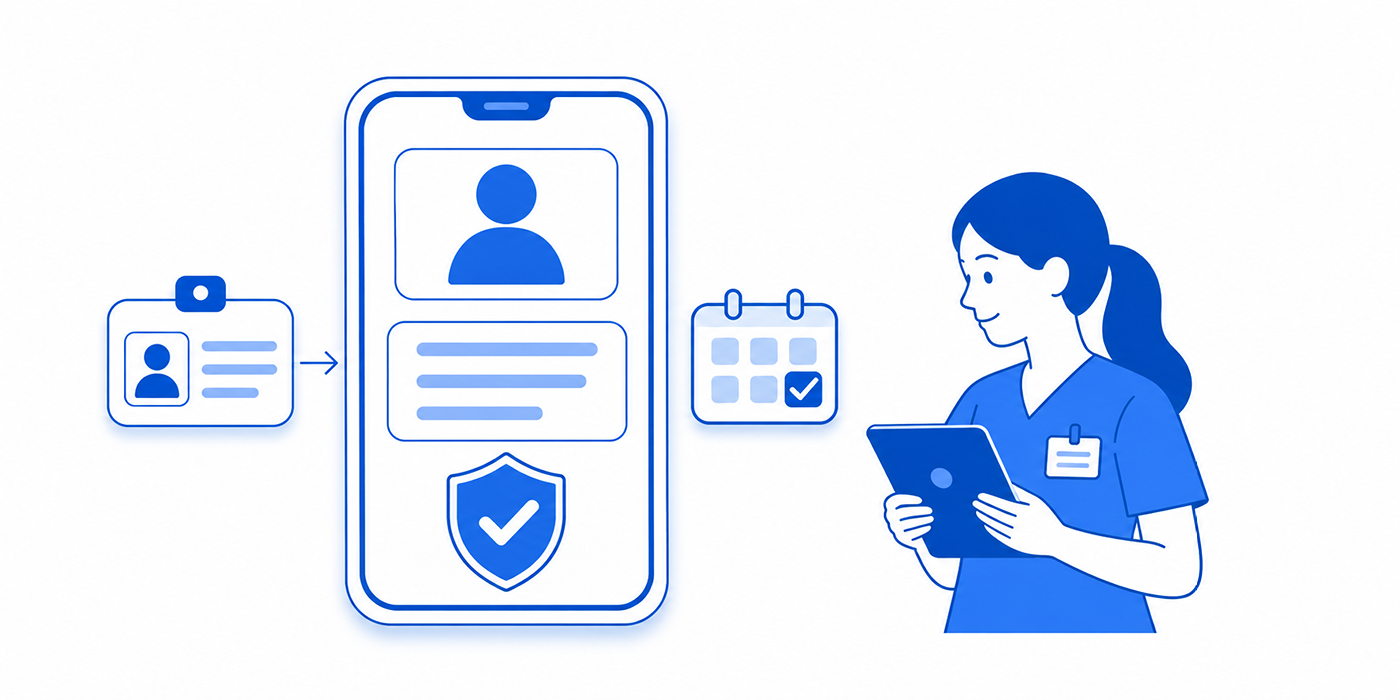
Patient registration establishes the identity, contact information, financial details, and administrative record necessary to support a healthcare encounter. Depending on the setting, registration may begin during appointment scheduling, continue through online pre-registration, and conclude when the patient checks in.
A reliable registration process connects several functions: patient identification, demographic verification, appointment matching, insurance verification, applicable notices and consent documentation, and financial communication.
The most important objective is accurate information that can be used safely throughout the patient's encounter. A registration completed in two minutes offers little operational value if the information causes a claim rejection, duplicates an existing medical record, or sends clinical information to the wrong person.
For this reason, registration quality should be evaluated alongside speed, patient experience, and error correction workload.
The seven stages of a reliable registration workflow
1. Appointment identification. Confirm the intended patient, provider, location, date, service type, and appointment status. Review patient scheduling integrations to prevent mismatches between appointments and registration records.
2. Patient identity matching. Search existing records using approved identifiers before creating a new chart. A reliable process reduces duplicate records and supports accurate cloud-based EMR management.
3. Demographic verification. Confirm the patient's legal name where required, date of birth, contact details, preferred communication methods, and other necessary registration information. Use appropriate written communication standards to record corrections.
4. Coverage verification. Confirm payer information, member and subscriber details, coverage dates, and relevant benefits. Resolve discrepancies through established administrative troubleshooting procedures.
5. Notices and permissions. Deliver applicable privacy notices and obtain required acknowledgments, treatment consents, or authorizations according to their specific purposes. Follow confidential communication procedures and informed consent requirements.
6. Financial communication. Explain verified patient responsibility, available estimates, applicable payment arrangements, and financial assistance pathways without representing estimated insurance benefits as guaranteed payment.
7. Final registration reconciliation. Ensure that the registration, appointment, payer details, and encounter record reference the correct patient. Confirm the handoff using established team communication protocols and workflow automation controls.
| # | Registration Term | Definition & Practical Example | Risk & Required Administrative Action |
|---|---|---|---|
| 1 | Pre-Registration | Collecting and verifying required patient information before the scheduled appointment. | Check outstanding fields before arrival using virtual registration tools. |
| 2 | Electronic Check-In | Patient completion of arrival confirmation, forms, or registration steps through an electronic interface. | Verify actual completion and appointment status synchronization. |
| 3 | Medical Record Number (MRN) | An identifier assigned to a patient's medical record within a healthcare organization's defined system. | Confirm the existing MRN before creating another electronic patient chart. |
| 4 | Master Patient Index (MPI) | An index used to identify patients and connect their records within an organizational environment. | Investigate possible matches before changing patient record identities. |
| 5 | Enterprise Master Patient Index (EMPI) | A patient identity index linking records across multiple affiliated systems or facilities. | Check cross-facility identity matches and record access controls. |
| 6 | Patient Encounter | A defined interaction or episode of service associated with the patient's healthcare record. | Distinguish an appointment from an active encounter in scheduling systems. |
| 7 | Duplicate Patient Record | Multiple unintended records representing the same patient, potentially fragmenting medical history. | Escalate suspected duplicates through approved record correction procedures. |
| 8 | Overlay Error | Information belonging to one patient incorrectly entered into or associated with another patient's record. | Stop further edits and notify authorized clinical and records teams. |
| 9 | Demographic Verification | Confirming necessary identifying and contact information, such as name, birth date, and address. | Record discrepancies accurately using administrative documentation standards. |
| 10 | Guarantor | The person or entity identified as financially responsible under the relevant account and legal arrangements. | Distinguish the guarantor from the insurance subscriber during financial registration. |
| 11 | Insurance Subscriber | The person through whom coverage is held under an insurance plan. | Confirm subscriber identity and relationship before submitting eligibility transactions. |
| 12 | Dependent | A person covered through an eligible subscriber relationship under a health plan. | Verify the relationship and dependent-specific coverage information in patient intake records. |
| 13 | Member ID | An identifier used by a health plan to locate a member's enrollment or benefits information. | Compare payer records and entered identifiers before resolving eligibility mismatches. |
| 14 | Eligibility Inquiry (270) | An X12 electronic transaction requesting information about healthcare coverage and benefits. | Confirm payer routing, patient identifiers, and automated request failures. |
| 15 | Eligibility Response (271) | An X12 response providing available eligibility and benefit information. | Review service-specific restrictions and record the response in the appropriate patient account workflow. |
| 16 | Copayment (Copay) | A fixed amount a patient may owe for a covered service, according to plan terms. | Confirm service category and plan conditions before providing financial explanations. |
| 17 | Deductible | An amount a covered person may need to pay toward specified services before certain plan benefits apply. | Check remaining deductible and applicable service rules through benefit verification procedures. |
| 18 | Coinsurance | A percentage of an applicable covered-service cost assigned to the patient under plan rules. | Base estimates on allowed amounts and benefit conditions when communicating patient responsibility. |
| 19 | In-Network Status | The provider's participation status under the patient's specific plan or network. | Verify the actual plan and service location rather than assuming all products from one insurer have identical coverage rules. |
| 20 | Prior Authorization | A payer review or approval process required for certain services under specified coverage rules. | Verify the service, provider, date range, and authorization status in clearance workflows. |
| 21 | Referral Requirement | A health plan rule requiring a qualifying referral for certain specialist services. | Check referring-provider information and validity before the specialist appointment. |
| 22 | Notice of Privacy Practices (NPP) | A notice explaining how a HIPAA-regulated organization uses and discloses health information and describing individual privacy rights. | Provide the notice as required and follow privacy communication procedures. |
| 23 | NPP Acknowledgment | Written acknowledgment that a patient received the privacy notice, subject to applicable requirements. | Document good-faith efforts if acknowledgment is unobtainable. Distinguish it from treatment consent. |
| 24 | Consent to Treatment | Permission relating to healthcare services, subject to clinical and legal requirements. | Distinguish general registration forms from procedure-specific informed consent processes. |
| 25 | Authorization to Disclose | Permission meeting applicable legal requirements for a use or disclosure of protected information that requires authorization. | Verify scope, recipient, purpose, and validity through secure information-sharing procedures. |
| 26 | Coordination of Benefits (COB) | Rules and processes used to establish the payment order when more than one health plan may cover a person. | Verify coverage order and relevant plan details before claim preparation. |
| 27 | Self-Pay Registration | Registering a patient who will not use health insurance to pay for the relevant services. | Evaluate estimate, payment, and financial assistance obligations using professional financial communication. |
| 28 | Good Faith Estimate (GFE) | A written estimate of expected charges for qualifying uninsured or self-pay healthcare items and services. | Check applicability, timing, and required content under relevant compliance procedures. |
| 29 | Registration Exception Queue | A worklist of registration records requiring correction, additional information, or authorized review. | Assign owners, priorities, and deadlines using workflow automation. |
| 30 | First-Pass Registration Accuracy | Registrations passing defined checks without correction divided by completed registrations assessed. | Track errors by cause and improve front-desk verification practices. |
2. Step-by-Step Patient Registration Process: From Appointment Booking to Financial Clearance
A strong registration workflow divides information gathering, verification, and exception handling into distinct stages. This approach allows staff to recognize unresolved problems before they disrupt the patient visit.
Step 1: Identify the correct patient before creating a record
When a patient schedules or arrives for an appointment, staff should search the existing patient index using the organization's approved matching criteria.
A name alone is insufficient. Multiple patients may share identical names, and a returning patient's address or telephone number may have changed.
Consider two records:
Patient A: Maria Johnson, born April 12, 1985, with an outdated address.
Patient B: Maria Johnson, born April 12, 1995, with a similar telephone number.
Selecting the wrong record could expose unrelated clinical history or cause information to enter the incorrect chart.
Registration staff should compare appropriate identifiers, investigate conflicting details, and escalate uncertain matches to authorized personnel. A possible duplicate should remain flagged until a trained team validates whether the records represent the same individual.
Standardized identity checks strengthen electronic medical record accuracy, reduce documentation correction errors, and improve confidential patient communication.
Critical control: The organization should distinguish routine demographic corrections from record merges and suspected overlays. Record merges and overlays require specialized review because incorrect changes can affect clinical information.
Step 2: Verify demographics and communication preferences
After identifying the correct record, confirm details relevant to the encounter.
These commonly include legal name where needed, date of birth, address, telephone number, preferred language, emergency contact details where appropriate, and authorized communication preferences.
Changes should follow defined verification and documentation procedures.
For example, a patient updating a telephone number may affect how the practice delivers appointment reminders or patient portal authentication messages. A mistyped digit could cause repeated communication failures or disclosure risks.
Staff should confirm the updated information and verify that it has propagated to relevant appointment scheduling software, patient reminder systems, secure messaging platforms, and virtual check-in services.
Critical control: Capture demographic updates using approved audit trails. When information conflicts across systems, determine which system is authoritative rather than repeatedly overwriting records.
Step 3: Verify insurance eligibility and benefits accurately
Insurance verification should establish whether the payer recognizes coverage for the relevant date and what benefit information is available for the planned service.
In U.S. healthcare administration, the X12 270 transaction requests eligibility information, while the 271 transaction provides the response.
A successful eligibility response may contain coverage status, deductible information, copayments, coinsurance, and service-specific benefits. The information returned depends on the payer and the inquiry.
For example, a patient may have active insurance but discover that a specialist visit requires a referral or that the provider participates in a different network from the patient's plan.
A useful verification record captures the date checked, payer, plan, service type, relevant benefit details, reference information where available, and any unresolved restrictions.
Active eligibility does not guarantee claim payment. Claim adjudication can depend on additional factors, including actual services, coding, coverage rules, medical necessity determinations, and applicable authorizations.
Administrators should apply consistent workflow automation procedures, compliance software controls, administrative troubleshooting practices, and patient communication standards.
Step 4: Confirm required notices, consents, and authorizations
Registration teams frequently handle several documents that serve different legal and operational purposes.
A Notice of Privacy Practices explains relevant privacy practices and rights. An acknowledgment documents receipt of that notice. A treatment consent addresses permission for healthcare services, while an authorization to disclose information applies to specified uses or disclosures that require authorization.
These documents should be classified and tracked independently.
For example, under HIPAA requirements applicable to covered providers with direct treatment relationships, staff generally must make a good-faith effort to obtain acknowledgment of the privacy notice. If the patient declines, the required efforts and reason should be documented.
Refusal to acknowledge receipt of the privacy notice does not itself prohibit treatment.
Appropriate informed consent procedures, confidential communication practices, healthcare compliance workflows, and written administrative records help prevent these documents from being misclassified.
Step 5: Complete financial clearance and encounter handoff
Financial clearance may involve confirming applicable patient responsibility, available estimates, payment arrangements, referral status, and authorization requirements.
The administrative record should clearly distinguish verified financial information from preliminary estimates.
For patients who qualify as uninsured or self-pay under applicable federal requirements, a Good Faith Estimate may be required when services are scheduled sufficiently in advance or requested. Timing and content requirements depend on the circumstances.
Staff should also identify applicable financial assistance policies and patient communication needs.
Before handing the patient to the clinical team, confirm that the encounter is connected to the correct record and that outstanding registration issues are classified by urgency and responsibility.
An unresolved billing question should be routed through the appropriate financial workflow. An identity mismatch affecting the clinical record requires prompt escalation.
These handoffs benefit from professional front-desk etiquette, team communication systems, patient rapport-building skills, and automated task management.
3. Patient Registration Mistakes That Cause Claim Denials, Duplicate Records, and Delays
Registration errors often create consequences after the patient leaves the front desk. The most effective investigations trace downstream problems back to the original information or workflow failure.
Scenario A: The patient has active insurance but the claim is denied
A patient arrives for a specialist consultation. The registration dashboard shows active insurance coverage, and the appointment proceeds.
Several weeks later, the payer denies the claim because the applicable referral requirement was unmet.
The underlying error occurred when staff treated active eligibility as confirmation that every coverage condition had been satisfied.
An effective root-cause investigation should determine whether the service-specific requirements were available, whether they were checked, and which team was responsible for resolving them.
A financial clearance checklist can separate eligibility verification, network confirmation, referral review, prior authorization, and patient responsibility estimation.
Integrating these checks with patient scheduling systems, healthcare compliance software, workflow automation tools, and administrative communication procedures reduces the risk of unresolved requirements going unnoticed.
Recommended action: Create separate completion indicators for eligibility, referral, authorization, and network verification. Route exceptions to the responsible team before the scheduled service when appropriate.
Scenario B: Two medical records exist for the same patient
A returning patient registers using a shortened first name and a new home address.
The registration employee cannot immediately locate the existing chart and creates another patient record.
The new encounter is documented under the second record, while earlier medications, allergies, and visit history remain associated with the original chart.
This is a patient matching problem with potential clinical consequences.
Registration staff should follow approved search procedures, use relevant additional identifiers, and escalate uncertain matches. Authorized health information management personnel should resolve verified duplicates according to organizational rules.
Preventive controls should also consider demographic normalization, potential-match alerts, and training on electronic medical records, patient registration tools, healthcare cybersecurity safeguards, and administrative troubleshooting procedures.
Recommended action: Track confirmed duplicate creation rates and the time needed to resolve suspected matches. Include errors detected after clinical documentation begins.
Scenario C: A parent is mistaken for the insurance subscriber and patient guarantor
A parent registers a minor child for an outpatient appointment.
The parent providing registration information is entered as the insurance subscriber, even though coverage is held through another parent. The account also automatically assigns financial responsibility without confirming the appropriate legal and organizational arrangements.
This creates two distinct problems: inaccurate insurance enrollment information and potentially incorrect financial account assignment.
The registration workflow should distinguish the patient, subscriber, guardian or authorized representative, and guarantor.
Each field has a separate purpose and should be verified according to applicable rules.
Careful use of patient interaction scripts, confidential communication practices, professional administrative terminology, and digital intake systems helps avoid confusing these relationships.
Recommended action: Use distinct fields and verification prompts for patient identity, subscriber identity, authorized representative, and guarantor.
Scenario D: Patient registration becomes a barrier to emergency evaluation
A patient arrives at a hospital emergency department with symptoms that may require immediate medical attention.
Administrative staff request complete insurance documentation and financial details before allowing the patient to proceed.
For hospitals subject to the Emergency Medical Treatment and Labor Act (EMTALA), reasonable registration activities cannot delay the required medical screening examination or necessary stabilizing treatment.
A hospital may collect appropriate preliminary information while clinical evaluation proceeds, provided the process does not delay or discourage required care.
The workflow should support rapid identification and clinically appropriate routing while allowing administrative details to be completed when feasible.
Training in front-desk communication, phone triage terminology, professional administrative behavior, and team communication protocols helps staff understand these priorities.
Recommended action: Establish an emergency registration pathway that allows timely clinical evaluation and supports completion of necessary administrative information without inappropriate delay.
Choose the registration issue your team encounters most frequently. Submit your answer to receive a targeted operational recommendation.
Submit Vote
Interactive registration self-assessment. Responses are displayed locally within the page. This component does not collect personal information, store votes, or transmit results.
4. Patient Registration Examples: Insurance Verification, Financial Responsibility, and Digital Intake
Registration teams need to understand how common administrative terms translate into real financial and operational decisions.
Example 1: Calculating an estimated patient responsibility
Consider a patient scheduled for an outpatient service with an illustrative insurance allowed amount of $300.
Assume the patient's applicable remaining deductible is $100 and the plan requires 20% coinsurance on the remaining allowed amount after the deductible.
The calculation would be:
Remaining deductible: $100.
Amount remaining after deductible: $300 − $100 = $200.
Coinsurance: $200 × 20% = $40.
Illustrative estimated patient responsibility: $100 + $40 = $140.
The estimate assumes the service is covered, the provider is in network, the specified benefit rules apply, and there are no additional copayments or relevant adjustments.
Actual patient responsibility may differ based on claim adjudication, other benefits, billing rules, or changes in accumulated deductible information.
Registration employees should explain the assumptions behind the estimate and avoid presenting it as a final bill.
Accurate patient communication scripts, verbal communication techniques, healthcare compliance controls, and written documentation standards can reduce misunderstandings.
Example 2: An insured patient elects to pay privately
A patient has health insurance but chooses to pay out of pocket for a particular scheduled service.
The registration team must confirm that the patient intends to self-pay for that service, document the arrangement appropriately, and assess whether applicable Good Faith Estimate requirements apply.
Under the federal No Surprises Act, qualifying uninsured or self-pay patients generally have rights to a written estimate when they request one or schedule care at least three business days in advance.
For appointments scheduled three to nine business days ahead, the applicable estimate generally must be provided within one business day. For those scheduled at least ten business days ahead, the usual deadline is three business days. Separate requirements apply to estimates requested without scheduling.
The estimate should describe expected charges according to applicable requirements and should be preserved with relevant registration records.
Staff should also consider applicable organizational financial assistance policies.
These procedures connect patient registration technology, healthcare compliance software, professional front-desk communication, and administrative documentation.
Example 3: Online registration appears complete, but the EHR is missing information
A medical group sends online registration invitations to 500 patients.
Four hundred patients open the invitation, 350 begin the forms, and 300 submit them. However, only 270 submissions successfully transfer into the clinical registration system.
Several useful metrics can be calculated:
Invitation-to-submission conversion: 300 ÷ 500 × 100 = 60%.
Completion among patients who started: 300 ÷ 350 × 100 = 85.7%.
Successful integration among submitted forms: 270 ÷ 300 × 100 = 90%.
End-to-end successful registration: 270 ÷ 500 × 100 = 54%.
The 90% integration rate suggests a problem affecting 30 submitted registrations. These records may require manual correction or additional verification.
The administrator should investigate rejected data fields, missing identifiers, outdated mappings, and system synchronization failures.
This process requires familiarity with virtual check-in systems, cloud-based EMR terminology, medical admin technology troubleshooting, and workflow automation.
Recommended action: Monitor form submission, interface acceptance, patient-record matching, and final registration readiness as separate events.
Example 4: Measuring registration accuracy and correction workload
A clinic audits 400 completed registrations during one month.
Of those, 344 pass all defined checks without correction. The remaining 56 contain errors or unresolved issues requiring staff intervention.
First-pass registration accuracy = 344 ÷ 400 × 100 = 86%.
The correction rate is 14%.
Further investigation finds 24 insurance-related errors, 18 demographic discrepancies, nine missing documentation issues, and five appointment mismatches.
Insurance-related errors account for approximately 42.9% of all registrations requiring correction.
A targeted improvement project should prioritize the confirmed insurance problems, while separately addressing any high-risk patient identification errors regardless of frequency.
After improvements, the practice should track correction volume, time spent reworking records, and downstream claim denials.
Linking results to healthcare automation tools, patient scheduling integrations, team communication processes, and front-desk professionalism helps ensure that process changes are implemented consistently.

5. How to Improve Patient Registration Accuracy, Speed, and Revenue Cycle Performance
Registration improvement requires a structured approach to patient identification, information validation, exception management, staff training, and performance monitoring.
The objective is to reduce preventable errors without creating unnecessary administrative barriers for patients.
Step 1: Establish a registration quality scorecard
Begin with measurable indicators linked to the organization's most important operational problems.
A practical registration scorecard should include the following:
First-pass registration accuracy: Percentage of assessed registrations passing defined checks without correction.
Duplicate record creation rate: Confirmed duplicates created during the period divided by new patient records created.
Eligibility verification completion: Percentage of applicable encounters with documented verification before the required operational cutoff.
Registration-related denial rate: Claims initially denied for verified registration-related reasons divided by the defined claim population.
Median registration cycle time: Middle observed duration from a defined registration starting point to completion.
Digital intake integration success: Submitted electronic registrations successfully accepted and correctly matched by the receiving system.
Exception resolution time: Time between identification of a registration issue and its documented resolution.
The scorecard should identify the numerator, denominator, relevant population, reporting period, source system, and responsible owner for each metric.
Connect these indicators to patient scheduling systems, virtual check-in technology, healthcare workflow automation, and administrative reporting procedures.
Step 2: Create a risk-based registration checklist
Registration errors should be prioritized according to their consequences.
High-priority issues include suspected patient identity overlays, mismatched records, significant confidentiality concerns, and unresolved information that could affect immediate clinical safety.
Financial clearance issues include inaccurate payer information, unresolved referral requirements, authorization problems, and incorrect subscriber relationships.
Routine administrative issues may include noncritical contact updates or incomplete optional fields.
The appropriate escalation route depends on the clinical setting, urgency, and applicable requirements. Emergency care must follow its own legally compliant workflow.
A risk-based approach helps employees prioritize issues while maintaining patient confidentiality standards, professional communication practices, healthcare compliance procedures, and team escalation protocols.
Step 3: Automate repetitive verification while preserving exception review
Suitable automation opportunities include pre-registration reminders, field validation, payer eligibility inquiries, incomplete-form notifications, and task assignment.
For example, a registration platform might identify that the patient's insurance information is missing before the scheduled appointment and generate an approved reminder.
However, automated responses should preserve enough context for staff to interpret the information correctly.
An eligibility response indicating active coverage still requires review of applicable service restrictions. Likewise, a possible duplicate patient match should be routed for authorized verification rather than automatically merged without appropriate safeguards.
Administrators should monitor failed automation attempts and provide fallback procedures.
Reviewing healthcare automation tools, workflow automation terminology, medical software troubleshooting, and cloud-based EMR systems helps identify appropriate technical controls.
Step 4: Train staff using scenario-based assessments
Registration training should assess decision-making under realistic conditions rather than relying exclusively on memorized definitions.
Useful training scenarios include a returning patient with conflicting identifiers, active insurance with an unmet referral requirement, a privacy notice acknowledgment refusal, a self-pay estimate request, and a parent whose financial relationship differs from the insurance subscriber relationship.
For each scenario, evaluate whether the employee identifies the relevant risk, follows approved verification procedures, records the issue accurately, and escalates it to the appropriate person.
Training should also cover respectful financial conversations, language access, patient confidentiality, and responding to patients who cannot complete digital registration.
These capabilities build on medical front-desk etiquette, verbal communication techniques, assertive administrative communication, and patient rapport-building methods.
Step 5: Conduct a monthly registration improvement review
A monthly audit should examine representative registration records, resolved exceptions, recurring error categories, and downstream consequences.
For example, suppose a practice reduces registration corrections from 14% to 9% after improving insurance verification procedures.
The difference is five percentage points, equivalent to approximately a 35.7% relative reduction.
Before attributing the improvement to the intervention, administrators should confirm that the audit method, reporting period, patient population, and error definitions remain comparable.
The team should also determine whether fewer corrections resulted in fewer claim denials and less manual rework.
Every improvement review should produce a documented action, responsible owner, implementation deadline, and follow-up measurement.
Combining healthcare compliance monitoring, administrative team communication, patient registration integrations, and workflow automation controls makes improvement efforts easier to sustain.
6. Frequently Asked Questions About the Patient Registration Process
-
Patient registration establishes or updates the administrative information needed to support a healthcare encounter. It may include identity verification, demographics, insurance details, privacy documentation, and financial information.
Patient check-in generally confirms arrival and completes remaining tasks for a particular appointment.
A patient can finish pre-registration several days before a visit and still need to confirm arrival on the appointment date.
Understanding virtual check-in systems, patient scheduling integrations, appointment reminders, and front-desk procedures helps administrators coordinate these activities.
-
Common information includes patient identifiers, relevant demographic details, contact information, appointment details, insurance information when applicable, and necessary administrative documentation.
Additional requirements depend on the patient's circumstances, the healthcare setting, and applicable policies.
Staff should verify required information through approved processes and avoid collecting unnecessary sensitive details.
Training in electronic medical record terminology, confidential communication, virtual registration, and professional administrative standards helps employees collect information accurately.
-
An eligibility response provides available information about coverage and benefits at the time of the inquiry.
Claim payment may depend on additional requirements involving the actual service, applicable network, referral, prior authorization, coding, and payer adjudication rules.
A successful eligibility response therefore provides useful verification evidence without guaranteeing claim payment.
Administrators should document relevant benefit information and separately confirm additional requirements.
Useful supporting skills include healthcare workflow automation, compliance software usage, registration troubleshooting, and team communication procedures.
-
Staff should follow approved patient matching procedures and avoid creating additional records until the relevant identity checks have been completed.
Suspected duplicates should be escalated to authorized records personnel. The review should consider verified identifiers, record history, and possible differences in demographic information.
Merging records without appropriate validation can introduce serious clinical and privacy problems.
Organizations should track duplicate creation and resolution through cloud-based EMR systems, administrative troubleshooting procedures, healthcare cybersecurity safeguards, and confidential communication controls.
-
Under the applicable HIPAA privacy notice rules, a covered provider generally must make a good-faith effort to obtain written acknowledgment that the patient received the notice.
A patient may decline to sign the acknowledgment. The provider should document the required good-faith effort and reason the acknowledgment was not obtained.
Refusal to sign that acknowledgment alone does not prevent permitted treatment.
Registration employees should distinguish privacy notice acknowledgment from other documents and applicable clinical consent requirements.
Knowledge of informed consent procedures, confidential communication rules, professional front-desk etiquette, and healthcare compliance requirements helps prevent inappropriate delays.
-
The patient receives healthcare services.
The insurance subscriber is the person through whom the relevant health coverage is held.
The guarantor is the person or entity identified as financially responsible under applicable account arrangements.
These roles may belong to the same person or different people.
For example, a child may be the patient, one parent may be the insurance subscriber, and the responsible guarantor may be determined separately.
Staff should maintain distinct fields and verification procedures through patient registration systems, administrative communication scripts, healthcare compliance workflows, and electronic record management.
