

A medical office can open on time and still be unprepared for its first patient. An unchecked refrigerator alarm, an unresolved appointment conflict, an unlocked workstation, or an undocumented cleaning task can disrupt care before the day begins. Closing presents equally serious risks when confidential documents, pending clinical messages, equipment, and unresolved patient requests are overlooked. This guide provides actionable opening and closing checklists, practical tutorials, and accountability controls for medical administrators managing front-desk operations, healthcare compliance, and daily workflow automation.
1. Understanding Medical Office Opening and Closing Procedures
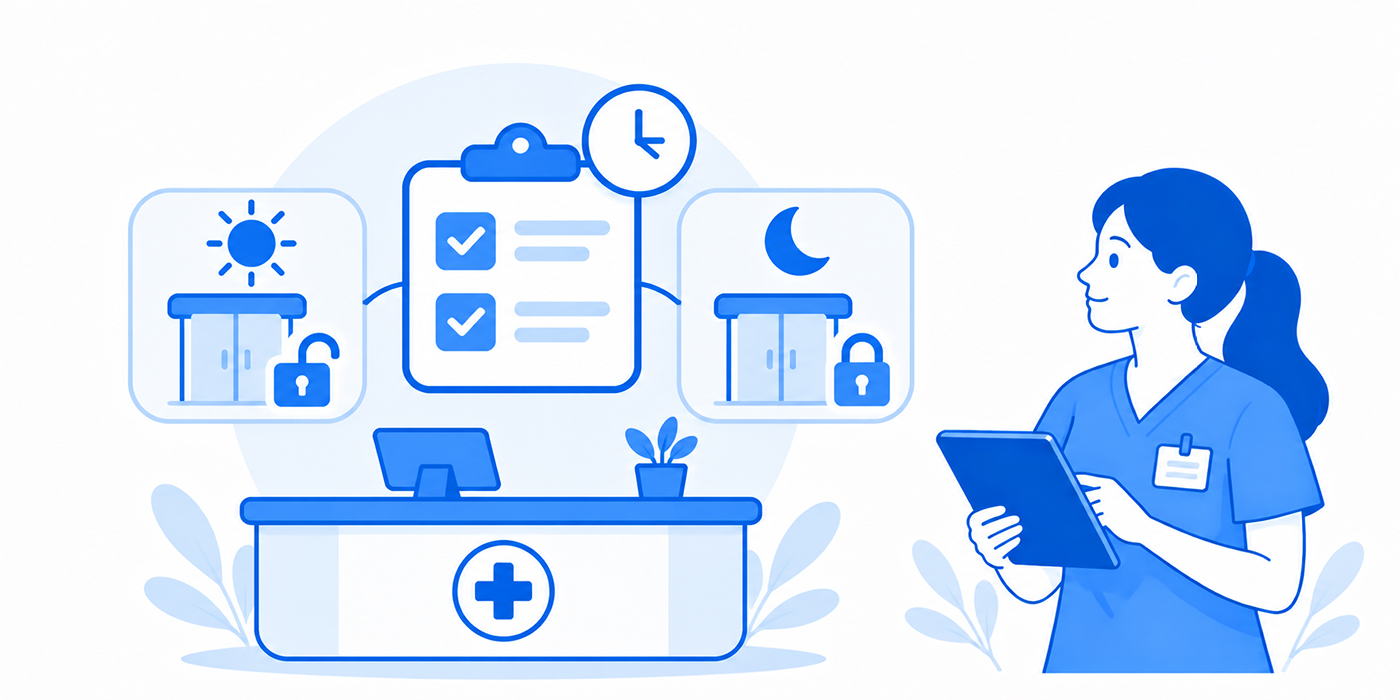
Office opening and closing procedures are standardized operational processes used to prepare a healthcare facility for patient care and leave it secure, organized, and properly handed over afterward.
These procedures cover physical security, infection prevention, equipment readiness, appointment verification, patient confidentiality, financial reconciliation, and outstanding administrative work.
The biggest operational failure often occurs when employees assume another department has completed a task. A receptionist may assume an examination room has been prepared, while clinical staff assume the front desk has checked the day's appointment restrictions. Clear ownership prevents these gaps.
Effective team communication, professional medical administration, and workflow automation help distinguish completed tasks from assumptions.
The Five Operational Readiness Areas
1. Facility readiness: Entrances, lighting, access controls, emergency routes, waiting areas, and environmental conditions must meet the practice's requirements before patient arrival.
2. Clinical readiness: Authorized clinical staff verify appropriate room preparation, equipment status, required supplies, infection prevention measures, and any temperature-controlled inventory.
3. Administrative readiness: Appointment schedules, registration systems, communication channels, pending referrals, and insurance-related worklists must be reviewed before the first scheduled encounter.
4. Information security: Workstations, documents, printers, electronic records, and physical storage areas must be protected according to approved healthcare cybersecurity procedures and confidential communication standards.
5. End-of-day accountability: Every incomplete activity needs a documented status, a responsible owner, and a clear next action. This applies to unresolved patient scheduling conflicts, secure patient messages, and outstanding virtual check-in tasks.
Why a Checklist Needs an Owner, Deadline, and Verification Method
A basic checklist might say, "Check examination rooms."
That instruction is too vague for operational accountability.
A stronger checklist specifies:
Task: Verify each assigned examination room meets the approved readiness standard.
Owner: Designated clinical team member.
Deadline: Before the room's first scheduled patient.
Evidence: Completed room-readiness record with identified exceptions.
Escalation: Notify the clinical lead if a required resource or safety control is unavailable.
This structure allows administrators to distinguish completed work from pending work and identify problems before they affect patients.
The same principle applies to patient scheduling integrations, medical office maintenance, and healthcare compliance monitoring.
30 operational controls covering facility readiness, patient scheduling, clinical preparation, confidentiality, documentation, and end-of-day handoff.
| # | Operational Check | Required Action | Verification / Escalation |
|---|---|---|---|
| OPENING PROCEDURES: COMPLETE BEFORE THE RELEVANT SERVICE BEGINS | |||
| 1 | Authorized Facility Entry | Access the facility using approved keys, credentials, and entry procedures. | Investigate damage, unexpected access alerts, or signs of intrusion. |
| 2 | Entry and Exit Safety | Inspect patient access routes, emergency exits, and obvious slip or trip hazards. | Escalate blocked exits or unsafe conditions before opening affected areas. |
| 3 | Environmental Conditions | Check applicable lighting, ventilation, temperature, water, and other facility requirements. | Report conditions outside the facility's approved operating parameters. |
| 4 | Clinical Storage Temperatures | Authorized staff check applicable vaccine or medication storage monitoring data. | Escalate temperature excursions and follow approved product-handling procedures. |
| 5 | Waiting Area Readiness | Inspect seating, accessibility, visible cleanliness, and patient information materials. | Remove unsafe furniture and report accessibility barriers. |
| 6 | Hand Hygiene Supplies | Verify applicable hand hygiene stations have adequate approved supplies. | Report unavailable sinks, dispensers, or required consumables. |
| 7 | Examination Room Readiness | Clinical staff verify room status, equipment availability, and required preparation. | Hold affected rooms from use until critical deficiencies are resolved. |
| 8 | Emergency Equipment Readiness | Assigned clinical staff perform approved checks on applicable emergency supplies and equipment. | Escalate missing, expired, defective, or inaccessible resources immediately. |
| 9 | EHR and System Access | Verify authorized access to scheduling, registration, and relevant clinical systems. | Report outages and activate approved downtime procedures when needed. |
| 10 | Appointment Schedule Review | Check provider absences, appointment types, durations, locations, and resource conflicts. | Assign ownership to unresolved appointment exceptions. |
| 11 | Referral and Authorization Queue | Identify incomplete referrals, eligibility issues, and outstanding authorizations. | Escalate time-sensitive cases to assigned administrative or clinical owners. |
| 12 | Communications Readiness | Test necessary telephone, approved messaging, and voicemail workflows. | Identify failed message delivery or unavailable communication channels. |
| 13 | Printer and Document Security | Remove unattended patient documents and verify authorized document handling. | Escalate suspected unauthorized disclosures under policy. |
| 14 | Registration and Payment Readiness | Verify approved check-in, payment, and receipt functions are available. | Report access, reconciliation, or device errors. |
| 15 | Opening Huddle and Sign-Off | Review staffing, schedule risks, unresolved safety issues, and service readiness. | Record responsible owners and restrict affected services when required. |
| CLOSING PROCEDURES: COMPLETE BEFORE FINAL HANDOFF AND SECURING THE FACILITY | |||
| 16 | Remaining Patient Review | Verify all patients and authorized visitors have completed or transitioned from their visits. | Escalate any unresolved patient presence or care transition. |
| 17 | Appointment Outcome Reconciliation | Review outstanding appointment statuses, cancellations, and rescheduling tasks. | Assign correction of inaccurate or unresolved appointment records. |
| 18 | Clinical Message Handoff | Route unresolved patient concerns, results messages, and clinical requests. | Confirm urgent items reach an appropriate clinical pathway. |
| 19 | Documentation Deficiency Handoff | Identify unsigned notes and missing administrative documentation. | Assign authorized review without improperly signing for clinicians. |
| 20 | Transaction Reconciliation | Reconcile applicable receipts, refunds, payment records, and approved cash handling. | Document variances and escalate unresolved discrepancies. |
| 21 | Outstanding Referral and Insurance Tasks | Review incomplete administrative prerequisites affecting upcoming appointments. | Set next-action owners and deadlines. |
| 22 | Exam Room Turnover and Cleaning | Assigned personnel complete required environmental cleaning and disinfection. | Follow approved cleaning methods, products, and contact times. |
| 23 | Sharps and Regulated Waste | Trained personnel inspect approved containers and manage waste under policy. | Escalate overfilled containers, spills, or handling hazards. |
| 24 | Medical Supply and Equipment Status | Record required restocking, maintenance alerts, and equipment restrictions. | Flag defective equipment against use and assign follow-up. |
| 25 | Refrigeration and Storage Review | Check applicable storage-unit doors, alarms, and temperature records. | Follow excursion protocols; do not independently release affected stock. |
| 26 | PHI and Paperwork Security | Secure retained records and approved confidential-disposal containers. | Investigate documents left in publicly accessible areas. |
| 27 | Workstation and Device Security | End authorized sessions, secure devices, and protect removable media. | Escalate unauthorized access or missing devices. |
| 28 | Next-Day Schedule Review | Flag tomorrow's provider absences, complex visits, and unresolved scheduling issues. | Prepare an assigned next-day exception list. |
| 29 | Final Facility Security | Complete approved checks of doors, windows, alarms, lights, and equipment states. | Confirm the facility is appropriately secured without interrupting essential systems. |
| 30 | Closing Sign-Off and Handoff | Record completed controls, exceptions, assigned owners, and handoff status. | Require designated approval for unresolved high-risk issues. |
ACMSO Daily Operations Checklist. Adapt task ownership, timing, clinical requirements, and escalation rules to your facility's approved procedures.
2. Medical Office Opening Procedures: Step-by-Step Morning Workflow
The opening routine should establish operational readiness before the first patient arrives. A useful sequence prioritizes safety, essential clinical systems, patient-facing services, and outstanding administrative risks.
The following workflow connects medical front-desk etiquette, patient scheduling tools, medical admin troubleshooting, and healthcare compliance procedures.
Step 1: Verify Facility Security Before Admitting Patients
The designated opening employee should check for signs of unauthorized entry, damage, alarms, and obvious facility hazards.
Confirm that required entrances and accessible routes can be used safely. Inspect emergency exits for obstructions without interfering with fire-safety equipment or approved building controls.
If a security concern suggests a possible intruder or immediate danger, follow the organization's emergency procedure rather than entering or investigating an unsafe area.
Example: The opening receptionist discovers that a side entrance is damaged and cannot be secured. The issue should be escalated to the responsible facilities or security personnel, with appropriate controls established before the affected area is used.
Document the incident through professional written communication, use approved team communication procedures, and preserve relevant information under healthcare cybersecurity and security protocols.
Completion standard: The facility's required access and safety checks are complete, with unresolved hazards assigned to an authorized owner.
Step 2: Complete Clinical Storage and Equipment Readiness Checks
Authorized clinical staff should review required storage conditions, equipment status, and emergency readiness before the relevant services begin.
For facilities storing vaccines, CDC guidance supports checking and documenting applicable minimum and maximum temperatures at the beginning of the workday using the appropriate temperature-monitoring device. Where the device lacks that capability, current temperatures are generally checked at least twice daily.
If a reading indicates a possible temperature excursion, follow the practice's storage-and-handling protocol. Affected vaccines may require segregation and labeling until their usability is determined by appropriate authorities or manufacturers. Staff should avoid independently deciding that exposed inventory remains usable.
Clinical equipment checks should also follow approved manufacturer instructions and facility procedures.
Example: A temperature-monitoring device reports an overnight refrigerator excursion. The team must initiate the designated response and determine which inventory may have been affected before using it.
Record the exception through medical administrative documentation, notify the responsible team through secure communication systems, and track any equipment issue using medical admin troubleshooting procedures.
Completion standard: Required checks are recorded, and potentially unsafe equipment or inventory is appropriately restricted pending resolution.
Step 3: Inspect Examination Rooms and Infection Prevention Readiness
Clinical room readiness extends beyond visible tidiness.
Assigned personnel should confirm that rooms have undergone required cleaning, reusable equipment has been appropriately processed, necessary supplies are available, and applicable hand-hygiene facilities function.
CDC environmental cleaning guidance emphasizes a risk-based approach, with particular attention to high-touch surfaces and areas where contamination is more likely.
Disinfection procedures should follow the product label, including the required contact time. A surface wiped dry before the required wet-contact period may not have received the intended disinfection process.
Example: An examination room appears clean, but the previous shift left an unresolved cleaning task. The designated clinical team should verify completion before the room is released for patient use.
Document problems using written communication standards, direct requests through team coordination channels, and apply healthcare compliance controls.
Completion standard: Required room readiness checks are complete, and each usable room has been cleared under the practice's clinical procedures.
Step 4: Verify the Appointment Schedule Against Actual Capacity
The morning schedule should be reviewed for operational conflicts before check-in begins.
Verify provider availability, appointment locations, visit durations, resource requirements, and unresolved requests.
Pay particular attention to appointments involving complex preparation, referrals, diagnostic services, or special resources.
Example: A clinician is listed at two locations during overlapping periods. Both calendars may contain valid-looking reservations, but the provider cannot fulfill both schedules simultaneously.
Review the issue through patient scheduling integrations, apply scheduling conflict management, and coordinate corrections through approved patient interaction scripts.
A schedule review should distinguish genuinely confirmed appointments from pending requests and identify whether proposed changes have reached the authoritative scheduling system.
Completion standard: Material conflicts have been resolved or assigned, and affected patients have a documented communication plan.
Step 5: Test Front-Desk Systems and Communications
The receptionist should verify that the necessary registration, scheduling, communication, and payment functions are available.
Typical checks include approved EHR login, telephone service, voicemail routing, printers, scanning equipment, secure messaging, and payment terminals.
Use authorized accounts and approved test procedures. Avoid unnecessarily accessing patient records merely to verify that a system functions.
If a service is unavailable, document the scope of the problem and activate the relevant downtime process.
Example: The EHR loads correctly, but the check-in application cannot retrieve today's appointments. Staff should determine whether the issue affects a single workstation or a broader patient scheduling integration.
Escalate through medical admin tech troubleshooting, protect data through healthcare cybersecurity procedures, and coordinate temporary operations through team communication.
Completion standard: Essential services are available or an approved alternative workflow is operational.
Step 6: Conduct a Pre-Opening Huddle
An effective opening huddle concentrates on information that changes the day's operations.
Discuss provider absences, room restrictions, time-sensitive referrals, expected patient access needs, unresolved clinical handoffs, and any unavailable systems.
Keep the meeting focused on decisions and ownership. Sensitive patient information should be communicated only as appropriate through approved channels.
For each issue, establish who owns the next action and when escalation is required.
A useful huddle question is:
Which unresolved issue could prevent a scheduled patient from receiving the intended service today?
This directs attention toward operational consequences rather than routine announcements.
Use team communication terminology, professional medical administration practices, assertive communication techniques, and appropriate confidential communication to ensure issues are raised and assigned.
Completion standard: The appropriate lead confirms readiness, including any restrictions or active contingencies.
3. Medical Office Closing Procedures: A Complete End-of-Day Tutorial
Closing is the final opportunity to identify failures that could affect the next shift. A complete handoff should preserve patient follow-up, documentation integrity, facility safety, and operational continuity.
An effective closing process incorporates secure healthcare messaging, medical documentation workflows, patient scheduling management, and workflow automation tools.
Step 1: Reconcile Patient and Appointment Statuses
Review the day's appointment records and identify statuses that require correction.
Appointments left as arrived after patients have departed may require review. Canceled visits should be accurately distinguished from no-shows, and rescheduled encounters should reflect their proper disposition.
The administrative team should also identify patients requiring follow-up communication or outstanding booking actions.
Example: A patient requested rescheduling during the afternoon, but the original appointment remains confirmed and no replacement has been accepted.
The request should be assigned for resolution under approved scheduling conflict procedures, with appropriate patient communication and verification through the scheduling system.
Completion standard: Each outstanding appointment issue has a verified status and assigned next action.
Step 2: Resolve or Transfer Unanswered Patient Communications
Unanswered messages are among the most important closing risks.
Review voicemail, approved secure messages, patient portal requests, and assigned communication queues.
Distinguish routine requests from matters requiring clinical escalation. Administrative personnel should follow the organization's protocols when a message describes potentially urgent symptoms or a time-sensitive clinical concern.
Example: A patient leaves a message about new symptoms shortly before closing. Staff should route the concern through the established clinical process rather than leave it in an unmonitored routine inbox.
Apply phone triage communication protocols, use therapeutic communication techniques when appropriate, and maintain accurate written patient communication.
Completion standard: Unresolved patient requests are appropriately prioritized, documented, and assigned to a monitored workflow.
Step 3: Review Documentation Deficiencies and Financial Exceptions
Closing responsibilities may include identifying unsigned clinical notes, incomplete registration records, unprocessed documents, unreconciled payments, and outstanding billing-related administrative issues.
The responsible clinician should handle required clinical authentication. Administrative staff should follow authorized workflows without signing clinical notes or altering information beyond their permissions.
For financial reconciliation, compare payment-system transactions with the approved daily report. Refunds, voids, and unexplained differences should be documented according to financial control procedures.
Example: The payment terminal reports 28 transactions, while the administrative system displays 27. The discrepancy should be researched using transaction references rather than corrected with an unsupported manual adjustment.
Document these problems through professional written communication, track them with workflow automation tools, and protect relevant records through healthcare cybersecurity controls.
Completion standard: Financial variances and documentation deficiencies have been reconciled or formally assigned for resolution.
Step 4: Complete Environmental Cleaning and Waste Checks
At the end of patient care, assigned staff must perform the cleaning and disinfection required for the facility's clinical areas.
A checklist should specify the surfaces, cleaning products, frequency, responsible personnel, and method of completion.
Sharps containers and regulated waste require specialized handling according to applicable standards and training. Staff should never manually reach into a sharps container or attempt unsafe waste consolidation.
OSHA's Bloodborne Pathogens Standard addresses applicable exposure controls, protective equipment, housekeeping, regulated waste, and related worker protections.
Example: A sharps container reaches its designated fill line. Trained personnel must follow the approved closure and replacement process rather than compress its contents to create more space.
Use team communication procedures, healthcare compliance tools, and documented medical office troubleshooting for unresolved problems.
Completion standard: Required cleaning and waste tasks have verifiable completion records, with hazardous conditions escalated.
Step 5: Secure Patient Information and Authorized Workstations
The closing employee should inspect approved work areas for unattended patient records, printed labels, discarded forms, and unsecured devices.
Patient information awaiting disposal must follow the organization's secure destruction procedures. Ordinary publicly accessible trash receptacles are generally inappropriate for identifiable protected health information.
Electronic systems should be signed out or secured according to workstation policies. Automatic screen-lock features provide an additional safeguard, while manual session security remains important.
Example: Printed patient registration forms are left on the reception printer. The responsible employee should secure them through an authorized process and report any suspected unauthorized disclosure.
Review confidential communication requirements, healthcare cybersecurity practices, secure healthcare messaging, and professional administrative standards.
Completion standard: Protected information is secured, and required user sessions and devices are appropriately protected.
Step 6: Prepare the Next-Day Handoff and Secure the Facility
Before the last authorized employee leaves, compile a concise handoff containing unresolved administrative work, upcoming scheduling risks, equipment restrictions, and assigned responsibilities.
Then follow the approved facility-security procedure for entrances, storage rooms, alarms, and applicable utilities.
Essential equipment such as medication refrigerators, necessary monitoring devices, or required environmental systems must remain operational as specified by policy.
Example: A malfunctioning examination room device is awaiting service. The closing handoff should identify the affected room, equipment restriction, service contact, and next responsible employee.
Use team communication systems, medical admin troubleshooting records, workflow automation tracking, and written documentation standards.
Completion standard: Facility security has been verified, required systems remain operational, and every material exception has a documented owner.
Choose the issue your team struggles with most to reveal a targeted operational improvement.
ACMSO interactive operational self-assessment. This tool reveals guidance based on your selection. Responses are not collected or counted.
4. Troubleshooting Opening and Closing Failures: Eight High-Risk Scenarios
A completed checklist can conceal unresolved problems when staff record the discovery of an issue as though it were a successful verification.
For example, identifying an equipment failure satisfies the inspection requirement, but the equipment may remain unsafe or unavailable. The checklist should therefore distinguish completed successfully, failed and escalated, and pending verification.
This distinction is essential to healthcare compliance monitoring, medical admin troubleshooting, team communication, and workflow automation.
Scenario 1: The Receptionist Arrives, but the EHR Is Unavailable
Operational impact: Staff may lose access to appointments, patient registration, clinical information, and communication records.
Response: Determine whether the outage affects a single workstation, the local network, or the broader application. Notify the approved support contact and activate the facility's downtime procedures.
Control: Maintain an authorized workflow for identifying existing appointments, documenting requests, and reconciling temporary records after restoration.
Train staff in cloud-based EMR operations, healthcare cybersecurity, and technology troubleshooting.
Resolution evidence: The system is restored or an approved downtime process is functioning, with responsible staff assigned to outstanding transactions.
Scenario 2: An Examination Room Fails Its Morning Inspection
Operational impact: A required examination or procedure may be delayed, canceled, or moved.
Response: Identify the specific deficiency and determine which appropriately trained team must resolve it. Restrict the room when the problem affects safe use.
Control: Maintain room-level readiness records and backup capacity procedures for predictable equipment failures.
Use team communication practices, scheduling conflict management, and accurate patient communication scripts when appointments are affected.
Resolution evidence: The room has been cleared for use by the appropriate personnel, or its appointments have been safely reassigned.
Scenario 3: A Patient Calls With a Time-Sensitive Concern Just Before Closing
Operational impact: An unanswered concern may remain in an administrative queue while the responsible team becomes unavailable.
Response: Follow the approved clinical escalation pathway. Verify essential contact information and document the handoff appropriately.
Control: Define how urgent and time-sensitive messages transfer to designated after-hours or on-call resources where applicable.
Support these procedures with phone triage communication, therapeutic communication techniques, and secure messaging systems.
Resolution evidence: The concern has entered the appropriate monitored clinical pathway, with an accountable handoff.
Scenario 4: A Confidential Document Is Found in an Unsecured Area
Operational impact: Patient information may be exposed to unauthorized individuals.
Response: Secure the document according to policy, identify its proper destination, and report a possible privacy incident through the designated channel.
Control: Add targeted checks covering reception desks, printers, scanners, shared work areas, and disposal containers.
Review confidential communication requirements, healthcare cybersecurity procedures, and compliance software workflows.
Resolution evidence: The information is secured, and required incident assessment or reporting has been initiated.
Scenario 5: A Refrigerator Alarm Is Active During Opening
Operational impact: Stored vaccines or other temperature-sensitive products may have been exposed to unsuitable conditions.
Response: Notify the designated clinical or storage-management personnel and initiate the relevant temperature-excursion procedure.
Control: Review monitoring records, affected inventory, alarm history, and the facility's required response process.
Document exceptions through professional written communication, coordinate through team messaging, and track equipment follow-up using medical admin troubleshooting.
Resolution evidence: Affected inventory has been appropriately evaluated and managed by authorized personnel.
Scenario 6: Cleaning Is Marked Complete, but Required Surfaces Remain Unprepared
Operational impact: The facility may release a treatment area without completing required infection prevention measures.
Response: Restrict affected spaces as appropriate and have designated personnel complete the required cleaning and disinfection.
Control: Specify cleaning locations, products, contact times, frequency, and verification responsibilities in the procedure.
Recurring defects should appear in healthcare compliance reporting, workflow automation worklists, and appropriate team communication records.
Resolution evidence: Required preparation has been completed and the area has been appropriately released for use.
Scenario 7: The Daily Payment Report Does Not Match Recorded Transactions
Operational impact: Unresolved differences may lead to inaccurate financial records, incorrect refunds, or reconciliation delays.
Response: Compare transaction identifiers, approved adjustments, payment timestamps, and relevant receipt records.
Control: Use a documented variance process with appropriate permissions and supervisory review.
Protect financial and patient information through confidential administrative communication, accurate written documentation, and authorized workflow automation.
Resolution evidence: The discrepancy is resolved or remains in an assigned, traceable financial exception queue.
Scenario 8: The Closing Employee Cannot Confirm That All Tasks Were Completed
Operational impact: Critical activities may remain unresolved overnight, with no responsible employee available for follow-up.
Response: Review incomplete checklist items, identify safety-critical concerns, and escalate them before securing the facility.
Control: Require named task ownership, recorded exceptions, and designated sign-off authority.
A closing checklist should allow an authorized supervisor to approve an appropriate contingency when a noncritical item cannot be completed.
Support this process with assertive team communication, professional administration standards, and workflow tracking systems.
Resolution evidence: Every material exception has an owner, priority, next action, and authorized disposition.
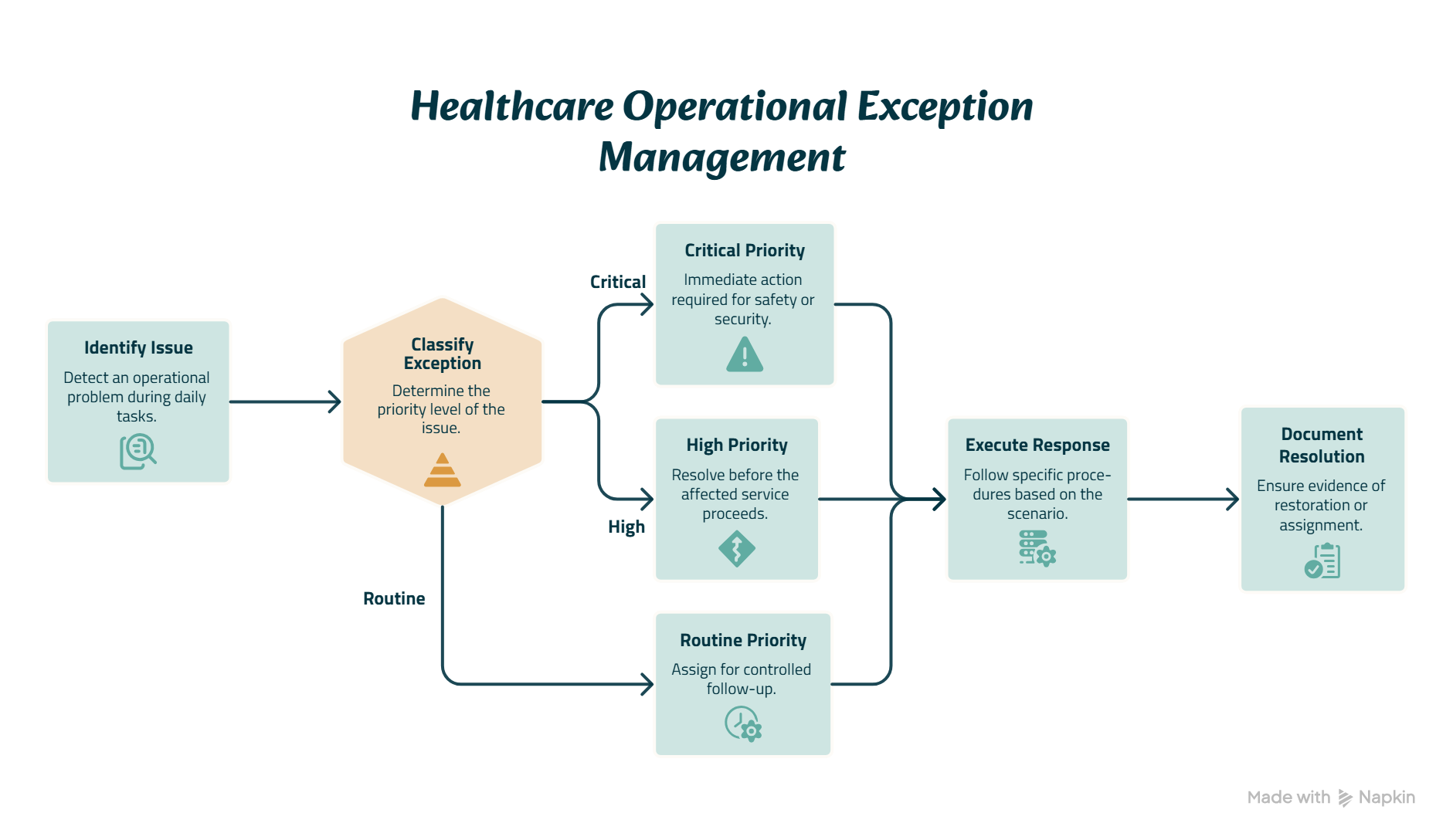
How to Prioritize Exceptions Before the Office Opens or Closes
A useful escalation model contains three levels.
Critical: Immediate action required. Examples include an immediate safety hazard, suspected serious security incident, or potentially urgent patient concern. Follow the applicable emergency or clinical procedure and involve the authorized personnel.
High: Resolve before the affected service proceeds. Examples include unavailable essential equipment, an unprepared examination room, or unresolved appointment conflicts that prevent the intended service.
Routine: Assign for controlled follow-up. Examples include nonessential supply replenishment, approved administrative improvements, or low-impact equipment service requests that do not affect safe operations.
The classification should be based on actual risk and organizational policy.
This approach strengthens scheduling conflict management, secure team communication, medical admin troubleshooting, and healthcare compliance monitoring.
5. How to Build a Reliable Opening and Closing Checklist System
A useful checklist system should identify failures early, prevent unresolved work from disappearing between shifts, and produce evidence that corrective actions were completed.
Managers should evaluate checklist effectiveness using actual operational outcomes rather than completed checkbox counts alone.
This requires combining workflow automation tools, team communication practices, medical admin troubleshooting records, and healthcare compliance controls.
A Five-Field Digital Checklist Structure
Each checklist task should contain five core data fields.
Task identifier: A unique reference that allows staff to distinguish tasks across departments and locations.
Assigned owner: The employee or role responsible for performing the work.
Required completion point: A deadline tied to operational readiness, such as before the first examination room use.
Status: Completed successfully, pending, failed and escalated, or approved as an exception.
Evidence: The completion timestamp, relevant reading, inspection record, responsible reviewer, or exception reference.
For example, a temperature-storage check might record the unit identifier, monitoring result, review time, assigned employee, and excursion case number where applicable.
The system should store this information through approved healthcare automation workflows, maintain appropriate data confidentiality, and support clear administrative documentation.
Metric 1: First-Patient Operational Readiness Rate
Calculation: Sessions meeting all required readiness controls before service begins ÷ sessions evaluated × 100.
Suppose 46 of 50 clinic sessions meet their required opening controls before the first applicable patient service.
The readiness rate is 92%.
For this metric, define essential controls clearly and exclude any session where an unresolved critical deficiency was incorrectly marked complete.
Track failures by cause, such as provider scheduling, room preparation, equipment availability, or system access.
Use the results to improve patient scheduling workflows, team communication, and technical troubleshooting.
Metric 2: Opening Delay Minutes
Calculation: Total preventable operational delay minutes caused by opening deficiencies ÷ number of sessions evaluated.
Consider a clinic with 120 minutes of documented preventable opening delays across 40 sessions.
Average delay equals three minutes per session.
Classify delays by root cause and distinguish administrative delays from clinical decisions or unavoidable circumstances.
An equipment issue affecting four rooms may have a different impact from a single delayed registration workstation.
Examine these patterns alongside scheduling conflict management, cloud-based EMR readiness, and front-desk operating procedures.
Metric 3: Closing Exception Closure Rate
Calculation: Closing exceptions resolved within their assigned deadlines ÷ closing exceptions due for resolution × 100.
If 36 of 40 exceptions due for resolution are completed on time, the closure rate is 90%.
Count a task as resolved only when its required outcome has been verified.
For example, reporting an equipment malfunction may complete the reporting action, while the separate repair task remains open.
This distinction supports accurate workflow automation reports, technical troubleshooting records, and team communication accountability.
Metric 4: Patient Message Handoff Completion Rate
Calculation: Patient communications requiring handoff that receive verified assignment to an appropriate monitored workflow ÷ total communications requiring handoff × 100.
Suppose 58 of 60 messages requiring handoff are appropriately assigned.
The handoff completion rate is approximately 96.7%.
Also monitor elapsed time and cases remaining beyond assigned deadlines. Urgent clinical communications require separate monitoring according to applicable escalation standards.
Use secure messaging systems, phone triage communication procedures, and team communication workflows to strengthen handoffs.
Metric 5: Repeat Checklist Defect Rate
Calculation: Defects recurring within a defined review period ÷ total documented checklist defects × 100.
Suppose a practice records 25 checklist defects in a month, with eight representing previously identified problems.
The repeat defect rate is 32%.
Investigate recurring failures by location, equipment, task category, staffing pattern, and corrective-action history.
A repeatedly missing supply may require inventory-level changes, while repeated incomplete cleaning records may indicate insufficient training, unclear ownership, or a flawed workflow.
Review recurring issues through medical admin troubleshooting, healthcare compliance software, and workflow automation systems.
A Practical 14-Day Implementation Plan
Days 1–2: Map existing responsibilities. Identify opening and closing tasks, responsible departments, safety-critical controls, and areas where ownership is unclear. Document existing team communication practices and front-desk workflows.
Days 3–4: Define completion evidence. Specify what must be observed or recorded before each task is considered complete. Identify tasks that need clinical personnel, supervisor approval, or compliance oversight.
Days 5–6: Build the digital checklist. Configure task assignments, required fields, escalation conditions, and exception tracking through an approved workflow automation tool. Apply appropriate healthcare cybersecurity safeguards.
Days 7–9: Pilot the checklist. Test normal operations and controlled failure scenarios, including unavailable equipment, missing supplies, delayed clinical messages, and EHR downtime.
Days 10–11: Review failures. Determine whether checklist items are ambiguous, excessively repetitive, assigned to the wrong role, or missing escalation instructions.
Days 12–13: Train staff. Use practical scenarios and clear written communication to demonstrate task completion, documentation, and escalation.
Day 14: Validate readiness. Evaluate outstanding critical defects, staff understanding, digital checklist accessibility, and supervisory review procedures.
A short pilot should be followed by regular monitoring. Rare failures, equipment breakdowns, and seasonal workflow changes may require longer observation before the organization can determine sustained improvement.
How to Prevent Checklist Fatigue
Overly long checklists can encourage employees to mark tasks complete without meaningful verification.
Separate universal daily controls from specialized clinical checks, weekly maintenance activities, and periodic compliance inspections.
Use conditional questions so that irrelevant items remain appropriately classified without requiring unnecessary actions.
For example, a practice that does not store vaccines should not be forced to record daily vaccine refrigerator checks. A practice operating several procedure rooms may need room-specific records with trained clinical ownership.
Review checklist design with staff responsible for medical administrative operations, team communication, workflow automation, and healthcare compliance.
Every checklist item should correspond to a necessary control, a meaningful operational outcome, or a clearly defined requirement.
6. Frequently Asked Questions About Medical Office Opening and Closing Procedures
-
Responsibility should be assigned according to job function, training, authorization, and facility policy.
A receptionist may handle authorized entry, front-desk systems, appointment verification, and administrative preparation. Clinical employees should perform tasks requiring clinical expertise, including applicable equipment checks and medication storage procedures.
Environmental services or trained clinical personnel should handle assigned cleaning and regulated waste responsibilities.
The practice should appoint a designated lead to review outstanding exceptions and confirm operational readiness.
Clear ownership depends on professional medical administration, team communication procedures, and documented workflow automation controls.
-
The required preparation period depends on the facility's services, staffing, number of rooms, equipment, and operational complexity.
Rather than applying one universal arrival time, measure the actual duration of essential opening tasks and account for predictable exceptions.
For example, a practice requiring equipment readiness checks, multiple examination rooms, and complex patient registration may need a longer preparation period than a small consultation-only office.
Use first-patient readiness results and opening delay data to determine an appropriate staffing schedule.
Monitor patient scheduling procedures, front-desk workflow requirements, and team coordination practices.
-
The responsible employee should document the failure, determine its applicable priority, and notify the designated owner.
Safety-critical deficiencies may require restricting a room, equipment item, or service until authorized personnel resolve the problem.
For administrative failures, an approved contingency may allow operations to continue while the issue is investigated.
Every unresolved defect should retain an owner, deadline, escalation status, and completion record.
Use medical admin troubleshooting, healthcare compliance procedures, and assertive team communication to ensure concerns are handled appropriately.
-
Review workstations, printed documents, scanners, printers, approved storage cabinets, removable media, and secure-disposal containers.
End or secure authorized electronic sessions according to policy, and verify that patient information is inaccessible to unauthorized people.
Printed protected health information awaiting destruction should be handled through approved secure disposal procedures.
Suspected privacy incidents require reporting under the organization's policies.
These checks should align with healthcare cybersecurity standards, confidential communication principles, secure healthcare messaging, and applicable compliance controls.
-
Cleaning requirements depend on the care setting, level of contamination risk, clinical activities, and applicable infection prevention policies.
CDC guidance supports structured cleaning schedules that address routine cleaning, patient-care transitions, and appropriate end-of-day procedures.
High-touch surfaces and areas exposed to blood or other potentially infectious materials may require particular attention under the applicable protocol.
Cleaning products must be used according to their instructions, including contact time and surface compatibility.
Assigned staff should document the required work and escalate unresolved deficiencies through team communication systems and healthcare compliance workflows.
-
Review messages through the facility's approved communication channels and determine their required priority.
Potentially urgent clinical matters must follow established clinical escalation procedures. Routine administrative requests should receive an assigned owner, next action, and appropriate deadline.
A handoff should clearly indicate whether the receiving team has access to the request and whether the workflow is actively monitored.
Maintain accurate documentation and avoid unnecessary disclosure of patient information.
Effective processes use phone triage communication, secure messaging platforms, patient interaction scripts, and team communication protocols.
