

Medical office maintenance directly affects patient safety, infection prevention, equipment reliability, and the continuity of clinical services. A neglected ventilation system, improperly disinfected examination table, or undocumented equipment malfunction can disrupt appointments and expose a practice to serious operational risks. Understanding maintenance terminology helps administrators identify hazards, coordinate repairs, and establish reliable preventive procedures. This interactive dictionary connects medical administrative troubleshooting, healthcare compliance procedures, workflow automation, and team communication with practical maintenance strategies for medical offices.

1. Medical Office Maintenance Fundamentals and Essential Terminology
Medical office maintenance involves inspecting, servicing, cleaning, repairing, and monitoring the physical environment and equipment used to deliver healthcare services. Responsibilities can include examination rooms, waiting areas, plumbing, heating and ventilation systems, medical devices, electrical infrastructure, and environmental safety controls.
Effective maintenance requires coordination between medical administrators, clinical personnel, facility managers, environmental services workers, and qualified outside contractors.
For example, a malfunctioning examination light may require a routine equipment repair, while a failed handwashing sink in a treatment area can create an immediate infection-prevention concern.
Administrators responsible for front-desk operations, patient scheduling, and healthcare technology management should understand how maintenance failures affect daily workflows.
The four major categories of medical office maintenance
Preventive maintenance consists of planned inspections and servicing intended to reduce the likelihood of failures. Examples include replacing HVAC filters according to applicable specifications, inspecting examination chairs, and testing backup power equipment.
Corrective maintenance addresses identified faults. Replacing a broken door closer, repairing a leaking faucet, or correcting an equipment error falls within this category.
Condition-based maintenance uses observations or measurements to determine when intervention is needed. Monitoring refrigerator temperature trends, identifying unusual equipment vibrations, and tracking recurring ventilation alarms can help detect problems.
Emergency maintenance addresses failures requiring immediate action because they threaten safety, essential operations, or critical systems. An electrical hazard in a treatment room may require taking the area out of service and contacting qualified personnel.
These categories should be connected to automated maintenance worklists, internal team communication, administrative troubleshooting, and compliance documentation.
The difference between cleaning, disinfection, and sterilization
These terms describe different processes, and choosing the appropriate method is critical.
Cleaning: Removes soil, organic material, and other contamination from surfaces or equipment using appropriate physical and chemical methods.
Disinfection: Uses an appropriate process to destroy or inactivate many or most relevant pathogenic microorganisms, depending on the level of disinfection.
Sterilization: Uses a validated process intended to destroy all forms of microbial life, including bacterial spores.
Under the Spaulding classification framework, critical medical devices generally require sterilization, semicritical devices generally require at least high-level disinfection, and noncritical devices generally require appropriate low-level disinfection.
Environmental surfaces and medical equipment must be maintained according to their intended use, contamination risk, product instructions, and applicable infection-prevention procedures.
Medical administrators should coordinate these requirements through professional staff training, written maintenance instructions, healthcare compliance systems, and departmental communication procedures.
| # | Maintenance Term | Meaning & Workplace Risk | Practical Administrative Control |
|---|---|---|---|
| 1 | Preventive Maintenance (PM) | Scheduled servicing designed to reduce failures. Missed inspections can allow equipment defects to accumulate. | Schedule tasks through automated maintenance workflows and verify completion. |
| 2 | Corrective Maintenance | Repair performed after a defect is identified. Repeated temporary fixes may conceal a persistent problem. | Document the fault, repair, and verification using troubleshooting procedures. |
| 3 | Condition-Based Maintenance | Maintenance triggered by equipment conditions such as vibration, temperature, or error trends. | Define alert thresholds in monitoring automation. |
| 4 | Emergency Maintenance | Urgent intervention involving immediate safety risks or critical service disruption. | Use predefined escalation contacts and emergency handoff procedures. |
| 5 | Computerized Maintenance Management System (CMMS) | Software for organizing assets, work orders, service history, and scheduled maintenance. | Connect task ownership with workflow tracking. |
| 6 | Asset Register | Inventory of equipment and facility assets, including identifiers, locations, service requirements, and responsible parties. | Track ownership and service documents through compliance records. |
| 7 | Maintenance Work Order | A documented request defining the defect, location, priority, assignee, and resolution. | Require clear maintenance documentation before closure. |
| 8 | Priority Classification | Ranking work by consequences, urgency, and service impact. Incorrect priorities can delay safety-critical repairs. | Use a risk-based decision guide supported by departmental communication. |
| 9 | Manufacturer Instructions for Use (IFU) | Manufacturer directions governing approved equipment operation, cleaning, servicing, and reprocessing. | Maintain current instructions in controlled documentation. |
| 10 | Calibration | Comparison and, where appropriate, adjustment of an instrument against a recognized reference. | Track due dates, results, and authorized service through maintenance scheduling. |
| 11 | Functional Verification | Checking whether equipment performs its intended functions after inspection or repair. | Record pass/fail results and acceptance responsibility in service reports. |
| 12 | Out-of-Service Tag | Identification showing that defective or potentially unsafe equipment must be withheld from use. | Notify staff using equipment status handoffs. |
| 13 | High-Touch Surface | A frequently contacted surface such as a door handle, counter, touch screen, or examination table control. | Create location-specific cleaning checklists and reception area protocols. |
| 14 | Disinfectant Contact Time | The required time a surface must remain appropriately wet for a disinfectant's labeled efficacy. | Include the product's label instructions in cleaning procedures. |
| 15 | EPA-Registered Disinfectant | A disinfectant registered for specified uses and organisms under EPA labeling requirements. | Verify approved application, dilution, contact time, and compatible surfaces through product control records. |
| 16 | Terminal Cleaning | Thorough cleaning of designated spaces at specified endpoints, including after certain procedures or at the end of a use period. | Define room-specific tasks and verification under cleaning schedules. |
| 17 | Environmental Cleaning Audit | A structured check of cleaning performance against approved procedures. | Record failed checks and reassess training using quality audit tools. |
| 18 | Personal Protective Equipment (PPE) | Task-appropriate protective equipment such as gloves, protective clothing, and eye protection. | Select PPE using exposure risk, manufacturer guidance, and workplace safety training. |
| 19 | Safety Data Sheet (SDS) | A document describing a hazardous chemical's risks, handling, first aid, and protective measures. | Ensure staff can obtain applicable SDS information during a shift through accessible safety instructions. |
| 20 | Hazard Communication (HazCom) | Requirements for communicating hazardous chemical information through labels, SDSs, and employee training. | Maintain a chemical inventory and document staff training with compliance records. |
| 21 | Bloodborne Pathogens Exposure Control Plan | A written plan for controlling occupational exposure to blood and other potentially infectious materials where OSHA's standard applies. | Define employee roles and exposure reporting through safety communication procedures. |
| 22 | Sharps Container | An appropriate puncture-resistant, closable, leak-resistant container for used contaminated sharps. | Check location, fill level, and safe replacement through routine safety rounds. |
| 23 | Regulated Medical Waste | Waste subject to applicable special handling and disposal requirements because of its characteristics or contamination. | Use approved containers and licensed services as required, with disposal documentation. |
| 24 | HVAC Preventive Service | Planned servicing of heating, ventilation, and air-conditioning components according to system requirements. | Track inspections and servicing in facility work orders. |
| 25 | Air Filtration Rating | A measure such as MERV describing filter performance under specified test conditions. | Use filtration compatible with the installed system and clinical requirements; record changes through maintenance logs. |
| 26 | Indoor Air Quality (IAQ) | Conditions affecting indoor air, including ventilation, contaminants, moisture, and occupant comfort. | Escalate persistent moisture, odor, and ventilation complaints through facility troubleshooting. |
| 27 | Water Management Program (WMP) | A risk-based program for controlling water-system conditions that can support harmful microbial growth. | Assign responsibility for monitoring and remediation; document findings through facility safety records. |
| 28 | Temperature Monitoring Log | A record of readings and excursions for temperature-sensitive storage equipment. | Use product-specific temperature ranges and defined excursion escalation through monitoring tools. |
| 29 | Electrical Safety Inspection | Assessment of applicable electrical hazards, equipment condition, and safe installation or operation. | Remove suspect equipment from use and create a documented technical service request. |
| 30 | Lockout/Tagout (LOTO) | Hazardous-energy control procedures to prevent unintended equipment energization during covered servicing work. | Use qualified personnel and applicable OSHA procedures; coordinate through maintenance handoffs. |
| 31 | Emergency Power / UPS | Backup electrical systems intended to support specified equipment during power interruptions. | Inventory protected loads and test backup arrangements through scheduled continuity checks. |
| 32 | Accessibility Inspection | Checking whether accessible routes, doors, fixtures, and other features remain functional and usable. | Escalate blocked routes or damaged features through patient access procedures. |
2. Medical Office Maintenance Problems: Real Scenarios and Correct Responses
Maintenance problems often appear during routine administrative work. A patient reports an unpleasant odor, a nurse notices a loose examination chair component, or a receptionist discovers water accumulating near an electrical outlet.
The most important administrative skill is recognizing the severity of the problem and initiating the appropriate response.
Scenario A: A blood spill occurs between patient appointments
An examination room has a visible blood spill following a procedure. The next patient is already waiting, and an employee suggests wiping the area quickly with a general-purpose cleaner.
Blood and other potentially infectious materials require established exposure-control and decontamination procedures. OSHA's Bloodborne Pathogens standard addresses appropriate worksite cleaning, contaminated surfaces, protective measures, and sharps handling when occupational exposure is involved.
Correct administrative response: Keep the affected area unavailable for patient use, notify personnel trained and equipped for the task, ensure the appropriate cleaning procedure is followed, and verify readiness before reopening the room.
The selected disinfectant must be appropriate for the surface and contamination involved, and personnel must follow applicable label instructions, including contact time.
Document the event through written incident procedures, coordinate staff through team communication protocols, and adjust appointments using scheduling conflict management.
Scenario B: A vaccine refrigerator records an abnormal temperature
A medical assistant discovers that the temperature monitoring device has recorded readings outside the applicable storage range.
The practice has appointments scheduled, and an employee suggests moving the vaccines to another refrigerator and continuing normal operations.
Temperature excursions require immediate action under the applicable vaccine or medication storage procedures.
Correct administrative response: Notify the designated clinical or vaccine coordinator, preserve the monitoring data, identify the affected inventory, and follow the relevant storage and excursion instructions.
Affected vaccines are commonly labeled "DO NOT USE" and separated from usable inventory while appropriate guidance is obtained. Staff should avoid independently deciding that products are usable or should be discarded.
The refrigerator should be assessed by qualified personnel, and its condition verified before normal storage resumes.
Use healthcare automation tools for temperature alerts, medical office troubleshooting for equipment escalation, and patient communication scripts if appointments require rescheduling.
Scenario C: A damaged examination chair remains in use
An adjustable examination chair develops intermittent movement faults. Staff repeatedly restart it, and the chair appears functional during occasional checks.
Intermittent faults deserve investigation because uncontrolled movement can create fall, positioning, or equipment-related hazards.
Correct administrative response: Remove potentially unsafe equipment from service, apply an appropriate out-of-service designation, record the symptoms, and arrange assessment by qualified personnel.
The repair record should identify the equipment model, asset identifier, reported failure, service work performed, and applicable post-repair verification.
Return-to-service approval should be documented according to organizational policy.
Link these actions with equipment troubleshooting procedures, maintenance communication, service documentation, and workflow tracking.
Scenario D: A patient notices water accumulating near a restroom
A patient reports water pooling beside a restroom sink. The area is near a frequently used walkway, and staff have placed a warning sign nearby.
The problem involves a potential slip hazard, possible water damage, and the underlying plumbing failure.
Correct administrative response: Restrict access to the hazardous area as appropriate, arrange qualified repair, provide a safe alternative route or facility, and confirm the leak has been corrected.
Inspect adjacent flooring and materials for water damage. Repeated moisture problems should be investigated for possible microbial growth.
Temporary warning signs should accompany appropriate controls until the area is safe.
Coordinate the response through front-desk communication procedures, patient interaction scripts, facility troubleshooting, and maintenance work orders.
Scenario E: The clinic's air conditioning works, but an examination room develops persistent odors
A clinic receives repeated complaints about a musty odor in one examination room. The room temperature remains comfortable, so employees assume the ventilation system is functioning correctly.
Persistent odors may indicate moisture intrusion, poor air distribution, plumbing issues, or other environmental concerns requiring assessment.
Correct administrative response: Record the location, timing, and conditions associated with the complaint. Arrange an inspection by qualified facility personnel and evaluate moisture sources, ventilation operation, and affected materials.
Avoid introducing fragrances to conceal the odor. Fragrances can create additional exposure and sensitivity concerns without addressing the underlying cause.
Document follow-up findings through medical office troubleshooting, staff reporting systems, compliance documentation, and maintenance automation.
3. Medical Office Cleaning, Infection Prevention, and Workplace Safety Requirements
Maintenance programs must account for the type of care provided, environmental hazards, medical equipment, cleaning products, and applicable safety regulations.
A routine primary care clinic, procedure-oriented specialty practice, and outpatient surgical facility may have different equipment, contamination risks, and regulatory obligations.
Environmental cleaning schedules should follow risk
CDC guidance recommends risk-based environmental cleaning procedures that consider contamination probability, patient vulnerability, and the likelihood of contact with surfaces.
This means cleaning schedules should identify specific areas, responsible personnel, methods, and frequencies.
For example, examination tables and other patient-contact surfaces may require cleaning or disinfection between patients according to their use and applicable guidance, while low-touch administrative storage areas may follow a different schedule.
Practical checklist: For each room, record the responsible worker, approved products, surfaces requiring attention, cleaning frequency, required protective equipment, and completion verification.
A room-specific checklist should be integrated into staff communication workflows, medical office compliance records, automated task scheduling, and professional employee training.
Disinfectant contact time and equipment compatibility
Using a disinfectant incorrectly can undermine its intended effectiveness or damage equipment.
Administrators should verify the product's approved use, target organisms where relevant, dilution instructions, required wet contact time, storage requirements, and compatibility with the surface.
For example, using an unsuitable chemical on a medical device's control panel could damage its components. Repeated alcohol exposure can also affect certain plastics and other materials.
Where applicable, follow both the disinfectant's label and the device manufacturer's instructions.
Staff should know how to locate the relevant product information through written operational guidance, report damage using technical troubleshooting procedures, and request guidance through departmental communication channels.
Hazardous cleaning chemicals and Safety Data Sheets
OSHA's Hazard Communication standard requires applicable employers to communicate hazardous chemical information through a written program, labeling, accessible Safety Data Sheets, and employee training.
An SDS provides essential information about hazards, handling, storage, personal protective equipment, first aid, and spill response.
Medical offices should maintain an accurate inventory of applicable hazardous chemicals and ensure employees can access required safety information during work shifts.
The wrong chemical combination can produce dangerous reactions. Employees should never improvise disinfectant mixtures or substitute cleaning chemicals without authorization.
Training and documentation can be coordinated using healthcare compliance software, professional safety procedures, written instructions, and team communication.
Sharps handling and regulated medical waste
Contaminated sharps must be handled through appropriate disposal systems when OSHA's Bloodborne Pathogens standard applies.
Sharps containers must satisfy relevant requirements, including puncture resistance, appropriate labeling or color coding, and protection against leakage. They must be accessible, maintained upright, and replaced before overfilling.
Medical offices also need appropriate procedures for other regulated waste under applicable federal, state, and local requirements.
Administrative control: Conduct documented checks of container condition, placement, replacement status, collection arrangements, and employee reporting procedures.
Any discovered sharps hazard should be escalated to trained personnel.
Include these controls in facility maintenance worklists, compliance reporting systems, incident communication procedures, and staff professionalism training.
HVAC, water systems, and accessible facilities
Building maintenance should also address systems that may affect environmental conditions and access to healthcare.
HVAC maintenance should follow system specifications and applicable building and healthcare requirements. Important checks may include filter condition, ventilation performance, moisture problems, and abnormal system alarms.
CDC recommends comprehensive water management programs for healthcare facilities within the scope of relevant guidance, including applicable provisions of ASHRAE Standard 188. These programs support control of Legionella and other water-related risks.
Accessible patient routes, doors, restroom fixtures, and other required accessibility features should remain functional.
A blocked accessible entrance can prevent a patient from obtaining care even when the clinical equipment inside the building is working correctly.
Route these issues through front-desk access procedures, maintenance monitoring workflows, technical escalation, and patient communication practices.
View My Improvement Plan
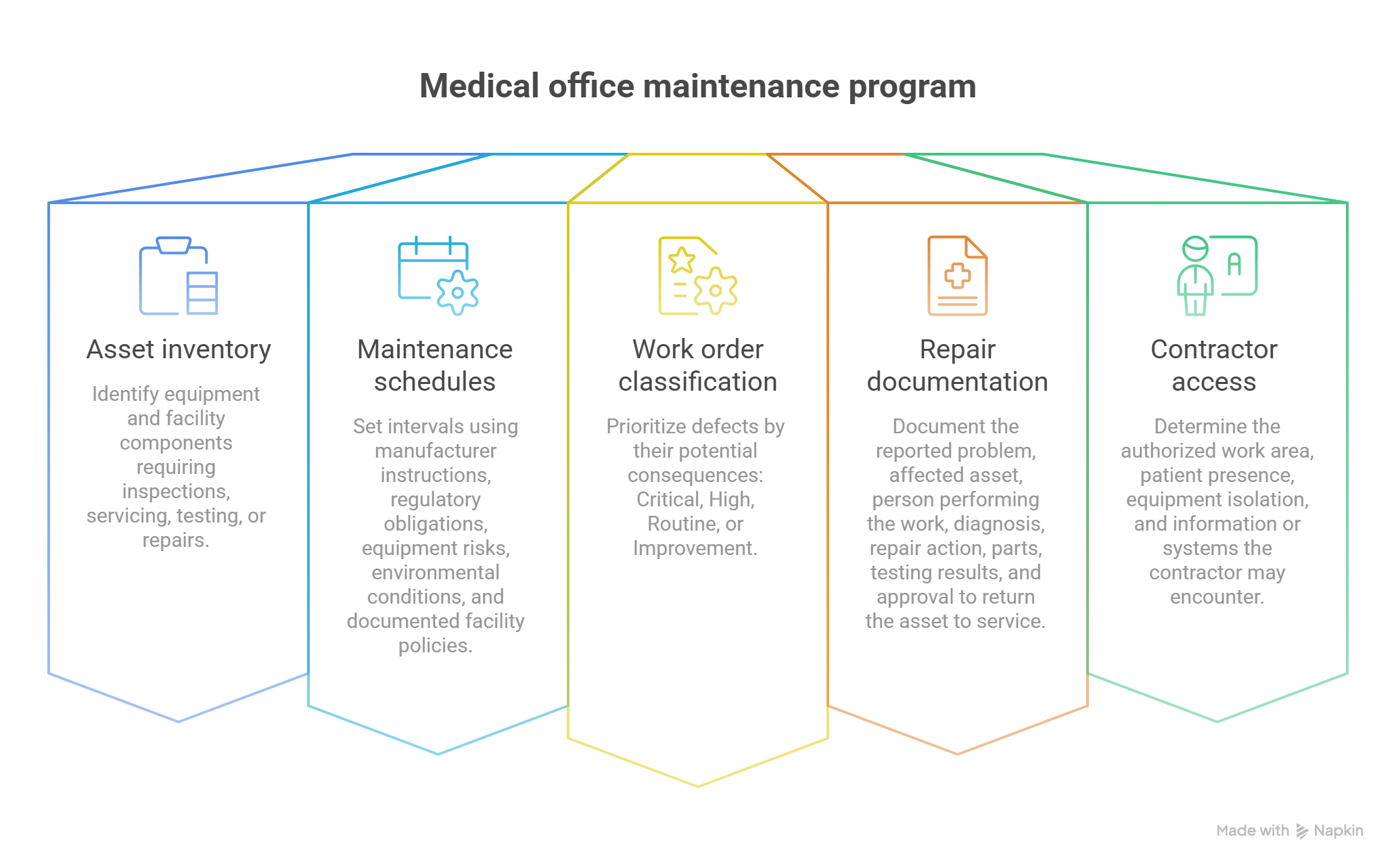
4. Building a Preventive Maintenance Schedule and Reliable Work Order System
A medical office maintenance program should define what needs servicing, when service is required, who is responsible, and how the practice confirms that the work is complete.
Without these elements, maintenance becomes reactive. Employees report the same defects repeatedly, contractors perform repairs with incomplete information, and managers struggle to determine which equipment is ready for use.
Step 1: Build an inventory of maintainable assets
Start by identifying equipment and facility components requiring inspections, servicing, testing, or repairs.
For each asset, record its unique identifier, location, manufacturer, model, serial number where applicable, installation date, warranty status, service provider, and relevant maintenance requirements.
Include items such as examination chairs, diagnostic equipment, sterilization devices where present, refrigerators, HVAC components, plumbing fixtures, and backup electrical systems.
An asset register should also distinguish clinical equipment from general facility infrastructure because inspection responsibilities and service requirements can differ.
Connect the register to maintenance workflow automation, compliance documentation, technical troubleshooting procedures, and departmental reporting.
Step 2: Assign schedules based on actual requirements
Establish each maintenance interval using applicable manufacturer instructions, regulatory obligations, equipment risks, environmental conditions, and documented facility policies.
For example, a device requiring periodic calibration should be scheduled according to its applicable specifications. An examination chair with a recurring mechanical fault may need additional inspection beyond routine servicing.
A practical maintenance schedule should identify:
Daily or between-use tasks: Applicable cleaning, visual checks, and immediate hazard reporting.
Weekly or periodic tasks: Area inspections, supplies checks, and recurring housekeeping verification.
Manufacturer-directed tasks: Equipment servicing, functional testing, calibration, and component replacement.
Risk-triggered tasks: Additional inspections following abnormal readings, damage, repeated failures, or environmental incidents.
These categories are planning tools. Specific frequencies must follow the relevant equipment, clinical setting, and applicable requirements.
Use healthcare automation systems to issue reminders, written maintenance instructions to define acceptable work, and compliance monitoring to review overdue tasks.
Step 3: Classify work orders by patient and workplace risk
Every reported defect should receive an appropriate priority based on its potential consequences.
A useful internal classification can include:
Critical: An immediate hazard or failure threatening patient safety, staff safety, or an essential service. Initiate applicable emergency procedures and isolate unsafe equipment or areas.
High: A significant defect that may interrupt scheduled services or create a substantial risk if left unresolved. Arrange prompt assessment and appropriate operational controls.
Routine: A defect with limited immediate consequences that can be addressed through planned maintenance.
Improvement: A planned upgrade or adjustment intended to improve usability, efficiency, or long-term reliability.
Organizations should establish their own response expectations based on actual risks, staffing, and resources.
The classification should appear in maintenance reporting workflows, internal communication standards, and technical escalation procedures.
Step 4: Require complete repair documentation
A contractor's statement that a device has been repaired should be supported by adequate service information.
A complete work order should identify the reported problem, affected asset, person performing the work, relevant diagnosis, repair action, replacement parts where applicable, testing results, and approval to return the asset to service.
Record any unresolved concerns or restrictions.
For recurring failures, compare repair histories to determine whether temporary fixes are repeatedly addressing symptoms rather than the underlying defect.
This is especially important for medical documentation systems, patient registration equipment, and facility systems whose failure affects clinical workflows.
Step 5: Control contractor access to sensitive areas
External technicians may need access to examination rooms, clinical equipment, electrical infrastructure, or administrative workstations.
Before work begins, determine the authorized work area, whether patients are present, whether equipment must be isolated, and what information or systems the contractor may encounter.
Patient schedules, printed records, and unattended EHR screens should be protected during maintenance visits.
A maintenance contractor does not automatically become a HIPAA business associate simply by entering a healthcare facility. The relevant relationship and functions determine whether a business associate agreement is required.
Establish contractor procedures using confidential communication standards, healthcare cybersecurity controls, front-desk visitor procedures, and compliance review practices.
5. Medical Office Maintenance Audits, Performance Metrics, and Cost Control
Maintenance performance should be evaluated through equipment reliability, timely corrective action, completed inspections, recurring failures, and operational disruption.
A practice may close hundreds of work orders while continuing to experience the same problems. High work-order closure volume has limited value unless repairs restore acceptable conditions and prevent repeat disruptions.
Metric 1: Preventive Maintenance Completion Rate
Calculation: Preventive maintenance tasks completed by their due dates ÷ total preventive maintenance tasks due during the measurement period × 100.
Suppose 46 of 50 scheduled tasks are completed on time. The completion rate is 92%.
Review overdue tasks according to their risk rather than relying exclusively on the aggregate rate. An overdue inspection of safety-critical equipment may deserve greater attention than several delayed low-risk building tasks.
Track these results through automated maintenance schedules, administrative troubleshooting systems, and compliance monitoring.
Metric 2: Mean Time to Repair (MTTR)
Calculation: Total elapsed time from work-order opening to verified restoration ÷ number of completed corrective repairs.
For example, six completed repairs requiring 30 hours of combined elapsed time produce an MTTR of five hours.
Define whether the calculation includes nights, weekends, contractor delays, and periods when the asset remains available for limited use.
Compare similar priority categories and asset types. Combining routine building repairs with critical clinical equipment failures can produce misleading averages.
Use findings to improve maintenance escalation procedures, workflow automation, and technical service reporting.
Metric 3: Repeat Failure Rate
Calculation: Corrective repairs involving the same asset and recurring failure category within a defined follow-up period ÷ relevant corrective repairs completed × 100.
A high rate can reveal inadequate root-cause investigation, recurring misuse, poor replacement parts, or aging equipment.
Review failures by asset and symptom rather than grouping unrelated repairs together.
For example, repeated HVAC shutdowns caused by the same unresolved electrical fault should trigger a more thorough investigation.
Document corrective actions through written maintenance records, compliance software, and technical troubleshooting workflows.
Metric 4: Patient-Care Disruption Hours
Calculation: Total time during which rooms, equipment, or services are unavailable because of maintenance failures.
Record the affected service, start and restoration time, and number of appointments requiring relocation, delay, or rescheduling.
This measure connects maintenance performance with actual clinical and administrative consequences.
For example, an examination room unavailable for three hours during scheduled clinic operations has a different impact from a nonessential storage area unavailable for the same duration.
Coordinate data collection through patient scheduling systems, scheduling conflict management, patient communication procedures, and maintenance worklists.
Metric 5: Maintenance Cost per Asset
Calculation: Total qualifying maintenance expenditures for an asset during a defined period, including relevant labor, parts, and contractor expenses.
Compare recurring maintenance costs with replacement costs, expected remaining service life, downtime consequences, and manufacturer support availability.
An inexpensive repair may remain appropriate when the equipment is otherwise reliable. Repeated expensive interventions on aging equipment may support a replacement proposal.
Document financial assumptions and service history before making replacement recommendations.
Integrate cost reviews into administrative workflow planning, maintenance reporting, and healthcare compliance documentation.
How to conduct a practical monthly maintenance audit
Select a sample of completed and open maintenance tasks, including at least some high-priority incidents and recurring defects.
For each task, check whether the problem was accurately recorded, the priority was appropriate, qualified personnel performed the work, required safety measures were followed, and post-repair verification was documented.
Review overdue preventive tasks and compare equipment failure patterns across departments.
A particularly valuable audit question is: How many previously closed problems have reappeared without a documented explanation?
This identifies weaknesses that completion dashboards may hide.
Use findings to improve team communication, staff training, automated follow-up processes, and compliance reviews.
6. Frequently Asked Questions About Medical Office Maintenance Terms
-
A daily checklist should focus on hazards and operational conditions that employees can identify before they affect patient care.
Relevant checks may include examination room readiness, safe access routes, visible equipment damage, housekeeping concerns, sharps container conditions, functioning handwashing facilities, and abnormalities in temperature-sensitive storage.
The checklist should identify the responsible employee, inspection area, time, observed condition, and escalation requirements.
Equipment requiring specialized testing should be assessed by qualified personnel according to applicable instructions.
Coordinate daily inspections with front-desk procedures, administrative troubleshooting, automated maintenance checklists, and compliance records.
-
The required cleaning method and frequency depend on the type of clinical activity, patient exposure risks, surfaces involved, manufacturer instructions, and applicable infection-prevention guidance.
Patient-contact surfaces and equipment may require appropriate cleaning or disinfection between patients. Other room surfaces may require daily, scheduled, or contamination-triggered attention.
Staff should follow a written procedure identifying the products, cleaning sequence, contact times, and verification requirements.
Administrators should coordinate room readiness through patient scheduling systems, staff communication workflows, written safety instructions, and healthcare compliance procedures.
-
Preventive maintenance includes planned activities intended to keep equipment in acceptable operating condition. These may involve inspections, cleaning, component replacement, adjustment, and functional testing.
Calibration specifically concerns comparing measurement equipment against appropriate references and, where applicable, making adjustments to achieve required measurement performance.
A device may require both preventive servicing and calibration, depending on its purpose and manufacturer requirements.
For example, a medical measurement instrument may function mechanically while producing inaccurate readings.
Administrators should document these activities separately where appropriate and track completion through maintenance workflow automation, equipment troubleshooting, and compliance documentation.
-
The employee should report the defect, communicate the symptoms accurately, and follow the organization's procedure for removing potentially unsafe equipment from service.
A qualified person should determine whether inspection, repair, testing, or replacement is required.
Administrators should assess whether the appointment can be relocated, safely rescheduled, or performed using an approved alternative.
The patient should receive clear and appropriate communication about any operational change.
Coordinate these actions using scheduling conflict management, patient interaction scripts, technical troubleshooting protocols, and team communication procedures.
-
Relevant OSHA standards depend on the hazards and work activities involved.
The Bloodborne Pathogens standard, 29 CFR 1910.1030, addresses occupational exposure to blood and other potentially infectious materials, including specified housekeeping and sharps requirements.
The Hazard Communication standard, 29 CFR 1910.1200, addresses applicable hazardous chemicals, labels, Safety Data Sheets, and employee training.
The Control of Hazardous Energy standard, 29 CFR 1910.147, applies to covered servicing and maintenance activities involving hazardous energy.
Other standards may apply depending on the setting and equipment.
Use healthcare compliance management, workplace safety communication, and written operational procedures to support adherence to applicable requirements.
-
Yes. Maintenance contractors can perform legitimate services in healthcare facilities when appropriate privacy and security safeguards are followed.
The organization should control contractor access to patient areas, records, workstations, and other sensitive resources according to the work being performed.
Whether a contractor is a HIPAA business associate depends on the functions performed and the relationship with the covered entity. Incidental exposure to PHI while providing general maintenance does not automatically establish business associate status.
Administrators should coordinate contractor access through confidential communication procedures, healthcare cybersecurity controls, visitor management practices, and compliance oversight.
