

A medical office can have experienced employees, advanced software, and detailed training while still struggling with inconsistent decisions. Missing escalation rules, outdated procedures, unclear responsibilities, and poorly documented exceptions can lead to privacy incidents, billing disputes, appointment delays, and patient complaints. Effective office policies give administrators consistent instructions for managing these risks. This interactive dictionary explains essential policy terms, realistic workplace examples, and practical implementation methods, connecting healthcare compliance software, professional administrative standards, workflow automation, and team communication.

1. Medical Office Policy Fundamentals and Essential Terminology
Medical office policies establish the expectations, responsibilities, and requirements governing everyday administrative operations. They help employees handle similar situations consistently, identify decisions requiring additional authority, and demonstrate that important procedures are followed.
A typical practice maintains policies covering patient registration, privacy, appointment scheduling, employee conduct, payments, records management, occupational safety, complaints, and emergency operations.
These policies affect front-desk interactions, secure patient messaging, scheduling decisions, and clinical documentation support.
Understanding policies, procedures, protocols, and work instructions
These four terms address different levels of operational control.
Policy: Establishes an organizational requirement or governing principle. For example, employees must verify patient identity before releasing protected information.
Procedure: Describes the steps used to satisfy a requirement, including the responsible employee, required records, and exceptions.
Protocol: Establishes a standardized approach to a defined situation, particularly when clinical or safety considerations require a prescribed response.
Work instruction: Provides detailed directions for completing a specific task, such as registering a patient in a particular EHR or documenting a records request.
For example, a patient confidentiality policy may require verification before disclosure. Its procedure identifies acceptable verification methods. A telephone communication script helps employees apply the procedure, while an EHR work instruction identifies where the verification outcome must be recorded.
Five characteristics of an enforceable office policy
A useful policy should establish:
Scope: Which locations, employees, contractors, patients, or activities are covered.
Authority: Who approves the policy and who is responsible for administering it.
Required conduct: What employees must do, including clearly defined restrictions.
Exceptions and escalation: How unusual situations are evaluated and who may approve deviations.
Evidence: How compliance is documented, monitored, and reviewed.
For example, a policy requiring prompt responses to patient complaints should define which issues qualify, who receives them, how urgent safety concerns are escalated, and how resolution is documented.
Organizations can reinforce these elements through written administrative communication, patient interaction scripts, team communication procedures, and compliance management systems.
| # | Policy Term | Definition & Administrative Risk | Practical Control |
|---|---|---|---|
| 1 | Policy Manual | An organized collection of approved workplace policies. Risk: employees rely on outdated or conflicting instructions. | Maintain one controlled source using compliance management software. |
| 2 | Policy Statement | A formal description of an organizational requirement. Risk: vague wording produces inconsistent employee decisions. | Define measurable expectations through clear written instructions. |
| 3 | Standard Operating Procedure (SOP) | A defined sequence of steps for performing a recurring activity. Risk: necessary verification steps are skipped. | Use step-by-step operational checklists. |
| 4 | Protocol | A standardized response to defined conditions. Risk: staff improvise when an urgent situation arises. | Train employees with scenario-based response procedures. |
| 5 | Work Instruction | Detailed directions for completing a task in a particular system or setting. Risk: incorrect EHR entries. | Maintain system-specific EHR task guidance. |
| 6 | Policy Owner | The person or role accountable for maintaining an assigned policy. Risk: necessary updates have no responsible owner. | Assign named responsibility through team governance workflows. |
| 7 | Document Control | Managing approval, distribution, revision, and withdrawal of documents. Risk: obsolete instructions remain in circulation. | Restrict uncontrolled copies through document control systems. |
| 8 | Version Control | Identifying revisions and maintaining a policy's change history. Risk: staff follow different versions. | Record changes within controlled documentation. |
| 9 | Effective Date | The date an approved policy begins governing operations. Risk: new procedures are applied before training is complete. | Coordinate effective dates with training and launch schedules. |
| 10 | Review Cycle | The defined frequency or triggering conditions for policy reassessment. Risk: requirements become outdated. | Schedule recurring and event-driven policy reviews. |
| 11 | Policy Attestation | An acknowledgment that an individual has received or reviewed a policy. Risk: organizations cannot demonstrate distribution. | Track acknowledgments and test understanding through staff training. |
| 12 | Scope of Practice | Activities a licensed professional may perform under applicable law and authorization. Risk: administrative staff make clinical decisions. | Set role boundaries in clinical escalation procedures. |
| 13 | Delegation of Authority | Formal assignment of specified decision-making responsibilities within lawful and organizational limits. | Define approval thresholds and escalation contacts. |
| 14 | Segregation of Duties | Dividing sensitive functions among responsible roles to reduce error, misuse, or fraud. | Separate relevant payment approval and adjustment steps through controlled workflows. |
| 15 | Least Privilege | Limiting system permissions to those needed for assigned responsibilities. Risk: excessive access persists after role changes. | Conduct periodic EHR access reviews. |
| 16 | Minimum Necessary Standard | A HIPAA requirement to reasonably limit PHI handling when applicable. Risk: unnecessary disclosure of entire records. | Build purpose-specific disclosure procedures. |
| 17 | Sanction Policy | A policy describing appropriate consequences for workforce violations. Risk: inconsistent responses to privacy misconduct. | Apply documented review procedures through professional conduct standards. |
| 18 | Incident Reporting | The documented process for identifying and escalating safety, privacy, operational, or security events. | Establish clear contacts and incident tracking procedures. |
| 19 | Breach Notification Policy | A process addressing assessment and required notifications following reportable information breaches. | Direct suspected events into security response workflows. |
| 20 | Records Retention Schedule | A timetable identifying which records are preserved and when authorized disposal may occur. | Map record categories using EHR records governance. |
| 21 | Release of Information (ROI) | Processing authorized or otherwise permitted disclosures and patient record requests. Risk: missed access deadlines. | Track identity verification and responses through records request procedures. |
| 22 | Patient Complaint Procedure | The process for recording, evaluating, responding to, and closing patient concerns. | Provide consistent complaint intake scripts. |
| 23 | Grievance Escalation | Referral of qualifying complaints for further review under applicable facility or regulatory requirements. | Define response owners and escalation communication. |
| 24 | Non-Retaliation | Protection against prohibited adverse treatment for exercising protected rights or raising covered concerns. | Provide confidential reporting routes and documented follow-up. |
| 25 | Informed Consent Policy | Rules for obtaining and documenting applicable consent for healthcare interventions. | Distinguish clinical authorization steps through consent workflows. |
| 26 | Cancellation and No-Show Policy | Rules for missed visits, cancellation notice, fees, and exceptions subject to applicable requirements. | Communicate rules through appointment reminders. |
| 27 | Financial Responsibility Policy | Terms covering patient payment obligations, estimates, billing communication, and available arrangements. | Explain payment terms using clear patient communication. |
| 28 | Refund Exception | A documented adjustment or departure from standard financial procedures requiring appropriate authorization. | Separate request, approval, and processing through controlled payment workflows. |
| 29 | Chaperone Policy | Procedures addressing the availability and use of appropriate chaperones during specified examinations. | Communicate applicable options with sensitive patient interaction methods. |
| 30 | Exposure Control Plan | An OSHA-required written plan for employers with covered bloodborne pathogen exposure. Risk: undefined safety and reporting procedures. | Keep applicable plans accessible and current using safety compliance tracking. |
| 31 | Hazard Communication Program | Applicable procedures covering hazardous chemical labels, Safety Data Sheets, and employee training. | Provide accessible chemical safety information and documented training. |
| 32 | Downtime and Business Continuity Policy | Instructions for sustaining essential operations during outages, emergencies, or system interruptions. | Test fallback processes through downtime simulations. |
2. Medical Office Policy Violations: Real Scenarios and Correct Administrative Responses
A policy becomes valuable when it helps an employee make a safe decision during a difficult situation. The most common failures involve unclear approval authority, inconsistent exceptions, incomplete documentation, and staff acting outside assigned responsibilities.
The following scenarios demonstrate how office policies should guide daily decisions.
Scenario A: A patient disputes a no-show fee after a reminder failure
A patient arrives at the clinic and discovers that a missed appointment fee has been added to their account. The patient explains that the practice's reminder system failed to send the scheduled notification.
The receptionist knows the cancellation policy but has no authority to waive the fee.
Correct administrative response: Verify the appointment history, check applicable cancellation terms, review available reminder logs, and document the patient's concern. If the circumstances qualify for a policy exception, forward the request to the designated approver.
Any fee or waiver must comply with applicable payer contracts, laws, and organizational requirements.
The employee should explain the review process without promising an outcome beyond their authority.
Policy improvement: Define who can approve fee adjustments, which circumstances justify review, how decisions are recorded, and when patients receive responses.
Connect this process with appointment reminder systems, scheduling conflict management, assertive communication, and patient interaction scripts.
Scenario B: A relative demands access to a patient's medical records
A caller identifies herself as the patient's daughter and requests the full medical chart. She states that she regularly transports the patient to appointments and knows the patient's date of birth.
The employee must determine whether the requested disclosure is permitted.
Correct administrative response: Follow the organization's identity and authority verification procedures, review applicable permissions, and determine which information may lawfully be disclosed.
HIPAA permits certain disclosures to family members and others involved in a patient's care or payment under specified conditions. Access to an entire record may require additional authority or a different disclosure basis.
The employee should escalate unusual requests and document the disclosure decision when required.
Policy improvement: Provide a decision pathway for disclosures to patients, legally authorized personal representatives, involved family members, and other third parties.
Support the pathway with confidential communication training, telephone verification procedures, secure messaging controls, and EHR access management.
Scenario C: A supervisor asks an employee to bypass the refund approval process
A patient has been charged twice for a service. A supervisor asks the receptionist to issue a refund immediately, even though the employee's account does not have the required approval permissions.
The request may be legitimate, but it conflicts with the established authorization process.
Correct administrative response: Confirm the duplicate transaction, preserve relevant payment records, and route the refund through an authorized approver.
Where the policy allows emergency or accelerated processing, follow the documented exception procedure.
Separating payment initiation, approval, and processing helps protect against incorrect adjustments and unauthorized financial activity.
Policy improvement: Specify approval limits, refund eligibility, documentation requirements, exception authority, and reconciliation responsibilities.
Train employees using written administrative procedures, team communication standards, professional conduct guidance, and controlled workflow automation.
Scenario D: A receptionist is asked to recommend medication
During a busy clinic session, a patient calls about worsening symptoms and asks whether they should increase the dosage of a prescribed medication.
The receptionist recognizes the medication but lacks the professional authority to give treatment advice.
Correct administrative response: Follow the approved triage and clinical escalation procedure. Collect the information specified for administrative handoff and direct the concern to an appropriately authorized clinician.
If the situation suggests an emergency, apply the organization's emergency communication procedures.
The employee should document the communication according to policy and avoid making independent decisions about medication or treatment.
Policy improvement: Define symptoms or requests requiring prompt clinical escalation, responsible contacts, communication methods, and documentation expectations.
This should be reinforced through phone triage training, therapeutic communication techniques, team handoff procedures, and patient interaction scripts.
Scenario E: The EHR becomes unavailable during check-in
A practice experiences an EHR outage while several patients are waiting. An employee begins recording demographic and clinical information in an unapproved personal spreadsheet.
This creates potential information security, documentation, and reconciliation problems.
Correct administrative response: Activate the approved downtime policy. Use authorized fallback materials, preserve information securely, and establish a controlled process for entering and reconciling records after service returns.
The practice should determine which appointments can safely continue, which require alternative arrangements, and who is authorized to make those decisions.
Policy improvement: Identify secure fallback systems, downtime documentation responsibilities, recovery procedures, and acceptable communication channels.
Test these processes through medical technology troubleshooting, cloud-based EHR management, healthcare cybersecurity procedures, and workflow continuity planning.
3. Essential Medical Office Policy Categories and Regulatory Requirements
Every medical office needs policies suited to its services, workforce, patient population, and regulatory obligations.
Requirements vary by jurisdiction and facility type. A physician practice, hospital outpatient department, ambulatory surgical center, and specialty clinic can face different licensing, accreditation, and operational rules.
Patient privacy, information access, and confidentiality
HIPAA-covered entities must develop and implement appropriate written privacy policies and procedures.
The HIPAA Privacy Rule also requires covered entities to designate responsible privacy personnel, provide necessary and appropriate workforce training, apply appropriate sanctions for violations, and retain specified required documentation.
For example, an office privacy policy should address authorized PHI access, disclosure decisions, workforce responsibilities, complaints, and escalation of potential violations.
A records-request procedure should identify the person responsible for verifying requests, obtaining records, tracking deadlines, and issuing responses.
Under HIPAA, covered entities generally must act on individual access requests within 30 calendar days of receipt. A qualifying one-time extension of up to 30 additional days may be available when applicable written notice requirements are met. Other laws may impose faster deadlines.
Train employees through confidential communication procedures, secure messaging practices, EHR access controls, and compliance software.
Patient complaints, grievance handling, and non-retaliation
Patient complaint procedures should explain how concerns are received, recorded, prioritized, reviewed, and resolved.
A complaint involving an unexpected bill may require administrative investigation. A complaint alleging privacy violations, discrimination, abuse, or immediate safety concerns may require a separate escalation pathway.
HIPAA-covered entities must provide a process for individuals to complain about privacy practices, and HIPAA prohibits certain retaliatory conduct.
Additional grievance obligations may apply to particular facility types, including hospitals subject to relevant Medicare Conditions of Participation.
A medical office should identify the rules applicable to its own setting instead of automatically applying hospital-specific grievance procedures.
Practical policy elements: Complaint categories, intake methods, urgent escalation triggers, assigned investigators, response expectations, documentation, and review of recurring problems.
Combine these requirements with patient interaction scripts, rapport-building techniques, assertive communication, and team communication protocols.
Employee conduct, role boundaries, and accountability
Workforce policies should cover professional communication, confidentiality, attendance, access permissions, conflicts of interest, workplace safety, and escalation responsibilities.
For example, a receptionist may be authorized to update demographic information but lack authority to provide medication recommendations or modify clinical findings.
The policy manual should identify these boundaries and provide a clear pathway to appropriately licensed clinical personnel.
Appropriate sanctions for HIPAA violations should follow applicable requirements and consider the circumstances of the conduct. Investigations should be documented fairly and consistently.
Office policies must also account for applicable employment, discrimination, accommodation, and occupational safety requirements.
Administrators should connect employee expectations with professionalism training, verbal communication skills, non-verbal communication, and clinical team communication.
Workplace safety, bloodborne pathogens, and hazardous chemicals
OSHA's Bloodborne Pathogens standard requires employers with covered occupational exposure to maintain an Exposure Control Plan and meet applicable protective measures.
The plan must be reviewed and updated at least annually and when relevant tasks, procedures, or positions change.
OSHA's Hazard Communication standard establishes applicable requirements for workplace hazardous chemicals, including a written program, labeling, Safety Data Sheets, and employee information and training.
A practice may also need policies concerning sharps safety, waste handling, cleaning chemicals, emergency response, and equipment maintenance.
Policies should identify qualified personnel and provide accessible instructions for emergencies and unusual exposures.
Integrate these obligations with medical office troubleshooting, written safety instructions, workflow automation tools, and healthcare compliance tracking.
Patient financial, scheduling, and accessibility policies
Scheduling and financial policies should explain patient responsibilities in straightforward language.
Topics may include appointment cancellations, no-show fees, payment arrangements, estimates, insurance verification, refunds, and billing disputes.
The rules must be consistent with applicable payer contracts and state and federal requirements.
Policies should also address communication accommodations, accessible facilities and services, and language assistance where required.
For example, a patient experiencing difficulty using an online registration form should have an appropriate way to obtain assistance.
An effective policy identifies the available alternative, responsible employee, and documentation requirements.
Coordinate these procedures through appointment reminder systems, virtual check-in tools, scheduling conflict management, and patient communication techniques.
Submit Vote & View Guidance
4. How to Write, Approve, Implement, and Enforce Medical Office Policies
A practical policy management system should make current instructions easy to find, define the appropriate responsibilities, and provide evidence that the requirements are being followed.
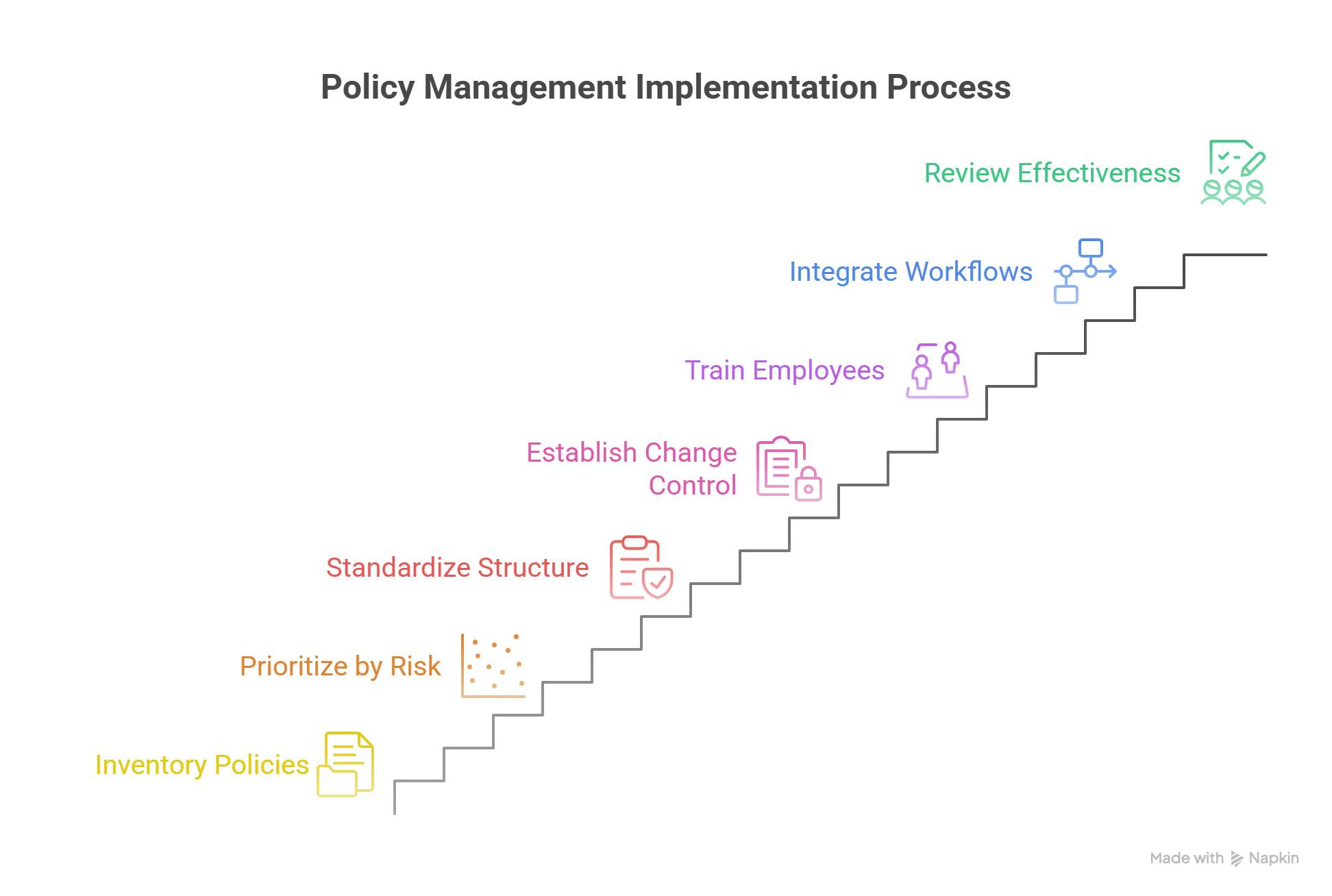
The following implementation process can be used by independent medical practices, specialty clinics, and larger administrative departments, with adjustments for their specific legal and operational obligations.
Step 1: Inventory existing policies and identify missing coverage
Begin by listing current policies, procedures, forms, protocols, and departmental work instructions.
Record each document's title, owner, effective date, last review date, applicable location, and approval status.
Group them by operational area, such as privacy, patient registration, scheduling, billing, employee conduct, infection prevention, safety, and emergency management.
Identify policies that are missing, duplicated, contradictory, or maintained only as informal employee knowledge.
Example: A practice may have a written cancellation policy but no procedure for handling patients who dispute fees or request exceptions.
The policy inventory should reveal that gap and assign responsibility for developing the missing procedure.
Use healthcare compliance software, written communication standards, workflow automation, and team coordination procedures to organize the inventory.
Step 2: Prioritize policies according to risk and regulatory requirements
Some policy failures have greater consequences than others.
Prioritize requirements related to patient safety, privacy, legal deadlines, employee exposure hazards, and essential service continuity.
For example, an unclear privacy incident escalation process may deserve immediate attention because reporting delays can affect investigation and notification obligations.
A routine formatting inconsistency in a low-risk administrative procedure may be addressed during the next planned document review.
A simple risk assessment can consider:
The severity of a potential failure.
The likelihood of the failure occurring.
The number of patients or employees potentially affected.
The organization's ability to detect the failure.
Applicable legal, licensing, or contractual obligations.
Document the assessment and use it to set review priorities.
This approach supports healthcare cybersecurity planning, administrative troubleshooting, professional conduct management, and compliance monitoring.
Step 3: Use a standardized policy document structure
A consistent structure makes policies easier to review and implement.
Each document should contain the following information, where relevant:
Policy title and identifier: A unique name and reference number.
Purpose and scope: The operational concern addressed and the employees or activities covered.
Policy requirements: The expected behavior and any prohibited conduct.
Roles and responsibilities: The owner, approvers, employees, and escalation contacts.
Procedure references: Links to associated instructions, forms, or checklists.
Exceptions: The circumstances allowing deviations and who can approve them.
Documentation: Records required to demonstrate compliance.
Approval and review details: Version, approver, effective date, and scheduled review.
For example, a policy on record disclosures could link to an identity-verification procedure, a disclosure request form, and an EHR work instruction.
Use written administrative communication to keep instructions precise, confidential communication guidance for privacy-related content, and workflow tools for assigning responsibilities.
Step 4: Establish approval, versioning, and change control
A policy should move through a documented review and approval process before implementation.
Privacy requirements may need review by the designated privacy official. Clinical procedures may require appropriate clinical leadership. Employee conduct policies may require human resources and legal review.
After approval, assign a unique version and effective date.
Archive superseded versions according to the organization's retention schedule and remove obsolete working copies from employee-facing systems.
Maintain a change log showing what changed, why the revision was necessary, and which employees or departments are affected.
Practical example: A new EHR release changes the process for documenting patient record disclosures. Update the relevant work instruction, assess whether the governing policy requires revision, and train staff before the new process takes effect.
Connect version management to EHR administration, healthcare compliance documentation, technical change management, and staff communication systems.
Step 5: Train employees using realistic decisions
Policy training should help employees recognize situations requiring action and apply the correct process.
For example, employees handling patient calls should demonstrate their ability to verify identity, recognize a clinical question, and escalate appropriately.
Staff responsible for financial transactions should demonstrate the approval process for refunds and adjustments.
Workers with occupational exposure risks need training that satisfies applicable safety requirements.
Use short scenario assessments, observed workflow practice, and targeted coaching to test understanding.
A signed acknowledgment can help document communication of a policy, but the organization should also evaluate whether employees can follow the requirements accurately.
Relevant training resources include patient interaction scripts, telephone triage communication, professionalism guidance, and team communication techniques.
Step 6: Integrate policy requirements into software workflows
Where practical, build important policy controls into the applications employees already use.
For example, a refund process can require approval before a transaction is processed. A records request system can track the receipt date and applicable response deadline. An incident reporting form can route urgent events to the appropriate personnel.
These controls reduce dependence on remembering every procedural detail.
Test exception handling carefully. Employees should have a documented escalation option when the normal workflow cannot be completed.
Consider whether automated reminders, approval queues, audit logs, and access controls can support the intended policy.
Integrate these measures through healthcare automation tools, EHR systems, medical technology troubleshooting, and healthcare compliance software.
Step 7: Review exceptions, incidents, and policy effectiveness
A policy may need revision when employees repeatedly encounter situations its procedures do not adequately address.
For example, frequent no-show fee disputes may reveal unclear communication, unsuitable exception criteria, or appointment reminder problems.
Similarly, recurring disclosure errors may indicate weaknesses in recipient verification or EHR configuration.
Record the triggering event, investigate the cause, identify an appropriate corrective action, and verify its effectiveness.
Review policy exceptions separately from misconduct investigations because the reasons for deviations can vary.
Schedule policy reassessments according to applicable requirements and risk, while updating procedures promptly when legal changes or significant operational failures require attention.
Use complaint-handling communication, workflow monitoring, professional conduct standards, and compliance reviews to support continuous improvement.
5. Medical Office Policy Audits, Performance Metrics, and Compliance Monitoring
A medical office policy audit evaluates whether approved requirements are current, understood, consistently followed, and supported by appropriate documentation.
Auditors should examine actual workflow evidence, employee decisions, exception records, and corrective actions.
A policy may appear complete on paper while employees continue to use outdated forms or bypass required approvals.
Metric 1: Policy Review Completion Rate
Calculation: Policies reviewed by their assigned deadlines ÷ total policies scheduled for review × 100.
For example, reviewing 48 of 50 policies by their assigned deadlines produces a 96% completion rate.
Evaluate overdue policies according to risk and applicable review requirements. An overdue privacy or occupational safety document may warrant greater attention than a lower-risk administrative instruction.
Track due dates with automated workflows, compliance management software, and administrative documentation controls.
Metric 2: Employee Policy Training Completion
Calculation: Employees completing assigned policy training by the applicable deadline ÷ employees required to complete that training × 100.
Analyze results by department, job role, and policy category.
A receptionist may require training in patient verification, scheduling, and complaints, while employees responsible for handling clinical materials may need additional occupational safety training.
Completion records should identify the training content and applicable version.
Use professionalism training, telephone communication exercises, and team communication development to evaluate practical understanding.
Metric 3: Policy Exception Rate
Calculation: Documented policy exceptions during the period ÷ relevant transactions or cases evaluated × 100.
Track exceptions by type, department, and approval authority.
For example, a large number of scheduling fee waivers may indicate a problem with cancellation rules or reminder reliability.
Interpret the rate alongside the legitimacy and appropriateness of the exceptions. Higher exception reporting may also reflect better documentation.
Use findings to improve scheduling conflict management, appointment reminder processes, and administrative workflow controls.
Metric 4: Complaint Resolution Timeliness
Calculation: Complaints resolved within the organization's applicable response targets ÷ complaints due for resolution during the period × 100.
Separate routine service complaints from privacy, safety, discrimination, and other regulated concerns.
Different complaint categories can have distinct escalation and response requirements.
Track the date received, responsible investigator, status, applicable deadline, and recorded outcome.
Review recurring complaints to identify underlying policy problems.
Integrate complaint monitoring with patient communication procedures, assertiveness training, and healthcare compliance systems.
Metric 5: Policy Compliance Audit Score
Calculation: Audited activities meeting all applicable policy requirements ÷ total relevant activities reviewed × 100.
For example, an audit of 100 patient record disclosures might find that 93 included the required recipient verification and documentation.
The practice should classify the seven failures according to their causes.
Potential causes include missing training, confusing instructions, inadequate software controls, or inappropriate employee decisions.
Compare findings over time using a consistent audit method.
Support reviews with confidential communication procedures, EHR audit capabilities, and healthcare compliance monitoring.
Metric 6: Corrective Action Effectiveness
Calculation: Corrective actions verified as effective during follow-up ÷ corrective actions evaluated × 100.
A corrective action should address the identified cause of a failure and include evidence of improvement.
For example, revising a disclosure procedure may be followed by employee coaching and an audit of subsequent record releases.
If the same error continues, additional investigation is needed.
Identify an accountable owner, completion deadline, follow-up method, and final review outcome.
Use administrative workflow automation, written documentation, and staff communication systems to maintain accountability.
Conducting a quarterly medical office policy audit
A useful quarterly review can select a sample of active policies and examine their approval status, effective dates, training records, operational implementation, and documented exceptions.
Include policies involving patient privacy, complaints, payments, scheduling, workplace safety, and system downtime.
For each sampled policy, ask:
Is the current version approved and accessible?
Do affected employees understand their responsibilities?
Are required forms and system controls functioning?
Can the practice produce evidence of compliance?
Have exceptions and incidents been appropriately reviewed?
Did previous corrective actions prevent repeat failures?
Document findings, assign responsible personnel, and verify corrections.
Some policies require reviews or actions at different intervals under applicable regulations. The quarterly audit serves as an additional management control.
A strong policy program uses these findings to improve actual decisions across front-desk operations, patient scheduling, healthcare cybersecurity, and medical administration compliance.
6. Frequently Asked Questions About Medical Admin Office Policy Terms
-
A policy establishes an organizational requirement or expectation. A standard operating procedure provides the steps used to carry out a recurring activity.
For example, a confidentiality policy may require patient identity verification before certain disclosures. The related procedure explains how employees verify identity, document the process, and escalate unusual requests.
Both documents should be maintained under appropriate approval and version control.
Medical practices can connect policies with patient interaction scripts, written communication procedures, EHR work instructions, and workflow automation.
-
Review frequency depends on applicable laws, regulatory obligations, risk, and operational changes.
For example, OSHA's Bloodborne Pathogens standard requires relevant Exposure Control Plans to be reviewed and updated at least annually and when specified changes occur.
Other policies may follow different schedules based on requirements and organizational risk assessments.
Practices should also review affected policies following significant incidents, regulatory changes, major software updates, or new clinical services.
Maintain review dates, assigned owners, and approval records through healthcare compliance software, automated policy reminders, and written administrative documentation.
-
Yes. HIPAA-covered entities generally must develop and implement written privacy policies and procedures consistent with the Privacy Rule.
They must also satisfy applicable requirements concerning privacy personnel, workforce training, sanctions, safeguards, complaints, and documentation.
These policies should be appropriate for the organization's functions and operating environment.
For example, a practice using remote staff and external documentation vendors should address relevant access and disclosure responsibilities.
Policies should be implemented through secure messaging controls, confidential communication training, EHR permissions, and compliance procedures.
-
The employee should clarify the instruction and follow the organization's established escalation or exception procedure.
Where a supervisor has authority to approve a particular exception, the decision should be documented according to policy.
Potential legal violations, privacy risks, and patient safety concerns should be escalated to the appropriate authorized personnel.
Employees should preserve accurate information about the situation and avoid taking actions outside their assigned authority.
Training in assertive administrative communication, professional conduct, and team escalation procedures can support appropriate responses.
-
The applicable distinction depends on the type of facility, governing regulations, and organizational policy.
A practice may classify routine service complaints separately from allegations involving privacy, discrimination, abuse, safety, or other matters requiring specialized review.
Hospitals subject to Medicare Conditions of Participation have specific grievance-related requirements. Physician practices may have different legal and licensing obligations.
Medical offices should establish a complaint process appropriate to their setting and identify circumstances requiring further escalation.
Train employees using patient interaction scripts, therapeutic communication techniques, rapport-building guidance, and compliance management.
-
Under the HIPAA Privacy Rule, covered entities generally must retain required policies, procedures, and specified documentation for six years from the date of creation or the date when the document was last in effect, whichever is later.
Medical record retention and other employment, safety, or business record requirements may follow separate federal or state rules.
A records retention schedule should distinguish policy documents from patient records, employee records, financial documentation, and incident reports.
Retain superseded versions and applicable approval records according to the relevant obligations.
Administrators should incorporate retention controls into cloud-based records management, written documentation workflows, and healthcare compliance systems.
