

A patient reports a billing error, but nobody follows up. Another complains about delayed test results, while the front desk treats it as a routine scheduling issue. A third raises a privacy concern that never reaches the compliance team. These failures can damage patient trust and expose serious operational weaknesses. Effective complaint management requires accurate classification, timely escalation, careful documentation, and verified resolution. This interactive dictionary explains essential complaint management terminology, practical response techniques, real healthcare scenarios, and measurable systems for preventing recurring problems across medical offices, clinics, and hospitals.
1. Patient Complaints Management Fundamentals: Classification, Accountability, and Patient Rights
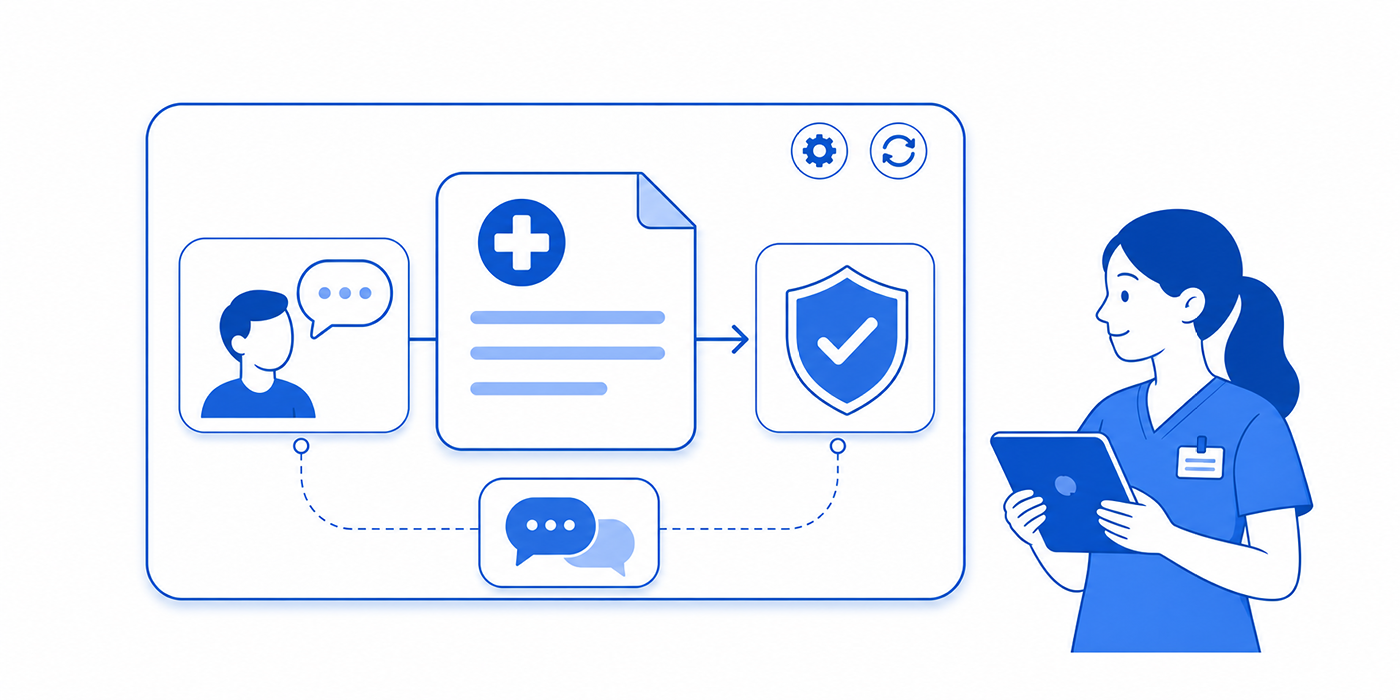
Patient complaints management is the structured process of receiving concerns, assessing their seriousness, assigning responsibility, investigating relevant facts, communicating outcomes, and identifying improvements.
Complaints may involve scheduling delays, unexpected charges, disrespectful interactions, accessibility barriers, privacy concerns, clinical communication failures, or potential patient safety events.
An administrator's first responsibility is to recognize the issue accurately. A patient frustrated about waiting 45 minutes needs a different response from someone reporting that their medical information was disclosed to an unauthorized person.
Staff working in medical front-desk operations, patient interaction management, confidential communication, and healthcare compliance workflows need a consistent process for identifying and routing each concern.
Complaint, grievance, incident, and service request: Four essential distinctions
Patient complaint: An expression of dissatisfaction concerning care, service, communication, administration, or another aspect of the patient experience. Complaints may be verbal, written, electronic, or communicated through an authorized representative.
Formal grievance: A concern that meets the applicable organization's regulatory or policy definition of a grievance. For Medicare-participating hospitals, CMS grievance requirements include a defined process for review, response, and written notice of the hospital's decision.
Patient safety incident: An event or circumstance involving actual or potential harm that requires assessment under the organization's clinical safety procedures. A patient complaint may reveal an incident that also requires separate safety reporting.
Service request: A request for assistance such as correcting contact information, obtaining a billing explanation, or arranging an appointment. A service request may also become a complaint when the patient expresses dissatisfaction with how the matter was handled.
Staff trained in therapeutic communication techniques, verbal communication skills, written communication standards, and professional medical administration can recognize these differences while remaining attentive to the patient's concerns.
The six stages of a reliable complaint-management process
Stage 1: Intake and acknowledgment
Receive the concern, confirm how the patient wants to be contacted, and document the issue accurately. Follow approved identity and representative-verification procedures before discussing protected information.
For example, if a patient says their specialist referral was lost, record when the problem occurred, which department was involved, and how the delay affected their access to care.
Clear rapport-building techniques, patient interaction scripts, non-verbal communication skills, and front-desk etiquette help patients feel heard without creating unrealistic expectations.
Stage 2: Classification and risk assessment
Determine the complaint category and whether it involves immediate clinical danger, possible abuse, discrimination, privacy exposure, or another issue requiring specialized escalation.
A patient describing severe symptoms while complaining about delayed contact should be directed through the organization's urgent clinical assessment pathway.
Appropriate phone triage communication, team communication procedures, healthcare compliance processes, and assertive escalation skills are essential at this stage.
Stage 3: Ownership and investigation
Assign the concern to the correct department or authorized individual. Establish the facts by reviewing appropriate appointment records, communications, transaction histories, and other permitted evidence.
Separate the patient's account, staff statements, documented events, and unresolved questions.
Investigations may involve patient scheduling integrations, cloud-based EMR records, secure messaging histories, and medical administration troubleshooting.
Stage 4: Communication and service recovery
Explain the verified findings, acknowledge the patient's experience, and communicate approved corrective actions.
Useful communication should identify what can be addressed immediately, which steps require further review, and when the patient should expect another update.
Staff benefit from therapeutic communication, assertive communication, written communication techniques, and patient interaction templates.
Stage 5: Resolution and appropriate closure
Confirm that the necessary investigation and approved actions have been completed. Document the outcome and provide any response required by the applicable policy or regulation.
A complaint involving an incorrect invoice may be resolved after a verified billing correction and appropriate patient notification. A clinical quality grievance may require a separate formal determination.
Use healthcare compliance software, workflow automation rules, confidential communication procedures, and team communication standards to maintain traceable records.
Stage 6: Trend review and prevention
Analyze recurring categories, unresolved cases, communication breakdowns, and repeated corrective actions.
If several patients report receiving appointment reminders after cancellations, investigate whether the scheduling and messaging systems are exchanging updates correctly.
Preventive improvement may involve appointment reminder software, workflow automation technology, healthcare automation tools, and patient scheduling integrations.
| # | Complaint Term | Definition & Purpose | Interactive Example & Action |
|---|---|---|---|
| 1 | Patient Complaint | A patient or representative's expression of dissatisfaction with healthcare services, conduct, communication, or an administrative process. | Open exampleA patient reports repeated unanswered calls. Record the specific concern, affected dates, desired response, and appropriate owner. Use patient interaction techniques to acknowledge the experience. |
| 2 | Formal Grievance | A concern that meets the organization's applicable formal grievance criteria and requires its prescribed review and response process. | Open exampleA hospital patient submits an unresolved written care concern. Route it under the facility's grievance rules, including required written determination and response procedures. |
| 3 | Complaint Intake | The initial process of receiving, documenting, and assessing a patient concern. | Open exampleA patient calls about a billing discrepancy. Capture the account reference securely, describe the concern in the patient's terms, and confirm contact preferences. |
| 4 | Acknowledgment | Confirmation that the organization received a complaint and will handle it through the applicable process. | Open exampleTell the patient when they can expect an update, name the responsible department, and use approved verbal communication procedures. |
| 5 | Complaint Classification | Assigning a concern to a category such as access, billing, communication, clinical quality, privacy, or staff conduct. | Open exampleA complaint about an incorrect invoice goes to billing review. Concerns about possible unsafe treatment require clinical quality assessment. |
| 6 | Risk Triage | Assessing whether a complaint requires urgent or specialized handling based on potential harm and applicable rules. | Open exampleA patient reports worsening symptoms while complaining about delayed results. Escalate through the approved clinical triage pathway immediately. |
| 7 | Patient Safety Concern | An allegation or observation suggesting actual or potential harm that warrants an appropriate safety assessment. | Open exampleA patient says their medication list contains the wrong allergy. Alert authorized clinical staff promptly and follow the incident reporting policy. |
| 8 | Service Recovery | Appropriate actions intended to address a service failure, reduce its impact, and restore reliable communication. | Open exampleA clinic sends an incorrect appointment reminder. Verify the correct schedule, inform the patient, and investigate the underlying reminder workflow. |
| 9 | De-escalation | Communication techniques for reducing tension, maintaining safety, and helping a distressed interaction progress constructively. | Open exampleA patient is angry about a long wait. Acknowledge the concern, provide verified information, and follow therapeutic communication and workplace safety procedures. |
| 10 | Empathetic Acknowledgment | Recognizing the patient's reported experience and impact without prematurely deciding disputed facts. | Open example“I understand that receiving conflicting instructions has been frustrating. I'll document the issue and find the appropriate person to review it.” |
| 11 | Complaint Owner | The role or individual responsible for coordinating follow-up and maintaining accountability for an assigned concern. | Open exampleA practice manager owns an access complaint while the scheduling team completes corrections. Record the lead owner and assigned actions. |
| 12 | Escalation Pathway | A predefined route for transferring a concern to a higher-level or specialized authority when required. | Open exampleA suspected privacy disclosure goes to the designated privacy team. A potential safety event goes to authorized clinical personnel through established team communication procedures. |
| 13 | Response Deadline | The timeframe in which the organization must provide an acknowledgment, update, or decision under applicable policies and rules. | Open exampleA hospital grievance is assigned its applicable review and response timeframe. Track upcoming deadlines rather than relying on memory. |
| 14 | Service-Level Agreement (SLA) | An internally or contractually defined performance commitment for specific response or resolution activities. | Open exampleAn office sets an internal target for initial administrative callbacks. Separate this target from regulatory deadlines and clinical escalation rules. |
| 15 | Case Status | A label describing a complaint's current stage, such as received, assigned, investigating, awaiting response, or closed. | Open exampleA complaint marked “resolved” still lacks patient notification. Add a distinct communication step to the workflow status. |
| 16 | Case Aging | Elapsed time since a complaint was received or entered a specified workflow stage. | Open exampleA complaint has been awaiting billing review for nine days. Examine its status, risk level, and applicable escalation deadline. |
| 17 | Fact-Finding | Collecting and checking relevant evidence before drawing an investigative conclusion. | Open exampleReview a disputed appointment using authorized scheduling records, cancellation timestamps, and communication history before deciding what happened. |
| 18 | Evidence Preservation | Keeping relevant records intact and available under authorized investigation, retention, and privacy procedures. | Open examplePreserve applicable system logs after a reported disclosure concern. Follow approved cybersecurity and evidence-handling procedures. |
| 19 | Privacy Complaint | A concern alleging inappropriate access, use, disclosure, or handling of personal health information. | Open exampleA patient reports receiving another person's results. Alert the designated privacy personnel and follow the organization's confidential information procedures. |
| 20 | Billing Dispute | A concern involving charges, payment processing, insurance claims, patient responsibility, or billing explanations. | Open exampleA patient questions a duplicate charge. Compare the encounter, claim, and payment records and assign the discrepancy to an authorized billing reviewer. |
| 21 | Access-to-Care Complaint | A concern about difficulty obtaining timely, accessible, appropriate, or properly coordinated healthcare services. | Open exampleA patient cannot schedule an approved follow-up. Review appointment availability, access barriers, and clinician instructions. |
| 22 | Accessibility Complaint | A concern about barriers affecting a patient's ability to access services, communications, facilities, or reasonable accommodations. | Open exampleA patient reports inaccessible registration instructions. Escalate the barrier and arrange the approved accommodation or accessible communication method. |
| 23 | Non-Retaliation | Protection from prohibited adverse treatment for raising a protected concern or exercising applicable rights. | Open exampleA patient raises a privacy complaint. Staff should follow professional conduct rules and applicable non-retaliation protections. |
| 24 | Root-Cause Analysis | A structured investigation into underlying contributing factors associated with a problem or failure. | Open exampleFive patients receive wrong appointment times. Investigate reminder configuration and system synchronization instead of handling each error in isolation. |
| 25 | Corrective Action | A change intended to correct an identified problem and address its contributing cause. | Open exampleA billing template caused incorrect invoices. Fix the template, review affected records, and verify subsequent invoices for accuracy. |
| 26 | Preventive Action | A control intended to reduce the likelihood of similar problems arising or recurring. | Open exampleIntroduce a validation check before appointment reminders are issued. Monitor errors using automation reporting. |
| 27 | Resolution Verification | Checking that promised corrections or actions were actually completed and properly documented. | Open exampleBefore closing a billing complaint, confirm the adjustment posted correctly and that the required patient communication occurred. |
| 28 | Reopened Complaint | A case returned to active review because the original concern remains unresolved or new relevant information requires action. | Open exampleA patient receives another incorrect bill after the case was closed. Reopen the complaint, connect it to the previous case, and verify the recurring defect. |
| 29 | Complaint Trend Analysis | Reviewing complaint patterns by category, location, timing, process, or contributing factor. | Open exampleTwenty patients report portal login problems after an update. Compare error dates and use technical troubleshooting to identify a shared failure. |
| 30 | Complaint Closure Rate | Cases meeting documented closure criteria divided by eligible cases in a defined reporting cohort, multiplied by 100. | Open exampleForty-five of 60 eligible cases satisfy verified closure criteria. The rate is 75%. Review overdue open cases separately to avoid misleading performance claims. |
Interactive training reference. Complaint and grievance definitions, reporting requirements, response periods, and clinical escalation procedures depend on the care setting and applicable policies and regulations.
2. Patient Complaint Categories, Escalation Rules, and Response Techniques
Accurate complaint classification helps the organization investigate the right problem without unnecessary delays or inappropriate disclosures.
A complaint involving an incorrect appointment date usually requires scheduling review. A report of a possible medication error needs prompt clinical assessment. Allegations of privacy violations, abuse, or discrimination require the appropriate specialist response.
The intake process should identify the patient's immediate needs, the underlying concern, and the department authorized to investigate.
Scheduling delays and appointment access complaints
Consider a patient who reports waiting six weeks for an appointment after being instructed to return within two weeks.
The complaint contains two separate issues: difficulty securing an appointment and a possible conflict with clinical follow-up instructions.
An administrator should verify the original instructions, scheduled appointment history, appointment availability, and prior communication.
If the requested clinical timeframe appears unmet, the concern should be routed to authorized clinical staff for review.
The investigation may involve patient scheduling integrations, scheduling conflict management, appointment reminder systems, and patient communication scripts.
Example response:
"I can see why this delay concerns you. I'll verify the follow-up instructions and ask the appropriate team to review the appointment timing. I'll also confirm how you'll receive an update."
Resolution standard: Document the scheduling outcome, clinical escalation where required, and patient notification. Track whether the underlying access problem remains unresolved.
Billing complaints and disputed patient charges
Billing complaints may involve duplicate charges, unexpectedly high balances, insurance processing discrepancies, outdated payment records, or explanations patients find confusing.
Suppose a patient reports being charged twice for a single office visit.
The administrator should review the relevant encounter identifiers, posted charges, payment transactions, and any applicable insurance adjustments through an authorized billing process.
A billing correction should be verified against the account ledger before the complaint is closed.
Use written communication standards, assertive administrative communication, professional medical office procedures, and team communication workflows to keep explanations clear and consistent.
Example response:
"I'll have the billing team compare the charges with your visit and payment records. They'll review whether a correction is needed and provide an explanation through our approved communication process."
Resolution standard: Confirm any approved adjustment, provide an accurate explanation, and follow applicable billing dispute procedures and deadlines.
Staff conduct and communication complaints
Patients may report dismissive language, poor explanations, inappropriate interruptions, or disrespectful behavior.
These complaints require careful fact-finding, particularly when the patient's description and staff account differ.
The investigator should collect relevant information without pressuring the patient to withdraw the concern. Staff interviews should follow organizational procedures, privacy requirements, and any applicable employment policies.
Communication training can address recurring problems involving verbal communication skills, non-verbal communication, rapport-building techniques, and therapeutic communication.
Example response:
"Thank you for explaining what happened. I'll document your experience accurately and refer it to the person responsible for reviewing staff conduct concerns. We'll communicate the outcome we can appropriately share."
Resolution standard: Verify that the complaint received an appropriate review, relevant actions were documented, and the response complied with privacy and personnel confidentiality rules.
Privacy and confidentiality complaints
Privacy-related complaints require special handling because they may involve unauthorized disclosure, improper access, insecure communications, or a suspected data breach.
Suppose a patient reports receiving a medical document belonging to another person.
Staff should preserve the relevant information under approved procedures, avoid further unnecessary disclosure, and promptly notify designated privacy or security personnel.
The privacy team determines the appropriate investigation, whether notification obligations apply, and which corrective actions are necessary.
These processes connect directly with confidential communication requirements, healthcare cybersecurity safeguards, secure healthcare messaging, and healthcare compliance software.
Patients may also raise eligible privacy concerns directly with the US Department of Health and Human Services Office for Civil Rights. Applicable HIPAA and other privacy protections prohibit retaliation for protected complaint activity.
Resolution standard: Follow the approved privacy investigation and response process, including any required notifications, documented mitigation, and prevention measures.
Clinical quality and patient safety complaints
A complaint about possible unsafe clinical care should receive appropriate clinical review.
Administrators should accurately document the patient's report, identify any immediate needs, and route the concern to authorized personnel. Clinical staff assess treatment questions and determine appropriate clinical actions.
A patient reporting potentially dangerous symptoms requires an urgent response through the organization's established clinical or emergency pathways.
The communication process should remain consistent with phone triage procedures, informed consent requirements, team communication protocols, and medical administration professionalism.
Example response:
"I understand that you're concerned about your care. I'm escalating this to our clinical team now so they can assess the situation and determine the appropriate next step."
Resolution standard: Confirm that the concern reached the correct clinical pathway and that all required quality or safety processes were initiated.
Accessibility, language, and discrimination concerns
Complaints involving inaccessible facilities, communication barriers, interpreter availability, or potential discriminatory treatment require appropriate review.
For example, an individual who cannot use an online-only complaint form may need an accessible alternative. A patient requiring qualified language assistance should be directed through the organization's applicable language-access procedures.
Administrators should document the barrier and arrange appropriate support without making assumptions about the patient's abilities or preferences.
Relevant training includes front-desk etiquette, patient interaction scripts, non-verbal communication, and professional communication standards.
Resolution standard: Verify that the accessibility concern was evaluated, approved assistance or corrective action was provided where required, and any specialized rights-related review was completed.
3. Complaint Management Metrics: Response Time, Resolution Quality, and Recurring Problems
A complaint dashboard becomes misleading when it focuses only on how many cases employees close.
Fast closure can coexist with unresolved problems, inadequate investigations, and repeated patient complaints. Strong measurement examines response timeliness, case aging, verified outcomes, and recurring causes.
Complaint acknowledgment rate
This metric evaluates whether complaints receive an initial acknowledgment within the applicable timeframe.
Formula:
Acknowledgment rate = Complaints acknowledged on time ÷ Eligible complaints requiring acknowledgment × 100.
Suppose 160 complaints require acknowledgment under the organization's policy, and 148 receive it within the approved timeframe.
Acknowledgment rate = 148 ÷ 160 × 100 = 92.5%.
Administrators should document the required response clock, whether it uses business or calendar days, and any exclusions.
Review written communication practices, secure messaging software, workflow automation terminology, and team communication standards to improve initial contact.
Important distinction: An acknowledgment confirms receipt and establishes communication expectations. Investigative findings and final decisions should be tracked separately.
Average and median resolution time
Resolution time measures the interval between a defined complaint starting event and verified closure.
For five complaints requiring 1, 2, 3, 4, and 20 calendar days to resolve:
Average resolution time = (1 + 2 + 3 + 4 + 20) ÷ 5 = 6 days.
The median is three days.
The difference matters because the single 20-day case increases the average substantially.
A dashboard should display median resolution time alongside the oldest unresolved complaint and the proportion exceeding applicable deadlines.
Administrators can identify delays through workflow automation monitoring, healthcare automation tools, administrative technology troubleshooting, and assertive team communication.
Practical control: Segment resolution time by category and risk. A straightforward scheduling correction and a complex formal clinical grievance should be evaluated against the requirements relevant to each.
Verified complaint closure rate
A case should meet the organization's applicable closure criteria before being classified as completed.
Formula:
Verified closure rate = Eligible cases satisfying closure criteria ÷ Cases in the defined assessment cohort × 100.
Suppose 90 complaints reach the end of their assessment window, and 72 have verified completion of the required steps.
Verified closure rate = 72 ÷ 90 × 100 = 80%.
A useful investigation may identify cases closed before required patient notification, billing corrections, clinical review, or another prescribed action was completed.
Strong healthcare compliance processes, professional administrative documentation, secure messaging, and team communication procedures can improve closure accuracy.
Reopened complaint rate
Reopening occurs when an issue returns to active investigation because resolution was incomplete or relevant new information emerges.
Formula:
Reopened complaint rate = Eligible closed cases reopened within a defined observation period ÷ Eligible closed cases observed × 100.
If 14 complaints are reopened among 200 closed cases monitored over an agreed period:
Reopened complaint rate = 14 ÷ 200 × 100 = 7%.
Reopening reasons should be analyzed individually. Some cases reveal inadequate correction, while others reflect genuinely new information.
Review patient interaction scripts, written communication standards, medical administration troubleshooting, and workflow automation procedures to determine whether closure processes need improvement.
Complaint rate per 1,000 encounters
Absolute complaint counts can mislead when comparing practices with different patient volumes.
A clinic recording 50 complaints across 20,000 encounters has:
Complaint rate = 50 ÷ 20,000 × 1,000 = 2.5 complaints per 1,000 encounters.
A smaller clinic recording 15 complaints across 3,000 encounters has five complaints per 1,000 encounters.
This normalized measure supports more meaningful comparisons, provided complaint definitions, encounter counting rules, access to reporting channels, and case mix are sufficiently comparable.
A lower complaint rate does not automatically demonstrate better care. Difficult reporting processes may discourage patients from raising concerns.
Combine complaint data with patient communication practices, front-desk accessibility, rapport-building techniques, and healthcare compliance monitoring to understand reporting patterns.
Escalation and recurrence indicators
Administrators should monitor additional indicators for complaints requiring specialized review.
These include the percentage of cases assigned to the correct owner, time to urgent escalation, overdue cases by category, corrective actions verified, and repeated complaints involving the same workflow.
A rise in privacy complaints after introducing a new portal feature may justify an investigation into permissions or patient messaging configuration.
A rise in appointment complaints may reflect capacity changes, unreliable reminders, or inconsistent scheduling instructions.
Relevant diagnostic resources include healthcare cybersecurity terminology, virtual check-in systems, patient scheduling integrations, and appointment reminder software.
Every metric should identify the responsible team and support a specific operational decision.
Submit Vote
Select your biggest challenge to display a recommended corrective action.
Your priority: Resolution verification. Audit previously closed complaints, identify repeated defects, and require evidence that corrective actions were completed. Track reopened complaints and recurrence by root cause.
Your priority: De-escalation training. Establish empathetic acknowledgment scripts, personal safety procedures, clear communication boundaries, and supervisor escalation triggers. Practice realistic scenarios with staff.
Your priority: Risk-based triage. Introduce intake screening for immediate clinical risk, potential abuse, privacy issues, and rights-related complaints. Route serious concerns through approved specialist pathways immediately.
Your priority: Accountability. Assign one coordinating owner per case, define department responsibilities, track next-action dates, and escalate cases that remain unassigned or inactive.
Your priority: Outcome measurement. Pair closure rate with reopened-case rate, overdue cases, recurring complaint categories, verified corrective actions, and relevant patient-experience feedback.
Interactive self-assessment. Selecting an option reveals relevant guidance. Answers are not stored or transmitted to a server.
4. Patient Complaint Management Scenarios: How to Investigate and Resolve Common Problems
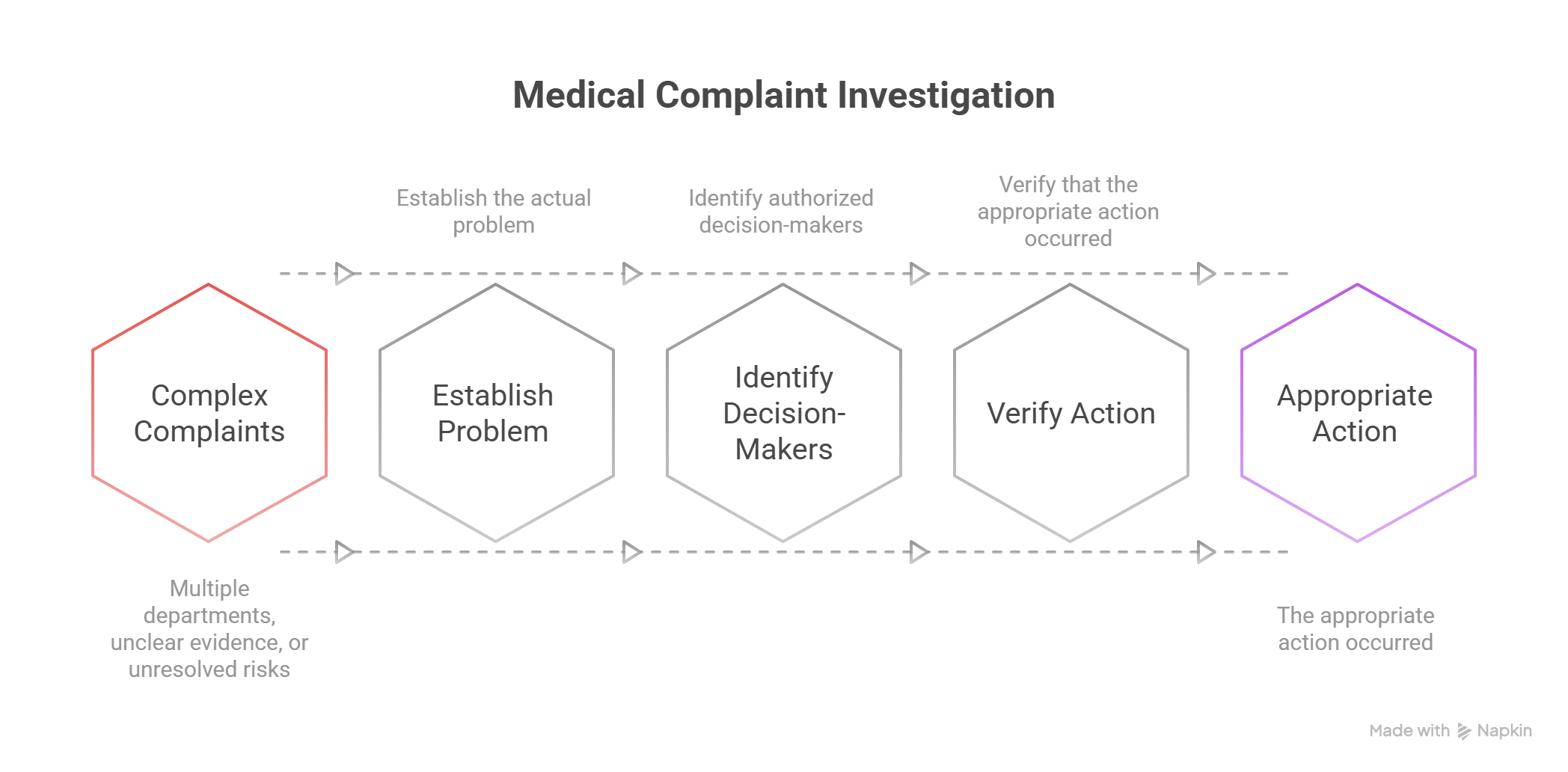
Medical administrators frequently encounter complaints that appear straightforward but involve multiple departments, unclear evidence, or unresolved risks.
An effective response should establish the actual problem, identify authorized decision-makers, and verify that the appropriate action occurred.
Scenario 1: A patient receives repeated incorrect appointment reminders
Situation: A patient cancels an appointment three days in advance but continues receiving reminders. The patient contacts the practice twice, and staff repeatedly confirm that the appointment is cancelled.
Underlying problem: The scheduling system may have updated successfully while the reminder platform continued using outdated appointment data.
The patient experiences repeated inconvenience because employees address the individual complaint without investigating the communication workflow.
Investigation: Check appointment status history, cancellation timestamps, reminder message queues, and the timing of synchronization between connected applications.
Review appointment reminder software, patient scheduling integrations, medical administration troubleshooting, and workflow automation terminology.
Corrective action: Verify the cancellation, follow the approved process for stopping outdated reminders, identify the synchronization defect, and confirm that future cancellation events are processed correctly.
Complaint response: Explain the verified correction and communicate any remaining follow-up.
Success indicator: Fewer complaints involving reminders for cancelled appointments and a measurable reduction in outdated messages.
Scenario 2: A patient alleges that medical results were disclosed to someone else
Situation: A patient reports receiving another individual's laboratory results through a portal message.
Immediate concern: The report suggests a potential privacy or security incident requiring specialized review.
Investigation: Staff should promptly inform designated privacy or security personnel, preserve relevant evidence under approved procedures, and avoid unnecessary further disclosure.
Authorized investigators may examine portal access logs, recipient identifiers, message routing, and related technical events.
A privacy complaint and a potential breach assessment may involve related but distinct organizational processes.
Appropriate handling relies on confidential communication standards, healthcare cybersecurity procedures, secure messaging systems, and compliance software workflows.
Corrective action: Follow the authorized investigation and mitigation process, including any applicable notification obligations. Address confirmed access or routing defects.
Complaint response: Acknowledge the concern and explain the available reporting and response pathway without promising an investigative result before review.
Success indicator: Verified completion of required privacy procedures and any applicable corrective actions.
Scenario 3: A patient is angry about an unexpected bill after an appointment
Situation: A patient receives a bill for $350 despite previously believing that their visit would cost $75.
Underlying problem: Possible explanations include inaccurate cost estimates, unmet deductible obligations, an incorrectly processed claim, or confusing prior communication.
Investigation: The billing team should review the encounter, applicable insurance processing, patient payments, written estimates where relevant, and posted charges.
The staff member receiving the complaint should document the discrepancy without independently guaranteeing a refund.
Relevant skills include verbal communication techniques, patient interaction scripts, assertive administrative communication, and written communication standards.
Corrective action: Verify billing accuracy and applicable patient responsibility, correct confirmed errors, and provide an understandable explanation.
Complaint response:
"I understand why the difference between the expected and billed amounts is concerning. Our billing team will review the charge and insurance details before explaining the result and any appropriate correction."
Success indicator: Verified resolution of billing discrepancies and fewer repeated inquiries about the same charges.
Scenario 4: A patient complains about delayed test results and reports worsening symptoms
Situation: A patient calls the front desk to complain that test results have not been communicated. During the conversation, the patient describes a worsening health concern.
Immediate concern: The call contains information requiring clinical assessment in addition to the original communication complaint.
Investigation: The administrator should activate the approved clinical triage or urgent escalation process and accurately communicate the patient's statements.
After the immediate safety needs are addressed, the organization can review result routing, provider notification, portal availability, and relevant communication timelines.
The response requires appropriate phone triage communication, team communication, medical documentation procedures, and cloud EMR reporting knowledge.
Corrective action: Confirm that the clinical escalation occurred, investigate the communication delay, and route any resulting quality concerns appropriately.
Complaint response: Provide factual process updates within the administrator's authorized role.
Success indicator: Verified urgent escalation and improved follow-up reliability for clinically important results.
Scenario 5: A formal grievance is closed without the required response
Situation: A hospital investigates a patient's complaint concerning care quality. Staff document that the investigation is finished and close the electronic case, but the patient never receives the required written decision.
Underlying problem: The workflow equates investigative completion with grievance closure.
For hospitals subject to the applicable CMS Conditions of Participation, the grievance process must include specified procedures and written notice requirements.
Investigation: Review the grievance classification, applicable timeframe, designated authority, investigative documentation, and evidence of patient notification.
Check healthcare compliance procedures, written administrative communication, workflow automation tools, and professional administrative standards.
Corrective action: Escalate the missed requirement to the designated grievance or compliance personnel, complete any outstanding required response process, and correct the electronic closure rules.
Success indicator: All applicable formal grievance closure requirements are verified before final closure.
Scenario 6: Multiple complaints identify the same front-desk communication problem
Situation: During one month, 18 patients complain about unclear check-in instructions. Several report arriving without required documents because they received conflicting information.
Underlying problem: Different communication channels may contain inconsistent instructions.
Investigation: Compare the website, appointment confirmations, reminder messages, portal instructions, and verbal front-desk scripts.
Determine whether the process changed without corresponding updates to every patient-facing channel.
Strong medical front-desk etiquette, written communication, virtual check-in systems, and appointment reminder software provide useful improvement opportunities.
Corrective action: Establish an approved source for check-in instructions, update affected communication channels, retrain staff, and test instructions with representative scenarios.
Success indicator: Lower check-in communication complaint rates and fewer visits delayed by missing administrative information.
A practical complaint investigation record
For each case, administrators should maintain a record appropriate to its category and regulatory requirements.
Useful fields include complaint ID, date received, reporting channel, verified patient or representative details, complaint category, urgency, responsible owner, factual description, investigative actions, relevant evidence, response dates, corrective actions, and final disposition.
Each important update should distinguish a reported allegation from a verified finding.
When a complaint spans several departments, the primary owner should coordinate the overall process while specialized teams handle their respective responsibilities.
This approach benefits from team communication workflows, written documentation practices, healthcare compliance software, and medical administration workflow automation.
5. How to Build a Reliable Patient Complaints Management System: A Practical 30-Day Plan
A strong complaint-management system should make concerns easy to report, identify serious issues promptly, assign responsibility clearly, and convert verified findings into operational improvements.
The following implementation plan can help clinics and medical offices standardize their approach. Hospitals and other regulated organizations must also incorporate their applicable formal grievance, patient rights, safety, and reporting requirements.
Days 1–7: Review existing complaints and establish clear categories
Begin by reviewing complaints received during a representative period.
Identify how concerns entered the organization, whether they were documented consistently, and how employees determined who should investigate them.
Look for common weaknesses such as unrecorded verbal complaints, unclear escalation responsibilities, missing response dates, and cases closed without verified resolution.
Establish standard categories covering patient access, billing, staff conduct, clinical quality, privacy, accessibility, and communication.
Create a separate designation for concerns requiring immediate clinical, safety, or specialized compliance review.
Training in medical office professionalism, front-desk etiquette, patient interaction scripts, confidential communication, and healthcare compliance procedures provides a foundation for consistent classification.
Deliverable: An approved complaint intake and classification checklist, including specialized escalation triggers.
Days 8–14: Define ownership, response expectations, and escalation
Assign every complaint a coordinating owner and a clear next action.
Identify who handles billing concerns, scheduling problems, clinical quality reviews, privacy allegations, and patient rights matters.
Establish response periods according to applicable requirements and organizational policy. Separate initial acknowledgment, interim updates, investigation deadlines, and final response.
For each category, define when staff should escalate a complaint and what information must accompany the referral.
The process should support assertive administrative communication, team communication standards, secure messaging workflows, written communication practices, and workflow automation rules.
Deliverable: A responsibility matrix identifying complaint owners, authorized reviewers, response timeframes, and escalation contacts.
Days 15–21: Train staff using realistic complaint scenarios
Complaint-management training should test how employees respond under pressure.
Use role-play scenarios involving an angry patient, a disputed charge, an alleged privacy breach, an inaccessible appointment process, and a concern about possible unsafe care.
Each scenario should require employees to demonstrate acknowledgment, accurate documentation, appropriate triage, respectful communication, and correct escalation.
For emotionally charged conversations, train staff to maintain a calm tone, avoid argumentative language, communicate professional boundaries, and request appropriate support when safety concerns arise.
Effective therapeutic communication techniques, non-verbal communication skills, rapport-building practices, assertive communication, and patient interaction templates support consistent responses.
Deliverable: A competency checklist demonstrating that staff can classify complaints, identify escalation requirements, and explain the next action accurately.
Days 22–30: Build a complaint dashboard and verify corrective actions
Develop a dashboard that reflects the quality of complaint handling rather than simply the number of closed cases.
Start with these measures:
Acknowledgment timeliness: Percentage of eligible complaints acknowledged within the applicable period.
Overdue complaints: Open cases exceeding the relevant response or action deadline.
Median resolution time: Typical time required for verified case closure.
Reopened complaint rate: Previously closed cases requiring renewed investigation during a defined observation period.
Category recurrence: Repeated complaints involving the same problem or underlying process.
Corrective action completion: Approved improvements implemented and verified by the required deadline.
Escalation compliance: Concerns routed through required specialist pathways within applicable timeframes.
Pair the dashboard with a review of representative cases so management can detect misleading closure statuses or inadequate corrective action.
Connected workflow automation systems, healthcare automation platforms, cloud-based EMR reporting, medical administration technology troubleshooting, and compliance monitoring can help identify unresolved work.
Deliverable: A complaint-management scorecard with documented metric definitions, assigned owners, and review procedures.
Establish a daily complaint review process
A practical 15-minute review can focus on four priorities.
Minutes 1–3: Identify urgent or specially regulated complaints requiring immediate escalation or time-sensitive action.
Minutes 4–7: Review unassigned cases, upcoming response deadlines, and complaints awaiting investigation.
Minutes 8–11: Verify actions taken on recently resolved cases and investigate reopenings.
Minutes 12–15: Assign next steps for unresolved cases and identify recurring patterns needing root-cause analysis.
Clinical or safety-sensitive complaints must follow the applicable escalation process immediately, independent of the scheduled daily review.
Reliable team communication, professional administrative practices, written documentation standards, and secure messaging systems keep follow-up responsibilities visible.
Protect privacy during complaint investigations
A complaint record may contain sensitive personal information, clinical allegations, staff statements, and investigative findings.
Access should reflect authorized responsibilities and applicable privacy requirements.
Where possible, management reports should use aggregated or appropriately de-identified information instead of exposing individual patient details unnecessarily.
Complaint investigators should follow approved procedures for identity verification, evidence access, disclosure, record retention, and incident reporting.
Knowledge of healthcare cybersecurity terminology, confidential communication requirements, secure healthcare messaging, and healthcare compliance software supports appropriate information handling.
The final management review should examine whether patients can report concerns through accessible channels, whether staff respond consistently, and whether verified corrective actions reduce repeated failures.
6. FAQs About Patient Complaints Management Terms and Procedures
-
Patient complaints management is the process of receiving concerns, classifying issues, identifying risks, investigating relevant facts, communicating outcomes, and implementing appropriate corrective actions.
Complaints may involve appointments, billing, staff interactions, privacy, accessibility, clinical quality, or patient rights.
Effective management requires clear ownership, appropriate response timeframes, and reliable documentation.
Administrators can strengthen their skills through patient interaction scripts, front-desk etiquette, therapeutic communication techniques, team communication procedures, and healthcare compliance workflows.
-
A patient complaint is an expression of dissatisfaction with care, services, or administrative processes.
A formal grievance is classified according to applicable regulatory or organizational criteria and may require additional investigation, documentation, and response procedures.
For Medicare-participating hospitals, federal regulations establish specific grievance-process requirements, including a written notice of the hospital's decision.
Other settings and programs may have different definitions and requirements.
Understanding professional medical administration, written communication standards, healthcare compliance software, and patient interaction procedures helps staff route concerns appropriately.
-
Begin by listening without unnecessary interruption, acknowledging the patient's concern, and identifying what assistance is needed.
Use calm language, maintain professional boundaries, and avoid promising outcomes that require investigation or authorization.
If the patient describes an immediate clinical concern, use the approved clinical escalation pathway. If threats or unsafe behavior occur, follow workplace safety procedures.
Practical training in verbal communication, non-verbal communication, rapport-building, assertive communication, and therapeutic communication helps staff manage difficult interactions.
-
A complaint record should identify the date received, reporting channel, verified patient or representative details, concern category, factual description, relevant dates, assigned owner, risk assessment, investigative steps, communications, and final disposition.
Additional fields may be necessary for formal grievances, safety concerns, privacy issues, or other specialized categories.
Distinguish reported allegations from verified findings and document how corrective actions were confirmed.
Secure records through confidential communication procedures, written administrative standards, healthcare cybersecurity safeguards, and healthcare compliance systems.
-
The required timeframe depends on the complaint type, care setting, applicable law, and organizational policy.
Urgent clinical or safety concerns require timely handling under approved escalation procedures.
Formal hospital grievances are subject to applicable CMS requirements, including a process specifying review and response timeframes.
Routine administrative issues may follow separate internal service targets.
Administrators should verify the relevant requirement and track acknowledgment, investigation, escalation, and final response separately.
Knowledge of workflow automation, team communication practices, assertive escalation, and healthcare compliance procedures helps prevent missed deadlines.
-
Staff should document the concern, notify designated privacy or security personnel promptly, and follow approved information-handling procedures.
Authorized investigators determine whether an impermissible use or disclosure occurred, what risk assessment is required, and whether notifications or other corrective actions are necessary.
Patients may also submit complaints about potential HIPAA violations to HHS's Office for Civil Rights.
OCR generally requires complaints within 180 days of when the complainant knew or should have known about the alleged violation, subject to a possible extension for good cause.
Understanding confidential communication, healthcare cybersecurity, secure messaging, and healthcare compliance software supports appropriate handling.
