

A patient’s medical information can be exposed through a single incorrect EHR permission, misdirected message, unauthorized disclosure, or careless registration decision. For healthcare administrators, understanding privacy terminology is essential to preventing these failures. This interactive dictionary explains 30 critical concepts, connects them to real administrative situations, and provides practical controls for safer operations. It also covers confidential patient communication, healthcare cybersecurity, secure messaging, and compliance software, giving medical teams an actionable resource for protecting patient information throughout everyday clinical workflows.
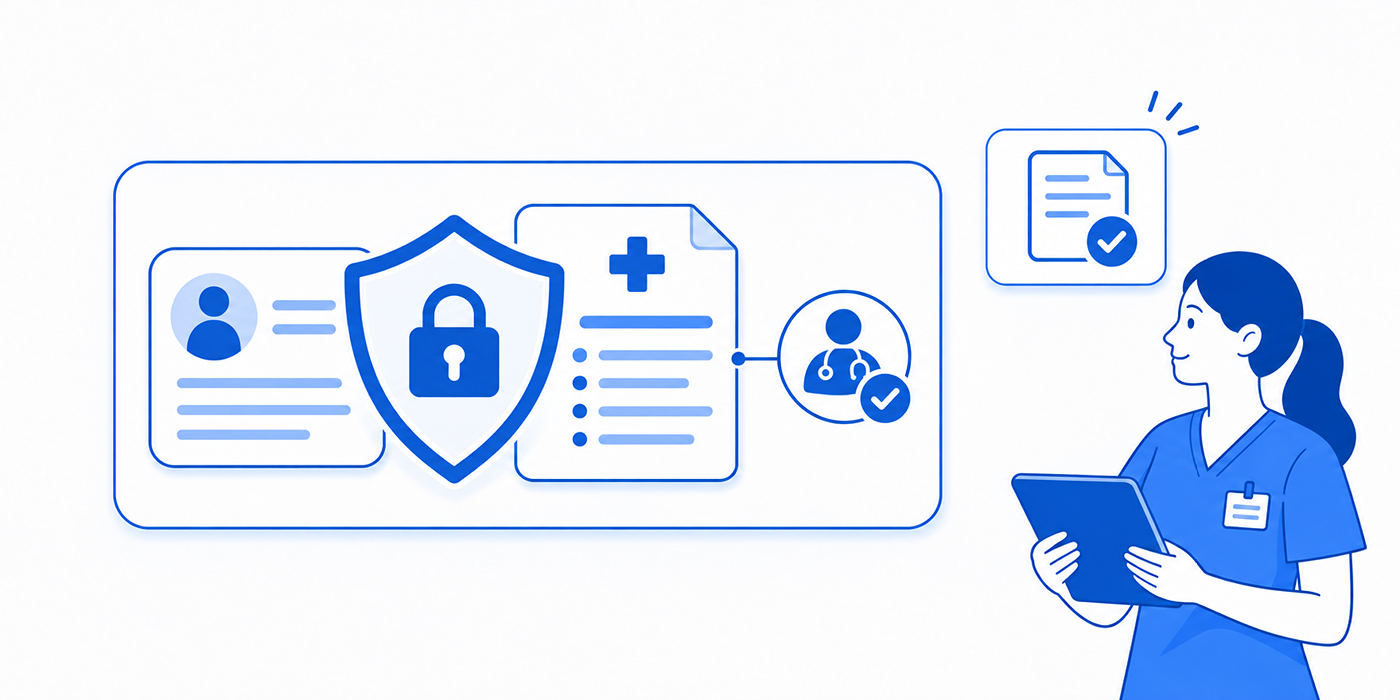
1. Healthcare Data Privacy Fundamentals and Essential Terminology
Healthcare data privacy governs how identifiable patient information may be collected, accessed, used, disclosed, retained, and destroyed. In the United States, HIPAA establishes requirements for covered healthcare providers, health plans, clearinghouses, and business associates.
Administrators encounter these requirements while coordinating patient appointments, handling clinical documentation, maintaining cloud-based medical records, and communicating through digital patient portals.
Privacy, confidentiality, and security: three separate responsibilities
Privacy establishes the conditions under which identifiable health information may be used or disclosed. It addresses questions of purpose, permission, individual rights, and appropriate access.
Confidentiality concerns preventing inappropriate disclosure of information entrusted to an organization. A confidential conversation requires consideration of the recipient, setting, and information being shared.
Security involves the safeguards protecting electronic information against unauthorized access, alteration, loss, and disruption. These include authentication, encryption, access controls, audit logs, and incident-response procedures.
Consider an administrator who opens a patient's chart out of curiosity. The employee may have successfully authenticated through a secure system, yet the access remains inappropriate because it serves no authorized work purpose.
Alternatively, a legitimate secure messaging workflow may expose PHI when the sender selects the wrong recipient. Both examples illustrate why professional behavior, confidential communication procedures, and technical cybersecurity safeguards must operate together.
The four decisions behind safe information handling
Before accessing or disclosing patient information, administrators should evaluate four practical questions:
Identity: Who is requesting access, and how has their identity or authority been established?
Purpose: What permitted healthcare, administrative, or other legitimate activity requires the information?
Scope: Which records or data elements are appropriate for the request?
Channel: Which approved system or communication method should be used?
This framework is especially useful for telephone triage communication, patient scheduling integrations, written administrative correspondence, and workflow automation.
The HIPAA minimum necessary standard generally requires reasonable efforts to limit PHI uses, disclosures, and requests when applicable. Important exceptions include disclosures to or requests by healthcare providers for treatment. Staff should follow the specific disclosure rules applicable to each situation.
| # | Privacy Term | Definition & Workplace Risk | Recommended Control |
|---|---|---|---|
| 1 | Protected Health Information (PHI) | Individually identifiable health information protected under HIPAA. Risk: disclosing patient diagnoses to an unauthorized caller. | Apply confidential communication checks. |
| 2 | Electronic PHI (ePHI) | PHI created, received, maintained, or transmitted electronically. Risk: an unattended workstation exposes patient charts. | Enforce EHR access and session controls. |
| 3 | Personally Identifiable Information (PII) | Information identifying or capable of identifying an individual. Risk: an exported spreadsheet exposes names and contact details. | Restrict exports using data security procedures. |
| 4 | Covered Entity | A HIPAA-regulated health plan, clearinghouse, or qualifying healthcare provider. Risk: incorrectly classifying organizational obligations. | Maintain a documented compliance responsibility register. |
| 5 | Business Associate | A person or organization performing specified functions involving PHI for a covered entity. Risk: unreviewed vendor access. | Review third parties before system integration. |
| 6 | Business Associate Agreement (BAA) | A required agreement establishing applicable PHI safeguards and responsibilities. Risk: activating a qualifying vendor without a BAA. | Check agreements before enabling scheduling integrations. |
| 7 | Treatment, Payment & Healthcare Operations (TPO) | Categories of generally permitted PHI handling, subject to applicable conditions. Risk: assuming every operational disclosure is automatically allowed. | Document purposes through departmental communication protocols. |
| 8 | Minimum Necessary | Reasonably limiting PHI handling when this standard applies. Risk: sending an entire chart to answer a narrow billing question. | Use purpose-specific documentation. |
| 9 | Role-Based Access Control (RBAC) | Assigning permissions according to job functions. Risk: reception staff receive unrestricted clinical-record access. | Build a role matrix for medical record systems. |
| 10 | Least Privilege | Giving users the privileges needed for assigned duties. Risk: transferred employees retain inappropriate permissions. | Schedule automated access reviews. |
| 11 | Audit Trail | A record of relevant user and system activity. Risk: investigators cannot establish who accessed a disputed chart. | Review audit logs and alerts. |
| 12 | Break-Glass Access | Controlled exceptional access for emergency circumstances. Risk: staff misuse emergency privileges for convenience. | Require justification and exception review. |
| 13 | Multifactor Authentication (MFA) | Authentication requiring two or more different factors. Risk: a stolen password grants improper account access. | Apply account protection controls. |
| 14 | Encryption in Transit | Cryptographic protection while information moves between systems. Risk: PHI travels through an inadequately protected connection. | Use approved secure transmission channels. |
| 15 | Encryption at Rest | Cryptographic protection for stored information. Risk: a lost device exposes readable patient records. | Verify storage security settings. |
| 16 | Identity Verification | Confirming the identity of someone requesting information. Risk: an impersonator obtains appointment details. | Use approved telephone verification scripts. |
| 17 | Notice of Privacy Practices (NPP) | Required information describing specified privacy practices, duties, and patient rights. Risk: outdated notices remain in circulation. | Review notices within registration procedures. |
| 18 | HIPAA Authorization | A permission document meeting specific requirements for certain uses or disclosures. Risk: accepting an unrelated consent form. | Differentiate authorization from clinical informed consent. |
| 19 | Personal Representative | Someone legally authorized to act for a patient in specified matters. Risk: unauthorized relatives receive records. | Verify authority using patient interaction procedures. |
| 20 | Patient Portal Proxy Access | Delegated access to specified patient portal information. Risk: outdated permissions expose sensitive notes. | Audit portal delegation settings. |
| 21 | Designated Record Set | Records maintained by or for a covered entity that fall within HIPAA's defined categories, including records used to make decisions about individuals. Risk: incomplete access fulfillment. | Map records through retrieval workflows. |
| 22 | Right of Access | An individual's right to inspect or obtain qualifying PHI, subject to defined exceptions. Risk: overdue requests. | Track deadlines with automated task management. |
| 23 | Right to Request Amendment | A patient's right to request amendments to qualifying records. Risk: employees improperly overwrite disputed documentation. | Use approved record correction procedures. |
| 24 | Accounting of Disclosures | A required accounting of certain PHI disclosures under applicable HIPAA rules. Risk: missing disclosure records. | Maintain disclosure tracking logs. |
| 25 | Privacy Incident | An actual or suspected improper handling of personal information. Risk: a misdirected fax goes unreported. | Follow incident escalation procedures. |
| 26 | Reportable Breach | A breach of unsecured PHI that triggers applicable notification obligations. Risk: missed legal deadlines. | Escalate through breach response tracking. |
| 27 | Breach Risk Assessment | Evaluation of relevant circumstances to determine the probability of PHI compromise. Risk: unsupported decisions to dismiss incidents. | Document findings under security response protocols. |
| 28 | De-identification | Processing information to satisfy HIPAA's Safe Harbor or Expert Determination method. Risk: supposedly anonymous datasets remain identifiable. | Validate datasets using information governance reviews. |
| 29 | Limited Data Set | PHI excluding specified direct identifiers, available for certain purposes under required conditions. Risk: sharing without appropriate restrictions. | Verify agreements before data integrations. |
| 30 | 42 CFR Part 2 | Special federal confidentiality protections for records maintained by qualifying substance use disorder programs. Risk: inappropriate disclosure of specially protected records. | Provide specialized confidentiality training. |
2. Applying Healthcare Privacy Terms to Real Administrative Situations
A medical administrator may understand HIPAA terminology and still make an incorrect decision when the waiting room is crowded, the phone is ringing, or a provider urgently requests documentation. Practical competency requires recognizing how privacy rules apply to specific requests, systems, and patient interactions.
The following scenarios address common failure points in patient communication, front-desk administration, medical documentation, and clinical team coordination.
Scenario A: An unidentified caller requests appointment information
A caller identifies himself as a patient's husband and asks whether she attended an appointment at a psychiatric clinic. The receptionist recognizes the patient's name and considers confirming the visit.
The specialty and appointment information may disclose sensitive healthcare details. Staff must determine whether the caller's identity and circumstances permit the requested disclosure.
HIPAA allows certain disclosures to family members and others involved in a patient's care or payment under specified conditions. Organizations should provide clear procedures for applying these permissions.
Recommended response: Establish the caller's identity using approved methods, review relevant patient preferences, determine whether the disclosure is permitted, and provide only appropriate information.
Training should include telephone verification scripts, confidential communication rules, assertive administrative responses, and professional patient interaction techniques.
Scenario B: Two patients have nearly identical identifying information
Two patients share the same surname and birth date. During registration, an employee selects the wrong chart and uploads an insurance document containing identifying information.
The resulting problem affects confidentiality and record integrity. The incorrect attachment may expose one patient's information to another and introduce misleading data into a clinical record.
Recommended response: Follow the organization's privacy incident and record-correction procedures. Authorized personnel should verify both patient identities, correct the attachment through an auditable process, and evaluate whether inappropriate access or disclosure occurred.
Prevention requires reliable patient identity verification, consistent registration communication, and appropriate medical system troubleshooting.
A useful training exercise presents employees with two similar records and asks them to identify which additional approved identifiers are needed before attaching documents.
Scenario C: A billing employee receives an unnecessarily large record
A billing specialist requests documentation supporting a denied claim. A colleague sends the patient's entire chart, including unrelated specialist notes and sensitive history.
The minimum necessary standard generally applies to payment-related uses and disclosures. The organization should evaluate the information reasonably needed to accomplish the payment purpose.
Recommended response: Identify the specific claim, service date, denial reason, and documentation needed. Use approved disclosure procedures to select the appropriate information.
Organizations can build request templates into written communication workflows, apply EHR permission controls, and route exceptions through compliance management systems.
The strongest corrective control identifies the exact decision that caused the oversharing. Additional staff reminders are less effective when software defaults continue selecting entire records.
Scenario D: A patient requests records through an online portal
A patient asks for an electronic copy of records in the designated record set. Staff redirect the patient to a portal containing only visit summaries and close the request.
Under HIPAA, covered entities generally must act on an access request within 30 calendar days of receipt. One extension of up to 30 additional days may be permitted when the required written explanation is provided within the original period. Stricter applicable laws may require faster action.
Records maintained by a business associate on the covered entity's behalf can still fall within the access obligation.
Recommended response: Log the receipt date, verify the requester, identify applicable records across systems, assign responsibility, and track fulfillment.
A centralized record retrieval workflow should connect patient portal requests, cloud-based medical records, and secure patient correspondence.
Scenario E: A medical scribe is asked to use a personal messaging account
During a busy emergency department shift, the EHR becomes temporarily unavailable. A physician asks a scribe to send a patient note through a personal messaging account.
The scribe should follow the organization's approved downtime and communication procedures, escalating the technical failure through the appropriate channel.
Unapproved tools can introduce uncertainty about information storage, recipient authentication, device access, and record retention.
Recommended response: Use the authorized downtime process, preserve required documentation, and report the system issue.
This scenario is especially relevant to emergency department scribing, where fast-paced clinical transitions increase pressure. Training should combine dictation system procedures, secure communication methods, and clinical documentation professionalism.
3. HIPAA Permissions, Patient Rights, and Special Confidentiality Requirements
Several healthcare privacy terms sound interchangeable but create different legal obligations. Administrators need to distinguish patient consent, HIPAA authorization, individual access rights, delegated authority, and specially protected records.
HIPAA authorization versus informed consent
Informed consent commonly concerns a patient's agreement to a procedure or treatment after receiving relevant information about the intervention.
HIPAA authorization permits specified uses or disclosures of PHI when authorization is required. A valid authorization must contain required elements, including the information involved, relevant parties, purpose, expiration, and statements about specified individual rights.
For example, a patient's consent to surgery does not automatically authorize an unrelated employer to obtain that patient's laboratory history.
Staff should use separate verification procedures for clinical informed consent, confidential patient correspondence, and administrative record disclosures.
High-value control: Maintain a disclosure decision guide explaining when an authorization is required, which permissions or exceptions may apply, who approves unusual requests, and where the decision must be documented.
Personal representatives and portal proxy permissions
Personal representatives generally derive their authority from applicable law. Their rights may depend on the type of healthcare decision involved, the patient's age, and other circumstances.
A person who assists with transportation or appointment scheduling does not necessarily have unrestricted authority to access the patient's medical record.
Similarly, proxy access within a patient portal should reflect the appropriate scope of delegation and applicable privacy rules.
Administrators should distinguish legal representation, involvement-in-care disclosures, and digital portal delegation.
Use patient interaction scripts to verify requests, virtual check-in controls to manage portal permissions, and secure communication procedures to communicate authorization changes.
De-identified information versus limited data sets
HIPAA recognizes two methods for de-identifying health information.
Safe Harbor generally requires removing 18 specified categories of identifiers and ensuring the entity has no actual knowledge that the remaining information could identify someone.
Expert Determination requires an appropriately qualified expert to apply accepted statistical or scientific principles and document a determination that the identification risk is very small.
A limited data set excludes certain direct identifiers but may retain some dates and geographic information. It remains PHI and is subject to permitted-purpose restrictions and a required data use agreement.
This distinction matters when an organization exports information for research, quality improvement, or analysis.
Before releasing information, confirm the dataset's classification, permitted recipient, applicable agreement, and transmission safeguards. Incorporate these checks into healthcare automation tools, compliance management processes, and cybersecurity reviews.
Substance use disorder records and 42 CFR Part 2
Certain records maintained by qualifying substance use disorder programs receive additional federal confidentiality protections under 42 CFR Part 2.
Updates to the Part 2 regulations required compliance beginning February 16, 2026. Among other changes, the rule permits a single consent for certain future treatment, payment, and healthcare operations uses and disclosures and establishes specific requirements for SUD counseling notes.
Special restrictions continue to govern using protected records in proceedings against patients.
Administrators handling these records need clearly defined permission controls, appropriate consent management, and escalation procedures for unusual disclosure requests.
This should be reflected in confidentiality training, clinical documentation workflows, EHR access settings, and regulatory compliance reviews.
A 2026 Notice of Privacy Practices checkpoint
Covered entities should ensure their Notices of Privacy Practices reflect applicable regulatory requirements, including the Part 2-related changes that became applicable in February 2026.
A June 18, 2025 federal court decision vacated most of the 2024 HIPAA reproductive-health privacy rule, while certain unaffected notice modifications remained in effect.
Practices relying on older policy templates should have their notices reviewed against the current requirements.
Administrative teams should verify that the current notice appears in relevant patient registration processes, digital check-in systems, and written patient information materials.
4. Building Privacy-Safe EHR, Scheduling, Messaging, and Automation Workflows
Healthcare privacy controls become most effective when incorporated into the software and processes employees use every day. A practice can have detailed privacy policies yet remain vulnerable when its EHR permissions, patient communication tools, or third-party integrations allow unnecessary data exposure.
A practical privacy-by-design approach focuses on the points where information enters a system, changes ownership, moves between applications, or leaves the organization.
These controls are particularly important for patient scheduling integrations, cloud-based medical records, healthcare automation tools, and secure digital communication.
Control 1: Develop a job-specific EHR permission matrix
An effective permission matrix identifies which information categories and system functions each role requires.
For example:
Front-desk administrators: Patient contact information, registration details, appointment schedules, and other information necessary for assigned duties.
Billing personnel: Relevant claims, payer details, payment information, and supporting documentation.
Medical scribes: Appropriate encounter documentation and relevant clinical information required for assigned responsibilities.
Supervisors: Department-specific management information and approved oversight functions.
Technical administrators: System configuration privileges appropriate to their responsibilities, with exceptional access appropriately controlled.
The exact permissions depend on the organization's systems, staffing model, and clinical requirements.
Review assignments whenever an employee joins, changes responsibilities, takes extended leave, or separates from the organization.
For remote medical scribes, assessments should also address approved devices, account sharing, workspace privacy, and remote-session protections.
Connect the permission matrix to EHR configuration controls, automated administrative workflows, and compliance audit procedures.
Control 2: Protect PHI at system integration points
Information can be exposed when an integration transfers more fields than required, sends records to an incorrect destination, or repeatedly retransmits failed messages.
Before enabling an integration, document the following:
The system producing the data and the intended receiving system.
The specific information fields being transferred.
The permitted processing purpose and applicable vendor agreements.
Authentication, authorization, and transmission safeguards.
Error-handling procedures, logs, and the person responsible for investigating failures.
For example, an appointment reminder service may require limited patient contact and scheduling details. The integration should be configured according to its legitimate purpose and applicable disclosure requirements.
Testing should include invalid recipient details, duplicate patient identifiers, transmission failures, and revoked permissions.
Relevant training includes appointment reminder software, scheduling integration terminology, workflow automation, and technical troubleshooting.
Control 3: Establish reliable communication verification
Sending records through an approved system reduces certain risks, but recipient mistakes and inappropriate information selection can still cause unauthorized disclosures.
For higher-risk communications, establish a verification checkpoint immediately before transmission.
Employees should confirm the recipient's identity or address, disclosure purpose, selected attachments, applicable permission, and approved delivery channel.
Where organizational policy requires an additional review, the workflow should route the communication to an authorized reviewer.
This approach supports safer written administrative communication, secure messaging, telephone disclosure procedures, and patient interaction workflows.
Practical improvement: Audit a sample of outgoing record disclosures and record whether the recipient, information scope, and required permissions were verified. Use actual failures to improve the checklist rather than adding steps that do not address observed risks.
Control 4: Govern AI medical scribes and external documentation vendors
AI documentation platforms may process voice recordings, clinical narratives, identifying information, and structured encounter data.
Before introducing such a platform, determine whether the vendor is a business associate, whether a BAA is required, which subcontractors process information, where data is retained, and how access is controlled.
Vendor due diligence should also establish whether patient information can be used for model training or other secondary purposes, what contractual restrictions apply, and how data deletion or return works.
The practice should identify who verifies clinical content, corrects transcription errors, and resolves conflicting documentation.
These safeguards are increasingly important as AI medical scribes become part of ordinary clinical operations.
Integrate vendor checks with medical dictation procedures, transcription quality workflows, healthcare compliance management, and cybersecurity risk assessment.
Control 5: Monitor access anomalies and confirm corrective action
EHR audit logs can identify unusual access patterns, including high-volume record viewing, unexpected exports, repeated emergency access, and activity involving records outside an employee's usual assignments.
These signals require contextual investigation because legitimate care activities can also produce unusual activity.
An effective review records the triggering event, relevant system activity, employee role, investigation outcome, and any required corrective action.
Administrative teams should know how to report suspicious events through team communication channels, while technical and compliance personnel evaluate them using cybersecurity procedures and compliance monitoring tools.
Review recurring findings to identify weaknesses in training, permissions, software defaults, or management oversight.

5. Healthcare Privacy Incident Response, Breach Reporting, and Performance Metrics
A privacy incident frequently begins with an ordinary mistake: a document attached to the wrong patient chart, a message delivered to an unintended recipient, an account left active after an employee departs, or suspicious access to sensitive records.
Staff must know how to recognize these events and escalate them without delay. The designated privacy and security personnel should then investigate the incident, determine applicable obligations, and coordinate remediation.
A five-stage incident response procedure
Stage 1: Recognize and escalate. An employee identifies a suspected privacy problem and reports it promptly through the organization's incident-response process. The report should preserve factual details, including discovery time, affected systems, and available information about the event.
Stage 2: Contain the exposure. Authorized personnel may revoke access, disable compromised credentials, correct erroneous sharing permissions, or take other approved containment actions. Staff should follow established cybersecurity response procedures and system troubleshooting protocols.
Stage 3: Investigate and preserve evidence. The response team identifies the information affected, potential recipients, relevant access logs, and actions taken. Documentation should follow written communication standards and approved compliance reporting procedures.
Stage 4: Assess regulatory obligations. The privacy or compliance team determines whether an impermissible use or disclosure occurred and whether a documented assessment or applicable exception affects breach notification obligations.
Stage 5: Verify remediation. Corrective measures may include permission changes, updated recipient checks, software configuration corrections, and targeted employee retraining. Confirm effectiveness through workflow audits and professional communication exercises.
HIPAA breach notification deadlines
For reportable breaches of unsecured PHI, applicable federal notification timelines include:
Affected individuals: Notification without unreasonable delay and no later than 60 calendar days after discovery.
HHS, 500 or more affected individuals: Notification without unreasonable delay and no later than 60 calendar days after discovery.
HHS, fewer than 500 affected individuals: Reporting generally within 60 days after the end of the calendar year in which the breach was discovered.
Business associates: Notification to the covered entity without unreasonable delay and no later than 60 calendar days after discovery, with contractual terms potentially requiring faster reporting.
Additional requirements, including media notification for certain larger breaches, can apply.
The compliance team should evaluate the specific facts and applicable rules. Internal escalation should occur promptly so investigators have sufficient time to fulfill required obligations.
Five measurable healthcare privacy indicators
Organizations can identify recurring weaknesses by tracking operational performance through healthcare compliance software and administrative workflow monitoring.
1. Unauthorized access finding rate
Calculation: Confirmed inappropriate access events divided by the access events audited, multiplied by 1,000.
This measures identified inappropriate access per 1,000 reviewed events. Document sampling methods and investigation criteria to make comparisons meaningful.
2. Disclosure verification compliance
Calculation: Audited disclosures meeting all required verification checks divided by total audited disclosures, multiplied by 100.
This measures adherence to identity, permission, and recipient-checking procedures. Review telephone disclosures, written medical correspondence, and secure portal messages separately to identify specific problem areas.
3. Incident escalation time
Calculation: Median elapsed time between an employee discovering a suspected privacy incident and notifying the designated response team.
This indicates whether employees understand escalation responsibilities and whether the reporting process works under pressure.
4. Access revocation timeliness
Calculation: Accounts with unnecessary access removed within the organization's required timeframe divided by all accounts requiring access removal during the period, multiplied by 100.
This helps identify offboarding weaknesses and failures to update permissions after role changes.
5. Corrective action recurrence rate
Calculation: Previously identified failure types that recur during the follow-up review period divided by the failure types reviewed after corrective action, multiplied by 100.
This reveals whether remediation addressed the underlying causes of an incident.
Organizations should define consistent measurement periods, audit populations, and follow-up rules before comparing results.
A rise in reported incidents can also reflect stronger employee awareness and reporting practices. Interpret incident volume alongside the severity of events, disclosure verification compliance, and the time required to resolve confirmed weaknesses.
Training that improves actual privacy decisions
Annual policy reviews provide a foundation, but employees also need opportunities to apply privacy rules to realistic workplace situations.
Create short scenario-based exercises involving unidentified callers, misdirected messages, duplicate patient records, unauthorized chart access, and unexpected third-party requests.
Require participants to identify the information involved, determine whether disclosure is permitted, choose an appropriate verification method, and explain when escalation is necessary.
Use the results to improve confidential communication training, administrative professionalism, patient interaction procedures, and team communication standards.
6. Frequently Asked Questions About Healthcare Data Privacy Terms
-
PHI is individually identifiable health information protected under HIPAA when handled by regulated entities. ePHI is the electronic form of PHI, including information stored in medical software, transmitted through electronic systems, or maintained on digital devices.
PII is a broader category covering information capable of identifying an individual. Its regulatory treatment depends on the information's context and applicable laws.
For example, a spreadsheet containing patient names, contact details, and appointment information may contain PHI when maintained by a covered provider.
Administrators should apply appropriate medical record access controls, confidential communication safeguards, and healthcare cybersecurity measures according to the information involved.
-
Yes. An appointment reminder can disclose sensitive information through the identity of the healthcare provider, specialty, appointment purpose, or recipient.
For example, a voicemail identifying a specialized treatment center may communicate information about the patient’s healthcare.
Healthcare organizations should establish reasonable safeguards for reminder communications, including appropriate patient contact preferences and message content.
Review appointment reminder software settings, establish approved patient communication scripts, and train employees in confidential telephone communication.
-
HIPAA includes an exception to the minimum necessary standard for disclosures to or requests by healthcare providers for treatment purposes.
The organization must still maintain appropriate safeguards, user authentication, and access procedures.
A treating clinician's request for relevant records should therefore be evaluated according to the applicable treatment exception and organizational policies. Other requests, including many payment or operational disclosures, may require a minimum necessary assessment.
Administrators should understand this distinction when configuring EHR permission systems, coordinating medical scribing activities, and implementing compliance monitoring procedures.
-
Patients have a HIPAA right to request amendments to certain information within a designated record set.
The covered entity generally must act on an amendment request within 60 days, with a possible one-time extension of up to 30 days when applicable requirements are satisfied.
The organization may deny an amendment request on specified grounds. When an amendment is denied, the patient has rights involving written notice and, in appropriate circumstances, a statement of disagreement.
Employees should route requests through the designated records or privacy team instead of independently deleting or rewriting disputed clinical documentation.
Use approved written documentation procedures, medical transcription quality controls, and records management workflows.
-
Encryption protects information against certain forms of unauthorized access, but a compliant disclosure also depends on the recipient, permitted purpose, appropriate information scope, and applicable administrative procedures.
An encrypted email containing the wrong patient's records may still create a privacy incident.
Organizations should implement reasonable safeguards, verify recipients, and follow applicable rules concerning patient communication preferences and requested communication methods.
Employees should receive practical training in secure healthcare messaging, written medical correspondence, and information security procedures.
-
The employee should report the event promptly according to the organization's established privacy incident procedures.
The initial report should identify the type of information involved, the intended and actual recipients, the time of transmission, and any known exposure.
Authorized personnel can then coordinate containment, preserve evidence, and determine whether a formal breach assessment is required.
The privacy or compliance team should evaluate notification obligations under the applicable rules.
Training should include incident communication techniques, healthcare cybersecurity response, and administrative troubleshooting procedures.
