

Prescription refill delays can leave patients without essential medication, overwhelm clinical inboxes, and create serious safety risks when requests are processed incorrectly. A reliable refill protocol connects patient identification, medication reconciliation, prescriber authorization, pharmacy communication, and documentation into one controlled workflow. Medical administrators need to recognize when a request requires routine processing, clinical escalation, or additional regulatory review. This guide explains prescription refill terminology, electronic prescribing transactions, common rejection scenarios, and practical safeguards using patient portal management, secure healthcare messaging, and healthcare workflow automation.

1. Prescription Refill Protocols: Understanding Authorization, Safety, and Administrative Responsibilities
A prescription refill protocol defines how a healthcare organization receives, verifies, reviews, authorizes, transmits, and closes medication continuation requests. It establishes who may perform each activity, which requests require clinical assessment, and how staff should respond when the original prescription has expired or medication information conflicts.
The distinction between a refill and a renewal is especially important.
A prescription refill generally refers to dispensing additional medication under an existing prescription that retains valid, available refill authorization. A prescription renewal involves obtaining new authorization from an appropriately licensed prescriber when an additional prescription is required.
A patient asking for another month of medication may need either process, depending on the original prescription, remaining refills, applicable law, and clinical circumstances.
Administrative teams should identify the correct pathway through patient portal workflows, electronic health records, professional telephone communication, and clinical team coordination.
The six verification gates in a refill protocol
Every refill request should pass through the following checks before the workflow is considered complete.
1. Patient identity verification. Confirm the correct patient record using approved identification procedures. Similar names, outdated telephone numbers, shared family portal accounts, and duplicate records create opportunities for wrong-patient errors. Apply confidential communication safeguards and appropriate EHR record controls.
2. Medication identification. Record the drug name, strength, dosage form, prescribed directions, and requested pharmacy. Compare the patient's request with the active medication list and relevant prescription history. Unclear information should follow established clinical documentation procedures.
3. Authorization status. Determine whether the pharmacy has a valid prescription with remaining authorized refills or whether a new prescriber decision is needed. The dispensing pharmacy should verify its own dispensing and refill records. Administrative staff should coordinate through approved medication renewal workflows.
4. Clinical review requirements. Identify organizational rules involving follow-up appointments, medication monitoring, reported adverse effects, treatment changes, or other clinician-defined checkpoints. Staff should route clinical questions to qualified professionals using medical office communication procedures.
5. Pharmacy and payer verification. Confirm the patient's intended pharmacy, determine whether the prescription was transmitted successfully, and identify relevant coverage or prior authorization requirements.
6. Closed-loop completion. Track the request until its outcome is documented and the patient receives an appropriate status update. Sending a request to a clinician establishes a handoff; final resolution requires confirmation of the next step. Effective secure messaging and workflow automation can support this process.
Administrative authority versus clinical authorization
Medical administrative professionals may collect information, verify records, route requests, contact pharmacies, track outstanding messages, and communicate documented decisions within their authorized roles.
Prescription authorization, medication changes, clinical risk assessment, and treatment decisions require appropriately licensed professionals acting within applicable law and organizational policy.
For example, a receptionist receiving a request for a higher dosage should document the patient's statement and forward it for clinical review. The employee should avoid changing prescription directions or suggesting a replacement medication.
These boundaries are particularly important when patients report missed doses, side effects, possible interactions, or difficulty obtaining time-sensitive medication.
Strong professionalism in medical administration, assertive communication, patient interaction scripts, and informed consent awareness help staff maintain these responsibilities.
| # | Refill Protocol Term | Definition & Example | Administrative Action |
|---|---|---|---|
| 1 | Prescription Refill | Additional dispensing under an existing valid prescription with remaining authorized refills. | Confirm the pharmacy's current refill status through approved communication channels. |
| 2 | Prescription Renewal | New prescriber authorization requested when the original prescription cannot supply another refill. | Route to the authorized prescriber using renewal request workflows. |
| 3 | Refills Remaining | Number of additional dispensings still authorized on a particular prescription, subject to applicable limits. | Check the specific prescription and distinguish older orders from the active medication record. |
| 4 | Days' Supply | Estimated treatment duration represented by the dispensed quantity and prescribed directions. | Flag contradictions in quantities and directions for qualified review through documentation checks. |
| 5 | Sig | Prescription directions specifying how medication should be used. | Do not reinterpret ambiguous instructions. Escalate through accurate written communication. |
| 6 | Medication Reconciliation | Reviewing medication information to identify and resolve discrepancies across sources. | Record reported differences and forward them to the responsible clinical team through clinical handoffs. |
| 7 | Active Medication List | Medicines recorded as active within a patient's chart, subject to the record's accuracy and currency. | Check recent changes and patient reports before relying on EHR list status. |
| 8 | Discontinued Medication | Medication previously ordered but subsequently stopped under an applicable clinical decision. | Flag refill requests for discontinued drugs and check documented treatment changes. |
| 9 | Prescriber of Record | Practitioner associated with the relevant prescription and its prescribing responsibility. | Confirm responsibility before routing requests through staff messaging. |
| 10 | Standing Refill Protocol | An approved organizational policy allowing designated tasks within defined limits and professional authority. | Verify delegation, exclusions, and required approvals under compliance controls. |
| 11 | Refill Request Queue | EHR or portal worklist holding requests awaiting triage, authorization, or follow-up. | Assign owners and escalation rules with queue automation. |
| 12 | Refill Request Triage | Initial classification by urgency, completeness, responsible team, and required review. | Refer clinical concerns according to approved triage procedures. |
| 13 | Bridge Prescription | A limited prescription authorized by a qualified prescriber to address a temporary continuity-of-care need. | Escalate requests for clinical assessment; administrators cannot independently authorize temporary medication renewals. |
| 14 | Emergency Supply | A dispensing option potentially available through pharmacists or other lawful pathways under specific jurisdictional rules. | Refer to authorized professionals; eligibility varies by medication and law. Use accurate pharmacy communication. |
| 15 | Controlled Substance Schedule | Legal classification affecting prescribing and dispensing restrictions for controlled medications. | Route requests under applicable federal and state regulatory procedures. |
| 16 | EPCS | Electronic Prescriptions for Controlled Substances, subject to additional regulatory and system requirements. | Verify authorized prescribing workflows and authentication safeguards. |
| 17 | PDMP | Prescription Drug Monitoring Program, a state-administered database supporting authorized controlled-substance oversight. | Follow state-specific access and review rules through approved clinical compliance workflows. |
| 18 | NCPDP SCRIPT | A standardized framework for electronic prescription and related pharmacy-prescriber messages. | Confirm supported message types in the relevant EHR integration. |
| 19 | RxRenewal | Electronic renewal request and response workflow between pharmacy and prescriber under supported SCRIPT transactions. | Track clinical decisions and distinguish receipt from approval using closed-loop processing. |
| 20 | RxChange | An electronic prescription change request/response workflow, such as a pharmacy inquiry about an alternative. | Do not treat proposed changes as approved. Route to appropriate clinical reviewers. |
| 21 | CancelRx | Electronic request and response associated with canceling a prescription through a supported interface. | Verify pharmacy acknowledgement and investigate failures through integration troubleshooting. |
| 22 | Prior Authorization (PA) | Payer review that may be required before a medication is covered under the patient's plan. | Record requests, clinical evidence needs, payer decisions, and deadlines through authorization workflows. |
| 23 | Formulary | List of medications covered or preferred by a payer under defined plan conditions. | Refer coverage problems for pharmacy, payer, or prescriber review using payer exception procedures. |
| 24 | Step Therapy | Payer requirement involving specified treatment attempts before coverage for a requested medication. | Gather relevant documented history for authorized payer review. |
| 25 | Refill-Too-Soon Rejection | A pharmacy benefit claim response indicating another fill is being requested earlier than the plan permits. | Investigate timing and plan rules before escalating through benefit controls. |
| 26 | Quantity Limit | Payer restriction on the quantity covered within a defined time period. | Document the denial details and refer exception requests through approved payer processes. |
| 27 | Pharmacy Transfer | Lawful transfer or routing of prescription information between pharmacies under relevant rules. | Verify the pharmacies and controlled-substance restrictions through pharmacy coordination. |
| 28 | Adherence Gap | Potential interruption in medication availability or use, inferred from refill history or patient reports. | Clarify the actual situation and route clinical concerns using patient follow-up protocols. |
| 29 | Adverse Drug Reaction | A harmful or unintended response associated with medication use requiring appropriate clinical assessment. | Document patient statements and follow clinical escalation rules. |
| 30 | Duplicate Therapy Flag | Warning that medications or active orders may overlap inappropriately. | Refer to clinical review and verify treatment changes in medication documentation. |
| 31 | Closed-Loop Refill Status | Documented outcome showing the request's disposition, communication, and remaining action if any. | Track receipt, assignment, approval/denial, transmission, and patient update using secure messaging. |
| 32 | Refill Turnaround Time | Elapsed time between a defined request starting point and a specified resolution milestone. | Distinguish prescriber decision time from pharmacy dispensing and report queue age through workflow monitoring. |
2. Step-by-Step Prescription Refill Workflow: From Patient Request to Pharmacy Confirmation
A reliable workflow distinguishes the status of a request from the status of a prescription and the status of pharmacy dispensing. These three events can occur at different times and are controlled by different participants.
Step 1: Receive and classify the request
Refill requests may arrive through patient portals, telephone calls, pharmacy messages, electronic renewal transactions, or clinical encounters.
Each request should enter a designated work queue with a timestamp, assigned owner, and documented source.
For example, a patient calling the reception desk may say, "The pharmacy told me my prescription is out of refills."
The administrator should verify the patient's identity and establish which medication, pharmacy, and prescription the patient is asking about. The next step is determining whether the pharmacy needs a renewal, clarification, payer action, or assistance with an existing prescription.
An effective intake workflow records the patient's remaining supply as reported, whether a dose has already been missed, any reported symptoms or treatment concerns, and the preferred callback method.
These details support appropriate routing through patient portal management, professional telephone etiquette, secure messaging systems, and patient interaction scripts.
Step 2: Verify the medication against the active record
Before routing the request, compare the requested medication with the relevant prescription history and medication list.
The verification should capture drug identity, strength, dosage form, prescribed directions, associated prescriber, and pharmacy destination.
A patient may request a refill using an old prescription bottle after the clinician has changed the medication. Another patient may ask for a 90-day supply while the active order authorizes a different quantity.
Neither situation should be resolved by administrative guesswork.
Document the discrepancy and send it to the appropriately qualified reviewer. The clinical team may need to reconcile the medication list, evaluate a new treatment plan, or clarify the prescription with the pharmacy.
Accurate medication documentation, clinical record management, team communication, and written administrative records make these discrepancies easier to resolve.
Step 3: Identify the correct authorization pathway
Once the prescription is identified, establish whether the pharmacy has remaining authorized refills or requires new prescriber authorization.
A patient who has refills remaining may need help contacting the correct pharmacy or resolving a dispensing problem. An expired or exhausted prescription generally requires a new prescription or another lawful authorization pathway.
The workflow must also account for controlled-substance restrictions, applicable state law, prescriber authority, and organization-specific requirements.
A prescription renewal can require clinical review of the patient's follow-up status, monitoring information, treatment changes, and other relevant factors.
Administrative teams can check whether the information needed for that review is available. Clinical decisions should remain with authorized professionals.
This handoff benefits from patient portal renewal workflows, clinical documentation procedures, healthcare compliance tools, and workflow automation.
Step 4: Route clinical exceptions before routine processing
A patient reporting an adverse effect, unexpected medication change, lost treatment supply, or possible interruption should be assessed under the organization's clinical triage procedures.
For example, a patient might report running out of an anticonvulsant medication and having missed doses. The administrator should promptly escalate the situation according to clinician-approved rules rather than advising on restarting treatment or making up doses.
Similarly, a patient reporting a potentially serious reaction requires appropriate clinical assessment. Emergency symptoms should be handled according to the organization's emergency response instructions.
The administrative record should capture the patient's words accurately, the urgency assigned under protocol, the person receiving the escalation, and the disposition.
Knowledge of phone triage communication, therapeutic communication, team handoff procedures, and medical administrative professionalism supports safe escalation.
Step 5: Track the prescriber decision and pharmacy transmission
After an authorized clinician makes a decision, the relevant prescription information may be transmitted electronically or through another legally permitted method.
The administrative workflow should distinguish the following statuses: request received, clinical review pending, approved or denied, electronic transmission attempted, transmission accepted or failed, and pharmacy dispensing status when known.
A successful electronic transmission generally establishes that the message passed through the relevant transaction pathway. It does not prove that insurance processed the claim or that medication was dispensed.
A pharmacy might still encounter a prior authorization requirement, stock problem, duplicate prescription, payer quantity limit, or other dispensing issue.
Tracking these events through EHR systems, prior authorization procedures, administrative technology troubleshooting, and secure pharmacy communication reduces misleading completion reports.
Step 6: Close the loop with the patient
A refill request should reach a documented disposition.
Possible outcomes include an authorized prescription transmitted, remaining refills confirmed with the pharmacy, clinical follow-up required, payer review pending, request declined by the prescriber, or a technical issue requiring additional action.
Patient communication should accurately reflect the outcome.
For example:
"Your refill request has been reviewed, and a prescription was sent to your selected pharmacy. Please confirm dispensing availability directly with the pharmacy. Contact our office if they report a problem."
When a request remains pending, the message should explain which step is outstanding and how the patient will receive further information. Avoid promising approval or an exact completion time unless the organization can support that commitment.
A closed-loop process combines patient interaction templates, secure healthcare messaging, patient portal communication, and workflow ownership.
3. Real Prescription Refill Scenarios: Common Failures and How to Resolve Them
Scenario A: A patient has two prescriptions for different strengths
A patient requests a refill of a medication at a previously prescribed strength. The active chart also shows a newer prescription for a different strength.
The older order remains visible in historical medication information, while the patient's most recent visit note describes a treatment adjustment.
The administrator should preserve the discrepancy and route the request for clinical verification. A stale chart entry can create a duplicate prescription or unintended return to an outdated regimen.
The clinical reviewer may need to confirm the intended treatment, address the old prescription status, and communicate with the pharmacy.
Effective safeguards include clinical transcription accuracy, EHR medication records, clinical team communication, and prescription-related portal workflows.
Recommended action: Flag conflicting active and historical prescriptions for clinical reconciliation before transmitting another order.
Scenario B: The pharmacy requests renewal while a separate request is already pending
A pharmacy sends an electronic renewal request. The patient also submits a portal message and calls the office the next morning.
The EHR creates three tasks related to the same medication.
If those tasks move independently through the clinical queue, multiple staff members may contact the prescriber or generate duplicate renewal activity.
An administrator should review existing requests by patient, medication, pharmacy, and date before creating another work item. Related requests can be linked under the organization's approved process while preserving their original transaction history.
The team should identify the current active task and ensure that the pharmacy and patient receive accurate updates.
Strong patient portal management, electronic workflow automation, secure messaging practices, and administrative recordkeeping reduce duplicate processing.
Recommended action: Introduce a duplicate-request detection process using patient identifiers, medication details, and recent request timestamps.
Scenario C: The prescription is approved but insurance refuses the claim
A clinician renews a patient's medication, and the prescription reaches the pharmacy successfully.
The patient later reports that the pharmacy cannot dispense it through insurance.
Investigation reveals a formulary restriction requiring prior authorization.
The prescribing decision and payer coverage decision are separate processes. Administrative staff should identify the actual reason for the rejection before routing it.
The pharmacist or payer may need to clarify the rejection, while the clinical team may need to supply supporting documentation, pursue an exception, or determine an appropriate treatment plan.
Documentation should include the payer requirement, relevant reference number, requested evidence, assigned owner, and next follow-up date.
A reliable response combines prior authorization management, healthcare compliance systems, patient communication scripts, and administrative task automation.
Recommended action: Maintain a separate medication coverage exception queue rather than classifying payer rejections as prescriber denials.
Scenario D: The patient has no medication remaining before a holiday
A patient contacts the clinic on the afternoon before a long holiday weekend and reports that the medication supply has run out.
The request may be time-sensitive, but the level of clinical urgency depends on the medication, treatment purpose, patient's circumstances, and any reported symptoms.
An administrator should document the remaining supply, missed doses, current concerns, and pharmacy availability. The request should be escalated to the appropriate clinical team under established urgency criteria.
Depending on the circumstances, a qualified prescriber might consider a temporary prescription, or a pharmacist may have an applicable lawful dispensing option. Those decisions must follow clinical judgment and jurisdictional rules.
Staff should avoid suggesting dose changes, substitutions, or ways to make remaining medication last longer.
Appropriate handling relies on medical office telephone procedures, clinical triage communication, patient rapport skills, and team escalation protocols.
Recommended action: Establish a holiday and after-hours refill escalation procedure with clearly documented responsibilities and patient instructions.
Scenario E: The pharmacy reports that a canceled prescription remains active
A clinician discontinues a medication in the EHR and prescribes an alternative.
The system sends an electronic cancellation request, but the interface returns a failed response or no confirmed pharmacy acknowledgment.
The medication may remain available for dispensing at the pharmacy.
Administrators should track cancellation outcomes through approved workflows and escalate failures to the clinical team and pharmacy. The staff member should distinguish the EHR's internal discontinued status from the pharmacy's confirmed cancellation status.
This distinction is especially important where an old and new medication could create therapeutic duplication or safety concerns.
The investigation should use electronic record management, healthcare technology troubleshooting, clinical documentation practices, and closed-loop team communication.
Recommended action: Review failed cancellation transactions and require an approved follow-up pathway for unresolved pharmacy acknowledgments.
Select your team's biggest refill challenge, then submit your choice for a targeted corrective action.
Submit Vote
Interactive self-assessment. The selected recommendation appears on this page. This component does not store votes, transmit answers, or maintain aggregate poll results.
4. Controlled-Substance Rules, Electronic Prescribing, and Insurance Restrictions
Prescription refill policies must account for medication classifications, federal and state prescribing requirements, electronic transaction rules, and payer limitations.
These requirements can overlap, but each addresses a different issue.
Controlled-substance refill restrictions
In the United States, federal law establishes important distinctions between controlled-substance schedules.
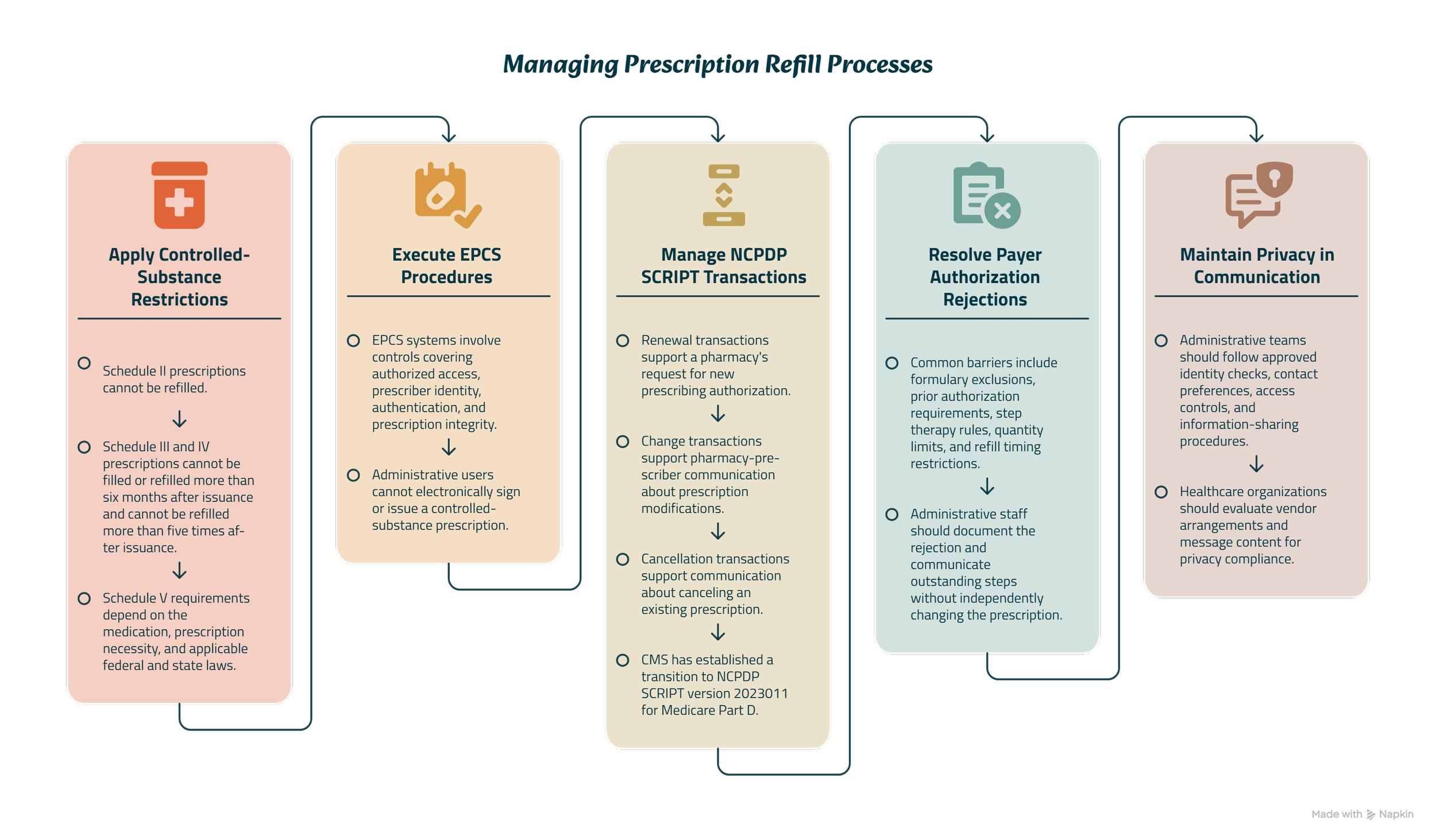
Schedule II prescriptions cannot be refilled. Continued treatment requires an appropriately issued new prescription, with limited exceptions concerning how particular prescriptions may be issued or dispensed under applicable rules.
Schedule III and IV prescriptions may be refilled only within applicable limits. Under federal law, they cannot be filled or refilled more than six months after issuance and cannot be refilled more than five times after issuance without renewal by the practitioner.
Schedule V requirements depend on the medication, whether a prescription is required, and applicable federal and state laws. State restrictions and other requirements may be more stringent.
A pharmacy may also need to verify dispensing history, prescriber information, prescription validity, and other legally required information.
Medical administrators should use these distinctions for proper routing and regulatory awareness. They should refer prescribing and dispensing decisions to authorized professionals and follow applicable healthcare compliance procedures, clinical documentation controls, and professional communication protocols.
Electronic Prescriptions for Controlled Substances (EPCS)
EPCS systems allow qualified practitioners to issue controlled-substance prescriptions electronically through systems meeting applicable regulatory requirements.
These systems involve additional controls covering authorized access, prescriber identity, authentication, and prescription integrity.
An administrative user who can prepare a refill message or support an EHR workflow does not thereby have authority to electronically sign or issue a controlled-substance prescription.
For example, a clinician may prepare a Schedule II prescription electronically. The authorized prescribing process must satisfy EPCS requirements, and dispensing remains subject to pharmacy verification and applicable law.
Relevant training includes healthcare cybersecurity controls, cloud-based EMR management, workflow access permissions, and healthcare compliance systems.
How NCPDP SCRIPT transactions affect prescription refills
Electronic prescribing depends on standardized communication between prescribing and dispensing systems.
NCPDP SCRIPT supports distinct transaction types for prescription-related workflows.
A renewal transaction supports a pharmacy's request for new prescribing authorization. Change transactions support particular pharmacy-prescriber communication about prescription modifications. Cancellation transactions support communication about canceling an existing prescription.
The system's message status requires careful interpretation. A message accepted by a technical intermediary may still require pharmacy acknowledgement or clinical action.
A CancelRx transmission failure, for example, should trigger an established exception process rather than being treated as confirmed cancellation.
CMS has also established a transition to NCPDP SCRIPT version 2023011 for applicable Medicare Part D electronic prescribing, with the earlier 2017071 version scheduled to cease being permitted for that purpose beginning January 1, 2028.
Administrators should coordinate standards transitions with EHR vendors and integration teams while testing renewal, change, cancellation, and error-handling workflows.
Useful operational resources include medical software troubleshooting, EHR integration knowledge, workflow automation principles, and secure healthcare communication.
Refills, payer authorization, and pharmacy benefit rejections
A medication can have valid prescriber authorization while still encountering payer restrictions.
Common barriers include formulary exclusions, prior authorization requirements, step therapy rules, quantity limits, refill timing restrictions, and insurance eligibility discrepancies.
Consider a patient who receives a 90-day prescription but whose health plan permits only a smaller quantity under the particular benefit.
The pharmacy may need to clarify the payer's limitation. A prescriber may need to authorize an appropriate change or request an exception.
Administrative staff should document the actual rejection, determine which party is responsible, and communicate the outstanding steps without independently changing the prescription.
A similar distinction applies when a claim is rejected as too early to refill. The administrator should verify the pharmacy's explanation and route any clinical or coverage exception through the appropriate process.
Effective coordination uses prior authorization procedures, healthcare compliance software, patient interaction scripts, and administrative team communication.
Privacy protections in refill communication
Prescription refill messages can reveal sensitive medical information, particularly through shared devices, voicemail, text notifications, or incorrectly addressed portal messages.
Administrative teams should follow approved identity checks, contact preferences, access controls, and information-sharing procedures.
HIPAA recognizes certain refill reminders and medication adherence communications as distinct from marketing, subject to applicable conditions. Additional considerations arise when pharmaceutical manufacturers or other third parties fund communications.
Healthcare organizations should evaluate their vendor arrangements and message content rather than assuming every medication-related communication has identical privacy treatment.
Appropriate safeguards include confidential communication practices, secure messaging systems, healthcare cybersecurity procedures, and patient portal access management.
5. How to Build a Prescription Refill Protocol That Prevents Delays and Medication Errors
A dependable prescription refill program needs clear clinical authority, standardized intake information, monitored queues, exception handling, and reliable performance measurement.
The following implementation process can be adapted to outpatient practices, specialty clinics, and other healthcare organizations according to their staffing, legal obligations, and clinical requirements.
Step 1: Establish a written refill responsibility matrix
Define which roles may receive, verify, review, authorize, transmit, and close prescription requests.
A practical matrix should identify the primary responsible role, backup coverage, escalation triggers, and required documentation for each step.
For example, administrative staff may verify patient information, document the requested pharmacy, and route the message. A qualified clinical reviewer may assess treatment-related questions. The authorized prescriber makes decisions requiring prescribing authority. The dispensing pharmacy manages its responsibilities under applicable pharmacy law.
The workflow should explicitly distinguish request intake, clinical authorization, electronic prescription transmission, and dispensing confirmation.
Staff should have access to medical office telephone standards, professional communication procedures, patient portal workflows, clinical documentation guidelines, and secure message routing rules.
Step 2: Standardize the minimum information required for intake
Every request should contain enough information to identify the patient, requested medication, pharmacy, and appropriate review pathway.
A practical intake record includes the date and source of the request, verified patient identifier, drug name, stated strength, requested pharmacy, reported remaining supply, and relevant patient concerns.
Medication details should be verified against the existing prescription record rather than accepted blindly from an outdated bottle or historical message.
If the patient reports a missed dose, adverse reaction, or unexplained medication discrepancy, record the statement and escalate according to clinical policy.
A complete request should also identify the responsible queue and next expected action.
Applying written communication standards, secure portal documentation, confidentiality procedures, medical dictation accuracy principles, and team communication requirements helps reduce avoidable clarification calls.
Step 3: Create separate queues for different refill problems
A single undifferentiated refill inbox makes it difficult to identify urgent issues and determine why requests remain unresolved.
A more reliable system distinguishes routine requests, clinical review exceptions, controlled-substance workflows, coverage barriers, pharmacy transmission failures, and requests awaiting patient information.
Each queue should have a named owner, priority rules, review schedule, backup coverage, and documented escalation criteria.
For example, a prior authorization problem requires a different operational response from a prescription awaiting the prescriber's decision.
Likewise, a patient reporting concerning symptoms should be routed through clinical triage rather than remaining in a routine administrative worklist.
These distinctions can be implemented through healthcare automation tools, patient portal management, medical office triage communication, prior authorization tracking, and healthcare administrative workflow design.
Step 4: Establish turnaround targets and escalation checkpoints
A refill protocol should define how quickly each category of request is reviewed, who acts when a deadline is approaching, and what happens when the responsible staff member is unavailable.
Targets must reflect clinical risk and available resources. A routine administrative inquiry and a potentially dangerous treatment interruption require different procedures.
The organization may establish internal service goals for routine requests, but these should be supported by staffing and clearly communicated to patients.
For clinical exceptions, deadlines should follow clinician-approved urgency criteria.
Escalation should occur when a request reaches a defined threshold without the required action. For instance, an unresolved renewal awaiting a covering prescriber may require reassignment under established coverage procedures.
Developing these controls involves medical administrative team coordination, secure healthcare messaging, workflow automation, patient communication templates, and phone triage procedures.
Step 5: Monitor refill metrics that reveal genuine performance
A prescription refill dashboard should measure the complete process rather than relying on the number of requests processed.
First-pass request completeness measures requests containing all required information without needing another administrative clarification.
For example, if 270 of 300 requests contain complete information at initial review, the first-pass completeness rate is 90%.
Prescriber decision turnaround time measures the duration from a defined clinical review starting point to the documented authorized decision.
Transmission failure rate measures failed prescription transmission attempts divided by relevant attempts during the reporting period.
Unresolved request rate measures requests remaining open beyond a defined internal review threshold.
Duplicate request frequency measures requests identified as duplicates according to documented matching rules.
Patient notification completion measures resolved requests with documented communication of the disposition, where required by protocol.
These indicators should be displayed with relevant counts, reporting periods, and clearly defined denominators.
A practice might discover that most renewal decisions occur within its service target while a disproportionate number of patients continue calling about unresolved pharmacy problems. This suggests the main bottleneck lies after prescribing.
Connecting performance reporting with patient portal tools, EHR information management, technical troubleshooting, secure pharmacy communication, and workflow automation analytics helps expose these hidden delays.
Step 6: Audit exceptions and improve the protocol monthly
Select a representative sample of requests involving delayed authorization, duplicate messages, rejected prescriptions, medication discrepancies, and complaints about unavailable medication.
Review whether staff identified the correct patient, recorded accurate medication details, assigned the right queue, followed applicable escalation rules, and documented the final outcome.
Separate preventable administrative delays from necessary clinical decision-making.
For example, if 40 of 200 reviewed requests require avoidable clarification, the administrative clarification rate is 20%. If workflow improvements reduce that number to 18 of 200 comparable requests, the rate falls to 9%, an improvement of 11 percentage points.
The organization should verify whether the improvement persists across subsequent reporting periods and whether any new safety concerns emerge.
Monthly reviews can incorporate medical documentation quality, professional communication standards, patient rapport techniques, healthcare compliance monitoring, and clinical team handoff practices.
6. Frequently Asked Questions About Prescription Refill Protocols
-
A refill generally occurs when a pharmacy dispenses more medication under a prescription with remaining valid refill authorization. A renewal requires new authorization from an appropriately licensed prescriber.
The distinction matters because an exhausted prescription, an expired prescription, or a medication requiring reassessment may need a new prescribing decision.
Administrative staff should verify the patient's request, relevant prescription information, and pharmacy details before routing the correct action.
A consistent process uses patient portal renewal management, electronic medical records, secure pharmacy communication, and clinical team coordination.
-
Administrative staff can perform activities authorized within their role, such as collecting information, verifying records, routing requests, and communicating documented decisions.
Authority to prescribe or authorize medication must follow professional licensing requirements, applicable laws, and organizational policies.
Certain organizations operate approved refill protocols involving appropriately licensed staff and delegated responsibilities. The scope of each role must be clearly defined.
A receptionist should avoid independently approving prescriptions, changing doses, or selecting substitute medications.
Relevant training includes professional administrative standards, medical office telephone procedures, healthcare compliance controls, and clinical documentation practices.
-
Verify the patient and medication, record when the supply ended, identify missed doses and relevant patient concerns, and promptly route the request using established clinical urgency criteria.
The appropriate response depends on the medication, clinical circumstances, and applicable prescribing or dispensing rules.
A qualified clinician may need to assess the patient, while a pharmacist may be able to explain lawful emergency dispensing options where available.
Administrative staff should avoid giving dosing instructions or promising that a temporary prescription will be issued.
Understanding phone triage communication, patient interaction scripts, secure messaging procedures, and team escalation workflows supports appropriate handling.
-
Under U.S. federal law, prescriptions for Schedule II controlled substances cannot be refilled.
Continued prescribing requires an appropriately issued new prescription under applicable federal and state requirements.
Medical administrative staff should distinguish requests for new prescriptions from ordinary refill transactions and avoid suggesting unauthorized workarounds.
The responsible prescriber and dispensing pharmacist must follow relevant prescribing, dispensing, and verification rules.
Healthcare organizations can support appropriate handling through compliance software, EHR access controls, healthcare cybersecurity safeguards, and professional documentation procedures.
-
Under federal U.S. law, Schedule III and IV prescriptions may be refilled up to five times within six months after the prescription was issued, when authorized by the prescriber.
A prescription reaches the applicable federal limit when either the refill count or time limit is exhausted. A new prescription is required for additional treatment beyond those limits.
State laws and other applicable restrictions may impose additional requirements.
Administrative staff should verify the relevant prescription, prescriber authorization, and pharmacy information rather than calculating eligibility from an incomplete chart history.
Useful knowledge includes healthcare compliance terminology, patient portal management, clinical record accuracy, and secure medical communications.
-
A refill-too-soon rejection commonly occurs when the payer's benefit rules indicate that the requested dispensing date is earlier than permitted.
Other relevant factors may include prior dispensing records, prescription changes, insurance rules, or special circumstances.
The pharmacy can help clarify the specific rejection. A clinician or payer may need to review the issue if an exception or medication change is being considered.
Administrative staff should accurately document the reason and direct it to the appropriate team.
Understanding prior authorization procedures, medical office communication, patient messaging templates, and workflow exception management helps prevent repeated callbacks.
