

A discarded needle, incorrectly labeled waste container, or expired medication placed in the wrong disposal stream can expose medical practices to serious safety and compliance risks. Effective medical waste management requires accurate classification, secure segregation, appropriate treatment, and verifiable disposal records. This interactive dictionary explains essential waste disposal terminology through practical examples, regulatory distinctions, and administrative controls. It connects medical office maintenance, healthcare compliance software, workflow automation, and team communication to safer, more accountable healthcare waste disposal practices.
1. Medical Waste Disposal Fundamentals and Essential Terminology
Medical waste disposal involves identifying, separating, containing, storing, transporting, treating, and disposing of waste generated during healthcare activities. A medical practice may produce contaminated sharps, blood-containing materials, expired pharmaceuticals, chemical waste, and ordinary administrative trash, each requiring appropriate handling.
The most consequential mistake is assuming every item generated in a clinical environment belongs in a regulated medical waste container.
In the United States, medical waste classification depends on the material, its contamination, applicable federal requirements, and state or local regulations. OSHA establishes important occupational exposure protections, while state environmental and health agencies generally regulate medical waste management and disposal. EPA hazardous waste rules and DOT transportation requirements may also apply to particular waste streams.
This distinction affects medical administrative compliance, written operating procedures, facility troubleshooting, and staff safety communication.
The five decisions behind compliant waste disposal
Every disposal process should begin with five questions:
What is the waste? Identify whether it contains sharps, potentially infectious material, pharmaceuticals, hazardous chemicals, or ordinary refuse.
Which rules apply? Determine the applicable OSHA, EPA, DEA, DOT, and state or local requirements.
Where should it be segregated? Select the appropriate waste stream and container at the point of generation.
How must it be managed? Establish packaging, labeling, storage, pickup, and treatment requirements.
What evidence must be retained? Maintain applicable shipment records, vendor documents, training records, and incident reports.
A syringe needle, expired chemotherapy medication, and clean examination-table packaging may originate from the same treatment room but require different disposal pathways.
Administrators should reflect these distinctions in front-desk and facility procedures, healthcare automation systems, professional staff training, and compliance documentation.
Why red bags, sharps containers, and pharmaceutical waste containers are different
A red biohazard bag commonly identifies a designated regulated medical waste stream under applicable procedures. It should not serve as a universal container for discarded clinical materials.
Contaminated sharps require an appropriate closable, puncture-resistant, leakproof, labeled or color-coded sharps container. Hazardous waste pharmaceuticals require management under applicable RCRA rules, while controlled substances can involve additional DEA obligations.
Color conventions and waste categories can differ by jurisdiction and vendor. Employees should follow the facility's approved waste segregation matrix.
For example, placing an expired hazardous medication in a red bag can create a classification and disposal problem even when the bag is collected by a licensed medical waste contractor.
Correct handling depends on clear written instructions, healthcare compliance oversight, administrative workflow training, and effective clinical team communication.
| # | Waste Disposal Term | Definition & Workplace Risk | Recommended Control |
|---|---|---|---|
| 1 | Regulated Medical Waste (RMW) | Medical waste subject to special handling or disposal rules. Classification varies by applicable law. Risk: incorrectly classifying ordinary trash or infectious material. | Maintain a state-specific waste classification guide within compliance procedures. |
| 2 | Other Potentially Infectious Materials (OPIM) | Specified body fluids, tissues, and materials covered by OSHA's bloodborne pathogens definitions. Risk: overlooking exposure hazards. | Train affected employees using workplace safety standards. |
| 3 | Contaminated Sharps | Contaminated objects capable of penetrating skin, including needles, scalpels, and broken glass. Risk: needlestick or cut injuries. | Place sharps promptly into approved containers and follow safety handoff protocols. |
| 4 | Sharps Disposal Container | A closable, puncture-resistant, leakproof, appropriately identified container for contaminated sharps. Risk: injuries from unsuitable bins. | Verify accessibility, stability, and condition using scheduled safety checks. |
| 5 | Sharps Fill Line | The manufacturer's designated maximum safe fill level. Risk: protruding needles and injuries during replacement. | Replace containers before overfilling and record checks through task reminders. |
| 6 | Biohazard Symbol | A standardized warning symbol used for specified biological hazards. Risk: unlabeled containers are mishandled. | Check required labeling through documented inspection procedures. |
| 7 | Red-Bag Waste | A commonly designated biohazardous waste stream under facility and jurisdictional rules. Risk: inappropriate disposal of medicines or ordinary trash. | Use a facility-approved segregation chart and staff instructions. |
| 8 | Point-of-Generation Segregation | Separating waste into appropriate streams where it is produced. Risk: dangerous sorting after containers are filled. | Position appropriate bins near workstations and reinforce employee handling practices. |
| 9 | Non-Regulated General Waste | Ordinary refuse that does not require specialized medical waste handling. Risk: unnecessary treatment costs from misclassification. | Review clean packaging and administrative refuse through segregation audits. |
| 10 | Microbiological Waste | Certain laboratory cultures, stocks, and related contaminated materials. Risk: unsafe handling or inappropriate treatment. | Follow laboratory-specific requirements and approved waste plans. |
| 11 | Pathological Waste | Human or animal tissues and specified anatomical materials requiring special handling under applicable rules. | Verify storage, packaging, and treatment requirements through written disposal procedures. |
| 12 | Bulk Blood Waste | Discarded blood or blood products subject to applicable regulated waste handling. Risk: leaking containers and exposure. | Use authorized disposal routes and exposure reporting protocols. |
| 13 | Secondary Containment | An additional appropriate container used when leakage or outer contamination creates a containment risk. | Escalate damaged packaging and follow spill and container procedures. |
| 14 | Leak-Resistant Packaging | Packaging designed to contain the intended waste and prevent fluid escape during normal handling. | Check compatibility, closure, and damage before pickup through inspection checklists. |
| 15 | RCRA Hazardous Waste | Waste meeting EPA hazardous waste listing or characteristic criteria. Risk: treating chemical hazards as ordinary infectious waste. | Perform appropriate waste determinations through regulatory compliance processes. |
| 16 | Hazardous Waste Pharmaceuticals | Discarded pharmaceuticals classified as hazardous waste under applicable RCRA criteria. | Apply applicable Subpart P and state rules using pharmaceutical compliance records. |
| 17 | Non-Hazardous Pharmaceutical Waste | Discarded medications that do not meet applicable hazardous waste classification. They may still require specialized disposal. | Use a designated medication waste stream and pharmaceutical disposal instructions. |
| 18 | Potentially Creditable Pharmaceutical | A qualifying prescription hazardous waste pharmaceutical with a reasonable expectation of manufacturer credit. | Verify eligibility before routing it into returns workflows. |
| 19 | Reverse Distributor | An entity receiving specified potentially creditable hazardous waste pharmaceuticals to facilitate manufacturer credit assessment. | Verify vendor function and routing under vendor governance procedures. |
| 20 | Controlled Substance Disposal | Disposal involving applicable DEA controls and authorized destruction processes. Risk: diversion or inadequate records. | Coordinate with authorized personnel through controlled handoff protocols. |
| 21 | Trace Chemotherapy Waste | Items with residual antineoplastic drug contamination, managed according to the drug, waste classification, and facility rules. | Verify the approved stream rather than relying solely on bin color; follow hazard-handling training. |
| 22 | Bulk Chemotherapy Waste | Discarded antineoplastic drugs or contaminated materials with residual quantities requiring classification and potentially hazardous waste controls. | Obtain pharmacy or environmental safety review through waste classification procedures. |
| 23 | Hazardous Waste Characteristics | Ignitability, corrosivity, reactivity, or toxicity criteria used in federal hazardous waste determinations. | Check relevant product information and document determinations using classification records. |
| 24 | Waste Profile | A description of a waste stream's composition, classification, and handling requirements used by a facility or waste vendor. | Review profiles when services or materials change; maintain approved documentation. |
| 25 | Waste Accumulation | Temporary collection of generated waste before treatment or transport. Risk: missed accumulation time or container requirements. | Apply waste-specific time limits and track due dates through collection reminders. |
| 26 | Medical Waste Storage Area | A designated location for contained waste awaiting pickup. Risk: leakage, pests, odors, or unauthorized access. | Inspect access, sanitation, and packaging through facility maintenance checks. |
| 27 | Authorized Waste Transporter | A carrier meeting applicable authorization requirements for the particular waste and jurisdiction. | Verify credentials, accepted waste streams, and pickup records using vendor compliance reviews. |
| 28 | Shipping Paper | Transportation documentation required for applicable hazardous-material shipments under DOT rules. | Verify the correct description and accompanying documents through shipment record checks. |
| 29 | UN3291 | A UN identification number for certain regulated medical waste shipments meeting the applicable DOT classification. | Have qualified personnel confirm shipping classification under transport compliance procedures. |
| 30 | Autoclave Treatment | A validated steam treatment process used for eligible waste streams under applicable requirements. | Verify approved loads, process parameters, and required records through treatment documentation. |
| 31 | Biological Indicator | A standardized microbial challenge used to assess the performance of applicable treatment or sterilization processes. | Review results according to the validated treatment plan and quality records. |
| 32 | Treatment / Disposal Confirmation | Vendor documentation confirming specified waste handling, treatment, or final disposal activities. Risk: missing evidence of proper downstream management. | Reconcile pickup and treatment records through compliance tracking systems. |
2. Medical Waste Disposal Scenarios: Common Mistakes and Correct Administrative Responses
Medical waste problems often develop when employees encounter an unfamiliar item, a full disposal container, or an unexpected pickup delay. Clear segregation procedures help prevent potentially hazardous materials from entering the wrong waste stream.
These situations should be incorporated into staff professionalism training, facility maintenance procedures, written safety instructions, and compliance reporting systems.
Scenario A: An overfilled sharps container has needles protruding from the opening
A medical assistant discovers that a sharps container has passed its marked fill line. Several used needles remain visible near the disposal opening, and another employee considers pushing the contents down to make room.
This creates an immediate needlestick risk.
OSHA requires contaminated sharps containers to be closable, puncture-resistant, leakproof on their sides and bottom, and properly labeled or color-coded. Containers should remain upright, be readily accessible near sharps use, and be replaced before overfilling.
Correct administrative response: Stop using the container, prevent further disposal into it, and notify appropriately trained personnel. Follow the approved procedure for safe closure, replacement, and handling. Employees should never reach inside, compress the contents by hand, or attempt to retrieve discarded needles.
The incident should trigger a review of container location, replacement responsibilities, and inspection frequency.
If the problem repeatedly occurs in one procedure room, adjust the replacement process through workflow automation and reinforce safety communication procedures. Record recurring deficiencies using compliance software and update written operating instructions.
Scenario B: Clean packaging is repeatedly placed into red biohazard bags
During a waste audit, a practice discovers that staff routinely discard clean packaging, unused paper towels, and ordinary office trash into regulated medical waste containers.
This can increase disposal costs and create unnecessary treatment volumes.
Correct administrative response: Review the actual waste items against the state-specific classification rules and approved segregation chart. Place clearly labeled containers at the point of generation and retrain employees using examples from their own work areas.
Staff should identify the characteristics that make a material regulated rather than relying only on where the material was generated.
Importantly, employees should not reopen or manually sort filled regulated waste bags to recover incorrectly discarded items. Correct the process for future disposal.
A practice can measure whether segregation improvements reduce the amount of ordinary refuse entering regulated streams.
Include segregation reviews in medical office troubleshooting, staff communication training, administrative worklists, and compliance audits.
Scenario C: Expired medications are mixed with infectious waste
A medical practice discovers expired medication vials during an inventory review. An employee assumes that placing them in a biohazard bag will satisfy disposal requirements.
Pharmaceutical waste must be evaluated separately from infectious waste because applicable hazardous waste rules, controlled substance requirements, and state disposal provisions may apply.
Correct administrative response: Separate the medications by appropriate classification and refer them to authorized pharmacy, environmental safety, or compliance personnel.
Determine whether the items qualify as RCRA hazardous waste pharmaceuticals, non-hazardous pharmaceutical waste, potentially creditable products, or controlled substances subject to additional rules.
The practice should also distinguish unused medication inventory from waste that has already been designated for disposal.
EPA prohibits healthcare facilities and reverse distributors from sewering hazardous waste pharmaceuticals. Hazardous pharmaceutical disposal requirements can also vary according to the facility's generator status and applicable state program.
Document decisions in healthcare compliance records, coordinate authorized handlers through team communication procedures, and use workflow tracking to monitor the resulting disposal process.
Scenario D: A red bag leaks during movement to the waste storage room
An environmental services employee notices liquid escaping from a closed waste bag while moving it to the designated storage area.
The risk depends on the contents, the extent of contamination, and whether the material may contain blood or other potentially infectious substances.
Correct administrative response: Restrict access to the affected area as appropriate and notify trained personnel. Follow the facility's exposure-control, spill-management, and secondary-containment procedures.
Use suitable protective equipment and the approved cleanup method for the material involved. Ensure any additional packaging meets applicable requirements and can safely contain the waste.
Investigate whether the original container was unsuitable, overloaded, damaged, or incorrectly closed.
Record the incident through written communication procedures, escalate facility hazards with technical troubleshooting workflows, and evaluate corrective measures using compliance management systems.
Scenario E: The medical waste contractor misses a scheduled pickup
A clinic's regulated waste storage area approaches its planned capacity after a contractor fails to arrive.
Employees consider leaving additional bags in a public-access hallway until the next collection.
Improper temporary storage can increase exposure, unauthorized access, leakage, odor, and pest risks.
Correct administrative response: Check the facility's approved storage capacity and applicable local storage requirements. Contact the authorized transporter, arrange compliant alternative pickup if necessary, and escalate conditions that could compromise safe storage.
Waste should remain in properly closed and identified containers in an appropriate designated area.
Investigate whether the missed pickup reflects a one-time service problem or inadequate collection frequency.
Use automated pickup reminders for scheduling principles, administrative exception tracking, facility maintenance reporting, and vendor compliance documentation.
3. OSHA, EPA, DOT, and State Medical Waste Disposal Requirements
Medical waste compliance involves several regulatory frameworks. Each addresses different hazards and responsibilities, so administrators need to recognize which requirements apply before approving a disposal procedure or signing a waste management contract.
OSHA: Protecting employees from bloodborne pathogens
OSHA's Bloodborne Pathogens standard, 29 CFR 1910.1030, establishes requirements for covered occupational exposures to blood and other potentially infectious materials.
Relevant obligations can include an exposure control plan, engineering and work practice controls, appropriate personal protective equipment, training, sharps handling, regulated waste containment, and exposure-related recordkeeping.
The standard defines regulated waste using specified conditions, including certain liquid or semiliquid blood and OPIM, contaminated sharps, and relevant pathological and microbiological waste.
This definition is particularly important when deciding whether contaminated materials require special handling.
For example, the mere presence of a small amount of dried blood on an item does not automatically establish that every disposal rule for regulated waste applies. The item's characteristics and applicable state requirements matter.
Train staff through medical administrative professionalism, written safety procedures, team communication standards, and compliance monitoring tools.
EPA: Distinguishing medical waste from RCRA hazardous waste
EPA recognizes that medical waste disposal is primarily regulated by state environmental and health agencies. Federal RCRA hazardous waste requirements may apply separately to materials meeting hazardous waste criteria.
A medical practice may generate infectious waste, hazardous pharmaceutical waste, hazardous chemical waste, and ordinary refuse within the same building.
Each category requires its own classification and disposal decisions.
A key distinction: Infectiousness alone generally does not make medical waste a federal RCRA hazardous waste. RCRA hazardous waste determinations depend on applicable listings and hazardous characteristics.
EPA's pharmaceutical waste rules under 40 CFR Part 266 Subpart P establish specific requirements for covered healthcare facilities and reverse distributors.
For example, healthcare facilities managing non-creditable hazardous waste pharmaceuticals under applicable Subpart P provisions generally must use structurally sound, compatible containers and label them appropriately. The federal rule also establishes accumulation requirements.
Very small quantity generators have different applicability provisions, although the hazardous waste pharmaceutical sewering prohibition also applies to them.
Administrators should confirm their facility's status with qualified compliance personnel and consult state requirements.
Use healthcare compliance systems, written waste classification procedures, administrative workflow automation, and facility safety reporting to document decisions.
DOT: Packaging and shipping regulated medical waste
The U.S. Department of Transportation establishes transportation requirements for hazardous materials, including regulated medical waste shipments subject to the Hazardous Materials Regulations.
Certain regulated medical waste shipments are classified as UN3291. Applicable rules address packaging, marking, labeling, shipping papers, and transportation practices.
The precise requirements depend on the waste classification, packaging type, shipment configuration, and applicable exceptions.
A facility should have qualified personnel verify the correct shipping classification and documentation rather than assuming all medical waste shipments use identical labels or paperwork.
For example, a standard medical waste pickup ticket and a federal hazardous waste manifest serve different purposes. A manifest may be mandatory for certain hazardous waste shipments, while other regulated medical waste streams have different tracking requirements.
Administrators should incorporate pickup verification into written shipping records, team handoff procedures, automated compliance tracking, and vendor oversight.
State regulations: Why local requirements need their own review
State rules may establish specific categories of regulated medical waste, registration requirements, approved treatment methods, storage periods, transportation conditions, or documentation obligations.
The requirements applicable to one medical office may differ from those governing a similar facility in another state.
A reliable compliance program should identify the applicable state environmental agency, state health department, licensing authorities, and local waste rules.
Practical compliance check: Maintain a jurisdiction-specific regulatory matrix that identifies each waste stream, applicable requirements, responsible department, approved vendor, and required records.
Review the matrix whenever the practice introduces a new service, drug category, laboratory activity, or treatment procedure.
Coordinate updates through healthcare compliance management, professional training procedures, administrative documentation, and workflow planning.
View My Improvement Plan
4. Building a Safe Medical Waste Segregation, Storage, and Collection Workflow
Effective waste management begins before an item reaches a disposal container. Administrators should identify the waste generated by each service, establish appropriate handling instructions, and assign responsibility for every stage of disposal.
A reliable program connects clinical departments, environmental services personnel, pharmacy teams, waste transporters, and compliance officers.
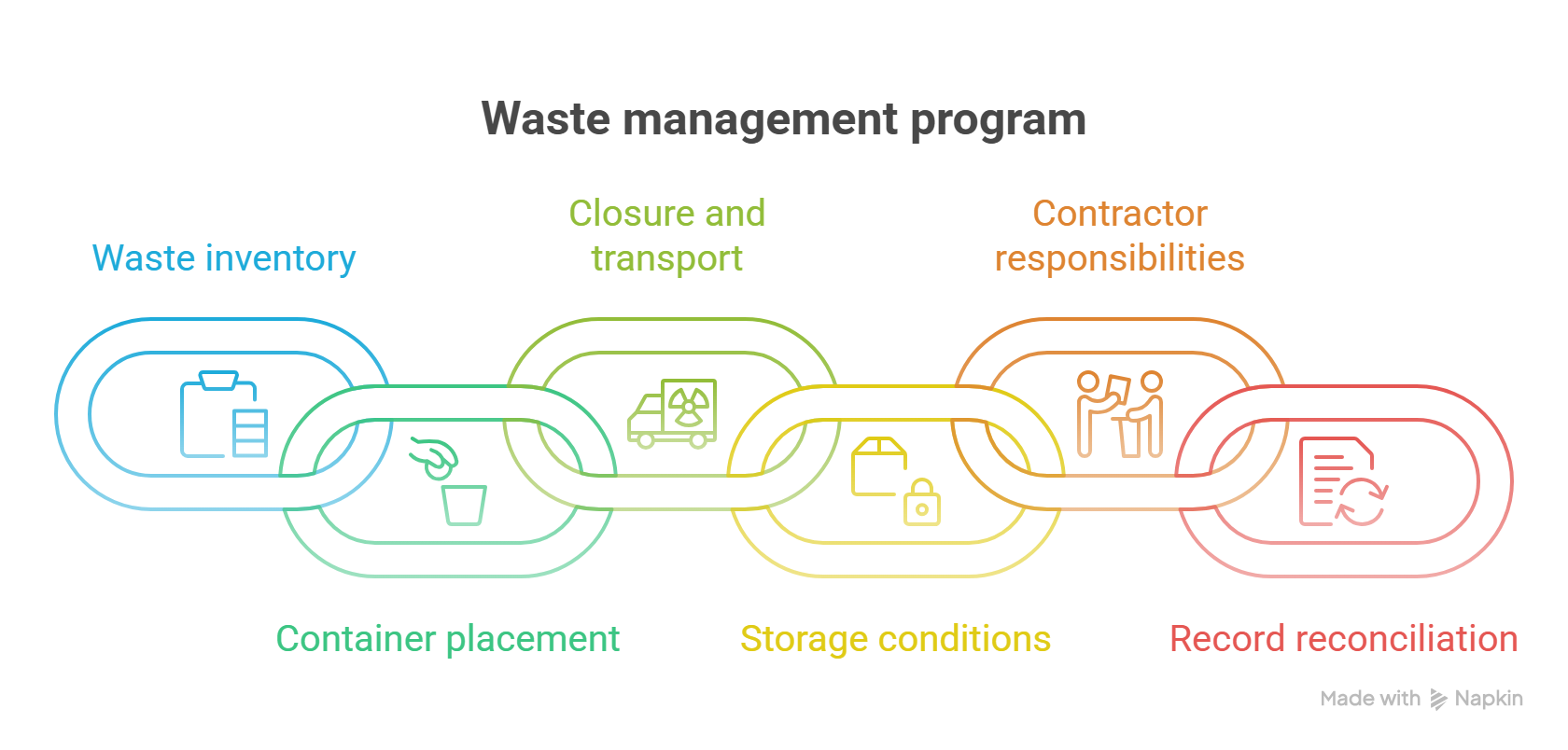
Step 1: Build a waste stream inventory
Start by identifying the materials generated in each department.
An outpatient clinic may produce used needles, blood-containing dressings, examination gloves, paper products, medication vials, cleaning chemicals, and expired pharmaceuticals.
A specialty clinic may also generate pathology specimens, laboratory cultures, antineoplastic drug waste, or other specialized materials.
For every waste stream, document the material, expected quantity, applicable classification, required container, storage conditions, approved treatment or disposal pathway, and responsible employee.
A complete inventory helps prevent employees from improvising disposal decisions.
Coordinate the inventory using written medical administrative records, departmental communication procedures, facility maintenance documentation, and healthcare compliance software.
Step 2: Place approved containers where waste originates
Poor container placement creates unnecessary handling and increases the likelihood of classification errors.
Sharps containers must be located as close as feasible to areas where sharps are used or can reasonably be anticipated. Other waste containers should be positioned to support appropriate segregation and safe working conditions.
A procedure room may require separate containers for sharps, designated regulated medical waste, and general refuse. Additional waste streams may require specialized containers.
Use consistent labels and clearly displayed examples of materials accepted in each container.
When designing a location-specific segregation chart, avoid suggesting that every colored container has the same meaning across jurisdictions.
Include container readiness in facility inspection workflows, reinforce expectations through professional employee training, and document exceptions using healthcare troubleshooting procedures.
Step 3: Define waste closure and internal transport procedures
Containers need to be closed and transported according to the material involved and applicable requirements.
For contaminated sharps, OSHA requires appropriate closure before removal to prevent spillage or protrusion of contents. Other regulated waste containers must also meet relevant containment and closure requirements.
Internal transport procedures should address who may move containers, which routes may be used, what protective equipment is required, and how a spill or damaged container must be handled.
Staff should avoid opening sealed waste bags for routine sorting.
Practical administrative control: Require personnel to report containers that are leaking, improperly labeled, damaged, or not securely closed. The receiving storage team should have clear authority to reject unsafe handoffs.
This process should be supported by team handoff communication, written safety instructions, administrative escalation tools, and compliance records.
Step 4: Establish compliant waste storage conditions
A designated medical waste storage area should provide appropriate access control, sanitation, containment, and environmental conditions.
CDC guidance recommends managing stored regulated medical waste in a way that reduces leakage, odor, pest exposure, and unnecessary accumulation.
Specific state or local rules may establish storage time limits, refrigeration requirements for certain materials, and other conditions.
The storage plan should include approved container arrangements, maximum working capacity, collection schedules, inspection responsibilities, and emergency contacts.
For example, a practice that routinely approaches storage capacity before a weekly pickup should consider whether the collection schedule is appropriate for its actual waste generation.
Where pharmaceutical or chemically hazardous wastes are stored, apply the separate requirements governing those materials.
Administrators can monitor storage through facility inspection checklists, automated reminders, waste compliance documentation, and departmental reporting.
Step 5: Verify waste contractor responsibilities and treatment methods
A waste management vendor should be evaluated according to the waste streams it accepts and the regulations governing its services.
The practice should identify the transporter, treatment or disposal facility, applicable permits, authorized service scope, and documentation provided after collection.
For regulated medical waste, approved treatment methods may include autoclaving or other permitted technologies, depending on the material and jurisdiction.
Certain waste streams, including some pathological or pharmaceutical waste, can require different treatment or disposal methods.
A contractor's claim that all medical waste is processed using a single technology should prompt closer review of the specific materials involved.
Vendor agreements should establish pickup expectations, acceptable packaging, rejected-load procedures, incident reporting, documentation, and responsibility for errors.
Use healthcare compliance monitoring, written vendor correspondence, workflow management tools, and professional administrative practices to maintain oversight.
Step 6: Reconcile pickup, shipment, and disposal records
Collection documentation should match what was actually transferred to the contractor.
Depending on the waste type, applicable paperwork may include pickup tickets, regulated medical waste tracking records, hazardous waste manifests, shipping papers, and treatment or destruction confirmations.
Administrators should confirm the date of collection, waste category, reported quantity, contractor identity, and relevant shipment identification.
Where downstream confirmation is required or contractually expected, reconcile it against the original pickup.
Missing records should enter a documented follow-up queue rather than disappearing after an invoice is paid.
Implement record reconciliation through healthcare workflow automation, compliance software, written documentation standards, and team communication procedures.
5. Medical Waste Disposal Audits, Performance Metrics, and Cost Control
Medical waste disposal performance should be measured through segregation accuracy, employee safety, documentation completeness, waste volumes, and vendor reliability.
A facility may receive regular waste pickups while continuing to experience unnecessary costs, incorrect classifications, or missing treatment documentation.
A useful performance system should identify these problems early and support targeted corrective action.
Metric 1: Waste Segregation Accuracy
Calculation: Audited disposal decisions classified correctly ÷ total disposal decisions reviewed × 100.
Suppose 92 of 100 observed disposal decisions comply with the approved segregation procedure. The segregation accuracy rate is 92%.
Record the type of mistake rather than reporting only the percentage.
Examples include ordinary trash entering regulated waste, sharps placed in inappropriate containers, or medications entering an incorrect pharmaceutical waste stream.
Audits should occur through safe observation, review of waste handling at the point of generation, and other approved methods. Employees should never open hazardous containers or manually sort contaminated waste to perform an audit.
Use findings to improve staff safety training, written segregation instructions, workflow monitoring, and compliance reviews.
Metric 2: Sharps Container Replacement Compliance
Calculation: Sharps containers replaced within their required limits ÷ total containers assessed for replacement × 100.
This measures adherence to manufacturer fill lines and applicable replacement procedures.
A useful audit should also assess whether containers are upright, accessible, properly secured, and appropriately labeled or color-coded.
Analyze repeat findings by location. A particular procedure room may need a different container capacity or replacement schedule.
The goal is to eliminate overfilling and unsafe handling, with corrective actions documented through facility inspection systems, team communication processes, and administrative automation.
Metric 3: Regulated Medical Waste per Encounter
Calculation: Weight of a defined regulated medical waste stream generated during the period ÷ number of relevant patient encounters.
For example, a practice producing 90 kilograms of regulated medical waste across 900 comparable encounters generates 0.1 kilogram per encounter.
This metric can reveal changes in segregation practices, service mix, and waste generation.
Compare similar clinical services and use consistent measurement units. Specialty clinics and primary care practices may produce very different waste quantities.
A reduction in regulated waste volume should be considered successful only when the underlying segregation remains appropriate.
Review trends through healthcare compliance reporting, workflow data monitoring, and administrative communication.
Metric 4: Waste Documentation Completion Rate
Calculation: Applicable waste transfers with all required records completed and reconciled ÷ total transfers requiring documentation × 100.
This evaluates whether pickup records, shipment documents, and treatment confirmations are available when required.
Review the metric separately for regulated medical waste, RCRA hazardous waste, and controlled substance disposal processes because documentation obligations differ.
For example, a routine medical waste pickup ticket may be sufficient for one stream's tracking requirements while another shipment requires a hazardous waste manifest and additional recordkeeping.
Administrators should follow up on missing records through vendor communication procedures, written compliance documentation, and healthcare compliance systems.
Metric 5: Waste Collection Reliability
Calculation: Scheduled waste pickups completed within the agreed service window ÷ total scheduled pickups × 100.
This helps identify missed pickups, contractor delays, and collection schedules that do not match actual waste generation.
Include the consequences of missed service, such as storage congestion, additional handling, or emergency collection charges.
Track performance by waste stream and vendor rather than combining all contractors into one figure.
When reliability declines, review the pickup schedule, backup collection options, vendor contract, and applicable waste storage requirements.
Coordinate corrective action through workflow automation, administrative troubleshooting, and professional vendor communication.
Metric 6: Disposal Cost per Unit of Waste
Calculation: Total qualifying collection, transportation, treatment, and disposal costs ÷ measured quantity of the relevant waste stream.
Compare costs separately for different waste categories. Hazardous pharmaceutical waste, sharps, and other regulated medical waste may have different pricing models.
Include container charges, transportation fees, minimum service charges, and required documentation costs where applicable.
If ordinary refuse is entering regulated waste containers, improving segregation may reduce unnecessary disposal expense.
However, disposal decisions must continue to comply with classification rules and safe handling requirements.
Use the results to support administrative workflow improvements, compliance oversight, and departmental communication.
Conducting a monthly medical waste audit
Select representative departments and assess their waste segregation procedures, sharps container condition, storage arrangements, labeling, collection schedules, and applicable documentation.
Compare observed practices against the facility's approved waste management plan.
Review incidents, recurring classification errors, expired training records, and outstanding contractor issues.
For every significant finding, record the responsible employee or department, corrective action, due date, and verification method.
A particularly valuable audit question is: Which disposal errors have continued after employees received corrective training?
Recurring problems may indicate confusing container placement, inadequate labeling, unsuitable procedures, or gaps in supervisory oversight.
Connect audit findings with staff professionalism training, written administrative procedures, healthcare automation tools, and compliance management.
6. Frequently Asked Questions About Medical Waste Disposal Terms
-
Regulated medical waste consists of waste that meets applicable definitions requiring special handling, treatment, or disposal. Ordinary healthcare waste includes materials that can be managed through general waste systems when they do not meet special classification requirements.
Examples of commonly regulated waste include contaminated sharps, certain microbiological materials, and specified blood-containing waste.
Clean packaging, ordinary paper products, and uncontaminated administrative refuse may qualify for general disposal.
Classification must account for the material's characteristics and applicable state or local requirements.
Administrators should maintain a clear waste segregation procedure and incorporate the requirements into staff safety training, facility inspection routines, and compliance audits.
-
The required disposal method depends on the type and amount of contamination, the material involved, OSHA's applicable definitions, and state or local medical waste regulations.
OSHA's regulated waste definition includes specified liquid or semiliquid blood or OPIM, contaminated items capable of releasing these materials under defined conditions, contaminated sharps, and certain pathological and microbiological waste.
A small dried blood spot on an item may require a different assessment from a saturated dressing capable of releasing blood during handling.
Medical practices should provide examples of relevant materials and their approved waste streams.
Employees can apply these decisions more consistently through written disposal instructions, safety communication training, and compliance management procedures.
-
Sharps containers should be replaced routinely and before becoming overfilled.
OSHA requires contaminated sharps containers to remain upright, be readily accessible near the area of use, and satisfy applicable containment and labeling requirements.
Staff should follow the manufacturer's designated maximum fill line and the organization's replacement procedures.
Employees should never reach inside a filled container, compress discarded sharps by hand, or attempt to transfer needles between containers as a routine replacement method.
A reliable inspection program assigns responsibility for checking containers and arranging replacements.
Include these tasks in automated safety checklists, medical office troubleshooting procedures, team communication, and professional staff training.
-
Expired medications require appropriate classification and handling before disposal.
Some pharmaceuticals qualify as RCRA hazardous waste, while others are non-hazardous pharmaceuticals subject to different management requirements. Controlled substances may also involve DEA obligations.
EPA prohibits healthcare facilities and reverse distributors from sewering hazardous waste pharmaceuticals under applicable federal rules. Additional restrictions may apply to other pharmaceutical wastes.
Medical practices should establish designated disposal procedures and consult qualified personnel when classification is uncertain.
Importantly, consumer medication take-back programs are generally designed for eligible ultimate users and do not provide a universal disposal route for healthcare facilities' own pharmaceutical waste.
Coordinate disposal through healthcare compliance procedures, inventory documentation, administrative workflow tracking, and authorized team handoffs.
-
Autoclaving is an accepted treatment method for certain medical waste streams when the technology and process are approved, validated, and operated according to applicable requirements.
The suitability of steam treatment depends on the waste material, contamination type, packaging, process parameters, and jurisdiction.
Certain pathological materials, hazardous chemicals, or pharmaceutical wastes may require different treatment or disposal methods.
Treatment effectiveness should be monitored using applicable process controls and validation requirements, including biological indicators when specified.
Administrators should verify that the waste contractor or treatment facility accepts the relevant materials and uses an appropriate authorized process.
Document these decisions through healthcare compliance systems, written waste management procedures, and vendor communication workflows.
-
Storage periods depend on the waste category, applicable state or local regulations, environmental conditions, and the facility's approved waste management plan.
Some jurisdictions establish time limits or specific storage conditions, while certain waste streams may require additional controls to prevent decomposition, leakage, odor, or other hazards.
Medical offices should identify applicable storage limits and establish a collection frequency that prevents unsafe accumulation.
A practice producing large amounts of regulated waste may require more frequent pickups than a low-volume outpatient office.
Storage monitoring should include container condition, access restrictions, sanitation, and available capacity.
Use automated collection schedules, facility maintenance procedures, written safety instructions, and compliance monitoring to control these risks.
