

A referral can disappear between a primary care clinic and a specialist even when every system shows it was successfully sent. Patients may wait weeks for appointments, insurance requirements may remain unresolved, and consultation reports may never reach the referring provider. These breakdowns create administrative backlogs and can delay important clinical decisions. Effective referral coordination requires understanding how orders are processed, appointments are secured, barriers are escalated, and specialist findings return to the care team. This guide explains essential referral coordination terminology, practical calculations, real-world scenarios, and actionable methods for improving referral completion and patient follow-up.

1. Referral Coordination Fundamentals: Understanding the Complete Referral Lifecycle
Referral coordination connects the clinician requesting a service, the patient receiving care, the specialist or receiving organization, and the administrative teams responsible for moving the request forward.
A well-managed referral requires several independently verified steps. An order must reach the appropriate destination, the receiving organization must process it, the patient must obtain the necessary service, and relevant findings must return to the referring clinician for appropriate follow-up.
These steps connect directly with patient scheduling integrations, secure healthcare messaging, cloud-based EMR workflows, and medical administration workflow automation.
The seven stages of a closed-loop referral
Stage 1: Referral initiation
An authorized clinician determines that the patient requires evaluation, treatment, or consultation from another provider and creates an appropriate referral request.
The request should identify the intended specialty or service, reason for referral, relevant clinical information, and any urgency instructions established by the clinician.
Administrators supporting medical documentation workflows, written communication, and team communication must recognize when required information is missing and route the request for authorized clarification.
Stage 2: Administrative validation
The coordination team confirms patient identifiers, destination details, required documents, contact information, and applicable payer requirements.
An incomplete referral packet can generate repeated requests for information and delay specialist review.
Standardized front-desk verification, confidential communication procedures, healthcare compliance processes, and workflow automation controls can reduce preventable administrative errors.
Stage 3: Transmission and receiving confirmation
The referral is delivered through an approved electronic referral system, secure message, fax, or another authorized channel.
A delivery confirmation shows that a communication reached a destination according to that channel's rules. The receiving practice may still need to register, validate, and accept the request.
Understanding secure fax and messaging workflows, cloud EMR integrations, and administrative troubleshooting helps prevent false completion statuses.
Stage 4: Acceptance and scheduling
The receiving organization confirms that it can process the referral or explains why the request requires further action.
Scheduling depends on provider availability, service appropriateness, patient preferences, insurance arrangements, and any clinically specified timeframe.
Coordinators should understand patient scheduling integrations, scheduling conflict management, patient interaction scripts, and rapport-building techniques when addressing barriers.
Stage 5: Appointment completion
An appointment being scheduled does not establish that the patient attended.
Coordination records should distinguish scheduled, cancelled, rescheduled, missed, and completed encounters using verified information.
Appointment reminder systems, patient communication techniques, and scheduling integrations help administrators track actual completion.
Stage 6: Specialist report receipt
After the consultation, the specialist's findings or report should return through an approved communication pathway to the referring clinician.
A referral may remain clinically unresolved when the appointment occurred but the referring provider cannot access the information required for follow-up.
Reliable medical documentation procedures, secure messaging systems, and team communication standards support this handoff.
Stage 7: Review, follow-up, and appropriate closure
The receiving clinician's report is routed to the referring clinician for review and any necessary follow-up. The patient receives the next steps through the appropriate clinical team.
The final status should accurately describe what happened, including completed referrals, declined services, cancellations, or other documented dispositions.
Professional administrative communication, patient interaction scripts, assertive escalation procedures, and healthcare compliance tools help ensure appropriate documentation and accountability.
| # | Referral Term | Definition & Purpose | Interactive Example & Action |
|---|---|---|---|
| 1 | Referral Order | A clinician's documented request for evaluation, treatment, consultation, or co-management by another service or provider. | Open exampleA primary care clinician orders a cardiology consultation. Check the order's patient, requested service, date, and instructions before routing. |
| 2 | Referring Provider | The clinician who initiates the referral and remains responsible for appropriate review and follow-up within the care arrangement. | Open exampleA family physician refers a patient to neurology. Confirm where the consultation report should return and how it will reach the ordering clinician. |
| 3 | Receiving Provider | The clinician, specialist, or organization receiving a referral request. | Open exampleA dermatology clinic receives a referral. Verify the destination's service capabilities, accepted patients, and contact information. |
| 4 | Referral Reason | The clinically documented purpose of requesting the specialist's evaluation or service. | Open exampleA referral says only “evaluation needed.” Route it for authorized clarification if the receiving practice requires a more specific clinical reason. |
| 5 | Clinical Priority | The urgency or timeframe established through authorized clinical assessment and referral instructions. | Open exampleA clinician marks a referral urgent. Follow the practice's urgent referral pathway rather than relying on routine scheduling timeframes. |
| 6 | Referral Packet | The collection of required order information, clinical records, test results, and administrative documents sent to the receiving provider. | Open exampleA specialist requires relevant test results before review. Use a standardized checklist to confirm the packet contains required documents. |
| 7 | Supporting Documentation | Relevant records accompanying the referral to explain the clinical need and support the requested service. | Open exampleAn orthopedic referral requires recent imaging reports. Verify the correct reports are included and associated with the intended patient. |
| 8 | Referral Identifier | A unique reference number used to track a particular referral request across workflow stages. | Open exampleTwo referrals exist for one patient. Compare unique order IDs, dates, and requested specialties before treating them as duplicates. |
| 9 | Outbound Referral | A referral sent from the originating practice to another provider or organization. | Open exampleA primary care office sends a specialist referral. Track transmission and acceptance as separate events in the referral workflow. |
| 10 | Inbound Referral | A referral received by the practice from another clinician or organization. | Open exampleA cardiology clinic receives an outside referral. Verify that incoming requests enter a monitored workqueue rather than an unassigned inbox. |
| 11 | Internal Referral | A referral to another service or department within the same healthcare organization. | Open examplePrimary care sends a patient to its own endocrinology department. Confirm the internal queue receives the order and identifies an owner. |
| 12 | External Referral | A referral to a provider or organization outside the originating healthcare organization. | Open exampleA clinic refers to an independent specialist. Confirm contact details, permitted information exchange, and report return arrangements. |
| 13 | Receipt Confirmation | Evidence that the intended destination received the transmitted request according to the communication channel. | Open exampleA fax transmission reports success. Contact the receiving practice if workflow policy requires confirmation that the referral was indexed correctly. |
| 14 | Referral Acceptance | Confirmation that a receiving organization can process the submitted request under applicable requirements. | Open exampleThe specialist accepts a referral for scheduling. Record the acceptance date separately from delivery and appointment dates. |
| 15 | Returned Referral | A request sent back for clarification, missing documentation, an incorrect destination, or another identified problem. | Open exampleA neurologist requests missing visit notes. Document the reason and assign the correction to the appropriate team rather than closing the request. |
| 16 | Network Status | Whether the receiving provider participates in the patient's applicable insurance network, subject to plan-specific verification. | Open exampleA specialist appears in an old directory. Verify current participation with appropriate plan and provider sources before advising the patient. |
| 17 | Payer Referral Requirement | An insurance-plan rule requiring a qualifying referral, often from a designated primary care provider, for specified specialist services. | Open exampleAn HMO patient needs specialist care. Verify whether the plan requires a PCP referral and confirm the correct authorization or reference details. |
| 18 | Prior Authorization | A payer's advance review or approval process for a specified service when required by plan rules. | Open exampleA specialist appointment may be scheduled while a procedure still requires separate prior authorization. Track both requirements independently. |
| 19 | Medical Necessity Documentation | Clinical information supporting why a requested evaluation, procedure, or treatment is appropriate. | Open exampleA payer requests clinical justification for an imaging service. Route missing clinical information to the authorized provider for completion. |
| 20 | Referral Validity Window | The period, visit limit, or other conditions under which an applicable payer referral or approval remains valid. | Open exampleA visit is moved beyond the recorded referral validity period. Confirm the current plan rules before assuming the old authorization still applies. |
| 21 | Referral Routing | Directing a referral to the correct specialty, receiving practice, workqueue, or designated owner. | Open exampleAn ophthalmology order lands in the general surgery queue. Correct the destination and confirm receipt by the intended service. |
| 22 | Referral Workqueue | A list of referral tasks awaiting review, action, scheduling, follow-up, or other documented disposition. | Open exampleTwenty referrals are unassigned. Sort by clinician-defined urgency, age, and service deadlines under the practice's team escalation procedures. |
| 23 | Queue Aging | Elapsed time since a referral entered a defined workflow stage without progressing to the next required action. | Open exampleA referral has remained in “awaiting review” for four business days. Compare its age with the approved service target and escalate as required. |
| 24 | Outreach Attempt | A documented effort to contact a patient or receiving organization about a referral. | Open exampleA coordinator calls twice and sends an approved portal message. Record methods, dates, results, and next action instead of reporting contact attempts as resolution. |
| 25 | Contact Barrier | A documented obstacle preventing timely patient or receiving-provider communication. | Open exampleA phone number is disconnected. Follow approved alternative outreach procedures and consider language, accessibility, or technology barriers. |
| 26 | Time to Appointment | Time between the defined referral starting event and the scheduled specialist appointment date. | Open exampleA referral is ordered March 1 and scheduled for March 18. Calendar time to appointment is 17 days. Compare with clinical instructions. |
| 27 | Referral No-Show | A scheduled referred appointment missed without qualifying cancellation, according to documented status rules. | Open exampleA patient misses a specialty consultation. Follow clinically approved outreach and rescheduling instructions using appointment reminder workflows. |
| 28 | Consultation Report | Documentation from the receiving clinician communicating findings, evaluation, and relevant recommendations to the referring clinician. | Open exampleThe patient attends cardiology, but the report is missing. Contact the receiving office through approved channels and track report receipt. |
| 29 | Closed-Loop Referral | A referral workflow in which relevant completion information returns to the referring care team and appropriate follow-up is addressed. | Open exampleA consultation report returns, reaches the referring clinician, and required follow-up is documented. Mark closure using the locally approved criteria. |
| 30 | Final Referral Disposition | The documented outcome of a referral, such as completed, cancelled, declined, redirected, or otherwise resolved. | Open exampleA patient declines the recommended consultation. Record the decision, notify the responsible clinician, and follow the practice's approved follow-up process. |
Interactive educational reference. Specific referral requirements, clinical priority rules, payer conditions, and closure criteria depend on the organization, patient circumstances, and applicable regulations.
2. Referral Authorization, Insurance Verification, and Scheduling Requirements
Referral coordination becomes especially complicated when a patient needs specialist care but administrative prerequisites remain unresolved. Three different processes often overlap: the clinician's referral order, the insurance plan's referral rules, and prior authorization for particular services.
Each needs its own verification and status tracking.
Clinical referral versus insurance referral versus prior authorization
A clinical referral communicates a healthcare provider's request for another professional to evaluate or manage a patient's condition.
An insurance referral is a plan-specific requirement that may involve approval or designation by a primary care provider before a specialist visit qualifies under the plan's rules. Many Medicare Advantage HMO plans require specialist referrals, subject to exceptions and the particular plan.
Prior authorization involves advance review by a payer for specified services or treatments. Some specialty visits require a referral while a subsequent procedure requires its own authorization.
For example, a patient may receive a valid orthopedic consultation referral while still needing separate authorization for a planned diagnostic procedure.
The coordinator should confirm which requirements apply, who is responsible for submission, and whether approvals cover the intended provider, service, date, and number of visits.
Accurate patient registration verification, written communication procedures, scheduling coordination, and compliance monitoring can prevent avoidable confusion.
Practical decision: Maintain distinct fields for the clinical referral, payer referral requirement, and service authorization. Include relevant approval identifiers, effective dates, visit limits, and unresolved conditions.
In-network verification and specialist selection
Provider directories can contain outdated information about network participation, office locations, and accepted insurance products.
A specialist appearing in an insurer's directory may no longer accept new patients under the particular plan. Similarly, a practice may participate with one product from an insurer while remaining out of network for another.
Administrators should use current authorized payer and provider information before communicating likely coverage arrangements.
Patient preferences, travel limitations, accessibility needs, language requirements, and clinically appropriate service availability can influence destination selection.
Knowledge of rapport-building techniques, patient interaction scripts, verbal communication skills, and therapeutic communication can improve these conversations.
Practical decision: Record when network participation was checked, the verification source, and any unresolved restrictions. Coverage and patient cost-sharing should be communicated according to verified plan information.
Referral packet completeness and rejection prevention
A referral can encounter delays before scheduling because the receiving practice requires additional documentation.
Common examples include incomplete demographic details, missing clinical notes, unsupported service requests, unavailable test results, or absent authorization information.
To reduce back-and-forth, build specialty-specific submission checklists approved by the receiving organization.
For a cardiology consultation, the required packet might include the referral reason, relevant prior assessments, medication information, and any available diagnostic results requested by that practice.
For physical therapy, the required information and approval process may differ substantially.
Administrators should use medical documentation terminology, medical dictation workflows, cloud EMR systems, and secure healthcare messaging to improve document preparation and transfer.
Practical decision: Track returned referrals by documented reason. If 40% of returned requests lack a particular document, review whether that requirement can be identified before transmission.
Referral priority and clinical escalation
A specialist's earliest available routine appointment may fall outside the timeframe requested by the referring clinician.
The correct response depends on clinical instructions, patient circumstances, and organizational escalation procedures.
Administrative teams should promptly route scheduling barriers to the responsible clinician or approved triage pathway. Clinical personnel determine whether the destination, priority, or treatment plan needs to change.
For potentially urgent concerns, administrative staff should follow established urgent communication or emergency escalation procedures.
Reliable phone triage communication, assertive administrative communication, team communication protocols, and professionalism standards support appropriate handling.
Practical decision: Display clinician-defined priority, requested timeframe, current scheduling status, and escalation ownership together. Administrative age-based rules should supplement clinical priority rather than replace it.
3. Referral Tracking Metrics: Measuring Completion, Delays, and Closed-Loop Performance
A referral dashboard should distinguish the progress of the request from the completion of the clinical service.
For example, a high transmission rate can coexist with poor appointment access. A high scheduling rate can coexist with frequent no-shows. A high visit-completion rate can coexist with missing specialist reports.
Separate measures reveal where the process is breaking down.
Referral acceptance rate
Formula:
Referral acceptance rate = Accepted eligible referrals ÷ Referrals with a documented receiving decision × 100.
Suppose a specialty clinic evaluates 200 referrals and accepts 174. Twenty-six are returned or declined under documented criteria.
Acceptance rate = 174 ÷ 200 × 100 = 87%.
This measure should be segmented by return reason, referring location, and specialty.
However, exclude pending decisions from this particular denominator consistently and report them separately. Otherwise, an increasing unresolved backlog may disappear from the acceptance rate.
Review workflow automation processes, medical admin troubleshooting, written communication standards, and secure messaging workflows when investigating poor acceptance.
Referral scheduling conversion
Formula:
Scheduling conversion = Referrals successfully scheduled ÷ Eligible referrals accepted for scheduling × 100.
If 150 referrals are accepted for scheduling and 126 receive confirmed appointments, scheduling conversion equals 84%.
The remaining 24 need further categorization.
Some may involve unreachable patients, insufficient specialty capacity, insurance problems, patient decisions, or unprocessed scheduling tasks.
An administrator should also measure the time from referral acceptance to appointment confirmation. This separates administrative scheduling delay from the future appointment date.
Patient scheduling integration tools, scheduling conflict management, appointment reminder software, and patient interaction scripts can help resolve specific bottlenecks.
Referral completion rate
Formula:
Referral visit completion rate = Verified completed specialty visits ÷ Eligible referrals in the defined follow-up cohort × 100.
Suppose a cohort contains 180 referrals whose relevant follow-up windows have elapsed, with 135 verified completed visits.
The completion rate is 75%.
The denominator should reflect the organization's documented cohort, appropriate exclusions, and observation period. Patient decisions, changes in clinical plans, and referrals still awaiting their intended appointment date require careful handling.
The calculation should avoid treating referrals scheduled for future dates as failures simply because they remain incomplete at the reporting cutoff.
Good appointment reminder practices, rapport-building methods, patient communication protocols, and secure healthcare messaging can support follow-through.
Closed-loop referral rate
For internal operational monitoring, organizations may calculate:
Closed-loop rate = Referrals meeting all locally defined closure criteria ÷ Eligible referrals whose closure assessment window has elapsed × 100.
Suppose 120 referrals are eligible for closure assessment, and 90 have the required specialist report, clinician review, and documented next-step handling.
The resulting local closure rate is 75%.
This definition should be distinguished from formal quality measures.
For example, the CMS measure Closing the Referral Loop: Receipt of Specialist Report uses specific patient-based eligibility and reporting requirements. Organizations reporting that measure must follow the applicable year's official specifications rather than substitute a locally calculated rate.
Reliable medical documentation workflows, secure messaging systems, cloud EMR reporting, and healthcare compliance procedures can support accurate closure tracking.
Queue aging and follow-up workload
Queue aging identifies how long requests remain unresolved in a specific stage.
A dashboard should show the oldest item, the median time in each stage, overdue counts, and the percentage of tasks with assigned ownership.
Consider two referral teams. Team A has 80 open referrals, with most received within the previous 24 hours. Team B has 25 open referrals, including 10 that have remained untouched for two weeks.
The smaller queue may contain more urgent operational problems.
The administrator should examine the age and urgency of individual referrals and use approved service-level targets for escalation.
Team communication workflows, assertive escalation, workflow automation alerts, and medical admin troubleshooting help prevent neglected referrals.
Reporting accuracy and denominator control
Every referral metric needs a documented event date, eligible population, exclusion rule, and definition of success.
A scheduling dashboard may count appointment offers, confirmed bookings, or completed visits. These represent different outcomes.
Likewise, a referral marked accepted in one system may remain pending in another because status updates have not synchronized.
Reconcile unique referral identifiers before comparing rates between systems or departments.
Knowledge of cloud EMR integrations, patient scheduling synchronization, healthcare automation tools, and technology troubleshooting terminology helps preserve the reliability of operational reporting.
Submit Vote
Select a challenge above to display a recommended corrective action.
Your priority: Receiving confirmation. Separate technical delivery from referral acceptance. Reconcile referral identifiers with receiving practices and establish follow-up thresholds for requests without acknowledgment.
Your priority: Payer requirement verification. Track clinical referral, insurance referral, and authorization requirements separately. Record plan-specific conditions, deadlines, and assigned follow-up owners.
Your priority: Patient access. Document contact barriers, verify network and appointment availability, offer approved communication alternatives, and escalate clinically important delays.
Your priority: Closed-loop communication. Create a missing-consult-report queue, link reports to the original referral, assign clinician review, and verify any required follow-up.
Your priority: Queue accountability. Segment referrals by age, clinician-defined urgency, current stage, and assigned owner. Require documented action and escalation for overdue records.
Interactive self-assessment. A selected response displays guidance on this page. Voting data is not recorded or transmitted to a server.
4. Referral Coordination Troubleshooting: Real Medical Office Scenarios
Referral failures usually become visible through patient complaints, delayed appointments, or unexpected administrative backlogs. A reliable investigation identifies the stage where the request stopped progressing and the evidence needed to confirm a correction.
Scenario 1: The referral was faxed successfully, but the specialist never received it
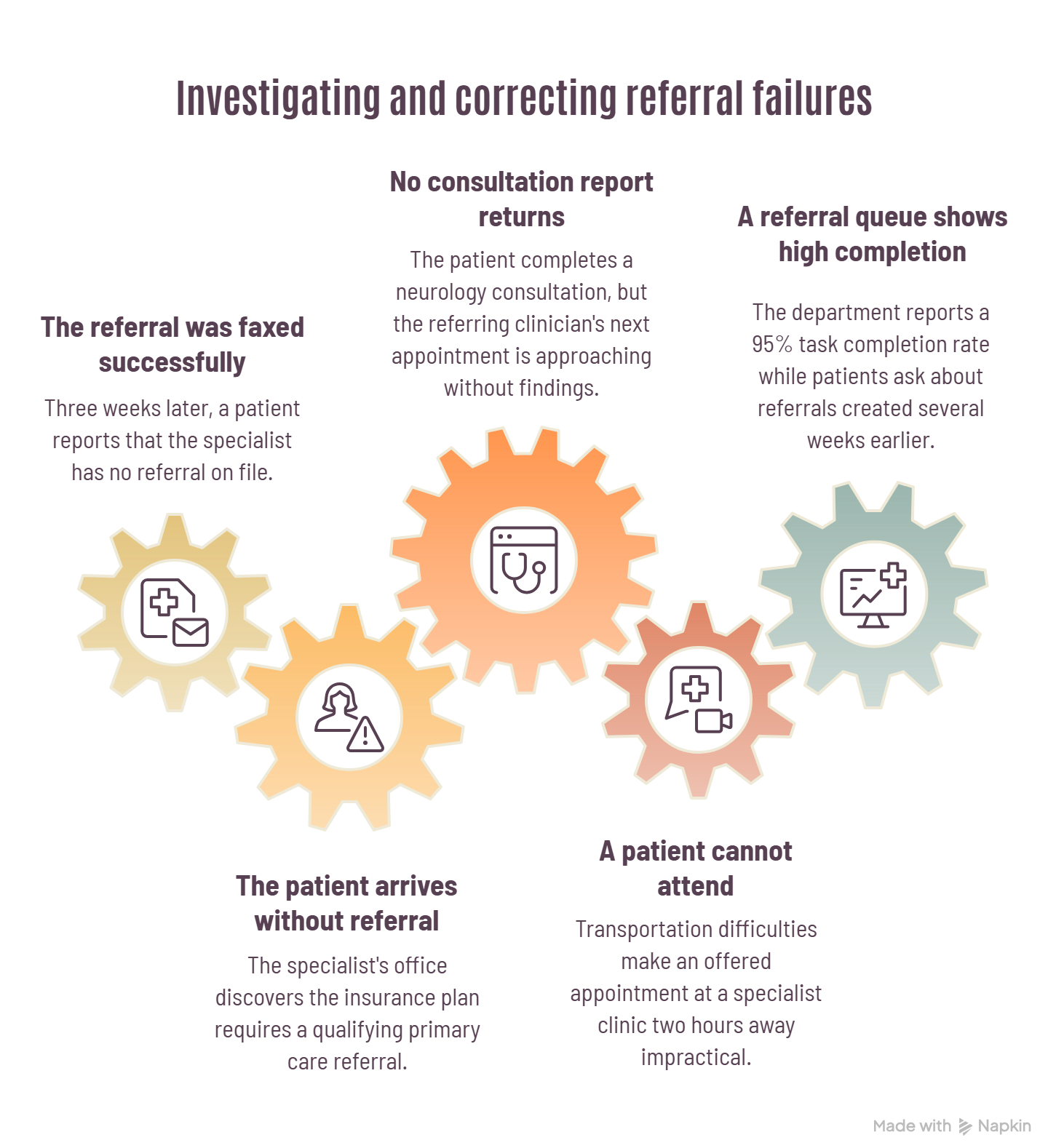
Situation: A primary care office transmits 25 referrals and receives successful fax confirmations. Three weeks later, a patient contacts the office because the specialist has no referral on file.
Underlying problem: The fax system confirmed transmission, but the receiving office may have encountered an indexing problem, incorrect routing, missing patient identifiers, or an internal processing failure.
Corrective action: Verify the recipient details and transmission record, contact the receiving practice through an approved channel, and confirm whether the referral was properly associated with the patient's record.
If the receiving practice cannot locate the referral, resend the approved packet using the verified destination and document the result. Review whether other referrals sent through the same pathway were affected.
This investigation should follow secure healthcare messaging procedures, written administrative communication, medical technology troubleshooting, and team communication standards.
Success indicator: Percentage of eligible referrals receiving confirmed acceptance within the defined follow-up timeframe.
Scenario 2: The patient arrives for the specialist appointment without the required insurance referral
Situation: A patient schedules an in-network consultation, but the specialist's office discovers that the insurance plan requires a qualifying primary care referral.
Underlying problem: The scheduling workflow checked network participation without completing the separate plan-referral verification.
Corrective action: Confirm the patient's specific plan requirements, determine whether a valid referral already exists, and identify the authorized process for resolving the missing requirement.
Communicate verified next steps to the patient and receiving practice. Any appointment changes or coverage implications should reflect the actual payer rules and clinical instructions.
Administrators should strengthen front-desk verification procedures, scheduling integration workflows, patient interaction scripts, and healthcare compliance checks.
Success indicator: Percentage of applicable appointments with verified referral requirements resolved before the service date.
Scenario 3: The patient attends the specialist visit, but no consultation report returns
Situation: A patient completes a neurology consultation. The referring clinician's next appointment with the patient is approaching, but the specialist's findings are unavailable.
Underlying problem: The receiving office may not have finalized the report, the transmission may have failed, or the report may have entered an unmonitored document queue.
Corrective action: Confirm encounter completion and report availability with the receiving practice. Request the report through an approved channel and track its arrival.
Once received, ensure that the report is correctly matched to the patient and referral and routed to the responsible clinician for review.
Appropriate medical documentation procedures, secure messaging systems, cloud EMR integrations, and team communication protocols are essential.
Success indicator: Specialist reports received within the practice's defined follow-up window, with separate tracking for clinician review.
Scenario 4: A patient cannot attend the offered specialist appointment
Situation: A patient is offered an appointment at a specialist clinic located two hours away. Transportation difficulties make the appointment impractical.
Underlying problem: The initial referral routing considered specialty availability but did not adequately address the patient's access barriers.
Corrective action: Document the barrier, review other clinically appropriate and plan-compatible options, and coordinate with the referring clinician when destination changes require approval.
Alternative appointment times, accessible locations, language support, or clinically appropriate telehealth options may help, depending on service requirements and availability.
Training in therapeutic communication, rapport-building, verbal communication skills, and scheduling conflict management supports practical problem-solving.
Success indicator: Documented resolution of patient-reported access barriers and verified completion of the appropriate next step.
Scenario 5: A referral queue shows high completion despite many unresolved patients
Situation: The referral department reports a 95% task completion rate, but patients continue asking about referrals created several weeks earlier.
Underlying problem: Staff may close administrative tasks after sending requests while the underlying referral remains unaccepted, unscheduled, or incomplete.
The system may also calculate completion using only tasks processed during the current day, excluding older open work.
Corrective action: Audit status definitions and closure rules. Create distinct indicators for transmission, acceptance, scheduling, visit completion, report receipt, and final disposition.
Track the oldest outstanding requests and require an accountable owner for every unresolved referral.
Review workflow automation logic, administrative technology troubleshooting, assertive team escalation, and medical office professionalism.
Success indicator: Lower overdue referral counts, improved stage-specific completion, and fewer repeat contacts involving unresolved requests.
5. How to Build an Effective Referral Coordination System: A Practical 30-Day Improvement Plan
Improving referral coordination requires a consistent process for managing requests from initiation through documented disposition.
The following implementation plan focuses on visibility, accountability, patient access, and communication between referring and receiving providers.
Days 1–7: Audit existing referrals and identify the biggest gaps
Begin by reviewing a representative sample of open and recently completed referrals.
Check whether each request has a unique identifier, correct destination, documented clinical priority, assigned owner, current status, and next required action.
Separate requests awaiting transmission, specialist acceptance, scheduling, patient attendance, consultation reports, and clinician follow-up.
Identify records that have remained in the same status beyond the organization's applicable service target.
Review cloud EMR integration practices, workflow automation terminology, medical administration troubleshooting, and healthcare compliance systems to understand recurring problems.
Deliverable: A referral backlog report organized by stage, age, clinician-defined priority, and accountable team.
Days 8–14: Standardize referral packets and receiving confirmation
Develop specialty-specific referral requirements in coordination with commonly used receiving practices.
A standardized packet may include patient identifiers, referring provider details, service requested, clinical reason, relevant records, and applicable insurance information.
Establish a consistent process for confirming receipt and documenting acceptance or return reasons.
Maintain a clear distinction between successfully transmitted requests and referrals accepted for processing.
Use secure healthcare messaging, written communication practices, team communication standards, and administrative professionalism procedures to document responsibilities.
Deliverable: A referral submission checklist and a receiving-confirmation workflow with defined follow-up triggers.
Days 15–21: Improve scheduling and patient follow-through
Review referrals accepted by specialists but still awaiting appointments.
Categorize barriers such as unavailable appointment capacity, pending insurance requirements, incomplete contact information, transportation difficulties, and patient decisions.
Set clinically appropriate escalation rules and assign owners for unresolved requests.
For patient outreach, document contact attempts, communication preferences, interpreter needs where applicable, and the next planned action.
Integrate these processes with patient scheduling tools, appointment reminder systems, patient interaction scripts, rapport-building methods, and phone triage communication protocols.
Deliverable: A documented patient-contact and scheduling escalation process that distinguishes pending, declined, rescheduled, and completed appointments.
Days 22–30: Implement closed-loop monitoring and accountability
Establish a referral dashboard organized around meaningful milestones.
A useful scorecard should report referral acceptance, scheduling conversion, visit completion, specialist report receipt, overdue open requests, and clinically important exceptions.
Assign each metric a specific numerator, denominator, time basis, and responsible owner.
For example, report receipt should be measured against an appropriately defined cohort of referrals whose specialist visits occurred and for which report follow-up is expected.
Track clinician review separately when it forms part of the organization's operational closure criteria.
Apply these controls through workflow automation, cloud EMR reporting, healthcare automation systems, and team communication workflows.
Deliverable: A referral dashboard with verified statuses, stage-specific time targets, escalation ownership, and a recurring quality review.
Establish a daily 15-minute referral review
The daily review should begin with referrals whose clinician-defined deadlines or other approved escalation criteria require immediate attention.
Next, examine unacknowledged transmissions, aging acceptance queues, unresolved scheduling barriers, and missing consultation reports.
Finish by assigning corrective action to named owners and documenting how resolution will be verified.
When a referral appears complete, confirm that the final status reflects the actual patient and provider outcome. Administrative closure should follow the organization's approved criteria and preserve any necessary clinical follow-up.
Reliable assertive communication practices, written administrative documentation, healthcare compliance processes, and professional team communication make the process repeatable.
Protect referral information during exchange and follow-up
Referral records may contain diagnoses, medication information, test results, and other protected health information.
Organizations should use approved exchange channels, appropriate access controls, and documented disclosure procedures.
Under HIPAA, disclosures to or requests by healthcare providers for treatment purposes are generally exempt from the minimum necessary standard. Internal uses still require appropriate role-based policies, and certain specially protected information may be subject to additional requirements.
Administrators should follow the organization's privacy and security procedures when transmitting referral packets, verifying recipient details, and accessing consultation records.
Training in confidential communication, healthcare cybersecurity terminology, secure messaging practices, and healthcare compliance software helps preserve appropriate safeguards.
6. FAQs About Referral Coordination Terms and Referral Management
-
Referral coordination is the administrative process of helping a clinician's request for another healthcare service progress through validation, transmission, acceptance, scheduling, patient follow-through, and communication of relevant outcomes.
A coordinator may verify insurance requirements, confirm documentation, contact receiving practices, help resolve scheduling barriers, and monitor missing reports.
Clinical decisions and urgency determinations remain with appropriately authorized professionals.
Understanding patient scheduling integrations, secure messaging systems, workflow automation, and team communication provides a foundation for this role.
-
A referral represents a clinician's request for another provider or service. Some insurance plans also require a qualifying referral as a condition of specialist coverage.
Prior authorization is a separate payer process involving advance review of particular services or treatments.
A specialist consultation may require one, both, or neither type of payer-related approval, depending on the patient's plan and the services involved.
Administrators should verify requirements individually and track them through front-desk insurance verification, scheduling integrations, written administrative communication, and healthcare compliance procedures.
-
Closing the referral loop generally means ensuring that the referring care team receives appropriate information about the referral's outcome and that necessary follow-up is addressed.
For a completed consultation, this commonly includes the specialist's findings returning to the referring clinician.
A referral may also have a documented alternative disposition, such as patient refusal or a clinician-approved change in the care plan.
Organizations should define their operational closure rules carefully and follow the official specifications when reporting formal quality measures.
Knowledge of medical documentation workflows, secure healthcare messaging, cloud EMR systems, and healthcare compliance software supports reliable tracking.
-
Create a report of accepted referrals without confirmed appointments, using a documented starting date and reporting cutoff.
For each record, include the responsible team, clinical priority, contact history, scheduling barrier, and next planned action.
Segment unresolved referrals by reason. The appropriate response to an unreachable patient differs from the response to an insurer restriction or unavailable specialist capacity.
Monitor overdue requests under approved escalation rules.
Patient scheduling systems, appointment reminder software, patient interaction scripts, and scheduling conflict management can help manage these cases.
-
Confirm the appointment status with the receiving organization through an approved channel.
Follow the practice's clinically approved outreach process, document the outcome, and offer appropriate rescheduling assistance when authorized.
Consider transportation, language, accessibility, cost, and communication barriers during follow-up.
Escalate the missed visit when its clinical priority or the referring provider's instructions require additional action.
Training in therapeutic communication, rapport-building, phone triage communication, and appointment reminder workflows supports effective patient outreach.
-
Useful indicators include referral acceptance rate, scheduling conversion, time to appointment, verified visit completion, specialist report receipt, and overdue referral queue percentage.
Each measure should use an explicit denominator, reporting window, and definition of success.
For example, an organization tracking appointment scheduling should distinguish accepted referrals that remain unscheduled from those scheduled for future dates.
A formal quality measure may use different inclusion rules than an operational dashboard.
Administrators can improve KPI reliability through workflow automation terminology, cloud EMR reporting, medical technology troubleshooting, and healthcare automation tools.
