

A medical practice loses power during a fully booked clinic, its EHR becomes inaccessible, and staff discover that the emergency contact list is stored inside the unavailable system. Within minutes, patient identification, prescription requests, scheduling, and communication can break down.
Effective disaster planning equips medical administrators to maintain essential operations through cyberattacks, severe weather, equipment failures, and other emergencies. This interactive dictionary explains critical preparedness terminology, provides practical downtime and recovery procedures, and shows how to protect patient information, coordinate staff, and restore healthcare services without creating dangerous documentation gaps.
1. Healthcare Disaster Planning Fundamentals: The Essential Terms and Responsibilities
Medical disaster planning establishes how healthcare organizations anticipate threats, protect people, maintain essential services, respond to disruptions, and restore normal operations.
For administrators, preparedness involves more than knowing evacuation routes. It includes identifying critical records, understanding downtime procedures, maintaining reliable communication channels, and coordinating with authorized clinical and emergency management personnel.
Failures in cloud-based medical records, patient scheduling systems, secure healthcare messaging, and healthcare workflow automation can occur simultaneously during a major incident.
The four foundational elements of healthcare emergency preparedness
The Centers for Medicare & Medicaid Services (CMS) organizes its Emergency Preparedness Rule around four core elements. Requirements vary by provider and supplier type.
1. Emergency planning and risk assessment
Organizations identify credible threats, evaluate vulnerabilities, and develop an all-hazards emergency plan appropriate to their facilities, patient populations, and services.
2. Policies and procedures
Documented instructions explain how personnel should handle emergencies, including relevant decisions about patient safety, supplies, essential operations, and alternate arrangements.
3. Communication planning
Organizations establish methods for contacting staff, coordinating with other healthcare providers, and communicating with emergency management and public health authorities.
4. Training and testing
Personnel learn their assigned responsibilities and participate in exercises that evaluate whether emergency procedures work under realistic conditions.
These elements depend on reliable team communication, professional medical administration, written emergency instructions, and healthcare compliance controls.
Disaster preparedness, business continuity, and disaster recovery
These three concepts govern different parts of an emergency.
Disaster preparedness covers activities completed before an incident, including risk assessment, staff training, equipment readiness, and response planning.
Business continuity focuses on maintaining essential functions during a disruption. Examples include emergency patient registration, clinical communications, access to critical information, and essential appointment coordination.
Disaster recovery focuses on restoring disrupted systems, information, infrastructure, and operational capabilities.
Consider a ransomware incident that disables the EHR. The emergency response process addresses the active threat, the continuity plan supports permitted temporary operations, and the recovery plan governs safe system restoration.
Administrators involved in healthcare cybersecurity, medical technology troubleshooting, confidential patient communication, and clinical team coordination should understand where these responsibilities intersect.
The three priorities during a medical administrative emergency
When a disruption begins, administrators need an established order of action.
Protect people. Follow emergency instructions and communicate immediate safety concerns to authorized personnel. Patient care decisions remain with qualified clinical staff.
Maintain essential functions. Activate approved backup registration, communication, scheduling, and documentation processes when directed.
Preserve reliable information. Protect patient identifiers, record timestamps, maintain appropriate access controls, and document actions so temporary records can be reconciled after recovery.
This approach helps prevent a common secondary failure: restoring technology while leaving emergency-period patient information incomplete or incorrectly associated with encounters.
Reliable patient identification procedures, medical transcription practices, patient communication scripts, and administrative workflow management support these priorities.
40 of 40 terms shown
| # | Disaster Planning Term | Meaning and Warning Sign | Medical Admin's First Action |
|---|---|---|---|
| 1 | All-Hazards Approach | Planning for capabilities needed across multiple threats. Warning: procedures address fires but ignore cyberattacks. | Include technology, facility, staffing, supply, and communication interruptions in the risk assessment. |
| 2 | Hazard Vulnerability Analysis (HVA) | Structured evaluation of likely threats, impact, and preparedness gaps. Warning: repeated local flooding has never been assessed. | Bring operational evidence to the facility's preparedness review. |
| 3 | Emergency Operations Plan (EOP) | Documented framework for responding to emergencies. Warning: employees cannot locate current instructions. | Maintain approved, accessible copies and know the activation authority. |
| 4 | Emergency Preparedness Program | Coordinated planning, procedures, communications, training, and testing. Warning: separate departments maintain conflicting plans. | Coordinate reviews using cross-department communication. |
| 5 | Incident Command System (ICS) | Standardized framework for emergency roles, coordination, and decisions. Warning: employees receive conflicting instructions. | Identify the activated command structure and follow designated reporting lines. |
| 6 | Hospital Incident Command System (HICS) | Healthcare-adapted incident management framework. Warning: operational responsibilities overlap during an emergency. | Use assigned roles and established emergency communication procedures. |
| 7 | Activation Trigger | Predefined condition prompting activation of an emergency procedure. Warning: staff wait for instructions after critical systems fail. | Recognize thresholds and notify the authorized decision-maker. |
| 8 | Incident Commander | Designated person responsible for overall incident management within the adopted command structure. Warning: departments independently direct recovery. | Communicate verified operational status through the approved chain of command. |
| 9 | Delegation of Authority | Assignment of defined decision-making authority. Warning: critical decisions stall because senior leaders are unreachable. | Check documented succession and authorization boundaries. |
| 10 | Continuity of Operations (COOP) | Arrangements supporting essential functions during disruption. Warning: registration stops when the main EHR becomes unavailable. | Activate approved alternative patient intake procedures. |
| 11 | Business Continuity Plan (BCP) | Documented strategies for maintaining essential business and care-supporting functions. Warning: staff lack a replacement scheduling process. | Review critical workflows and approved scheduling contingencies. |
| 12 | Disaster Recovery Plan (DRP) | Procedures for restoring disrupted technology and information. Warning: backups exist but restoration responsibilities are unclear. | Confirm recovery contacts and system priorities with IT. |
| 13 | Business Impact Analysis (BIA) | Assessment of the consequences and timing of interrupted functions. Warning: low-priority services are restored before critical processes. | Document patient-care impact and dependencies for each administrative workflow. |
| 14 | Essential Function | Activity that must continue or resume promptly during disruption. Warning: emergency requests are mixed with routine correspondence. | Prioritize patient identification and clinically important communications. |
| 15 | Recovery Time Objective (RTO) | Target time for restoring a service after interruption. Warning: recovery takes longer than the approved tolerance. | Record outage start and report impacts through incident support. |
| 16 | Recovery Point Objective (RPO) | Maximum targeted age of recoverable data, expressed as a time interval. Warning: restored information excludes recent patient transactions. | Preserve downtime records for later reconciliation. |
| 17 | Single Point of Failure | One component whose loss can stop a critical function. Warning: all emergency contacts are stored in one inaccessible system. | Identify alternate approved access to critical contact information. |
| 18 | Redundancy | Additional systems or resources that provide resilience. Warning: a single internet connection supports every communication service. | Confirm authorized backup communication methods. |
| 19 | Failover | Switching operations to an available alternate system. Warning: staff continue using outdated screens during a system transition. | Follow IT instructions and verify the active EHR environment. |
| 20 | Emergency Mode Operations | Procedures maintaining critical processes and protection of ePHI during an emergency. Warning: employees use unapproved personal applications. | Follow authorized emergency security controls. |
| 21 | EHR Downtime Procedure | Approved workflow for operating temporarily without normal electronic records. Warning: staff improvise patient registration and documentation. | Use controlled forms, patient identifiers, timestamps, and escalation pathways. |
| 22 | Data Backup Plan | Procedures for creating and maintaining retrievable copies of important data. Warning: critical systems are excluded from backup coverage. | Report missing systems to the designated recovery owner. |
| 23 | Restore Test | Controlled exercise checking whether backed-up information can be recovered and used. Warning: backup logs show success but recovery has never been demonstrated. | Participate in approved functional verification after restoration. |
| 24 | Offline Backup | Backup copy isolated from normal network access. Warning: ransomware reaches connected backup storage. | Escalate protection concerns to authorized IT security personnel. |
| 25 | Cyber Incident Containment | Actions limiting the spread or effects of a suspected cyber incident. Warning: compromised devices remain in active use. | Follow the security team's instructions and avoid unapproved workarounds. |
| 26 | Alternate Communication Channel | Approved backup method used when primary communications fail. Warning: staff cannot contact essential services during an outage. | Use the designated backup communication system. |
| 27 | Emergency Call Tree | Prearranged notification sequence for contacting personnel. Warning: several critical employees receive no notification. | Record contact attempts, acknowledgments, and required escalation. |
| 28 | Situation Report (SITREP) | Concise update describing incident status, impacts, and resource needs. Warning: leadership receives inconsistent operational information. | Submit verified facts using standard reporting formats. |
| 29 | Patient Tracking | Process for maintaining accurate patient identities and locations during emergencies. Warning: teams cannot verify where transferred patients went. | Maintain approved patient movement and receiving-location records. |
| 30 | Shelter-in-Place | Staying within a designated protected area when evacuation is inappropriate or unsafe. Warning: conflicting instructions cause unnecessary movement. | Follow the incident command and facility safety instructions. |
| 31 | Evacuation Plan | Procedures for safely moving people away from an unsafe location. Warning: patient location and transport responsibilities are unclear. | Support authorized patient movement coordination. |
| 32 | Alternate Care Site | Approved location used to provide or support care when normal facilities are unavailable. Warning: redirected patients receive incomplete location information. | Verify destination instructions and communicate through approved channels. |
| 33 | Mutual Aid Agreement | Agreement describing assistance available from other organizations during emergencies. Warning: required supplies or services are unavailable locally. | Refer needs through established resource-request procedures. |
| 34 | Resource Burn Rate | Rate at which supplies or other resources are consumed. Warning: emergency inventory lasts less time than anticipated. | Track actual usage and notify the resource coordinator. |
| 35 | Emergency Supply Cache | Designated reserve of equipment and supplies for disruption response. Warning: stock is expired, incomplete, or inaccessible. | Verify assigned inventory checks and replenishment procedures. |
| 36 | Staffing Contingency | Plan for maintaining essential responsibilities when personnel are unavailable. Warning: one absent employee stops all referral processing. | Activate approved cross-coverage and handoff protocols. |
| 37 | Tabletop Exercise | Facilitated discussion of an emergency scenario and planned responses. Warning: staff understand written procedures but cannot explain their actions. | Practice decision-making and document gaps in the plan. |
| 38 | Functional Exercise | Exercise evaluating response capabilities through simulated operational activities. Warning: staff cannot perform assigned emergency tasks. | Test communications, coordination, and downtime workflows. |
| 39 | After-Action Report (AAR) | Document analyzing what occurred, what worked, and what needs improvement. Warning: the same drill failures recur. | Document evidence, timeline gaps, and lessons learned. |
| 40 | Corrective Action Plan (CAP) | Assigned improvement actions addressing identified preparedness failures. Warning: issues are discussed but never fixed. | Set an owner, deadline, verification method, and closure evidence. |
U.S.-focused healthcare administration training reference. Follow your facility's approved emergency plan, applicable regulations, and instructions from authorized clinical, safety, and IT personnel.
2. EHR Downtime, Cyberattacks, and Data Recovery: Keeping Patient Information Available During Emergencies
An EHR outage can affect several departments at once. Registration cannot verify patient histories, scheduling cannot confirm appointments, clinicians may lose access to relevant documentation, and billing teams may lose the ability to associate services with encounters.
An effective downtime plan identifies which processes must continue, which processes can be deferred, and how temporary information will be reconciled after recovery.
Scenario 1: The EHR goes offline during a busy outpatient clinic
Imagine a clinic with 45 patients scheduled for the afternoon. At 1:30 p.m., the EHR becomes unavailable. Staff cannot access appointment details, medication lists, referral statuses, or electronic forms.
An administrator should follow the approved downtime activation procedure and verify which services remain available.
The immediate administrative priorities are:
Confirm incident status. Record the outage start time, affected systems, and instructions from authorized personnel.
Verify patient identity. Use approved downtime registration records and available verified identifiers.
Separate clinical and administrative responsibilities. Route patient care decisions and clinically important missing information to authorized clinicians.
Maintain a controlled encounter log. Record relevant patient identifiers, encounter times, locations, and the responsible team.
Protect temporary records. Restrict access, secure physical documents, and use approved emergency communication methods.
Track outstanding transactions. Identify referrals, appointments, requests, and documentation that require later electronic entry or verification.
These processes connect virtual patient registration, appointment scheduling, medical documentation workflows, and secure team communication.
RTO versus RPO: Two recovery measurements administrators must understand
Recovery Time Objective (RTO) defines the target time within which a system or function should be restored after a disruption.
Recovery Point Objective (RPO) defines the target maximum period of data loss that a recovery arrangement is designed to tolerate.
Consider a hypothetical clinic with an approved EHR RTO of four hours and an RPO of fifteen minutes.
If the EHR becomes unavailable at 2:00 p.m., the four-hour RTO establishes a target of restoring the service by 6:00 p.m.
If the latest usable backup represents data as of 1:45 p.m., the fifteen-minute RPO target has been met for that restoration point. Transactions created after 1:45 p.m. still require investigation and appropriate reconciliation.
These targets must be established through an organization's risk assessment and operational requirements.
RTO and RPO are especially important when evaluating cloud EHR resilience, healthcare automation dependencies, medical technology recovery, and administrative workflow continuity.
Scenario 2: A ransomware warning appears on a medical office workstation
An employee notices that files are inaccessible and a suspicious message demands payment to restore access.
This situation requires immediate reporting through the organization's cybersecurity incident procedure.
Staff should follow instructions from authorized IT security responders about using affected devices, disconnecting systems, preserving evidence, and activating approved alternate processes.
Employees should avoid deleting suspicious files, experimenting with recovery software, or using personal accounts to transfer patient information.
Ransomware incidents can involve compromised credentials, unavailable applications, altered information, and possible unauthorized disclosure.
A reliable response therefore includes investigation of both operational disruption and information-security risks.
Administrators should maintain necessary emergency records through approved healthcare cybersecurity procedures, confidential communication methods, medical IT escalation workflows, and healthcare compliance reporting.
The five components of a reliable data recovery process
The HIPAA Security Rule includes a contingency-plan standard for covered entities and business associates handling electronic protected health information.
Its implementation specifications address data backups, disaster recovery, emergency-mode operations, testing and revision, and application or data criticality.
The backup plan, disaster recovery plan, and emergency-mode operation plan are required specifications under the existing rule. Testing and revision, along with application and data criticality analysis, are addressable specifications requiring appropriate documented consideration.
Operationally, a reliable recovery process should provide:
1. Backup coverage: Identification of essential systems, databases, documents, and information requiring protection.
2. Recoverable copies: Backup arrangements capable of producing usable information, with access appropriately protected against unauthorized activity.
3. Restoration procedures: Documented responsibilities, recovery sequence, and methods for restoring services.
4. Recovery verification: Tests confirming that restored information is complete enough for its purpose, accessible to authorized users, and appropriately associated with patient records.
5. Post-recovery reconciliation: Processes for identifying transactions created, modified, or deferred during the outage.
This framework supports medical data accuracy, EHR system management, secure administrative communication, and workflow automation reliability.
Reconciliation after downtime: Preventing a second operational crisis
When electronic systems return, staff should follow a controlled recovery process.
Consider a patient whose appointment was rescheduled on paper during the outage. Another employee may already have entered a replacement appointment after partial system recovery.
Entering the paper record again without reviewing existing transactions could create a duplicate appointment.
Similar risks affect patient registration, referral submissions, laboratory requests, messages, and clinical documentation.
A reconciliation record should identify the original downtime transaction, responsible employee, patient and encounter identifiers, electronic record status, and verification outcome.
Clinical content should be entered or authenticated only by appropriately authorized personnel, maintaining accurate authorship and timing.
The final review should confirm that required transactions have been completed while avoiding duplicate entries.
Effective patient scheduling integration, written documentation, team handoffs, and medical administration troubleshooting make this process significantly more reliable.
3. Emergency Communication, Evacuation, and Resource Coordination During Healthcare Disasters
A disaster becomes harder to manage when staff receive conflicting instructions, patient locations cannot be verified, or essential supplies run out unexpectedly.
Medical administrators support incident coordination by maintaining accurate contact information, recording verified updates, monitoring resources, and documenting patient movement under the direction of authorized personnel.
Incident Command System: Who makes decisions during an emergency?
The Incident Command System (ICS) provides a structured approach to emergency coordination.
The Hospital Incident Command System (HICS) adapts incident management concepts to healthcare operations.
Depending on the incident and facility, an activated structure may include an incident commander and personnel responsible for operations, planning, logistics, and administration or finance.
Administrators need to understand their assigned reporting relationships.
For example, an employee responsible for maintaining a patient transfer log should report through the designated coordination process instead of independently directing transportation.
Clear reporting arrangements strengthen professional communication, administrative team coordination, written situation reporting, and assertive escalation procedures.
Scenario 3: A hospital must evacuate patients after a facility emergency
Imagine a facility emergency requiring movement of patients to another approved location.
Clinical and incident command personnel determine the appropriate evacuation approach and patient movement priorities.
Medical administrators may be assigned to maintain transfer records, verify destination details, coordinate permitted communication, or support patient tracking.
For each authorized patient transfer, the tracking process should establish:
The patient's verified identity and relevant encounter reference.
The original department or location.
The designated receiving organization or destination.
The date and time of the transfer or movement.
The communication handoff and receiving confirmation.
Any unresolved documentation requiring follow-up.
For hospitals subject to the relevant CMS requirements, patient and staff tracking during emergency relocation includes documenting the receiving facility or other destination.
Avoid relying on a single unverified spreadsheet or handwritten list without appropriate access controls and reconciliation procedures.
Patient transfer documentation should remain connected to secure healthcare messaging, medical documentation management, patient identification workflows, and confidential information handling.
Emergency call trees and communication redundancy
An emergency call tree establishes how designated personnel are contacted and how unsuccessful contact attempts are escalated.
A well-maintained contact process should identify the staff role, approved communication methods, alternate contact pathway, acknowledgment requirements, and escalation destination.
Suppose the facility's primary messaging platform becomes unavailable during a power outage.
An employee should know which alternate method has been approved and where to access the emergency contact directory.
The communication process should also distinguish an attempted notification from a confirmed acknowledgment.
For staff who perform critical duties, a failed notification may require contacting an authorized backup or initiating another documented escalation.
A dependable plan connects secure medical communication, phone communication procedures, medical team handoffs, and healthcare technology contingencies.
Resource burn rate: How quickly can emergency supplies run out?
Resource burn rate describes how quickly consumable supplies are being used.
A facility may have an emergency inventory of a particular item but underestimate how long it will last during increased demand.
Consider a hypothetical practice with 300 units of an essential disposable supply. Under emergency conditions, staff consume 75 units daily.
The calculation is:
Estimated supply duration = available units ÷ units consumed per day
In this example, 300 ÷ 75 = 4 days of supply.
If replenishment may take six days, the facility faces a potential shortage unless authorized personnel arrange additional resources or operational alternatives.
Consumption should be recalculated when patient volume, staffing, or service requirements change.
Inventory tracking also needs expiration dates, storage requirements, alternate supplier information, and minimum stock thresholds.
Medical administrators can support healthcare workflow automation, written inventory reporting, professional escalation, and team coordination by providing accurate consumption and availability information.
Prioritizing patients and administrative work during disruptions
Administrative queues should reflect the urgency assigned through approved clinical and operational protocols.
For example, an appointment reminder campaign may be deferred during an EHR outage, while communicating an urgent referral issue may require immediate clinical escalation.
Administrators can classify work into three operational categories:
Critical: Tasks requiring prompt action because delays may affect safety or essential care continuity.
Time-sensitive: Tasks that must be completed within a defined operational window to prevent significant disruption.
Deferrable: Routine activities that can be postponed under an approved continuity plan.
These categories should be established before incidents wherever possible, with clinical personnel responsible for clinical urgency decisions.
Proper prioritization benefits patient scheduling management, appointment reminder coordination, medical front-desk procedures, and patient communication scripts.
4. CMS Emergency Preparedness, HIPAA Contingency Planning, and Healthcare Compliance Requirements
Healthcare disaster planning must reflect the facility's actual services, patient population, operating environment, and applicable regulatory obligations.
A small outpatient practice, hospital, ambulatory surgical center, and long-term care facility may share certain preparedness principles while having different regulatory requirements and operational risks.
Administrators should understand the governing frameworks and verify requirements specific to their organization.
CMS Emergency Preparedness Rule: What medical administrators should know
The CMS Emergency Preparedness Rule establishes requirements for specified Medicare- and Medicaid-participating providers and suppliers.
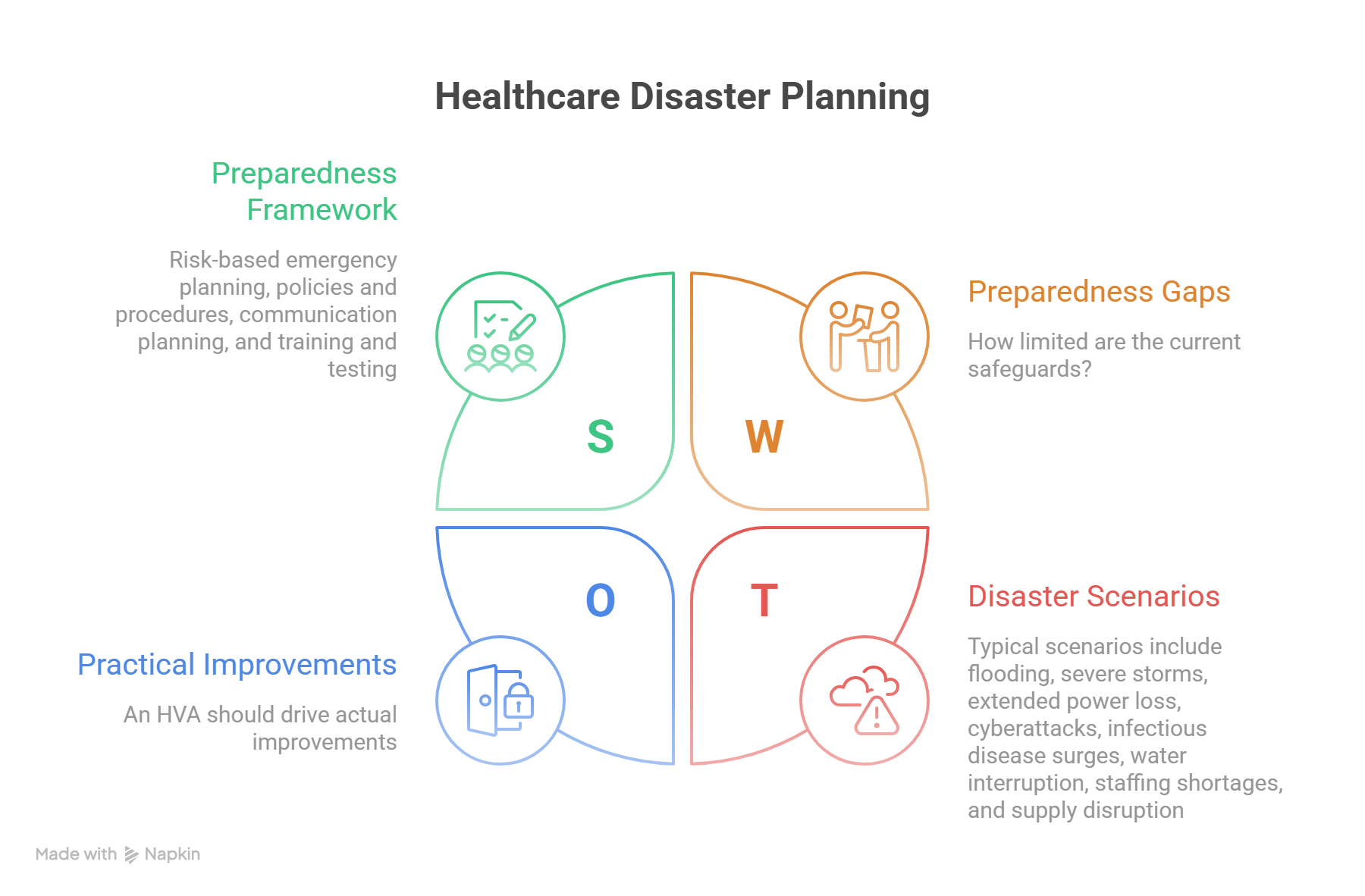
Its principal components include risk-based emergency planning, policies and procedures, communication planning, and training and testing.
The required review cycles and exercise formats depend on the provider or supplier category.
For example, under 42 CFR § 482.15, hospitals must review and update their emergency plans at least every two years and perform emergency preparedness exercises at least twice annually, subject to the rule's detailed provisions and exceptions.
Other regulated provider types may follow different exercise and review requirements.
Administrators should work with responsible compliance personnel to identify the provisions applicable to their facility.
Relevant evidence may include approved plans, risk assessments, emergency contact information, training attendance, exercise records, and corrective actions.
These activities connect healthcare compliance software, professional medical administration, documented team communication, and written administrative procedures.
Hazard Vulnerability Analysis: Choosing which disasters deserve attention first
A Hazard Vulnerability Analysis (HVA) helps organizations identify threats and evaluate their likely consequences.
Typical scenarios include flooding, severe storms, extended power loss, cyberattacks, infectious disease surges, water interruption, staffing shortages, and supply disruption.
An HVA should consider the local environment, surrounding healthcare network, patient population, and facility dependencies.
One practical internal scoring method evaluates each hazard across four dimensions:
Likelihood: How credible or frequent is the threat?
Patient and operational impact: What happens if it occurs?
Preparedness gap: How limited are the current safeguards?
Recovery difficulty: How difficult would restoring essential services be?
A simple illustrative model might score each dimension from 1 to 5 and multiply the scores.
For example, a cyberattack rated 4 for likelihood, 5 for impact, 4 for preparedness gap, and 4 for recovery difficulty would receive an illustrative score of 320.
A short power interruption rated 5, 2, 2, and 2 would receive a score of 40.
These scores are internal prioritization aids rather than standardized CMS risk ratings. Organizations should use approved assessment methods and validate their assumptions with appropriate experts.
Most importantly, an HVA should drive actual improvements in healthcare cybersecurity readiness, cloud EHR contingency planning, medical technology resilience, and administrative workflow continuity.
HIPAA contingency planning during disasters
The HIPAA Security Rule requires covered entities and business associates to establish appropriate contingency procedures for emergencies affecting systems that contain electronic protected health information.
This includes required backup, disaster recovery, and emergency-mode operation components under 45 CFR § 164.308(a)(7).
The objective is to preserve the confidentiality, integrity, and availability of ePHI while supporting necessary operations.
An emergency does not automatically authorize the use of personal email accounts, unsecured shared devices, or unrestricted access to patient records.
Instead, the organization should establish permitted alternative methods for accessing and communicating essential information.
Where relevant, healthcare personnel should also understand the Privacy Rule's permissions and requirements for emergency-related disclosures.
Medical administrators can support compliance through confidential patient communication, secure messaging systems, healthcare cybersecurity practices, and compliance incident reporting.
Tabletop exercises, functional exercises, and full-scale drills
Different exercise formats evaluate different aspects of preparedness.
Tabletop exercises use facilitated discussions to test decisions and responsibilities against an emergency scenario.
For example, the facilitator might announce that the EHR and primary phone system have failed simultaneously. Participants must explain how they would identify patients, contact critical staff, and maintain permitted documentation.
Functional exercises evaluate particular operational capabilities, such as activating an emergency communication process or coordinating a simulated patient transfer.
Full-scale exercises involve more extensive simulated response activities and may require coordination across departments and external organizations.
The appropriate exercise schedule depends on facility-specific requirements and approved emergency preparedness policies.
Administrators should document who participated, which procedures were tested, what failed, and how weaknesses will be corrected.
These exercises improve team communication, patient interaction procedures, secure information handling, and medical administration technology troubleshooting.
After-action reports and corrective action plans
An After-Action Report (AAR) records what happened during an exercise or actual incident.
A useful report distinguishes observed performance from assumptions about how the plan should have worked.
For each significant finding, document:
Expected action: What the approved plan required.
Observed action: What staff actually did during the scenario.
Operational consequence: How the gap affected patient safety, communication, access, or recovery.
Root cause: The underlying reason the problem occurred.
Corrective action: The specific change required.
Accountability: The assigned owner, deadline, and verification method.
Suppose a tabletop exercise reveals that employees cannot locate the paper downtime registration forms.
An incomplete corrective action would simply tell staff to become more familiar with emergency supplies.
A stronger corrective action would designate a verified storage location, assign an inventory owner, distribute appropriate access instructions, and require staff to demonstrate retrieval during a follow-up exercise.
This approach creates measurable improvements in administrative professionalism, written procedure management, workflow coordination, and healthcare compliance monitoring.
5. Building a Medical Admin Disaster Preparedness Program: A Practical 30-Day Action Plan
A disaster preparedness program becomes useful when employees can demonstrate that they know what to do, where to find the necessary resources, and how to document their actions during an emergency.
The following 30-day plan provides a practical implementation framework. It can supplement an existing preparedness program and should be adapted to applicable requirements and the organization's approved emergency management structure.
Days 1–7: Identify essential functions and operational dependencies
Begin by reviewing the administrative activities that support patient care.
Identify which functions must remain available during a disruption and which can be temporarily deferred.
Important areas include patient registration, access to essential records, clinical communication, appointment coordination, referral processing, and patient transfer documentation.
For every essential function, establish:
Primary system: Which application or resource normally supports the function?
Dependency: Does it require electricity, internet access, a particular employee, or an external vendor?
Failure consequence: What happens if the function becomes unavailable?
Backup method: Which approved alternative process can maintain the activity?
Responsible owner: Who is accountable for activating and supervising the backup procedure?
Restoration requirement: What must be verified before normal processing resumes?
A practice may discover that its emergency contact directory, appointment schedule, and downtime instructions are all accessible only through the same cloud platform.
That dependency deserves immediate review because one outage could simultaneously disable several essential functions.
Coordinate the inventory across cloud-based EHR systems, patient scheduling integrations, secure messaging platforms, and healthcare workflow automation.
Expected deliverable: A prioritized list of essential functions, system dependencies, backup procedures, and responsible personnel.
Days 8–14: Create practical downtime and emergency communication procedures
Review the organization's approved emergency plans and identify the procedures that frontline administrators must carry out.
Prepare or validate the controlled resources supporting those tasks.
These may include patient registration forms, administrative encounter logs, authorized emergency contacts, communication instructions, incident-reporting templates, and document reconciliation checklists.
Each resource should have an assigned owner and an appropriate storage or access arrangement.
Staff must know how to retrieve the necessary information when primary systems are unavailable.
For example, a backup contact list stored only inside the inaccessible EHR provides little operational benefit during a complete EHR outage.
The organization's authorized emergency management and privacy personnel should approve suitable alternate access methods.
Create clear instructions for:
Patient identification: How employees verify patients using approved downtime records.
Clinical escalation: How staff communicate potentially urgent concerns to authorized clinicians.
Appointment management: How deferred, completed, and rescheduled appointments are recorded.
Document protection: How paper and other temporary records remain appropriately secured.
Recovery handoff: How downtime transactions are identified for eventual electronic reconciliation.
These procedures should align with medical front-desk training, patient communication scripts, written medical documentation, and confidential information handling.
Expected deliverable: An approved administrative downtime toolkit with defined storage, ownership, and activation procedures.
Days 15–21: Conduct a realistic disaster simulation
Use a fictional patient scenario and a controlled training environment to test emergency procedures.
A useful combined scenario involves an extended power interruption, unavailable EHR access, limited communication, and a patient requiring transfer coordination.
The facilitator can introduce complications progressively.
Minute 0: The clinic loses its primary EHR connection. Participants must identify the appropriate downtime activation procedure.
Minute 10: A patient arrives for an appointment, and staff must demonstrate approved identity verification and encounter tracking.
Minute 20: The primary messaging system becomes unavailable. Participants must activate an appropriate alternative communication process.
Minute 30: A clinician identifies a need for a simulated patient transfer. Participants must demonstrate their assigned documentation and communication roles.
Minute 45: The simulated EHR becomes available again. Staff must explain how they would prevent duplicate entries, verify downtime records, and resume normal operations.
Exercise controllers should evaluate performance against the approved plan and applicable clinical and safety requirements.
The assessment should identify missing instructions, incorrect role assumptions, unavailable resources, and documentation gaps.
This process tests practical capabilities across medical IT troubleshooting, secure healthcare messaging, team communication, and patient registration workflows.
Expected deliverable: A documented exercise report listing observed performance, unresolved weaknesses, and assigned corrective actions.
Days 22–30: Establish measurable disaster readiness indicators
A preparedness scorecard should measure whether the organization can perform critical tasks, rather than merely counting completed training sessions.
Seven metrics provide useful starting points.
1. Emergency contact acknowledgment rate
Calculation: Required emergency contacts who acknowledge a notification ÷ required contacts targeted × 100.
This reveals whether the notification process reaches the intended workforce.
Review failed contacts separately and confirm that alternate notification paths are available.
2. Downtime procedure activation time
Calculation: Elapsed time from recognized disruption or activation instruction to verified commencement of the approved downtime process.
Record the trigger consistently.
A shorter activation time may indicate better readiness, but performance must also include correct authorization and safe execution.
3. Critical function continuity rate
Calculation: Essential functions maintained at their approved minimum operating level ÷ essential functions designated for continuation × 100.
Define what acceptable minimum operation means for each function.
For example, a scheduling process may operate through a controlled temporary log even when the normal appointment interface is unavailable.
4. Patient record reconciliation completion rate
Calculation: Verified downtime records fully reconciled ÷ downtime records requiring reconciliation × 100.
This measure should include appropriate checks for duplicates, patient identification errors, and incomplete transactions.
5. Recovery objective compliance rate
Calculation: Relevant recovery events meeting their approved recovery targets ÷ recovery events evaluated × 100.
Monitor RTO and RPO performance separately, because restoring a system promptly does not guarantee that its recovered information meets the data-loss tolerance.
6. Emergency training competency rate
Calculation: Staff demonstrating the required role-specific emergency competencies ÷ staff evaluated × 100.
A practical demonstration offers stronger evidence than attendance alone.
For administrative personnel, evaluation might involve locating downtime forms, recognizing an escalation trigger, or completing an accurate fictional encounter record.
7. Corrective action closure rate
Calculation: Verified corrective actions completed within their assigned deadlines ÷ corrective actions due during the reporting period × 100.
Track unresolved high-risk findings independently.
These measures help strengthen healthcare compliance monitoring, medical administrative professionalism, workflow automation planning, and technical recovery coordination.
Calculating the financial impact of a medical office outage
Consider a hypothetical outpatient clinic that completes 120 patient visits daily.
If a technology disruption prevents the completion of 30 scheduled visits, the clinic faces a significant operational backlog.
Assume each affected visit represents an illustrative $140 in expected gross service revenue.
The immediate gross revenue associated with those 30 disrupted visits is:
30 × $140 = $4,200
This amount represents revenue associated with affected visits, rather than an automatically realized financial loss.
Some visits may be rescheduled, while others may require additional work or remain uncompleted.
Suppose ten administrative employees each spend two additional hours resolving documentation, scheduling, and communication problems.
At an illustrative loaded labor cost of $25 per hour:
10 × 2 × $25 = $500 in additional administrative labor
These calculations exclude potential clinical consequences, additional vendor expenses, and disruption to other departments.
A useful business impact analysis should therefore distinguish delayed revenue, permanently lost revenue, direct rework expense, recovery costs, and patient-care impact.
These estimates help organizations evaluate investments in cloud EHR resilience, administrative workflow automation, healthcare cybersecurity safeguards, and medical technology support.
A reusable emergency incident handoff template
When administrators transfer responsibility during an active incident, a standardized handoff can reduce confusion.
Incident: Primary EHR outage affecting outpatient services.
Current status: Approved downtime procedures activated. System restoration remains under IT investigation.
Affected functions: Electronic registration, appointment updates, referral processing, and selected communication workflows.
Patient safety escalation: Clinical concerns referred to the designated clinical team.
Temporary records: Controlled downtime logs maintained at approved locations.
Open administrative issues: Unverified appointments, pending referrals, incomplete communications, and records awaiting reconciliation.
Responsible owners: Assigned registration, clinical coordination, IT, and recovery personnel.
Next review: Designated incident status update or escalation milestone.
Closure requirements: Verified system restoration, approved return to normal operations, and reconciliation of outstanding transactions.
This format supports written healthcare communication, team coordination, professional escalation, and secure information exchange.
6. FAQs: Medical Disaster Planning, Emergency Preparedness, and Administrative Recovery
-
An emergency plan defines the organization's approach to preparing for and responding to emergencies, including safety, coordination, and operational requirements.
A business continuity plan establishes how essential functions can continue when normal operations are disrupted.
For example, an emergency plan may address a building evacuation, while business continuity procedures identify how essential administrative services will operate from an approved alternate location.
Both should coordinate with patient scheduling systems, secure healthcare messaging, and medical team communication.
-
Verify the disruption, follow the facility's incident reporting and activation procedures, and obtain instructions from authorized personnel.
Use approved downtime methods for patient identification, administrative documentation, and communication.
Maintain accurate records of temporary transactions so they can be reconciled after systems recover.
Avoid unauthorized shortcuts involving personal accounts or uncontrolled copies of patient information.
Training in cloud EMR operations, medical technology troubleshooting, and confidential patient information handling supports these responsibilities.
-
Recovery Time Objective (RTO) defines the target time for restoring a disrupted system or function.
Recovery Point Objective (RPO) defines the target maximum age of recoverable data, expressed as the acceptable time interval between the most recent usable recovery point and the disruption.
An EHR may meet its RTO while still requiring reconciliation of data created after the latest recoverable point.
These concepts support healthcare automation planning, cloud record recovery, and administrative technology management.
-
The HIPAA Security Rule requires covered entities and business associates to establish contingency plans addressing emergencies affecting systems containing ePHI.
Under 45 CFR § 164.308(a)(7), data backup, disaster recovery, and emergency-mode operation plans are required implementation specifications.
The rule also addresses testing and revision procedures and application or data criticality analysis as addressable specifications.
Organizations should verify their responsibilities through appropriate healthcare compliance procedures and cybersecurity policies.
-
Testing requirements depend on the organization's regulatory category and applicable emergency preparedness obligations.
For example, hospitals subject to 42 CFR § 482.15 must conduct at least two emergency preparedness exercises annually under the rule's specific requirements and exceptions.
Other participating providers and suppliers may have different testing schedules.
Medical administrators should confirm the applicable requirements with their preparedness and compliance teams and maintain appropriate exercise records.
Effective exercises should test actual team communication procedures, administrative workflows, and technical recovery processes.
-
Activate approved emergency-mode procedures that maintain appropriate protection of patient information while supporting essential operations.
Use authorized communication systems, controlled temporary records, suitable patient identification methods, and established access restrictions.
Report suspected security incidents promptly and follow authorized incident-response instructions.
Temporary documentation should be reconciled after the disruption without compromising record integrity.
These principles connect healthcare cybersecurity, secure messaging practices, and medical documentation accuracy.
